Appearance
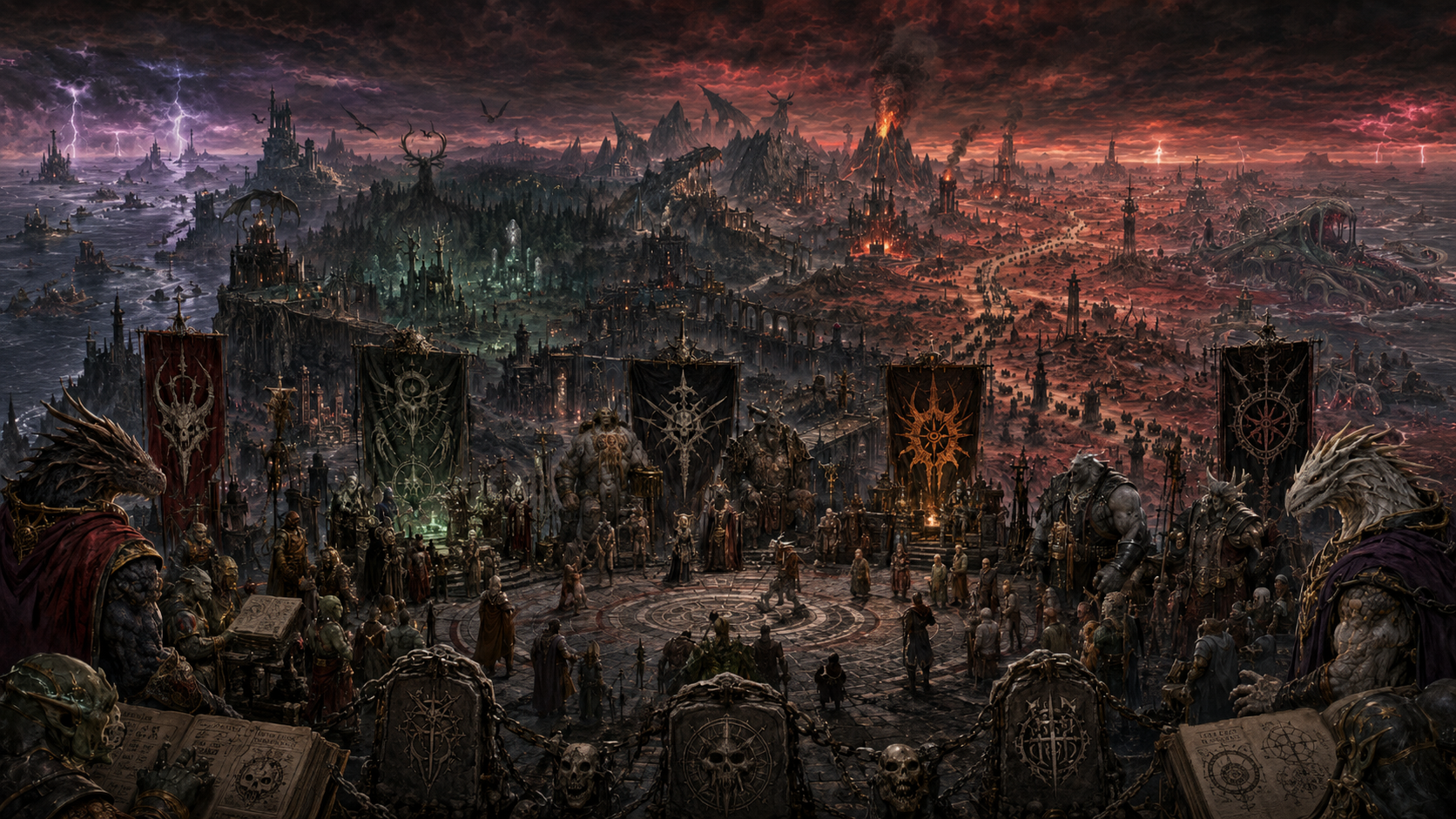
Vorrak
Vorrak is the continent across the Dread Sea.
In Caerlon, parents use its name to frighten children. Soldiers spit before saying it. Old veterans still wake at night when they hear chains dragged over stone. Sailors call its western coast “the monster shore.” Priests argue over whether its rulers are divine punishment, mortal failure, ancient hunger, or proof that power can wear a crown without ever becoming civilized.
Those fears are not baseless.
Vorrak invaded Caerlon. Its forces crossed the Dread Sea by way of the Broken Chain, struck eastern Caerlon, and helped create the current age now called the Crownless Age. The Scoured Marches exist because Vorrak came west.
But Vorrak is not a single horde.
It is a monster-ruled continent of rival courts, tribute roads, war-hosts, tomb sovereignties, ash forges, blackwood bargains, red waste clans, cliff eyries, brood coasts, prisoner routes, hidden subject peoples, and dangerous law. Its powers gather under the shadow of the Dread Synod, but they do not trust one another. They can coordinate. They can bargain. They can invade. They can betray.
Vorrak is frightening not because it has no order.
Vorrak is frightening because its monsters have institutions.
Short Summary
Vorrak is the eastern monster-ruled continent of Thesalon. It lies across the Dread Sea from Caerlon. The Broken Chain is the island route that carried Vorrak’s invasion westward into eastern Caerlon and changed the world.
Most outsiders reduce Vorrak to “the enemy continent.” That is understandable, but incomplete. Vorrak is enemy territory to many, but it is also homeland, prison, hunting ground, court, ruin, marketplace, road system, battlefield, refuge, and nightmare bureaucracy.
Vorrak’s powers are often cruel, predatory, violent, and inhuman. But they are not all the same. Different courts follow different forms of law. A person who survives in the Maw Court may die in Varkul because they misunderstood corpse-claim. A trader who pays tribute on an Iron Host road may still be hunted in the Blackwood if they break an old boundary. A prisoner who knows the right guest-right formula may live long enough to be exchanged. A fool who assumes monster law is random may die before drawing a blade.
The central public truth about Vorrak is this:
Vorrak is monstrous, but it is not simple.
What Most People Know
Most people outside Vorrak know only fragments. Those fragments are shaped by war memory, sailor rumor, refugee testimony, military reports, priestly warning, merchant greed, and fear.
Common public knowledge includes:
- Vorrak lies east of Caerlon, across the Dread Sea.
- Vorrak invaded Caerlon and helped begin the Crownless Age.
- The Broken Chain was the invasion route.
- The Dread Synod is a feared assembly of monstrous powers.
- Vorrak’s rulers are not all united.
- Some Vorrakian powers are undead, monstrous, draconic, giant-related, brood-based, ash-forged, beast-cultic, or otherwise inhuman.
- Tribute, challenge, hostage custom, court marks, corpse-claim, hunting rights, and guest-right matter in Vorrak.
- Some people born in Vorrak are not monsters in body.
- Not every person from Vorrak willingly serves a Monster Court.
- Defectors, prisoners, spies, envoys, hunters, traders, smugglers, and monster-born exiles may appear far from Vorrak.
- Caerlonian hatred of Vorrak is intense, but not always precise.
- Maritheli ports sometimes see illegal or semi-legal trade in Vorrakian goods.
Most people also know that speaking too confidently about Vorrak is dangerous. A tavern tale may call a court “orcish” when it is actually ruled through undead law. A sailor may call all Vorrakian ships raiders when some are smugglers, tribute carriers, prisoner transports, or envoys under dreadful but recognized protections. A priest may denounce a monster power without understanding that its rival is worse.
Vorrak is known through fear, and fear preserves some truths while distorting others.
What People From Vorrak Might Know
A character from Vorrak may know things outsiders do not.
They might know:
- how to stand before a dangerous court without accidentally issuing a challenge;
- which monsters honor bargains and which only imitate honor;
- how tribute is counted, marked, delivered, stolen, or disputed;
- which roads are safer when carrying a court mark;
- which roads are never safe no matter what mark is carried;
- how hostage-bonds work;
- how prisoner exchange can become a trap;
- why some subject towns serve monsters without loving them;
- why some people collaborate to keep worse things away;
- how to recognize a false safe-conduct;
- when to speak a name and when to hide it;
- why corpse records matter in Varkul;
- why Ashen tools may carry obligations;
- why Blackwood bargains should never be treated like ordinary contracts;
- how a Red Waste guide decides whether a traveler is worth saving;
- why the Dreadshore watches the sea even when no fleet is visible;
- why the Gaping Coast is feared even by people who grew up with monsters.
A Vorrak-born character may not know the secrets of the Dread Synod or every Monster Court. Vorrak is too divided for that. A person from the Red Wastes may know little about Varkul tomb law. A Breathbound clerk from Varkul may know nothing about Gaping Coast brood custom. A Dreadshore raider may misunderstand Blackwood covenant signs.
Still, a Vorrak-born character understands one thing most outsiders do not:
Vorrak is brutal, but it is rarely random.
Safety and Character Framing: Monstrous Is Not Moral Destiny
Vorrak is a monster-ruled continent. That does not mean every person from Vorrak is evil, hostile, or loyal to its courts.
A character from Vorrak might be:
- a defector;
- a former captive;
- a tribute-born survivor;
- a monster-born exile;
- a subject-town negotiator;
- a war-host deserter;
- a court envoy with divided loyalties;
- a smuggler who knows monster routes;
- a hunter fleeing a failed oath;
- a prisoner exchanged after the war;
- a living subject of Varkul;
- a Blackwood covenant-breaker;
- a Red Waste guide;
- a Dreadshore sailor seeking a new life;
- a Gaping Coast escapee;
- a spy who wants out;
- a person who belongs to a cruel place without serving its cruelty.
Vorrak can support characters with monstrous ancestry, but ancestry is not morality. A goblin from Caerlon is not automatically Vorrakian. An orc from Vorrak is not automatically an invader. A tiefling, dragonborn, hobgoblin, kobold, lizardfolk, bugbear, goliath, human, dwarf, elf, halfling, or any other character may come from Vorrak under the right story.
For play, the important question is not “Are you from the evil continent?”
The better questions are:
- Who claimed you?
- Who did you escape?
- What law shaped you?
- What monster did you learn to fear?
- What mercy did you witness where no outsider expected mercy?
- What did you do to survive?
- What would you never do again?
Major Regions and Player-Safe Geography
Vorrak’s geography is not only terrain. In Vorrak, land is often claim.
A forest may be protected by covenant. A road may belong to a tribute host. A tomb valley may be legally dead. A coast may be brood-held. A forge city may own the tools made in it even after they cross the sea. A mountain pass may demand challenge before passage. A ruin may not be abandoned; it may be waiting for the correct claimant.
The Monster Courts
The Monster Courts are the political heart of Vorrak’s great monstrous powers. Outsiders use the phrase broadly and often incorrectly. Sometimes they mean the Dread Synod. Sometimes they mean the Five Great Seats. Sometimes they mean any Vorrakian power capable of issuing court marks, taking tribute, or sending envoys abroad.
A traveler near the Monster Courts must understand rank, challenge, guest-right, and witness. A wrong bow can be weakness. A wrong boast can be challenge. A wrong silence can be contempt. A right gift can buy speech. A right witness can save a life.
Player character origins from this region often include court servants, defectors, interpreters, hostage-raised envoys, challenge survivors, monster-born dissidents, tribute negotiators, spies, or gladiatorial survivors.
The Ashen Peaks
The Ashen Peaks are associated with fire, forge, smoke, war production, ash-oaths, brutal industry, and court-controlled craft. Outsiders tell stories of weapons quenched in blood, memory, or oath. Whether every story is true matters less than the fact that everyone believes Ashen work is dangerous to own.
Goods from the Ashen Peaks may be powerful but politically tainted. A blade, chain, armor plate, lock, furnace charm, or signal device from the Ashen Throneholds may carry obligation, mark, debt, or suspicion.
Characters tied to the Ashen Peaks may be forge escapees, war-forge laborers, ash-oath breakers, military engineers, defecting artificers, mercenaries, branded workers, or merchants who know too much about the war economy.
The Blackwood
The Blackwood is old, dangerous, and covenant-bound. It is not merely a dark forest. It is a place where boundaries matter, bargains have teeth, and even monsters may tread carefully.
Some say the Blackwood predates the Dread Synod’s authority. Some say the forest remembers older laws than any court. Some say the wrong axe can doom a war-host before the first battle. Travelers tell stories of roots that hold footprints, antlered watchers, missing names, bargains whispered through bark, and clearings where predators refuse to hunt.
Characters from or connected to the Blackwood may be covenant-breakers, guides, herbalists, hunters, hidden villagers, oath-speakers, scouts, exiles, or people marked by a bargain they do not fully understand.
The Red Wastes
The Red Wastes resist easy rule. Harsh land, water law, survival routes, independent clans, hidden wells, and wasteland guides make the region difficult for the Great Seats to dominate completely.
In the Red Wastes, power often belongs to those who know where water is, when to move, which route is cursed, and which ruler cannot enforce a claim beyond sight of their own riders. Outsiders may imagine wastelanders as lawless. Red Waste people may reply that water law is older and more honest than court law.
Characters tied to the Red Wastes may be guides, raiders, exiles, water-keepers, scouts, escaped tribute bearers, survivalists, smugglers, monster hunters, or people who reject the Great Seats without pretending to be gentle.
The Grimspine Range
The Grimspine Range is a region of mountains, fortress paths, draconic forces, giant-related powers, harsh passes, cliff holds, and old strength. Stories from the Grimspine often involve trials of endurance, dominance, ancient lineages, mountain monsters, and rulers who measure legitimacy through proven might.
Travel through the Grimspine is dangerous because the land itself enforces hierarchy. A bridge may be held by a champion. A pass may require challenge. A mine may be claimed by a bloodline, a dragon, a giant oath, or something older.
Characters from the Grimspine may be mountain scouts, challenge survivors, draconic servants, giant-kin envoys, fortress deserters, mercenaries, miners, oathbound guards, or people who fled after refusing to bend.
The Dreadshore Cliffs
The Dreadshore Cliffs face the sea and the memory of crossing. They are associated with cliff cities, watchers, raiders, signal fires, sea monsters, hidden harbors, Dread Sea navigation, and the western horizon.
Caerlon fears the Dreadshore because ships and signals from there may mean another crossing. Marithel fears and profits from it because dangerous goods, rumors, defectors, and black-market cargo can move through coastal routes.
Characters tied to the Dreadshore may be sailors, raiders, cliff watchers, signal runners, escaped prisoners, smugglers, pilots, sea monster hunters, or people who know which ships never appear on honest manifests.
The Gaping Coast
The Gaping Coast is feared for brood territories, strange mouths, living caves, sinkholes, sea-hollows, monstrous breeding grounds, and coastal horrors that make even hardened sailors speak carefully.
Some stories say the coast is literally alive in places. Some say its caves breathe because of tides. Some say brood powers carved it into a hunting ground. Some say planar wounds open under certain moons. Player-facing knowledge does not settle the truth.
Characters from the Gaping Coast may be brood escapees, coastal scouts, fishers from subject enclaves, smugglers, monster-touched survivors, horror witnesses, or people who know how to read hunger before it opens.
The Dread Synod and the Great Seats
Most people outside Vorrak know the name Dread Synod but not the details.
The Dread Synod is the feared assembly through which Vorrak’s greatest monstrous powers coordinate. It is not a friendly council, and it is not one crown. It is a structure of threat, ritual, precedence, hostage pressure, rivalry, and mutual advantage. It matters because when the Synod acts together, Vorrak can become more dangerous than any single Monster Court.
Player-safe knowledge names several major powers.
Kharzug-Maul, the Maw Court
The Maw Court is associated with hunger, challenge, predation, strength, and ritualized dominance. Outsiders imagine it as pure savagery. Those who survive its law say it is savage, but not without rules.
Common rumor says a guest before the Maw Court must prove they are not prey before being allowed to speak.
Varkul Neth-Kharn, the Hollow Crown of Varkul
Varkul is associated with undead rule, tomb law, corpse-claim, grave records, death-bound aristocracy, and the frightening idea that the dead can be governed more permanently than the living.
Common rumor says Varkul does not merely bury the dead; it audits them.
Drakkar-Grim, the Grimspine Dominion
The Grimspine Dominion is associated with mountain power, draconic influence, giant-related force, fortress roads, and brutal hierarchy.
Common rumor says no pass in the Grimspine is truly open unless something stronger than you has permitted it.
Varkhûl-Ashak, the Ashen Throneholds
The Ashen Throneholds are associated with forge cities, war industry, fire-bound discipline, ash-oaths, siege craft, and dangerous artifice.
Common rumor says Ashen iron remembers who it was made to kill.
Urgath-Korr, the Iron Tribute Host
The Iron Tribute Host is associated with tribute roads, hostage-bonds, war-host movement, forced supply, and the practical machinery of domination.
Common rumor says an Iron Tribute marker beside a road means someone paid to survive there.
Grathmora Veyk, the Blackwood Covenants
The Blackwood Covenants are associated with old forest bargains, boundaries, taboos, hidden settlements, and powers that even Great Seats may not fully command.
Common rumor says the Blackwood does not forgive axes carried under false oaths.
Kharrokh Zul, the Red Waste Kharruk
The Red Waste Kharruk are associated with survival independence, water law, wasteland routes, raiding, hard bargains, and refusal to be fully owned by the Great Seats.
Common rumor says a Red Waste guide will sell you water, but not the location of the well.
Skarth Eyrak, the Dreadshore Eyries
The Dreadshore Eyries are associated with cliff settlements, sea watching, raiding, signal craft, flight, and western routes.
Common rumor says the Dreadshore sees ships before the ships see themselves.
Ghorvash Brood-Coast, the Gaping Coast Broods
The Gaping Coast Broods are associated with monstrous breeding grounds, living coasts, brood law, coastal horror, and things that blur the line between territory and body.
Common rumor says no map of the Gaping Coast stays accurate after it has been hungry.
Law, Claim, and Survival
Vorrak has too much law, not too little.
Its laws are often cruel. They may protect monsters more than subjects. They may treat bodies, names, bones, hostages, and hunger as legitimate legal objects. But they are laws, and player characters from Vorrak may understand them better than outsiders.
Common Vorrakian legal ideas include:
- Tribute-right: the claimed right to demand payment, goods, labor, bodies, or service in exchange for protection or survival.
- Guest-right: limited protection granted to an outsider who has been properly received, tested, marked, or witnessed.
- Challenge-right: the ability to demand status, passage, proof, or settlement through ritual contest.
- Hunting-right: permission to pursue prey in a claimed territory.
- Corpse-claim: the right to possess, record, tax, bind, bury, raise, or deny the dead.
- Blood-price: payment owed for injury, killing, insult, or failed protection.
- Lair-sanctity: recognition that certain places belong to powerful beings under rules outsiders violate at great risk.
- Hostage-bond: protection or obligation enforced through held kin, debtors, prisoners, or oath-bound dependents.
- Brood-debt: obligation tied to spawning, kin-groups, monstrous lineage, or coastal brood protection.
- Feast-law: rules governing who may be eaten, spared, invited, ransomed, or made witness.
- Ash-oath: a forge-bound promise with industrial, magical, or military consequences.
- Name-forfeit: loss or seizure of legal identity.
- Court-mark: visible or recorded status under a Monster Court.
- Synod warrant: dangerous authority recognized by multiple courts.
For a player, this means a Vorrak-born character might solve problems through status, ritual phrasing, intimidation, witness, proof of claim, or knowledge of which law applies.
It also means they may be uncomfortable in places where law pretends to be gentle while power hides behind courtesy.
Subject Peoples, Captives, and Defectors
Vorrak contains subject peoples.
Some are conquered. Some are tribute-bound. Some are prisoner-descended. Some live in forge districts, road camps, mortuary towns, brood-adjacent fishing settlements, Blackwood margin villages, Red Waste water-holds, Dreadshore labor harbors, or hidden enclaves beneath court protection.
Not all subject peoples are innocent. Not all collaborators are villains. Not all rebels are safe. Vorrak forces ugly choices.
A subject-town leader may deliver tribute to prevent a massacre. A prisoner interpreter may help a court to keep children alive. A living clerk in Varkul may alter death records to save families from worse fates. A war-host deserter may have committed crimes before fleeing. A monster-born envoy may oppose the Synod while still believing in monstrous law.
This is why Vorrak-born characters should be built around specific relationships, not general labels.
Useful background questions:
- Were you claimed, protected, hunted, raised, bought, spared, or exchanged?
- Did you escape alone, or did someone remain behind?
- Did you collaborate to survive?
- Did you betray someone to flee?
- Did a monster show you mercy?
- Did a person from a “civilized” land refuse you mercy?
- What law still follows you?
Vorrak and Caerlon
Caerlon and Vorrak are bound by invasion memory.
To Caerlon, Vorrak is the source of the wound. Its name recalls burned towns, broken roads, missing prisoners, monstrous war-hosts, and the Scoured Marches.
To Vorrak, Caerlon is a disputed memory. Different courts remember the invasion differently. Some call it unfinished. Some call it glorious. Some call it wasteful. Some call it profitable. Some call it betrayal. Some quietly fear it awakened pressures even Vorrak cannot control.
A Vorrak-born character in Caerlon or among Caerlonian refugees may face suspicion, hatred, fear, or violence, even if they personally fled the courts.
This can create strong character drama, but it should be handled with care at the table. The point is not to punish a player for choosing a Vorrakian origin. The point is to give that origin weight.
A Vorrakian character may ask:
- How much of my past do I reveal?
- Do I correct lies about Vorrak if the truth is worse?
- Do I accept hatred because I understand where it came from?
- Who has the right to judge me?
- What must I do before people stop seeing a continent instead of a person?
Vorrak and Marithel
Vorrak and Marithel connect through sea routes, smuggling, prisoners, defectors, monster materials, black-market cargo, maritime intelligence, and fear.
Marithel is not eager to publicly embrace Vorrakian trade, but harbors are practical places. Someone somewhere will buy dangerous goods if profit is high enough and legal risk can be hidden.
Goods rumored to move out of or through Vorrak include:
- Ash-Oath Iron;
- Blackwood material;
- Red Waste Glass;
- Grave-Cold Ink;
- Brood Resin;
- Dreadshore Signal Bone;
- Broken Chain Warglass;
- monster bone;
- sea monster oil;
- rare poisons;
- court marks;
- forged safe-conducts;
- prisoner lists;
- stolen Caerlonian records.
A Vorrak-born character in Marithel might be safer than in Caerlon, but not safe. Maritheli freeports may protect false names, hear asylum claims, or provide work aboard ships. They may also exploit foreign vulnerability, sell information, trade with monsters, or hand someone over if the price is right.
Marithel is a place where a Vorrakian defector, smuggler, captive, envoy, hunter, or exile can plausibly begin the campaign aboard the Azure Aviary.
Why Someone From Vorrak Might Be in Marithel
A Vorrakian character might be in Marithel because they are:
- a defector seeking protection;
- a former prisoner exchanged after the war;
- a captive who escaped during transport;
- a court envoy traveling under dangerous safe-conduct;
- a monster-born sailor avoiding Caerlonian suspicion;
- a smuggler using Marithel’s legal gray zones;
- a hunter tracking a creature, fugitive, or stolen court-mark;
- a scholar of Monster Court law;
- a former subject trying to start over;
- a spy who wants out;
- a hostage sent abroad as leverage;
- a mercenary with experience fighting monsters or serving them;
- a Blackwood covenant-breaker seeking distance from an oath;
- a Red Waste guide hired by foreign merchants;
- a Dreadshore sailor who knows forbidden routes;
- a Gaping Coast survivor who refuses to go back;
- someone hiding from both Vorrak and Caerlon.
Marithel offers routes, false names, ships, freeports, sanctuary hearings, smugglers, legal advocates, and enough confusion that a person can disappear if they are careful.
It also offers danger. Someone from Vorrak may be valuable as witness, hostage, guide, translator, informant, scapegoat, or bargaining chip.
Why You Might Be Aboard the Azure Aviary
The campaign begins aboard the Azure Aviary, a Maritheli vessel traveling through Windrider Gulf waters.
A Vorrak-born or Vorrak-connected character might be aboard because:
- you booked passage under an assumed name;
- you are traveling to Windrider Freeport for a sanctuary hearing;
- you were hired as a guard because you know monster tactics;
- you are escorting a prisoner, witness, or defector;
- you are being escorted and do not know who paid;
- you are crew because ships ask fewer questions than courts;
- you are carrying a court-mark you cannot safely discard;
- you are hunting someone who fled aboard Maritheli ships;
- you are fleeing a Monster Court claim;
- you are smuggling Vorrakian material;
- you are trying to sell information about Dreadshore routes;
- you are seeking a Blue Lantern advocate;
- someone aboard knows your real origin;
- someone aboard is not supposed to know.
A Vorrakian aboard the Azure Aviary should have a reason to want distance from both the Dread Sea and the courts that made them.
Common Vorrakian Character Concepts
Use these concepts as starting points.
Defector from a Monster Court
You served, translated, fought, counted, carried messages, forged tools, marked prisoners, guarded roads, or stood in a court’s shadow. Then something changed.
Questions:
- What court claimed you?
- Why did you leave?
- Who did you leave behind?
- What proof of your service still marks you?
Tribute-Born Survivor
You were born in a settlement that survived by paying tribute. You know the cost of protection and the ugliness of bargains made under threat.
Questions:
- What tribute did your people pay?
- Who collected it?
- Did you hate the negotiator or become one?
- What would you do to end the tribute?
Former Captive
You were taken, traded, ransomed, exchanged, or escaped. You may know prison roads, hostage rules, court languages, or the habits of monsters.
Questions:
- Who captured you?
- Who failed to ransom you?
- Who helped you survive?
- What place still appears in your dreams?
Monster-Born Exile
You are marked by ancestry, appearance, or history in a way others associate with Vorrak. You may have rejected the courts, fled them, or never belonged to them but suffer their reputation anyway.
Questions:
- What do people assume about you?
- What is true that you do not say?
- Who treated you as a person first?
- What would make you stop explaining yourself?
Court Envoy with Divided Loyalties
You understand etiquette, safe-conduct, court marks, and political danger. You may still technically serve someone in Vorrak.
Questions:
- Who sent you?
- Are you still loyal?
- What message are you not delivering?
- What would make you betray your sender?
War-Host Deserter
You served in a Vorrakian war-host or were forced into its supply system. You know marching law, discipline, fear, and what armies become when mercy is not expected.
Questions:
- Did you desert from guilt, fear, exhaustion, or strategy?
- Who hunted deserters?
- What did you do before you left?
- Who would you warn if another host gathers?
Living Subject of Varkul
You come from a place where death is not freedom. You know corpse records, burial taxes, tomb law, undead bureaucracy, and the fear of being claimed after life.
Questions:
- Who owns your death?
- Whose record did you alter?
- What grave are you trying to protect?
- What would you risk to die free?
Blackwood Covenant-Breaker
You broke, fled, inherited, or misunderstood a Blackwood bargain. Whether you are guilty or not, the forest may not be finished with you.
Questions:
- What was promised?
- Who broke the covenant?
- What sign follows you?
- What would make you return to the trees?
Red Waste Guide
You know hard roads, water law, survival routes, and the difference between court power and actual control.
Questions:
- What well would you never reveal?
- Who did you abandon to save a caravan?
- What Great Seat do you refuse to serve?
- What does survival excuse?
Dreadshore Raider Seeking a New Life
You know ships, cliffs, signals, raids, and the fear of the western sea. You may be trying to become something other than what your coast made you.
Questions:
- What ship do you regret taking?
- What signal do you still watch for?
- Who would call you pirate?
- Who would call you survivor?
Gaping Coast Escapee
You survived a place where territory and hunger blur. You may know brood signs, coastal horrors, forbidden caves, or things no one believes.
Questions:
- What opened?
- What followed?
- What did you leave inside?
- What smell, sound, tide, or shadow warns you?
Classes in a Vorrakian Context
Any class can come from Vorrak. These examples show how class might fit the setting.
Barbarian: war-host survivor, Red Waste raider, challenge champion, escaped gladiator, brood-scarred berserker, Grimspine oath-fighter.
Bard: court interpreter, tribute singer, prisoner-story keeper, signal chanter, propaganda reciter, hidden rebel messenger.
Cleric: death-law dissident, predatory cult initiate, prisoner healer, Blackwood rite-keeper, ash shrine attendant, saintless battlefield priest.
Druid: Blackwood covenant speaker, Red Waste water guardian, brood-coast watcher, monster-haunted land steward, primal exile.
Fighter: war-host deserter, court guard, tribute road escort, prisoner bodyguard, mercenary, Dreadshore sailor, arena survivor.
Monk: hostage-trained envoy, discipline survivor, ash-oath ascetic, corpse-road pilgrim, challenge-law initiate.
Paladin: oathbreaker seeking redemption, court champion in exile, protector of subject peoples, anti-Synod vowkeeper, grim justice bearer.
Ranger: Dreadshore scout, Red Waste guide, monster tracker, Blackwood pathfinder, Broken Chain survivor, hunter of court fugitives.
Rogue: court-mark forger, prisoner smuggler, tribute thief, envoy spy, corpse-record falsifier, black-market runner.
Sorcerer: brood-touched survivor, ash-blooded heir, death-marked child, storm-scarred Dreadshore traveler, Blackwood-changed wanderer.
Warlock: desperate bargain maker, Blackwood pact bearer, court-patron agent, escaped servant of a predatory power, Hollow Crown resister.
Wizard: ash-forge arcanist, tomb-law necromancy student, court scribe, monster scholar, defector with stolen formulas, signal mage.
Common Goods, Skills, and Traditions
Vorrakian travelers may bring or know about:
- court marks;
- tribute tokens;
- bone tallies;
- ash-forged tools;
- blackwood charms;
- Red Waste glass;
- grave-cold ink;
- brood resin;
- Dreadshore signal bone;
- Broken Chain warglass;
- monster-bone tools;
- safe-conduct brands;
- prisoner exchange tags;
- hostage-bond cords;
- challenge scars;
- survival maps that omit more than they reveal.
Common Vorrakian skills include:
- reading danger quickly;
- recognizing hierarchy;
- surviving interrogation;
- bargaining from weakness;
- identifying court marks;
- moving under false status;
- understanding monster body language;
- detecting tribute traps;
- navigating brutal etiquette;
- surviving with limited trust;
- knowing when mercy is real and when it is bait.
Common Vorrakian sayings include:
- “A law with teeth is still a law.”
- “Do not run unless you know who owns the road.”
- “A gift may be tribute if your hand trembles.”
- “The dead are quiet only where Varkul is not listening.”
- “A court mark opens one gate and closes three.”
- “The Blackwood remembers the axe before the hand.”
- “Water has no master in the Red Wastes. Only witnesses.”
- “If the coast breathes, leave before it hungers.”
Player-Safe Rumors
These rumors are safe for character background use. They may be true, false, exaggerated, or locally believed.
- “The Dread Synod never agreed on the invasion of Caerlon.”
- “Some monster courts gained more from losing the war than they would have gained from winning it.”
- “A Varkul ledger lists Caerlonian dead as future soldiers.”
- “A Blackwood covenant was broken during the invasion, and something old noticed.”
- “The Ashen Throneholds are building a weapon that does not look like a weapon.”
- “The Red Waste Kharruk refuse to send full tribute to the Great Seats.”
- “Dreadshore signal fires were seen on nights when no ship sailed.”
- “A subject town changed court-claim and survived, but no one knows what price it paid.”
- “Some Vorrakian defectors are telling the truth. Some are bait.”
- “A court mark can protect you in one region and condemn you in another.”
- “A Gaping Coast cave swallowed a war-host and later returned only its banners.”
- “Some monsters in Vorrak oppose another invasion because they fear what the first one awakened.”
- “There are Caerlonian prisoners who cannot return because their names were sold under Vorrakian law.”
- “A Maritheli trader has been buying Brood Resin through three layers of false cargo.”
- “The Broken Chain still holds Vorrakian depots no court admits owning.”
Character Questions Before Session One
If your character is from Vorrak or strongly connected to it, answer at least three of these.
- What court, host, settlement, road, coast, or law claimed you?
- Were you born free, subject, captive, tribute-bound, or claimed?
- What did you do to survive that you do not like explaining?
- Who from Vorrak still has power over you?
- Who in Vorrak helped you when they did not have to?
- What law do you still respect, even if outsiders call it monstrous?
- What law do you hate?
- What mark, scar, document, token, or memory proves where you came from?
- Why are you in Marithel instead of Caerlon, Suthrane, Veyrskold, Ilyr, or back in Vorrak?
- Who would call you traitor?
- Who would call you property?
- Who would call you family?
- What rumor about Vorrak do you correct, and what truth do you hide?
- What would make you return across the Dread Sea?
- What would make you help prevent another invasion?
Playing a Vorrakian Character in This Campaign
A Vorrakian character brings moral complexity, survival knowledge, and danger into the party.
You do not need to play a villain to come from Vorrak. You also do not need to make your character innocent of everything. Vorrak is most interesting when characters carry complicated histories: coercion, survival, compromise, loyalty, fear, hidden mercy, broken law, and the question of whether a person can belong to a cruel place without serving its cruelty.
In a Marithel campaign, Vorrakian characters are especially useful because Marithel is full of routes, ports, false names, smuggling, refugees, legal ambiguity, and people who profit from uncertainty. A Vorrakian aboard the Azure Aviary is not out of place. They may be passenger, guard, sailor, fugitive, witness, hunter, envoy, spy, or someone using the sea to put distance between themselves and a claim.
The most important question is not whether your character is trusted.
The most important question is:
What did Vorrak teach you about power, and what are you trying to become now?