Appearance
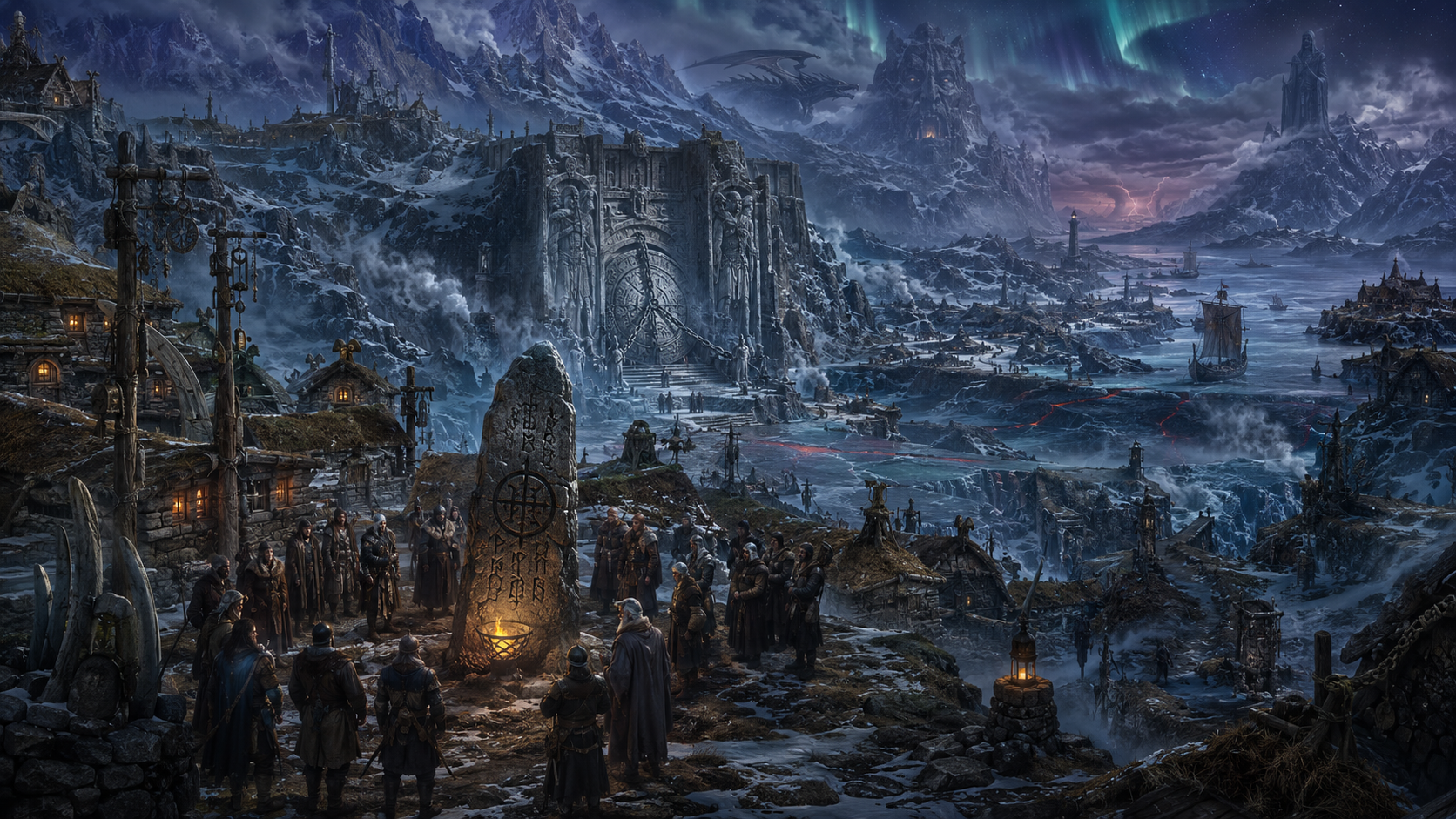
Veyrskold
Veyrskold is the northern cold continent of Thesalon.
It is a land of fjords, glaciers, black ice coasts, oath-stones, clan holds, ruin fields, dragonspine mountains, seal-singer islands, memory cairns, winter roads, buried halls, steam valleys, giant remnants, and sealed places that still shape the living.
Veyrskold is not empty.
It is inhabited, old, communal, practical, severe, beautiful, and watchful.
People live by hearths, storehouses, oath benches, fishing fleets, sled routes, seal roads, winter markets, forest traplines, highland signal fires, memory stones, and the hard knowledge that survival depends on trust.
The cold is not only weather.
It is law.
It is discipline.
It is memory.
It is warning.
A broken oath can kill a village as surely as a blizzard. A forgotten name can unsettle a clan. A ruined hall may be inheritance, tomb, prison, or threat. A thawing glacier may reveal a road, a body, a weapon, a sealed door, or something that was meant to stay buried.
Veyrskold’s people often say:
“The ice remembers. The living must decide what to do with what it gives back.”
Page Index
- Veyrskold at a Glance
- What Players Should Know
- The Central Question of Veyrskold
- First Impressions
- The Shape of Veyrskold
- Major Regions
- Major Polities and Powers
- Cities, Holds, Ruin-Towns, Ports, and Important Sites
- Life in Veyrskold
- Oath Law, Memory Law, and Winter Obligation
- Ruins, Sealed Places, and Ancient Danger
- Roads, Fjords, Ice Routes, and Winter Travel
- Faith, Temples, Ancestors, and Cold Saints in Veyrskold
- Magic, Ice, Memory, Dragons, Giants, and Buried Fire
- Peoples, Ancestries, and Languages
- Veyrskoldi Character Origins
- Public Factions
- Important Public NPCs
- Common Rumors and Misconceptions
- Adventure Hooks
- How to Play a Veyrskoldi Character
- Veyrskold Quick Reference
- Settlement Index by Region
- Common Shops and Services in Veyrskold
- Common Veyrskold Encounters by Region
- Veyrskold Travel Complications
- Veyrskold Downtime Ideas
- Veyrskold Character Name and Identity Notes
- Player Safety and Spoiler Boundary
- Page Use Guide
- Related Pages
Veyrskold at a Glance
| Topic | Veyrskold |
|---|---|
| World Role | The northern cold continent of Thesalon. |
| Core Identity | A land shaped by winter survival, oath-stones, ancient ruins, giant-kind, dragon memory, sealed places, and dangerous thaw. |
| Defining Features | Glaciers, fjords, black ice coasts, oath holds, cairn fields, buried halls, dragonspine mountains, old sealed places. |
| Major Waters and Routes | Frostmere Fjords, Black Ice Coast, seal roads, glacier roads, winter passes, thaw rivers, coastal ice lanes, island song routes. |
| Political Mood | Practical, severe, communal, memory-bound, suspicious of recklessness, respectful of old vows. |
| Major Tensions | What must be remembered, what must stay sealed, who owns old vows, who may wake ancient power, who survives winter, who speaks for the dead. |
| Common Conflicts | Broken oaths, winter stores, ruin claims, thaw danger, dragon tribute, giant relics, clan disputes, ice road closures, buried fire, memory theft. |
| Best Known For | Oath-stones, cold harbors, sled roads, glacier guides, giant ruins, dragon watchfires, ancestor cairns, seal-singers, winter markets, sealed northern places. |
| Player Character Fit | Oathkeepers, hunters, skalds, ruin delvers, glacier guides, hold guards, winter traders, dragon-watchers, cairn tenders, seal-singers, exiles, thaw scouts. |
What Players Should Know
Veyrskold is a cold northern continent where survival is social before it is heroic.
Food, fuel, shelter, memory, routes, guest law, and oaths matter. A person who lies about stores, breaks a winter promise, moves a cairn, ignores a route bell, or opens a sealed place without right can endanger more than themselves.
The people of Veyrskold are not all one culture, clan, ancestry, or government. The continent contains fjord holds, oathstone assemblies, glacier waystations, tundra camps, ruin towns, dragon-watch fortresses, black ice ports, geothermal forge settlements, longwinter forest clans, cairn keepers, island kinships, and northern watchholds.
Veyrskold is ancient in a visible way.
The past is not hidden in books alone. It stands in stone circles. It lies beneath glaciers. It protrudes from snow as giant fingers, broken thrones, half-buried roads, black doors, dragon-scorched valleys, and cairns that mark names no one is allowed to forget.
Ruins are common enough to shape daily law. That does not make them safe. Many Veyrskoldi traditions insist that some places were closed for good reason.
A visitor should understand three things before traveling in Veyrskold:
First, winter makes promises practical.
Second, memory is a public duty.
Third, sealed things are not invitations.
A warm hearth may save your life. An oath may bind your descendants. A door under ice may be worth more unopened than opened.
The Central Question of Veyrskold
Veyrskold’s central question is:
When the past was sealed to protect the living, who has the right to open it?
This question touches ruins, families, clans, holds, giant relics, dragon bargains, ancestor cairns, sealed doors, buried fire, and thawing ice.
A ruin delver may say old halls belong to whoever can reach them.
A memory keeper may say the dead still have rights.
A hold speaker may say the living need what is buried.
A glacier guide may say no treasure is worth opening a road that should stay closed.
A dragon-watch captain may say old pacts still bind the highlands.
A forge house may say buried fire can keep thousands warm.
A skald may ask whether forgetting a danger is worse than waking it.
A starving village may answer that philosophy is easier beside a full storehouse.
The Past Is Not Past
In Veyrskold, old things return.
A glacier cracks and reveals a body wearing a clan mark from six generations ago.
A thaw river exposes a stone door sealed with warnings no living scholar fully understands.
A child finds a giant-carved bead in a reindeer trail.
A dragon-oath stone begins to smoke on a clear morning.
A cairn shifts after a storm and exposes a second name beneath the first.
When old things emerge, people argue over whether they are gifts, duties, traps, debts, or warnings.
Oaths Outlive People
Many Veyrskoldi communities believe some promises bind more than the person who spoke them.
An oath made to protect a road, guard a spring, feed a guest, maintain a cairn, avoid a sealed ruin, watch a dragon pass, or preserve winter stores may pass through family, hold, office, or memory.
This can create stability.
It can also trap the living under the weight of dead decisions.
Survival Can Break Ideals
Winter creates hard questions.
If a hold is starving, may it raid another hold’s storehouse?
If a sealed ruin contains fuel, tools, or food, may it be opened?
If an ancient pact requires tribute to a dragon, must it be honored when children go hungry?
If a guest threatens a household’s survival, does guest law still protect them?
If a memory is dangerous, should it be preserved?
Veyrskold does not answer these questions with one law. It answers them through oaths, moots, skalds, cairns, holds, bargains, exile, and sometimes blood.
First Impressions
A traveler entering Veyrskold may first notice the scale of the land.
Fjord cliffs rise like walls. Glaciers grind against valleys. Black ice beaches shine under pale light. Snowfields stretch toward blue horizons. Pines stand heavy with frost. Smoke rises from longhouses. Sled bells sound across hard roads. Whale-bone gates frame harbors. Oath-stones stand in circles where wind has polished them smooth.
The cold is constant, but not silent.
Ropes creak. Ice cracks. Dogs bark. Ravens call. Hammers ring in covered boat halls. Skalds chant names beside hearths. Seal-singers guide boats through fog. Dragon-watch fires burn on high ridges. Glacier bells warn when routes shift. Markets open beneath hide awnings while snow gathers on the edges.
Common first impressions include:
- Longhouses built low against the wind.
- Public oath-stones carved with layered names and marks.
- Sled teams waiting beside frozen roads.
- Fish drying under roofed racks.
- Smoke holes glowing at dusk.
- Whale-rib arches over harbor gates.
- Cairns under aurora light.
- Rune-marked doors sealed with iron and old warnings.
- Glacier guide ropes hung in white loops.
- Seal-oil lanterns burning blue-gold in cold harbors.
- Dragon-watch beacons on distant highlands.
- Giant stone fragments protruding from snow.
- Hot springs steaming beneath frost in the Buried Firelands.
- Winter markets filled with furs, fish, bone tools, lamps, knives, sled runners, and route news.
- People carrying memory knots, carved oath sticks, bone tablets, or ancestor tokens.
Veyrskold often feels watchful.
The living watch the weather.
The dead watch through cairns.
The past watches through ice.
The Shape of Veyrskold
Veyrskold is organized by cold, coast, route, memory, and old danger.
The Frostmere Fjords hold major coastal settlements, winter harbors, fishers, ship halls, seal roads, ice pilots, coastal clans, and cold-tide shrines.
The Oathstone Holds are inland and coastal hold communities structured around oath-stones, longhouses, winter stores, clan law, guest benches, memory courts, and public assemblies.
The Glacier Roads form dangerous but important routes across glacial terrain, ice bridges, crevasse fields, waystations, sled routes, glacier bells, rescue houses, and survey camps.
The White Tundra is open migratory land of reindeer herds, hunting camps, sky omens, snowhide lodges, and sparse but resilient communities.
The Giantfall Ruins contain enormous stone remains, buried halls, giant-scale roads, relic claim courts, translation camps, and sealed ruin entrances.
The Dragonspine Highlands rise in jagged ridges, old eyries, tribute caves, signal fires, dragon-oath stones, high passes, and valleys scarred by ancient fire.
The Black Ice Coast is a dangerous coastline of frozen harbors, black ice beaches, wreck fields, salvage leagues, lighthouses, quarantine chains, and drowned-name registries.
The Buried Firelands are geothermal valleys where steam, hot springs, forge halls, sulfur glass, thaw-watch towers, unstable vents, and sealed old fire sites complicate the cold.
The Longwinter Forests are snowbound forests of timber holds, traplines, wolf roads, hidden shrines, herbal lodges, faintly glowing groves, and forest law.
The Memory Cairn Fields preserve ancestral names, old battle sites, unidentified dead, memory moots, cairn watchers, skaldic halls, and forbidden fields where stones must not be moved.
The Seal-Singer Isles are northern islands of seal hunters, song navigation, iceboats, oil lantern houses, island guest law, wave-listening shrines, and fog routes.
The Sealed North lies beyond ordinary settlement, where watchholds, warning stones, forbidden doors, failed expedition cairns, no-fire camps, and sanctioned routes mark the edge of what Veyrskoldi law permits.
No part of Veyrskold is truly separate from winter.
Even its warm places are defined by the cold surrounding them.
Major Regions
The regions below are player-facing geographic and cultural divisions. They are not all formal political borders. Some are hold territories, some are travel networks, some are sacred landscapes, some are ruin zones, and some are defined by survival.
Each region includes notable settlements and sites by name. Deeper descriptions appear later in the Cities, Holds, Ruin-Towns, Ports, and Important Sites section.
The Frostmere Fjords
The Frostmere Fjords are among the most inhabited and traveled parts of Veyrskold.
Steep cliffs shelter cold harbors, fishing towns, longship halls, sealroad quays, coastal markets, ice pilots, storm shrines, whale-bone gates, and holdfasts built around protected inlets.
The fjords are beautiful but dangerous. Weather changes quickly. Ice closes harbors without warning. Storms can smash boats against stone. Winter sea routes may open or vanish according to wind, current, and local knowledge.
People of the Frostmere Fjords often think in terms of tide, ice, fish, oath, and harbor.
What Defines the Frostmere Fjords
- Fjord settlements
- Winter harbors
- Fishing fleets
- Seal roads
- Ice pilots
- Coastal clans
- Longship halls
- Cold-tide shrines
- Whale-bone gates
- Harbor oath-stones
- Fish stores
- Route warnings
Common Sights
Travelers in the Frostmere Fjords may see:
- Longhouses built along cliff terraces.
- Boats pulled into covered halls for winter repair.
- Fish drying beneath roofed racks.
- Seal hunters preparing sleds and boats.
- Ice pilots reading cracks near harbor mouths.
- Whale-bone arches over ceremonial gates.
- Harbor oath-stones carved with names of drowned captains.
- Children learning knotwork before letters.
- Thalara shrines hung with shells, bone, and storm cloth.
- Winter markets lit by seal-oil lamps.
Settlements and Sites in the Frostmere Fjords
- Frostmere Holdfast — major fjord city-hold and coastal authority.
- Longwake Harbor — winter harbor and trade port.
- The Whale-Bone Gate — ceremonial harbor gate.
- Sealroad Quays — docks for seal hunters, fishers, and ice pilots.
- Thalara’s Cold Tide Shrine — sea, storm, and winter-navigation shrine.
- The Net-Freezing Yards — fishers’ repair and ice-work district.
- Black Gull Watch — coastal warning tower.
- The Ice-Lantern Market — winter market for fish, furs, lamps, bone tools, and route news.
- The Harbor Oathstone — public oath and law stone.
- The Frostmere Boat Halls — covered ship halls for winter repair.
- Stormhook Point — cliff signal post watching fjord weather.
- The Salt-Fish Storehouses — communal and merchant-controlled food stores.
- Blue Rope Pilot House — office of ice pilots and fjord guides.
- The Drowned Captain’s Bench — public seat where sea-debt cases are heard.
The Oathstone Holds
The Oathstone Holds are the cultural and legal heart of much of Veyrskold.
They are built around longhouses, stone circles, guest benches, winter stores, clan halls, memory shrines, training yards, law assemblies, and oath-stones carved by generations.
An oathstone is not decoration. It is witness, record, symbol, and warning.
The Holds preserve guest law, winter obligations, clan agreements, food-sharing customs, memory testimony, and survival duties.
They can be generous to guests, harsh to oathbreakers, and deeply suspicious of people who treat promises as private matters.
What Defines the Oathstone Holds
- Clan holds
- Oath-stones
- Longhouses
- Law assemblies
- Winter stores
- Guest benches
- Memory courts
- Hearthguard
- Public vows
- Food and fuel obligations
- Skaldic records
- Broken oath law
Common Sights
Travelers in the Oathstone Holds may see:
- Stone circles half-buried in snow.
- Longhouses roofed in turf, timber, bone, and hide.
- Winter store vaults guarded by elders and armed hearthguard.
- Guest benches placed near public fires.
- Skalds reciting names before legal arguments.
- Oath sticks carved and broken in formal ceremony.
- Children learning which promises must never be made lightly.
- Clan banners hung beside fishing nets, sled harness, and winter tools.
- Hearth smoke rising through snow.
- Red doors marking public shelters.
Settlements and Sites in the Oathstone Holds
- Skoldhall of the First Oath — major oath-hold and assembly seat.
- The Circle of Standing Vows — great oath-stone assembly field.
- Red Hearth Longhouse — public hall and winter shelter.
- The Winter Store Vaults — communal food and fuel reserves.
- Olyrra’s Knot-House — memory, ancestry, and oath record shrine.
- The Broken Oath Court — legal court for vow disputes.
- The Iron Guest Bench — protected guest-law seating.
- The Snowmoot Grounds — seasonal assembly field.
- The Bone-Tablet Archive — carved memory and law records.
- The Hearthguard Yards — hold militia and winter defense training grounds.
- The Ashbread Kitchens — public kitchens activated during hard winter.
- The Red Cord Market — trade in oath cords, household goods, knives, wool, and winter gear.
- The Quiet Exile Gate — gate used when a hold formally casts someone out.
- The Children’s Store Lesson Hall — school where young hold members learn winter accounting.
The Glacier Roads
The Glacier Roads are essential and feared.
They cross ice fields, glacier tongues, crevasse networks, frozen rivers, white ridges, blue cracks, unstable snow bridges, and stretches where the world seems to have no edge.
Travel on the Glacier Roads is controlled by guide houses, waystations, rope teams, sledwrights, rescue crews, route bells, and seasonal surveys. No wise traveler ignores a glacier guide.
The roads shift. Ice moves. A safe crossing can become a grave between one moon and the next.
What Defines the Glacier Roads
- Ice routes
- Sled caravans
- Crevasse danger
- Glacier bells
- Waystations
- Rope teams
- Rescue houses
- Snowblind shelters
- Ice bridges
- Route surveys
- Passage stones
- Emergency shelters
Common Sights
Travelers on the Glacier Roads may see:
- Sled teams moving in single file across white distance.
- Blue cracks descending into darkness.
- Rope teams tied together by waist and oath.
- Guide houses marked with white banners.
- Bells hanging from poles to warn of shifting ice.
- Snowblind travelers led by hand.
- Ice bridges carved by wind and reinforced by tools.
- Old route markers swallowed halfway by moving glacier.
- Surveyors hammering glass-ice stakes into snow.
- Emergency milehouses stocked with dry fuel, blankets, and bitter tea.
Settlements and Sites on the Glacier Roads
- Glaciergate Waystation — major ice road settlement and route authority.
- The Blue Crevasse Bridge — dangerous but important ice crossing.
- The Glacier Bell Towers — warning system for moving ice.
- Sledwright Row — sled builders, harness makers, runners, and ice gear.
- The White Rope Houses — guide families and rescue teams.
- The Ice-Tithe Marker — tax and passage stone for glacier routes.
- Saint Veyra’s Snowblind House — healing shelter for frostbite and snowblindness.
- The Lost Bell Field — abandoned route markers swallowed by ice.
- The Frozen Milehouse — emergency shelter.
- The Glass-Ice Survey Camp — scholars and scouts studying thawing routes.
- The White Hook Rescue Yard — rescue sleds, ropes, hooks, and trained teams.
- The Cracked Moon Crossing — seasonal passage safe only under certain ice conditions.
- The Old Sled Shrine — shrine made from the runners of failed expeditions.
- The Deep Blue Listening Post — station where guides listen for ice movement beneath the road.
The White Tundra
The White Tundra is open, vast, and never as empty as outsiders think.
It is a land of reindeer herds, migratory camps, hunting grounds, wind-cut stones, snowhide lodges, sky omens, grass basins, hunter silences, beast shrines, and route knowledge carried by families rather than maps.
Life here is mobile and seasonal. People follow herds, weather, forage, old paths, and obligations to other camps.
The White Tundra teaches distance, patience, silence, and the difference between being alone and being lost.
What Defines the White Tundra
- Open tundra
- Reindeer herds
- Migratory camps
- Winter hunting
- Sky omens
- Sparse settlements
- Snowhide lodges
- Wind markers
- Herd markets
- Beast shrines
- Seasonal routes
- Clan mobility
Common Sights
Travelers in the White Tundra may see:
- Reindeer bells sounding under wide sky.
- Snowhide lodges arranged in wind-wise circles.
- Hunters moving low and quiet across white ground.
- Thin columns of smoke from distant camps.
- Children learning herd calls.
- Antler racks marking seasonal gathering places.
- Wind-cut stones tied with hide strips.
- Skalds reciting migration memory beside low fires.
- Star readers watching aurora and cloud.
- Wolves seen far away, and sometimes too close.
Settlements and Sites in the White Tundra
- Whitehoof Camp — major migratory herd settlement.
- The Sky-Reed Plains — wind-singing tundra grasslands.
- Reindeer Bell Market — seasonal herd market.
- The Snowhide Lodges — mobile winter shelter network.
- Vaelthorn’s Antler Shrine — wilderness, beasts, growth, decay, and migration shrine.
- The Thin Smoke Camps — small hunting camps.
- The Wind-Cut Stones — weather and route markers.
- The Last Grass Hollow — protected grazing basin.
- The Star-Skin Tent — sky-omen and dream-reading lodge.
- The Hunter’s Silence Field — ritual hunting ground.
- The Whitehoof Calving Grounds — protected seasonal herd territory.
- The Low Aurora Camp — gathering place for winter sky omens.
- The Bone Sled Circle — temporary market for sled repair and bone tools.
- The Lost Antler Trail — route that appears and disappears with snow cover.
The Giantfall Ruins
The Giantfall Ruins are among the most famous and dangerous landscapes in Veyrskold.
Here, enormous stone remains lie across snowfields and valleys: broken hands, vast steps, shattered halls, giant-scale roads, buried thrones, stone ribs, huge bowls, toppled pillars, and doors too large for ordinary hands.
No one agrees what all of them were.
Some ruins are treated as tombs. Some as forbidden places. Some as claims. Some as sources of relics, knowledge, danger, and wealth. Some are sealed by law. Some are sealed by fear.
The Giantfall Ruins attract scholars, delvers, claim judges, guards, merchants, skalds, giant-tongue students, relic smugglers, and people who think ancient warnings were made for someone else.
What Defines the Giantfall Ruins
- Ancient giant ruins
- Enormous stone remains
- Buried halls
- Ruin law
- Relic claims
- Translation disputes
- Forbidden excavations
- Giant-tongue inscriptions
- Expedition camps
- Sealed gates
- Old roads
- Dangerous treasure
Common Sights
Travelers in the Giantfall Ruins may see:
- A giant stone hand rising from snow.
- Camps built between enormous fallen blocks.
- Scholars brushing ice from inscriptions.
- Claim flags marking excavation boundaries.
- Guards posted at sealed ruin doors.
- Relic merchants arguing over legal provenance.
- Skalds reciting warnings before expeditions.
- Snow drifting inside halls built for beings far larger than humans.
- Children warned not to play near “sleeping stones.”
- Tools and ladders made to reach carvings no ordinary person could touch.
Settlements and Sites in the Giantfall Ruins
- Giantfall Encampment — ruin-town and expedition base.
- The Fallen Hand of Grumharr — enormous giant statue fragment.
- The Stone-Rib Halls — partially buried giant halls.
- The Deep Step Causeway — giant-scale road.
- The Relic Claim Court — ruin claims and excavation rights.
- The Giant-Tongue Archive — translation and inscription hall.
- The Broken Bowl Quarry — site of giant stone vessels and carved basins.
- The No-Hammer Gate — sealed ruin entrance where excavation is forbidden.
- The Snow-Covered Throne — giant ruin landmark.
- The Smallfolk Camp Ring — mixed camp of scholars, delvers, guards, merchants, and scavengers.
- The Half-Buried Forge Palm — ruin believed to be part of a giant crafting complex.
- The Echo Understone — underground chamber where spoken words return in a larger voice.
- The White Claim Fence — boundary line around legally contested ruin ground.
- The Giant’s Sleeping Road — ancient raised path partly hidden under snow.
The Dragonspine Highlands
The Dragonspine Highlands are jagged, high, and watched.
They contain dragon eyries, old tribute caves, skyfire beacon lines, highland fortresses, burned valleys, ash-snow passes, observatories, dragon-oath stones, and places where people still speak carefully about bargains made generations ago.
Dragons in Veyrskold are not merely monsters in stories. They are part of old law, fear, memory, tribute, negotiation, and warning.
Some communities guard against them.
Some preserve pacts.
Some deny old obligations.
Some whisper that the dragons remember more accurately than people do.
What Defines the Dragonspine Highlands
- Jagged highlands
- Dragon eyries
- Watchholds
- Signal fires
- Old tribute caves
- Dragon-oath stones
- High passes
- Burned valleys
- Highland defense
- Wyrmglass observation
- Ancient bargains
- Fear of renewed tribute
Common Sights
Travelers in the Dragonspine Highlands may see:
- Watchfires burning on distant ridges.
- Cliffs marked by scorch-black streaks.
- Highland guards scanning the sky.
- Old offering caves sealed with iron grates.
- Stone platforms used for negotiations no one enjoys remembering.
- Glass lenses trained on cloud banks.
- Herd valleys still scarred by ancient fire.
- Children taught to identify wing shadows.
- Snow mixed with ash near old passes.
- Oath-stones carved with claw marks and witness names.
Settlements and Sites in the Dragonspine Highlands
- Dragonspine Watchhold — major highland fortress and dragon-watch center.
- The Ember-Eyrie Cliffs — known dragon roost cliffs.
- The Old Scale Tribute Caves — ancient offering caves.
- Kharos’ High Spear Bastion — defense shrine and fortress.
- The Skyfire Beacon Line — watchfires across high ridges.
- The Dragon-Oath Stones — old bargain stones.
- The Ash-Snow Pass — dangerous high road.
- The Wyrmglass Observatory — skywatch and dragonwatch scholars.
- The Scale-Moot Platform — negotiation platform for dragon-linked disputes.
- The Burned Herd Valley — valley scarred by old dragon fire.
- The Red Wing Warning Tower — signal tower watching the southern ridges.
- The Claw-Scored Gate — old fortress entry marked by dragon attack.
- The High Hoard Claim Office — legal office for relics found in dragon-linked sites.
- The Smoke-Eater Barracks — trained highland defenders and fire-response crews.
The Black Ice Coast
The Black Ice Coast is a dangerous northern coast of frozen harbors, black ice beaches, wreck fields, storms, salvage leagues, drowned-name registries, lighthouses, quarantine chains, and sea roads that open and close with deadly unpredictability.
Its ice is dark, slick, and treacherous. Its beaches shine like glass under pale light. Its waters carry wreckage from storms, old expeditions, failed trade routes, and sometimes things no one can identify.
The people of the Black Ice Coast are practical and suspicious. They respect the sea, but they also take from it. A wreck may be grave, warning, salvage claim, legal dispute, or temptation.
What Defines the Black Ice Coast
- Black ice beaches
- Frozen wrecks
- Coastal storms
- Salvage law
- Dangerous harbors
- Drowned-name records
- Lighthouses
- Icehook markets
- Quarantine chains
- Wreck claims
- Cold sea shrines
- Deadly channels
Common Sights
Travelers on the Black Ice Coast may see:
- Ship ribs trapped in frozen surf.
- Salvagers cutting ice around wreckage.
- Lighthouses burning behind storm haze.
- Drowned bodies brought to registry quays.
- Black gulls circling wreck fields.
- Quarantine chains dragged across harbor mouths.
- Icehook crews hauling cargo from dangerous shore.
- Thalara shrines covered in salt frost.
- Sailors arguing over whether a wreck is still a tomb.
- Blue-black ice reflecting stars at midday.
Settlements and Sites on the Black Ice Coast
- Blackice Harbor — major frozen coast port.
- The Obsidian Shore — black ice beach and wreck field.
- The Frozen Keel Yards — ship salvage and repair district.
- The Stormjaw Lighthouse — coastal warning tower.
- The Wreck-Name Registry — records of lost ships and drowned dead.
- Thalara’s Black Wave Chapel — shrine of cold seas and dangerous storms.
- The Icehook Market — salvage, whale bone, seal oil, wreck goods, iron.
- The Driftdead Quay — recovered bodies and wreck claims.
- The Blue Coffin Strait — deadly coastal channel.
- The Salt-Ice Chainhouse — harbor chain and quarantine control site.
- The Black Gull Salvage Yard — legal salvage sorting yard.
- The Frozen Ropewalk — cold-resistant rope, chain, and rigging district.
- The Ice-Pilot’s Warning Bench — public place for route declarations and sea warnings.
- The Widow’s Lamp Row — homes and shrines of families lost to the coast.
The Buried Firelands
The Buried Firelands are places where heat survives beneath ice.
Steam rises from vents. Hot springs melt snow. Warm channels cut through frozen ground. Red forges glow under frost. Sulfur glass shines in markets. Thaw-watch towers monitor unstable melt. Old sealed fire sites are treated with caution that borders on fear.
These lands are precious because they provide warmth, healing, metalwork, and winter refuge.
They are dangerous because heat changes ice.
A warm spring can save a life.
A sudden thaw can destroy a valley.
What Defines the Buried Firelands
- Geothermal valleys
- Hot springs
- Steam caves
- Buried fire
- Forge houses
- Thaw danger
- Warm stone baths
- Sulfur glass
- Melt channels
- Old sealed vents
- Disaster shrines
- Distorted tunnels
Common Sights
Travelers in the Buried Firelands may see:
- Steam rising from snow.
- Red-lit forge halls beneath ice cliffs.
- People bathing in warm stone pools while snow falls.
- Thaw-watch crews measuring meltwater.
- Sulfur glass traders polishing yellow-red lenses.
- Warning stakes around unstable ground.
- Ice bridges collapsing where heat reaches them from below.
- Bravik shrines built beside forge vents.
- Malrec offerings left near split ground.
- Children warned never to sleep near soft snow.
Settlements and Sites in the Buried Firelands
- Steamwell Hold — geothermal settlement and hot spring hold.
- The Warm Stone Baths — healing and ritual hot springs.
- The Fire-Under-Ice Caves — dangerous steam cave network.
- Bravik’s Red Forge Hall — forge shrine and geothermal smithing hall.
- The Ashmelt Channels — warm streams cutting through snow.
- The Thaw-Watch Towers — monitoring dangerous melt and flood release.
- The Sulfur Glass Market — trade in glass, metalwork, minerals, and heat-forged goods.
- The Deep Ember Seal — sealed old fire site.
- Malrec’s Split Vent — disaster shrine at an unstable vent.
- The Steamblind Warrens — tunnels where vision and sound distort.
- The Red-Snow Basin — melt basin used for heat rituals and smithing water.
- The Soft Ice Warning Field — marked danger zone over unstable ground.
- The Emberwright Quarter — forge workers, toolmakers, bath attendants, and glasscutters.
- The Winter Fever House — healing house using warm steam and mineral water.
The Longwinter Forests
The Longwinter Forests are snowbound pine, black spruce, hidden groves, wolf roads, traplines, timber holds, herbal lodges, old forest shrines, and settlements that measure wealth in fuel as much as coin.
The forest can feed and shelter people. It can also hide them, mislead them, starve them, and take them into silence.
Forest law differs from fjord law or hold law. Traplines, timber rights, hunting territories, spirit sites, and hidden paths are guarded carefully.
Outsiders who see only trees often miss the politics.
What Defines the Longwinter Forests
- Snow forests
- Dark pines
- Timber holds
- Trapping
- Forest herbs
- Wolf roads
- Hidden shrines
- Hunting territories
- Glowing groves
- Forest law
- Trapline disputes
- Old green ruins
Common Sights
Travelers in the Longwinter Forests may see:
- Pine branches heavy with snow.
- Trap markers tied in coded knots.
- Smoke from hidden lodges.
- Timber sledges drawn by oxen or reindeer.
- Herbalists scraping bark beneath moonlight.
- Wolves watching from treelines.
- Lantern-bark trees glowing faintly in deep winter.
- Hunters leaving offerings before entering silent ground.
- Old doors half-swallowed by roots and snow.
- Logging courts held in timber yards.
Settlements and Sites in the Longwinter Forests
- Pinewatch Hold — major forest hold and timber authority.
- The Wolfroad Paths — forest travel routes.
- The Black Pine Market — furs, timber, herbs, traps, bows, and winter goods.
- The Snowmoss Healer’s Lodge — herbal and healing house.
- Vaelthorn’s Root-in-Snow Shrine — forest survival shrine.
- The Lantern-Bark Groves — faintly glowing winter trees.
- The Silent Trapline — disputed hunting territory.
- The Old Green Door — hidden forest ruin entrance.
- The Moonwolf Cairn — ancestral and beast-spirit site.
- The Timber-Oath Yard — logging contracts and forest law court.
- The Deep Bark Charcoal Pits — fuel production site.
- The Snowhare Children’s Ring — winter teaching ground for tracking and survival.
- The Black Antler Watch — lookout used by forest clans.
- The Green-Under-Snow Hollow — sheltered valley where herbs grow under frost.
The Memory Cairn Fields
The Memory Cairn Fields are landscapes of stones, names, ancestors, old battles, unidentified dead, oath testimony, memory moots, mourning music, cairn watchers, and paths that must be walked carefully.
To outsiders, a cairn field may look like a graveyard.
To Veyrskoldi communities, it is also archive, court, witness, warning, map, family tree, and public conscience.
Moving a stone can be a crime.
Forgetting a name can be a wound.
Adding a false name can be worse.
What Defines the Memory Cairn Fields
- Ancestor cairns
- Preserved names
- Memory law
- Old battlefields
- Unidentified stones
- Oath testimony
- Skaldic mourning
- Cairn watchers
- Forbidden stone movement
- Public remembrance
- Lineage disputes
- Name correction
Common Sights
Travelers in the Memory Cairn Fields may see:
- Cairns stretching across snowfields.
- Blue cords marking paths between stones.
- Skalds reciting names into wind.
- Families brushing snow from ancestor markers.
- Cairn watchers inspecting shifted stones.
- Bone flutes played during mourning.
- Blank stones set aside for unidentified dead.
- Memory courts held beneath aurora.
- Children learning names by touch.
- Signs warning travelers not to move even fallen stones.
Settlements and Sites in the Memory Cairn Fields
- Cairnfield of Ten Thousand Names — major ancestral cairn field.
- The Name-Keeper’s House — memory records and cairn office.
- Olyrra’s Snow Memory Shrine — memory, ancestors, history, and time.
- The Old Battle Snowfield — ancient battlefield cairns.
- The Blue Cord Path — route through cairn markers.
- The Unnamed Stones — stones for unidentified dead.
- The Memory Moot Circle — assembly for disputes over names and remembrance.
- The Bone-Flute Hall — skaldic memory and mourning music.
- The Cairn-Watcher Huts — guardians of grave markers.
- The Forbidden Turning Field — place where stones must not be moved.
- The Lineage Icehouse — cold archive of bone tablets and family records.
- The Mourner’s Fire Ring — public place for grief and witness.
- The Second Name Bench — legal site for corrected, restored, or disputed names.
- The Snow-Blank Ledger House — office for names lost to ice, war, or failed expeditions.
The Seal-Singer Isles
The Seal-Singer Isles are cold northern islands where sea ice, fog, seal hunting, song navigation, kinship law, oil lanterns, iceboats, wave shrines, and coastal spirits shape daily life.
Island communities are tightly connected by song, route memory, marriage, guest law, and practical need. A person’s voice can matter as much as their map.
Seal-singers preserve navigation songs that describe currents, reefs, ice thickness, fog behavior, safe approaches, and dangerous waters. Outsiders often mistake these songs for folklore until they survive by following one.
What Defines the Seal-Singer Isles
- Northern islands
- Seal hunting
- Song navigation
- Iceboats
- Seal-oil trade
- Island kinship
- Sea ice routes
- Fog danger
- Wave-listening shrines
- Guest halls
- Whale bone markets
- Protected rookeries
Common Sights
Travelers in the Seal-Singer Isles may see:
- Iceboats dragged across frozen channels.
- Seal-oil lantern houses glowing through fog.
- Hunters repairing harpoons under low roofs.
- Children learning navigation songs before reading charts.
- Whale ribs used as market supports.
- Listening rocks where waves are interpreted.
- Guests announced by song rather than bell.
- White seals watched under strict ritual rules.
- Fog banks that seem to hum.
- Island halls filled with oil lamps, fish smoke, and layered voices.
Settlements and Sites in the Seal-Singer Isles
- Seal-Singer Haven — major island harbor and song-law center.
- The Songmarked Docks — docks marked by navigation songs.
- The Seal-Oil Lantern Houses — oil processing and lamp houses.
- Thalara’s Listening Rock — shrine where waves are interpreted.
- The Iceboat Sheds — boats and runners for sea ice travel.
- The Singing Fog Banks — dangerous fog route.
- The White Seal Rookery — protected hunting and ritual site.
- The Island Guest Hall — kinship and guest-law center.
- The Whale-Rib Market — bone, oil, hides, fish, and island goods.
- The Lost Song Reef — reef tied to missing navigators.
- The Low Tide Song School — school teaching route songs and island memory.
- The Oil-Lamp Registry — office tracking fuel, kinship dues, and winter stores.
- The Fogbell Post — warning site used when songs cannot carry.
- The Broken Harpoon Shrine — shrine for hunters who refused wasteful killing.
The Sealed North
The Sealed North is less a region of ordinary settlement and more a boundary of law, warning, memory, and fear.
It lies beyond the safer holds, roads, cairn fields, and known ice lanes. Travel north of the boundary requires sanction from watch authorities, oath witnesses, guide houses, and often memory keepers.
People disagree about what exactly lies there.
Most agree that parts of it were sealed for reasons that should not be treated lightly.
The Sealed North holds failed expeditions, warning fields, forbidden gates, no-fire camps, icebound ruins, cold star shrines, northern oathlines, and watchholds whose job is not exploration but prevention.
What Defines the Sealed North
- Restricted northern travel
- Forbidden doors
- Icebound ruins
- Warning stones
- Failed expeditions
- Sanctioned routes
- No-fire camps
- Watchholds
- Sealed archives
- Expedition courts
- Boundary oaths
- Old danger
Common Sights
Travelers near the Sealed North may see:
- Red-rune warning stones half-buried in snow.
- Watchfires behind ice walls.
- Empty expedition sledges preserved as memorials.
- Guides refusing coin with open contempt.
- Boundary cords tied between stone posts.
- No-fire camps marked by blackened but unused hearth rings.
- Cold star shrines with no roof.
- Doors in ice that no one local will touch.
- Longhouses built more like guard posts than homes.
- Snowfields where sound seems too flat.
Settlements and Sites in the Sealed North
- Northseal Watch — last major watchhold before restricted north.
- The Sealed Door of Hrund — legendary forbidden gate.
- The Red-Rune Warning Field — field of warning stones.
- The Last Expedition Cairn — memorial to failed northern expedition.
- The White Silence Road — dangerous route into restricted ice.
- The No-Fire Camp — emergency camp where flame is forbidden.
- The Cold Star Shrine — remote shrine of memory and warning.
- The Ice-Closed Library — sealed archive rumored beneath a glacier.
- The Gatekeeper’s Longhouse — watch authority and expedition court.
- The Northern Oathline — boundary beyond which travel requires sanction.
- The Frost-Buried Signal Mast — old warning tower half-lost to ice.
- The Three Empty Sledges — memorial site for an expedition that returned without bodies.
- The Silent Iron Doorfield — field of small sealed doors set into stone and ice.
- The Watcher’s Final Bench — place where sanctioned travelers make last testimony before departure.
Major Polities and Powers
Veyrskold is not ruled by one crown, one clan, one temple, or one ancient bloodline.
Authority is local, oath-bound, seasonal, and practical.
A harbor hold may control fish stores and ice pilots.
An oathstone moot may settle guest law and winter obligations.
A glacier guide house may close a route no warrior can safely force open.
A memory keeper may decide whether a name may be restored to a cairn.
A ruin claim court may determine whether a giant hall can be entered.
A dragonspine watchhold may light beacons that change the movement of whole valleys.
A forge house in the Buried Firelands may keep thousands warm, but also risk a thaw disaster.
A northern watchhold may refuse an expedition not because it fears discovery, but because it remembers why the road was closed.
In Veyrskold, power comes from the ability to keep people alive through winter, preserve memory, enforce oaths, control routes, interpret old dangers, and decide when to open or refuse the past.
The Oathstone Moots
Type: Hold assemblies and oath-law authorities
Primary Regions: The Oathstone Holds, Frostmere Fjords, Memory Cairn Fields
Public Identity: Oaths, guest law, winter obligations, clan agreements, public judgment
Common Reputation: Severe, necessary, traditional, difficult to deceive
The Oathstone Moots are public assemblies where holds, clans, families, travelers, guests, and oath witnesses bring disputes before carved stones and living memory.
A moot may be held in a stone circle, a longhouse, a snowmoot field, a harbor square, or beside an ancestor cairn. The form varies by region, but the principle is consistent: promises made before witnesses matter.
The Moots judge broken oaths, winter store disputes, guest-law violations, inheritance claims, route obligations, cairn offenses, exile petitions, and public accusations.
They are not quick courts. A moot may begin with testimony, songs, genealogies, old weather records, witness objects, oath sticks, carved tablets, and the recitation of promises made long before anyone present was born.
What the Oathstone Moots Control
- Public oath recognition
- Guest-law hearings
- Winter obligation disputes
- Clan and hold agreements
- Exile declarations
- Storehouse claims
- Broken oath penalties
- Oath witness certification
- Seasonal assembly procedures
- Public testimony rules
- Restored-name petitions
- Hold-to-hold dispute mediation
Why People Respect Them
The Moots preserve trust in places where trust keeps people alive.
If storehouses, routes, guest rights, rescue promises, and shared labor cannot be enforced, winter becomes deadlier for everyone.
Why People Distrust Them
Critics say the Moots can bind the living to old mistakes, protect established families, punish desperation too harshly, and turn public memory into public shame.
Character Connections
A character tied to the Oathstone Moots might be:
- An oath witness.
- A hearthguard.
- A moot runner.
- A skald’s apprentice.
- A guest-law advocate.
- A person exiled by a moot.
- A hold envoy.
- A storehouse clerk.
- A family representative in an old dispute.
- Someone accused of breaking an oath they never personally made.
The Frostmere Coastal Holds
Type: Fjord holdfasts, harbor councils, and coastal clan authorities
Primary Region: The Frostmere Fjords
Public Identity: Fishing, winter harbors, ice pilots, ship halls, cold-tide law
Common Reputation: Practical, storm-tested, proud, suspicious of inland certainty
The Frostmere Coastal Holds control the most important fjord settlements, fishing fleets, seal roads, cold harbors, covered boat halls, ice-lane pilots, fish stores, and coastal warning systems.
Their authority is built on food, boats, weather knowledge, and the ability to move when ice allows.
Coastal holds often cooperate with oathstone assemblies, but they also maintain their own harbor law. A sea debt, wreck dispute, fishing claim, or ice route warning may be judged differently at the water’s edge than in an inland longhouse.
What the Frostmere Coastal Holds Control
- Fjord harbors
- Fishing rights
- Sealroad quays
- Ice pilot assignments
- Covered boat halls
- Fish stores
- Harbor oath-stones
- Coastal warning towers
- Winter mooring rights
- Cold-tide shrine maintenance
- Salvage near fjords
- Sea-debt hearings
Why People Respect Them
The Coastal Holds feed and connect much of northern Veyrskold.
Their pilots, fishers, shipwrights, and storm watchers keep families alive through seasons when overland travel becomes impossible.
Why People Distrust Them
Inland communities sometimes accuse coastal holds of hoarding fish, exaggerating route danger, manipulating pilot fees, and treating sea custom as superior to hold law.
Character Connections
A character tied to the Frostmere Coastal Holds might be:
- A fisher.
- A harbor guard.
- An ice pilot.
- A seal hunter.
- A shipwright.
- A fish-store clerk.
- A storm tower runner.
- A cold-tide shrine keeper.
- A person whose family was ruined by a sea-debt ruling.
- A sailor who knows which fjord routes are used unofficially.
The Glacier Guide Houses
Type: Ice route authorities, guide families, and rescue networks
Primary Regions: The Glacier Roads, Sealed North approaches
Public Identity: Glacier routes, sled caravans, route closures, rescue rights, ice safety
Common Reputation: Expensive, blunt, lifesaving, hard to overrule
The Glacier Guide Houses control practical knowledge of the ice roads.
They maintain route bells, rope teams, rescue houses, sled routes, crevasse maps, seasonal crossings, old marker records, frozen milehouses, and guide lineages.
No official seal, noble name, temple blessing, or merchant contract makes a bad ice crossing safe. The Guide Houses are respected because they say no when saying yes would kill people.
What the Glacier Guide Houses Control
- Glacier route permissions
- Guide contracts
- Ice condition reports
- Crevasse warnings
- Rope team assignments
- Sled caravan scheduling
- Rescue obligations
- Frozen milehouse maintenance
- Route bells and warning poles
- Seasonal crossing maps
- Emergency closures
- Northern expedition advice
Why People Respect Them
The Guide Houses know the ice.
They rescue stranded travelers, recover bodies, close roads before disaster, and preserve route knowledge that cannot be learned from a map.
Why People Distrust Them
Merchants accuse them of closing routes for leverage. Desperate travelers accuse them of abandoning those who cannot pay. Some holds suspect them of hiding paths to protect family monopolies.
Character Connections
A character tied to the Glacier Guide Houses might be:
- A sled guide.
- A rescue runner.
- A rope team member.
- A glacier bell keeper.
- A snowblind healer.
- A route scout.
- A failed expedition survivor.
- A guide house child.
- A person blamed for a closed route.
- A traveler who owes their life to a guide and cannot repay the debt.
The Memory-Keepers of Olyrra
Type: Shrine archivists, cairn recorders, skaldic witnesses, and name preservers
Primary Regions: Memory Cairn Fields, Oathstone Holds, Grand ruin sites
Public Identity: Names, ancestry, memory law, cairn records, historical witness
Common Reputation: Patient, exacting, solemn, quietly powerful
The Memory-Keepers of Olyrra preserve names, oaths, ancestry, cairn records, old battles, expedition lists, restored identities, and the testimony required to keep memory lawful.
They are not merely scribes. In Veyrskold, a remembered name can determine inheritance, responsibility, burial rights, clan standing, oath obligation, and whether a person is considered wronged or forgotten.
Memory-Keepers serve in cairn fields, oathstone moots, old archives, ruin claim courts, hold halls, burial houses, and skaldic circles.
What the Memory-Keepers Control
- Cairn records
- Restored-name petitions
- Ancestry testimony
- Oath histories
- Expedition records
- Name correction procedures
- Memory archive access
- Unidentified dead records
- Skaldic witness standards
- Public mourning records
- Cairn movement rulings
- Old battle histories
Why People Respect Them
The Memory-Keepers prevent the dead from being erased and the living from escaping old responsibility.
They preserve the continuity of families, holds, oaths, and public truth.
Why People Distrust Them
They can refuse to correct a name, preserve shame beyond mercy, reveal old obligations, protect dangerous records, or force the living to carry memories they would rather bury.
Character Connections
A character tied to the Memory-Keepers might be:
- A cairn recorder.
- A shrine archivist.
- A skaldic witness.
- A name-restoration petitioner.
- A mourner’s aide.
- A keeper of expedition records.
- A person whose ancestor’s name was removed.
- A student of old oath law.
- A witness in a disputed lineage.
- Someone who knows a memory that could harm a hold.
The Giantfall Claim Courts
Type: Ruin-law courts and excavation authorities
Primary Region: The Giantfall Ruins
Public Identity: Relic claims, excavation rights, sealed gates, giant inscriptions, ruin safety
Common Reputation: Necessary, argumentative, corruptible, always surrounded by trouble
The Giantfall Claim Courts judge who may enter, excavate, translate, claim, sell, seal, guard, or abandon sites within the Giantfall Ruins.
Their work is difficult because the ruins are not merely abandoned property. They may be tombs, old homes, giant sacred sites, traps, prisons, workshops, courts, or warnings.
Claim judges must balance scholarship, survival, greed, ancestral respect, hold law, foreign interest, and the danger of opening something no one understands.
What the Giantfall Claim Courts Control
- Ruin claim registration
- Excavation permissions
- Relic ownership disputes
- Sealed entrance rulings
- Giant inscription access
- Expedition licensing
- Camp boundary disputes
- Relic sale restrictions
- Dangerous site closures
- Translation testimony
- Ruin guard assignments
- Penalties for unlawful digging
Why People Respect Them
Without ruin law, the Giantfall Ruins would become a field of theft, death, and broken seals.
The Courts prevent some disasters before they start.
Why People Distrust Them
The Courts can be bribed, misled, pressured by powerful patrons, manipulated by scholars, or too eager to license dangerous work.
Many delvers believe claim law exists so others can profit from their risk.
Character Connections
A character tied to the Giantfall Claim Courts might be:
- A claim court guard.
- A ruin scribe.
- A relic porter.
- A giant-tongue student.
- A licensed delver.
- An illegal scavenger.
- A translator’s aide.
- A person injured in a forbidden excavation.
- A claimant to a sealed hall.
- Someone hired to prove a court ruling was bought.
The Dragonspine Watchholds
Type: Highland fortress network and dragon-watch authority
Primary Region: The Dragonspine Highlands
Public Identity: Dragon monitoring, old pacts, signal fires, highland defense, tribute memory
Common Reputation: Vigilant, grim, proud, alarmist until proven right
The Dragonspine Watchholds exist because Veyrskold remembers dragons.
They maintain watchfires, highland patrols, tribute cave records, eyrie sightings, smoke response teams, fortified passes, signal towers, and old dragon-oath stones.
Some Watchholds prepare for war. Some preserve old bargains. Some do both and speak of neither casually.
A dragon may not be seen for years, but the Watchholds do not consider absence the same as safety.
What the Dragonspine Watchholds Control
- Highland signal fires
- Dragon sighting reports
- Tribute cave supervision
- High pass defense
- Eyrie watch routes
- Fire response crews
- Dragon-oath stone records
- Herd valley warnings
- Negotiation platforms
- Skywatch patrols
- Wyrmglass observations
- Evacuation orders
Why People Respect Them
When the sky darkens with wings, no one complains that the Watchholds were too cautious.
They preserve knowledge of old dangers and train communities to survive fire, tribute, and fear.
Why People Distrust Them
They may exaggerate threats, demand supplies, keep old pacts secret, interfere with herders, and maintain authority through fear of dragons no one has seen recently.
Character Connections
A character tied to the Dragonspine Watchholds might be:
- A signal fire keeper.
- A highland scout.
- A dragon-watch guard.
- A tribute cave recorder.
- A smoke response fighter.
- A Wyrmglass observer.
- A highland messenger.
- A person descended from an old dragon bargain.
- A herder whose valley was burned.
- Someone who believes the Watchholds are hiding the truth.
The Steamwell Forge Houses
Type: Geothermal forge authorities and hot spring hold powers
Primary Region: The Buried Firelands
Public Identity: Buried fire, hot springs, forgecraft, thaw monitoring, heat rights
Common Reputation: Skilled, wealthy, warm, dangerous, hard to do without
The Steamwell Forge Houses control geothermal heat, hot spring access, forge vents, steam tunnels, sulfur glass, warm baths, thaw-monitoring systems, and heat-forged goods.
They are respected because heat is precious in Veyrskold. A forge house can produce tools, weapons, sled fittings, stove plates, ship nails, glass lenses, warm water, and winter medicine that other regions need.
They are feared because buried fire is unstable. A careless vent, cracked ice shelf, or misjudged thaw channel can destroy homes or open old sealed places.
What the Steamwell Forge Houses Control
- Geothermal forges
- Hot spring access
- Steam tunnel work
- Heat rights
- Sulfur glass production
- Forge apprenticeships
- Thaw monitoring
- Warm bath schedules
- Red metalwork
- Vent safety inspections
- Fire-under-ice permits
- Emergency melt warnings
Why People Respect Them
The Forge Houses make winter more survivable.
Their tools, heat, glass, medicine, and metalwork are essential across the continent.
Why People Distrust Them
They profit from dangerous heat, may hide unstable vents, resist outside inspection, and sometimes push deeper into old fire sites for wealth.
Character Connections
A character tied to the Steamwell Forge Houses might be:
- A forge apprentice.
- A sulfur glass trader.
- A thaw watcher.
- A hot spring healer.
- A steam tunnel scout.
- A vent inspector.
- A bath attendant.
- A person burned by a forge house accident.
- A smith who believes Bravik speaks through heat.
- Someone who knows a sealed fire site is weakening.
The Longwinter Forest Clans
Type: Forest holds, hunting families, trapline authorities, and timber law networks
Primary Region: The Longwinter Forests
Public Identity: Timber, traplines, herbs, wolf roads, winter fuel, forest shrines
Common Reputation: Quiet, self-reliant, territorial, harder to find than to offend
The Longwinter Forest Clans control timber rights, hunting grounds, traplines, charcoal pits, herbal lodges, wolfroad paths, forest shrines, and winter fuel production.
Their authority often follows paths outsiders cannot see and boundaries marked by knots, cuts, scent, old stories, and memory of who survived which winter.
Fuel is life in Veyrskold. Timber law is therefore not minor law.
What the Longwinter Forest Clans Control
- Timber claims
- Trapline rights
- Charcoal pits
- Herb-gathering territories
- Wolfroad guidance
- Forest shrine maintenance
- Hunting seasons
- Winter fuel contracts
- Logging courts
- Hidden shelter routes
- Forest warning marks
- Disputed tree rights
Why People Respect Them
They provide fuel, furs, medicines, bows, traps, charcoal, route guidance, and forest knowledge.
They often know when something in the woods has changed before anyone else believes it.
Why People Distrust Them
They can be secretive, hostile to outsiders, violent over traplines, unwilling to explain forest law, and too protective of hidden paths.
Character Connections
A character tied to the Longwinter Forest Clans might be:
- A trapper.
- A timber judge.
- A wolfroad guide.
- An herbalist.
- A charcoal worker.
- A shrine keeper.
- A forest scout.
- A person accused of crossing a trapline.
- A child raised in hidden winter shelters.
- Someone who knows what lies behind the Old Green Door.
The Seal-Singer Island Kinships
Type: Island clans, song navigators, seal-hunting communities, and guest-law halls
Primary Region: The Seal-Singer Isles
Public Identity: Seal hunting, song navigation, iceboat routes, island guest law, oil lamps
Common Reputation: Strange to mainlanders, deeply reliable if properly hosted, dangerous if insulted
The Seal-Singer Island Kinships preserve navigation songs, seal hunting rites, iceboat routes, oil-lamp stores, wave-listening customs, rookery law, fog warnings, and island guest traditions.
They are less centralized than mainland holds, but their kinship obligations are strong. A song may function as map, law, prayer, warning, and family memory all at once.
Mainlanders sometimes dismiss Seal-Singer practices as superstition.
Those mainlanders should not sail in the fog.
What the Seal-Singer Island Kinships Control
- Song navigation
- Iceboat routes
- Seal hunting grounds
- Seal-oil production
- Island guest halls
- Fog warning systems
- Rookery protection
- Whale-rib markets
- Kinship dues
- Wave-listening shrines
- Lost song records
- Sea ice crossings
Why People Respect Them
The Kinships can navigate waters and fog banks where maps fail.
They supply oil, hides, fish, bone, and island knowledge that coastal holds depend on.
Why People Distrust Them
They may refuse to teach songs to outsiders, judge visitors through customs mainlanders do not understand, and hide routes for kinship advantage.
Character Connections
A character tied to the Seal-Singer Island Kinships might be:
- A song navigator.
- A seal hunter.
- An iceboat pilot.
- A lantern oil worker.
- A guest hall speaker.
- A rookery guardian.
- A wave listener.
- A lost song student.
- A person exiled from an island kinship.
- Someone who knows why one song must not be sung.
The Black Ice Salvage Leagues
Type: Coastal salvage associations, wreck courts, and frozen harbor powers
Primary Region: The Black Ice Coast
Public Identity: Wreck claims, salvage law, frozen harbors, drowned names, coastal warnings
Common Reputation: Useful, greedy, brave, morally complicated
The Black Ice Salvage Leagues recover goods, bodies, ships, tools, cargo, metal, rope, relics, and records from frozen wrecks and black ice beaches.
Their work is dangerous and necessary. It is also morally fraught. A wreck may be property, tomb, evidence, warning, or prize.
The Leagues operate beside drowned-name registries, Thalara shrines, port courts, ice pilots, quarantine chainhouses, and families waiting for news.
What the Black Ice Salvage Leagues Control
- Wreck claims
- Salvage crews
- Frozen keel yards
- Recovered cargo sorting
- Drowned body recovery
- Wreck-name reporting
- Icehook markets
- Legal salvage auctions
- Quarantine compliance
- Coastal hazard reports
- Storm salvage rights
- Disputed ship remains
Why People Respect Them
They recover bodies, supplies, and important cargo from places others cannot survive.
They keep harbors functional and preserve evidence from disasters.
Why People Distrust Them
They are accused of looting the dead, concealing valuable finds, cutting wrecks too early, bribing registries, and profiting from grief.
Character Connections
A character tied to the Salvage Leagues might be:
- A salvager.
- A wreck registrar.
- A frozen harbor sailor.
- A lighthouse runner.
- A drowned-name clerk.
- A black ice rope worker.
- A salvage auction guard.
- A person looking for a missing family ship.
- A smuggler hiding goods among legal salvage.
- Someone who found something in a wreck that should not exist.
The Northseal Watch
Type: Restricted northern travel authority and sealed-site guard network
Primary Region: The Sealed North
Public Identity: Warning law, sanctioned expeditions, sealed doors, northern boundaries
Common Reputation: Grim, secretive, necessary, accused of hiding too much
The Northseal Watch guards the boundary of the Sealed North.
Its purpose is not conquest or exploration. Its purpose is refusal.
The Watch maintains warning stones, expedition courts, sanctioned route records, northern oathlines, no-fire camp rules, sealed door reports, failed expedition memorials, and the authority to turn back travelers.
Many people resent them. Fewer people ignore them twice.
What the Northseal Watch Controls
- Northern expedition sanction
- Warning stone maintenance
- Boundary oath enforcement
- Sealed site reports
- No-fire camp rules
- Failed expedition records
- Watchhold patrols
- Restricted route permissions
- Gatekeeper testimony
- Expedition return hearings
- Forbidden object confiscation
- Emergency northern closures
Why People Respect Them
The Watch preserves boundaries that may protect all of Veyrskold.
It remembers disasters most people would rather turn into stories.
Why People Distrust Them
They conceal information, deny expeditions, confiscate discoveries, restrict scholars, and sometimes refuse to explain what they know.
Character Connections
A character tied to the Northseal Watch might be:
- A watch guard.
- A gatekeeper’s child.
- A warning-stone reader.
- A failed expedition survivor.
- A confiscated relic courier.
- A sanctioned guide.
- A northern oath witness.
- A scholar denied access.
- A person who believes the Watch is right.
- A person who believes the Watch is protecting a lie.
Winter Store Councils
Type: Food, fuel, shelter, and emergency reserve authorities
Primary Regions: Oathstone Holds, Frostmere Fjords, Longwinter Forests, White Tundra
Public Identity: Winter stores, ration law, communal survival, emergency shelter
Common Reputation: Practical, resented, lifesaving, politically dangerous
Winter Store Councils manage communal food, fuel, lamp oil, dried fish, grain, preserved meat, medicinal herbs, blankets, emergency shelters, and ration procedures.
Their work is not glamorous. It determines who lives through hard winter.
A store council decision may be more important than a warrior’s duel, and everyone knows it.
What Winter Store Councils Control
- Food reserves
- Fuel stores
- Seal oil stores
- Emergency shelter access
- Ration schedules
- Storehouse locks
- Public kitchens
- Winter guest limits
- Relief distribution
- Spoilage inspections
- Labor obligations
- Winter emergency declarations
Why People Respect Them
They prevent starvation and panic.
A well-run store council can save a hold, harbor, camp, or forest settlement.
Why People Distrust Them
They can favor kin, hide shortages, deny guests, miscount stores, hoard during crisis, or punish political rivals through ration decisions.
Character Connections
A character tied to a Winter Store Council might be:
- A storehouse keeper.
- A ration clerk.
- A public kitchen worker.
- A seal oil counter.
- A fuel cutter.
- A winter guest registrar.
- A person accused of stealing stores.
- A whistleblower.
- A hold child raised on ration math.
- Someone who broke a storehouse lock to save lives.
Skaldic Memory Circles
Type: Oral historians, song-law keepers, public reputation networks
Primary Regions: Oathstone Holds, Memory Cairn Fields, Seal-Singer Isles, White Tundra
Public Identity: Oral law, memory songs, public names, reputation, witness tradition
Common Reputation: Honored, feared, entertaining, impossible to silence completely
Skaldic Memory Circles preserve history through song, chant, story, genealogy, legal recitation, mourning music, and public performance.
A skald can honor a family, expose a lie, preserve an oath, shame a tyrant, or carry news across winter roads faster than written courts.
Skalds are not all neutral. Some serve holds, some serve temples, some serve patrons, some serve truth, and some serve whichever truth will survive being sung.
What Skaldic Memory Circles Control
- Memory songs
- Oath recitations
- Public reputation
- Genealogy performances
- Mourning music
- Battle histories
- Travel tales
- Clan praise and shame
- Oral witness standards
- Song-law instruction
- Disputed memory debates
- Festival histories
Why People Respect Them
They keep memory alive where paper rots, ink freezes, and stones cannot travel.
They make history public.
Why People Distrust Them
A skald can distort memory, weaponize shame, sell praise, bury truth in clever wording, or turn a complex event into a song people remember wrongly for generations.
Character Connections
A character tied to a Skaldic Memory Circle might be:
- A skald apprentice.
- A bone-flute player.
- A genealogy singer.
- A mourning musician.
- A public witness.
- A satire target.
- A song messenger.
- A person trying to correct a famous song.
- A historian of old giant or dragon lore.
- Someone whose family name survives because a skald refused to forget it.
Cities, Holds, Ruin-Towns, Ports, and Important Sites
Veyrskoldi settlements are shaped by winter.
A city-hold may be built around a harbor and fish stores.
A longhouse town may be built around an oathstone.
A waystation may exist because one glacier crossing must be watched.
A ruin-town may be a camp that became permanent because ancient stone attracted too much greed and too much scholarship to remain temporary.
A port may be half market, half salvage court.
A northern watchhold may exist so people do not travel farther.
The locations below are player-facing reference entries suitable for character origins, travel planning, rumors, faction contact, shopping, downtime, and adventure hooks.
Frostmere Holdfast
Region: The Frostmere Fjords
Primary Identity: Major fjord city-hold and coastal authority
Known For: Winter harbor, oathstone law, ship halls, fish markets, cold-tide shrines
Frostmere Holdfast stands along a deep fjord where cliffs shield the harbor from the worst winter storms.
It is one of Veyrskold’s great coastal settlements: part city, part hold, part harbor, part winter store, part law stone.
From the water, visitors see whale-bone arches, steep timber terraces, smoke from longhouses, covered boat halls, fish racks, ice-lanterns, harbor chains, and a public oathstone standing near the quay where sea wind has polished the carvings.
Frostmere survives by fish, boats, stores, pilots, oaths, and shared winter discipline.
It is more welcoming than it looks, provided a traveler respects its laws.
Districts of Frostmere Holdfast
The Whale-Bone Gate
The Whale-Bone Gate is the ceremonial harbor entrance, built from enormous ribs reinforced with iron, rope, carved timber, and old storm marks.
Arriving ships pass beneath it when ice allows. During winter festivals, lanterns are hung from the bone arches to honor those who returned and those who did not.
Sealroad Quays
Sealroad Quays serve seal hunters, fishers, ice pilots, small cargo boats, and coastal travelers.
The quays are crowded with sledges, nets, drying racks, oil barrels, carved hooks, fish baskets, and people shouting over wind.
Frostmere Boat Halls
The Boat Halls are covered ship sheds where longboats, fishing boats, ice skiffs, sealcraft, and winter hulls are repaired.
They smell of tar, wet timber, seal oil, iron nails, and old rope.
Ice-Lantern Market
The Ice-Lantern Market is the holdfast’s central winter market.
It sells fish, furs, bone tools, seal oil, lamps, sled gear, storm cloth, knives, dried berries, wool, memory cords, and route news.
Harbor Oathstone Square
Harbor Oathstone Square is where public oaths, sea-debt cases, guest law, fish store disputes, and winter declarations are witnessed.
The stone is carved with names of drowned captains, old harbor promises, and warnings about false tide reports.
Net-Freezing Yards
The Net-Freezing Yards are working yards where fishers repair, thaw, scrape, hang, and preserve nets, lines, hooks, and cold-weather fishing gear.
Children often learn practical work here before formal schooling.
Longhouse Rise
Longhouse Rise climbs above the harbor in stepped terraces.
It contains public halls, family longhouses, hearth shelters, guest benches, skald corners, and the Red Hearth of Frostmere.
Salt-Fish Storehouse Ring
The Storehouse Ring contains communal and private fish reserves.
Access is regulated carefully in winter. Storehouse theft is treated as a survival crime.
Important Landmarks
- The Whale-Bone Gate — ceremonial harbor gate and storm memory structure.
- Sealroad Quays — working docks for fishers, seal hunters, and ice pilots.
- Frostmere Boat Halls — covered ship halls for winter repair.
- Ice-Lantern Market — winter market for food, tools, lamps, and route news.
- Harbor Oathstone Square — public law and oath site.
- Thalara’s Cold Tide Shrine — sea, storm, and winter-navigation shrine.
- Black Gull Watch — coastal warning tower.
- The Salt-Fish Storehouses — guarded winter food stores.
- Blue Rope Pilot House — office of ice pilots and fjord guides.
- The Drowned Captain’s Bench — public seat where sea-debt and wreck responsibility cases are heard.
Temples and Shrines
- Thalara’s Cold Tide Shrine — cold sea, storms, ice routes, fishers, sailors, and safe return.
- Olyrra’s Harbor Memory Niche — drowned names, family records, and old sea routes.
- Halven’s Red Hearth — shelter, food, family, winter stores, and guest warmth.
- Aurelion’s Oathstone Face — law, promises, harbor judgments, and witness.
- Morvane’s Salt-Wind Room — proper rites for drowned or frozen dead.
- Vaelthorn’s Seal-Breath Shrine — seal herds, coastal beasts, fish cycles, and winter ecology.
- Oranth’s Returning Light Lamp — renewal after dark winter, dawn fires, and watchfulness.
Shops, Inns, and Useful Places
- The Whale Gate Inn — large harbor inn used by pilots, traders, hunters, and travelers waiting on ice conditions.
- Blue Rope Pilot House — hires ice pilots, fjord guides, and coastal route advisers.
- Cold Hook Chandlery — ropes, hooks, lamps, tar, seal-oil flasks, sailcloth, rigging, and boat tools.
- Ice-Lantern Market Stalls — fish, furs, bone tools, wool, oil, knives, sled runners, and route tokens.
- Net-Freezing Repair Hall — net repair, line work, hook sharpening, and cold-water gear.
- Frostmere Sled & Keel — sled runners, small boats, hull repair, runners for iceboats, and cargo skids.
- The Drowned Ledger Scribes — sea-debt documents, drowned-name copies, cargo claims, and witness statements.
- Salt-Fish Provisioners — dried fish, preserved meat, hard bread, oil, and winter travel rations.
- Harbor Hearth Tea Room — warm drink, local gossip, skald songs, and unofficial legal advice.
- Stormhook Signal Shop — lanterns, signal flags, horn calls, storm cloth, and warning bells.
Oath Law and Local Tensions
Frostmere’s conflicts are often practical and public:
- Fishers versus storehouse councils.
- Ice pilots versus merchants who want routes open too soon.
- Coastal clans versus harbor officials.
- Seal hunters versus shrine keepers protecting breeding grounds.
- Salvage crews versus drowned families.
- Guest law versus winter rationing.
- Boat hall workers versus wealthy ship owners.
- Harbor law versus inland oathstone rulings.
Frostmere is proud of its hospitality, but hospitality has limits when stores run low.
What Adventurers Find Here
Adventurers in Frostmere Holdfast may find:
- Ice pilot contracts.
- Missing fishing crews.
- Storm tower sabotage.
- Drowned-name disputes.
- Sealroad escort work.
- Fish store theft.
- Wreck responsibility cases.
- Harbor oath conflicts.
- Smugglers using frozen quays.
- A route bell ringing when no ice has moved.
- A boat pulled from the fjord with old runes burned into its keel.
Skoldhall of the First Oath
Region: The Oathstone Holds
Primary Identity: Major oath-hold and assembly seat
Known For: Oathstone moots, winter stores, clan law, guest benches, memory courts
Skoldhall of the First Oath is one of the oldest and most respected hold settlements in Veyrskold.
It is built around the Circle of Standing Vows, a ring of oath-stones carved over generations with names, promises, warnings, broken lines, restored names, exile marks, and memory knots.
Skoldhall is not the largest settlement in Veyrskold, but its legal and cultural weight is enormous.
People travel to Skoldhall to settle oath disputes, restore names, ask for guest-law judgment, appeal winter store rulings, make public vows, arrange clan agreements, and hear old memory recitations.
The settlement is severe, but not joyless. Its longhouses are warm. Its feasts are careful. Its songs are long. Its children grow up knowing that a promise made aloud may one day be carved into stone.
Districts of Skoldhall
The Circle of Standing Vows
The Circle is the heart of Skoldhall.
Its oath-stones stand in a wide open field, each carved with layered histories. Some stones are smooth from being touched. Others bear crossed marks indicating broken oaths, restored promises, or dangerous precedents.
No weapon may be drawn within the Circle except by formal legal order.
Red Hearth Longhouse
The Red Hearth Longhouse is the public hall, winter shelter, feast hall, emergency sleeping space, and guest-law center.
Its central fire is kept through the deepest winter and used to relight other public hearths after major ceremonies.
Broken Oath Court
The Broken Oath Court hears vow disputes, storehouse betrayals, guest-law violations, false testimony, oath inheritance, and appeals from smaller holds.
The court is famous for long hearings and exact questions.
Winter Store Vaults
The Winter Store Vaults hold preserved food, fuel, blankets, emergency tools, dried herbs, lamp oil, and reserve grain.
They are guarded by storekeepers and hearthguard. Their locks are symbolic as well as practical.
Olyrra’s Knot-House
The Knot-House is a memory shrine, archive, and testimony hall.
It stores carved tablets, knotted cords, family records, old songs, restored names, oath copies, and winter death lists.
Snowmoot Grounds
Snowmoot Grounds are seasonal assembly fields used when too many people gather for the longhouses.
Tents, sledges, market stalls, and clan banners fill the grounds during major moots.
Hearthguard Yards
The Yards train hold defenders, guest-law protectors, winter patrols, and oath escorts.
The Hearthguard are not merely soldiers. They enforce law and shelter obligations.
Quiet Exile Gate
This side gate is used when a person is formally exiled from Skoldhall or from a hold under Skoldhall’s judgment.
It is not theatrical. That makes it worse.
Important Landmarks
- The Circle of Standing Vows — great oath-stone assembly field.
- Red Hearth Longhouse — public hall and winter shelter.
- The Broken Oath Court — legal court for vow disputes.
- The Winter Store Vaults — communal food and fuel reserves.
- Olyrra’s Knot-House — memory, ancestry, and oath record shrine.
- The Iron Guest Bench — protected guest-law seating.
- The Snowmoot Grounds — seasonal assembly field.
- The Bone-Tablet Archive — carved memory and law records.
- The Hearthguard Yards — hold militia and winter defense training grounds.
- The Quiet Exile Gate — formal exile gate.
- The Ashbread Kitchens — public kitchens for winter hardship.
- The Children’s Store Lesson Hall — school where young hold members learn winter accounting.
Temples and Shrines
- Olyrra’s Knot-House — memory, ancestors, oath records, and preserved names.
- Aurelion’s Standing Vow Face — law, judgment, rightful order, and oath enforcement.
- Halven’s Red Hearth — winter shelter, food, family, public warmth, and guest obligations.
- Morvane’s Quiet Snow Bench — death, burial, frozen dead, and proper naming.
- Edrun’s Stone Witness Shrine — endurance, stone, mountain memory, and lasting promises.
- Kharos’ Hearthguard Niche — defense, courage, and lawful protection.
- Oranth’s Returning Dawn Lamp — renewal after winter darkness and public truth.
Shops, Inns, and Useful Places
- The Red Hearth Guesthouse — lodging for legal petitioners, travelers, oath witnesses, and clan envoys.
- Oathcord Market — oath cords, carved sticks, witness tokens, wool, knives, winter tools, and household goods.
- Bone-Tablet Carvers — legal tablets, memory bones, carved family records, and oath copies.
- Winter Store Provisioners — preserved food, lamp oil, blankets, dried herbs, emergency supplies.
- Hearthguard Armory — spears, axes, shields, armor repair, training gear, and patrol equipment.
- Knot-House Scriptorium — written copies, genealogies, restored-name petitions, witness records.
- Ashbread Kitchens — public meals, emergency rations, winter bread, and communal cooking.
- The Moot Cup Hall — warm drink, skaldic debate, legal gossip, and clan negotiation.
- Snowcloak Tailors — furs, cloaks, mittens, boots, hooded coats, and ceremonial winter garments.
- Exile Road Outfitters — harsh supplies sold quietly to those leaving under judgment.
Oath Law and Local Tensions
Skoldhall is built around trust, which means it is also built around distrust.
Common tensions include:
- Old oaths versus current survival.
- Guest law versus winter store limits.
- Clan reputation versus individual mercy.
- Memory keepers versus families seeking silence.
- Hearthguard enforcement versus local custom.
- Exiles seeking return.
- Restored names challenging inheritance.
- Young reformers questioning inherited obligations.
- Storehouse accusations before hard winter.
- Skalds preserving shame long after families want peace.
What Adventurers Find Here
Adventurers in Skoldhall may find:
- Oath dispute hearings.
- Storehouse theft investigations.
- Guest-law protection work.
- Escort contracts for witnesses.
- Restored-name cases.
- Exile petitions.
- Clan feuds.
- Missing memory tablets.
- Winter patrol duty.
- A broken oath that binds people who were not born when it was made.
- A public vow that no one wants fulfilled but no one can legally ignore.
Glaciergate Waystation
Region: The Glacier Roads
Primary Identity: Major ice road settlement and route authority
Known For: Glacier guides, sled caravans, route bells, snowblind shelters, crevasse crossings
Glaciergate Waystation stands at the edge of the great ice roads where stone, snow, and glacier begin to blur into one dangerous landscape.
It is not a city in the southern sense. It is a fortified crossing settlement, guide house cluster, rescue depot, sled yard, warning post, shrine ground, and legal gate for those who intend to cross moving ice.
A traveler who reaches Glaciergate may think the hard road is behind them.
The people of Glaciergate know the hard road has only begun.
Here, every rope is checked. Every sled runner is inspected. Every guide mark is read. Every route bell is listened for. Every delay is taken seriously, because the glacier does not care who is impatient.
Districts of Glaciergate Waystation
The White Rope Houses
The White Rope Houses are the offices, homes, and training yards of the glacier guide families.
Each house maintains its own route records, rescue marks, rope customs, and stories of lost crossings. Outsiders often mistake family rivalry for disunity. In a crisis, the Houses can move with terrifying coordination.
Sledwright Row
Sledwright Row builds and repairs sledges, cargo skids, runner frames, ice shoes, harness rigs, rope hooks, and winter travel gear.
The row is always busy before seasonal crossings and nearly silent after a major disaster.
Glacier Bell Yard
The Bell Yard stores, repairs, and assigns bells used on routes to warn of shifting ice, crevasse movement, storms, and rescue signals.
Each bell tone has meaning. A traveler who cannot recognize at least the basic warning bells is considered a danger to others.
Saint Veyra’s Snowblind House
This healing shelter treats frostbite, snowblindness, exposure, broken limbs, shock, and the strange silence that follows near-death on the ice.
Patients are often forced to stay longer than they wish.
The Ice-Tithe Marker
The Ice-Tithe Marker is a stone post where route fees, rescue obligations, winter taxes, and passage acknowledgments are recorded.
It is both administrative and sacred. Those who cross without acknowledging the Marker may be denied rescue claims later.
Frozen Milehouse Court
This small court handles disputes over abandoned cargo, guide refusal, rescue debt, false ice reports, and deaths blamed on bad leadership.
The court is cramped, cold, and blunt.
Glass-Ice Survey Camp
The Survey Camp hosts scholars, scouts, guide apprentices, and thaw watchers studying route changes, ice colors, deep cracks, and old objects emerging from glaciers.
Guide families tolerate them because sometimes scholars notice danger early.
Important Landmarks
- The Blue Crevasse Bridge — dangerous but important ice crossing near Glaciergate.
- The Glacier Bell Towers — warning system for moving ice.
- Sledwright Row — sled builders, harness makers, runners, and ice gear.
- The White Rope Houses — guide families and rescue teams.
- The Ice-Tithe Marker — tax and passage stone for glacier routes.
- Saint Veyra’s Snowblind House — healing shelter for frostbite and snowblindness.
- The Lost Bell Field — abandoned route markers swallowed by ice.
- The Frozen Milehouse — emergency shelter and court post.
- The Glass-Ice Survey Camp — scholars and scouts studying thawing routes.
- The Deep Blue Listening Post — station where guides listen for ice movement beneath the road.
Temples and Shrines
- Veyra’s Snowblind House Chapel — healing, recovery, frostbite care, and mercy after exposure.
- Edrun’s Ice-Stone Niche — endurance, stone under ice, patience, and careful passage.
- Olyrra’s Lost Bell Shrine — memory of those lost on closed routes.
- Selari’s Sled Bargain Post — route contracts, guide agreements, and caravan luck.
- Oranth’s White Horizon Lamp — vigilance, visibility, renewal, and warning.
- Morvane’s Cold Hand Bench — proper rites for those recovered from ice.
Shops, Inns, and Useful Places
- The White Gate Inn — lodging for travelers waiting on route approval.
- Sledwright Row Workshops — sleds, runners, cargo skids, ice shoes, harness rigs, and repair.
- Blue Crevasse Outfitters — ropes, hooks, crampons, goggles, snow cloaks, ice poles, and climbing gear.
- Guide-Marked Contracts — route papers, guide agreements, rescue clauses, and cargo records.
- Snowblind Apothecary — salves, wraps, eye covers, bitter teas, warming stones, and exposure remedies.
- The Bell-Tone Hall — training room where travelers learn basic route bell signals.
- Ice-Tithe Counting Table — passage fees, rescue deposits, and route tax records.
- Frozen Milehouse Provisioners — emergency rations, lamp oil, blankets, fuel bricks, and travel kits.
- The Deep Blue Listening Room — guide consultation chamber for route conditions.
- Cracked Runner Smithy — metal runners, hooks, buckles, sled nails, and cold-resistant fittings.
Local Tensions
Glaciergate’s tensions include:
- Guide Houses versus impatient merchants.
- Rescue teams versus travelers who ignored warnings.
- Survey scholars versus traditional route families.
- Poor travelers versus guide fees.
- Sledwrights versus caravan owners using unsafe equipment.
- Ice-tithe collectors versus smugglers.
- Route closure orders versus urgent need.
- Recovered bodies versus families who do not want the truth known.
What Adventurers Find Here
Adventurers in Glaciergate may find:
- Ice road escort work.
- Rescue missions.
- Missing sled teams.
- Route bell sabotage.
- Crevasse bridge repairs.
- Recovered relics emerging from ice.
- Disputes over guide refusal.
- Snowblind pilgrims needing protection.
- A Frozen Milehouse that has stopped answering signals.
- A glacier bell ringing from a route abandoned decades ago.
Giantfall Encampment
Region: The Giantfall Ruins
Primary Identity: Ruin-town and expedition base
Known For: Giant ruins, relic claims, translation disputes, sealed gates, delver camps
Giantfall Encampment began as a temporary camp.
It has been temporary for generations.
The settlement stands among enormous broken stones, half-buried walls, fallen giant statuary, wind-carved steps, and ruins too large for ordinary architecture. Tents, timber halls, sledge sheds, claim offices, translation huts, guard posts, cookfires, rope towers, and market stalls cluster in the shelter of stone remnants older than any living hold.
Giantfall is full of people who insist they are being careful.
Some are.
The ruins attract scholars, delvers, guards, giant-tongue students, claim judges, merchants, relic smugglers, skalds, forge buyers, oath witnesses, memory keepers, and desperate people hoping ancient stone contains modern wealth.
Districts of Giantfall Encampment
The Smallfolk Camp Ring
The Smallfolk Camp Ring is the main inhabited area, built in a wide circle between giant stone fragments.
It contains tents, timber halls, cookfires, supply sheds, bunkhouses, merchant stalls, and temporary homes that have become permanent through stubbornness.
Relic Claim Court
The Relic Claim Court registers excavation rights, claim boundaries, relic finds, sealed areas, translation disputes, camp crimes, and deaths caused by unlawful digging.
Its judges are surrounded by more argument than dignity.
Giant-Tongue Archive
The Archive studies giant inscriptions, carved stone tablets, ruin songs, scale diagrams, old measurements, and disputed translations.
It is part school, part shrine, part legal resource, part battleground of egos.
The Fallen Hand of Grumharr
This enormous statue fragment rises from snow outside the encampment.
Its open palm is large enough to hold a small market. No one agrees whether Grumharr was a ruler, saint, tyrant, builder, or warning figure.
Stone-Rib Hall Camp
Stone-Rib Hall Camp is an excavation district inside and around partially buried giant halls.
Support beams, ladders, ropes, pulleys, and warning flags cover the area. The halls groan during temperature shifts.
No-Hammer Gate Watch
The No-Hammer Gate is a sealed entrance where excavation is forbidden.
A permanent watch post prevents unauthorized digging, though everyone knows smugglers have tried.
Broken Bowl Quarry
This ruin zone contains massive stone vessels, carved basins, and broken containers that may have been ceremonial, industrial, domestic, or something no one understands.
White Claim Fence
The White Claim Fence marks disputed excavation boundaries.
It is moved illegally so often that the fence has its own guards.
Important Landmarks
- The Fallen Hand of Grumharr — enormous giant statue fragment.
- The Stone-Rib Halls — partially buried giant halls.
- The Deep Step Causeway — giant-scale road.
- The Relic Claim Court — ruin claims and excavation rights.
- The Giant-Tongue Archive — translation and inscription hall.
- The Broken Bowl Quarry — site of giant stone vessels and carved basins.
- The No-Hammer Gate — sealed ruin entrance where excavation is forbidden.
- The Snow-Covered Throne — giant ruin landmark.
- The Smallfolk Camp Ring — mixed camp of scholars, delvers, guards, merchants, and scavengers.
- The Echo Understone — underground chamber where spoken words return in a larger voice.
Temples and Shrines
- Olyrra’s Stone Memory Niche — memory, history, inscription, and ruin testimony.
- Edrun’s Buried Hall Shrine — stone, endurance, mountains, and deep foundations.
- Myrrakai’s Star-Carved Tablet — old magic, ancient knowledge, and inscription mystery.
- Aurelion’s Claim Witness Post — lawful claims, sworn finds, and public ownership rulings.
- Morvane’s Snow-Covered Dead Bench — rites for those crushed, lost, or found in ruin depths.
- Malrec’s Warning Bowl — collapse, disaster, and the wisdom of leaving danger alone.
Shops, Inns, and Useful Places
- The Open Palm Bunkhouse — lodging built against the Fallen Hand, popular with delvers.
- Deep Step Outfitters — rope, pulleys, lanterns, chalk, sledges, cold tools, and climbing gear.
- Giant-Tongue Copy Room — inscription rubbings, translation notes, legal copies, and old maps.
- Claim Court Advocates — legal help for excavation rights, relic disputes, and sealed-site accusations.
- Broken Bowl Cookfires — cheap meals for delvers, workers, guards, and scholars.
- Stone-Rib Timberworks — beams, supports, ladders, braces, and ruin shoring.
- Relic Weight Exchange — licensed appraisal, weighing, storage, and sale of approved finds.
- No-Hammer Watch Office — permits, warnings, complaints, and enforcement records.
- The Smallfolk Market — gloves, lamps, knives, charms, food, camp gear, and suspect curios.
- The Echo Mug Hall — tavern where ruin stories become larger every time they are told.
Ruin Law and Local Tensions
Giantfall is built on unresolved questions:
- Who owns ruins left by giant-kind?
- Are sealed halls tombs, prisons, temples, or hazards?
- Should giant inscriptions be translated publicly?
- Are relics property, memory, danger, or sacred remains?
- Can a camp court override an old oath not to dig?
- When does scholarship become theft?
- When does caution become hoarding?
- Who pays when a ruin collapses on workers?
Common tensions include:
- Scholars versus delvers.
- Claim judges versus relic smugglers.
- Memory keepers versus merchants.
- Hold authorities versus foreign buyers.
- Giant-tongue translators versus each other.
- No-Hammer Gate guards versus desperate treasure seekers.
- Camp workers versus wealthy expedition patrons.
What Adventurers Find Here
Adventurers in Giantfall may find:
- Licensed ruin delves.
- Illegal excavation jobs.
- Missing scholar searches.
- Relic theft investigations.
- Translation disputes.
- Sealed gate protection.
- Camp murder cases.
- Giant inscription puzzles.
- Ruin collapse rescues.
- A claim map that shows a hall no one admits exists.
- A giant-carved warning that changes meaning depending on who translates it.
Dragonspine Watchhold
Region: The Dragonspine Highlands
Primary Identity: Major highland fortress and dragon-watch center
Known For: Signal fires, dragon-oath stones, tribute caves, highland defense, skywatch patrols
Dragonspine Watchhold clings to a high ridge overlooking burned valleys, ash-snow passes, dragon-scarred cliffs, and the old routes leading toward known eyries.
It is a fortress, signal station, legal archive, barracks, evacuation office, shrine ground, and public reminder that Veyrskold remembers dragons whether dragons choose to appear or not.
The Watchhold’s people are often called grim by outsiders.
They answer that optimism is not a fire plan.
Dragonspine maintains skyfire beacons, watch patrols, tribute cave records, highland evacuation routes, smoke response crews, Wyrmglass observers, old bargain stones, and the Scale-Moot Platform where disputes tied to dragon pacts may be heard.
Districts of Dragonspine Watchhold
Skyfire Beacon Court
The Beacon Court maintains the signal fire system across the highlands.
Beacon crews train constantly. Each fire pattern has meaning: sighting, smoke, evacuation, false alarm, eyrie movement, tribute dispute, and emergency muster.
High Spear Bastion
High Spear Bastion is the fortress and defensive center of the Watchhold.
It houses the garrison, armor stores, fire shields, ballista platforms, highland patrol offices, and emergency command hall.
Dragon-Oath Stone Terrace
This terrace holds stones carved with old pacts, warnings, tribute records, witness names, and disputed interpretations.
Some stones show claw marks. Others show deliberate chisel scars where later generations attempted to alter memory.
Wyrmglass Observatory
The Observatory uses polished glass, lenses, mirrors, sighting tubes, sky charts, and weather records to watch ridges, clouds, eyries, and strange lights.
Its scholars are both respected and mocked until their warnings prove useful.
Old Scale Tribute Cave Road
This guarded road leads toward caves once used for offerings, negotiations, or tribute under old dragon bargains.
Access is restricted and politically sensitive.
Smoke-Eater Barracks
The Smoke-Eaters are trained highland defenders and fire-response crews.
They evacuate valleys, fight fire, reinforce shelters, and recover bodies after dragon or wildfire events.
Scale-Moot Platform
The Platform is a high stone negotiation space used for disputes involving old pacts, tribute claims, dragon sightings, and accusations that a community has violated an inherited bargain.
No one enjoys being summoned there.
Important Landmarks
- The Ember-Eyrie Cliffs — known dragon roost cliffs.
- The Old Scale Tribute Caves — ancient offering caves.
- Kharos’ High Spear Bastion — defense shrine and fortress.
- The Skyfire Beacon Line — watchfires across high ridges.
- The Dragon-Oath Stones — old bargain stones.
- The Ash-Snow Pass — dangerous high road.
- The Wyrmglass Observatory — skywatch and dragonwatch scholars.
- The Scale-Moot Platform — negotiation platform for dragon-linked disputes.
- The Burned Herd Valley — valley scarred by old dragon fire.
- The Red Wing Warning Tower — signal tower watching southern ridges.
Temples and Shrines
- Kharos’ High Spear Shrine — defense, courage, readiness, and highland protection.
- Aurelion’s Pact Stone Face — oath law, old bargains, judgment, and public witness.
- Olyrra’s Scale Memory Niche — preserved dragon sightings, tribute records, and names of burned valleys.
- Oranth’s Watchfire Lamp — vigilance, flame, renewal, and warning.
- Edrun’s Ridgefast Shrine — endurance, mountain stone, and holding ground.
- Morvane’s Ash Name Bench — rites for those lost to fire, smoke, or mountain disaster.
Shops, Inns, and Useful Places
- The Watchfire Hall — lodging for scouts, patrols, petitioners, and travelers delayed by warning orders.
- Smoke-Eater Armory — fire shields, heavy cloaks, hooks, axes, helmets, and reinforced gear.
- Wyrmglass Lensworks — lenses, mirrors, sky tubes, signal glass, and observation tools.
- Ash-Snow Provisioners — highland rations, cold gear, fireproof wraps, climbing kits, and signal oil.
- Scale-Moot Advocates — legal help for old pacts, tribute disputes, and highland claims.
- Dragon-Oath Copy Desk — copies of pact stones, sighting records, evacuation orders, and witness reports.
- Red Wing Stable Yard — mountain goats, hardy ponies, sled rigs, and highland pack animals.
- The Burned Valley Map Room — maps of old burn zones, evacuation paths, and eyrie lines.
- High Spear Smithy — weapons, armor repair, signal brackets, and fortress fittings.
- The Clawmark Tea Bench — a grim meeting place for scouts, herders, and people waiting for bad news.
Local Tensions
Dragonspine’s tensions include:
- Watchholds versus herders who resent evacuation orders.
- Scholars versus soldiers over warning interpretation.
- Old pact keepers versus those who reject inherited tribute.
- Highland communities versus fortress supply demands.
- False alarm accusations.
- Tribute cave secrecy.
- Dragon cult rumors.
- Disputes over whether a dragon sighting was real.
- Watch captains concealing panic to preserve order.
- Families who lost people because a warning came too late.
What Adventurers Find Here
Adventurers in Dragonspine Watchhold may find:
- Highland patrol work.
- Beacon repair missions.
- Dragon sighting investigations.
- Tribute cave escort contracts.
- Evacuation route clearing.
- Wyrmglass anomaly reports.
- Old pact disputes.
- Smoke rescue operations.
- A burned valley where something has begun growing again.
- A dragon-oath stone that now bears a mark no one carved.
Blackice Harbor
Region: The Black Ice Coast
Primary Identity: Major frozen coast port
Known For: Frozen wrecks, black ice beaches, salvage law, drowned-name registries, storm lighthouses
Blackice Harbor is a port built against a coastline that kills the careless and rewards the stubborn.
Its harbor is open only when ice, storm, and chain crews permit. The surrounding beaches are black and slick, shining like glass beneath frost. Wrecks lie trapped in frozen surf, some recent, some old enough to have become landmarks. Salvagers, fishers, wreck registrars, lighthouse crews, chainhouse guards, shipwrights, drowned families, and merchants all live under the same hard sky.
Blackice Harbor does not romanticize the sea.
It names the dead, cuts the wrecks, sells what law permits, and keeps the lights burning.
Districts of Blackice Harbor
The Obsidian Shore
The Obsidian Shore is the black ice beach and wreck field outside the main harbor.
Only trained crews should walk there. The ice is slick, sharp, thin in places, and full of hidden movement.
Frozen Keel Yards
The Frozen Keel Yards handle ship salvage, hull repair, keel cutting, timber recovery, and the rebuilding of damaged vessels.
They are loud with saws, axes, shouted warnings, and frozen rope.
Wreck-Name Registry
The Registry records lost ships, recovered bodies, drowned names, cargo claims, witness statements, and disputes between families and salvage leagues.
It is one of the most emotionally difficult offices in the city.
Stormjaw Lighthouse
Stormjaw Lighthouse stands on a black cliff and burns through storms when it can.
Its keepers are expected to warn ships, signal harbor closures, and witness sea disasters.
Icehook Market
Icehook Market sells salvage, whale bone, seal oil, wreck goods, iron fittings, rope, salt fish, cold lanterns, boots, ship tools, and goods recovered legally or questionably.
Driftdead Quay
Driftdead Quay receives recovered bodies, wreck remains, and cargo brought in from the coast.
Morvane’s attendants, registry scribes, salvage officers, and grieving families are often present.
Salt-Ice Chainhouse
The Chainhouse controls harbor chains, quarantine closures, ice gates, and restricted entry.
It can close the harbor faster than any merchant can protest.
Widow’s Lamp Row
Widow’s Lamp Row is a residential and shrine district for families who have lost people to the Black Ice Coast.
It is both community and accusation.
Important Landmarks
- The Obsidian Shore — black ice beach and wreck field.
- The Frozen Keel Yards — ship salvage and repair district.
- The Stormjaw Lighthouse — coastal warning tower.
- The Wreck-Name Registry — records of lost ships and drowned dead.
- Thalara’s Black Wave Chapel — shrine of cold seas and dangerous storms.
- The Icehook Market — salvage, whale bone, seal oil, wreck goods, and iron.
- The Driftdead Quay — recovered bodies and wreck claims.
- The Blue Coffin Strait — deadly coastal channel.
- The Salt-Ice Chainhouse — harbor chain and quarantine control site.
- The Black Gull Salvage Yard — legal salvage sorting yard.
Temples and Shrines
- Thalara’s Black Wave Chapel — cold seas, storms, wrecks, sailors, and warnings.
- Morvane’s Driftdead Room — rites for drowned, frozen, and unidentified dead.
- Olyrra’s Wreck Memory Niche — ship histories, drowned names, and route records.
- Selari’s Salvage Bargain Post — lawful salvage, cargo claims, and trade.
- Aurelion’s Chainhouse Face — harbor law, quarantine authority, and public judgment.
- Halven’s Widow Hearth — food, shelter, and support for families of the lost.
Shops, Inns, and Useful Places
- The Stormjaw Inn — lodging for salvagers, sailors, merchants, and families awaiting registry news.
- Icehook Salvage Exchange — legal salvage sales, recovered cargo, wreck tools, and appraisals.
- Frozen Keel Shipworks — hull repair, keel cutting, ship timber, and ice damage work.
- Black Wave Chandlery — cold rope, lanterns, hooks, tar, seal oil, storm cloth, and rigging.
- Wreck-Name Scriptorium — registry copies, cargo claims, death records, and witness statements.
- Obsidian Shore Outfitters — ice cleats, hooked poles, black ice boots, safety ropes, and cold gear.
- Driftdead Funeral Supplies — shrouds, lamps, name plaques, salt cloth, and mourning tokens.
- Chainhouse Legal Desk — harbor permits, quarantine papers, closure appeals, and chain orders.
- The Widow’s Lamp Kitchen — public meals, grief support, rumors, and quiet organizing.
- Blue Coffin Pilot Table — dangerous route consultation and coastal pilot hiring.
Local Tensions
Blackice Harbor’s tensions include:
- Salvage leagues versus grieving families.
- Harbor chain officers versus merchants.
- Lighthouse warnings versus captains who want passage.
- Wreck registries versus smugglers.
- Legal salvage versus grave robbery.
- Quarantine closures versus food shortages.
- Widow communities versus port officials.
- Ice pilots versus distant trade houses.
- Frozen Keel workers versus wealthy ship owners.
- Unidentified wreck goods that no one wants recorded.
What Adventurers Find Here
Adventurers in Blackice Harbor may find:
- Salvage escort work.
- Wreck investigations.
- Drowned-name disputes.
- Lighthouse repair missions.
- Quarantine enforcement.
- Smuggling cases.
- Body recovery contracts.
- Black ice rescue work.
- A wreck that appears newer than it should.
- A ship name recorded in the Registry before the ship has vanished.
Steamwell Hold
Region: The Buried Firelands
Primary Identity: Geothermal settlement and hot spring hold
Known For: Hot springs, red forges, buried fire, sulfur glass, thaw-watch towers, steam tunnels
Steamwell Hold is one of the strangest and most valuable settlements in Veyrskold.
It stands in a valley where heat rises through the earth. Snow melts in ribbons. Steam curls from stone vents. Warm pools sit beneath frost-covered cliffs. Forges glow red through winter dusk. The air smells of mineral water, hot iron, sulfur glass, wet wool, smoke, and thawing stone.
To outsiders, Steamwell can feel like a miracle.
To locals, it is a responsibility.
Warmth is precious, but buried fire is not tame. A vent can shift. Ice can collapse. A warm channel can undermine a road. A sealed fire site can crack open after generations of silence. Steamwell’s people live with one foot in comfort and the other over a sleeping danger.
Districts of Steamwell Hold
Warm Stone Bath Quarter
The Warm Stone Bath Quarter contains public and private hot springs used for healing, ritual washing, frostbite treatment, diplomacy, and winter rest.
Some baths are open to travelers. Others are restricted by hold law, healer order, forge house contract, or old oath.
Bravik’s Red Forge Hall
The Red Forge Hall is a forge shrine, smithing center, and craft school built around geothermal heat.
Its smiths produce sled fittings, iron tools, nails, blades, forge plates, bath hardware, vent braces, chain, glass frames, and specialized cold-weather equipment.
Emberwright Quarter
The Emberwright Quarter houses forge workers, glasscutters, vent inspectors, bath attendants, toolmakers, coal handlers, mineral washers, and apprentices.
Its streets are wet with meltwater and crowded with carts carrying metal, stone, and glass.
Thaw-Watch Tower Line
The Thaw-Watch Towers monitor melt channels, soft ice, steam vent movement, sudden runoff, and dangerous warm ground.
Tower crews ring warning bells, raise colored cloths, and send runners when the valley shifts.
Sulfur Glass Market
The Market trades heat-forged goods, mineral glass, red-yellow lenses, bath salts, metalwork, stove plates, sealed lamps, and polished stone vessels.
Its goods are prized across Veyrskold.
Fire-Under-Ice Gate
This guarded gate leads toward the dangerous steam cave network beneath the hold.
Entry requires permission, guide approval, and often a legal witness.
Deep Ember Seal Yard
This yard surrounds an old sealed fire site.
No public digging is allowed. Forge houses, thaw watchers, priests, and old families disagree about whether the seal is weakening.
Winter Fever House
The Winter Fever House combines hot spring care, mineral steam, herbal treatment, and Veyra-linked healing for illness, frostbite, shock, and long cold exhaustion.
Important Landmarks
- The Warm Stone Baths — healing and ritual hot springs.
- Bravik’s Red Forge Hall — forge shrine and geothermal smithing hall.
- The Fire-Under-Ice Caves — dangerous steam cave network.
- The Ashmelt Channels — warm streams cutting through snow.
- The Thaw-Watch Towers — monitoring dangerous melt and flood release.
- The Sulfur Glass Market — trade in glass, metalwork, minerals, and heat-forged goods.
- The Deep Ember Seal — sealed old fire site.
- Malrec’s Split Vent — disaster shrine at an unstable vent.
- The Steamblind Warrens — tunnels where vision and sound distort.
- The Red-Snow Basin — melt basin used for heat rituals and smithing water.
- The Soft Ice Warning Field — marked danger zone over unstable ground.
- The Winter Fever House — healing house using warm steam and mineral water.
Temples and Shrines
- Bravik’s Red Forge Hall — craft, forge, invention, tools, and useful heat.
- Veyra’s Winter Fever House Chapel — healing, restoration, frostbite care, and mercy through warmth.
- Malrec’s Split Vent — disaster, collapse, warning, and respect for systems that break.
- Edrun’s Deep Stone Niche — earth, endurance, mountain roots, and stable foundations.
- Oranth’s Steamlight Lamp — renewal, vigilance, fire, and light returning through mist.
- Olyrra’s Heat Memory Wall — old vent records, thaw disasters, and names of those lost below.
Shops, Inns, and Useful Places
- The Warm Bench Inn — lodging built around a heated common room and strict bath schedules.
- Red Forge Toolhall — tools, stove plates, knives, sled fittings, nails, hinges, and cold-weather ironwork.
- Sulfur Glass Exchange — mineral glass, lenses, lamp covers, signal plates, and heat-treated glassware.
- Steamcloak Outfitters — wool wraps, waterproof cloaks, heated gloves, bath cloths, vent masks, and boots.
- Thaw-Watch Office — route warnings, soft-ice maps, emergency notices, and inspection records.
- Mineral Apothecary of the Red Basin — bath salts, frostbite salves, steam herbs, fever teas, and heat stones.
- Vent Guide Table — authorized guides for steam caves, warm channels, and restricted lower tunnels.
- The Soft Ice Smithy — vent braces, warning spikes, red-metal brackets, and repair hardware.
- Split Vent Tea Room — favored by thaw watchers, forge apprentices, and people with bad news.
- Emberwright Repair Stalls — small tool repair, lamp repair, sled runner fitting, and stove mending.
Local Tensions
Steamwell’s tensions include:
- Forge houses versus thaw watchers.
- Bath access for locals versus wealthy travelers.
- Hot spring healers versus commercial bath owners.
- Deep Ember Seal guardians versus forge interests.
- Engineers versus old oath families.
- Thaw warnings versus trade schedules.
- Vent expansion versus valley safety.
- Workers injured in steam tunnels versus employers denying fault.
- Priests of Malrec warning against greed while merchants accuse them of fearmongering.
What Adventurers Find Here
Adventurers in Steamwell Hold may find:
- Steam cave rescue missions.
- Thaw-watch investigations.
- Forge sabotage.
- Hot spring poisoning.
- Missing vent scouts.
- Illegal digging near the Deep Ember Seal.
- A sudden warm stream opening under an old road.
- A sulfur glass shipment stolen before winter.
- A forge house hiring outsiders because local witnesses are compromised.
- A sealed fire site making sounds no one wants to hear.
Pinewatch Hold
Region: The Longwinter Forests
Primary Identity: Major forest hold and timber authority
Known For: Timber law, trapline disputes, wolf roads, forest shrines, black pine markets
Pinewatch Hold stands in the Longwinter Forests where black pines grow thick, snow muffles sound, and paths can disappear beneath one night’s wind.
It is a timber hold, hunting center, trapline court, herbal refuge, fuel store, and forest law settlement. Its people measure wealth in timber, furs, charcoal, herbs, bows, sled frames, winter shelters, and knowledge of which trail remains passable after a storm.
Pinewatch is quieter than a fjord hold and less ceremonial than Skoldhall, but it is no less political. Forest boundaries are marked by knots, cuts, old promises, hidden shrines, traplines, and memory.
A traveler who sees only trees is already lost.
Districts of Pinewatch Hold
Timber-Oath Yard
The Timber-Oath Yard is the hold’s public legal and commercial center.
Logging contracts, fuel obligations, forest road claims, trapline disputes, and cutting rights are witnessed here. Timber marks are carved into posts around the yard.
Black Pine Market
The Black Pine Market sells furs, timber, charcoal, herbs, bows, traps, snowshoes, sled parts, winter cloaks, cured meat, carved bone, and forest charms.
It is busiest before deep winter and after thaw.
Snowmoss Healer’s Lodge
The Healer’s Lodge uses forest herbs, moss, bark medicine, warming poultices, bone-setting, smoke treatments, and Veyra-linked care.
It also trains scouts to recognize dangerous plants, frostbite signs, and contaminated snowmelt.
Wolfroad Gate
The Wolfroad Gate marks the beginning of the known forest paths.
Only some routes are public. Others are clan paths, trapline paths, shrine paths, or paths that no one admits using.
Deep Bark Charcoal Pits
The Charcoal Pits produce fuel needed by holds, forges, kitchens, and winter shelters.
They are smoky, laborious, and politically important because fuel means life.
Root-in-Snow Shrine Grove
This shrine grove honors Vaelthorn’s presence in winter growth, beasts, decay, hunger, and forest survival.
Hunters, herbalists, trappers, and those entering dangerous woods leave offerings there.
Trapline Court House
The Trapline Court House hears disputes over hunting rights, damaged traps, stolen furs, boundary violations, hidden snares, and deaths caused by unlawful trap-setting.
Lantern-Bark Edge
The Lantern-Bark Edge is a grove of faintly glowing winter trees watched by shrine keepers, herbalists, and children who are told not to enter at night.
Important Landmarks
- The Wolfroad Paths — forest travel routes.
- The Black Pine Market — furs, timber, herbs, traps, bows, and winter goods.
- The Snowmoss Healer’s Lodge — herbal and healing house.
- Vaelthorn’s Root-in-Snow Shrine — forest survival shrine.
- The Lantern-Bark Groves — faintly glowing winter trees.
- The Silent Trapline — disputed hunting territory.
- The Old Green Door — hidden forest ruin entrance.
- The Moonwolf Cairn — ancestral and beast-spirit site.
- The Timber-Oath Yard — logging contracts and forest law court.
- The Deep Bark Charcoal Pits — fuel production site.
- The Snowhare Children’s Ring — winter teaching ground for tracking and survival.
- The Black Antler Watch — lookout used by forest clans.
Temples and Shrines
- Vaelthorn’s Root-in-Snow Shrine — wilderness, beasts, growth, decay, and survival through winter.
- Halven’s Pine Hearth — shelter, family, food, winter fuel, and shared warmth.
- Veyra’s Snowmoss Niche — healing herbs, frost care, and quiet mercy.
- Olyrra’s Ringed Bark Shrine — forest memory, old paths, and family lineages.
- Edrun’s Root-Stone Post — endurance, buried stone, and winter foundations.
- Morvane’s White Wolf Bench — rites for those taken by forest, hunger, or cold.
Shops, Inns, and Useful Places
- The Black Pine Inn — warm, low-roofed lodging for hunters, traders, scouts, and travelers.
- Wolfroad Outfitters — snowshoes, forest cloaks, axes, trail rope, traps, bows, and winter packs.
- Snowmoss Apothecary — herbs, moss salves, poultices, cold remedies, smoke bundles, and healing teas.
- Timbermark Carvers — legal timber marks, carved tokens, oath posts, and boundary stakes.
- Deep Bark Charcoal Exchange — fuel bricks, charcoal sacks, stove plates, and winter delivery contracts.
- Trapline Advocate Table — legal help for hunting claims, trap injuries, and boundary disputes.
- Black Antler Bowyer — bows, arrows, snow-weighted shafts, hunting knives, and hide quivers.
- Pine Resin Works — pitch, glue, waterproofing, torch resin, and sled sealants.
- Moonwolf Tea Hall — quiet meeting place for hunters, shrine keepers, and forest guides.
- Snowhare Teaching Yard — survival lessons, tracking practice, and child-safe training gear.
Local Tensions
Pinewatch’s tensions include:
- Timber cutters versus shrine keepers.
- Trapline families versus outsiders.
- Forest clans versus hold officials.
- Fuel contracts versus forest preservation.
- Hunters versus wolfroad guides.
- Herbalists versus commercial gatherers.
- Secret paths versus public law.
- The Old Green Door and whether it should remain hidden.
- A growing number of missing trappers near the Silent Trapline.
What Adventurers Find Here
Adventurers in Pinewatch Hold may find:
- Missing trapper searches.
- Timber boundary disputes.
- Forest ruin investigations.
- Escort work through wolf roads.
- Fuel theft cases.
- Strange lights in Lantern-Bark Groves.
- Illegal trapping accusations.
- A shrine keeper asking for protection.
- A child who found a key near the Old Green Door.
- A wolf pack behaving like it is guarding something.
Cairnfield of Ten Thousand Names
Region: The Memory Cairn Fields
Primary Identity: Major ancestral cairn field and memory-law center
Known For: Ancestor cairns, name preservation, memory moots, cairn watchers, restored-name disputes
The Cairnfield of Ten Thousand Names is one of the most sacred memory landscapes in Veyrskold.
It stretches across wind-smoothed snowfields, low ridges, frozen ground, and blue-cord paths lined with cairns of many sizes. Some are humble piles of stone. Some are carved family monuments. Some mark old battles. Some mark unidentified dead. Some mark vows. Some mark people whose bodies were never found.
The Cairnfield is not only a grave field.
It is a public archive, legal court, mourning ground, ancestor shrine, route map, and witness to old promises.
Visitors are warned before entering:
Do not move stones.
Do not speak false names.
Do not step off the blue cord path unless invited.
Do not assume the dead are finished with law.
Districts and Areas of the Cairnfield
The Blue Cord Path
The Blue Cord Path is the marked route through the cairns.
It winds between family fields, old battle markers, unnamed stones, restored-name benches, and memory courts. Leaving the path without cause is considered disrespectful and sometimes unlawful.
Name-Keeper’s House
The Name-Keeper’s House is the main office for cairn records, ancestry claims, restored names, unidentified dead, and memory disputes.
It is quiet, crowded with tablets and cords, and more politically significant than its modest size suggests.
Olyrra’s Snow Memory Shrine
The Shrine honors memory, ancestors, history, and time.
Its attendants preserve old names, prepare memory rites, and train cairn watchers.
Memory Moot Circle
The Moot Circle hears disputes involving names, cairn movement, disputed dead, ancestral rights, restored identities, and old battle responsibility.
Some cases take years.
Bone-Flute Hall
Bone-Flute Hall preserves mourning music, skaldic laments, funeral songs, and memory recitations.
Its music can be beautiful, painful, and legally significant.
Forbidden Turning Field
The Turning Field contains stones that must not be moved.
No public explanation is given for every stone. That is part of why people fear the field.
Unnamed Stones Ridge
This ridge holds markers for unidentified dead found in ice, battlefields, ruins, forests, seas, and failed expeditions.
Some families visit for generations hoping one stone will receive a name.
Lineage Icehouse
The Icehouse preserves bone tablets, carved memory records, family cords, recovered objects, and cold-stored evidence in disputed identity cases.
Important Landmarks
- The Name-Keeper’s House — memory records and cairn office.
- Olyrra’s Snow Memory Shrine — memory, ancestors, history, and time.
- The Old Battle Snowfield — ancient battlefield cairns.
- The Blue Cord Path — route through cairn markers.
- The Unnamed Stones — stones for unidentified dead.
- The Memory Moot Circle — assembly for disputes over names and remembrance.
- The Bone-Flute Hall — skaldic memory and mourning music.
- The Cairn-Watcher Huts — guardians of grave markers.
- The Forbidden Turning Field — place where stones must not be moved.
- The Lineage Icehouse — cold archive of bone tablets and family records.
- The Mourner’s Fire Ring — public place for grief and witness.
- The Second Name Bench — legal site for corrected, restored, or disputed names.
Temples and Shrines
- Olyrra’s Snow Memory Shrine — memory, ancestors, history, time, and preserved identity.
- Morvane’s Quiet Cairn Bench — death, proper passage, and respect for the dead.
- Aurelion’s Witness Stone — lawful testimony, name correction, and public judgment.
- Halven’s Mourner Hearth — family grief, food for mourners, and shelter for visitors.
- Edrun’s Stone-Endures Niche — stone, endurance, and lasting markers.
- Oranth’s Dawn Name Lamp — renewal, restored names, and truth after long darkness.
Shops, Inns, and Useful Places
- The Blue Cord Guesthouse — lodging for mourners, petitioners, skalds, and legal witnesses.
- Name-Keeper’s Copy Desk — record copies, ancestry petitions, restored-name forms, and cairn maps.
- Stonehand Carvers — cairn stones, name plaques, oath markers, and memorial carvings.
- Bone-Flute Hall Shop — mourning instruments, memory cords, song tablets, and funeral music copies.
- Mourner’s Fire Kitchen — simple food, hot drink, and public meals for grieving families.
- Cairn-Watcher Supply Room — brushes, blue cords, snow shovels, stone tools, and marker repair.
- Lineage Advocate Table — legal help for inheritance, restored names, and identity disputes.
- Frost Ink Scriptorium — cold-resistant ink, parchment cases, bone tablets, and memory documents.
- The Second Name Tea Room — quiet meeting place near disputed-name hearings.
- Unnamed Ridge Offering Stall — lamps, stones, cords, cloth, and small tokens for unidentified dead.
Local Tensions
The Cairnfield’s tensions include:
- Families seeking restored names.
- Clans resisting shameful memory.
- Cairn watchers versus careless travelers.
- Memory keepers versus political pressure.
- Skalds versus written records.
- Disputed battle histories.
- Unnamed dead and inheritance claims.
- Forbidden stones shifting after storms.
- People who want to erase an ancestor.
- People who claim a name they may not deserve.
What Adventurers Find Here
Adventurers in the Cairnfield may find:
- Restored-name investigations.
- Cairn vandalism cases.
- Missing memory tablets.
- Disputed inheritance.
- Old battlefield mysteries.
- Unidentified remains.
- Protection work for a controversial moot.
- A forbidden stone turned overnight.
- A name appearing on a cairn no one carved.
- A family hiring outsiders because local memory cannot be trusted.
Seal-Singer Haven
Region: The Seal-Singer Isles
Primary Identity: Major island harbor and song-law center
Known For: Song navigation, seal hunting, iceboats, oil lantern houses, island guest law
Seal-Singer Haven is the most important harbor of the Seal-Singer Isles.
It sits around a protected cold-water inlet ringed by low cliffs, iceboat sheds, seal-oil lantern houses, whale-rib market halls, listening rocks, songmarked docks, kinship guest halls, and houses whose doors are painted with route marks instead of street numbers.
The Haven is famous for navigation songs that preserve routes through fog, ice, reef, current, and storm.
Mainlanders often ask to see the maps.
Islanders answer by singing.
Districts of Seal-Singer Haven
Songmarked Docks
The Songmarked Docks are marked with carved symbols corresponding to navigation verses.
A trained song navigator can identify routes, tide warnings, and safe approaches by reading the marks and recalling the right verse.
Seal-Oil Lantern Houses
These houses process seal oil, store lamp fuel, maintain winter light supplies, and regulate oil distribution.
Lamp oil is survival, trade, ritual, and law.
Island Guest Hall
The Guest Hall is the center of island hospitality and kinship law.
Visitors are announced, seated, questioned, fed, warned, and sometimes judged here.
Whale-Rib Market
The Market trades bone, oil, hides, fish, cold-weather clothing, carved tools, harpoons, charms, lamps, and island goods.
Its stalls are supported by whale ribs and heavy rope beams.
Low Tide Song School
The Song School trains children and apprentices in navigation songs, island memory, fog patterns, route ethics, and the difference between a song that guides and a song that lures.
Iceboat Sheds
The Sheds store and repair iceboats, runners, sail frames, sealcraft, sled boats, and sea-ice travel gear.
Thalara’s Listening Rock
This shrine sits on a wave-worn stone where priests, navigators, and elders listen to water sounds and interpret dangerous sea conditions.
Lost Song Reef Office
This small office records missing navigators, broken route songs, shipwrecks tied to bad singing, and disputes over whether a route should be taught again.
Important Landmarks
- The Songmarked Docks — docks marked by navigation songs.
- The Seal-Oil Lantern Houses — oil processing and lamp houses.
- Thalara’s Listening Rock — shrine where waves are interpreted.
- The Iceboat Sheds — boats and runners for sea ice travel.
- The Singing Fog Banks — dangerous fog route.
- The White Seal Rookery — protected hunting and ritual site.
- The Island Guest Hall — kinship and guest-law center.
- The Whale-Rib Market — bone, oil, hides, fish, and island goods.
- The Lost Song Reef — reef tied to missing navigators.
- The Low Tide Song School — school teaching route songs and island memory.
- The Oil-Lamp Registry — office tracking fuel, kinship dues, and winter stores.
- The Fogbell Post — warning site used when songs cannot carry.
Temples and Shrines
- Thalara’s Listening Rock — cold seas, waves, storms, song routes, and safe return.
- Olyrra’s Low Tide Memory Room — island ancestry, navigation songs, and preserved route memory.
- Vaelthorn’s White Seal Shrine — seal herds, rookeries, hunting balance, and living sea ecology.
- Halven’s Guest Hall Hearth — shelter, kinship, food, and island hospitality.
- Morvane’s Lost Song Bench — rites for navigators, hunters, and sailors lost in fog.
- Oranth’s Fogbreak Lamp — vigilance, dawn after fog, and warning light.
Shops, Inns, and Useful Places
- The Guest Hall Sleeping Loft — lodging offered under island guest law, not ordinary inn custom.
- Whale-Rib Market Stalls — bone tools, oil, fish, hides, lamps, harpoons, and carved goods.
- Songmarked Pilot Table — hires song navigators, iceboat pilots, and island route advisers.
- Seal-Oil Lampworks — lamps, oil flasks, wicks, lantern cases, and fuel seals.
- Iceboat Sheds — iceboat repair, runners, sail frames, rope, and sea-ice gear.
- Low Tide Song Copy Room — song tablets, teaching cords, route memory tokens, and disputed verses.
- Harpoon & Hide Workshop — harpoons, hide armor, cold-weather clothing, sealcraft repair.
- Fogbell Signal Shop — bells, horns, lanterns, warning flags, and fogline ropes.
- The Broken Harpoon Table — quiet tavern for hunters, navigators, and guests who have been properly introduced.
- Rookery Steward’s Office — hunting permits, rookery closures, ritual restrictions, and complaint hearings.
Local Tensions
Seal-Singer Haven’s tensions include:
- Islanders versus mainland traders.
- Song navigators versus chart-makers.
- Seal hunters versus rookery stewards.
- Guest law versus suspected smugglers.
- Oil distribution versus private hoarding.
- Lost song traditions versus safety bans.
- Young navigators wanting to teach outsiders.
- Elders refusing to reveal dangerous routes.
- Fog routes changing faster than songs can be updated.
What Adventurers Find Here
Adventurers in Seal-Singer Haven may find:
- Iceboat escort work.
- Missing navigator searches.
- Fog route investigations.
- Seal rookery disputes.
- Oil theft.
- Song sabotage.
- Island guest-law conflicts.
- A route song that describes a place no map shows.
- A fogbell ringing from Lost Song Reef.
- A white seal arriving with a carved token tied around its neck.
Northseal Watch
Region: The Sealed North
Primary Identity: Last major watchhold before restricted north
Known For: Sealed routes, warning stones, sanctioned expeditions, failed expedition cairns, forbidden doors
Northseal Watch is the last great hold before the lawful boundary of the Sealed North.
It is not built to welcome travelers.
It is built to stop them.
Its walls are low and thick. Its gates are narrow. Its longhouses are organized like barracks. Its courts are severe. Its stores are guarded. Its warning stones are maintained with more care than many towns give their shrines.
Northseal Watch exists because Veyrskold remembers that curiosity can be a disaster.
Scholars, treasure seekers, exiles, visionaries, desperate holds, foreign patrons, and fools all come asking to go farther north.
The Watch asks why.
Then it often says no.
Districts of Northseal Watch
Gatekeeper’s Longhouse
The Gatekeeper’s Longhouse is the legal and administrative center of the Watch.
Expedition petitions, boundary oaths, route sanctions, confiscations, warnings, last testimonies, and return hearings are handled here.
Northern Oathline Yard
The Oathline Yard marks the legal boundary beyond which travel requires sanction.
Boundary cords, oath posts, route stones, and testimony benches stand in the yard.
Red-Rune Warning Field
The Warning Field contains stones carved with old warnings, expedition names, sealed symbols, and route prohibitions.
Some runes are repainted regularly. Others are never touched except by specific keepers.
Last Expedition Cairn
This memorial honors failed expeditions that did not return, returned changed, returned incomplete, or returned with discoveries later sealed.
It is one of the most solemn sites in the Watch.
No-Fire Camp Office
The No-Fire Camp Office trains sanctioned travelers in rules for regions where flame is forbidden.
No one gives a simple public explanation for every no-fire rule.
Confiscated Relic Room
The Relic Room stores objects brought back from restricted routes, forbidden digs, failed expeditions, and unauthorized northern travel.
Access is tightly controlled.
Watcher’s Final Bench
This bench is where sanctioned travelers make last testimony before departure.
They declare purpose, route, companions, supplies, and who should receive their names if they do not return.
Frost-Buried Signal Mast
The old signal mast is half-lost to ice but still maintained as a warning marker.
Watch members say it should never be allowed to fall.
Important Landmarks
- The Sealed Door of Hrund — legendary forbidden gate beyond the Watch’s boundary.
- The Red-Rune Warning Field — field of warning stones.
- The Last Expedition Cairn — memorial to failed northern expedition.
- The White Silence Road — dangerous route into restricted ice.
- The No-Fire Camp — emergency camp where flame is forbidden.
- The Cold Star Shrine — remote shrine of memory and warning.
- The Ice-Closed Library — sealed archive rumored beneath a glacier.
- The Gatekeeper’s Longhouse — watch authority and expedition court.
- The Northern Oathline — boundary beyond which travel requires sanction.
- The Frost-Buried Signal Mast — old warning tower half-lost to ice.
- The Three Empty Sledges — memorial site for an expedition that returned without bodies.
- The Watcher’s Final Bench — final testimony site for sanctioned travelers.
Temples and Shrines
- Olyrra’s Cold Star Shrine — memory, warning, history, and names preserved against erasure.
- Aurelion’s Boundary Stone — law, oath, rightful refusal, and sanctioned travel.
- Morvane’s Last Snow Bench — rites for those presumed dead beyond recovery.
- Edrun’s White Wall Niche — endurance, stone, ice, and holding boundaries.
- Oranth’s No-Fire Lamp — vigilance without flame, renewal after darkness, and restrained light.
- Myrrakai’s Sealed Star Tablet — old magic, forbidden knowledge, and the limits of inquiry.
Shops, Inns, and Useful Places
- The Last Warm Room — sparse lodging for petitioners, sanctioned travelers, and returned expeditions.
- Gatekeeper’s Petition Desk — expedition petitions, sanction forms, boundary oaths, and denial records.
- Northseal Outfitters — extreme cold gear, no-fire supplies, white tents, sealed food, and survival tools.
- Warning Stone Copy Room — legal copies of warnings, route prohibitions, and sanctioned marks.
- Confiscated Relic Registry — records of restricted objects and forbidden recoveries.
- Final Bench Scriptorium — last testimony documents, name transfers, expedition rosters.
- No-Fire Training Yard — drills for cold survival without flame.
- Red-Rune Paint House — paints, chisels, sealants, stone tools, and warning maintenance supplies.
- The Denied Scholar’s Table — a bitter tea table where rejected petitioners argue quietly.
- Watch Armory — spears, cold iron tools, signal gear, sled harness, and boundary patrol equipment.
Local Tensions
Northseal Watch’s tensions include:
- Scholars versus gatekeepers.
- Watch law versus desperate need.
- Restricted knowledge versus public safety.
- Returned expedition survivors versus official accounts.
- Confiscated relic disputes.
- Watch secrecy versus memory keeper pressure.
- Guides who refuse northern routes.
- Holds seeking resources beyond the Oathline.
- Rumors that the Watch knows which seals are weakening.
- The question of whether refusal is protection or control.
What Adventurers Find Here
Adventurers in Northseal Watch may find:
- Sanctioned expedition hearings.
- Boundary patrol work.
- Missing watch scouts.
- Relic confiscation disputes.
- Warning stone vandalism.
- Unauthorized route investigations.
- No-fire survival missions.
- A failed expedition survivor who remembers too much.
- A sealed object that appeared inside the Watch without anyone crossing the boundary.
- A petition to open a northern route because a southern hold is starving.
Longwake Harbor
Region: The Frostmere Fjords
Primary Identity: Winter harbor and trade port
Known For: Ice-lane trade, covered docks, fish oil, pilot houses, fjord exchange markets
Longwake Harbor is Frostmere Holdfast’s busiest partner and occasional rival.
Where Frostmere is older, more ceremonial, and more oath-centered, Longwake is more commercial, flexible, and trade-driven. It is built around a deep harbor where certain ice lanes remain workable longer than surrounding routes, making it a crucial port during seasons when other harbors close.
Longwake is full of traders, fishers, oil pressers, boatwrights, cold-storage clerks, foreign merchants, ice pilots, route brokers, and people who know exactly how much a week of open water is worth.
Districts of Longwake Harbor
Longwake Covered Docks
The Covered Docks allow loading and unloading under timber roofs reinforced against snow and ice.
Cargo crews work there through weather that would shut down lesser ports.
Ice-Lane Exchange
The Exchange handles cargo contracts, pilot schedules, route openings, ship berths, fish oil shipments, and trade disputes.
It is noisy, crowded, and politically sharp.
Fish Oil Press District
This district processes fish oil and seal oil for lamps, trade, cooking, waterproofing, and ritual use.
Its smell announces Longwake before its towers do.
Blue Rope Pilot House
Longwake’s Pilot House competes with Frostmere’s, claiming faster route intelligence and better ice-lane charts.
Frostmere pilots claim Longwake pilots take more risks than memory permits.
Winter Warehouse Row
Warehouse Row contains cold-storage houses, sealed cargo rooms, customs offices, winter reserve vaults, and guarded trade goods.
A great deal of Longwake’s political influence is locked behind these doors.
The Foreign Bench
The Foreign Bench is a guest-law and trade dispute site where non-Veyrskoldi merchants, mainlanders from other continents, and unfamiliar travelers may be seated, questioned, protected, or fined.
Harbor Lamp Hill
Lamp Hill holds signal lanterns, route lamps, weather horns, and shrines for safe winter return.
It looks beautiful at night and ominous in fog.
Important Landmarks
- Longwake Covered Docks — snow-roofed harbor docks and cargo platforms.
- Ice-Lane Exchange — trade and pilot scheduling hall.
- Fish Oil Press District — oil processing and lamp fuel trade.
- Blue Rope Pilot House — ice-lane pilots and route brokers.
- Winter Warehouse Row — cold storage and guarded trade goods.
- The Foreign Bench — guest-law and trade dispute site.
- Harbor Lamp Hill — signal lanterns and winter return shrine.
- The Long Wake Chain — harbor chain used during storms and quarantine.
- The Keel-Shelter Sheds — boat repair and winter hull storage.
- The Open Water Bell — bell rung when ice lanes open unexpectedly.
Temples and Shrines
- Thalara’s Long Wake Shrine — cold navigation, safe return, harbor storms, and ice-lane mercy.
- Selari’s Ice-Lane Bargain Post — trade contracts, pilot fees, cargo luck, and fair exchange.
- Halven’s Warehouse Hearth — food, shelter, worker meals, and winter stores.
- Aurelion’s Foreign Bench Face — guest law, trade judgment, and public oath.
- Olyrra’s Route Memory Niche — old ice-lane records and harbor histories.
- Oranth’s Open Water Lamp — vigilance and renewal when routes unexpectedly clear.
Shops, Inns, and Useful Places
- The Long Wake Inn — trade inn for merchants, pilots, guards, and travelers waiting on ice lanes.
- Ice-Lane Brokerage — route fees, pilot hiring, passage contracts, and cargo scheduling.
- Fish Oil Pressers’ Hall — lamp oil, sealants, fuel contracts, and ritual oil.
- Covered Dock Chandlery — rope, lamps, waterproofing, cold hooks, sailcloth, and dock gear.
- Winter Warehouse Factors — storage, customs copies, guarded cargo, and trade arbitration.
- Blue Rope Map Table — ice-lane charts, route rumors, pilot marks, and dangerous shortcuts.
- Foreign Bench Scribes — translation, guest-law documents, trade copies, and dispute filings.
- Keel-Shelter Shipwrights — boat repair, hull storage, runners, mast bracing, and winter refit.
- Harbor Lamp Glassworks — lantern glass, signal covers, oil lamp parts, and colored warning lenses.
- Open Water Cookhouse — hot meals for dock workers and sailors when routes suddenly open.
Local Tensions
Longwake’s tensions include:
- Longwake pilots versus Frostmere pilots.
- Trade houses versus oathstone traditionalists.
- Foreign merchants versus harbor guest law.
- Open water risks versus profit.
- Warehouse owners versus winter store councils.
- Fish oil workers versus merchant factors.
- Route brokers versus shrine warnings.
- Smugglers hiding among legitimate cargo.
- Emergency harbor closures that cost fortunes.
What Adventurers Find Here
Adventurers in Longwake Harbor may find:
- Cargo escort contracts.
- Ice-lane disputes.
- Smuggling investigations.
- Pilot rivalry.
- Warehouse theft.
- Fish oil sabotage.
- Foreign merchant protection.
- Sudden open-water opportunities.
- A ship arriving from a route officially marked closed.
- A pilot selling a shortcut that may cross forbidden water.
Other Notable Settlements and Sites
The locations below are smaller, more specialized, or less central than the major gazetteer entries above, but they give Veyrskold its playable depth.
They can serve as origins, stops, adventure sites, rumor sources, faction bases, or future subpage anchors.
Frostmere Fjords Sites
The Whale-Bone Gate
The Whale-Bone Gate marks ceremonial entry into Frostmere Holdfast’s harbor.
Its carved ribs preserve the names of returned ships, drowned captains, winter rescues, and storms survived.
Sealroad Quays
Sealroad Quays support fishers, seal hunters, coastal travelers, and ice pilots.
They are excellent places to hire rough help, hear dangerous route rumors, or find someone who knows the coast better than officials do.
Thalara’s Cold Tide Shrine
This shrine serves sailors, fishers, seal hunters, ice pilots, and families awaiting return.
Its priests are less interested in pretty prayers than honest weather reports.
The Net-Freezing Yards
The Yards are working spaces where nets, hooks, ropes, and cold-water gear are repaired.
They are social centers for fisher families and informal political debate.
Black Gull Watch
Black Gull Watch is a coastal warning tower.
Its signal crews watch for storms, wrecks, ice shifts, raiders, and strange lights on the water.
The Ice-Lantern Market
The Ice-Lantern Market is a winter market filled with fish, furs, lamps, bone tools, route news, and cold-weather goods.
It is also where many unofficial contracts begin.
The Harbor Oathstone
The Harbor Oathstone records sea debts, harbor rulings, captain promises, and guest-law protections.
Lying before it is considered especially shameful.
The Frostmere Boat Halls
These covered halls repair and store boats during winter.
They are valuable, loud, and politically important during harbor closures.
Stormhook Point
Stormhook Point is a cliff signal post used to monitor fjord weather.
Old sailors say the point sees storms before clouds do.
The Drowned Captain’s Bench
This public bench is where sea-debt cases, wreck responsibility, and disputes involving lost crews are heard.
Oathstone Hold Sites
The Circle of Standing Vows
The Circle is the great oath-stone assembly field of Skoldhall.
It is one of Veyrskold’s most important public witness sites.
Red Hearth Longhouse
The Red Hearth Longhouse serves as public hall, winter shelter, feast hall, guest-law center, and emergency refuge.
Its central fire is never allowed to die in deep winter.
The Winter Store Vaults
The Vaults hold food, fuel, blankets, oil, tools, medicine, and emergency reserves.
Their ledgers can be as politically explosive as a royal decree.
Olyrra’s Knot-House
The Knot-House preserves memory cords, carved tablets, genealogies, restored names, oath copies, and legal testimony.
It is quiet and formidable.
The Broken Oath Court
This court hears vow disputes and broken promise cases.
A ruling here can follow a family for generations.
The Iron Guest Bench
The Bench marks a protected place for guests under hold law.
A person seated there has rights, obligations, and witnesses.
The Snowmoot Grounds
These assembly fields host seasonal moots, clan gatherings, markets, political negotiations, and public accusations.
The Bone-Tablet Archive
This archive holds carved law records, family histories, oath tablets, and winter death lists.
Fire is tightly controlled inside.
The Hearthguard Yards
The Yards train hold defenders, guest-law protectors, storehouse guards, and winter patrols.
The Quiet Exile Gate
This gate is used when someone is formally cast out.
Many hold members avoid looking at it unless they must.
Glacier Road Sites
The Blue Crevasse Bridge
This ice crossing is dangerous but vital.
Its condition changes by season, weather, and glacier movement. Guide approval is strongly advised.
The Glacier Bell Towers
The Towers hold route bells whose tones warn of ice movement, storms, crevasse shifts, and rescue calls.
Ignoring a bell can be treated as reckless endangerment.
Sledwright Row
Sledwright Row builds and repairs sledges, cargo skids, runners, harness frames, and ice travel gear.
A bad sled can kill everyone tied to it.
The White Rope Houses
The Houses belong to guide families and rescue teams.
Their rivalries are real, but their rescue coordination is legendary.
The Ice-Tithe Marker
The Marker records passage fees, route obligations, and rescue rights.
Some travelers resent paying before danger. Survivors usually understand afterward.
Saint Veyra’s Snowblind House
This healing house treats frostbite, exposure, snowblindness, and trauma after ice disasters.
Its healers are known for refusing to release patients too early.
The Lost Bell Field
This field contains old bell posts and route markers swallowed by glacier movement.
No one enters casually.
The Frozen Milehouse
A small emergency shelter and legal post on a dangerous route.
Its supplies are checked frequently. Theft from a milehouse is treated as a grave offense.
The Glass-Ice Survey Camp
Scholars and scouts study thawing ice, route changes, and objects emerging from glaciers.
Guide families watch their work with practical suspicion.
The Deep Blue Listening Post
This station allows experienced guides to listen for ice movement below the road.
Outsiders often find the practice strange until it saves them.
White Tundra Sites
Whitehoof Camp
Whitehoof Camp is a major migratory herd settlement.
It moves with reindeer, weather, grazing, and old route obligations.
The Sky-Reed Plains
These tundra grasslands sing when wind cuts through dry winter reeds.
Herders use the sound to judge weather changes.
Reindeer Bell Market
This seasonal market trades herd animals, bells, hides, sled gear, milk goods, bone tools, and marriage news.
It is one of the liveliest places on the tundra.
The Snowhide Lodges
These mobile shelter networks support hunting, herding, and migration.
Their layout often reveals who is kin, guest, or under suspicion.
Vaelthorn’s Antler Shrine
This shrine honors migration, beasts, growth, decay, and the balance between taking and preserving life.
Hunters often leave antler shavings or food there.
The Thin Smoke Camps
Small hunting camps recognized by the faint smoke they release.
Experienced travelers read their smoke before approaching.
The Wind-Cut Stones
These stones mark weather routes, shelter directions, herd paths, and old dangers.
Moving them is a serious offense.
The Last Grass Hollow
A protected grazing basin used during difficult seasons.
Access disputes can become violent.
The Star-Skin Tent
This tent serves as a sky-omen and dream-reading lodge.
Its readers are respected by some and mocked by others until predictions come true.
The Hunter’s Silence Field
A ritual hunting ground where speech is forbidden during certain seasons.
Breaking silence may ruin more than a hunt.
Giantfall Ruin Sites
The Fallen Hand of Grumharr
This enormous statue fragment is the most famous landmark near Giantfall Encampment.
People gather in its palm for markets, arguments, and oath-taking.
The Stone-Rib Halls
These partially buried giant halls are dangerous excavation sites.
Their supports groan during temperature changes.
The Deep Step Causeway
This ancient giant-scale road is difficult for ordinary travelers to use but excellent for identifying old ruin routes.
The Relic Claim Court
The Court manages excavation rights, relic ownership, sealed site disputes, and ruin law.
It is loud, necessary, and frequently accused of corruption.
The Giant-Tongue Archive
This archive studies inscriptions, old giant speech, ruin markings, and translation disputes.
A single mistranslated warning can kill an expedition.
The Broken Bowl Quarry
This site contains massive carved vessels whose original use remains disputed.
Some claim they were ceremonial. Others suspect industrial or magical purpose.
The No-Hammer Gate
A sealed entrance where excavation is forbidden.
The name comes from the command carved above it in multiple scripts: no hammer, no chisel, no opening.
The Snow-Covered Throne
A giant stone seat half-buried in snow.
No one agrees whether it was throne, altar, judgment seat, or warning marker.
The Echo Understone
A buried chamber where spoken words return in a larger voice.
Memory keepers insist no oath should be spoken there casually.
The Giant’s Sleeping Road
An ancient raised path partly hidden beneath snow.
Some guides say it leads to ruin sites not yet registered by the Claim Courts.
Dragonspine Highland Sites
The Ember-Eyrie Cliffs
Known dragon roost cliffs.
Approach is restricted, watched, and considered deeply unwise without sanction.
The Old Scale Tribute Caves
Ancient offering caves tied to dragon bargains.
Some are sealed. Some are watched. Some may still receive visitors no one admits sending.
Kharos’ High Spear Bastion
A defensive shrine and fortress dedicated to highland protection, courage, and readiness.
Its defenders train for fire, flight, and evacuation.
The Skyfire Beacon Line
A chain of watchfires across high ridges.
Its patterns can move whole valleys before danger arrives.
The Dragon-Oath Stones
Old stones recording bargains, warnings, tribute, witness names, and claw marks.
Some stones are politically dangerous to read aloud.
The Ash-Snow Pass
A high road marked by ash in old snow.
Travelers use it when necessary and curse it when wise.
The Wyrmglass Observatory
A skywatch site using lenses, mirrors, and patient recordkeeping.
Its scholars often see trouble before soldiers do.
The Scale-Moot Platform
A negotiation platform for dragon-linked disputes.
No one wants a case heard here unless every other option has failed.
The Burned Herd Valley
A valley scarred by old dragon fire.
Herders still graze nearby, but only after checking watch signals.
The Smoke-Eater Barracks
Home of fire-response crews trained to rescue, evacuate, and survive dragonfire or wildfire events.
Black Ice Coast Sites
The Obsidian Shore
A black ice beach and wreck field.
Walking there without proper gear and local guidance is foolish.
The Frozen Keel Yards
These yards cut, repair, salvage, and rebuild vessels damaged by black ice.
They are half shipyard, half battlefield surgery.
The Stormjaw Lighthouse
A major coastal warning tower.
Its keepers carry heavy responsibility when storms close routes.
The Wreck-Name Registry
The Registry records lost ships, recovered bodies, cargo claims, and drowned names.
Families often wait there in silence.
Thalara’s Black Wave Chapel
A cold sea shrine focused on storms, wrecks, warnings, sailors, and the dangerous mercy of return.
The Icehook Market
This market sells salvage, whale bone, seal oil, wreck goods, iron, rope, and questionable finds.
Buyers should ask where an item came from.
The Driftdead Quay
Recovered bodies and wreck remains are brought here.
Morvane’s attendants, registrars, and grieving families often stand side by side.
The Blue Coffin Strait
A deadly coastal channel known for wrecks and sudden ice movement.
Some pilots refuse it under any price.
The Salt-Ice Chainhouse
The Chainhouse controls harbor chains, quarantine orders, restricted entry, and emergency closures.
It is deeply unpopular during profitable weather.
Widow’s Lamp Row
A residential and shrine district for families who lost people to the coast.
Its lamps are kept lit through storm seasons.
Life in Veyrskold
Daily life in Veyrskold is shaped by cold, oath, fuel, food, route, memory, and the nearness of old things.
A person’s experience of the continent depends heavily on where they live.
A fjord child may grow up around fish racks, harbor chains, seal-oil lamps, storm bells, boat halls, and cold-tide shrines.
A hold child may learn storehouse math, guest law, oath phrases, clan names, and how to sit quietly while elders argue before a stone.
A glacier-road apprentice may learn rope knots before letters.
A tundra child may know herd calls, sky signs, and how to read snow for movement.
A ruin-town worker may grow up beneath a giant stone hand and know the difference between a legal relic and a forbidden one.
A highland scout may learn beacon codes before sword forms.
A black ice salvager may know how to recover a body without disturbing a wreck claim.
A seal-singer may learn routes as songs rather than lines on a map.
Veyrskold’s common life is not separate from its law or faith. A hearth can be a home, a court, a shrine, a shelter, a political symbol, and the difference between life and death.
Winter as Law
Winter is not merely a season in Veyrskold.
It is the condition around which society is built.
Winter determines when roads open, when stores are counted, when guest law applies most strongly, when travel becomes dangerous, when old promises matter, when trade slows, when family grudges must wait, and when a careless person can endanger an entire hold.
The phrase “winter heard it” means a promise was made under conditions too serious to dismiss.
In many places, winter law increases penalties for:
- Stealing food or fuel.
- Lying about route conditions.
- Abandoning a traveler.
- Breaking guest protection.
- Damaging emergency shelters.
- Wasting seal oil.
- Concealing a sickness that could spread through a longhouse.
- Moving a warning stone.
- Opening a sealed place without witnesses.
- Taking from a storehouse without public need.
Winter can make ordinary selfishness into a public crime.
Holds, Hearths, and Guest Rights
The hold is one of Veyrskold’s most important social units.
A hold may be a fortified settlement, a clan seat, a harbor community, a forest town, a mountain watch, or a network of longhouses tied by oath and stores.
Hearths matter because heat is life.
A guest seated at a public hearth may receive protection, food, warmth, and witness. In return, the guest is expected to speak honestly, obey house rules, avoid hidden weapons or hidden illness, respect store limits, and leave when lawfully required.
Guest law is not soft hospitality. It is survival infrastructure.
A person who violates guest law may not be welcomed anywhere along a winter road.
Food, Fuel, and Storehouses
Food and fuel are political.
Veyrskoldi settlements plan around dried fish, preserved meat, roots, grain, berries, seal oil, lamp oil, timber, charcoal, peat, bone fuel, forge heat, medicinal herbs, blankets, and shelter capacity.
Storehouses are counted publicly in many holds.
A storehouse keeper may be more powerful in deep winter than a war leader in summer.
Common storehouse disputes include:
- Whether enough food is being released.
- Whether guests may be fed.
- Whether one family is favored.
- Whether spoilage was hidden.
- Whether emergency stores can be opened early.
- Whether a distant settlement deserves relief.
- Whether a failed expedition may draw from public reserves.
- Whether a sealed ruin may be opened to find fuel or tools.
The answer is rarely simple.
Work and Craft
Veyrskoldi labor is often seasonal.
Common work includes:
- Fishing.
- Seal hunting.
- Herding.
- Trapping.
- Timber cutting.
- Charcoal burning.
- Boat repair.
- Sled building.
- Forgework.
- Glass cutting.
- Glacier guiding.
- Route surveying.
- Cairn tending.
- Storehouse counting.
- Oil pressing.
- Wreck salvage.
- Oath witnessing.
- Skaldic memory.
- Ruin guarding.
- Translation work.
- Beacon keeping.
- Bath tending.
- Healing.
- Winter patrol.
Tools are valued. A good sled runner, weatherproof cloak, proper rope, sealed lamp, sharp axe, strong boots, or reliable knife may be treated with more respect than jewelry.
Names, Memory, and Reputation
Names matter.
A name preserved in cairn, song, oath, tablet, or story can carry honor, shame, obligation, claim, grief, warning, and legal standing.
Reputation travels by skald, trader, guide, harbor clerk, memory keeper, and oath witness.
A person known to have broken guest law may be refused shelter.
A person known to have saved a winter road may receive aid in places they have never visited.
A family name can open doors, close benches, or summon old debts.
Some people seek to restore names. Others try to hide them. Both choices can drive conflict.
Children and Winter Lessons
Children in Veyrskold are taught survival early.
Depending on region, a child may learn:
- How to sit near a hearth without wasting heat.
- How to count preserved food.
- How to recognize frostbite.
- How to listen for ice.
- How to tie a guide rope.
- How to read storm bells.
- How to respect a cairn.
- How to greet a guest.
- How to keep a lamp burning.
- How to identify safe snow.
- How to hear false confidence in a traveler’s voice.
- How to leave a sealed door alone.
These lessons are practical, but they also shape character.
A Veyrskoldi child may be allowed to play loudly in summer and expected to understand silence in winter.
Ruins in Daily Life
Ruins are not unusual in Veyrskold.
People farm near old stones, herd around buried roads, build markets beside giant fragments, hang warning signs on sealed doors, use old walls as windbreaks, avoid forbidden fields, and tell children which carvings must not be touched.
Not every ruin is an adventure site to locals.
Some are graves.
Some are landmarks.
Some are legal problems.
Some are old neighbors.
Some are mistakes that have not finished happening.
Thaw and Fear
Thaw can be welcome.
It opens roads, softens ground, releases streams, improves grazing, and allows repairs.
Thaw can also be terrifying.
It can reveal bodies, crack cairns, weaken ice bridges, flood valleys, expose sealed doors, release disease, shift ruins, wake old magic, or undermine forge valleys.
A Veyrskoldi person may celebrate spring and still watch meltwater with suspicion.
Honor Without Romance
Veyrskoldi honor is not simply pride or battle glory.
It often means reliability.
A person of honor keeps the fire, tells the truth about weather, returns borrowed tools, names the dead correctly, does not waste stores, does not exaggerate safety, protects guests, remembers debts, and refuses dangerous glory when others would pay the cost.
A hero who endangers a hold for reputation may not be admired.
A quiet person who repaired a milehouse before a storm may be remembered for generations.
Oath Law, Memory Law, and Winter Obligation
Veyrskold’s law is built around survival and remembrance.
There are courts, assemblies, councils, shrine records, family customs, guild rules, and local authorities, but the strongest legal language often comes from three ideas:
An oath must mean something.
A memory must not be falsified.
Winter obligation can outweigh private desire.
These ideas are simple to state and difficult to apply.
Oath-Stones
Oath-stones are public witness stones.
They may be large standing stones, harbor stones, cairn stones, boundary stones, dragon-oath stones, guest stones, storehouse markers, or carved pillars in longhouses.
An oath-stone may record:
- Names.
- Dates.
- Marks of witnesses.
- Clan symbols.
- Guest protections.
- Storehouse promises.
- Route obligations.
- Old pacts.
- Exile marks.
- Restored names.
- Broken oath notches.
- Warnings.
Not every oath is carved. Carving is reserved for public, lasting, dangerous, or disputed obligations.
To swear before a stone is to invite memory.
Guest Law
Guest law protects travelers, strangers, petitioners, envoys, mourners, witnesses, and people in need.
It also protects the host from abuse.
A lawful guest may receive:
- Fire.
- Food.
- Shelter.
- A place on a guest bench.
- Protection while seated.
- Witness to their words.
- Emergency care.
- Limited route advice.
- A chance to state need.
A lawful host may require:
- Honest name or declared false-name status.
- Surrender of certain weapons.
- Health disclosure.
- Respect for store limits.
- Departure after lawful notice.
- Payment, work, testimony, or reciprocal obligation.
- Silence during certain rites.
- No disturbance of cairns, stores, or sealed places.
Guest law is sacred in many holds, but it is not unlimited.
The hardest cases happen during scarcity.
Winter Stores
Winter stores include food, fuel, oil, medicine, hides, tools, blankets, spare runners, ropes, and emergency supplies.
Storehouse law is often public because hidden storage can destroy trust.
Winter store disputes ask:
- Who contributed?
- Who may draw?
- Who counts need?
- Who decides emergency release?
- Who receives priority?
- Were stores spoiled or stolen?
- Were guests counted properly?
- Did leaders conceal shortage?
- Did someone break the storehouse lock for greed or mercy?
- Does a distant settlement have a claim on local stores?
Storehouse theft is serious because it steals from future hunger.
Broken Oaths
Breaking an oath can carry legal, social, spiritual, and practical consequences.
Penalties may include:
- Public confession.
- Restitution.
- Labor service.
- Loss of guest rights.
- Loss of voting voice in a moot.
- Storehouse repayment.
- Exile.
- Name marking.
- Family obligation.
- Formal oath repair.
- Ritual silence.
- Ban from certain roads or benches.
Not every broken oath is treated equally.
A person who breaks a promise to save a child may be judged differently than a person who breaks a route warning for profit.
But even mercy can require public reckoning.
Memory Testimony
Memory testimony is the use of preserved memory in law.
It may come from:
- Skaldic recitation.
- Carved bone tablets.
- Cairn records.
- Witness knots.
- Old songs.
- Family genealogies.
- Expedition logs.
- Harbor ledgers.
- Oath sticks.
- Storehouse counts.
- Dragon-oath stones.
- Giant inscriptions.
- Drowned-name registries.
Memory testimony is powerful, but not automatically trusted.
Skalds can distort.
Stones can be moved.
Tablets can be forged.
Songs can be shortened.
Records can be hidden.
This is why memory disputes can be as fierce as land disputes.
Name Preservation
Names are preserved so the dead are not erased, the living are not falsely freed, and obligations remain visible.
Name preservation matters in cases of:
- Inheritance.
- Burial.
- Cairn rights.
- Oath inheritance.
- Restored identity.
- Expedition loss.
- Drowned ships.
- Dragon tribute.
- Storehouse obligation.
- Clan membership.
- Exile reversal.
- Wrongful accusation.
A name can be added, restored, corrected, disputed, sealed, or in rare cases removed.
Removing a name is one of the most serious memory actions in Veyrskold.
Cairn Rights
Cairn rights govern who may build, maintain, visit, alter, correct, or move cairns.
A cairn may belong to a family, hold, battle dead, expedition, unknown person, shrine, road, or public memory field.
Common cairn disputes include:
- A stone moved by storm or person.
- A false name added.
- A correct name refused.
- An ancestor claimed by two families.
- A battle cairn used for political memory.
- A cairn blocking a new route.
- A body found far from its marker.
- A cairn placed for someone who still lives.
- An unnamed stone finally identified.
- A forbidden field disturbed.
Moving a cairn without right can be legal offense, spiritual violation, or declaration of hostility.
Ruin Claims
Ruin claims govern access to old halls, giant sites, buried doors, sealed chambers, relics, inscriptions, collapsed roads, old forges, and exposed structures.
A ruin claim may involve:
- Finder’s right.
- Hold territory.
- Ancient oath.
- Memory keeper authority.
- Giant-kind respect.
- Dragon pact.
- Shrine concern.
- Safety inspection.
- Excavation skill.
- Relic ownership.
- Sealed-site law.
- Foreign patronage.
- Public danger.
Ruin law is contentious because old stone promises new wealth and old disaster at the same time.
Dragon Bargains
Some highland communities preserve records of old dragon bargains.
These may involve tribute, protected valleys, forbidden caves, warning fires, hunting restrictions, seasonal offerings, or promises not to enter certain eyries.
The central legal question is whether such bargains still bind the living.
The practical question is whether refusing them will bring fire.
Dragon bargain cases are among the most politically dangerous in Veyrskold.
Survival Exceptions
Veyrskoldi law recognizes that survival can force terrible choices.
A survival exception may be argued when someone breaks a law to prevent death or disaster.
Examples include:
- Opening a storehouse during a storm.
- Taking fuel from a shrine.
- Entering a sealed shelter.
- Cutting through another clan’s timber.
- Breaking guest limits for children.
- Ignoring a route closure to warn a hold.
- Moving a cairn to recover a body.
- Burning a forbidden fire to prevent freezing.
Survival exceptions do not erase consequences.
They create hearings.
The difference matters.
Who Judges an Oath?
An oath may be judged by:
- Oathstone Moots.
- Hold speakers.
- Guest-law advocates.
- Skaldic Memory Circles.
- Olyrra’s Memory-Keepers.
- Aurelion-linked law speakers.
- Winter Store Councils.
- Dragonspine Watchholds.
- Giantfall Claim Courts.
- Glacier Guide Houses.
- Seal-Singer kinship halls.
- Black Ice registries.
- Northseal expedition courts.
- Family elders.
- Public witnesses.
Jurisdiction disputes are common.
A single oath case may involve a hold, a cairn, a route, a storehouse, a dragon pact, and a song no one agrees how to interpret.
Ruins, Sealed Places, and Ancient Danger
Ruins are part of Veyrskold’s daily landscape.
They are not all dungeon entrances, treasure vaults, or mysteries waiting for bold hands.
Some ruins are homes of the dead.
Some are giant works.
Some are old roads.
Some are warnings.
Some are sealed because opening them once nearly destroyed something.
Some are sealed because no one remembers why, which may be worse.
Giant Ruins
Giant ruins dominate parts of Veyrskold.
They include fallen statues, vast halls, enormous roads, stone bowls, shattered thrones, buried workshops, impossible stairways, and inscriptions carved at a scale that makes ordinary people feel temporary.
Local law often treats giant ruins with caution.
Even when giant-kind are no longer present in a site, the question remains: is this abandoned property, ancestral memory, sacred space, grave, weapon, or danger?
A party entering a giant ruin may face:
- Physical scale problems.
- Collapsing stone.
- Legal claim disputes.
- Giant-language puzzles.
- Relic smugglers.
- Memory keeper objections.
- Sealed chambers.
- Old mechanisms.
- Strange acoustics.
- Unclear ownership.
- The possibility that some giant warning was entirely correct.
Buried Halls
Buried halls may lie beneath snow, stone, forest roots, glacier ice, or old cairn fields.
Some were built by Veyrskoldi ancestors. Some by giant-kind. Some by unknown hands. Some by people later erased from public memory.
Buried halls are dangerous because their contents may be preserved.
Preservation can mean treasure.
It can also mean disease, curses, old fire, trapped spirits, forgotten weapons, unstable structures, or evidence that changes current law.
Sealed Doors
A sealed door is not merely a closed door.
It may be bound by law, oath, magic, warning, stonework, taboo, or fear.
Common seal types include:
- Iron bands.
- Rune stones.
- Cold locks.
- Oath cords.
- Dragon claw marks.
- Giant-language warnings.
- Cairn circles.
- No-fire signs.
- Memory keeper seals.
- Northseal markings.
- Shrine wax.
- Stone plugs.
- Ice walls.
- Public witness marks.
Opening a sealed door without right can make someone an explorer, criminal, oathbreaker, fool, or public threat.
Sometimes all at once.
Old Warnings
Veyrskold preserves warnings seriously.
A warning may be carved in stone, sung in a route song, painted on a red-rune marker, tied into a cord, preserved in a skaldic line, kept in a shrine, or carried by a guide family.
Old warnings are often frustrating because they rarely explain everything.
They may say:
- Do not light fire here.
- Do not hammer this gate.
- Do not move these stones.
- Do not sing this route in fog.
- Do not take metal from this hall.
- Do not wake the lower water.
- Do not answer the third bell.
- Do not bargain beneath red wings.
- Do not thaw the black door.
- Do not count the unnamed dead aloud.
Outsiders often want reasons.
Veyrskoldi law often answers: the warning is the reason until properly judged.
Relic Claims
Relics from old sites may include tools, weapons, tablets, carved bones, giant fragments, dragon-scale objects, old keys, stone vessels, sealed jars, memory cords, star-metal pieces, forge plates, masks, lenses, and unknown devices.
A relic’s value may be historical, magical, legal, religious, practical, or dangerous.
Relic disputes ask:
- Who found it?
- Where was it found?
- Was the site legal to enter?
- Was the object part of a grave?
- Is it safe?
- Does it bear a name?
- Does it belong to a hold, family, court, shrine, or no one?
- Does it prove an old oath?
- Is it tied to giant-kind or dragons?
- Should it be sold at all?
Illegal relic trade is common in ruin-towns, ports, and foreign markets.
Excavation Taboos
Some places may not be dug.
Reasons include:
- Grave protection.
- Structural danger.
- Old oath.
- Giant warning.
- Dragon bargain.
- Northseal restriction.
- Memory contamination.
- Buried disease.
- Unstable fire.
- Prior disaster.
- Religious prohibition.
- Unknown but preserved ban.
Excavation taboos are often tested by hunger, greed, scholarship, desperation, and foreign coin.
Thawing Ruins
Thawing ruins are especially dangerous because they appear without permission.
A glacier cracks.
A valley warms.
A river cuts new ground.
A forest melt exposes a lintel.
A sealed object rises from mud.
A cairn shifts and reveals a stair.
When a ruin emerges through thaw, legal authority may be unclear. Guide houses, hold speakers, claim courts, memory keepers, shrines, and local families may all assert rights.
Meanwhile, the ruin may be collapsing, leaking, or waking.
Ancient Weapons
Veyrskoldi stories warn of ancient weapons sealed under ice, hidden in giant halls, buried in dragon-scorched valleys, locked in Northseal vaults, or lost in old battle snowfields.
Public knowledge does not agree on what these weapons are.
Some may be literal arms.
Some may be magic.
Some may be oaths.
Some may be names.
Some may be machines.
Some may be knowledge no one should use.
The player-facing truth is simple: old power exists, and not all old power is treasure.
When Not to Open Something
Many Veyrskoldi communities teach that wisdom includes refusal.
Do not open something because:
- You are curious.
- A patron is impatient.
- A song mentions treasure.
- A rival might open it first.
- The door has no visible lock.
- The warning is old.
- The dead cannot object aloud.
- Winter is hard.
- You believe bravery cancels consequence.
Sometimes something must be opened.
When it must, Veyrskold expects witnesses, law, preparation, memory, tools, guards, healers, and a plan for what happens if the warning was true.
Roads, Fjords, Ice Routes, and Winter Travel
Travel in Veyrskold is never only distance.
It is season, weather, law, oath, route memory, guide trust, fuel count, store access, storm signs, and whether the road itself still exists.
A summer path may vanish in winter.
A winter road may become a river in thaw.
A fjord may be open while the inland pass is closed.
A glacier route may be lawful but unsafe.
A sealed northern path may be physically passable and legally forbidden.
Fjord Travel
Fjord travel depends on boats, ice pilots, harbor signals, cold-tide shrines, storm towers, and local knowledge.
Fjord routes carry:
- Fish.
- Seal oil.
- Travelers.
- Trade goods.
- Furs.
- Tools.
- Pilgrims.
- Messengers.
- Skalds.
- Wreck news.
- Winter relief.
- Coastal patrols.
A harbor may open or close quickly.
A good ice pilot is worth paying.
Coastal Ice Lanes
Coastal ice lanes are seasonal routes used by sleds, iceboats, fishers, hunters, and traders.
They can shorten travel dramatically.
They can also kill dramatically.
Ice lane travel may require:
- Pilot approval.
- Route bells.
- Ice cleats.
- Sled runners.
- Seal-oil lamps.
- Fog ropes.
- Harbor papers.
- Weather witness.
- Emergency shelter knowledge.
- Agreement about who pays rescue debt.
Glacier Roads
Glacier roads are controlled by guide houses and route watchers.
Travelers should expect inspections, delays, rope requirements, route closures, and blunt advice.
Common glacier travel hazards include:
- Crevasses.
- Whiteout.
- Snowblindness.
- Moving ice.
- Thin bridges.
- Lost route markers.
- Buried bells.
- Exposure.
- Frostbite.
- Panic.
- Bad leadership.
A glacier guide’s refusal is not a negotiation tactic unless the guide is corrupt.
Assume it means danger.
Sled Routes
Sled routes connect holds, markets, forests, glacier roads, tundra camps, cairn fields, and winter shelters.
Sled travel depends on animals, runners, snow conditions, loads, route markers, and emergency supply points.
A sled team is a community for the length of the road. Everyone’s behavior matters.
Tundra Migration Paths
Tundra paths follow herds, grazing, wind, weather, and camp memory.
They are less fixed than roads but not random.
A traveler without local guidance may cross old routes without recognizing them.
Tundra communities may react harshly to outsiders who disturb calving grounds, hunting silences, or protected grazing hollows.
Mountain Passes
Mountain passes in the Dragonspine Highlands and other ranges are shaped by snow, ash, wind, rockfall, old fire, dragon-watch orders, and signal beacons.
A pass may close because of weather, dragon sighting, fire warning, tribute dispute, military order, or avalanche risk.
Some passes have old bargain stones that travelers are expected to acknowledge.
Forest Roads
Forest roads in the Longwinter Forests are often narrow, snow-covered, and locally marked.
Wolfroads, trapline paths, timber roads, shrine trails, and hidden refuge paths may overlap.
A traveler can offend a forest clan without realizing they have crossed a boundary.
Signs may be knots, cuts, stones, hanging bones, bark marks, scent markers, or arrangements of branches.
Island Song Routes
In the Seal-Singer Isles, some routes are preserved through song.
Songs may encode reef positions, fog behavior, safe water, dangerous ice, seasonal timing, and where not to go.
Learning such songs is a privilege.
Singing one incorrectly can be dangerous.
Teaching one to outsiders without permission may be a serious offense.
Sealed North Expeditions
Travel into the Sealed North requires sanction.
A sanctioned expedition may need:
- Northseal approval.
- Guide house testimony.
- Memory keeper witness.
- Boundary oath.
- No-fire training.
- Route plan.
- Name transfer.
- Emergency stores.
- Object surrender agreement.
- Return hearing commitment.
- Written purpose.
- Final testimony.
Unauthorized expeditions are not merely illegal. They may endanger others who must recover, stop, or contain them.
Travel Documents, Oath Tokens, and Route Bells
Travelers may carry:
- Oath tokens.
- Guest marks.
- Harbor papers.
- Ice pilot contracts.
- Sled route tallies.
- Storehouse permission.
- Expedition sanction.
- Relic claim copies.
- Cairn access letters.
- Dragon-watch clearance.
- Seal-singer guest songs.
- Forest path tokens.
- Winter relief orders.
- Wreck claim statements.
Route bells may signal:
- Open road.
- Closed road.
- Moving ice.
- Storm warning.
- Rescue call.
- Body recovered.
- Fire danger.
- Dragon sighting.
- Harbor closure.
- Storehouse emergency.
- Guest-law assembly.
- Forbidden route breach.
A traveler who does not know the bells should ask before moving.
Faith, Temples, Ancestors, and Cold Saints in Veyrskold
Veyrskoldi faith is practical, ancestral, seasonal, and memory-bound.
The gods are honored through hearths, stones, roads, seas, forests, cairns, forges, watchfires, winter stores, guest benches, and sealed warnings.
No single church controls all Veyrskoldi religion.
Local shrines, ancestor rites, hold traditions, cold saints, skaldic memory, island songs, forest offerings, mountain watchfires, and formal temples all shape lived faith.
Olyrra in Veyrskold
Olyrra is central to Veyrskoldi memory.
Her shrines preserve names, ancestry, oath histories, cairn records, old battles, restored identities, and forgotten warnings.
Olyrra’s priests, memory keepers, skalds, and recorders often serve as witnesses in law.
They are respected because forgetting can kill.
They are feared because remembering can hurt.
Edrun in Veyrskold
Edrun is honored in mountains, stones, glacier roots, buried halls, oath-stones, endurance rites, and foundations.
His worship emphasizes patience, stability, strength, and respect for what lies beneath.
Edrun’s shrines often stand beside passes, stone circles, old walls, and places where people must endure rather than triumph.
Thalara in Veyrskold
Thalara rules the cold sea, storms, fjords, seal routes, ice lanes, wrecks, fog, and safe return.
Her worship is practical among sailors, fishers, seal hunters, islanders, lighthouse keepers, and coastal families.
A Thalaran shrine in Veyrskold may care more about honest storm reports than polished hymns.
Vaelthorn in Veyrskold
Vaelthorn is present in tundra, forests, wolves, seals, reindeer, migration, traplines, roots under snow, hunger, growth, and decay.
His worship can feel harsh to outsiders because it does not deny predation.
Vaelthorn’s followers often insist that taking life for survival requires respect, restraint, and memory.
Kharos in Veyrskold
Kharos is honored by hearthguard, highland defenders, dragon-watch crews, rescue fighters, patrols, and those who stand between danger and home.
His Veyrskoldi worship is less about conquest and more about courage under terrible conditions.
A Kharos shrine may bless a spear, a fire shield, a rescue rope, or a person who must close a gate against someone begging entry.
Morvane in Veyrskold
Morvane governs frozen dead, drowned dead, cairns, proper naming, recovery of bodies, and rites for those lost beyond reach.
Morvane’s priests may work with wreck registries, cairn watchers, glacier guides, and burial houses.
In Veyrskold, death is often delayed by ice. The dead may return to the living years later.
Morvane’s law helps communities face that return.
Halven in Veyrskold
Halven is beloved in hearths, storehouses, public kitchens, guest benches, family halls, winter shelters, and food-sharing rites.
Halven’s worship is warm, communal, and politically serious.
Feeding someone is mercy, duty, alliance, and sometimes accusation.
Bravik in Veyrskold
Bravik is honored by smiths, sledwrights, shipwrights, forge houses, toolmakers, glasscutters, rope makers, and repair crews.
His shrines emphasize useful craft.
A broken hinge repaired before a storm may be a better prayer than a song.
Oranth in Veyrskold
Oranth is honored through watchfires, returning dawn, aurora, signal lamps, winter vigilance, safe light, and renewal after long darkness.
In the far north, light itself can feel sacred.
Oranth’s worship often appears in beacon lines, harbor lamps, no-fire rules, dawn rites, and ceremonies after the dark season.
Myrrakai in Veyrskold
Myrrakai is tied to old stars, sealed magic, ancient inscriptions, icebound libraries, giant mysteries, dragon lore, and the study of what should be known carefully.
Scholars of Myrrakai are often divided between curiosity and restraint.
The wisest ones understand that forbidden knowledge may be forbidden for reasons beyond politics.
Aurelion in Veyrskold
Aurelion appears in oath law, guest law, public judgment, boundary stones, contract witness, and the solemn authority of courts.
His worship reinforces rightful order, but Veyrskoldi communities often judge order by whether it keeps people alive through winter.
A lawful ruling that starves a hold may be challenged even when spoken before a bright stone.
Malrec in Veyrskold
Malrec is not widely loved, but he is acknowledged.
Avalanche, thaw collapse, broken stores, failed expeditions, cracked ice, vent explosions, ruin cave-ins, and disaster all carry Malrec’s shadow.
Offerings to Malrec often ask not for ruin, but for the courage to see ruin before it arrives.
Cold Saints and Ancestor Traditions
Veyrskold has many local saints, ancestors, and remembered figures tied to survival.
Common cold saint traditions include:
- The guide who closed a route and saved a village.
- The child who heard a glacier bell before it fell.
- The storekeeper who confessed shortage before famine.
- The skald who preserved the name of the wrongly exiled.
- The fisher who kept a harbor lamp burning alone.
- The forge worker who sealed a vent and died doing it.
- The cairn watcher who refused to move a forbidden stone.
- The seal-singer who sang a fleet home through fog.
- The Northseal guard who turned back a beloved sibling.
Some are officially recognized.
Some are only local.
Some are disputed because memory itself is contested.
Magic, Ice, Memory, Dragons, Giants, and Buried Fire
Magic in Veyrskold is often described through cold, memory, stone, fire, oath, breath, name, and warning.
Arcane, divine, primal, and other traditions all exist here, but local interpretation focuses on what magic does to survival systems.
A spell that warms a hall may change store law.
A divination about a storm may close a route.
A charm on a cairn may preserve identity.
A fire spell near soft ice may be a crime.
A relic from a giant hall may be scholarship, tool, curse, or weapon.
A dragon pact may function like magic even when written as law.
Ice and Cold Magic
Ice magic in Veyrskold may preserve, bind, shield, reveal, silence, slow, harden, reflect, or imprison.
It is used in:
- Cold storage.
- Glacier travel.
- Snow shelters.
- Cairn preservation.
- Frost wards.
- Sealed doors.
- Winter healing.
- Route marking.
- Emergency bridges.
- Ritual silence.
- Icebound archives.
Not all cold magic is trusted.
Preservation can become imprisonment. Silence can become concealment. A frozen thing may not be dead.
Memory Stones and Oath Marks
Memory stones and oath marks may preserve names, witness oaths, confirm testimony, resist weather, react to false speech, or reveal old carvings under frost.
Some are clearly divine or arcane.
Others are treated as sacred craft.
Oath marks are used carefully because a stone that remembers can also accuse.
Giant Relic Magic
Giant relic magic is poorly understood by most people.
It may involve scale, resonance, stone memory, deep sound, weather shaping, old craft, enormous tools, or forms of magic designed for bodies and minds unlike those of smaller peoples.
Common giant relic concerns include:
- Misuse due to scale.
- Dangerous mistranslation.
- Relics that respond to sound.
- Structures that wake under pressure.
- Stone vessels that preserve unknown contents.
- Tools mistaken for weapons.
- Weapons mistaken for tools.
- Giant words that change meaning by context.
Giant relics should be treated as serious even when they appear simple.
Dragonfire and Old Pacts
Dragonfire in Veyrskold is not only flame.
It is memory, fear, law, tribute, scars, burned valleys, old bargains, and the possibility that a pact still has witnesses among beings who live longer than holds.
Dragon-related magic may appear in:
- Scale objects.
- Fire-scarred stones.
- Tribute caves.
- Wyrmglass lenses.
- Smoke omens.
- Burned herd valleys.
- Claw-marked oath stones.
- Ancient pacts.
- Heat that does not fade.
A dragon bargain may be magically binding, socially binding, or simply dangerous to break.
Often no one knows which until too late.
Buried Fire and Steam Forges
Buried fire magic appears in geothermal valleys, forge halls, sulfur glass, steam caves, warm stone baths, and sealed fire sites.
It can heal, forge, warm, melt, reveal, distort, or destroy.
Steamwell smiths and thaw watchers treat heat as a tool that must be watched like a predator.
Buried fire can make winter survivable.
It can also undermine the ice beneath a settlement.
Aurora Omens
Aurora lights are interpreted differently across Veyrskold.
Some see them as Oranth’s returning light, Olyrra’s memory banners, Myrrakai’s star-script, dragonfire reflected in the sky, or simply beautiful weather.
Aurora omens may be read for:
- Storms.
- Births.
- Deaths.
- Route openings.
- Dragon movement.
- Expedition danger.
- Restored names.
- Sealed sites weakening.
- Winter severity.
- Public change.
Wise readers do not claim certainty too easily.
Sealed Magic
Sealed magic is common in stories and rare in responsible public explanation.
A sealed magical site may contain:
- Bound spirit.
- Old weapon.
- Frozen plague.
- Giant mechanism.
- Dragon bargain.
- Forbidden archive.
- Failed spell.
- Memory curse.
- Ancient fire.
- Planar wound.
- Sleeping guardian.
- Unknown danger.
Breaking a magical seal without witnesses is considered reckless at best.
Planar Absence and Thin Cold
Some Veyrskoldi traditions speak of places where the world feels too still, too silent, or too absent.
These are not always understood as open planar gates.
They may be places where magic is thin, sound fails, memory repeats, stars seem closer, shadows freeze oddly, or fire behaves wrong.
Examples include:
- The White Silence Road.
- The No-Fire Camp.
- Icebound libraries.
- Silent cairn fields.
- Deep glacier cracks.
- Steamblind warrens.
- Dragon-scorched stone.
- Giant halls where sound returns too large.
- Fog banks that sing unfamiliar songs.
Most Veyrskoldi people treat such places with caution rather than theory.
Thaw-Warnings
Thaw-warnings are signs that something frozen, sealed, hidden, or stable is changing.
They may include:
- Sudden meltwater.
- A cairn sinking.
- A route bell ringing without wind.
- Warm cracks in snow.
- Steam where none should be.
- A preserved body emerging.
- A door appearing in ice.
- A warning rune bleeding color.
- A dragon-oath stone smoking.
- A giant inscription becoming readable.
- A seal cracking.
- A song no longer matching the route.
Thaw can be natural.
It can also be the first sentence of an old story resuming.
Peoples, Ancestries, and Languages
Veyrskold is culturally diverse.
No ancestry is locked to Veyrskold, and no Veyrskoldi identity belongs to only one ancestry.
Humans, elves, dwarves, halflings, gnomes, dragonborn, tieflings, half-orcs, orcs, goblinoids, genasi, aasimar, giant-blooded lineages, dragon-touched families, and other peoples may all have Veyrskoldi histories, holds, clans, professions, saints, songs, and obligations depending on the campaign’s character options.
A person may be Veyrskoldi because they were born in a fjord hold, raised beside an oath-stone, adopted by a glacier guide house, sworn into a forest clan, trained by a black ice salvage league, named at a cairn field, fostered by a seal-singer kinship, or accepted into a watchhold after surviving the north.
Veyrskoldi identity is often less about blood than about memory, obligation, and whether people will open a hearth to you in winter.
Regional Identity
Common Veyrskoldi identities include:
- Fjord-born
- Hold-sworn
- Glacier-road people
- Tundra camp families
- Giantfall campfolk
- Dragonspine highlanders
- Black ice coastfolk
- Steamwell forge families
- Longwinter forest clans
- Cairnfield memory houses
- Seal-singer island kinships
- Northseal watch families
- Winter store households
- Skaldic lineages
- Exiles and oathless wanderers
These identities often matter in daily life before ancestry does.
A dwarf from the Frostmere Fjords and an elf from the Frostmere Fjords may share more practical culture than either shares with distant kin from another continent.
A tiefling raised in Skoldhall may be judged first by the oath they keep.
A dragonborn from the Dragonspine Highlands may face assumptions tied to old dragon bargains whether those assumptions are fair or not.
A goblin guide from the Glacier Roads may be more trusted on the ice than any noble visitor with polished papers.
Common Language Use
Common is widely understood in major ports, holds, markets, courts, guide houses, ruin camps, and trade routes.
However, Common alone does not guarantee trust.
Veyrskoldi law and custom rely on precise words, oath phrases, guest-law declarations, memory names, route warnings, cairn terms, song marks, and local honorifics.
A traveler who speaks Common fluently but misuses guest law may still be treated as dangerous.
A traveler who knows how to ask for hearth rights correctly may receive better protection than one who only asks for a room.
Useful Languages and Codes
Useful languages in Veyrskold may include:
- Common — broad travel, trade, courts, markets, and interregional communication.
- Giant — giant ruins, inscriptions, relic claims, old warnings, and ruin scholarship.
- Draconic — dragon pacts, old tribute stones, arcane records, highland warnings, and dragon-linked sites.
- Dwarvish — stonework, mining, forge houses, cistern-like cold storage, mountain holds, and structural craft.
- Elvish — old songs, forest traditions, memory poetry, aurora omen language, and long-lived witness records.
- Halfling — household networks, guest law, food stores, traveling families, and hearth hospitality.
- Gnomish — sled mechanisms, lenses, survey tools, signal devices, glasswork, and clever route equipment.
- Primordial / Auran / Aquan dialects — storm, ice, wind, sea, glacier, and elemental traditions.
- Sylvan — forest shrines, beast rites, old grove speech, and Longwinter spirit traditions.
- Celestial — temple records, oath liturgies, saint traditions, and formal divine inscriptions.
- Orc or Goblin — clan networks, mercenary routes, old war histories, frontier trade, and survival communities.
- Undercommon — buried halls, deep ruin contacts, under-ice routes, and dangerous trade.
- Thieves’ Cant — relic smuggling, false claims, black ice contraband, illegal routes, and oath evasion.
- Skaldic memory codes — poetic compression of names, routes, laws, and shame.
- Seal-singer route songs — island navigation, fog routes, reef warnings, sea ice travel, and kinship memory.
- Guide-house knot marks — glacier route warnings, rescue symbols, rope-line instructions, and closed-road signs.
Oath Speech and Guest Forms
Many Veyrskoldi communities use formal phrases around oaths, hearths, stores, and roads.
Examples include:
- “I ask fire under witness.”
- “My name is spoken without hiding.”
- “My name is hidden for cause, not deceit.”
- “I sit as guest, not claimant.”
- “I carry no false weather.”
- “The road behind me is unsafe.”
- “I ask store mercy.”
- “I will repay heat with service.”
- “I speak before stone.”
- “I remember the dead by name.”
- “I do not claim what is sealed.”
- “I heard the bell and obeyed.”
These phrases vary by region. Misusing them can create confusion or suspicion.
Signs, Marks, and Memory Objects
Veyrskoldi people often carry or recognize objects that communicate identity and obligation.
These may include:
- Oath sticks.
- Memory knots.
- Bone tablets.
- Seal-oil lamp tokens.
- Guide ropes.
- Red warning cords.
- Guest-bench marks.
- Cairn stones.
- Skaldic beads.
- Dragon-watch fire tokens.
- Winter store tallies.
- Forest path knots.
- Seal-singer song shells.
- Northseal sanction tags.
- Black ice salvage hooks.
- Steamwell heat marks.
A small object may tell a local person more than a long explanation.
Veyrskoldi Character Origins
Veyrskold supports many kinds of characters.
A Veyrskoldi character does not need to be a stoic warrior, oathbound skald, or cold-weather hunter, though all of those fit well. They might be a fisher, shipwright, guide, healer, clerk, cook, relic porter, forge apprentice, seal-singer, sledwright, salvage worker, cairn tender, lighthouse runner, guest-law advocate, exiled storekeeper, dragon-watch scout, or someone whose life changed when the ice gave something back.
| Origin | You Might Be |
|---|---|
| Frostmere Fjords | Ice pilot, fisher, harbor guard, shipwright, cold-tide shrine keeper, seal hunter, fish-store clerk, storm tower runner. |
| Oathstone Holds | Hearthguard, oath witness, storehouse keeper, skald apprentice, clan envoy, guest-law advocate, longhouse cook, exile petitioner. |
| Glacier Roads | Sled guide, rescue runner, glacier bell keeper, route scout, snowblind healer, rope team member, sledwright, survey camp aide. |
| White Tundra | Herd keeper, hunter, migratory camp scout, sky-omen reader, hide worker, reindeer bell trader, snowhide lodge child. |
| Giantfall Ruins | Ruin delver, translator’s aide, claim court guard, relic porter, giant-tongue student, camp cook, illegal scavenger, inscription copyist. |
| Dragonspine Highlands | Dragon-watch scout, signal fire keeper, tribute cave guard, highland defender, smoke-eater, Wyrmglass assistant, burned valley herder. |
| Black Ice Coast | Salvager, wreck registrar, frozen harbor sailor, lighthouse runner, drowned-name clerk, chainhouse guard, icehook market worker. |
| Buried Firelands | Forge apprentice, hot spring healer, thaw watcher, steam tunnel scout, sulfur-glass trader, bath attendant, vent inspector. |
| Longwinter Forests | Trapper, timber judge, wolfroad guide, herbalist, forest shrine keeper, charcoal worker, bowyer, hidden shelter scout. |
| Memory Cairn Fields | Cairn watcher, name keeper, mourner, skald, memory court witness, bone-flute player, restored-name petitioner. |
| Seal-Singer Isles | Seal hunter, iceboat pilot, song navigator, oil lamp worker, island guest-law speaker, rookery guardian, fogbell keeper. |
| Sealed North | Expedition survivor, Northseal guard, warning-stone reader, failed scholar, gatekeeper’s child, no-fire trainee, confiscated relic courier. |
Origin Questions
When creating a Veyrskoldi character, ask:
- What kept you alive in winter?
- What oath shaped your family?
- What name are you responsible for remembering?
- What road, harbor, hold, camp, or shrine would still recognize you?
- Have you ever been a lawful guest?
- Have you ever denied someone guest protection?
- What storehouse, guide house, clan, kinship, court, or watch do you owe?
- Do you trust old warnings?
- Have you ever entered a ruin?
- Have you ever refused to open something?
- Did the ice ever return someone or something to your life?
- What would make you break an oath?
- What would you let stay buried?
- Who would open a hearth to you without question?
- Who would refuse?
Common Veyrskoldi Character Motivations
A Veyrskoldi character might adventure to:
- Restore a lost or disputed name.
- Repay a winter debt.
- Find a missing expedition.
- Protect a guest under oath.
- Clear their family of oathbreaking.
- Recover a stolen memory tablet.
- Investigate a sealed door that has begun to thaw.
- Escape exile.
- Prove a guide house was right about a closed route.
- Challenge a corrupt storehouse council.
- Recover a body from glacier, wreck, ruin, or battlefield.
- Stop an illegal excavation.
- Learn the truth behind a dragon bargain.
- Track relic smugglers.
- Bring fuel, food, medicine, or warning to a threatened hold.
- Find out why a route song no longer matches the sea.
- Decide whether an old warning still deserves obedience.
Veyrskoldi Background Flavor
A Veyrskoldi character may carry:
- A carved oath stick.
- A family memory knot.
- A small cairn stone.
- A seal-oil lamp token.
- A glacier rope scar.
- A storehouse tally mark.
- A skaldic verse fragment.
- A dragon-watch signal bead.
- A splinter from a wreck.
- A sulfur glass lens.
- A forest path knot.
- A sealed letter from a Northseal court.
- A bone tablet with a name no one else speaks.
These objects do not need mechanical rules. They are useful story anchors.
Public Factions
Veyrskold’s factions are public, practical, and often inseparable from survival.
A faction may be a hold assembly, route authority, shrine order, family network, craft house, rescue team, court, skaldic circle, kinship hall, or watch command. Many are legal in one place, resented in another, and necessary everywhere.
The factions below are player-facing and suitable for contacts, patrons, rivals, debts, background ties, rumors, and adventure hooks.
Oathstone Moots
The Oathstone Moots are public assemblies that judge oaths, guest law, winter obligations, exile petitions, restored names, and hold disputes.
They are respected because they preserve trust.
They are feared because they can preserve shame.
A character tied to the Moots may know law, public testimony, guest rights, clan politics, and how to speak before stone.
Frostmere Coastal Holds
The Frostmere Coastal Holds control fjord harbors, fishing fleets, seal roads, ice pilots, storm towers, ship halls, and fish stores.
They feed and connect many northern settlements.
A character tied to the Coastal Holds may be skilled with boats, weather, cold-tide customs, harbor law, and the politics of food supply.
Glacier Guide Houses
The Glacier Guide Houses control ice road knowledge, route closures, sled caravan guidance, rescue rights, glacier bells, rope teams, and frozen milehouses.
They are blunt because the ice punishes politeness.
A character tied to a Guide House may know routes, knots, survival medicine, rescue law, and how to say no to powerful people.
White Rope Rescue Teams
White Rope Rescue Teams specialize in glacier rescue, storm recovery, crevasse extraction, frozen body retrieval, and emergency shelter maintenance.
They often work under guide house authority but may operate across regional boundaries.
A character tied to them may have saved strangers, recovered dead friends, or survived a rescue that still haunts them.
Memory-Keepers of Olyrra
The Memory-Keepers preserve names, cairn records, ancestry, oaths, old battles, expedition lists, and restored identities.
They serve shrines, cairn fields, moots, archives, ruin courts, and death registries.
A character tied to them may know that memory can heal, accuse, protect, or destroy.
Cairn-Watcher Orders
Cairn-Watchers maintain cairn fields, repair markers, prevent stone theft, witness mourning, guard forbidden fields, and report disturbed names.
They are quiet public guardians.
A character tied to them may know routes through grave fields, old battle stories, or why a certain stone must never be moved.
Skaldic Memory Circles
Skaldic Memory Circles preserve history through song, chant, story, genealogy, mourning music, and public reputation.
They carry memory where records cannot travel.
A character tied to them may be beloved, feared, mocked, or hunted for the song they refuse to stop singing.
Giantfall Claim Courts
The Giantfall Claim Courts regulate ruin access, excavation rights, relic ownership, sealed gates, giant inscriptions, and camp boundaries.
They exist because unmanaged ruins kill people.
A character tied to them may be a legal guard, court scribe, licensed delver, translator’s aide, or former illegal scavenger.
Giant-Tongue Scholars
Giant-Tongue Scholars study inscriptions, old giant speech, ruin measurements, stone resonance, and warnings left at impossible scale.
They are useful, arrogant, cautious, reckless, or all of these depending on the scholar.
A character tied to them may understand that one mistranslated word can change a safe expedition into a disaster.
Dragonspine Watchholds
The Dragonspine Watchholds maintain signal fires, tribute cave records, eyrie watch routes, evacuation plans, highland patrols, and dragon-oath stones.
They are mocked in quiet years and obeyed in dangerous ones.
A character tied to them may know beacon codes, old dragon stories, fire response, and the burden of warning people who do not want to listen.
Skyfire Beacon Keepers
Skyfire Beacon Keepers maintain the highland fire signals used to warn of dragon sightings, wildfire, evacuation, route closure, and emergency muster.
They live by vigilance.
A character tied to them may have lit a beacon too late, too early, or exactly when no one believed them.
Steamwell Forge Houses
The Steamwell Forge Houses control geothermal forges, hot spring access, sulfur glass, forge apprenticeships, heat rights, and vent work.
They produce tools Veyrskold needs.
They also live beside unstable danger.
A character tied to them may be a smith, bath healer, glass trader, vent scout, or whistleblower warning that a seal is failing.
Thaw-Watch Towers
Thaw-Watch Towers monitor melt channels, warm ground, unstable ice, steam movement, and flood danger.
Their warnings can halt trade, evacuation, or excavation.
A character tied to them may know that thaw is not always spring.
Longwinter Forest Clans
Longwinter Forest Clans control timber, traplines, hunting grounds, charcoal pits, herb gathering, hidden shelters, and wolfroad paths.
They know the forest as law.
A character tied to them may be a guide, trapper, herbalist, timber judge, or someone accused of crossing a boundary they did not see.
Seal-Singer Island Kinships
Seal-Singer Island Kinships preserve song navigation, seal hunting, rookery law, iceboat routes, oil-lamp stores, and island guest halls.
Their songs are maps, laws, prayers, and warnings.
A character tied to them may be a song navigator, seal hunter, oil worker, island envoy, or keeper of a song no outsider should learn.
Black Ice Salvage Leagues
The Black Ice Salvage Leagues recover bodies, cargo, ships, relics, tools, and records from wreck fields.
Their work is necessary and morally uncomfortable.
A character tied to them may be a brave rescuer, legal salvager, grave robber, registry witness, or someone who found the wrong thing in a frozen hull.
Northseal Watch
The Northseal Watch guards the lawful boundary of the Sealed North.
It controls expedition sanctions, warning stones, no-fire rules, confiscated relics, boundary oaths, and return hearings.
A character tied to the Watch may be loyal, conflicted, secretive, or determined to prove the Watch is hiding the truth.
Winter Store Councils
Winter Store Councils manage food, fuel, oil, medicine, emergency shelters, public kitchens, ration schedules, and storehouse ledgers.
They are not glamorous.
They decide survival.
A character tied to one may understand logistics, resentment, mercy, ration politics, and the terror of counting less than the village needs.
Guest Bench Advocates
Guest Bench Advocates represent travelers, hosts, witnesses, exiles, strangers, and petitioners in guest-law disputes.
They know that hospitality is not simple kindness. It is enforceable survival law.
A character tied to them may protect strangers, expose false guests, or argue that mercy must survive winter.
Relic Smugglers
Relic Smugglers move illegal finds from giant ruins, sealed sites, black ice wrecks, dragon caves, and northern expeditions.
Some are greedy criminals.
Some rescue knowledge from corrupt courts.
Some are both.
A character tied to them may know hidden buyers, dangerous routes, forged claim marks, and the cost of carrying old things without permission.
Forbidden Door Cults
Forbidden Door Cults believe sealed places should be opened, worshipped, studied, or awakened.
Some claim the past was sealed by cowards.
Others believe the sealed north contains salvation.
Most communities treat them as dangerous.
A character tied to such a cult may be an infiltrator, escaped believer, investigator, or someone whose family vanished after listening to one.
Important Public NPCs
These NPCs are public-facing figures, useful as contacts, patrons, rivals, witnesses, teachers, local authorities, or rumor anchors.
They do not represent all of Veyrskold’s leadership. They are starting points for play.
Hrolda Vein-Skald
Role: Oathstone law speaker
Primary Location: Skoldhall of the First Oath
Public Reputation: Severe, exacting, fair when she chooses to be, impossible to hurry
Hrolda Vein-Skald presides over major oath disputes at Skoldhall.
She is known for requiring witnesses to repeat the exact words of an oath before she allows anyone to argue intent.
Her enemies say she cares more for stone than people.
Her supporters answer that people lie and stone waits.
Eirik Coldwake
Role: Frostmere harbor speaker
Primary Location: Frostmere Holdfast
Public Reputation: Practical, storm-worn, loyal to fishers, suspicious of inland law
Eirik Coldwake represents fisher families, ship halls, and harbor workers in disputes with store councils and trade houses.
He is respected for keeping Frostmere fed through two hard winters and disliked by merchants who think he uses weather as a political weapon.
Svala Blue-Rope
Role: Glacier guide captain
Primary Location: Glaciergate Waystation
Public Reputation: Blunt, expensive, rarely wrong, unforgiving toward reckless travelers
Svala Blue-Rope leads one of the strongest White Rope Houses.
She has closed routes against the demands of wealthy patrons and personally recovered the bodies of people who ignored her.
She does not raise her voice.
She does not need to.
Toman Fellbell
Role: Glacier bell keeper
Primary Location: Glacier Bell Yard, Glaciergate Waystation
Public Reputation: Nervous, precise, superstitious, trusted by guides
Toman Fellbell maintains route bells and warning tones.
He claims he can tell the difference between wind, ice movement, and something ringing a bell from below.
People laugh until he sends them away from a route that collapses the next day.
Maera Whitehoof
Role: Tundra herd speaker
Primary Location: Whitehoof Camp
Public Reputation: Calm, observant, protective of herds, difficult to flatter
Maera Whitehoof speaks for several migratory herd families during grazing disputes and winter aid negotiations.
She knows which holds make promises to tundra people only when they need meat.
Judge Korren Deepstep
Role: Giantfall claim judge
Primary Location: Giantfall Encampment
Public Reputation: Tired, sharp, rumored to be incorruptible because no bribe has been large enough
Judge Korren Deepstep handles ruin claim disputes and sealed-site violations.
He believes every expedition should write its death plan before it writes its profit estimate.
Velka Stone-Tongue
Role: Giant-tongue translator
Primary Location: Giant-Tongue Archive, Giantfall Encampment
Public Reputation: Brilliant, arrogant, often correct, hated by rival scholars
Velka Stone-Tongue is famous for refusing to translate warnings in convenient ways.
She has halted three excavations, ruined two patrons, and saved at least one camp by insisting that a carved word meant “contain,” not “enter.”
Captain Rurik Ashwatch
Role: Dragonspine watch captain
Primary Location: Dragonspine Watchhold
Public Reputation: Grim, disciplined, politically inconvenient, respected by smoke-eaters
Captain Rurik Ashwatch commands highland patrols and beacon readiness.
He believes quiet years make people stupid.
He keeps old dragon tribute records locked, not because he wants secrecy, but because he fears panic and opportunists equally.
Ilya Wyrmglass
Role: Dragonwatch observer
Primary Location: Wyrmglass Observatory
Public Reputation: Eccentric, sleepless, visionary, sometimes alarming
Ilya Wyrmglass studies cloud shadows, wing patterns, old eyries, aurora distortions, and heat scars.
She has reported three dragon sightings no patrol confirmed.
One of them later matched a burned ridge no one expected to burn.
Bruni Redvent
Role: Steamwell forge elder
Primary Location: Steamwell Hold
Public Reputation: Warm in private, ruthless in inspection, protective of apprentices
Bruni Redvent supervises forge safety and vent access in Steamwell Hold.
She knows exactly how much heat the valley can give before greed turns it into collapse.
Sella Thawmark
Role: Thaw watcher
Primary Location: Thaw-Watch Towers, Steamwell Hold
Public Reputation: Unsettling, meticulous, disliked by forge merchants
Sella Thawmark records melt patterns, vent changes, soft ice, and warning bell incidents.
She believes the Deep Ember Seal is changing.
The Forge Houses say she is exaggerating.
Odrin Blackbark
Role: Forest trapline judge
Primary Location: Pinewatch Hold
Public Reputation: Quiet, territorial, fair to those who know the law, harsh to those who pretend not to
Odrin Blackbark hears disputes over traps, timber, hidden paths, and forest injuries.
He can identify a clan boundary by a knot half-buried in snow.
Mother Nessa Snowmoss
Role: Forest healer
Primary Location: Snowmoss Healer’s Lodge, Pinewatch Hold
Public Reputation: Gentle, practical, difficult to deceive about wounds
Mother Nessa Snowmoss treats frostbite, trap injuries, fever, bad lungs, and strange forest sickness.
She knows which herbs should not grow in winter but have started appearing anyway.
Aunra Ten-Names
Role: Cairnfield name keeper
Primary Location: Cairnfield of Ten Thousand Names
Public Reputation: Solemn, patient, terrifying when angered
Aunra Ten-Names oversees restored-name petitions and cairn disputes.
She has refused powerful families who wanted old shame removed and poor families who lacked perfect proof but spoke true grief.
She says memory without discipline becomes theft.
Kel Oathflute
Role: Skaldic memory keeper
Primary Location: Bone-Flute Hall / traveling moots
Public Reputation: Beloved singer, dangerous satirist, banned from two halls and invited back to both
Kel Oathflute carries songs of exile, winter debts, failed expeditions, and wrongfully buried names.
He claims a song should be accurate enough to hurt the right person.
Ragna Blackwake
Role: Black ice salvage master
Primary Location: Blackice Harbor
Public Reputation: Brave, greedy, honest about greed, careful with the dead
Ragna Blackwake leads salvage crews on the Obsidian Shore.
She has recovered bodies other crews left behind and sold cargo before families finished mourning.
Both truths define her reputation.
Sori Driftname
Role: Wreck-name registrar
Primary Location: Wreck-Name Registry, Blackice Harbor
Public Reputation: Quiet, compassionate, impossible to bribe
Sori Driftname records drowned names, recovered bodies, wreck claims, and family petitions.
She keeps a private list of ships whose official records do not match the bodies recovered.
Vala Low-Tide
Role: Seal-singer navigator
Primary Location: Seal-Singer Haven
Public Reputation: Clear-voiced, secretive, trusted in fog
Vala Low-Tide teaches route songs to island apprentices and refuses to write them for mainland buyers.
She once sang three boats through a fog bank after their charts became useless.
She will not sing the route again.
Othrek Northseal
Role: Northseal watch commander
Primary Location: Northseal Watch
Public Reputation: Severe, controlled, widely resented, hard to dismiss
Othrek Northseal decides which expeditions may cross the Northern Oathline.
He has denied scholars, nobles, desperate petitioners, and friends.
He keeps every denial recorded.
He says refusal is also a duty.
Mira No-Fire
Role: Failed expedition survivor and no-fire instructor
Primary Location: Northseal Watch
Public Reputation: Haunted, direct, trusted by those who survive her training
Mira No-Fire returned from a sanctioned expedition with three empty sledges and no willingness to explain everything publicly.
She now trains travelers in survival without flame.
She tells them rules first and reasons only if they return.
Common Rumors and Misconceptions
Veyrskold is widely imagined across Thesalon as a place of ice, giants, dragons, and hard people.
That image is not entirely false.
It is also incomplete.
Misconception: Veyrskold is only ice and empty wilderness.
Reality: Veyrskold contains fjord cities, oathstone holds, forests, islands, markets, roads, ruin towns, geothermal valleys, ports, cairn fields, and ancient settlement networks.
The cold matters, but it does not make the continent empty.
Misconception: Veyrskoldi people care only about honor.
Reality: Oaths matter because winter survival depends on trust, memory, storehouses, guest rights, route truth, and shared risk.
Honor is practical before it is romantic.
Misconception: All ruins should be explored.
Reality: Many Veyrskoldi traditions say some places were sealed for good reason.
A sealed door is not a challenge. It is a legal, historical, and possibly magical warning.
Misconception: Giants and dragons are only monsters in Veyrskold.
Reality: Giant-kind and dragons are tied to history, law, ruins, old pacts, fear, tribute, memory, and survival.
They may be threats, ancestors of conflict, political realities, or forces that shaped the land long before current communities.
Misconception: Thaw is always good.
Reality: Thaw can open roads and grazing.
It can also reveal corpses, old weapons, sealed doors, dangerous magic, disease, unstable ruins, cracked cairns, and buried fire.
Misconception: Guest law means anyone can demand shelter forever.
Reality: Guest law gives protection and obligation to both guest and host.
A guest who lies, steals, hides danger, or abuses stores may lose protection.
A host who wrongfully refuses lawful aid may face serious judgment.
Misconception: Veyrskoldi people are all traditionalists.
Reality: Many are traditional because tradition preserves survival knowledge.
Many others are reformers, skeptics, merchants, smugglers, scholars, heretics, inventors, oathbreakers, exiles, and people arguing fiercely over what tradition actually means.
Misconception: The Northseal Watch is just afraid of exploration.
Reality: The Watch may be fearful, secretive, controlling, or correct.
Most Veyrskoldi people believe at least some northern restrictions exist because something terrible happened before.
Rumors Commonly Heard
- A glacier bell rang from beneath the ice near Glaciergate.
- A child in Pinewatch found a warm key beside the Old Green Door.
- A dragon-oath stone in the highlands smoked at dawn.
- A giant inscription at the No-Hammer Gate has changed translation.
- A drowned ship was recorded in Blackice Harbor before it wrecked.
- A seal-singer song now describes an island no one has seen.
- A cairn in the Forbidden Turning Field rotated during a windless night.
- The Deep Ember Seal is warmer than it was last winter.
- A Northseal patrol returned with one more shadow than people.
- A relic smuggler sold a giant’s tooth that still whispered.
- The Red Hearth at Skoldhall flickered blue during an oath case.
- A tundra herd refused to cross a route marked safe by guides.
- Wyrmglass observers saw wings inside the aurora.
- A frozen body emerged from ice wearing a living clan’s current mark.
- Someone has been buying up winter stores under false names.
- A song banned in the Seal-Singer Isles has appeared in a foreign tavern.
- Three empty sledges moved by themselves during a storm.
- A Memory-Keeper erased a name and died before explaining why.
Adventure Hooks
Use these hooks for Veyrskoldi characters, travel scenes, downtime complications, or larger campaign arcs.
The Bell Beneath the Ice
A glacier bell rings from a route abandoned generations ago. Guide Houses argue over whether to investigate or seal the approach.The Guest Who Lied
A traveler claimed guest protection at Skoldhall, then vanished with storehouse keys and a false name carved into an oath stick.The Opened Cairn
A cairn in the Ten Thousand Names field has been opened without disturbing the snow around it.The No-Hammer Breach
Someone chipped stone from the forbidden No-Hammer Gate. The camp wants the culprit. The gate now sounds hollow.The Smoke Without Fire
Dragonspine Watchhold sees smoke rising from a tribute cave that has been sealed for decades.The Warm Road
A winter road near Steamwell turns soft overnight, revealing a stone stair leading downward.The Wrong Wreck
Blackice Harbor recovers a ship bearing a name that still sails elsewhere.The Broken Route Song
A Seal-Singer navigation song leads three boats toward a reef that should not exist.The Storehouse Mercy
Someone broke a winter storehouse lock to feed starving guests. The law says crime. The witnesses say mercy.The Name That Returned
A name erased from a cairn field appears on new stone during a storm.The Dragon Debt
A highland family receives a demand tied to an old dragon bargain no living member admits knowing.The Whitehoof Refusal
Reindeer herds refuse to cross a migration path, and the Star-Skin Tent reads the omen as a warning from below.The Forbidden Song Buyer
A foreign patron is paying island youths for fragments of a banned seal-singer route song.The Thaw-Watch Accusation
A thaw watcher claims a forge house hid vent instability that killed workers.The Giant Bowl Wakes
A carved stone bowl in the Giantfall Ruins fills with frost every morning, spelling a different warning.The Northseal Petition
A southern hold is starving and petitions to open a sealed northern route to reach old stores.The Oath No One Wants
An old oath is discovered requiring a hold to defend a ruin everyone believes should remain sealed.The Driftdead Ledger
A wreck-name registrar finds evidence that recovered bodies were deliberately misidentified.The Silent Trapline
Trappers disappear near the Silent Trapline, leaving their tools arranged in perfect circles.The Three Empty Sledges
The memorial sledges at Northseal Watch are found miles from their cairn, facing north.
How to Play a Veyrskoldi Character
A Veyrskoldi character is shaped by survival, memory, oath, and the question of what should remain sealed.
You may be stern, warm, practical, skeptical, devout, rebellious, cautious, generous, haunted, humorous, ambitious, or all of these at different moments.
The most important thing is that you understand winter as a social reality.
In Veyrskold, trust is infrastructure.
A person who keeps a promise, tells the truth about danger, shares heat, names the dead, and refuses reckless glory may be more heroic than someone who wins a duel.
Good Character Questions
Ask yourself:
- What hearth would still welcome you?
- What oath do you carry?
- What name must you remember?
- What warning do you trust?
- What sealed place tempts or frightens you?
- Have you ever survived because someone kept guest law?
- Have you ever seen guest law abused?
- What did your family store for winter?
- What did your community lack?
- Did you grow up near ruins?
- Have you heard a dragon-watch beacon?
- Have you crossed a glacier road?
- Have you lost someone to ice, sea, forest, fire, or north?
- What would you refuse to open?
- What would you open if people were starving?
Veyrskoldi Character Themes
Strong Veyrskoldi character themes include:
- Oath and consequence
- Memory and identity
- Survival without cruelty
- Guest law
- Winter scarcity
- Ancient danger
- Refusal as wisdom
- Ruins as inheritance
- Names of the dead
- Practical honor
- Dragon fear and old pacts
- Giant memory
- Thaw and revelation
- Exile and return
- Storehouse justice
- Cold saints and local faith
- Suspicion of reckless discovery
Veyrskoldi Characters Outside Veyrskold
A Veyrskoldi character traveling elsewhere may notice things others ignore:
- Casual promises.
- Wasteful fires.
- Poor storehouse planning.
- Unmarked graves.
- Guests treated without clear rights.
- Warnings ignored because they are old.
- Roads used without local consultation.
- Ruins entered without witnesses.
- Ships sailing without proper weather testimony.
- Food abundance handled without gratitude.
- Written records trusted more than living memory.
- Names forgotten too quickly.
They may also struggle in places where social trust is loose, authority is impersonal, or weather does not enforce consequences.
Veyrskoldi Characters and Other Continents
A Veyrskoldi in Caerlon may understand broken trust, public memory, and the burden of past violence, but find Caerlon’s crown wounds and postwar legitimacy crises unfamiliar.
A Veyrskoldi in Suthrane may respect sacred law, route discipline, and survival systems, while finding water politics as intense as winter store law.
A Veyrskoldi in Marithel may understand maritime danger and island memory, but be surprised by warmer seas, harbor pluralism, and looser shipboard identities.
A Veyrskoldi in Ilyr may recognize living landscape power, but find forest, wetland, and river traditions less oath-bound and more ecological or relational.
A Veyrskoldi dealing with Vorrak may recognize discipline and endurance while recoiling from survival turned into domination without guest mercy.
Playing the Tension
A Veyrskoldi character becomes most interesting when they face a conflict between principles.
For example:
- Keep an oath or save a stranger.
- Preserve a name or protect a family.
- Obey a warning or stop a disaster.
- Refuse a sealed door or open it for medicine.
- Enforce guest law or protect limited stores.
- Tell the truth or prevent panic.
- Honor dragon memory or reject inherited fear.
- Trust a guide or follow urgent need.
- Preserve tradition or admit the old law failed.
Veyrskoldi characters are not defined by never bending.
They are defined by knowing that bending has cost.
Veyrskold Quick Reference
Regional Tone Reference
| Region | Tone at the Table | Common Play Uses |
|---|---|---|
| Frostmere Fjords | Cold, coastal, practical, storm-tested | Harbor law, fishing disputes, ice pilots, winter markets, sea travel |
| Oathstone Holds | Communal, severe, lawful, memory-bound | Oath disputes, guest law, storehouse conflict, clan politics |
| Glacier Roads | Dangerous, exposed, disciplined, tense | Ice crossings, rescue missions, route closures, sled caravans |
| White Tundra | Vast, quiet, mobile, watchful | Herd migration, hunting, sky omens, survival travel |
| Giantfall Ruins | Ancient, dangerous, argumentative, awe-filled | Ruin delving, relic claims, translation disputes, sealed gates |
| Dragonspine Highlands | Grim, high, vigilant, fire-scarred | Dragon watch, old pacts, beacon missions, tribute disputes |
| Black Ice Coast | Harsh, maritime, mournful, profitable | Salvage, wreck law, drowned names, frozen harbor intrigue |
| Buried Firelands | Strange, warm, unstable, industrial | Forge politics, hot springs, thaw danger, steam tunnels |
| Longwinter Forests | Quiet, territorial, hidden, primal | Traplines, timber law, forest shrines, missing hunters |
| Memory Cairn Fields | Solemn, sacred, legal, ancestral | Name disputes, cairn law, restored identity, mourning rites |
| Seal-Singer Isles | Insular, musical, maritime, fogbound | Song navigation, island guest law, seal hunting, fog routes |
| Sealed North | Forbidden, watchful, ominous, restricted | Expedition law, warning stones, sealed doors, failed journeys |
Core Veyrskold Concepts
| Concept | Player-Safe Meaning |
|---|---|
| Oath-stone | A public stone used to witness, preserve, or judge serious promises. |
| Guest law | The rights and duties of host and guest, especially during dangerous travel or winter. |
| Winter obligation | The idea that food, fuel, shelter, route truth, and shared survival can outweigh private convenience. |
| Memory law | Legal and cultural rules governing names, cairns, witness, ancestry, public memory, and restored identity. |
| Sealed place | A door, ruin, chamber, road, archive, cave, or northern site closed by law, oath, warning, magic, or fear. |
| Ruin claim | A legal claim involving who may enter, excavate, guard, translate, or own items from an ancient site. |
| Route bell | A bell used to communicate road, glacier, harbor, storm, rescue, or emergency information. |
| Storehouse council | A local authority managing food, fuel, oil, medicine, and emergency winter supplies. |
| Thaw-warning | A sign that ice, stone, route, seal, cairn, or buried danger is changing. |
| Cold saint | A local holy or remembered figure tied to survival, winter mercy, rescue, memory, or refusal. |
Common Veyrskold Conflicts
| Conflict | Typical Question |
|---|---|
| Oath versus mercy | Should a promise be kept when keeping it harms the living? |
| Memory versus peace | Should a painful truth remain public? |
| Store law versus hunger | Is stealing food or fuel still theft if it saves lives? |
| Exploration versus warning | Who may decide whether a sealed place should be opened? |
| Ruin wealth versus ruin danger | Is an ancient site inheritance, property, grave, or threat? |
| Guest right versus scarcity | How much must a host give when winter stores are low? |
| Dragon pact versus current need | Do old bargains still bind descendants? |
| Guide authority versus urgency | Can a route closure be defied for a greater cause? |
| Thaw versus preservation | Is the ice giving back a gift or releasing a problem? |
| Name versus erasure | Who has the right to restore, remove, or correct a name? |
Settlement Index by Region
The Frostmere Fjords
| Settlement or Site | Type | Known For |
|---|---|---|
| Frostmere Holdfast | Major fjord city-hold | Winter harbor, oathstone law, ship halls |
| Longwake Harbor | Trade port | Ice-lane trade, covered docks, fish oil |
| The Whale-Bone Gate | Harbor gate | Ceremonial entry and storm memory |
| Sealroad Quays | Working docks | Seal hunters, fishers, ice pilots |
| Thalara’s Cold Tide Shrine | Shrine | Cold sea, storms, winter navigation |
| The Net-Freezing Yards | Work district | Net repair and fishing gear |
| Black Gull Watch | Warning tower | Coastal storms, wrecks, strange lights |
| The Ice-Lantern Market | Market | Fish, furs, lamps, bone tools, route news |
| The Harbor Oathstone | Law stone | Sea debts and public oath cases |
| The Frostmere Boat Halls | Ship halls | Winter repair and boat storage |
| Stormhook Point | Signal post | Fjord weather warnings |
| The Salt-Fish Storehouses | Storehouses | Winter food reserves |
| Blue Rope Pilot House | Pilot office | Ice pilots and fjord guides |
| The Drowned Captain’s Bench | Public court site | Sea-debt and lost crew cases |
The Oathstone Holds
| Settlement or Site | Type | Known For |
|---|---|---|
| Skoldhall of the First Oath | Major oath-hold | Oathstone moots and clan law |
| The Circle of Standing Vows | Assembly field | Great oath-stone circle |
| Red Hearth Longhouse | Public hall | Winter shelter and guest law |
| The Winter Store Vaults | Storehouses | Communal food and fuel reserves |
| Olyrra’s Knot-House | Shrine/archive | Memory, ancestry, oath records |
| The Broken Oath Court | Court | Vow disputes and broken promises |
| The Iron Guest Bench | Guest-law site | Protected seating for lawful guests |
| The Snowmoot Grounds | Assembly grounds | Seasonal moots and markets |
| The Bone-Tablet Archive | Archive | Carved memory and law records |
| The Hearthguard Yards | Training grounds | Hold militia and winter defense |
| The Ashbread Kitchens | Public kitchens | Emergency meals and winter food |
| The Red Cord Market | Market | Oath cords, tools, wool, household goods |
| The Quiet Exile Gate | Gate | Formal exile proceedings |
| The Children’s Store Lesson Hall | School | Winter accounting and survival lessons |
The Glacier Roads
| Settlement or Site | Type | Known For |
|---|---|---|
| Glaciergate Waystation | Major waystation | Ice road authority and route control |
| The Blue Crevasse Bridge | Ice crossing | Dangerous but vital glacier passage |
| The Glacier Bell Towers | Warning towers | Moving ice and rescue signals |
| Sledwright Row | Workshop district | Sleds, runners, harness, ice gear |
| The White Rope Houses | Guide houses | Glacier guides and rescue teams |
| The Ice-Tithe Marker | Passage stone | Route fees and rescue obligations |
| Saint Veyra’s Snowblind House | Healing shelter | Frostbite, snowblindness, exposure |
| The Lost Bell Field | Hazard site | Abandoned markers swallowed by ice |
| The Frozen Milehouse | Emergency shelter | Route refuge and supplies |
| The Glass-Ice Survey Camp | Survey camp | Thawing routes and ice studies |
| The White Hook Rescue Yard | Rescue yard | Sleds, hooks, ropes, trained teams |
| The Cracked Moon Crossing | Seasonal crossing | Passage safe only under certain conditions |
| The Old Sled Shrine | Shrine | Failed expeditions and old runners |
| The Deep Blue Listening Post | Listening station | Ice movement beneath the road |
The White Tundra
| Settlement or Site | Type | Known For |
|---|---|---|
| Whitehoof Camp | Migratory settlement | Herd families and tundra routes |
| The Sky-Reed Plains | Tundra grassland | Wind-singing reeds and weather signs |
| Reindeer Bell Market | Seasonal market | Herd animals, bells, hides, sled gear |
| The Snowhide Lodges | Mobile shelter network | Hunting and migration shelter |
| Vaelthorn’s Antler Shrine | Shrine | Beasts, migration, survival |
| The Thin Smoke Camps | Hunting camps | Small recognized tundra camps |
| The Wind-Cut Stones | Route markers | Weather, herd, and shelter signs |
| The Last Grass Hollow | Grazing basin | Protected emergency grazing |
| The Star-Skin Tent | Omen lodge | Sky omens and dream reading |
| The Hunter’s Silence Field | Ritual ground | Silent hunting rites |
| The Whitehoof Calving Grounds | Protected territory | Reindeer birth and herd protection |
| The Low Aurora Camp | Gathering place | Winter sky omens |
| The Bone Sled Circle | Temporary market | Sled repair and bone tools |
| The Lost Antler Trail | Seasonal route | Path hidden or revealed by snow |
The Giantfall Ruins
| Settlement or Site | Type | Known For |
|---|---|---|
| Giantfall Encampment | Ruin-town | Expedition base and ruin claims |
| The Fallen Hand of Grumharr | Giant statue fragment | Enormous stone hand landmark |
| The Stone-Rib Halls | Ruin halls | Partially buried giant structures |
| The Deep Step Causeway | Giant road | Ancient giant-scale route |
| The Relic Claim Court | Court | Excavation rights and relic ownership |
| The Giant-Tongue Archive | Archive | Giant inscriptions and translation |
| The Broken Bowl Quarry | Ruin site | Massive carved stone vessels |
| The No-Hammer Gate | Sealed gate | Forbidden excavation site |
| The Snow-Covered Throne | Ruin landmark | Giant seat of disputed purpose |
| The Smallfolk Camp Ring | Camp district | Scholars, delvers, guards, merchants |
| The Half-Buried Forge Palm | Ruin site | Possible giant crafting complex |
| The Echo Understone | Underground chamber | Words returning in larger voices |
| The White Claim Fence | Boundary | Disputed excavation lines |
| The Giant’s Sleeping Road | Ancient path | Hidden route through ruin lands |
The Dragonspine Highlands
| Settlement or Site | Type | Known For |
|---|---|---|
| Dragonspine Watchhold | Major fortress | Dragon watch and highland defense |
| The Ember-Eyrie Cliffs | Dragon cliffs | Known roosting sites |
| The Old Scale Tribute Caves | Tribute caves | Ancient dragon bargains |
| Kharos’ High Spear Bastion | Fortress shrine | Defense and fire response |
| The Skyfire Beacon Line | Signal network | Dragon and emergency warnings |
| The Dragon-Oath Stones | Oath stones | Old pacts and claw-marked records |
| The Ash-Snow Pass | High road | Dangerous ash-streaked mountain route |
| The Wyrmglass Observatory | Observatory | Dragon and skywatch scholars |
| The Scale-Moot Platform | Negotiation site | Dragon-linked disputes |
| The Burned Herd Valley | Scarred valley | Old dragonfire damage |
| The Red Wing Warning Tower | Signal tower | Southern ridge watch |
| The Claw-Scored Gate | Fortress gate | Old dragon attack marks |
| The High Hoard Claim Office | Legal office | Dragon-linked relic disputes |
| The Smoke-Eater Barracks | Barracks | Fire-response crews |
The Black Ice Coast
| Settlement or Site | Type | Known For |
|---|---|---|
| Blackice Harbor | Major port | Frozen wrecks and salvage law |
| The Obsidian Shore | Wreck beach | Black ice and frozen wrecks |
| The Frozen Keel Yards | Shipyard | Salvage and hull repair |
| The Stormjaw Lighthouse | Lighthouse | Coastal warning and storm signals |
| The Wreck-Name Registry | Registry | Lost ships and drowned dead |
| Thalara’s Black Wave Chapel | Shrine | Cold seas and wreck warnings |
| The Icehook Market | Market | Salvage, whale bone, oil, iron |
| The Driftdead Quay | Quay | Recovered bodies and wreck claims |
| The Blue Coffin Strait | Sea channel | Deadly coastal passage |
| The Salt-Ice Chainhouse | Chainhouse | Harbor closure and quarantine |
| The Black Gull Salvage Yard | Salvage yard | Legal salvage sorting |
| The Frozen Ropewalk | Rope district | Cold-resistant rigging |
| The Ice-Pilot’s Warning Bench | Public bench | Route declarations and warnings |
| The Widow’s Lamp Row | Shrine district | Families lost to the coast |
The Buried Firelands
| Settlement or Site | Type | Known For |
|---|---|---|
| Steamwell Hold | Geothermal hold | Hot springs and red forges |
| The Warm Stone Baths | Baths | Healing and ritual hot springs |
| The Fire-Under-Ice Caves | Cave network | Dangerous steam tunnels |
| Bravik’s Red Forge Hall | Forge shrine | Geothermal smithing |
| The Ashmelt Channels | Warm streams | Meltwater through snow |
| The Thaw-Watch Towers | Watch towers | Melt and collapse monitoring |
| The Sulfur Glass Market | Market | Glass, metalwork, minerals |
| The Deep Ember Seal | Sealed site | Old fire sealed beneath stone |
| Malrec’s Split Vent | Shrine | Disaster and unstable vent |
| The Steamblind Warrens | Tunnels | Distorted vision and sound |
| The Red-Snow Basin | Melt basin | Heat rites and forge water |
| The Soft Ice Warning Field | Hazard field | Unstable warm ground |
| The Emberwright Quarter | Work district | Forge workers and glasscutters |
| The Winter Fever House | Healing house | Steam healing and mineral water |
The Longwinter Forests
| Settlement or Site | Type | Known For |
|---|---|---|
| Pinewatch Hold | Major forest hold | Timber law and trapline disputes |
| The Wolfroad Paths | Forest routes | Hidden and clan-controlled travel |
| The Black Pine Market | Market | Furs, timber, herbs, traps |
| The Snowmoss Healer’s Lodge | Healing lodge | Herbs and winter medicine |
| Vaelthorn’s Root-in-Snow Shrine | Shrine | Forest survival and living winter |
| The Lantern-Bark Groves | Sacred grove | Faintly glowing winter trees |
| The Silent Trapline | Disputed territory | Missing trappers and hidden snares |
| The Old Green Door | Hidden ruin entrance | Forest ruin mystery |
| The Moonwolf Cairn | Cairn | Ancestor and beast-spirit site |
| The Timber-Oath Yard | Court yard | Logging contracts and forest law |
| The Deep Bark Charcoal Pits | Fuel site | Charcoal and winter heat |
| The Snowhare Children’s Ring | Training ground | Tracking and survival lessons |
| The Black Antler Watch | Lookout | Forest clan warnings |
| The Green-Under-Snow Hollow | Hidden valley | Winter herbs and sheltered growth |
The Memory Cairn Fields
| Settlement or Site | Type | Known For |
|---|---|---|
| Cairnfield of Ten Thousand Names | Major cairn field | Ancestors, names, memory law |
| The Name-Keeper’s House | Record house | Cairn records and identity petitions |
| Olyrra’s Snow Memory Shrine | Shrine | Memory, ancestors, time |
| The Old Battle Snowfield | Battlefield | Ancient cairns and war memory |
| The Blue Cord Path | Sacred path | Route through cairn markers |
| The Unnamed Stones | Memorial stones | Unidentified dead |
| The Memory Moot Circle | Assembly circle | Name and remembrance disputes |
| The Bone-Flute Hall | Music hall | Mourning music and skaldic memory |
| The Cairn-Watcher Huts | Guard huts | Cairn protection |
| The Forbidden Turning Field | Forbidden field | Stones that must not be moved |
| The Lineage Icehouse | Cold archive | Bone tablets and family records |
| The Mourner’s Fire Ring | Public fire | Grief and witness |
| The Second Name Bench | Legal site | Corrected or restored names |
| The Snow-Blank Ledger House | Record office | Names lost to ice, war, expedition |
The Seal-Singer Isles
| Settlement or Site | Type | Known For |
|---|---|---|
| Seal-Singer Haven | Major island harbor | Song navigation and island law |
| The Songmarked Docks | Docks | Navigation song marks |
| The Seal-Oil Lantern Houses | Oil houses | Lamp fuel and oil stores |
| Thalara’s Listening Rock | Shrine | Wave interpretation |
| The Iceboat Sheds | Boat sheds | Sea ice travel craft |
| The Singing Fog Banks | Hazard route | Fog navigation danger |
| The White Seal Rookery | Protected site | Seal rites and hunting limits |
| The Island Guest Hall | Guest-law hall | Kinship hospitality |
| The Whale-Rib Market | Market | Bone, oil, hides, fish |
| The Lost Song Reef | Reef | Missing navigators |
| The Low Tide Song School | School | Route songs and island memory |
| The Oil-Lamp Registry | Registry | Fuel, kinship dues, winter stores |
| The Fogbell Post | Warning post | Fog warnings when songs fail |
| The Broken Harpoon Shrine | Shrine | Refusal of wasteful killing |
The Sealed North
| Settlement or Site | Type | Known For |
|---|---|---|
| Northseal Watch | Major watchhold | Restricted northern travel |
| The Sealed Door of Hrund | Forbidden gate | Legendary sealed northern door |
| The Red-Rune Warning Field | Warning field | Stones carved with prohibitions |
| The Last Expedition Cairn | Memorial cairn | Failed northern expeditions |
| The White Silence Road | Restricted route | Dangerous northern passage |
| The No-Fire Camp | Emergency camp | Survival where flame is forbidden |
| The Cold Star Shrine | Remote shrine | Memory and warning |
| The Ice-Closed Library | Sealed archive | Rumored glacier-buried records |
| The Gatekeeper’s Longhouse | Watch court | Expedition sanction and refusal |
| The Northern Oathline | Boundary | Legal limit of ordinary travel |
| The Frost-Buried Signal Mast | Signal mast | Old warning tower half-lost to ice |
| The Three Empty Sledges | Memorial site | Failed expedition mystery |
| The Silent Iron Doorfield | Forbidden field | Small sealed doors in stone and ice |
| The Watcher’s Final Bench | Testimony site | Last words before sanctioned travel |
Common Shops and Services in Veyrskold
Travel and Survival Services
| Service | Common Locations | Notes |
|---|---|---|
| Ice pilot hiring | Frostmere Holdfast, Longwake Harbor, Blackice Harbor | Essential for fjords, coastal ice lanes, and frozen harbors. |
| Glacier guide contracts | Glaciergate Waystation, Northseal Watch | Often required before crossing dangerous ice roads. |
| Sledwrights | Glaciergate, Frostmere, Pinewatch, Longwake | Build and repair sleds, runners, cargo skids, and harness frames. |
| Rope houses | Glacier roads, black ice ports, seal-singer harbors | Sell and maintain ropes, rescue lines, climbing gear, and foglines. |
| Winter outfitters | Most major settlements | Cloaks, boots, mittens, ice cleats, goggles, tents, warming stones. |
| Frozen milehouses | Glacier Roads, tundra routes, high passes | Emergency shelter and supplies. Theft is a serious offense. |
| Route scribes | Ports, waystations, watchholds | Prepare route papers, guide contracts, harbor permits, and expedition records. |
| No-fire training | Northseal Watch | Required for certain sanctioned northern travel. |
Legal, Memory, and Oath Services
| Service | Common Locations | Notes |
|---|---|---|
| Oath witnesses | Oathstone Holds, harbor squares, cairn fields | Witness and record serious promises. |
| Guest-law advocates | Holds, ports, waystations | Represent guests, hosts, exiles, and travelers. |
| Name-keepers | Cairn fields, memory shrines, wreck registries | Handle identity, restored names, ancestry, and memorial records. |
| Cairn carvers | Memory Cairn Fields, Oathstone Holds | Create and repair cairn stones, name plaques, and oath markers. |
| Relic claim advocates | Giantfall Encampment, Blackice Harbor | Legal help for relic ownership and excavation rights. |
| Wreck-name scribes | Blackice Harbor, Frostmere, Longwake | Record lost ships, recovered bodies, cargo claims. |
| Dragon pact copyists | Dragonspine Watchhold | Prepare copies of old pact stones, tribute records, and witness reports. |
| Expedition petition desks | Northseal Watch, Glaciergate | File sanction requests and travel petitions. |
Food, Fuel, and Shelter Services
| Service | Common Locations | Notes |
|---|---|---|
| Winter store provisioners | Oathstone Holds, ports, forest holds | Dried fish, preserved meat, grain, oil, blankets, fuel. |
| Public kitchens | Holds, ports, storehouse districts | Food aid, worker meals, winter relief, political organizing. |
| Seal-oil houses | Frostmere, Seal-Singer Isles, Black Ice Coast | Lamp oil, ritual oil, waterproofing, fuel. |
| Fish stores | Fjords, Black Ice Coast, Longwake Harbor | Preserved fish and winter food reserves. |
| Charcoal exchanges | Pinewatch, Longwinter Forests, Steamwell | Fuel bricks, charcoal sacks, stove plates. |
| Guesthouses | Holds, ports, waystations | Shelter governed by local guest law, not always ordinary inn custom. |
| Hearth halls | Oathstone Holds, forest holds, tundra camps | Public warmth and protection under local rules. |
Craft, Ruin, and Special Materials
| Service | Common Locations | Notes |
|---|---|---|
| Forge houses | Steamwell Hold, Dragonspine, ports | Tools, weapons, sled fittings, stove plates, braces. |
| Sulfur glass sellers | Steamwell Hold | Lenses, lamp covers, signal plates, heat-treated glass. |
| Giant-tongue copyists | Giantfall Encampment | Inscription rubbings, translation copies, old maps. |
| Relic appraisers | Giantfall, Blackice Harbor, major markets | Legal and illegal appraisal both exist. |
| Shipwrights | Frostmere, Longwake, Blackice, Seal-Singer Haven | Boat repair, hull storage, iceboat construction. |
| Bone tool carvers | Seal-Singer Isles, tundra camps, ports | Hooks, needles, tablets, instruments, charms. |
| Forest apothecaries | Pinewatch, Longwinter Forests | Herbs, moss salves, cold remedies, poultices. |
| Steam healers | Steamwell Hold | Hot spring treatment, mineral baths, frost recovery. |
Common Veyrskold Encounters by Region
Frostmere Fjords
- Ice pilots arguing over whether a fjord route is safe.
- Fishers accusing a storehouse clerk of hiding spoilage.
- Seal hunters returning with a boat scarred by something under ice.
- A harbor oathstone newly marked with an unknown name.
- A storm tower bell ringing before clouds appear.
- A drowned captain’s family disputing a sea-debt ruling.
Oathstone Holds
- A traveler claiming guest law while concealing their name.
- A storehouse count that does not match public records.
- A skald reciting an oath no family wants remembered.
- Hearthguard escorting someone toward the Quiet Exile Gate.
- A restored-name petition drawing hostile witnesses.
- A public vow that becomes dangerous as soon as it is spoken.
Glacier Roads
- A guide house closing a route against merchant pressure.
- A sled team missing after a route bell warning.
- Snowblind travelers led into a waystation by rope.
- A crevasse bridge cracking before scheduled repair.
- A recovered body wearing modern clothing from an old route.
- Surveyors finding carved stone inside blue ice.
White Tundra
- Herds refusing a known migration path.
- Hunters observing ritual silence while outsiders interrupt.
- A Star-Skin Tent reader warning against a safe-looking road.
- A thin smoke camp sending no reply to calls.
- Reindeer bells found without animals.
- Wind-cut stones moved overnight.
Giantfall Ruins
- Claim court guards stopping an unauthorized dig.
- Scholars arguing over whether a warning means “sleep” or “seal.”
- A relic porter selling an object before it is registered.
- A ruin chamber echoing a voice larger than the speaker’s.
- Delvers returning from a hall that should not have had a lower door.
- The No-Hammer Gate covered in fresh frost from inside.
Dragonspine Highlands
- A beacon lit with the wrong signal.
- Highland herders refusing an evacuation order.
- Smoke rising from a sealed tribute cave.
- Wyrmglass observers arguing over a wing-shaped shadow.
- A dragon-oath stone warm to the touch.
- Smoke-eaters recovering a burned object that was not there before.
Black Ice Coast
- Salvagers fighting over whether a wreck is a grave or claim.
- A drowned body recovered with no sign of freezing.
- A lighthouse lamp going dark during clear weather.
- Chainhouse officers closing a harbor before a profitable tide.
- Wreck-name scribes finding duplicate ship records.
- A salvage item whispering when warmed.
Buried Firelands
- A thaw-watch crew marking soft ice in a trade road.
- Forge merchants denying a vent has shifted.
- A bathhouse closing after mineral water changes color.
- A steam tunnel scout returning burned but frost-covered.
- Malrec’s Split Vent receiving secret offerings.
- The Deep Ember Seal making rhythmic sounds.
Longwinter Forests
- Trappers arguing over an invisible boundary.
- Wolves shadowing travelers without attacking.
- A shrine keeper blocking timber crews.
- Lantern-bark trees glowing brighter than usual.
- A child carrying a key from the Old Green Door.
- A trapline arranged in a warning pattern.
Memory Cairn Fields
- Cairn watchers stopping travelers who step off the Blue Cord Path.
- A family demanding a name be removed.
- Bone-flute music heard from an empty hall.
- An unnamed stone cracking after a thaw.
- A forbidden stone turned without tracks around it.
- A memory moot drawing witnesses from rival holds.
Seal-Singer Isles
- A fogbell sounding from the wrong direction.
- Islanders refusing to sing a route for mainland traders.
- A white seal carrying a carved token.
- A banned song appearing in a child’s lesson.
- Seal-oil stores found watered down.
- An iceboat returning without its navigator.
Sealed North
- Warning stones newly painted by someone unknown.
- A rejected scholar trying to hire smugglers.
- A no-fire camp showing signs of recent flame.
- A patrol returning with missing time.
- Three empty sledges facing the wrong way.
- A sanctioned traveler refusing to give final testimony.
Veyrskold Travel Complications
| Complication | Possible Consequence |
|---|---|
| Route bell sounds | Travel halts until locals determine whether the warning is storm, ice, rescue, or danger. |
| Storehouse shortage | Guest rights, prices, rations, and local patience change immediately. |
| Guide refuses route | Party must wait, negotiate, find another route, or risk social/legal consequence. |
| Guest-law dispute | Shelter becomes a legal matter rather than a simple lodging problem. |
| Whiteout | Travel becomes slow, dangerous, and dependent on rope, bells, and guides. |
| Cairn field crossing | Mistakes can become spiritual, legal, and social offenses. |
| Wreck claim conflict | Salvage, bodies, cargo, and ownership become entangled. |
| Thaw-warning appears | A road, ruin, vent, cairn, or seal may become unstable. |
| Beacon signal changes | Highland travel may halt for dragon-watch, fire, or evacuation. |
| Song route disagreement | Islanders debate whether a route is safe, forbidden, or misremembered. |
| Forest path markers conflict | Party may have crossed into hidden trapline or clan ground. |
| Expedition sanction denied | Northward travel becomes illegal unless the party accepts consequences. |
| Relic found in baggage | Claim law, shrine law, and smuggling suspicion arise at once. |
| Name dispute emerges | A local NPC’s identity or inheritance may suddenly become contested. |
| Emergency hospitality request | The party may be asked to share resources under guest law. |
Veyrskold Downtime Ideas
In a Fjord Hold or Port
- Work in boat halls repairing winter hulls.
- Learn basic ice-lane signals from harbor pilots.
- Help count fish stores before deep winter.
- Copy drowned-name records for grieving families.
- Serve as guard during a harbor closure.
- Train with cold-tide shrine runners.
- Investigate a suspicious salvage item.
- Earn favor by keeping a storm lamp lit.
In an Oathstone Hold
- Witness a minor oath case.
- Work in public kitchens during ration season.
- Train with hearthguard.
- Help a guest-law advocate prepare testimony.
- Research an old family oath.
- Carve or repair an oath marker.
- Attend a Snowmoot and gather rumors.
- Petition for a restored name or exile hearing.
On the Glacier Roads
- Train in rope team procedures.
- Repair sled runners or route bells.
- Assist at Saint Veyra’s Snowblind House.
- Help survey a changing ice route.
- Stock a frozen milehouse.
- Recover supplies from an abandoned sled.
- Learn route knots from a guide house.
- Join a rescue drill that becomes real.
In a Ruin-Town
- Work as a licensed relic porter.
- Copy giant inscriptions.
- Guard a sealed gate.
- Assist in a claim court hearing.
- Learn basic Giant terminology.
- Map a safe camp boundary.
- Identify illegal relic trade.
- Help reinforce unstable ruin supports.
In the Dragonspine Highlands
- Train with smoke-eaters.
- Maintain beacon lines.
- Copy dragon-oath stones.
- Assist Wyrmglass observers.
- Escort herders through a warning zone.
- Repair a highland watchtower.
- Study old tribute records.
- Prepare evacuation plans.
In the Buried Firelands
- Work in forge halls or glass markets.
- Assist thaw-watch inspections.
- Recover tools from a steam tunnel.
- Help at the Winter Fever House.
- Learn vent safety rules.
- Repair warning stakes in soft ice.
- Study sulfur glass crafting.
- Investigate unusual heat beneath snow.
In the Longwinter Forests
- Learn forest path knots.
- Help gather snowmoss or winter herbs.
- Guard timber crews.
- Check trapline boundaries.
- Work charcoal pits.
- Visit forest shrines.
- Track missing hunters.
- Study the Old Green Door from a safe distance.
In the Memory Cairn Fields
- Clean snow from cairns.
- Copy ancestry records.
- Assist a restored-name petition.
- Learn mourning songs.
- Guard the Blue Cord Path.
- Prepare offerings for unnamed stones.
- Help investigate a shifted cairn.
- Sit witness at a memory moot.
In the Seal-Singer Isles
- Learn a harmless route song.
- Repair iceboats.
- Work in seal-oil lantern houses.
- Serve in the Island Guest Hall.
- Help maintain fogbells.
- Assist rookery stewards.
- Trade for whale-bone tools.
- Investigate a broken navigation verse.
Near the Sealed North
- Train for no-fire survival.
- Copy warning stones.
- Prepare expedition papers.
- Guard confiscated relics.
- Maintain boundary cords.
- Interview returned travelers.
- Assist a denied petitioner.
- Decide whether refusal is protection or control.
Veyrskold Character Name and Identity Notes
Veyrskoldi naming practices vary by region, ancestry, family, hold, and local custom.
This page does not require players to use one naming style. It offers identity logic that can help characters feel connected to the continent.
Common Identity Markers
A Veyrskoldi person may be known by:
- Given name.
- Family name.
- Hold name.
- Clan name.
- Parent name.
- Foster name.
- Oath name.
- Route name.
- Deed name.
- Exile name.
- Restored name.
- Island song name.
- Cairn name.
- Watch name.
- Profession title.
- Guest name.
Name Examples by Style
| Style | Example |
|---|---|
| Hold-based | Mara of Skoldhall, Tovin Red Hearth, Hessa Frostmere |
| Family or clan-based | Svala Blue-Rope, Odrin Blackbark, Maera Whitehoof |
| Profession-based | Ragna Salvage-Hand, Ilya Wyrmglass, Toman Bellkeeper |
| Memory-based | Aunra Ten-Names, Kel Oathflute, Sori Driftname |
| Route-based | Vala Low-Tide, Eirik Coldwake, Mira No-Fire |
| Exile or event-based | Bren Quiet-Gate, Ossa Storebreaker, Harn Three-Winters |
| Restored-name style | Lethra Second-Name, Orun Name-Found, Vessa Cairn-Returned |
Restored Names
A restored name is used when someone’s name was lost, disputed, erased, misrecorded, or recovered after time.
Restored names can be honorable, painful, controversial, or politically dangerous.
A character with a restored name might have:
- A reclaimed family history.
- A corrected cairn.
- A disputed inheritance.
- An ancestor once falsely accused.
- A secret reason for recovering the name.
- Enemies who preferred the name forgotten.
Exile Names
Some exiles receive or adopt names marking what happened.
These can be official, insulting, self-chosen, or temporary.
An exile name may become permanent if the person never returns home.
Hidden Names and Guest Names
Veyrskoldi guest law sometimes allows a person to declare that their true name is hidden “for cause, not deceit.”
This is risky.
A guest who hides their name must still submit to witness rules. If the hidden name conceals danger, crime, sickness, or oathbreaking, guest protection may fail.
Adventurers may use hidden names, but locals will notice.
Player Safety and Spoiler Boundary
This page is written as a player-safe overview of Veyrskold.
It is appropriate for pre-session-one reading and general character creation.
Safe for Players
Players may treat the following as public knowledge:
- Veyrskold is the northern cold continent of Thesalon.
- Winter survival shapes law, culture, travel, and politics.
- Oath-stones, guest law, memory law, and winter stores are major public institutions.
- Giant ruins and dragon-linked sites are important parts of the continent’s history.
- Some places are sealed by law, oath, magic, warning, or fear.
- Glacier roads, fjords, black ice coasts, forests, tundra, islands, hot springs, and cairn fields all shape the continent.
- The Northseal Watch restricts travel into the Sealed North.
- Thaw can reveal dangerous things.
- Local factions disagree over what should be remembered, opened, restored, sealed, or refused.
Not Established Here
This page does not reveal or decide:
- What lies behind every sealed door.
- Whether specific giant ruins are tombs, prisons, workshops, temples, or weapons.
- Which dragon bargains are still active.
- What exactly is beyond the Sealed North.
- Whether the Northseal Watch is fully correct, corrupt, mistaken, or hiding something.
- Which rumors are true.
- Which ancient warnings are accurate.
- What old magic may awaken through thaw.
- Which public NPCs are secretly aligned with hidden powers.
Table Use
Players can use this page to build characters, choose origins, understand cultural assumptions, and identify public factions.
The DM can decide which rumors become true, which ruins matter, which sealed places open, and how deeply Veyrskold’s ancient dangers affect the campaign.
Page Use Guide
Use this page as:
- A player-facing overview of Veyrskold.
- A character origin guide.
- A travel reference.
- A faction primer.
- A settlement index.
- A rumor and hook generator.
- A tone guide for scenes set in the northern continent.
- A source for shops, services, downtime, and regional complications.
For fast play:
- Use Veyrskold at a Glance for summary.
- Use Major Regions to pick where a scene or character comes from.
- Use Cities, Holds, Ruin-Towns, Ports, and Important Sites for location detail.
- Use Life in Veyrskold and Oath Law, Memory Law, and Winter Obligation for cultural logic.
- Use Public Factions for patrons and rivals.
- Use Adventure Hooks for session starts.
- Use Settlement Index by Region when placing shops, NPCs, factions, and travel stops.