Appearance
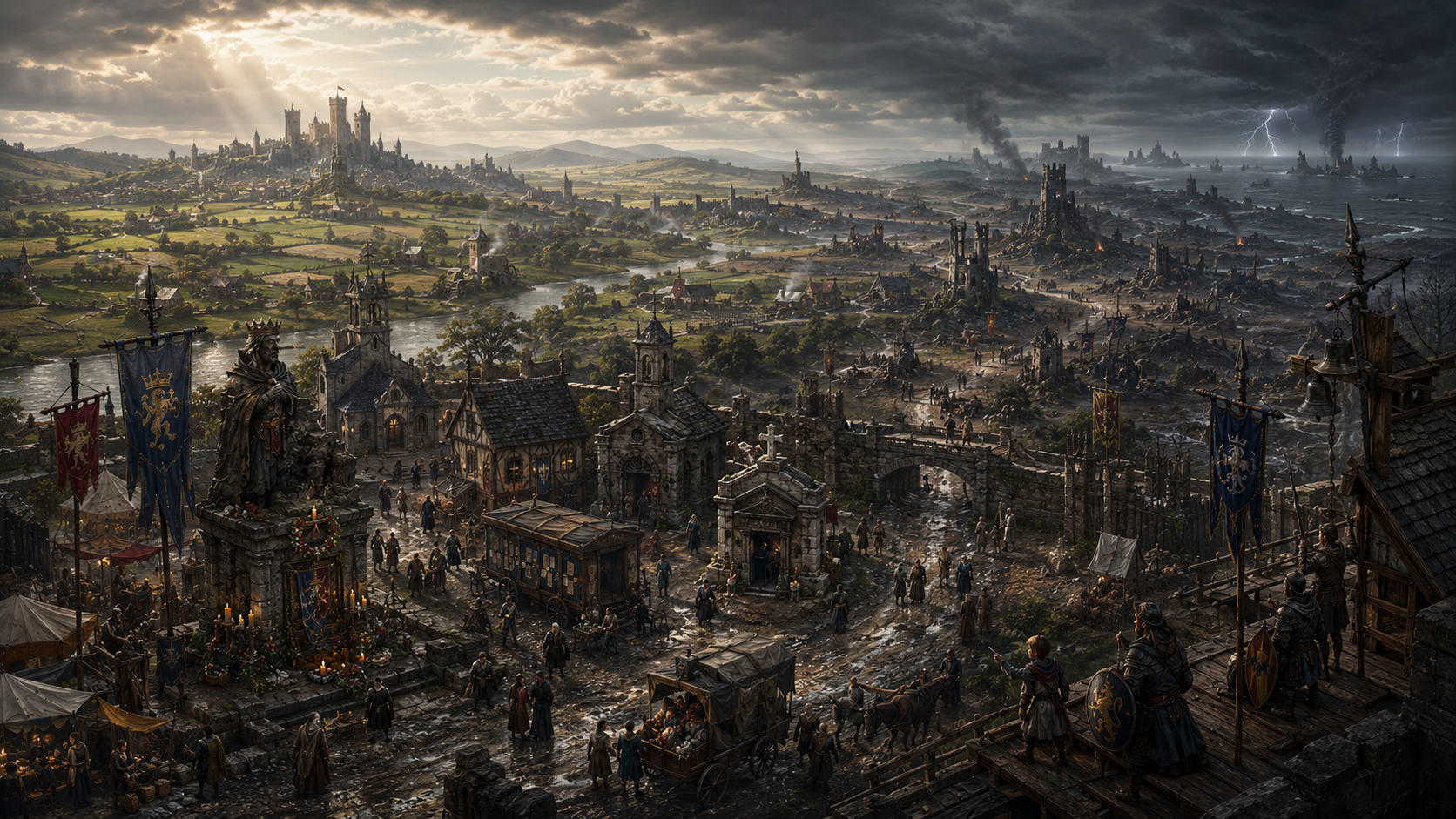
Caerlon
Caerlon is the central-western surviving continent of Thesalon.
It is the continent most associated with the beginning of the Crownless Age: the age that followed the invasion from Vorrak, the failure of many crowns, and the collapse of automatic trust in inherited authority.
Caerlon survived.
That matters.
Its fields still grow. Its rivers still carry barges. Its ports still trade. Its temples still ring bells. Its roads are being repaired. Its towns are being rebuilt. Its markets are reopening. Its children are learning songs that their grandparents thought would be lost.
But survival is not the same as trust.
The old crowns did not all fall, but they failed to protect enough people to be obeyed without question. Local councils, temple houses, freeholds, militias, river compacts, veteran leagues, archive offices, grain assemblies, and rebuilt towns now claim authority because they kept people alive when distant thrones could not.
Caerlon is not a wasteland.
It is a wounded, living continent deciding what kind of world should exist after the old one proved breakable.
Page Index
- Caerlon at a Glance
- What Players Should Know
- The Central Question of Caerlon
- First Impressions
- The Shape of Caerlon
- Major Regions
- Major Polities and Powers
- Cities, Towns, Forts, and Important Sites
- Life in Caerlon
- Law, Records, and Identity
- Resurrection and Inheritance
- Roads, Rivers, Ports, and Travel
- Faith and Temples in Caerlon
- Magic, Archives, and War Scars
- Peoples, Ancestries, and Languages
- Caerlonian Character Origins
- Public Factions
- Important Public NPCs
- Common Rumors and Misconceptions
- Adventure Hooks
- How to Play a Caerlonian Character
- Related Pages
Caerlon at a Glance
| Topic | Caerlon |
|---|---|
| World Role | The surviving continent most shaped by the beginning of the Crownless Age. |
| Core Identity | A wounded but living crownland rebuilding after invasion and institutional failure. |
| Defining Event | Vorrak invaded across the Dread Sea and Broken Chain, devastating eastern Caerlon. |
| Great Wound | The Scoured Marches, the eastern invasion-scarred region. |
| Political Mood | Reconstruction, suspicion, reform, local authority, surviving crowns, disputed legitimacy. |
| Common Conflicts | Land claims, lost records, military authority, resurrection disputes, refugee rights, road control, monster suspicion, inheritance law. |
| Best Known For | Failed crowns, rebuilt towns, archives, veteran patrols, ruined roads, river compacts, emergency bells, public arguments over who deserves trust. |
| Player Character Fit | Veterans, refugees, nobles, scouts, farmers, archivists, healers, smugglers, militia agents, monster-born citizens, heirs, record-priests, bridge wardens, reformers. |
What Players Should Know
Caerlon is the continent that survived the invasion from Vorrak.
A generation ago, monstrous powers from Vorrak crossed the Dread Sea by way of the Broken Chain, an island route between the two continents. The invasion struck eastern Caerlon and tore through the region now known as the Scoured Marches.
Caerlon rallied. Crowns, towns, temples, military orders, river powers, local councils, foreign allies, farmers, priests, mercenaries, sailors, and ordinary people fought to stop the invasion.
The world did not fall.
But Caerlon did not truly win.
The invasion was halted, but the cost broke the old political imagination. Cities burned. Records vanished. Roads collapsed. Marchlands emptied. Refugees carried dead town names westward. Temples became hospitals and grave houses. Noble heirs died, returned, disputed one another, or vanished entirely. Soldiers came home to find that the authority they served was no longer trusted by the people it failed to save.
Most people in Caerlon are not trying to live inside a tragedy every day.
They farm, trade, argue, repair, worship, marry, gamble, raise children, rebuild bridges, reopen schools, haul timber, move grain, hire guards, sue neighbors, repair mills, and complain about tolls.
But the war remains visible in daily life:
- New bridges stand beside blackened older spans.
- Alarm bells hang from town halls.
- Refugee camps have become permanent neighborhoods.
- Veterans watch eastern roads even during festivals.
- Archive notices are posted beside job boards.
- Monster warning signs still mark roads that merchants insist are safe.
- Temples keep lists of the dead, the missing, and the returned.
- Courts argue over whether old claims still matter when old protection failed.
The most important thing to know is this:
Caerlon survived, but it has not agreed on who deserves to lead it now.
The Central Question of Caerlon
Caerlon’s central question is:
What does it mean to rebuild a continent when the old powers survived, but no longer deserve automatic trust?
The old crowns are not gone.
Some still command soldiers. Some still own archives. Some still hold roads. Some still maintain courts, seals, charters, tax offices, noble houses, oath halls, and temple relationships.
But survival changed the meaning of authority.
A village that held its bridge when the crown’s army retreated may ask why it should obey a royal tax collector.
A temple that fed refugees for three winters may ask why a lord should reclaim land without answering for those abandoned on it.
A military commander in the Scoured Marches may ask why civilians should be allowed to resettle a road that scouts know is not safe.
A farmer may ask why anyone is arguing about crowns while the granaries are short.
An archivist may ask how anyone can inherit anything if the records are gone.
A resurrected heir may ask whether death broke an oath.
A monster-born veteran may ask how many towns must be saved before suspicion ends.
Caerlon is not defined by one answer.
It is defined by the argument.
Survival Is Not Legitimacy
Many Caerlonians respect practical authority.
A repaired bridge may matter more than an old title.
A fair grain office may matter more than a royal banner.
A local council that kept the town alive may be obeyed before a distant court.
That does not mean old institutions are useless. The Crownward Remnant still has maps, engineers, road offices, legal memory, military experience, and archive systems that no village can easily replace.
The conflict is not simply old versus new.
It is trust versus proof.
Reconstruction Is Political
In Caerlon, rebuilding is never only construction.
A bridge decides who controls a trade road.
A recovered ledger decides who owns a farm.
A reopened port decides which merchants gain power.
A repaired watchtower decides where patrols can reach.
A temple registry decides who is legally alive.
A grain depot decides which settlement survives winter.
Every practical question becomes political because every repair changes who can claim authority.
The War Ended Differently Depending on Where You Live
In western Caerlon, the invasion may feel like history.
In rebuilt towns, it may feel like a scar.
In the Scoured Marches, it may feel unfinished.
Along the Dread Sea, it may feel like a warning.
In archive cities, it may feel like a missing record.
In noble courts, it may feel like an inheritance crisis.
In refugee neighborhoods, it may feel like a promise nobody kept.
A common saying in Caerlon is:
“The war ended on paper before it ended on the road.”
First Impressions
A traveler entering Caerlon for the first time may be struck by how alive it is.
Outsiders who expected only ruins often find markets, farms, shrines, barges, schoolyards, roadside inns, craft shops, ferries, patrol posts, music halls, and rebuilt bridges. Caerlon is not silent. It is noisy with work.
But the rebuilding carries memory.
A town square may have bright stalls on one side and a wall of carved names on the other.
A mill may run on a river beside a ruined ford where no one fishes.
A tavern may serve good ale under a beam taken from a burned manor.
A schoolteacher may stop lessons when a patrol horn sounds, not because danger is near, but because children must still learn what each horn means.
A road shrine may contain old swords melted into bell metal.
A market clerk may ask for a traveler’s name, second name, place of origin, road token, witness mark, and reason for crossing.
A child may know which roads are safe before they know which noble technically owns the land.
Common first impressions include:
- Low stone walls rebuilt with mismatched masonry.
- Fresh timber palisades around older blackened foundations.
- Bell towers repaired before manor houses.
- War memorials placed beside wells, bridges, and granaries.
- Markets selling tools, nails, lamp oil, old books, scavenged hinges, militia cloaks, and road charms.
- Priests arguing with clerks over death records.
- Veterans with practical eyes and little patience for speeches.
- Refugee neighborhoods named after towns that no longer exist.
- Public notice boards crowded with tax claims, missing persons, road warnings, land petitions, and paid recovery work.
- Children playing games where one child is the alarm bell and another is the scout.
Caerlon often feels hopeful and exhausted at the same time.
The Shape of Caerlon
Caerlon is a broad central-western continent of plains, rivers, coasts, mountains, old crownlands, rebuilt roads, forested principalities, local assemblies, military marches, and invasion-scarred eastern territories.
Its geography matters because each region developed different answers to the same crisis.
The old administrative centers of the Crownward Heart preserve records, laws, ministries, and symbolic authority.
The Heart Plains feed people and claim legitimacy through survival.
The Scoured Marches mark the invasion wound and remain the most contested region of rebuilding.
The Highharbor Coast watches the Dread Sea and handles trade, quarantine, patrols, and maritime suspicion.
The Valenic River Corridor and Torin Riverlands move goods, people, tolls, law, refugees, and rumors through the interior.
Estenmark preserves military discipline and frontier vigilance.
The Verdant Expanse holds old houses, forest courts, inheritance disputes, and resurrection cases.
The Silveredge Mountains provide hard autonomy, passes, mining, signals, and mountain defense.
The Elderidge Oathlands preserve rural oath law, ancestor memory, and local witness traditions.
The Dread Sea Coast lives with eastern fear.
The Broken Chain Approaches remain a zone of quarantine, patrol, old invasion infrastructure, island ruins, and dangerous sea movement.
Caerlon’s regions are connected by roads, rivers, ports, ferries, local courts, temple registries, military patrols, and arguments over who gets to decide what counts as safe.
Major Regions
The regions below are player-facing geographic and cultural divisions. They are not clean administrative provinces. Some overlap politically. Some contain settlements claimed by more than one authority. Some are known more by road usage, local identity, or postwar function than by formal borders.
Each region includes notable settlements and sites by name. Deeper descriptions appear later in the Cities, Towns, Forts, and Important Sites section.
The Crownward Heart
The Crownward Heart is the old administrative and symbolic core of Caerlon.
It contains the surviving institutions of the Crownward Remnant: archives, ministries, oath halls, legal chambers, road offices, reconstruction bureaus, noble houses, temple registries, and ceremonial districts that once projected confidence across the continent.
That confidence is gone.
The Crownward Heart still matters because it can do things other regions cannot. It has old maps, trained clerks, engineers, surviving courts, diplomatic seals, treasury remnants, road crews, tax histories, noble genealogies, and archive methods that can hold together claims too complicated for local memory alone.
It is also distrusted because it represents the old order that failed.
Many Caerlonians visit the Crownward Heart because they need something from it: a road warrant, inheritance record, archive copy, resurrection identity ruling, military pay note, noble claim, refugee confirmation, bridge charter, or permission to recover property from a ruined district.
Few leave without forming an opinion.
What Defines the Crownward Heart
- Surviving crown authority
- Legal memory
- Archive recovery
- Reconstruction ministries
- Noble legitimacy disputes
- Road restoration
- Public petitions
- Reform movements
- Old ceremonial power
- Quiet resentment toward inherited rule
Common Sights
Travelers in the Crownward Heart may see:
- Clerks carrying sealed boxes through guarded streets.
- Public squares filled with petitioners.
- Noble houses hiring investigators to recover burned family records.
- Road engineers arguing with treasury officials.
- Archive priests washing ash from salvaged ledgers.
- Veterans waiting years for corrected pay papers.
- Public debates over whether old crowns deserve restoration.
- Lamps burning late in ministry offices.
- Stone lions with their crowns chiseled off by protesters.
- Newly carved plaques listing villages that no longer exist.
Settlements and Sites in the Crownward Heart
- Crownward Seat — the old capital and surviving administrative heart of the Crownward Remnant.
- Ashledger Hall — reconstruction ministry complex and headquarters of road, bridge, and record recovery bureaus.
- Oathmarket — public square where charters, decrees, witness notices, and accusations are posted.
- The Old Crown Archives — damaged but still powerful archive institution.
- Ashleaf Repository — Olyrran record-priest archive focused on lost records, disputed identity, and recovered documents.
- Road Glass Station at Mile 0 — symbolic origin point of restored Crownward roads.
- Crown Crypt of Hollow Oaths — old royal crypt, oath site, and political symbol.
- Saint Veyra’s Southward Hospital — major healing house serving veterans, refugees, resurrection cases, and the unrestored.
- Charterbell Square — public declaration square where bells announce rulings, pardons, tax changes, and emergency decrees.
- The Ministry Yards — warehouses, offices, stables, timber lots, and stone depots used for reconstruction.
- The Low Petition Steps — crowded steps outside the old civic court where common claims are heard.
- Three Seals Row — street of legal scriveners, notaries, oath-brokers, and counterfeit seal hunters.
- Broken Crown Gate — old ceremonial gate now used as a protest site, rally point, and public memory marker.
The Heart Plains
The Heart Plains are the broad agricultural center of Caerlon.
They are not as symbolically grand as the Crownward Heart, but their importance is practical and undeniable: Caerlon eats because the Heart Plains endured.
During the invasion and its aftermath, many towns in the Heart Plains fed refugees, housed the displaced, stored seed grain, hid livestock, and organized local defense when larger authorities were too slow or too broken to respond. This gave the region enormous moral authority.
The Heartplain Assembly grew from that practical legitimacy.
The people of the Heart Plains often distrust speeches about destiny, bloodline, or rightful rule. They tend to ask simpler questions:
Who brought grain?
Who repaired the mill?
Who guarded the road?
Who counted the children?
Who stayed?
What Defines the Heart Plains
- Grain politics
- Local assemblies
- Refugee feeding networks
- Agricultural legitimacy
- Public granaries
- Mill towns
- Practical self-government
- Suspicion of distant authority
- Strong village councils
- Harvest shrines
- Food convoys
Common Sights
Travelers in the Heart Plains may see:
- Granaries guarded like fortresses.
- Town bells mounted above mill houses.
- Field shrines made from plowshares and broken spearheads.
- Assembly notices nailed beside seed prices.
- Refugee families farming land they do not legally own.
- Market arguments over grain taxes and winter quotas.
- Local militias drilling after harvest.
- Children collecting scattered battlefield iron from old fields.
- Traveling judges hearing land disputes under canvas.
- Public meals held in honor of towns that fed strangers during the war.
Settlements and Sites in the Heart Plains
- Heartplain Assembly Halls — political center of the Heartplain Assembly and the region’s most important civic gathering place.
- Grainwake — major grain town and storage hub.
- Miller’s Concord — mill-town known for wartime refugee feeding and local food-law traditions.
- Westrow Barns — fortified granary settlement and winter reserve site.
- Hearthford — bridge-town and market crossing.
- The Heartplain Granary Vault — secure food reserve and political flashpoint.
- Fieldbell Green — rural alarm-bell settlement known for public muster traditions.
- Refuge Row — permanent town grown from refugee camps.
- Halven’s Table Shrine — harvest and shelter shrine tied to feeding obligations.
- The Three-Camp Market — market district formed from three merged displacement camps.
- Golden Ditch — irrigation settlement where canal rights are fiercely argued.
- Widowseed Commons — farmland granted by local custom to war widows and orphan households.
- Assembly Roadhouse Nine — major road inn and courier relay.
- The Bread Ledger House — public office tracking grain debts, relief allocations, and emergency stores.
The Scoured Marches
The Scoured Marches are the eastern invasion-scarred lands of Caerlon.
They are not empty.
They are not fully reclaimed.
They are not one uniform wasteland.
The Scoured Marches contain rebuilt towns, burned estates, survivor enclaves, abandoned roads, old battlefields, new palisades, hidden graves, ruined fortifications, monster-haunted pockets, disputed farms, scavenger routes, refugee returns, buried supplies, lost records, and military patrol lines.
The Marcher Concord controls the safer rebuilt western portions and sends scouts deeper east. It does not fully control every road to the coast.
This matters because maps often lie.
Some maps show old borders.
Some maps show military confidence.
Some maps show what merchants want to believe.
Some maps show what frightened settlers need to hear.
Few maps show what a scout saw last week.
What Defines the Scoured Marches
- Invasion scars
- Rebuilt towns
- Patrol roads
- Military emergency law
- Ruined estates
- False safety claims
- Monster suspicion
- Survivor enclaves
- Abandoned fortresses
- Refugee return disputes
- Burial fields
- Hidden records
- Dangerous eastern roads
Common Sights
Travelers in the Scoured Marches may see:
- Fresh palisades around blackened stone foundations.
- Watch bells on every town hall.
- Fields divided by warning stakes.
- Road shrines carved with many names at once.
- Children who know alarm signals by sound.
- Soldiers marking monster signs on old invasion stones.
- Settlers arguing with scouts over whether land is safe.
- Ruined manor walls reused as barn foundations.
- Burned roads repaired in straight lines because no one wants to leave the patrol route.
- Public boards listing missing persons, false claims, and road closures.
The Western Rebuilt Marches
The Western Rebuilt Marches are the safest and most settled part of the Scoured Marches.
They are still scarred, but towns here are functioning. Roads are patrolled. Forts communicate. Farmers are returning. Markets exist. Bells work. Scouts come and go. Local councils argue with the Marcher Concord because they are alive enough to argue.
This is where visitors most often see the contradiction of Caerlon: ruin beside renewal.
Settlements and Sites in the Western Rebuilt Marches
- New Bellweather — rebuilt town near the ruins of Bellweather Ford.
- Bellweather Ford Ruins — destroyed crossing, memorial ruin, and lingering symbol of wartime loss.
- Fort Harrowline — Marcher Concord fortification and patrol base.
- Harrowline Outer Redoubt — forward military ruin and scout post.
- Westwatch Palisade — rebuilt settlement and western Marcher checkpoint.
- Ashroad Camp — road-repair and escort station.
- Saintsbridge — bridge-town with evacuation shrines.
- Redpost Yard — patrol resupply post.
- Mournbell Orchard — orchard settlement planted over a former refugee camp.
- Concord Timber Lot — fortified lumber and palisade supply yard.
- The Returned Well — village well reopened after years under quarantine.
- Old Alarm Hill — signal hill where warning fires are still tested every month.
The Contested Middle Marches
The Contested Middle Marches are neither fully lost nor fully safe.
Settlers, scouts, salvage crews, patrols, priests, monster-hunters, smugglers, claimants, and desperate families all enter this zone for different reasons. Some roads are usable in one season and closed the next. Some ruins are quiet for years before something changes. Some villages are inhabited but refuse official census takers.
Here, the question is often not whether a place is dangerous.
The question is who benefits from declaring it safe.
Settlements and Sites in the Contested Middle Marches
- Mournleigh Crossing — haunted road crossing and witness-site.
- Blackbell Watch — alarm tower and patrol village.
- Tallowford — partially rebuilt river settlement.
- The Old Retreat Road — route marked by conflicting military orders.
- Greyfield Shrine Rows — battlefield grave-shrine fields.
- Concord Milehouse Seven — fortified road station.
- The Broken Manor Belt — ruined noble estates turned scavenger territory.
- Cinderbrook — stream village with repeated missing-person reports.
- The Witness Elm — tree used for survivor testimony and public oaths.
- Rookscar Yard — abandoned supply depot now used by patrols and scavengers.
- East Grain Cut — disputed farm belt marked safe on some maps and unsafe on others.
- The Lanternless Chapel — ruined roadside shrine where travelers still leave oil.
The Dangerous Coastward Marches
The Dangerous Coastward Marches are the least secure eastern depth of the region.
The Marcher Concord scouts them, but does not fully govern them. Some roads vanish into silence. Some invasion structures remain. Some coastal sites may contain old supply works, hidden prisoners, buried weapons, abandoned camps, or things that were never properly understood during the retreat.
Most ordinary travelers are warned away.
That warning is not always obeyed.
Settlements and Sites in the Dangerous Coastward Marches
- Salt Ash Landing — ruined coastal supply point.
- Vorrak Camp-Remnant Theta — public name for an abandoned invasion camp.
- The Coastward Silence — road zone where patrol reports become unreliable.
- Crowhook Watch — destroyed watch station.
- The Iron-Stake Fields — marked no-travel battlefield.
- Eastbell Hollow — settlement whose current status is uncertain.
- The Unreclaimed Road — route the Marcher Concord does not certify safe.
- Ash-Keel Flats — coastal flatland where old wreckage and burned timbers remain half-buried.
- Gallows Beacon — ruined signal tower overlooking the Dread Sea approaches.
- The Second Retreat Ditch — defensive trench line that does not appear on many public maps.
- Red Foam Cove — coastal inlet avoided by fishermen and patrol craft.
- Dead Cart Hollow — road depression filled with broken wagons from the retreat.
The Highharbor Coast
The Highharbor Coast is Caerlon’s major western and southwestern maritime region.
It is wealthy, wary, practical, and politically sharp. Ships arrive with grain, timber, refugees, soldiers, foreign envoys, merchant contracts, salvage claims, private letters, temple aid, and rumors from every sea connected to Caerlon.
The coast is shaped by two truths:
Trade keeps Caerlon alive.
The sea once carried invasion.
Because of that, the Highharbor Coast is never simply open or closed. It is inspected, negotiated, taxed, watched, blessed, patrolled, and argued over.
The Highharbor League controls much of the region’s maritime power, but port life includes dockworkers, shipwrights, customs clerks, fishers, foreign pilots, naval patrols, temple houses, Maritheli contractors, merchant families, smugglers, refugee brokers, and Dread Sea watchers.
What Defines the Highharbor Coast
- Maritime trade
- Dread Sea vigilance
- Customs law
- Refugee routes
- Foreign ships
- Coastal patrols
- Salvage claims
- Quarantine authority
- Port politics
- Ship repair
- Merchant credit
- Storm warnings
Common Sights
Travelers on the Highharbor Coast may see:
- Signal flags snapping above harbor towers.
- Customs clerks checking cargo twice and passengers three times.
- Sailors from Marithel arguing with Caerlonian inspectors.
- Refugee families waiting beside warehouse walls.
- Patrol ships leaving before dawn.
- Fish markets beside mortuary quays.
- Shipwrights repairing hulls marked by war.
- Harbor shrines full of names of the drowned.
- Public boards listing missing ships and forbidden routes.
- Taverns where half the arguments are about weather and the other half about politics.
Settlements and Sites on the Highharbor Coast
- Highharbor — major port city and league center.
- Saltwatch Quays — patrol, mortuary, and Dread Sea watch district.
- Farwake Piers — Maritheli-linked pilotage and contract docks.
- Salt Verdict Court — maritime legal court.
- Highharbor Watch Stations — coastal signal chain.
- Gullmarket — fish, ship supplies, gossip, and rumor trade.
- The Chainward Customs House — inspection office for Dread Sea traffic.
- Mourners’ Dock — place where war dead, wreck claims, and lost cargo are processed.
- Blue Signal Chapel — Thalara shrine tied to storm warnings and lost sailors.
- The Ropewalk Ward — working district of sailmakers, rope-makers, netters, and cargo laborers.
- West Lantern Point — lighthouse and pilot signal station.
- Drychain Yard — ship repair and quarantine drydock.
- Mariner’s Petition House — public legal office for sailors, widows, and cargo claimants.
- Harbor Bell Arsenal — guarded alarm-bell and signal equipment storehouse.
The Valenic River Corridor
The Valenic River Corridor follows the River Valen and its connected roads, locks, ferries, mills, and compact towns.
The region is politically important because river movement is power. Grain, timber, stone, refugees, soldiers, pilgrims, letters, court summons, archive crates, and contraband all move along the river.
The Valenic Compact is less concerned with crowns than with agreements that keep the river functioning. Who may cross? Who may tax? Who maintains locks? Who controls flood damage? Who guarantees barge safety? Who compensates a town when a bridge collapse cuts trade in half?
The Valenic River Corridor is often described as orderly by outsiders. Locals laugh at that.
It is orderly only because generations of argument have been written into toll law.
What Defines the Valenic River Corridor
- River trade
- Barge law
- Toll disputes
- Compact politics
- Flood claims
- Lockhouses
- Bridge charters
- Ferry rights
- River courts
- Towpath settlements
- Transport legitimacy
Common Sights
Travelers along the River Valen may see:
- Barges painted with compact seals.
- Lockkeepers recording every boat by hand.
- Toll boards updated more often than tavern menus.
- River judges hearing cases from temporary platforms.
- Children running tow ropes along muddy paths.
- Dwarven engineers arguing with local millers.
- Shrines to Selari beside ferry ramps.
- Flood marks carved into civic buildings.
- Smugglers pretending to be grain factors.
- Merchants accusing each other of false weight, false waterline, or false destination.
Settlements and Sites in the Valenic River Corridor
- Valenbridge — major bridge city and river compact center.
- Riverseal Court — water and toll court.
- Valenic Lockhouses — chain of locks, mills, and toll stations.
- Bargewright’s Reach — shipyard and riverboat construction town.
- Oxbow Petition Hall — public claims hall for river damages.
- The Twelve-Marker Towpath — old river road.
- Silver-Valen Ferry — important crossing toward the mountains.
- Lowbank — flood-prone settlement with strong local council power.
- The Silt Ledger Office — archive of river claims, debts, and flood boundaries.
- Caskbend — brewery and barge-stop town.
- Redwater Mill — disputed mill site and frequent legal flashpoint.
- Selari’s Crossing Shrine — pilgrim and merchant shrine.
- Towmaster’s Yard — labor hub for river-haulers, rope crews, and dockhands.
- The Mud Bell Office — warning office for floods, closures, and unsafe crossings.
The Torin Riverlands
The Torin Riverlands are a region of crossings, freeholds, local defense, bridge law, and practical independence.
The Torin Freeholds gained influence because they controlled movement and defended local communities when broader authority was unreliable. Their power is not based on one grand crown or one ancient capital. It is spread across bridges, fortified towns, ferries, road wards, local councils, asylum houses, toll agreements, and mutual defense obligations.
The Torin Riverlands are also known for complicated identity cases. Travelers, refugees, defectors, monster-born veterans, displaced families, and people carrying uncertain papers often pass through the region because crossings create both danger and opportunity.
A bridge is never just a bridge here.
It is a checkpoint, market, court, shelter, military asset, tax office, and test of trust.
What Defines the Torin Riverlands
- Freehold autonomy
- Bridge law
- Local defense
- River crossings
- Asylum disputes
- Monster-born rights
- Refugee movement
- Tollhouses
- Militia musters
- Practical local justice
- Fortified crossings
Common Sights
Travelers in the Torin Riverlands may see:
- Bridge wardens checking names against handwritten lists.
- Tollhouses fortified like miniature keeps.
- River traders carrying multiple seals from different authorities.
- Monster-born veterans working as guards, pilots, smiths, or scouts.
- Local councils meeting in bridge towers.
- Old chains across ford approaches.
- Asylum houses guarded by people who refuse to answer questions.
- Ferry disputes settled with public testimony.
- Militia yards beside market greens.
- Children learning which flags mean “pay,” “wait,” “danger,” or “run.”
Settlements and Sites in the Torin Riverlands
- Torinbridge — major river crossing and political node.
- Torin Bridgeholds — fortified bridge communities.
- Torin Broken Span — damaged bridge ruin and contested crossing.
- Torin Tollhouse Underwater Room — strange flooded legal/archive site.
- Bridgeward Green — settlement tied to bridge wardens.
- Freehold Hearth — council center of the Torin Freeholds.
- Three-Pier Landing — ferry and cargo settlement.
- Stonechain Ford — crossing with old defensive chains.
- The Lantern Asylum House — protected house for defectors, witnesses, and disputed persons.
- The Eastbank Muster Yard — militia gathering ground.
- Greybarrow Bridge — older stone bridge with burial markers built into its side walls.
- Rillhouse Market — riverside market for small traders and local farmers.
- The Watch Rope Inn — known meeting place for guides, wardens, and people traveling under assumed names.
- Old Chain Chapel — shrine to Aurelion, Selari, and Morvane used for oath, passage, and burial rites.
Estenmark
Estenmark is a disciplined region of watch towns, military roads, river-march defenses, fortified farms, and old eastern vigilance.
It is not as devastated as the Scoured Marches, but it is shaped by proximity to danger and by a long tradition of defense readiness. Estenmark communities tend to be organized, suspicious of disorder, and proud of practical service.
The region’s people often describe themselves as the ones who stand before the alarm reaches softer lands.
That pride can become courage.
It can also become rigidity.
Estenmark’s leaders tend to value readiness, chain of command, clear roads, militia training, and reliable muster obligations. Reformers complain that Estenmark sees every civic question as a security question. Estenmark loyalists answer that people who survived because of discipline should not apologize for it.
What Defines Estenmark
- Border discipline
- Watch towns
- Military settlements
- Muster courts
- Fortified mills
- Road markers
- Militia obligations
- Defensive agriculture
- Veteran communities
- Suspicion of complacency
Common Sights
Travelers in Estenmark may see:
- Roadside spear racks maintained by local law.
- Children drilling with wooden shields during festivals.
- Farms built around signal poles.
- Watch captains inspecting bridge repairs.
- Veterans serving as civic witnesses.
- Market bells that double as alarm bells.
- Public maps marking patrol response times.
- Inns with posted evacuation rules.
- Shrines to Kharos and Aurelion near muster grounds.
- Old war banners repaired rather than retired.
Settlements and Sites in Estenmark
- Estenhall — regional seat of Estenmark authority.
- Estenwatch — fortified watch-town.
- North Esten Ford — military crossing.
- The Esten Mileposts — old road-marker defensive chain.
- Fallowshield — farming settlement with militia obligation.
- Rookenfield — veteran settlement.
- The Esten Muster Court — military and legal assembly.
- Red Mill Bastion — mill-fortification and local defense site.
- The Split Spear Grounds — training field and memorial.
- Watchgrain Depot — fortified food and equipment reserve.
- Kharos’ Gate Chapel — war and defense shrine.
- South Rook Barracks — rotating militia barracks.
- Ironhorn Green — public alarm field and gathering place.
- The Clear Road Office — bureau responsible for keeping military roads usable.
The Verdant Expanse
The Verdant Expanse is a region of forests, old estates, green courts, noble houses, inheritance law, resurrection disputes, woodland towns, and quiet rivalries.
It is beautiful, wealthy in places, and deeply uneasy.
The Verdant Principalities preserve some of Caerlon’s oldest noble traditions, but the war damaged those traditions in ways that cannot be repaired by ceremony alone. Entire family lines died out. Some heirs returned through resurrection. Some claimants appeared with incomplete records. Some estates were abandoned, occupied, or protected by locals who now refuse to leave. Some noble houses insist old law must continue. Others privately know that old law no longer answers the questions before them.
The Verdant Expanse is not only courtly intrigue. It contains hunters, farmers, orchard towns, shrine keepers, woodcutters, herbalists, charcoal burners, foresters, river hamlets, and common people tired of being treated like scenery in noble disputes.
What Defines the Verdant Expanse
- Forested principalities
- Inheritance disputes
- Resurrection law
- Old noble houses
- Green courts
- Estate claims
- Ancestor shrines
- Woodland settlements
- Legal memory
- Quiet political rivalries
Common Sights
Travelers in the Verdant Expanse may see:
- Manor gates repaired while tenant cottages remain damaged.
- Public inheritance notices nailed to old trees.
- Forest roads marked by family crests, local warnings, and shrine ribbons.
- Funerary houses asked to decide whether a returned heir is truly the same person.
- Garden courts where legal disputes are heard beneath living branches.
- Villagers who know more about estate history than the lords claiming it.
- Noble retainers searching ruins for marriage contracts.
- Priests carrying sealed death records.
- Greenhouses filled with medicinal plants for war injuries.
- Children daring one another to knock on abandoned manor doors.
Settlements and Sites in the Verdant Expanse
- Verdant Court of Returning Heirs — major court for inheritance and resurrection disputes.
- Verdant Court of Withered Branches — older court or rival legal site.
- Greenwarden Hall — noble-princely assembly site.
- Witherbranch Manor — disputed estate.
- Larkgrove — woodland town.
- Deep Orchard — agricultural estate-town.
- The Hall of Unproven Names — major identity and claimant institution.
- Morvane’s Quiet House — funerary and resurrection-review temple.
- The Heirwood Roads — forest roads connecting noble estates.
- Glassleaf Shrine — memory and ancestor shrine.
- Old Briar Court — abandoned legal garden now used for secret meetings.
- Veyra’s Green Infirmary — healing house for long war wounds and restoration cases.
- Crownhart Lodge — former hunting lodge turned negotiation site.
- The Root-Seal Registry — archive of land, marriage, and estate claims.
The Silveredge Mountains
The Silveredge Mountains form one of Caerlon’s major mountain regions.
The people of the Silveredge Holds are known for hard local autonomy, mining, fortified passes, signal towers, stonework, mountain roads, and a practical suspicion of lowland politics.
During the invasion and its aftermath, the Silveredge Holds provided metal, stone, skilled labor, scouts, engineers, and mountain refuge. They also watched lowland authorities fail to coordinate quickly enough. This made the holds less willing to accept orders from below.
Silveredge communities tend to respect craft, endurance, clear obligation, and debt paid in visible work. A promise made at a mountain gate is expected to survive weather, politics, and inconvenience.
What Defines the Silveredge Mountains
- Mountain holds
- Fortified passes
- Mining
- Signal towers
- Stonework
- Road engineering
- Hard local autonomy
- Dwarven influence
- Mountain shrines
- Watch ridges
- Reconstruction materials
Common Sights
Travelers in the Silveredge Mountains may see:
- Signal fires mirrored from tower to tower.
- Mountain goats wearing small bells.
- Stone roads carved into cliff faces.
- Minehold gates marked with old family and guild signs.
- Shrines built into pass walls.
- Engineers inspecting lowland road stone with open contempt.
- Pack trains carrying iron, silver, slate, glass, and quarried blocks.
- Children learning knot signals and rockfall warnings.
- Public debt boards listing who owes labor, coin, or rescue duty.
- Hold guards asking travelers who will come looking if they vanish.
Settlements and Sites in the Silveredge Mountains
- Silveredge Holds — collective mountain hold region.
- Silveredge Gatehold — fortified pass settlement.
- Silveredge Signal Holds — signal-tower chain.
- Ironroot Minehold — mining and smithing settlement.
- Stonewake Pass — strategic mountain road.
- Dwarfglass Foundry — craft and reconstruction supply site.
- High Anvil Court — mountain arbitration hall.
- Kitewatch Ridge — signal and scout post.
- The Snowmelt Cisterns — protected mountain water site.
- Edrun’s Shoulder Shrine — mountain endurance shrine.
- Slatebell Yard — quarry town known for bell-stone and road markers.
- The Upper Chain Lift — winch road and cargo lift through a dangerous pass.
- Stormstep Refuge — emergency mountain shelter maintained by hold law.
- The Silver Ledger House — debt and contract office for mining, trade, and rescue claims.
The Elderidge Oathlands
The Elderidge Oathlands are a region of rural law, old memory, ancestor witness, boundary stones, oath fields, and settlements that value spoken obligation as much as written record.
Outsiders sometimes mistake the Oathlands for backward country.
They are wrong.
The Elderidge Oathlands preserve legal and social systems that survived because people remembered what they owed each other when documents burned elsewhere. An oath sworn before the right witnesses may carry more local weight than a charter issued by a distant court. A boundary stone may be treated as testimony. A barn may be a court. A family song may preserve land history more accurately than a damaged noble ledger.
This makes the Oathlands both valuable and difficult.
Crownward clerks want documents.
Elderidge elders ask who witnessed the promise.
What Defines the Elderidge Oathlands
- Old oaths
- Rural law
- Local witnesses
- Ancestor memory
- Boundary disputes
- Oral testimony
- Sacred stones
- Hearth courts
- Community obligation
- Skepticism of distant records
Common Sights
Travelers in the Elderidge Oathlands may see:
- Boundary stones wrapped in seasonal cloth.
- Court hearings held in barns, fields, or under old trees.
- Children reciting family obligations.
- Elders correcting written maps from memory.
- Shrine bells rung before testimony.
- Roads marked by names of rescuers, not distances.
- Families refusing to sell land because an ancestor promised shelter there.
- Oath witnesses treated with more respect than minor nobles.
- Public feasts held after disputes are settled.
- Travelers asked not only who they are, but who would speak for them.
Settlements and Sites in the Elderidge Oathlands
- Elderidge Hall — oathland assembly site.
- Old Oathstone Field — sacred public oath site.
- Bellroot Village — rural oathkeeping settlement.
- Ancestor’s Mile — road lined with memory markers.
- The Witness Barns — legal testimony houses.
- Grey Elder Shrine — Olyrra and ancestor shrine.
- Hearthlaw Green — local court common.
- Seven-Oath Ford — crossing where treaties are sworn.
- The Quiet Boundary Stones — disputed border markers.
- Redthread Hamlet — village known for oath cords and witness knots.
- Morvane’s Last Bench — funerary testimony site.
- The Old Rescue Road — route maintained because of an ancestral promise.
- Crowcall Field — mustering field for community defense.
- The Memory Kiln — place where oath tablets and witness tokens are fired.
The Dread Sea Coast
The Dread Sea Coast is Caerlon’s anxious eastern maritime edge.
It faces the waters between Caerlon and Vorrak. Even where the land is not part of the Scoured Marches, the coast is shaped by fear, warning, quarantine, patrols, smuggling, wreckage, and memory.
The Dread Sea is not empty water. It carries trade, spies, storms, wreckage, rumors, refugees, patrols, illegal salvage, and the possibility of another crossing.
Coastal communities are often practical and grim. They know the difference between a fishing boat, a merchant hull, a patrol cutter, a smuggler’s sail, and a ship that should not be there.
What Defines the Dread Sea Coast
- Fear of the east
- Coastal patrols
- Quarantine
- Smuggling
- Invasion memory
- Sea-warning culture
- Ship inspection
- Wreck recovery
- Beacon towers
- Drowned dead rites
- Refugee landings
Common Sights
Travelers on the Dread Sea Coast may see:
- Beacon towers painted with warning colors.
- Fishermen watching the horizon more than their nets.
- Quarantine piers outside town walls.
- Driftwood sorted for ship marks.
- Patrol bells rung before dawn.
- Children taught to identify sail shapes.
- Thalara shrines beside Morvane markers.
- Smugglers pretending to be wreck salvagers.
- Old invasion debris used as fence posts.
- Coastal taverns where strangers are noticed immediately.
Settlements and Sites on the Dread Sea Coast
- Chainwatch Harbor — coastal watch harbor.
- Saltwatch Mortuary Quay — war-dead and wreck-processing site.
- Black Gull Point — lighthouse and warning station.
- The Dread Sea Patrol House — naval watch headquarters.
- Greywake Village — fishing town with invasion trauma.
- The Unlit Beacon — abandoned warning tower.
- Eastwind Quarantine Pier — ship inspection and isolation site.
- The Driftbone Shore — beach where wreckage and bodies wash ashore.
- Thalara’s Blackwater Chapel — sea and storm shrine.
- Low Lantern Fishery — fishing settlement known for suspicious night lights.
- The Chainward Rope Station — coastal signal and rescue post.
- Morvane’s Tideyard — sea-burial and recovered-dead temple yard.
- Black Foam Watch — small fortified lookout.
- The Salt Name Office — registry for drowned, missing, and unidentified arrivals.
The Broken Chain Approaches
The Broken Chain Approaches are the island, reef, anchorage, quarantine, and sea-route zone between Caerlon and the direction of Vorrak.
The Broken Chain is infamous because it was used as part of the invasion route into Caerlon. That history makes every island, ruin, anchorage, and crossing point politically sensitive.
The region is watched by coastal patrols, Highharbor officials, Dread Sea captains, quarantine officers, Maritheli pilots, smugglers, scavengers, temple envoys, and people searching for evidence of what happened during the invasion.
Some islands are guarded.
Some are abandoned.
Some are officially empty.
That does not always mean the same thing.
What Defines the Broken Chain Approaches
- Island routes
- Quarantine islets
- Invasion memory
- Maritime patrols
- Hidden infrastructure
- Smuggling
- Dangerous reefs
- Old camps
- Restricted anchorages
- Signal stations
- Unreliable charts
Common Sights
Travelers near the Broken Chain Approaches may see:
- Patrol cutters circling quarantine buoys.
- Island signal fires tested at dusk.
- Ship captains arguing over whether a chart is current.
- Burned piers on otherwise quiet rocks.
- Warning bells mounted on lighthouse platforms.
- Temple boats carrying names of the drowned.
- Smugglers avoiding both Caerlonian patrols and older dangers.
- Maritheli pilots refusing certain channels without explanation.
- Quarantine flags on islands where no one admits a settlement exists.
- Sea birds nesting on broken invasion works.
Settlements and Sites in the Broken Chain Approaches
- Broken Chain Quarantine Islets — controlled approach islands.
- Quarantine Islet of Unlit Fires — abandoned or restricted island.
- Chainward Anchorage — guarded fleet anchorage.
- Old Camp Ash — ruined invasion-era island camp.
- Marrowchain Rock — dangerous navigation marker.
- Lantern Reef Station — lighthouse and signal outpost.
- The Sundered Mooring Stones — broken harbor works.
- Pilot’s Warning House — Maritheli and Caerlonian chart station.
- The Chain Graves — memorial island cemetery.
- Ashchain Sound — narrow channel with difficult currents.
- Black Buoy Line — quarantine boundary.
- The Lower Signal Raft — floating watch and message platform.
- Glasswater Shoal — shallow reef with wreckage visible beneath clear water.
- The Sealed Camp Storehouse — restricted ruin said to contain wartime supplies, records, or hazards.
Major Polities and Powers
Caerlon is not one kingdom.
It contains old crowns, freeholds, assemblies, river compacts, coastal leagues, mountain holds, forest principalities, oathlands, marcher authorities, and local settlements that recognize different kinds of legitimacy.
Some powers claim authority through law.
Some through inheritance.
Some through survival.
Some through defense.
Some through roads, rivers, grain, archives, ports, bridges, oaths, or temples.
The invasion did not erase Caerlon’s political order. It damaged the trust that made that order easy to obey.
The powers below are the major public polities and political structures most Caerlonians would recognize.
The Crownward Remnant
Type: Surviving old crown authority
Primary Region: The Crownward Heart
Public Identity: Continuity, archives, roads, old law, reconstruction
Common Reputation: Powerful, useful, proud, wounded, distrusted
The Crownward Remnant was once the strongest and most visible Caerlonian authority. Before the invasion, many expected it to coordinate the continent’s defense, preserve order, and speak for the old crownlands.
It failed to do enough.
That failure did not destroy it. The Remnant still has ministries, archives, surviving noble lines, road offices, engineers, clerks, treasuries, military remnants, temple relationships, and legal records that other powers still need.
Its reformers argue that the Remnant can earn legitimacy by serving the continent instead of demanding obedience from it.
Its hardliners argue that Caerlon’s disunity proves the old crown must be restored before the next disaster.
Its critics answer that the old crown already had its chance.
What the Crownward Remnant Controls
- Crownward ministries
- Archive houses
- Road charters
- Reconstruction warrants
- Noble genealogies
- Crown courts
- Engineering crews
- Some old military supply lines
- Legal claims to abandoned estates
- Diplomatic seals recognized by foreign powers
Why People Respect It
The Crownward Remnant can still organize large projects.
It can issue documents other regions recognize, preserve old legal memory, pay trained engineers, recover records, maintain roads, and negotiate with foreign governments. Even people who distrust the Remnant may need its paperwork.
Why People Distrust It
Many blame the Remnant for arrogance, delay, suppressed warnings, failed coordination, abandoned towns, or protecting symbols of power over living communities.
Even where the accusations are unfair, the association remains.
The Remnant is the face of the old order.
Character Connections
A player character tied to the Crownward Remnant might be:
- A reformist clerk trying to repair trust.
- A road officer carrying reconstruction warrants.
- A noble retainer whose house lost legitimacy.
- An archive hunter recovering burned records.
- A soldier who served a crown but now doubts it.
- A ministerial courier carrying documents people may kill for.
- A legal witness who knows a claim the Remnant wants hidden.
- A loyalist who believes restoration is the only way to survive another invasion.
The Heartplain Assembly
Type: Agricultural assembly and local-authority bloc
Primary Region: The Heart Plains
Public Identity: Food, survival, local legitimacy, practical governance
Common Reputation: Plain-spoken, stubborn, necessary, populist, difficult to control
The Heartplain Assembly grew from the towns, farms, mills, granaries, refugee kitchens, and local councils that kept people alive during and after the invasion.
Its authority is simple to understand:
When people were hungry, the Heart Plains fed them.
That gives the Assembly moral force. It speaks for mill towns, grain depots, farm councils, refugee districts, local militias, and communities that believe survival should matter more than inherited title.
The Assembly is not a single peaceful democratic ideal. It contains reformers, radicals, farmers, merchants, grain officers, local bosses, refugee advocates, militia captains, temple food networks, and political opportunists.
It is powerful because food is power.
What the Heartplain Assembly Controls
- Grain storage networks
- Local food policy
- Farm councils
- Mill-town alliances
- Refugee allocation records
- Public granary guards
- Assembly roads
- Relief kitchens
- Seasonal labor agreements
- Agricultural militia musters
Why People Respect It
The Assembly kept people alive when other powers failed.
It is close to ordinary life. Its arguments are public. Its leaders can be shouted at in market squares. Its authority comes from work people remember.
Why People Distrust It
Critics say the Assembly confuses hunger with law.
Some Assembly factions are willing to seize land, block tax collection, hide grain, or burn old records to prevent crown restoration. Others may use public anger to build their own power.
Character Connections
A player character tied to the Heartplain Assembly might be:
- A grain guard.
- A farmer’s child turned militia scout.
- A refugee quartermaster.
- A mill-town advocate.
- A local assembly courier.
- A food convoy escort.
- A radical pamphleteer.
- A practical negotiator sent to settle grain disputes.
- A former refugee who owes everything to an Assembly town.
The Marcher Concord
Type: Military concord and reconstruction-defense authority
Primary Region: The Scoured Marches
Public Identity: Patrols, forts, safety, vigilance, reclaimed roads
Common Reputation: Brave, necessary, severe, secretive, increasingly hard to question
The Marcher Concord is the major military and civic defense structure of the Scoured Marches.
It controls the safer rebuilt western portions of the Marches, maintains patrol roads, guards settlements, certifies routes, monitors old invasion sites, and sends scouts deeper east.
The Concord is respected because danger is real. Many towns exist because Marcher patrols held roads long enough for settlers to return.
The Concord is feared because emergency power can become habit.
A commander who can close roads for safety can also close them to hide mistakes.
A patrol that controls who returns home can decide which homes exist again.
A military map can save lives or lie with official ink.
What the Marcher Concord Controls
- Fortified road stations
- Scout routes
- Marcher patrols
- Safety certifications
- Alarm bell networks
- Rebuilt western Marches
- Military escort contracts
- Abandoned fortress investigations
- Monster-warning records
- Emergency evacuation authority
Why People Respect It
The Concord has real enemies to watch.
It guards dangerous roads, trains local defense, recovers lost people, warns settlers, fights monsters, and keeps the western Marches from collapsing back into fear.
Why People Distrust It
Critics accuse the Concord of hiding danger, exaggerating danger, falsifying reports, militarizing civilian life, suppressing retreat records, or declaring roads safe before they truly are.
Both accusations can be true in different places.
Character Connections
A player character tied to the Marcher Concord might be:
- A scout.
- A fort runner.
- A veteran.
- A bellkeeper.
- A monster tracker.
- A settlement guard.
- A military cartographer.
- A whistleblower.
- A deserter who refused a false order.
- A survivor whose town was marked safe too soon.
The Highharbor League
Type: Coastal league and maritime trade authority
Primary Region: The Highharbor Coast
Public Identity: Ports, trade, patrols, customs, Dread Sea vigilance
Common Reputation: Wealthy, practical, suspicious, indispensable
The Highharbor League is Caerlon’s strongest coastal and maritime power.
It governs through harbor councils, merchant houses, customs offices, patrol captains, dock law, quarantine rules, lighthouse contracts, and naval agreements. It is not one crown, but a league of port authorities and coastal interests that understand the value of ships, cargo, timing, and information.
Highharbor’s importance rose after the invasion because sea routes now carry everything: aid, grain, refugees, soldiers, foreign envoys, contraband, warnings, and lies.
The League believes Caerlon cannot rebuild if its ports are weak.
Its critics believe the League has learned to profit from every crisis.
What the Highharbor League Controls
- Major docks
- Customs houses
- Port courts
- Coastal patrol contracts
- Quarantine piers
- Shipping permits
- League warehouses
- Maritime credit
- Lighthouse maintenance agreements
- Dread Sea inspection procedures
Why People Respect It
The League keeps ships moving.
It brings in goods, monitors the coast, supports naval patrols, repairs vessels, processes wreck claims, and connects Caerlon to Marithel, Suthrane, and other trade partners.
Why People Distrust It
The League is very good at turning danger into fees.
Merchants, refugee families, sailors, and minor ports often accuse it of using security, quarantine, and customs law to enrich itself or control rivals.
Character Connections
A player character tied to the Highharbor League might be:
- A customs clerk.
- A sailor.
- A dockworker.
- A patrol captain’s aide.
- A refugee broker.
- A shipwright.
- A smuggler.
- A maritime advocate.
- A quarantine inspector.
- A Maritheli pilot under Caerlonian contract.
The Valenic Compact
Type: River compact and transport-law polity
Primary Region: The Valenic River Corridor
Public Identity: River law, toll agreements, bridge charters, barge movement
Common Reputation: Lawful, tedious, reliable, argumentative, hard to bypass
The Valenic Compact is built around the River Valen and the systems that keep river movement possible.
It is less dramatic than crowns or forts, but no less important. Whoever controls river transport controls grain, timber, stone, letters, refugees, troops, and trade.
The Compact is famous for toll law, lockhouse agreements, flood claims, ferry rights, bridge charters, and long public arguments that end with extremely specific rules.
To outsiders, Valenic law can seem absurdly detailed.
To river folk, that detail prevents war.
What the Valenic Compact Controls
- River tolls
- Lockhouses
- Ferry permissions
- Bridge maintenance agreements
- Flood boundary records
- Towpaths
- Barge charters
- River court rulings
- Cargo inspection rules
- Damage compensation procedures
Why People Respect It
The Compact keeps the river moving.
It gives merchants, farmers, ferrymen, and towns a way to settle disputes without turning every bridge and lock into a battlefield.
Why People Distrust It
The Compact can be slow, expensive, and obsessed with precedent.
A desperate town may not want to wait for a river ruling while its grain rots on the wrong side of a closed lock.
Character Connections
A player character tied to the Valenic Compact might be:
- A barge pilot.
- A river clerk.
- A ferry guard.
- A lockhouse apprentice.
- A toll negotiator.
- A flood witness.
- A smuggler moving goods around legal chokepoints.
- A compact advocate hired to settle river disputes.
- A courier carrying a ruling that changes who controls a bridge.
The Torin Freeholds
Type: Freehold alliance and fortified crossing network
Primary Region: The Torin Riverlands
Public Identity: Local defense, bridge law, asylum disputes, freehold autonomy
Common Reputation: Independent, practical, stubborn, protective, politically inconvenient
The Torin Freeholds are a network of fortified communities, bridgeholds, river towns, ferry settlements, local councils, and mutual-defense obligations.
They gained influence because they controlled crossings and protected people moving through dangerous territory. Their authority is practical and place-based. A freehold may not rule far, but it may decide who crosses a bridge everyone needs.
The Torin Freeholds are known for hard local justice, asylum cases, bridge wardens, monster-born rights disputes, toll conflicts, and refusal to obey distant orders that do not account for local danger.
What the Torin Freeholds Control
- Bridgeholds
- Fortified ferries
- Local musters
- Asylum houses
- Freehold courts
- Crossing tolls
- River watch posts
- Defector and witness protection sites
- Local road guards
- Mutual defense agreements
Why People Respect Them
The Freeholds are reliable in a crisis.
They defend crossings, shelter the pursued, maintain local roads, and often care more about who is actually present than who claims distant authority.
Why People Distrust Them
They can shelter criminals as easily as witnesses.
They can defy lawful warrants. They can block movement. They can turn local custom into an excuse for refusing accountability.
Character Connections
A player character tied to the Torin Freeholds might be:
- A bridge warden.
- A ferry guard.
- A local militia scout.
- A freehold advocate.
- A protected witness.
- A monster-born veteran.
- A tollhouse clerk.
- A river smuggler.
- A defector being hidden under freehold law.
- A negotiator trying to keep bridge disputes from becoming open conflict.
Estenmark
Type: Military-settlement region and defensive polity
Primary Region: Estenmark
Public Identity: Watch towns, fortified farms, muster law, disciplined roads
Common Reputation: Reliable, severe, vigilant, controlling
Estenmark is a defensive region built around readiness.
Its towns maintain musters, watch roads, fortified mills, military crossings, alarm systems, and civic habits shaped by the expectation that danger may return. Estenmark people often consider themselves practical realists. They are not waiting for another invasion; they are preparing in case one comes.
The region’s authority rests on discipline, training, and the belief that safety requires people to accept obligations before danger arrives.
What Estenmark Controls
- Muster courts
- Watch towns
- Military roads
- Fortified mills
- Local training grounds
- Road clearance offices
- Defensive food depots
- Alarm posts
- Veteran settlements
- Eastern approach monitoring
Why People Respect It
Estenmark is prepared.
Its roads are usually clear, its militias trained, its watch posts staffed, and its settlements organized.
Why People Distrust It
Estenmark can treat every disagreement as a security issue.
Critics say it confuses order with obedience and fear with wisdom.
Character Connections
A player character tied to Estenmark might be:
- A watch officer.
- A militia trainer.
- A fortified farm child.
- A veteran settler.
- A road-clearance clerk.
- A defensive engineer.
- A Kharos shrine guard.
- A reformer trying to soften military rule.
- A scout who knows the cost of ignoring danger.
The Verdant Principalities
Type: Forested noble principalities and inheritance-law region
Primary Region: The Verdant Expanse
Public Identity: Old houses, green courts, estate law, resurrection disputes
Common Reputation: Elegant, tangled, proud, beautiful, legally dangerous
The Verdant Principalities are among Caerlon’s oldest and most politically intricate regions.
Their forests, estates, manor towns, green courts, ancestor shrines, and noble houses preserve traditions older than the Crownless Age. But the war damaged their inheritance systems deeply. Death, missing records, refugee occupation, battlefield marriages, resurrection, disputed heirs, and abandoned estates have made noble law unstable.
The Principalities remain beautiful and influential, but much of that beauty now hides legal tension.
What the Verdant Principalities Control
- Forest estates
- Noble courts
- Inheritance hearings
- Estate records
- Resurrection claimant review
- Manor roads
- Ancestor shrines
- Woodland resources
- Green court diplomacy
- Noble retainers and household guards
Why People Respect Them
The Principalities preserve long memory, art, healing gardens, cultivated forests, old legal traditions, and powerful noble patronage.
Why People Distrust Them
Critics say the Principalities care more about who inherits a manor than who repaired the tenant roofs.
Their courts can bury obvious justice under beautiful language and old precedent.
Character Connections
A player character tied to the Verdant Principalities might be:
- A disputed heir.
- A noble retainer.
- A forester.
- A resurrection claimant.
- A funerary advocate.
- A court witness.
- A tenant farmer.
- A legal scribe.
- A gardener-scholar.
- A person whose family record was lost, altered, or weaponized.
The Silveredge Holds
Type: Mountain hold network
Primary Region: The Silveredge Mountains
Public Identity: Mining, passes, signal towers, stonework, mountain autonomy
Common Reputation: Hard, reliable, proud, difficult to command
The Silveredge Holds are a network of mountain settlements, mineholds, pass forts, signal towers, foundries, quarry towns, and high courts.
They supplied materials, engineering skill, refuge, and mountain routes during Caerlon’s crisis. They also learned that lowland authorities often failed to understand mountain reality.
The Holds respect obligation, craft, rescue debt, clear contracts, and visible work. They are not isolationist, but they do not appreciate being ordered by people who cannot survive their roads.
What the Silveredge Holds Control
- Mountain passes
- Mineholds
- Signal towers
- Foundries
- Stone quarries
- High-road shelters
- Rescue obligations
- Mountain courts
- Metal and stone supply
- Engineering contracts
Why People Respect Them
The Holds build things that last.
They produce materials Caerlon needs and maintain roads through places where weather can kill faster than enemies.
Why People Distrust Them
The Holds can be inflexible, suspicious, and slow to accept lowland urgency.
They may honor a contract exactly as written, even when circumstances change.
Character Connections
A player character tied to the Silveredge Holds might be:
- A miner.
- A signal keeper.
- A mountain scout.
- A pass guard.
- A smith.
- A quarry worker.
- An engineer.
- A rescue guide.
- A debt witness.
- A hold envoy sent to negotiate with lowland powers.
The Elderidge Oathlands
Type: Oathland assembly and rural witness-law region
Primary Region: The Elderidge Oathlands
Public Identity: Oaths, ancestors, boundary stones, oral testimony, local law
Common Reputation: Old-fashioned, trustworthy, stubborn, memory-bound
Valenbridge
Region: The Valenic River Corridor
Primary Identity: River bridge city, compact court seat, toll-law hub
Known For: River tolls, bridge charters, lockhouse disputes, barge traffic, public river law
Valenbridge is the busiest legal and commercial crossing on the River Valen.
It is a city of stone bridge arches, barge bells, toll chains, flooded cellars, legal offices, river shrines, warehouses, ferry ramps, and argument. Almost everything in Valenbridge depends on movement: cargo moving downstream, grain moving upstream, workers crossing by bridge, pilgrims waiting for ferries, legal notices moving between towns, and money moving faster than anyone admits.
The city is governed through a dense web of compact law. Its people are proud of that complexity. Outsiders often complain that Valenbridge can turn a simple crossing into an afternoon of signatures, seals, and witness marks.
Valenbridge locals answer that bridges collapse when people ignore details.
Districts of Valenbridge
High Span
High Span is the district built around the main stone bridge.
It includes tollhouses, guard platforms, bridge shrines, inspection booths, charter offices, and old defensive alcoves from earlier centuries.
Every cart that crosses leaves a record.
Some records are honest.
The Lockhouse Steps
The Lockhouse Steps descend toward the river-control works, water gates, mill channels, and barge locks.
This is where lockkeepers, millers, barge crews, engineers, and water clerks argue over timing, flow, damage, and fees.
Silt Ledger Ward
Silt Ledger Ward holds the offices that preserve flood records, boundary claims, cargo disputes, river debts, toll histories, and compact rulings.
The ward is full of scriveners, advocates, paper carriers, seal cutters, and people trying to prove that a river did or did not move.
Bargewright’s Bank
Bargewright’s Bank is a working district of boatyards, rope sheds, timber stacks, tar pits, cooperages, and hull-repair slips.
Riverboat crews come here for repairs, work, news, and strong drink.
Oxbow Market
Oxbow Market is the city’s main public market.
It sells grain, river fish, oil, tools, livestock, cloth, salt, boat gear, salvage, travel food, and questionable charms against toll collectors.
Lowbank Reach
Lowbank Reach is a flood-prone neighborhood of workers, ferry families, small traders, and cheap lodging houses.
Its people know the river better than many officials who rule on it.
Important Landmarks
- The Valen High Span — major bridge and civic symbol.
- Riverseal Court — water and toll court.
- The Silt Ledger Office — archive of river claims, debts, flood boundaries, and toll rulings.
- The Valenic Lockhouses — lock and water-control chain.
- Oxbow Petition Hall — public claims hall for river damages.
- The Twelve-Marker Towpath — old river road and cargo-hauling route.
- Silver-Valen Ferry Gate — major ferry route toward mountain roads.
- Towmaster’s Yard — labor hub for river-haulers, rope crews, and dockhands.
- The Mud Bell Office — warning office for floods, closures, and unsafe crossings.
- Redwater Mill — disputed mill site and frequent legal flashpoint.
Temples and Shrines
- Selari’s Crossing Shrine — shrine of trade, roads, bargains, and safe passage.
- Thalara’s River Step — water shrine where barge crews make offerings before difficult crossings.
- Aurelion’s Toll Oath Post — oath station for toll declarations and sworn cargo statements.
- Olyrra’s Floodmark Niche — memory shrine preserving carved flood dates and old settlement marks.
- Halven’s Lowbank Hearth — local food and shelter shrine serving flood victims and stranded travelers.
Shops, Inns, and Useful Places
- The Ninth Toll Inn — inn famous for hosting merchants stuck in legal delay.
- Rope, Reed & Rudder — river gear, boat hooks, rope, oars, and patching supplies.
- Compact Sealhouse — prepares legal seals, cargo statements, and crossing documents.
- The Wet Ledger Tavern — meeting place for clerks, barge captains, and smugglers pretending not to know each other.
- Bargewright’s Tools — boat repair tools, pitch, nails, planks, and waterproofing supplies.
- Lowbank Lanterns — oil, river lamps, fog lights, signal shutters, and waterproof cases.
- Oxbow Scribes — petition writing, cargo claims, debt notices, and family record copies.
- The Ferry Widow’s Kitchen — cheap meals and strong local rumor network.
- Redwater Mill Store — flour, grain, animal feed, and mill tools.
- Towpath Boots — boots, waders, cloaks, and rope belts for river workers.
What Adventurers Find Here
Adventurers in Valenbridge may find:
- Toll disputes.
- Missing cargo.
- River sabotage.
- Flood damage claims.
- Smuggling investigations.
- Escort work along the towpath.
- Legal fights over bridge charters.
- Barges carrying hidden passengers.
- Lockhouse machinery failures.
- Compact officials needing discreet evidence.
- Merchants willing to pay for faster answers than the court provides.
Estenhall
Region: Estenmark
Primary Identity: Defensive regional seat, muster-law center, military civic town
Known For: Watch courts, militia obligations, disciplined roads, veteran politics, fortified civic order
Estenhall is the disciplined heart of Estenmark.
It is a town of straight roads, clear bells, fortified civic halls, muster greens, watch towers, drill yards, quartermaster stores, and public boards listing obligations by household. Visitors often notice how clean the streets are and how quickly locals notice visitors.
Estenhall does not feel frightened.
It feels ready.
That readiness is its pride and its tension. Estenhall’s leaders believe preparation saves lives. Critics say the town has forgotten how to stop preparing.
Districts of Estenhall
The Muster Green
The Muster Green is the central open field where militia companies assemble, train, receive orders, and hold public ceremonies.
It is also used for festivals, though even festivals here tend to include contests of archery, shield lines, horn calls, and timed wagon loading.
Watchcourt Hill
Watchcourt Hill contains the Esten Muster Court, regional offices, legal chambers, alarm tower, and road command rooms.
This is where civic law and military obligation meet.
Red Mill Ward
Red Mill Ward surrounds the fortified mills and food stores that support Estenmark’s defensive readiness.
The ward is heavily guarded because grain is considered a strategic asset.
Spearline Barracks
Spearline Barracks houses rotating militia companies, trainers, patrol captains, armorers, and messenger riders.
Its walls display old battle standards and lists of villages assigned to each road.
The Clear Road Quarter
The Clear Road Quarter contains road offices, surveyor sheds, cart repair shops, timber stores, ditching crews, and emergency bridge materials.
Its workers are proud that Estenmark roads remain passable when other regions are still debating responsibility.
Rookenfield Gate
Rookenfield Gate is the main road entrance toward veteran settlements and eastern watch routes.
Travelers are inspected here with courtesy, but not casually.
Important Landmarks
- The Esten Muster Court — military and legal assembly.
- The Split Spear Grounds — training field and memorial.
- Red Mill Bastion — fortified mill and local defense site.
- Kharos’ Gate Chapel — war and defense shrine.
- Ironhorn Green — public alarm field and gathering place.
- The Clear Road Office — bureau responsible for keeping military roads usable.
- Watchgrain Depot — fortified food and equipment reserve.
- Estenhall Signal Tower — central bell, horn, and flag tower.
- The Obligation Boards — public boards listing household duties, road work, militia rotation, and emergency responsibilities.
Temples and Shrines
- Kharos’ Gate Chapel — shrine of courage, defense, and disciplined violence.
- Aurelion’s Order Hall — oath and law shrine used for muster obligations.
- Halven’s Storehouse Shrine — shelter and community shrine tied to grain defense.
- Veyra’s Drillfield Room — healing room for soldiers, workers, and injured travelers.
- Olyrra’s Roll of Names — memory shrine preserving service records and evacuation rolls.
Shops, Inns, and Useful Places
- The Ready Gate Inn — clean, strict inn used by officers, messengers, and travelers with proper papers.
- Split Spear Armory — weapons, armor repair, shield work, spearheads, practice gear.
- Clear Road Cartworks — wagons, wheels, axles, bridge planks, and road gear.
- Watchgrain General — preserved food, hardbread, salt meat, oil, rope, and field supplies.
- Horn and Hide — horns, drums, leather armor, boots, and signal equipment.
- The Ordered Cup — tavern where locals debate policy in very serious voices.
- Rookenfield Tack — horse and mule gear for patrol routes.
- Red Mill Bakery — ration loaves, flour, field biscuits, and grain contracts.
- Linekeeper Scribes — service records, duty ledgers, travel papers, and road permits.
What Adventurers Find Here
Adventurers in Estenhall may find:
- Patrol work.
- Muster disputes.
- Road-clearing contracts.
- Missing messenger cases.
- Sabotage investigations.
- Veteran politics.
- Fortified farm disputes.
- Escort jobs to watch towns.
- Military supply protection.
- Conflicts between civic freedom and defensive obligation.
- Evidence that a supposedly safe road has been quietly reinforced.
Verdant Court of Returning Heirs
Region: The Verdant Expanse
Primary Identity: Inheritance court, resurrection claimant tribunal, green noble legal center
Known For: Disputed heirs, old estates, returned nobles, funerary advocates, beautiful legal danger
The Verdant Court of Returning Heirs is one of the most famous and feared legal centers in Caerlon.
It is not a single building. It is a court settlement: garden halls, record houses, manor offices, funerary chapels, witness lodges, advocate chambers, heraldic archives, guest houses, and carefully maintained groves where old noble disputes are heard beneath living branches.
People come here to decide who inherits when death, war, missing records, resurrection, adoption, battlefield marriage, and abandoned estates collide.
The Court is beautiful.
That beauty makes its cruelty quieter.
A family may lose a home under flowering trees. A resurrected heir may be told they are legally incomplete while birds sing overhead. A village may learn that the person who kept it alive has no recognized claim to the land because an old document names someone else.
Districts of the Verdant Court
The Green Hearing Gardens
The Green Hearing Gardens are open-air legal spaces where major inheritance cases are heard.
Each garden is shaped for a different kind of proceeding: family testimony, noble claims, resurrection review, estate boundary disputes, or public judgment.
The Heraldic Walk
The Heraldic Walk contains banners, carved house markers, old crests, and memorial tablets of noble lines.
Some crests are covered in black cloth. Some are disputed. Some have been scratched out by angry claimants.
Morvane’s Quiet House
Morvane’s Quiet House is a funerary and resurrection-review temple where death records, soul-passage testimony, and returned-person questions are examined.
It is calm, severe, and deeply respected.
The Hall of Unproven Names
The Hall of Unproven Names handles claimants whose identity, inheritance, family connection, or resurrection status cannot yet be accepted.
It is crowded with desperate people, professional advocates, and quiet tragedies.
Root-Seal Registry
The Root-Seal Registry holds estate documents, marriage records, old boundary claims, adoption papers, noble genealogies, and legal copies of court rulings.
It is heavily guarded against theft, fire, and inconvenient truth.
Guest Groves
The Guest Groves contain lodging for families, witnesses, noble delegations, priests, and out-of-region petitioners.
The groves are polite, expensive, and full of spies.
Important Landmarks
- The Green Hearing Gardens — court gardens for major legal disputes.
- Morvane’s Quiet House — funerary and resurrection-review temple.
- The Hall of Unproven Names — institution for disputed identity and claimant review.
- The Root-Seal Registry — archive of estate and family law.
- The Heraldic Walk — public display of noble lines, disputed crests, and dead houses.
- Glassleaf Shrine — memory and ancestor shrine.
- Old Briar Court — older court garden now used for difficult or private hearings.
- Crownhart Lodge — negotiation house for noble families and mediators.
- Witherbranch Manor Road — road leading toward one of the region’s most disputed estates.
Temples and Shrines
- Morvane’s Quiet House — death, burial, souls, and proper passage.
- Olyrra’s Glassleaf Shrine — memory, ancestors, history, and recorded testimony.
- Aurelion’s Branch of Judgment — legal oath shrine used before court speech.
- Veyra’s Green Infirmary — healing house for returned persons, long grief, and war wounds.
- Halven’s Tenant Hearth — shrine serving common families affected by noble rulings.
- Nymora’s Garden Niche — shrine used for marriages, reconciliations, and bitterly disputed unions.
Shops, Inns, and Useful Places
- The Unproven Guesthouse — affordable lodging for claimants awaiting hearings.
- Branch & Seal Advocates — legal office specializing in inheritance, identity, and estate claims.
- Green Ink Scriptorium — document copies, family trees, petitions, and court transcripts.
- The Returned Cup — quiet tavern frequented by claimants, advocates, and people avoiding family.
- Rootlock Chests — strongboxes, document cases, locks, and fire-resistant storage.
- Glassleaf Florist — memorial flowers, court-garden offerings, and coded bouquet messages.
- Morvane’s Veil Goods — mourning clothes, burial cloth, witness candles, and funeral tokens.
- Heirloom Exchange — buys, sells, and appraises family objects, often amid dispute.
- The Witness Bench Tea House — polite meeting place for pre-hearing negotiations.
What Adventurers Find Here
Adventurers at the Verdant Court may find:
- Missing heir investigations.
- Estate disputes.
- Resurrection identity cases.
- Document recovery jobs.
- Witness protection.
- Noble intrigue.
- Forged genealogy cases.
- Haunted inheritance claims.
- Family relic recovery.
- Tenant protection work.
- Dangerous questions about whether law should preserve a house that failed its people.
Silveredge Gatehold
Region: The Silveredge Mountains
Primary Identity: Fortified mountain pass settlement, hold gate, trade and signal node
Known For: Pass control, mining caravans, mountain law, signal towers, stonework, rescue obligations
Silveredge Gatehold controls one of the most important pass routes through the Silveredge Mountains.
It is built into, against, and beneath stone. Walls rise from cliff faces. Watch platforms cling to ridges. Road tunnels pass through carved gates. Signal mirrors flash from high towers. Mine carts rattle below the main road. Bells warn of weather, rockfall, fire, and hostile movement.
Gatehold people are not unfriendly.
They are exacting.
Visitors are expected to state who they are, where they are going, who knows their route, what they carry, and whether they can pay for rescue if they ignore advice.
Districts of Silveredge Gatehold
Lower Gate
Lower Gate is the main arrival district for travelers coming from the lowlands.
It contains inspection posts, mule yards, cart repair sheds, lodging houses, and toll offices.
Stonewake Road
Stonewake Road climbs through the settlement toward the pass.
It is lined with retaining walls, shrine niches, weather boards, rope rails, and warning carvings.
High Signal Quarter
The High Signal Quarter contains signal towers, mirror stations, flag platforms, fire baskets, and messenger rooms.
Its keepers communicate with other Silveredge holds and lowland allies.
Ironroot Yard
Ironroot Yard is the mining, smithing, and cargo district.
Ore, tools, stone, slate, timber, coal, and metal goods move through constantly.
The Holdcourt
The Holdcourt is the civic and legal center of Silveredge Gatehold.
It includes contract halls, debt offices, rescue ledgers, arbitration chambers, and the local assembly room.
Snowmelt Cisterns
The Snowmelt Cisterns are protected waterworks fed by mountain runoff.
They are treated as a civic treasure and guarded carefully.
Important Landmarks
- The Gatehold Stone Doors — great pass gates built into mountain walls.
- Stonewake Pass Road — strategic mountain road.
- Silveredge Signal Tower — high signal station.
- High Anvil Court — mountain arbitration hall.
- Ironroot Mine Road — route toward the Ironroot Minehold.
- The Snowmelt Cisterns — protected mountain water site.
- Edrun’s Shoulder Shrine — mountain endurance shrine.
- The Upper Chain Lift — winch road and cargo lift through a dangerous pass.
- Stormstep Refuge Board — public board marking open shelters and dangerous weather routes.
- The Silver Ledger House — debt and contract office for mining, trade, and rescue claims.
Temples and Shrines
- Edrun’s Shoulder Shrine — endurance, stone, mountains, and protection.
- Bravik’s Hammer Niche — craft, tools, forge work, and invention.
- Aurelion’s Contract Stone — oath and contract shrine.
- Halven’s Hearth Below Snow — shelter shrine for travelers and rescue parties.
- Olyrra’s Carved Wall — memory wall of those lost in passes and mines.
- Kharos’ Ridge Post — defense shrine used by pass guards.
Shops, Inns, and Useful Places
- The Low Gate Inn — sturdy inn for travelers entering or leaving the mountains.
- Stonewake Outfitters — climbing gear, cold-weather clothing, rope, spikes, lanterns, and packs.
- Ironroot Smithy — weapons, tools, armor repair, mining tools, and metal fittings.
- Gatehold Mule Exchange — pack animals, handlers, fodder, and mountain tack.
- Silver Ledger Contracts — legal office for mining claims, cargo debts, and rescue agreements.
- Snowmelt Canteen — hot food, boiled water, and mountain gossip.
- Signal Glass Workshop — mirrors, lenses, signal shutters, and lamp fittings.
- Bravik’s Bolt House — mechanical parts, pulleys, locks, hinges, and lift components.
- Slatebell Stonecutters — stone markers, grave plaques, road signs, and building blocks.
What Adventurers Find Here
Adventurers in Silveredge Gatehold may find:
- Pass escort work.
- Mine trouble.
- Rescue missions.
- Signal sabotage.
- Contract disputes.
- Mountain beast hunts.
- Missing caravan cases.
- Dangerous weather jobs.
- Smuggling through old mine routes.
- Conflicts between lowland urgency and mountain caution.
- Strange reports from high signal towers.
Elderidge Hall
Region: The Elderidge Oathlands
Primary Identity: Oathland assembly site, rural witness-law center, ancestor-memory settlement
Known For: Oath fields, boundary disputes, witness law, oral testimony, old local legitimacy
Elderidge Hall is the civic and spiritual center of the Elderidge Oathlands.
It is not large compared to Crownward Seat or Highharbor, but its influence is deep. The settlement is built around an old hall, oath fields, witness barns, ancestor markers, shrine trees, boundary stones, and communal hearth courts.
People come to Elderidge Hall when written records fail or when a dispute requires more than ink.
A land claim may be settled by three elders, two boundary stones, a marriage song, a burned tax copy, and a witness who remembers where a road used to bend.
To outsiders, this can feel informal.
To locals, it is law.
Districts of Elderidge Hall
The Old Hall
The Old Hall is the main assembly building.
Its beams are carved with names, rescue marks, boundary signs, and fragments of older oaths. Public disputes are heard here during bad weather.
Oathstone Field
Oathstone Field is the most important sacred and legal space in the settlement.
It contains standing stones used for public oaths, treaty renewals, marriage promises, land settlements, and community obligations.
Witness Barn Row
Witness Barn Row contains long barns used as testimony houses, guest lodges, seasonal courts, and storage spaces during festivals.
A witness barn is not merely a barn. It is a place where memory is formally heard.
Ancestor’s Mile
Ancestor’s Mile is a road lined with memory markers, family stones, rescue plaques, and carved posts.
Travelers walk it before some hearings to remember that claims outlive the people who make them.
Hearthlaw Green
Hearthlaw Green is the everyday civic common where smaller disputes, local judgments, and public meals occur.
Redthread Hamlet
Redthread Hamlet is a cluster of homes, workshops, and cord-makers known for producing oath cords and witness knots used throughout the Oathlands.
Important Landmarks
- Elderidge Hall — main assembly and oath-law building.
- Old Oathstone Field — sacred public oath site.
- The Witness Barns — legal testimony houses.
- Ancestor’s Mile — memory road lined with markers.
- Hearthlaw Green — local court common.
- Grey Elder Shrine — Olyrra and ancestor shrine.
- Seven-Oath Ford Road — road toward the treaty crossing.
- The Quiet Boundary Stones — disputed border markers outside the main settlement.
- The Memory Kiln — place where oath tablets and witness tokens are fired.
- Morvane’s Last Bench — funerary testimony site.
Temples and Shrines
- Grey Elder Shrine — Olyrra, memory, ancestors, and time.
- Aurelion’s Oathstone Post — sacred oath and judgment site.
- Morvane’s Last Bench — death, passage, and final testimony.
- Halven’s Common Hearth — household, shelter, and shared obligation.
- Edrun’s Boundary Stone — earth, endurance, and land witness.
- Selari’s Guest Road Niche — travel and guest-right shrine.
Shops, Inns, and Useful Places
- The Witness Table Inn — inn where hearings continue over meals.
- Redthread Cordworks — oath cords, witness knots, travel ties, and ritual bindings.
- Memory Kiln Pottery — oath tablets, household markers, urns, and boundary plaques.
- Hearthlaw Scribes — prepares written copies of oral testimony.
- The Old Rescue Store — blankets, rope, lanterns, tools, and emergency supplies.
- Ancestor Alehouse — tavern where locals tell stories that often turn out to be evidence.
- Boundary Stonecutters — markers, field stones, grave tablets, and carved signs.
- Grey Elder Herbal — teas, salves, funeral herbs, and memory incense.
- The Guest Bell Pantry — food hall for travelers under local guest custom.
What Adventurers Find Here
Adventurers in Elderidge Hall may find:
- Boundary disputes.
- Oath-breaking cases.
- Missing witness searches.
- Oral history investigations.
- Ancestor shrine mysteries.
- Land claims with no surviving documents.
- Escort work to remote oath sites.
- Local feuds.
- Hidden truths preserved in songs.
- Conflicts between Crownward records and Elderidge memory.
Chainwatch Harbor
Region: The Dread Sea Coast
Primary Identity: Coastal watch harbor, patrol town, quarantine and warning site
Known For: Dread Sea vigilance, beacon towers, ship inspection, wreck recovery, nervous fishermen
Chainwatch Harbor is one of Caerlon’s most important watch settlements facing the Dread Sea.
It is smaller than Highharbor, but more tense. Where Highharbor balances trade and suspicion, Chainwatch begins with suspicion and negotiates from there.
Every ship is watched before it arrives.
Every stranger is noticed.
Every sail on the horizon becomes conversation.
The harbor is built around patrol docks, fish piers, quarantine berths, beacon towers, salt-stained shrines, rope stations, and narrow streets that climb from the water toward fortified watch platforms.
People here do not apologize for caution.
Districts of Chainwatch Harbor
Watch Quay
Watch Quay is the patrol and inspection dock.
Patrol cutters, quarantine boats, signal crews, and armed harbor officers work here. Incoming ships may wait offshore until cleared.
Fishgut Steps
Fishgut Steps are the working fishery district.
It contains fish stalls, net sheds, smokehouses, gutting tables, cold rooms, and taverns where fishermen watch strangers carefully.
Beacon Hill
Beacon Hill rises above the harbor.
It holds signal fires, flag towers, horn posts, lighthouse rooms, and the offices that communicate with other coastal watch stations.
Quarantine Pier
Quarantine Pier extends away from the main docks.
Ships or persons considered unsafe are held there under guard. The pier is practical, hated, and sometimes necessary.
The Driftbone Shore
The Driftbone Shore is a stretch of beach where wreckage, bodies, cargo, and strange debris sometimes wash up.
Morvane’s priests and patrol officers both claim authority there, depending on what is found.
Blackwater Lane
Blackwater Lane is a narrow street of sea shrines, cheap lodgings, wreck salvagers, charm sellers, and people who know which patrol officers can be bribed.
Important Landmarks
- The Dread Sea Patrol House — naval watch headquarters.
- Black Gull Point — lighthouse and warning station.
- Eastwind Quarantine Pier — ship inspection and isolation site.
- The Driftbone Shore — beach where wreckage and bodies wash ashore.
- Thalara’s Blackwater Chapel — sea and storm shrine.
- The Chainward Rope Station — coastal signal and rescue post.
- Black Foam Watch — small fortified lookout.
- The Salt Name Office — registry for drowned, missing, and unidentified arrivals.
- The Unlit Beacon Road — road toward an abandoned warning tower.
- Low Lantern Fishery — nearby fishing settlement with a reputation for suspicious lights.
Temples and Shrines
- Thalara’s Blackwater Chapel — storms, tides, navigation, and dangerous waters.
- Morvane’s Tideyard Bench — recovered dead, sea burial, and proper naming.
- Selari’s Last Safe Step — travel shrine at the final road before open water.
- Aurelion’s Inspection Oath Post — oath station used for ship declarations.
- Veyra’s Salt-Wound Room — small clinic for sailors, fishers, and patrol crews.
- Olyrra’s Wreck Bell Niche — memory shrine where ship bells are hung.
Shops, Inns, and Useful Places
- The Horizon Knife Inn — inn for patrol crews, fishers, and travelers who do not mind being questioned.
- Black Gull Chandlery — rope, hooks, oil, nets, sailcloth, tar, and fishing gear.
- Driftbone Salvage — buys wreckage, cargo fragments, and sea-found goods.
- Salt Name Scribes — prepares missing-person notices and recovered-body records.
- Beacon Glass Stall — signal lenses, lamps, shutters, and waterproof cases.
- Low Lantern Smokehouse — smoked fish, hard travel food, and coastal gossip.
- Quarantine Kettle — food stall serving workers on the isolated pier.
- Stormhook Smithy — hooks, knives, anchors, chain, cleats, and patrol hardware.
- Blackwater Charms — sea charms, ward knots, warning bells, and questionable protection tokens.
What Adventurers Find Here
Adventurers in Chainwatch Harbor may find:
- Wreck investigations.
- Quarantine mysteries.
- Patrol escort jobs.
- Smuggling cases.
- Missing ship reports.
- Strange debris from the Dread Sea.
- Disputes over recovered bodies.
- Lighthouse sabotage.
- Suspicious lights near Low Lantern Fishery.
- Warnings about the Broken Chain.
- Rumors of ships that should not have crossed unseen.
Ashleaf Repository
Region: The Crownward Heart
Primary Identity: Olyrran archive house, record recovery institution, identity-law support site
Known For: Burned records, lost names, restored ledgers, archive law, memory rites
The Ashleaf Repository is one of the most important archive houses in Caerlon.
It is operated by record-priests and trained scribes devoted to memory, testimony, restoration, and the preservation of names. The Repository specializes in damaged records: burned ledgers, waterlogged charters, battlefield lists, broken seals, torn family books, half-erased temple rolls, and documents recovered from ruins.
Its work is quiet but powerful.
A restored page can return land.
A corrected name can free a family from false debt.
A recovered death record can settle inheritance.
A missing line can start a feud.
The Ashleaf Repository is player-facing as a place of research, record disputes, identity confirmation, archive jobs, and uncomfortable truths.
Areas of the Repository
- The Burned Stacks — sealed chambers of charred and damaged documents.
- The Washing Room — where ash, mold, blood, and river silt are carefully removed from pages.
- The Name Tables — public research tables where families search for lost names.
- The Seal Vault — guarded chamber preserving official seals, fragments, and counterfeit examples.
- The Witness Rooms — private chambers where oral testimony is compared against surviving records.
- The Quiet Index — restricted catalog of sensitive names, disputed claims, and politically dangerous documents.
Temples and Shrines
- Olyrra’s Ashleaf Shrine — memory, ancestors, records, and time.
- Aurelion’s Verification Post — oath station for sworn testimony.
- Morvane’s List of the Dead — funerary record shrine.
- Veyra’s Gentle Room — grief support chamber for families receiving hard news.
Shops and Useful Places Nearby
- Ash & Thread Bindery — repairs books, ledgers, scroll cases, and family records.
- The Index Cup — quiet tea house for scholars, clerks, and nervous petitioners.
- Sealwise Scriveners — legal copies, document review, and seal verification.
- Old Ink Market — inks, parchment, writing tools, document tubes, wax, and lockboxes.
- The Lost Page Counter — public desk where people ask whether a record exists before paying for deeper search.
What Adventurers Find Here
Adventurers at Ashleaf Repository may find:
- Archive recovery contracts.
- Research assistance.
- Identity disputes.
- Record forgery investigations.
- Lost family names.
- Dangerous legal evidence.
- Burned ledgers recovered from ruins.
- Priests who care about accuracy more than comfort.
- Families hoping the truth will help them and fearing that it will not.
Hall of Unproven Names
Region: The Verdant Expanse
Primary Identity: Identity and claimant institution
Known For: Disputed heirs, resurrected claimants, incomplete records, legal uncertainty
The Hall of Unproven Names is where people go when the law cannot yet say who they are.
Some arrive voluntarily.
Others are sent by courts, temples, noble houses, military offices, local councils, or families that refuse to accept them without proof.
The Hall handles cases involving returned heirs, missing soldiers, false identities, lost family records, adoption disputes, refugee name changes, resurrection uncertainty, destroyed marriage ledgers, and people who know exactly who they are but cannot prove it to anyone with power.
The Hall is not a prison.
It can feel like one.
Areas of the Hall
- The Waiting Gallery — public hall where claimants wait for hearings.
- The Name Desks — intake desks for identity statements.
- The Family Rooms — private chambers for relatives, witnesses, and advocates.
- The Unproven Archive — records of unresolved claims.
- The Mirror Chapel — quiet shrine used before identity testimony.
- The Advocate Row — offices of legal specialists, funerary advocates, and claimant representatives.
Temples and Shrines
- Aurelion’s True Statement Post — oath station for identity claims.
- Olyrra’s Name Shrine — memory and lineage shrine.
- Morvane’s Return Bench — funerary space for cases involving death and resurrection.
- Veyra’s Mercy Niche — small shrine for those harmed by legal uncertainty.
Shops and Useful Places Nearby
- The Almost Inn — lodging house for claimants awaiting rulings.
- Namewright Scribes — family trees, petitions, claim statements, and witness copies.
- The Second Self Tailor — clothing for court appearances and restored status.
- Proof & Parcel — lockboxes, document tubes, sealed pouches, and courier services.
- The Witness Cup — tea house used for private pre-hearing conversations.
What Adventurers Find Here
Adventurers at the Hall of Unproven Names may find:
- Missing proof searches.
- Identity investigations.
- Protection jobs.
- Family disputes.
- Resurrection cases.
- Forged claimant schemes.
- People hiding behind false uncertainty.
- People trapped by real uncertainty.
- Legal questions that cannot be solved by a sword, but may still get someone killed.
Bellweather Ford Ruins
Region: The Western Rebuilt Marches
Primary Identity: Destroyed crossing, memorial ruin, recovery site
Known For: War memory, ruined bridgework, old ford stones, missing names, scavenged remains
Bellweather Ford Ruins lie east of New Bellweather.
The old ford was once a practical crossing, market stop, and local gathering place. During the invasion, it became a site of death, retreat, confusion, and loss. The bridgeworks are broken. The ford stones remain. Burned foundations line the old road. Some cellars have collapsed. Some have not been fully searched.
The ruins are not simply abandoned.
They are visited by mourners, scavengers, patrols, priests, historians, and families looking for proof of what happened.
Notable Areas
- The Broken Ford Stones — old crossing markers still visible at low water.
- The Burned Market Line — remains of shops and stalls destroyed during the attack.
- The Old Bell Base — foundation of the original town bell tower.
- The Ford Shrine Row — memorial shrines maintained by New Bellweather families.
- Collapsed Cellars — unsafe underground spaces beneath ruined homes and shops.
- The East Road Cut — old road leading farther into the Marches.
- The Blackened Millrace — ruined water channel near the former mill.
What Adventurers Find Here
Adventurers at Bellweather Ford Ruins may find:
- Missing remains.
- Old supplies.
- Buried family goods.
- War records.
- Memorial disputes.
- Hidden cellars.
- Scavengers.
- Monster signs.
- Evidence that an official story is incomplete.
- Families who need closure more than treasure.
Saltwatch Quays
Region: The Highharbor Coast
Primary Identity: Patrol and mortuary quay district
Known For: Dread Sea patrols, recovered bodies, wreck claims, quarantine vessels
Saltwatch Quays are among the most serious docks in Highharbor.
This is where patrol ships berth, recovered wreckage is unloaded, unidentified dead are carried ashore, quarantine craft are inspected, and Dread Sea reports are filed.
Sailors lower their voices here.
Even smugglers tend to be respectful near the mortuary doors.
Notable Areas
- The Patrol Berths — docks for Dread Sea patrol vessels.
- Saltwatch Mortuary Quay — landing for recovered dead.
- The Wreck Claim Office — records cargo, ship remains, and salvage disputes.
- Morvane’s Tideyard — sea-burial temple yard.
- The Black Report Room — office where dangerous sea reports are reviewed.
- The Quarantine Chain Dock — berth for vessels awaiting clearance.
- The Bell of Unreturned Ships — bell rung when a vessel is declared lost.
What Adventurers Find Here
Adventurers at Saltwatch Quays may find:
- Missing ship cases.
- Wreck salvage claims.
- Unidentified bodies.
- Patrol contracts.
- Dread Sea rumors.
- Quarantine disputes.
- Maritime evidence.
- Sailors afraid to say what they saw.
- Records that connect Caerlon to Marithel, Vorrak, or the Broken Chain.
Farwake Piers
Region: The Highharbor Coast
Primary Identity: Foreign pilotage and Maritheli contract docks
Known For: Maritheli pilots, sea charts, hidden routes, charter work, foreign crews
Farwake Piers are the most foreign-feeling part of Highharbor.
They are named for the Farwake Navigators of Marithel, though not everyone working here belongs to that tradition. The district hosts pilots, chart brokers, translators, foreign sailors, contract captains, weather readers, and people who understand that a route can be more valuable than cargo.
Caerlonian officials tolerate Farwake Piers because they need the expertise.
They distrust it for the same reason.
Notable Areas
- The Pilot Boards — public posting wall for captains seeking pilots.
- The Chart Rooms — map houses and route-brokering offices.
- Foreign Ropewalk — working area for crews from outside Caerlon.
- The Quiet Berths — docks for ships that prefer limited questions.
- The Farwake Contract House — office for route contracts and pilotage agreements.
- The Weather Cup — tavern where sailors compare storms and lies.
- Blue Lantern Desk — small legal desk for freeport-related documents and protected travelers.
What Adventurers Find Here
Adventurers at Farwake Piers may find:
- Passage to Marithel.
- Pilot contracts.
- Secret chart rumors.
- Foreign crew disputes.
- Smuggling opportunities.
- Refugee transport cases.
- Disagreements between Highharbor inspectors and Maritheli navigators.
- Evidence that not every ship entering Caerlon came by the route it claims.
Broken Chain Quarantine Islets
Region: The Broken Chain Approaches
Primary Identity: Restricted island quarantine and patrol zone
Known For: Inspection stations, abandoned camps, dangerous routes, invasion memory
The Broken Chain Quarantine Islets are a controlled chain of small islands, reefs, anchorages, and inspection posts near the infamous route between Caerlon and Vorrak.
Some islets are staffed.
Some are sealed.
Some are marked forbidden.
Some are listed as empty.
No sailor who knows the region assumes those categories are simple.
The islets are watched by Caerlonian patrols, Highharbor officials, Dread Sea captains, quarantine officers, Maritheli pilots, and smugglers willing to risk both law and history.
Notable Islets and Sites
- Quarantine Islet of Unlit Fires — abandoned or restricted island with a troubled reputation.
- Chainward Anchorage — guarded fleet anchorage.
- Old Camp Ash — ruined invasion-era island camp.
- Marrowchain Rock — dangerous navigation marker.
- Lantern Reef Station — lighthouse and signal outpost.
- The Sundered Mooring Stones — broken harbor works.
- Pilot’s Warning House — Maritheli and Caerlonian chart station.
- The Chain Graves — memorial island cemetery.
- Black Buoy Line — quarantine boundary.
- Glasswater Shoal — shallow reef with wreckage visible beneath clear water.
- The Sealed Camp Storehouse — restricted ruin said to contain wartime supplies, records, or hazards.
What Adventurers Find Here
Adventurers in the Broken Chain Quarantine Islets may find:
- Restricted patrol work.
- Quarantine mysteries.
- Abandoned camp investigations.
- Smuggling routes.
- Old invasion infrastructure.
- Dangerous wreckage.
- Secret landings.
- Missing patrol boats.
- Island graves.
- Evidence that the invasion route may still matter.
Other Notable Settlements and Sites
The following locations are useful for travel, rumors, character origins, side quests, and future development.
Grainwake
Region: The Heart Plains
A major grain town and storage hub known for large public silos, guarded seed vaults, mill contracts, and tense relations between local farmers and outside buyers.
Miller’s Concord
Region: The Heart Plains
A mill-town famous for feeding refugees during the invasion. Its mill families have become politically influential and sometimes overbearing.
Westrow Barns
Region: The Heart Plains
A fortified granary settlement used as a winter reserve and emergency food depot.
Refuge Row
Region: The Heart Plains
A permanent town grown from refugee camps. Its residents preserve the names, customs, and grievances of several lost eastern communities.
Fieldbell Green
Region: The Heart Plains
A rural alarm-bell settlement where militia musters and harvest festivals share the same public field.
Mournleigh Crossing
Region: The Contested Middle Marches
A road crossing associated with survivor testimony, old retreat stories, and repeated reports of voices near dusk.
Blackbell Watch
Region: The Contested Middle Marches
A patrol village built around an alarm tower painted black after a failed warning.
Tallowford
Region: The Contested Middle Marches
A partially rebuilt river settlement where candle-makers, ferrymen, and patrol officers all claim the right to decide when the ford is open.
Cinderbrook
Region: The Contested Middle Marches
A stream village with repeated missing-person reports and a reputation for giving different answers to different officials.
Salt Ash Landing
Region: The Dangerous Coastward Marches
A ruined coastal supply point where burned timbers, salt flats, and old dock stones remain.
Crowhook Watch
Region: The Dangerous Coastward Marches
A destroyed watch station overlooking a road the Marcher Concord does not certify safe.
Eastbell Hollow
Region: The Dangerous Coastward Marches
A settlement whose current status is uncertain. Some maps show it abandoned. Some survivor letters disagree.
Greywake Village
Region: The Dread Sea Coast
A fishing town marked by invasion trauma, strict visitor customs, and deep suspicion of ships that arrive without warning.
Low Lantern Fishery
Region: The Dread Sea Coast
A small fishery known for suspicious night lights, smuggling rumors, and fishermen who refuse to discuss certain catches.
Black Gull Point
Region: The Dread Sea Coast
A lighthouse and warning station tied to Chainwatch Harbor’s coastal signal network.
Chainward Anchorage
Region: The Broken Chain Approaches
A guarded fleet anchorage used by patrol craft, quarantine officers, and ships waiting for clearance.
Lantern Reef Station
Region: The Broken Chain Approaches
A lighthouse and signal outpost on a dangerous reef near the Broken Chain routes.
Old Camp Ash
Region: The Broken Chain Approaches
A ruined invasion-era island camp. Access is restricted, but rumors persist about buried stores and hidden records.
Glasswater Shoal
Region: The Broken Chain Approaches
A shallow reef where wreckage is visible beneath unusually clear water.
Bargewright’s Reach
Region: The Valenic River Corridor
A riverboat construction town known for hull repair, barge crews, labor disputes, and timber contracts.
Lowbank
Region: The Valenic River Corridor
A flood-prone settlement with strong local council power and deep resentment toward officials who redraw maps after every flood.
Caskbend
Region: The Valenic River Corridor
A brewery and barge-stop town where river crews gather before dangerous stretches of water.
Redwater Mill
Region: The Valenic River Corridor
A disputed mill site and recurring flashpoint in water-use cases.
Bridgeward Green
Region: The Torin Riverlands
A settlement tied to bridge wardens, local militia law, and crossing disputes.
Three-Pier Landing
Region: The Torin Riverlands
A ferry and cargo settlement where three river routes meet.
Stonechain Ford
Region: The Torin Riverlands
An old crossing with defensive chains and a long history of disputed tolls.
Greybarrow Bridge
Region: The Torin Riverlands
An older stone bridge with burial markers built into its side walls.
Rillhouse Market
Region: The Torin Riverlands
A riverside market for small traders, farmers, ferry crews, and freehold messengers.
Estenwatch
Region: Estenmark
A fortified watch-town responsible for monitoring eastern road traffic and relaying alarm signals.
Fallowshield
Region: Estenmark
A farming settlement with strong militia obligations and a reputation for never leaving fields unguarded.
Rookenfield
Region: Estenmark
A veteran settlement where many households are tied to patrol service, road clearance, or military widows’ claims.
Red Mill Bastion
Region: Estenmark
A fortified mill and local defense site that stores grain, weapons, and emergency tools.
Greenwarden Hall
Region: The Verdant Expanse
A noble-princely assembly site where forest houses negotiate inheritance, road rights, and estate obligations.
Witherbranch Manor
Region: The Verdant Expanse
A disputed estate associated with inheritance conflict, abandoned tenant claims, and rumors of sealed family rooms.
Larkgrove
Region: The Verdant Expanse
A woodland town known for foresters, herbalists, shrine ribbons, and quiet resentment toward nearby noble houses.
Deep Orchard
Region: The Verdant Expanse
An agricultural estate-town producing fruit, cider, medicinal plants, and estate gossip.
Old Briar Court
Region: The Verdant Expanse
An abandoned legal garden now used for private meetings, clandestine negotiations, and local dares.
Ironroot Minehold
Region: The Silveredge Mountains
A mining and smithing settlement supplying metal, tools, and reconstruction hardware to much of Caerlon.
Dwarfglass Foundry
Region: The Silveredge Mountains
A craft and reconstruction supply site known for signal lenses, reinforced glass, metal fittings, and technical expertise.
Stonewake Pass
Region: The Silveredge Mountains
A strategic mountain road that is beautiful in clear weather and deadly in storms.
Kitewatch Ridge
Region: The Silveredge Mountains
A signal and scout post overlooking several mountain routes.
Slatebell Yard
Region: The Silveredge Mountains
A quarry town known for bell-stone, road markers, grave plaques, and carved civic signs.
Bellroot Village
Region: The Elderidge Oathlands
A rural oathkeeping settlement where boundary disputes are often settled through witness testimony and old songs.
Seven-Oath Ford
Region: The Elderidge Oathlands
A crossing where treaties are sworn and renewed under local law.
Redthread Hamlet
Region: The Elderidge Oathlands
A village known for oath cords, witness knots, and ritual bindings used across the Oathlands.
Crowcall Field
Region: The Elderidge Oathlands
A mustering field for community defense and public dispute settlement.
The Memory Kiln
Region: The Elderidge Oathlands
A place where oath tablets, family markers, witness tokens, and memorial ceramics are fired.
The Elderidge Oathlands preserve one of Caerlon’s strongest local legal cultures.
Here, spoken obligation, public witness, ancestor memory, boundary stones, and local testimony matter enormously. Written records are respected, but not automatically trusted. A document may burn. A witness can answer questions.
The Oathlands became especially important after the invasion because many places lost records. Elderidge traditions helped preserve claims, duties, rescues, marriages, debts, and land boundaries through people rather than paper.
What the Elderidge Oathlands Control
- Oath fields
- Witness assemblies
- Boundary traditions
- Local court commons
- Ancestor shrines
- Oral land records
- Testimony houses
- Hearth law
- Rural defense obligations
- Community memory markers
Why People Respect Them
The Oathlands remember what others lost.
Their witness traditions can settle disputes no surviving archive can answer.
Why People Distrust Them
Critics say the Oathlands resist necessary modernization and allow local elders too much power over truth.
A hostile witness network can be as dangerous as a forged ledger.
Character Connections
A player character tied to the Elderidge Oathlands might be:
- An oath witness.
- A boundary keeper.
- A local judge.
- A shrine guardian.
- A family memory bearer.
- A rural militia member.
- A wandering legal witness.
- A person sent to confirm a claim no archive can prove.
- Someone accused of breaking an oath their family still remembers.
Cities, Towns, Forts, and Important Sites
Caerlon’s settlements are more than dots on a map.
A city may be a legal engine.
A town may be a memory of three refugee camps.
A bridge may be a court.
A fort may be the only reason a road exists.
A port may be a trade hub, quarantine office, mortuary, and spy market at once.
A village may survive because its bell rang early enough.
The locations below are player-facing reference entries. They are suitable for character origins, travel planning, rumors, faction contact, shopping, downtime, and adventure hooks.
Crownward Seat
Region: The Crownward Heart
Primary Identity: Old capital, surviving administrative heart, archive city, reconstruction command center
Known For: Crownward ministries, old courts, damaged archives, public petitions, road restoration, noble pressure, reform politics
Crownward Seat was once the unquestioned symbolic center of Caerlonian authority.
It is still grand, but no longer effortless.
Its old avenues remain broad. Its stone halls remain impressive. Its crown towers still stand. Its courts still hear claims. Its archives still hold records that can change lives.
But the city’s confidence is cracked.
Petitioners crowd its steps. Reform pamphlets circulate in taverns. Nobles fight to preserve titles. Ministers try to prove usefulness through reconstruction. Veterans demand back pay. Refugees demand recognition. Archive priests recover half-burned documents from ruined districts. Local envoys arrive to argue that the old capital no longer speaks for them.
Crownward Seat is not dead.
It is too busy defending its right to matter.
Districts of Crownward Seat
The Old Crown District
The Old Crown District contains the surviving ceremonial halls, crown courts, noble residences, old parade avenues, and royal administrative chambers.
Its buildings are impressive but politically tense. Some statues have been repaired. Others remain damaged. A few have had crowns removed deliberately and left that way to avoid unrest.
Visitors come here for formal hearings, noble petitions, diplomatic appointments, old charters, and public ceremonies.
Charterbell Square
Charterbell Square is one of the city’s most important public spaces.
The Charterbell rings when major decrees, emergency rulings, pardons, tax changes, public accusations, or reconstruction announcements are issued.
The square is crowded with petitioners, criers, guards, pamphleteers, witnesses, food sellers, and people who simply want to hear news before officials can soften it.
The Ministry Yards
The Ministry Yards are a sprawling complex of offices, warehouses, stables, stone lots, timber stacks, wheelwright sheds, surveyor rooms, and guarded document stores.
Road crews, bridge engineers, military quartermasters, archive porters, and reconstruction clerks all work here.
Adventurers often find paid work in the Ministry Yards: escorting engineers, recovering stone from ruined estates, guarding road crews, transporting sealed documents, or investigating missing supplies.
Ashleaf Archive Ward
This district surrounds the Ashleaf Repository and several related archive houses.
It smells of lamp oil, wet parchment, ash wash, binding glue, and old stone. Record-priests, scribes, legal advocates, historians, counterfeit hunters, and desperate families move through its narrow streets.
Here, a single page may restore a farm, destroy a noble claim, identify a missing soldier, or prove a town existed.
Southward Hospital Quarter
The Southward Hospital Quarter grew around Saint Veyra’s Southward Hospital.
It includes healing houses, veteran wards, prosthetic workshops, refugee clinics, apothecaries, temple kitchens, grief rooms, and quiet courtyards where families wait for news.
Not every wound here is visible.
Road Glass Market
Road Glass Market began as a place where surveyors, cartwrights, lantern-makers, and road crews bought equipment. It has grown into a bustling district of maps, tools, boots, mule tack, wheel rims, guide services, salvage contracts, and travel rumors.
A traveler leaving Crownward Seat for dangerous roads usually buys something here.
The Low Petition Steps
The Low Petition Steps are outside the old civic court.
Common people wait here for hearings involving land claims, missing persons, tax correction, refugee status, military pay, disputed marriage, apprenticeship records, and identity confirmation.
The steps are also a place for rumor, anger, bargaining, and quiet recruitment.
Important Landmarks
- The Old Crown Archives — massive archive complex, damaged but still one of the most important record institutions in Caerlon.
- Ashledger Hall — headquarters of reconstruction ministries and public works coordination.
- Crown Crypt of Hollow Oaths — old royal crypt and oath site, now politically controversial.
- Road Glass Station at Mile 0 — ceremonial and practical starting point for restored Crownward roads.
- Saint Veyra’s Southward Hospital — major healing and veteran care institution.
- Charterbell Square — public announcement and protest square.
- Broken Crown Gate — ceremonial gate turned symbol of public disillusionment.
- The Three-Seal Court — legal court handling complex claims requiring crown, temple, and local testimony.
Temples and Shrines
- Aurelion’s Hall of Judged Oaths — law and judgment temple used for formal oath disputes.
- Veyra’s Southward Chapel — healing chapel attached to the hospital.
- Olyrra’s Archive Shrine — shrine of memory, records, ancestors, and preserved testimony.
- Morvane’s Quiet Registry — funerary office and death-record temple.
- Selari’s Road Blessing Post — small but busy shrine where travelers seek road luck.
- Halven’s Refuge Hearth — public food shrine serving displaced families and petitioners.
Shops, Inns, and Useful Places
- The Broken Seal Inn — popular with legal advocates, minor nobles, couriers, and people waiting on court dates.
- Ledger & Lamp Scriptorium — copying house, document repair shop, and legal writing service.
- Three Crowns Pawn and Salvage — buys relics, noble goods, battlefield salvage, and recovered household items.
- Mile Zero Cartwrights — cart, wagon, wheel, and road equipment shop.
- The Petitioners’ Bathhouse — cheap bathhouse where people waiting for hearings trade information.
- Bellglass Map Room — map shop and surveyor hall with expensive but reliable road maps.
- Ash & Thread Bindery — bookbinder and record restoration shop.
- The Witness Cup — tea room where legal witnesses are interviewed privately.
- Crownhinge Ironmongers — hardware shop specializing in locks, hinges, strongboxes, and archive fittings.
- Southward Mercy Apothecary — temple-approved seller of medicines, salves, and sleep draughts.
What Adventurers Find Here
Adventurers in Crownward Seat may find:
- Archive recovery contracts.
- Legal warrants.
- Road escort jobs.
- Noble disputes.
- Missing record investigations.
- Public hearings.
- Reform politics.
- Veteran claims.
- Resurrection identity cases.
- Counterfeit document rings.
- Ministry corruption.
- Old maps to dangerous ruins.
- People who know too much and need protection.
Heartplain Assembly Halls
Region: The Heart Plains
Primary Identity: Civic assembly town, grain-law center, public debate seat
Known For: Assembly politics, granary authority, refugee rights, food policy, local legitimacy
The Heartplain Assembly Halls are both a settlement and a political institution.
The town grew around large meeting halls, grain offices, storehouses, petition yards, market greens, and public kitchens. It is not elegant in the way Crownward Seat is elegant. Its buildings are broad, practical, heavily used, and constantly repaired.
The Assembly Halls are loud.
Farmers argue with millers. Refugee advocates argue with landholders. Grain officers argue with temple kitchens. Crownward envoys argue with local speakers. Veterans argue with everyone. Public debate is not a sign of weakness here. It is how the region proves nobody is ruling from behind a closed door.
Districts of the Assembly Halls
The Great Floor
The Great Floor is the main assembly hall, a vast timber-and-stone chamber designed for public debate.
It contains speaker platforms, town benches, witness rails, grain quota boards, voting stones, and galleries crowded with observers.
On heated days, the noise can be heard from the street.
Granary Ring
The Granary Ring contains the major food stores, counting houses, grain inspection rooms, guarded silos, seed vaults, and emergency ration offices.
Guards here are serious. Theft from a granary is treated not merely as property crime, but as an attack on survival.
Petition Yard
The Petition Yard is an open space where towns, families, guilds, refugees, widows, and local councils present grievances before formal hearings.
It is full of temporary awnings, food stalls, scribes, witnesses, and people trying to gather support before their matter reaches the Great Floor.
Refuge Row Annex
The Refuge Row Annex houses offices that process refugee claims, settlement petitions, food allotments, family tracing, and abandoned land disputes.
It is one of the most emotionally charged parts of town.
Millers’ Quarter
The Millers’ Quarter contains millwrights, grain factors, flour merchants, weighing houses, mule yards, and bakeries.
It is also a strong political bloc. Whoever controls milling can quietly influence who eats.
The Public Hearths
The Public Hearths are temple-supported kitchens where travelers, petitioners, and the poor can receive food.
They began as emergency relief during the invasion and became a permanent institution.
Important Landmarks
- The Great Assembly Floor — central public debate chamber.
- The Bread Ledger House — office tracking grain debts, relief, ration promises, and emergency stores.
- The Heartplain Granary Vault — secured reserve beneath the Granary Ring.
- Speaker’s Bell Tower — rings to open and close public sessions.
- The Three-Camp Marker — memorial to the refugee camps that shaped local politics.
- Seed Mother’s Hall — seed preservation house and agricultural planning chamber.
- The Open Quota Wall — public wall listing grain duties and emergency allocations.
Temples and Shrines
- Halven’s Table Shrine — harvest, shelter, family, and shared meals.
- Veyra’s Kitchen Chapel — healing and mercy shrine attached to public food service.
- Aurelion’s Fair Measure Post — oath post used in disputes over grain weight and distribution.
- Olyrra’s Memory Bench — shrine where names of vanished villages are recited.
- Selari’s Road Loaf Shrine — small shrine blessing food convoys.
Shops, Inns, and Useful Places
- The Full Measure Inn — crowded inn favored by farmers, petitioners, and assembly observers.
- Stone-Scoop Grain Tools — sells scales, scoops, sacks, seal cords, and grain inspection supplies.
- Miller’s Luck Bakery — known for cheap travel loaves and political gossip.
- The Quota Cup — tavern where assembly aides gather after sessions.
- Fieldmark Scribes — prepares petitions, land statements, and relief applications.
- Oxbell Tack and Harness — outfitter for carts, oxen, and convoy animals.
- The Widowseed Exchange — seed, tool, and household goods market for resettled families.
- Plain-Dealing Advocates — legal office specializing in land, food, and refugee claims.
What Adventurers Find Here
Adventurers in the Assembly Halls may find:
- Grain convoy work.
- Land claim disputes.
- Refugee protection jobs.
- Missing food investigations.
- Political escort duties.
- Sabotaged granaries.
- Public testimony scenes.
- Militia recruitment.
- Assembly faction intrigue.
- Contracts to inspect unsafe roads before food is sent through them.
New Bellweather
Region: The Western Rebuilt Marches
Primary Identity: Rebuilt frontier town, survivor settlement, road and bell community
Known For: Reconstruction, Bellweather Ford ruins, alarm bells, returning families, Marcher patrols
New Bellweather is a rebuilt town near the ruins of Bellweather Ford.
It is one of the clearest examples of Caerlon’s stubborn recovery. The old settlement was damaged badly enough that rebuilding in the exact same place was considered unwise. Survivors, returning families, refugee laborers, Marcher engineers, and local farmers founded New Bellweather slightly west of the ruined ford, close enough to remember and far enough to live.
The town is practical, wary, and full of new timber.
Its people are tired of being treated as symbols. Outsiders call New Bellweather inspiring. Locals call it unfinished.
Districts of New Bellweather
Bell Green
Bell Green is the town center.
It contains the main alarm bell, market stalls, town notice boards, militia posts, and public gathering space. Every child in town knows the bell patterns.
New Timber Ward
This ward contains many of the newest homes, built from Marcher timber grants and salvaged stone.
The houses are mismatched but cared for. Many families here came from places farther east that no longer exist.
Old Ford Road
Old Ford Road leads toward Bellweather Ford Ruins.
It has shrines, warning posts, patrol markers, and small stalls selling flowers, candles, and memory tokens. Some locals avoid it. Others walk it daily.
Palisade Row
Palisade Row follows the town’s defensive wall.
It includes guard platforms, militia sheds, arrow stores, bell ropes, and homes of families who agreed to take first watch obligations in exchange for building rights.
The Cellar Blocks
The Cellar Blocks are older underground storage spaces discovered beneath the rebuilding zone.
Some are used for food and tools. Others remain sealed pending inspection.
Rebuilder’s Yard
The Rebuilder’s Yard is a noisy district of carpenters, masons, wagon repairers, lime burners, saw pits, and salvage piles.
It is one of the best places in town to find work.
Important Landmarks
- The Bellweather Town Bell — alarm bell cast from old weapons, broken tools, and salvaged bronze.
- Bellweather Ford Ruins — destroyed crossing and memorial site east of town.
- Mayor’s Workhall — civic office, council room, and supply planning hall.
- The New Palisade — timber defensive wall around the rebuilt settlement.
- The Old Ford Shrine Line — line of small memorial shrines along the road to the ruins.
- New Bellweather Cellars — discovered underground storage spaces beneath part of town.
- Marcher Notice Post — board where patrol warnings, route closures, and escort postings are updated.
Temples and Shrines
- Veyra’s Handhouse — small healing house for injuries, childbirth, and lingering war trauma.
- Morvane’s Ford Shrine — funerary shrine for those lost at the old crossing.
- Kharos’ Bell Niche — small defense shrine near the militia shed.
- Halven’s Roofpost — household and shelter shrine built into the town hall beam.
- Olyrra’s Name Rail — public rail where names of the lost are carved as they are confirmed.
Shops, Inns, and Useful Places
- The Second Bell Inn — main inn, favored by patrols, builders, and returning families.
- Fordshadow Salvage — buys and sells recovered tools, hinges, nails, stone, and household goods.
- Bellweather General Stores — basic supplies, rope, lamps, oil, blankets, flour, salt, and field tools.
- Timber & Tallow Yard — candles, pitch, torches, firewood, and construction timber.
- Mara’s Needle and Patch — clothing repair, militia cloak lining, and quiet gossip.
- The Watch Loaf Bakery — bread, travel rations, and late-night meals for patrols.
- Old Road Farriers — horseshoeing, mule care, wagon repair.
- Grey Nail Smithy — nails, brackets, hinges, bell fittings, spearheads, and farm tools.
- The Closed Map Table — back room in the Second Bell where scouts compare unofficial maps.
What Adventurers Find Here
Adventurers in New Bellweather may find:
- Escort work.
- Ruin recovery.
- Missing person searches.
- Cellar investigations.
- Patrol support.
- Salvage disputes.
- False safety rumors.
- Memorial thefts.
- Monster signs near old roads.
- Families looking for proof of what happened at the ford.
- Local leaders trying to rebuild without becoming a military camp forever.
Fort Harrowline
Region: The Western Rebuilt Marches
Primary Identity: Marcher Concord fortification, patrol headquarters, scout base
Known For: Route certification, patrol musters, eastern scouting, emergency authority
Fort Harrowline is one of the key Marcher Concord strongholds in the safer western Scoured Marches.
It is not a romantic fortress. It is a working military site: mud, stone, timber, watch platforms, patrol yards, map rooms, supply sheds, stables, signal posts, training grounds, and tired soldiers.
Fort Harrowline exists because the Marches are not fully safe.
It is respected by nearby settlements and resented by some of the same people. It protects roads, but also controls them. It warns settlers, but also restricts them. It can save a village by closing a route or ruin livelihoods by doing the same thing too late or too often.
Districts and Areas of Fort Harrowline
The Main Yard
The Main Yard is the center of daily military life.
Patrols assemble here. Scouts report here. Wagons unload here. Prisoners are marched through here. Public notices are posted near the yard gate.
The Map House
The Map House contains official patrol maps, route certifications, danger marks, scout reports, and disputed safety records.
Access is restricted, but many people want what is inside.
The Bell Platform
The Bell Platform holds alarm bells, signal horns, and flag masts used to communicate with nearby settlements and watch posts.
Its bells are tested on a strict schedule.
The Outer Palisade
The Outer Palisade includes watch platforms, spear racks, barricade stores, and emergency firebreaks.
New recruits spend many cold mornings here learning the difference between vigilance and panic.
The Scout Barracks
The Scout Barracks house rangers, trackers, road surveyors, monster-sign readers, and runners.
The walls are covered with unofficial marks, jokes, warnings, and names of those who did not return.
The Evidence Sheds
The Evidence Sheds contain recovered weapons, strange tracks cast in plaster, broken armor, sealed boxes, old invasion objects, and items awaiting classification.
They are unpopular after sunset.
Important Landmarks
- Harrowline Main Gate — fortified entrance and inspection point.
- The Map House — restricted route and patrol archive.
- The Bell Platform — signal center for nearby settlements.
- Harrowline Outer Redoubt — forward position east of the fort.
- The Scout Wall — wall where patrol routes and missing scouts are marked.
- The Closed Wagon Shed — guarded shed for recovered materials not yet cleared.
- The East Road Muster Stones — stones where patrol teams assemble before heading deeper into the Marches.
Temples and Shrines
- Kharos’ Watch Chapel — war, courage, and defense shrine.
- Aurelion’s Order Post — oath and command shrine used for patrol vows.
- Morvane’s Quiet Tent — funerary space for unidentified remains.
- Veyra’s Field Room — healing room for patrol injuries and exhaustion.
- Olyrra’s Report Niche — small shrine where scouts leave written accounts before dangerous missions.
Shops, Inns, and Useful Places
Fort Harrowline is not a normal market town, but several services cluster around it.
- The Harrowline Canteen — soldier tavern, ration hall, and rumor source.
- Boots Before Dawn — cobbler specializing in patrol boots.
- Redpost Tack Shed — mule gear, saddle repair, and wagon fittings.
- Marcher Issue Store — basic military supplies, cloaks, rope, oil, lanterns, and field tools.
- The Scout’s Spare Knife — small stall selling knives, whetstones, cord, chalk, and practical gear.
- Bell-Rope Laundry — laundry and mending service used by soldiers and camp followers.
- The Last Hot Bowl — soup stall outside the fort gate, famous among patrols.
What Adventurers Find Here
Adventurers at Fort Harrowline may find:
- Patrol contracts.
- Route escort jobs.
- Scout recovery missions.
- Evidence classification work.
- Ruin-clearing assignments.
- Disputes over safety maps.
- Military hearings.
- Missing patrol investigations.
- Requests to verify whether a settlement can be reopened.
- Quiet warnings that the official map is wrong.
Highharbor
Region: The Highharbor Coast
Primary Identity: Major port city, maritime league center, coastal trade hub
Known For: Shipping, customs, Dread Sea patrols, quarantine law, maritime courts, foreign pilots
Highharbor is Caerlon’s great port city.
It is busy, salt-stained, wealthy, crowded, suspicious, and impossible to understand from one street. Ships from Caerlon, Marithel, Suthrane, and farther waters crowd its docks. Refugees arrive with old names and new papers. Merchants argue over tariffs. Sailors watch the weather. Customs clerks inspect cargo. Patrol captains read Dread Sea reports. Priests bless ships and receive the drowned. Smugglers use the same fog as everyone else.
Highharbor does not sleep easily.
The sea made it rich.
The sea also carried war.
Districts of Highharbor
Leaguehall Rise
Leaguehall Rise contains the offices, meeting chambers, counting houses, and residences of the Highharbor League’s major families and officials.
Its streets are clean, guarded, and full of people pretending not to watch one another.
Saltwatch Quays
Saltwatch Quays are the city’s patrol, mortuary, and Dread Sea watch district.
Here, patrol ships dock beside recovered wreckage, quarantine craft, mortuary barges, and inspection cutters. It is one of the most serious districts in the city.
Farwake Piers
Farwake Piers host Maritheli pilots, foreign navigators, charter captains, chart brokers, and sea-route specialists.
The district is multilingual, expensive, and full of quiet deals.
Gullmarket
Gullmarket is a vast fish, rope, sail, tool, lamp oil, charm, and ship-supply market.
It is also one of the best rumor markets in Caerlon.
The Ropewalk Ward
The Ropewalk Ward is a long working district of rope-makers, sailmakers, netters, tar boilers, cargo haulers, cooperages, and warehouses.
It smells of hemp, tar, fish, sweat, and smoke.
Chainward Customs
Chainward Customs is the inspection district for ships arriving from or near dangerous eastern routes.
Its officials are hated, bribed, feared, and occasionally correct.
Mourners’ Dock
Mourners’ Dock processes recovered bodies, wreck claims, unidentified sailors, and disputed cargo from lost ships.
It is one of the most spiritually heavy places in the city.
Stormglass Hill
Stormglass Hill contains lighthouse offices, weather readers, signal towers, temple observatories, and expensive homes overlooking the harbor.
Important Landmarks
- Leaguehall — political and commercial center of the Highharbor League.
- Salt Verdict Court — maritime legal court.
- The Chainward Customs House — major inspection office.
- Blue Signal Chapel — Thalara shrine tied to storm warnings and lost sailors.
- Highharbor Watch Stations — coastal signal network.
- West Lantern Point — lighthouse and pilot signal station.
- Drychain Yard — quarantine drydock and repair yard.
- Mariner’s Petition House — public legal office for sailors and widows.
- Harbor Bell Arsenal — guarded signal equipment storehouse.
- The Tide Ledger Exchange — merchant credit and shipping record house.
Temples and Shrines
- Thalara’s Blue Signal Chapel — sea, storm, navigation, and safe return.
- Morvane’s Tideyard — sea-burial, recovered dead, and drowned-name rites.
- Selari’s Dockroad Shrine — trade, luck, routes, bargains, and safe passage.
- Veyra’s Salt Mercy House — healing house serving sailors, dockworkers, and refugees.
- Aurelion’s Customs Oath Post — oath station for lawful declarations.
- Olyrra’s Lost Manifest Niche — memory shrine for ships and passengers whose records vanished.
Shops, Inns, and Useful Places
- The Gull and Lantern — inn favored by ship officers, pilots, and cautious adventurers.
- Stormline Chandlery — ropes, lamps, hooks, tar, canvas, signal flags, and ship supplies.
- Farwake Chart Room — expensive chart shop and pilot broker.
- Salt Verdict Advocates — maritime law office.
- The Netmender’s Hall — repair hall for nets, sails, and working gear.
- Three Buoys Tavern — dockworker tavern and rumor hub.
- Chainward Pawn — buys salvage, foreign goods, and suspicious cargo.
- Blue Glass Weather House — sells storm readings, barometers, signal lenses, and weather charms.
- Mourners’ Candle Stall — candles, name tags, burial cloth, and sea-offering tokens.
- The Drychain Refit Office — ship repair contracts and quarantine clearance.
What Adventurers Find Here
Adventurers in Highharbor may find:
- Escort contracts.
- Ship passage.
- Customs investigations.
- Smuggling cases.
- Refugee protection work.
- Maritime legal disputes.
- Quarantine mysteries.
- Salvage claims.
- Dread Sea patrol jobs.
- Foreign faction contacts.
- Missing ship investigations.
- Rumors from Marithel, Suthrane, Vorrak, and the Broken Chain.
Torinbridge
Region: The Torin Riverlands
Primary Identity: Major river crossing, freehold political node, bridge city
Known For: Bridge law, asylum cases, toll disputes, militia musters, local autonomy
Torinbridge is less a city built beside a bridge than a city built because of one.
The bridge is old, repaired, fortified, widened, damaged, blessed, taxed, argued over, and watched constantly. Whoever controls Torinbridge controls one of the most important crossings in the region.
The city belongs to the Torin Freeholds in practice, though many outside powers claim some right to influence it. Crownward officials cite old charters. Local councils cite defense. Merchants cite necessity. Refugees cite survival. Bridge wardens cite the fact that they are the ones standing on it.
Torinbridge is full of traffic: carts, barges, pilgrims, soldiers, refugees, river merchants, toll agents, livestock, witnesses, and people traveling under incomplete names.
Districts of Torinbridge
The Great Span
The Great Span is the main fortified bridge and the heart of the city.
It contains toll gates, guard posts, side chambers, signal bells, shrine niches, and legal markers. Crossing can be quick or very slow depending on papers, weather, politics, and suspicion.
Westbridge Market
Westbridge Market serves traffic heading into the safer western roads.
It sells food, tools, wagon parts, bridge tokens, travel cloaks, river charms, and forged excuses.
Eastbank Ward
Eastbank Ward is more guarded and tense.
It contains muster grounds, inspection posts, asylum approaches, and roads leading toward more dangerous territory.
The Bridgeholds
The Bridgeholds are fortified neighborhoods built around older defensive towers and toll structures.
Families here often inherit bridge duties.
Asylum Row
Asylum Row contains protected houses, legal offices, witness rooms, and quiet courtyards for people whose status is disputed.
Not every person sheltered here is innocent.
That is part of the argument.
Underbridge
Underbridge is a damp, cramped district of boat landings, repair platforms, rope ladders, storage rooms, and hidden spaces beneath the bridge and along the river walls.
It is useful, dangerous, and full of secrets.
Important Landmarks
- The Great Torin Span — fortified river bridge and city center.
- Torin Broken Span — damaged old bridge section and contested ruin.
- The Lantern Asylum House — protected house for defectors, witnesses, and disputed persons.
- Eastbank Muster Yard — militia gathering ground.
- Torin Tollhouse Underwater Room — strange flooded legal/archive space beneath an old tollhouse.
- Freehold Hearth — council center of the Torin Freeholds.
- Stonechain Ford — older crossing with defensive chains.
- Bridgeward Green — civic and militia green.
- Old Chain Chapel — shrine for oaths, passage, and burial rites.
Temples and Shrines
- Aurelion’s Bridge Oath Shrine — legal oath shrine used in toll, asylum, and witness disputes.
- Selari’s Crossing Niche — travel and luck shrine on the bridge itself.
- Morvane’s River Bench — funerary shrine for those lost at crossings.
- Veyra’s Wayfarer Room — healing room for travelers, refugees, and wounded guards.
- Olyrra’s Witness Shelf — memory shrine holding bridge ledgers and old testimony tokens.
Shops, Inns, and Useful Places
- The Watch Rope Inn — known meeting place for guides, wardens, and travelers with complicated papers.
- Bridge Nail Smithy — ironwork, spikes, hinges, brackets, and bridge tools.
- Three-Pier Provisioners — travel food, rope, lamp oil, water skins, and ferry supplies.
- Underbridge Salvage — buys river-found items and damaged cargo.
- Freehold Papers — legal writing shop specializing in witness marks and crossing documents.
- The Toll Cup — tavern popular with guards and frustrated merchants.
- Eastbank Farrier — animal care for travelers waiting to cross.
- Greybarrow Stoneworks — marker stones, grave stones, bridge plaques, and oath tablets.
- Lantern House Kitchen — quiet food hall near Asylum Row.
What Adventurers Find Here
Adventurers in Torinbridge may find:
- Escort work.
- Asylum disputes.
- Bridge sabotage.
- Toll fraud.
- Missing witnesses.
- Underbridge mysteries.
- Smuggling routes.
- Monster-born rights cases.
- Defector protection.
- River salvage.
- Military muster jobs.
- Legal conflicts between Crownward warrants and freehold protection.
Life in Caerlon
Daily life in Caerlon is shaped by reconstruction, memory, argument, and practical endurance.
Most Caerlonians are not rulers, generals, or famous survivors. They are farmers, millers, dockworkers, bridge wardens, ferrymen, teachers, priests, scribes, shepherds, miners, carpenters, cooks, brewers, soldiers, healers, scouts, innkeepers, tailors, masons, fishers, cartwrights, gravediggers, and children learning how to live in places adults are still repairing.
The Crownless Age is visible in politics, but it is also visible in ordinary habits.
People keep extra lamp oil.
Town bells are tested monthly.
Many households preserve road bags.
Family papers are stored in clay tubes, oilcloth, or hidden wall boxes.
Travelers ask about road safety before asking about distance.
Children are taught where to gather if the alarm sounds.
Old weapons are not always displayed. Some have been reforged into plowshares, hinges, bell metal, or bridge fittings. Others remain above doors.
Work and Rebuilding
Rebuilding is one of Caerlon’s largest common labors.
Road crews, bridgewrights, masons, carpenters, smiths, ditchers, quarry teams, timber haulers, surveyors, cooks, guards, scribes, and temple healers all move through reconstruction zones.
A rebuilt road may create jobs, taxes, resentment, and danger all at once.
Common rebuilding work includes:
- Replacing bridges.
- Reopening wells.
- Reinforcing palisades.
- Repairing mills.
- Clearing roads.
- Restoring boundary stones.
- Recovering town records.
- Resettling abandoned farms.
- Building new houses from salvaged stone.
- Digging old cellars out of ruin.
- Establishing alarm bell networks.
- Reopening schools, shrines, markets, and courts.
Rebuilding crews often hire adventurers for protection, investigation, hauling, scouting, or dealing with hazards that ordinary workers should not be asked to face.
Food and Grain
Food is political in Caerlon.
The Heart Plains are respected because they fed people during the worst years. Granaries, mills, bakeries, seed vaults, and convoy routes are treated as strategic infrastructure.
A failed harvest can shift political power.
A stolen grain wagon can become a regional dispute.
A town that hides food may be condemned or quietly admired, depending on who is asking.
Common food staples include:
- Barley loaves
- Wheat bread
- Oat cakes
- Hard cheese
- Salt pork
- River fish
- Smoked fish
- Root vegetables
- Apples and pears
- Field greens
- Lentils and beans
- Dark beer
- Small ale
- Cider
- Broths served at public hearths
In many towns, community meals remain important because refugee kitchens became permanent civic institutions.
Markets and Trade
Caerlonian markets are lively, practical, and often full of legal notices.
A market board may list food prices, road warnings, missing persons, labor needs, toll changes, land claims, militia musters, public accusations, and temple announcements.
Common market goods include:
- Grain
- Flour
- Beer
- Cider
- Rope
- Nails
- Hinges
- Repair tools
- Boots
- Lanterns
- Lamp oil
- Salt
- Wool
- Linen
- Used weapons
- Farm tools
- Cart parts
- Salvaged stone
- Recovered books
- Legal copies
- Road maps
- Memorial candles
- Charms of safe return
Markets are also places where political arguments become public. A person can learn a great deal about a town by listening near the flour stalls, road boards, or tavern steps.
Veterans and Refugees
Veterans and refugees are central to Caerlonian society.
Some veterans are respected as protectors. Some are feared. Some are ignored until danger returns. Some became local leaders because they knew how to organize people quickly. Others returned with wounds, guilt, debts, or memories no one wanted to hear.
Refugees changed the shape of the continent.
Many “temporary” camps became neighborhoods, towns, labor districts, or political blocs. Some families still hope to return east. Others refuse. Some preserve the names of lost villages in street names, festivals, songs, and children’s middle names.
This creates tension.
A landholder may call a refugee settlement illegal.
A refugee may answer that no one else was using the land when children were freezing.
A local council may support the refugees because they helped rebuild.
A crown office may demand records that no longer exist.
Family and Household Records
Many Caerlonian households treat family records as treasures.
A family book may include births, marriages, deaths, debts, fields, tools, service obligations, apprenticeship marks, evacuation routes, returned relatives, and names of people who sheltered the family during the war.
Households that lost records may rely on:
- Temple copies
- Neighbor testimony
- Archive fragments
- Oathland witnesses
- Military rolls
- Refugee ledgers
- Marriage tokens
- Burial cloth marks
- Family songs
- Carved door beams
- Saved letters
- Personal scars or keepsakes
This makes identity both intimate and political.
Bells and Public Warnings
Bells matter in Caerlon.
A bell may announce a market, fire, flood, patrol return, public ruling, route closure, death list, emergency muster, or eastern warning.
Many towns have local bell codes.
In rebuilt areas, children are taught bell meanings early. Some bells were cast from old weapons, broken tools, or salvaged bronze from ruined towers. A town bell is often treated as a civic heart.
Common bell signals may include:
- Market opening
- Fire
- Flood
- Road closure
- Patrol return
- Muster
- Stranger ship
- Death announcement
- Emergency shelter
- Eastern alarm
A broken bell is a serious matter. A false bell is worse.
Law, Records, and Identity
Caerlon is haunted by records.
This does not mean Caerlonians are obsessed with paperwork for its own sake. Records matter because records decide practical survival.
A single ledger can decide who owns a field.
A marriage record can decide whether children inherit.
A death roll can decide whether a widow receives support.
A military note can prove someone was ordered to retreat rather than accused of cowardice.
A refugee token can give a family food.
A bridge charter can decide who collects tolls.
A temple registry can decide whether a resurrected person is legally restored.
A missing page can ruin a life.
Why Records Matter
Records in Caerlon affect:
- Land claims
- Inheritance
- Marriage legitimacy
- Noble succession
- Military pay
- Veteran status
- Refugee rights
- Taxation
- Debt
- Apprenticeship
- Burial
- Resurrection identity
- Town charters
- Temple authority
- Bridge ownership
- Road maintenance duties
- Grain allocations
- Legal testimony
- Criminal accusations
The invasion destroyed, scattered, burned, drowned, or falsified countless records.
That loss created entire professions.
Common Record Keepers
Record authority may be held by:
- Crownward archive houses
- Olyrran record-priests
- Temple registries
- Local scribes
- River compact clerks
- Freehold witness offices
- Oathland memory keepers
- Military rollmasters
- Noble genealogists
- Refugee ledger houses
- Guild notaries
- Bridge toll scribes
- Funeral houses
- Assembly food clerks
No single institution holds all truth.
That is part of the problem.
Record Recovery
Record recovery is dangerous and valuable.
Adventurers may be hired to recover:
- Burned ledgers from ruined town halls.
- Military orders from abandoned forts.
- Noble genealogies from manor cellars.
- Temple rolls from collapsed shrines.
- Cargo records from wrecked ships.
- Bridge charters from flooded tollhouses.
- Refugee lists from damaged camps.
- Death rolls from battlefield chapels.
- Archive crates lost during evacuation.
- Marriage books from abandoned villages.
Not every recovered record is welcome.
A document may prove that someone lied, abandoned a duty, stole land, hid food, changed a name, or survived when they claimed to be dead.
Forgery and False Papers
False papers are common enough to be a public concern.
Some are desperate attempts to survive. Others are deliberate fraud. Some are political weapons.
Common forged or disputed documents include:
- Refugee tokens
- Road passes
- Land claims
- Death records
- Marriage copies
- Military service notes
- Noble genealogies
- Bridge toll exemptions
- Temple identity statements
- Resurrection confirmations
- Merchant charters
- Adoption papers
- Grain allocation marks
Forgery cases are difficult because some false documents represent true suffering, while some true documents support unjust claims.
Local Testimony
Because so many records were lost, local testimony matters enormously.
A witness may prove:
- A marriage occurred.
- A person died.
- A person returned.
- A field belonged to a family.
- A soldier carried an order.
- A village existed.
- A refugee camp sheltered a household.
- A noble abandoned tenants.
- A local council fed people when a crown office failed.
- A bridge was repaired by the town, not the old owner.
The Elderidge Oathlands are especially respected for witness traditions, but every region uses testimony in some form.
Identity in Daily Life
Caerlonians often ask more identity questions than outsiders expect.
A traveler may be asked:
- What is your name?
- What road did you come by?
- Who can speak for you?
- What town claims you?
- What papers do you carry?
- Are you traveling under your birth name?
- Were you displaced?
- Were you in service?
- Were you declared dead?
- Are you under debt, oath, or protection?
- Are you wanted by a court, commander, guild, or family?
These questions are not always hostile.
In Caerlon, knowing who someone is can decide whether they are owed help, suspected danger, protected by law, or caught in a dispute bigger than themselves.
Resurrection and Inheritance
Resurrection exists in Thesalon, but it has consequences.
In Caerlon, those consequences are often legal, spiritual, political, and personal.
The war created many cases where people died, vanished, returned, were misidentified, or were restored after their property, titles, marriages, debts, or commands had already been reassigned.
A resurrection spell may restore life.
It does not automatically restore trust.
Common Resurrection Questions
Caerlonian courts, temples, families, and local councils may ask:
- Is the returned person truly the same person?
- Was the person legally dead?
- Did their marriage end?
- Did their oath end?
- Did command pass to someone else?
- Did inheritance transfer?
- Are debts restored with the person?
- Did the person return with changed memories?
- Did a noble title pass permanently?
- Can someone reclaim land after tenants rebuilt it?
- Does a resurrected heir outrank a living heir who governed during their absence?
- What if two claimants were both declared legitimate before one returned?
- Who pays for resurrection?
- Does resurrection create obligation to a temple, family, patron, or crown?
These are not abstract debates. They affect property, marriage, leadership, family, military command, and public peace.
The Hall of Unproven Names
The Hall of Unproven Names is one of the most important institutions for identity disputes.
It handles people whose names, lineage, death status, resurrection status, inheritance, or legal personhood cannot yet be confirmed.
Some claimants are frauds.
Some are victims.
Some are both.
The Verdant Problem
The Verdant Expanse is especially known for resurrection and inheritance disputes because of its old noble houses.
When a noble line is broken by war, every return becomes political.
A returned heir may be welcomed by family, feared by tenants, rejected by rivals, examined by priests, challenged by siblings, or used by factions that do not care who they were before death.
Common Public Attitudes
Caerlonians do not all view resurrection the same way.
Some see it as divine mercy.
Some see it as a blessing that must be handled carefully.
Some fear it disrupts rightful death.
Some believe returned people should recover their lives fully.
Some believe death changes legal status permanently.
Some believe nobles use resurrection to preserve power while common families must accept loss.
Some believe refusing a true return is cruelty.
Some believe accepting every return is chaos.
Player Character Uses
A player character may be:
- A resurrected heir.
- A temple witness in resurrection cases.
- A soldier declared dead incorrectly.
- A person whose spouse returned after remarriage.
- A claimant without proof.
- A family member displaced by a returned relative.
- A healer who assisted a controversial resurrection.
- A skeptic of resurrection law.
- A defender of returned persons.
- A fraud hunter.
- A person who does not know whether they were truly dead.
Roads, Rivers, Ports, and Travel
Travel in Caerlon is possible, but not simple.
The continent is rebuilding its roads, bridges, ports, ferries, river locks, watch stations, and wayhouses. Some routes are reliable. Some are politically disputed. Some are safe only in certain seasons. Some are safe on official maps and unsafe in practice.
Travelers should ask three questions:
Where does the road go?
Who controls it?
Who says it is safe?
Major Travel Routes
Important travel routes include:
- Crownward restoration roads
- Heartplain assembly roads
- Marcher patrol roads
- Valenic towpaths
- Torin bridge roads
- Estenmark military roads
- Verdant estate roads
- Silveredge mountain passes
- Highharbor coastal roads
- Dread Sea patrol routes
- Broken Chain sea approaches
Each kind of route has its own hazards and authorities.
Road Travel
Road travel often requires:
- Local advice
- Road tokens
- Toll money
- Weather information
- Patrol updates
- Bridge status
- Food planning
- Knowledge of which authority controls the next stop
In safe regions, roads are busy with merchants, farmers, pilgrims, couriers, temple wagons, militia patrols, and reconstruction crews.
In dangerous regions, roads may include warning stakes, abandoned inns, escort requirements, Marcher patrol signs, ruined bridges, and old battlefield markers.
River Travel
Rivers are vital to Caerlon.
The River Valen, River Esten, and River Torin support trade, transport, law, farming, mills, ferries, and political movement.
River travel is often faster than road travel, but it involves tolls, lock rules, cargo declarations, ferry rights, bridge inspections, flood conditions, and local river authorities.
Common river hazards include:
- Floods
- Closed locks
- Broken ferries
- Toll disputes
- Smuggling
- Bridge sabotage
- Waterlogged ruins
- Disputed cargo
- Fog
- Bandits
- Legal delays
Port Travel
Caerlon’s ports connect it to Marithel, Suthrane, and wider waters.
Highharbor is the major port city, but smaller coastal settlements, watch harbors, fishing towns, and quarantine piers also matter.
Sea travel may involve:
- Customs inspection
- Quarantine
- Pilotage
- Weather delays
- Dread Sea patrols
- Smuggling suspicion
- Refugee documentation
- Ship repair
- Salvage claims
- Temple blessing
- League fees
Travel near the Dread Sea or Broken Chain Approaches is more restricted and dangerous than ordinary coastal movement.
Travel Documents
Common travel documents include:
- Road passes
- Bridge tokens
- Toll receipts
- Temple letters
- Guild marks
- Military escort papers
- Refugee tokens
- Merchant cargo lists
- River compact seals
- Freehold witness marks
- Port clearance papers
- Quarantine declarations
- Reconstruction work permits
Not every traveler needs every document, but lacking the right one at the wrong crossing can cause serious problems.
Inns, Wayhouses, and Shelters
Caerlon has many forms of travel shelter:
- Road inns
- Temple hostels
- Freehold guest houses
- Marcher milehouses
- Assembly road kitchens
- River bunkhouses
- Mountain refuges
- Port lodging houses
- Pilgrim shelters
- Emergency barns
- Veteran-run taverns
- Refugee guest rooms
Hospitality is common, but not always free.
In some places, shelter creates obligation. In others, guest law protects travelers. In dangerous regions, a wayhouse may ask where you are going because they need to know where to search if you do not return.
Faith and Temples in Caerlon
The gods are real in Caerlon, but religious authority is local and contested.
Temples were central during the invasion and its aftermath. They healed the wounded, sheltered refugees, buried the dead, preserved names, mediated disputes, stored food, registered deaths, reviewed resurrection cases, and sometimes became the only functioning institutions left in a town.
That gave temples great moral authority.
It also placed them inside politics.
Common Religious Institutions
Caerlon contains many kinds of religious institutions:
- Healing houses
- Battlefield chapels
- Funerary houses
- Oath shrines
- Record shrines
- Road shrines
- Harvest shrines
- Harbor chapels
- Veteran reliquaries
- Refugee hearth temples
- Resurrection review chambers
- Local saint shrines
- Household altars
No single temple controls Caerlonian religion.
A god may be honored differently in a port, a Marcher fort, a mountain hold, a noble estate, and a farming village.
Important Gods in Caerlonian Public Life
Aurelion
Aurelion is associated with law, crowns, oaths, judgment, rightful order, and public authority.
In Caerlon, Aurelion’s temples are under pressure because crown legitimacy itself is disputed. Some Aurelion shrines support restoration. Others argue that rightful order must be earned through justice, not inherited symbols.
Veyra
Veyra is associated with mercy, healing, birth, and restoration.
Veyran healing houses are widely respected because they served during the war and continue to treat veterans, refugees, the poor, the injured, and the unrestored.
Morvane
Morvane is associated with death, burial, souls, and proper passage.
Morvane’s funerary houses are essential in Caerlon because death records, battlefield remains, sea burials, resurrection review, and proper naming remain major public issues.
Olyrra
Olyrra is associated with memory, ancestors, history, and time.
Olyrran record-priests preserve names, restore documents, maintain archives, and help communities remember what war tried to erase.
Kharos
Kharos is associated with war, courage, conquest, and defense.
Kharos chapels are common in forts, muster grounds, veteran halls, and defensive settlements. Some are places of courage and duty. Others are criticized for keeping wartime thinking alive.
Selari
Selari is associated with trade, roads, luck, and bargains.
Selari shrines are common at crossings, markets, ferries, inns, trade roads, and convoy departure points.
Halven
Halven is associated with hearth, harvest, family, and shelter.
Halven’s shrines are especially important in the Heart Plains, refugee districts, public kitchens, and rebuilt neighborhoods.
Thalara
Thalara is associated with sea, storms, navigation, and tides.
Thalara is important along the Highharbor Coast, Dread Sea Coast, and Broken Chain Approaches.
Saints and Local Holy Figures
The Crownless Age created many local saints and holy dead.
Common saintly traditions include:
- Saints of evacuation
- Saints of last stands
- Saints of hidden roads
- Saints of refugee kitchens
- Saints of battlefield burial
- Saints of broken gates
- Saints of lost bells
- Saints of bridge defense
- Saints of plague wards
- Saints of restored wells
- Saints of the Scoured Marches
Saints are often local. One town’s saint may be unknown elsewhere, disputed by another region, or rejected by a formal temple.
Temple Conflicts
Temples may disagree over:
- Whether a resurrected person is legally restored.
- Whether old crown oaths still bind.
- Who has burial rights over battlefield dead.
- Whether a local saint should be recognized.
- Whether a temple may refuse a noble claimant.
- Whether refugee marriages are valid without old records.
- Whether a road should reopen after omens.
- Whether a monster-born veteran may swear at a public shrine.
- Whether stolen relics should be returned to noble houses or local communities.
Temples in Caerlon can be patrons, judges, shelters, obstacles, investigators, or political forces.
Magic, Archives, and War Scars
Magic is part of Caerlonian life, but it is not evenly trusted.
The invasion and its aftermath left magical questions behind: damaged wards, battlefield hauntings, broken academies, cursed sites, unstable ruins, lost spellbooks, resurrection disputes, ward-stone failures, and places where ordinary magic behaves strangely.
Caerlon needs magic to rebuild.
Caerlon also remembers that magic did not save everyone.
Arcane Reconstruction
Arcane workers help with:
- Bridge reinforcement
- Road surveys
- Ward restoration
- Archive preservation
- Water purification
- Battlefield cleansing
- Ruin inspection
- Sending messages
- Detecting old curses
- Stabilizing damaged buildings
- Identifying dangerous relics
A wizard with practical skill may find more work repairing culverts than throwing fire.
Lost Academies and Broken Wards
Some eastern arcane institutions were damaged or destroyed during the invasion.
Their ruins may contain:
- Broken wards
- Sealed classrooms
- Damaged libraries
- Failed protective circles
- Lost research
- Unstable magic
- Haunted instructors
- Abandoned apprentices’ notes
- Monster-corrupted experiments
- Old defense plans
The Academy of Broken Wards is one of the best-known examples of an arcane ruin tied to the war.
Archive Magic
Magic is also used to preserve and study records.
Archive workers may use spells to:
- Detect forgery
- Restore damaged ink
- Preserve fragile pages
- Confirm seals
- Read obscured writing
- Protect records from fire or damp
- Compare handwriting
- Speak with the dead in limited legal contexts
- Identify magical tampering
These practices are expensive, regulated, and often contested.
Battlefield Hauntings
Some battlefields in Caerlon are spiritually or magically unsettled.
This may appear as:
- Repeating sounds
- Cold spots
- Unquiet dead
- Phantom bells
- Bloodless wounds
- Dreams shared by nearby sleepers
- Animals refusing a field
- Weapons rusting overnight
- Fires going out without wind
- Names appearing on stones after rain
Not every haunting is evil.
Some are grief.
Some are warning.
Some are memory refusing to vanish.
Planar Scars
Some places in Caerlon may be affected by planar pressure, especially where mass death, broken oaths, failed magic, or old ruins overlap.
Most people do not describe this in scholarly language. They say:
- The road remembers.
- The dead are close there.
- The bells sound wrong.
- The shadow falls east at noon.
- The shrine refuses flame.
- The old ward still thinks the war is happening.
Stable planar gates are extremely rare. Most strange sites are not open doorways to another plane. They are scars, thin places, hauntings, or local magical wounds.
Peoples, Ancestries, and Languages
Caerlon is multi-ancestral, multilingual in practice, and culturally varied.
No ancestry, class, culture, magical tradition, or religion is locked to Caerlon or excluded from it.
A Caerlonian may be human, dwarf, elf, halfling, gnome, orc, goblin, tiefling, dragonborn, half-elf, half-orc, aasimar, or another ancestry appropriate to the campaign. What makes someone Caerlonian is not ancestry alone. It may be birthplace, family, oath, service, adoption, refugee history, local belonging, language, worship, law, or choice.
Ancestry and Belonging
Caerlon’s war history created painful suspicion toward people associated in the public imagination with Vorrak or monstrous powers.
This especially affects monster-born people, orcish and goblin communities, tieflings, unusual-looking travelers, Vorrak-born defectors, and people with incomplete papers.
But suspicion is not universal.
Caerlon also contains monster-born veterans, orcish farmers, goblin translators, tiefling clerks, mixed communities, adopted children, foreign spouses, refugee families, and people whose loyalty was proven in ways no bigot wants to admit.
Player characters should not assume that ancestry defines morality, loyalty, culture, or political allegiance.
Common Languages
Common is widely used across Caerlon, especially in cities, courts, markets, roads, ports, military camps, and reconstruction zones.
Other useful languages may include:
- Dwarvish — mountain holds, engineering, stonework, mining, fortifications, technical records.
- Elvish — old noble houses, scholarship, diplomacy, forest traditions, long memory.
- Halfling — farming communities, inns, river travel, domestic networks, local trade.
- Gnomish — craft, invention, technical work, archives, mechanisms, arcane study.
- Orc — veterans, prisoners, monster studies, border intelligence, mixed communities, war memory.
- Goblin — scouts, translators, prisoners, border knowledge, salvage groups, monster-court research.
- Draconic — arcane institutions, old scholarship, magical records, heraldry, ruins.
- Thieves’ Cant — smugglers, black-market record traders, dock networks, urban crime, protected fugitives.
- Celestial — formal temple rites, sacred law, oath contexts, divine records.
- Primordial — mountain, river, storm, and elemental magical contexts.
Languages follow contact, not ancestry alone.
A farmer may know Halfling because of neighbors.
A soldier may know Orc because of wartime service.
A clerk may know Draconic because old magical records require it.
A refugee may know more languages than a noble because survival required listening carefully.
Codes and Signs
Caerlon also uses practical non-language communication:
- Patrol marks
- Bell codes
- Refugee route symbols
- Bridge flags
- River signal boards
- Military hand signs
- Warning stakes
- Archive seal marks
- Grain tally knots
- Oathland witness knots
- Smuggler chalk marks
- Temple mourning colors
- Quarantine flags
- Road safety markers
These systems can matter as much as spoken language.
Caerlonian Character Origins
The following origins can help players build characters from Caerlon.
They are suggestions, not restrictions.
| Origin | You Might Be |
|---|---|
| Crownward Heart | Archivist, ministry courier, noble retainer, reformist clerk, road officer, legal witness, crown loyalist, public works guard. |
| Heart Plains | Farmer, grain guard, assembly courier, refugee quartermaster, mill worker, public kitchen volunteer, harvest militia scout. |
| Scoured Marches | Survivor, scout, rebuilder, monster-hunter, bellkeeper, patrol guide, ruin scavenger, local defender, missing-person searcher. |
| Highharbor Coast | Sailor, customs clerk, shipwright, dockworker, quarantine inspector, refugee broker, patrol aide, maritime advocate. |
| Valenic River Corridor | Barge pilot, toll clerk, ferry guard, river advocate, lockhouse worker, compact courier, cargo inspector. |
| Torin Riverlands | Bridge warden, freehold militia member, asylum house guard, ferry worker, tollhouse clerk, protected witness, local negotiator. |
| Estenmark | Watch officer, militia trainer, fortified farmer, road-clearance worker, veteran settler, signal runner, defensive engineer. |
| Verdant Expanse | Disputed heir, noble retainer, forester, tenant farmer, funerary advocate, resurrection claimant, court scribe, estate scout. |
| Silveredge Mountains | Miner, smith, signal keeper, pass guard, mountain scout, engineer, rescue guide, hold envoy, quarry worker. |
| Elderidge Oathlands | Oath witness, boundary keeper, ancestor shrine guardian, rural judge, family memory bearer, community defender. |
| Dread Sea Coast | Fisher, patrol lookout, wreck salvager, quarantine worker, lighthouse keeper, sea-shrine acolyte, smuggler, warning runner. |
| Broken Chain Approaches | Patrol sailor, island quarantine worker, pilot assistant, wreck diver, signal keeper, restricted-zone scout, survivor of an island station. |
Questions for a Caerlonian Character
Consider answering a few of these:
- What did your family lose during the invasion?
- What did your family keep?
- Which authority do you trust most?
- Which authority do you distrust most?
- Was your home rebuilt, abandoned, occupied, or never touched?
- Do you believe the old crowns deserve another chance?
- Do you think the war is over?
- What record, name, road, or oath matters to you?
- Did you serve, flee, hide, heal, rebuild, inherit, investigate, or arrive afterward?
- Who would speak for you if your identity were questioned?
- What bell sound still makes you stop moving?
Public Factions
The groups below are publicly knowable forces within Caerlon. They are not all formal organizations. Some are political blocs, legal traditions, professional networks, religious movements, or local pressure groups.
Crownward Reformists
Crownward Reformists believe the old institutions can earn back trust through service, transparency, road repair, record recovery, and legal humility.
They often clash with both hardline restorationists and anti-crown radicals.
Crownward Restorationists
Restorationists believe Caerlon needs strong crown authority again before another crisis comes.
Some are sincere. Some are ambitious. Some cannot tell the difference between order and obedience.
Heartplain Localists
Heartplain Localists argue that communities that kept people alive deserve lasting political authority.
They support assemblies, public grain oversight, refugee rights, and limits on distant crown power.
Heartplain Radicals
Radicals within the Heartplain movement believe old records and titles are tools of oppression.
Some are willing to seize land, hide grain, destroy documents, or force political change before old powers recover.
Marcher Concord Patrols
The patrols are the visible arm of Marcher authority in the Scoured Marches.
They guard roads, escort settlers, certify routes, recover bodies, fight threats, and sometimes withhold information for what they call public safety.
Marcher Returnee Councils
Returnee councils represent families and settlements trying to reclaim homes in the Scoured Marches.
They often clash with the Marcher Concord over whether land is safe enough to resettle.
Highharbor Merchant Houses
Merchant houses control shipping contracts, dock credit, warehouses, insurance, and foreign cargo relationships.
They can fund reconstruction or strangle it with debt.
Highharbor Customs Bloc
Customs officials, inspectors, quarantine officers, and maritime clerks who believe strict port control is necessary after the invasion.
Many are honest. Many are bribed. Some are both on different days.
Valenic River Advocates
Legal experts, barge representatives, compact clerks, and river towns who defend the importance of stable river law.
They are often boring until they decide whether a region receives food.
Torin Bridgewardens
Bridgewardens control crossings, inspect travelers, maintain toll order, and uphold freehold bridge law.
They are respected by locals and cursed by merchants in a hurry.
Freehold Asylum Houses
Protected houses that shelter disputed persons, witnesses, defectors, monster-born travelers, and people whose legal status is dangerous.
They can save lives or hide criminals.
Verdant Claimant Circles
Networks of heirs, advocates, family agents, resurrection witnesses, noble retainers, and estate claimants.
Some seek justice. Others seek property.
Morvane Funerary Advocates
Priests and legal specialists who handle death, burial, resurrection review, and proper passage.
They are essential in inheritance disputes and battlefield recovery.
Olyrran Record-Priests
Religious archivists devoted to memory, records, ancestors, and names.
They restore damaged documents and often know truths that make powerful people nervous.
Silveredge Signal Keepers
Mountain signal workers who maintain tower communications, road warnings, pass closures, and emergency messages.
They are trusted because mistakes can kill whole caravans.
Elderidge Witness Circles
Oathland networks of elders, witnesses, boundary keepers, and memory bearers.
They preserve truth through testimony where written records fail.
Foreign Aid Missions
Suthrani temple missions, Maritheli ship contacts, Veyrskoldic engineers, Ilyrian healers, and other foreign groups may appear in Caerlon.
Some came to help.
Some came to trade.
Some came to study the damage.
Some came to gain influence.
Vorrakian Defector Networks
Quiet networks of defectors, escaped captives, informants, subject peoples, and people born under Vorrakian power who now live in Caerlon.
They are dangerous to expose carelessly because public fear can destroy innocent lives.
Important Public NPCs
The following NPCs are suitable for player-facing knowledge. Their deeper secrets, if any, should remain for the DM.
Minister Walthar Ashledger
A Crownward reconstruction minister known for severe discipline and tireless work.
Walthar believes the Crownward Remnant must earn legitimacy through service, not demand it through history. He can provide road warrants, archive access, reconstruction contracts, and difficult political problems.
Speaker Kaeelle Heartplain
A plain-spoken leader of the Heartplain Assembly.
Kaeelle argues that the communities that fed Caerlon during the crisis deserve a permanent voice in its future. She is respected by farmers, refugees, and local councils, and feared by old powers that cannot easily dismiss her.
Commander Yorgar Dain
A Marcher Concord field commander associated with Fort Harrowline and the safer western Scoured Marches.
Yorgar is respected for discipline and practical defense, but his work places him inside the difficult question of who gets to decide when a road is safe.
Mayor Halnor Bellweather
Mayor of New Bellweather and a public face of rebuilt Marcher communities.
Halnor is known for practical leadership, town defense, reconstruction disputes, and the burden of representing a place outsiders too easily turn into a symbol.
Record-Priest Phaeviel Ashleaf
An Olyrran record-priest associated with the Ashleaf Repository.
Phaeviel works with damaged records, lost names, archive law, and families seeking proof of what happened to their dead, missing, or displaced relatives.
Claimant Garhelm Unproven
A resurrected noble claimant tied to the Hall of Unproven Names.
Garhelm’s public case is often cited in debates over resurrection, inheritance, identity, and whether old noble law can survive the Crownless Age unchanged.
Warden Zellyn Bridgeward
A monster-born veteran and bridge warden in the Torin Riverlands.
Zellyn is known among those who follow freehold politics as a defender of crossings and a living challenge to people who treat monster-born Caerlonians as enemies by default.
Courier Ilylyn Riverseal
A courier tied to the Highharbor League and river-town networks.
Ilylyn is known for moving letters, legal notices, and sensitive information through regions where the wrong paper can become dangerous.
Captain Heluna Saltwatch
A Dread Sea patrol captain associated with Highharbor and Saltwatch Quays.
Heluna is known for vigilance, coastal suspicion, and a grim understanding of what the sea can carry.
Pilot Raeyra Farwake
A Maritheli pilot under Caerlonian contract.
Raeyra works routes linked to the Dread Sea, Highharbor, and Broken Chain approaches. Her presence reminds many Caerlonians that foreign expertise is both necessary and unsettling.
Scholar Yorion Wardstone
An arcane reconstruction scholar tied to destroyed eastern academies and ward-stone recovery.
Yorion studies damaged magical protections, old defensive systems, and the question of why some wards failed while others held.
Contractor Lirviel Roadwright
A reconstruction contractor involved in road and supply-line repair.
Lirviel is useful to anyone dealing with roads, bridges, missing materials, or the politics of who gets rebuilt first.
Raesia Grainkeeper
A Heart Plains farmer and unofficial quartermaster.
Raesia is known for hidden stores, refugee feeding, grain disputes, and practical survival ethics.
Patron Ilmir Freehold
An independent adventuring patron and fixer tied to the Torin Freeholds.
Ilmir connects capable people with jobs that official powers cannot, or will not, handle directly.
Common Rumors and Misconceptions
Caerlon is full of rumors because many truths are incomplete, politically dangerous, or locally different.
The following are player-safe examples.
Things Many Caerlonians Say
“Caerlon survived. That does not mean Caerlon won.”
“A bridge is a promise you can walk across.”
“The war ended on paper before it ended on the road.”
“If the bell rings twice, listen. If it rings wrong, run.”
“Never trust a clean map of the Marches.”
“A crown is only heavy if someone still believes it matters.”
“Records burn. Witnesses remember. Both can lie.”
Things Outsiders Often Get Wrong
Misconception: Caerlon is ruined.
Reality: Caerlon is wounded, but alive and rebuilding.
Misconception: The old crowns are gone.
Reality: Many survived. The question is whether they deserve obedience.
Misconception: The Scoured Marches are empty.
Reality: They contain rebuilt towns, ruins, patrols, survivors, dangers, and disputed roads.
Misconception: Every monster-born traveler is a Vorrakian agent.
Reality: Many monster-born people are Caerlonian citizens, veterans, refugees, workers, or victims of suspicion.
Misconception: Records are boring.
Reality: In Caerlon, records decide land, food, marriage, debt, death, inheritance, and identity.
Misconception: Resurrection solves death cleanly.
Reality: Resurrection can create new legal, spiritual, and personal conflicts.
Misconception: The Marcher Concord controls the whole Scoured Marches.
Reality: It controls safer rebuilt areas and scouts deeper east, but not every road to the coast.
Tavern Rumors
- A bell from a dead town was heard ringing under the floor of a rebuilt inn.
- A noble heir returned from death, but their childhood dog refused to approach them.
- Someone is buying old refugee tokens in bulk.
- A Marcher patrol found a road marker with fresh Vorrakian cuts.
- A Highharbor ship arrived with cargo from a port it never visited.
- A Valenic lock opened at midnight without a keeper.
- A Torin bridge warden let a wanted person cross after hearing one sentence.
- An Elderidge witness can prove a famous charter is false.
- A Silveredge signal tower flashed a warning no one admits sending.
- A field in the Heart Plains grows wheat over a mass grave and never needs planting.
- A sealed storehouse in the Broken Chain still contains invasion records.
- A Crownward ministry has a list of towns that were never supposed to be rebuilt.
Rumors That Are Probably Exaggerated
- The Crownward Remnant has a secret crown hidden under the old crypt.
- The entire Heartplain Assembly is planning to burn every noble archive.
- Every road east of Fort Harrowline is haunted.
- Highharbor customs officers can smell lies.
- The Torin Broken Span repairs itself at night.
- The Verdant courts have resurrected the same heir three times.
- Silveredge mountain bells can predict betrayal.
- Elderidge oath-stones kill anyone who lies near them.
- The Dread Sea is full of ships that sank during the invasion but still follow orders.
Some exaggerated rumors contain a useful piece of truth.
That is why people keep repeating them.
Adventure Hooks
The hooks below are player-facing and suitable for early or mid-level play.
Record and Identity Hooks
- Recover a burned village ledger from a ruined courthouse.
- Protect a witness traveling to the Ashleaf Repository.
- Prove whether a refugee token is forged or merely unofficial.
- Find a marriage record before an estate is seized.
- Escort a record-priest into a dangerous archive ruin.
- Investigate why several families have the same land deed.
- Recover a military order from an abandoned fort.
- Determine whether a claimant at the Hall of Unproven Names is lying.
Reconstruction Hooks
- Guard a bridge crew repairing a road into the Scoured Marches.
- Investigate missing timber from a Marcher palisade project.
- Escort engineers to inspect a collapsed river span.
- Clear a haunted mill so a village can grind grain again.
- Find out who sabotaged a town bell before patrol season.
- Protect a public works convoy from bandits or political enemies.
- Recover tools stolen from a rebuilding yard.
- Decide which of two settlements gets limited repair materials.
Scoured Marches Hooks
- Scout a road the Marcher Concord wants to certify safe.
- Search for a missing patrol near the Contested Middle Marches.
- Recover family remains from Bellweather Ford Ruins.
- Investigate a settlement marked abandoned that may still be occupied.
- Explore an old invasion camp in the Coastward Marches.
- Escort settlers to reclaim a farm that scouts say is unsafe.
- Discover why warning stakes were moved.
- Find the source of a false alarm bell.
Political Hooks
- Mediate between Crownward officials and a local assembly.
- Protect a Heartplain speaker from intimidation.
- Expose corruption in a reconstruction ministry.
- Carry a dangerous court ruling to Torinbridge.
- Investigate a Highharbor merchant house accused of profiting from refugees.
- Defend a monster-born veteran from false accusation.
- Resolve a dispute between a Marcher commander and a returnee council.
- Help an Elderidge witness reach a Crownward court alive.
River, Road, and Port Hooks
- Escort a grain barge through a disputed Valenic lock.
- Investigate a tollhouse that floods only when certain names are spoken.
- Find smugglers using refugee routes.
- Protect a ship under quarantine at Chainwatch Harbor.
- Recover cargo from Glasswater Shoal.
- Find out why a lighthouse signal contradicted official weather.
- Cross the Broken Chain Approaches under restricted clearance.
- Track a missing ferry crew in the Torin Riverlands.
Faith and Magic Hooks
- Determine whether a battlefield haunting is dangerous or simply unquiet.
- Escort a Veyran healer to a settlement that refuses outside help.
- Investigate a resurrection case that could start a noble feud.
- Recover a saint’s bell from a ruined chapel.
- Study a broken ward-stone near an old academy.
- Protect a Morvane funerary procession through disputed land.
- Find a lost Olyrran name list before it is sold.
- Decide whether to open a sealed shrine that may contain proof of old wrongdoing.
How to Play a Caerlonian Character
A Caerlonian character does not need to be grim.
They may be hopeful, angry, practical, funny, faithful, exhausted, ambitious, loyal, skeptical, gentle, ruthless, or tired of everyone assuming they are broken.
Caerlon is a place of survival, but survival produces many kinds of people.
Choose What Your Character Trusts
Your character might trust:
- Family
- Local councils
- Old crowns
- Temples
- Roads
- Records
- Witnesses
- Soldiers
- Farmers
- River law
- Bridge wardens
- Mountain contracts
- Oath stones
- Their own eyes
- Nobody without proof
Choose What Failed
Your character may believe the failure came from:
- Crowns
- Nobles
- Armies
- Temples
- Merchants
- Local leaders
- Foreign allies
- Cowards
- Bad records
- Pride
- Fear
- Everyone at once
This belief does not need to be objectively correct. It only needs to matter to the character.
Choose What the War Means to You
For your character, the war may be:
- A memory
- A wound
- A duty
- A family story
- A lie
- A debt
- A warning
- A thing adults will not stop talking about
- A thing nobody talks about enough
- A reason to rebuild
- A reason to leave
- Not over
Choose a Personal Anchor
A strong Caerlonian character often has one anchor that ties them to the setting.
Examples:
- A missing name.
- A lost farm.
- A disputed bridge.
- A family record.
- A town bell.
- A battlefield oath.
- A refugee token.
- A noble claim.
- A dead sibling.
- A returned parent.
- A road they refuse to abandon.
- A village that sheltered them.
- A monster-born friend treated unjustly.
- A map they believe is wrong.
- A temple that saved them.
- A crown they still serve or despise.
Good Character Questions
Ask:
- Who would speak for me if my papers were challenged?
- What place in Caerlon do I still call home?
- What authority do I refuse to obey?
- What authority do I obey even when I hate it?
- What did my family do during the invasion?
- What did we lose?
- What did we gain?
- Who do I blame?
- Who do I forgive?
- What would I rebuild if I had the power?
- What truth would I rather not uncover?
Related Pages
- Continents Overview
- Vorrak
- Overview of Thesalon
- The Current Age
- Kingdoms, Harbors, Routes, and Power
- Trade, Travel, War, and Exile
Caerlon Quick Reference
This section gathers player-facing Caerlon information into fast-use tables for character creation, travel planning, session reference, and campaign orientation.
Regional Tone Reference
| Region | Tone at the Table | Common Play Uses |
|---|---|---|
| The Crownward Heart | Political, legal, formal, tense, archive-heavy | Court petitions, lost records, reconstruction warrants, noble claims, reform politics |
| The Heart Plains | Practical, public, agricultural, argumentative | Grain disputes, refugee rights, local assemblies, food convoys, harvest politics |
| The Scoured Marches | Wounded, vigilant, dangerous, rebuilding | Patrols, ruins, missing people, monster signs, resettlement, old battlefields |
| The Highharbor Coast | Busy, maritime, suspicious, commercial | Ships, customs, quarantine, smuggling, foreign contacts, sea patrols |
| The Valenic River Corridor | Legal, commercial, procedural, river-driven | Toll law, locks, ferries, cargo disputes, bridge claims, river travel |
| The Torin Riverlands | Independent, guarded, local, crossing-focused | Bridge law, asylum cases, freehold politics, monster-born rights, toll disputes |
| Estenmark | Disciplined, defensive, organized, severe | Muster law, road clearance, watch posts, militia duty, security disputes |
| The Verdant Expanse | Beautiful, courtly, haunted by inheritance | Noble disputes, resurrection law, estate claims, old houses, forest roads |
| The Silveredge Mountains | Hard, practical, elevated, contract-bound | Mountain passes, mining, signals, rescue missions, engineering, hold law |
| The Elderidge Oathlands | Rural, memory-bound, oath-centered | Witness testimony, boundary disputes, ancestor law, local promises |
| The Dread Sea Coast | Suspicious, salt-stained, watchful | Wrecks, quarantine, patrols, lighthouses, smuggling, sea warnings |
| The Broken Chain Approaches | Restricted, dangerous, secretive, maritime | Island patrols, old invasion sites, quarantine islets, hidden routes |
Settlement Index by Region
Use this index when choosing a character origin, planning travel, or finding where a settlement belongs.
The Crownward Heart
| Settlement or Site | Type | Known For |
|---|---|---|
| Crownward Seat | Major city | Old capital, ministries, courts, archives, public petitions |
| Ashledger Hall | Ministry complex | Reconstruction planning, road warrants, public works |
| Oathmarket | Public square | Charters, decrees, witness notices, accusations |
| The Old Crown Archives | Archive complex | Crown records, damaged legal memory, old claims |
| Ashleaf Repository | Archive-temple | Lost records, identity cases, restored ledgers |
| Road Glass Station at Mile 0 | Road office and landmark | Restored Crownward road network |
| Crown Crypt of Hollow Oaths | Crypt and oath site | Old royal legitimacy, disputed vows |
| Saint Veyra’s Southward Hospital | Healing house | Veterans, refugees, restoration cases |
| Charterbell Square | Civic square | Public decrees, protests, emergency announcements |
| The Ministry Yards | Work district | Reconstruction supplies, engineers, escort contracts |
| Broken Crown Gate | Civic landmark | Public disillusionment with old authority |
The Heart Plains
| Settlement or Site | Type | Known For |
|---|---|---|
| Heartplain Assembly Halls | Major civic town | Grain politics, public debate, local authority |
| Grainwake | Grain town | Storage hubs, food convoys, guarded silos |
| Miller’s Concord | Mill-town | Refugee feeding, mill families, food politics |
| Westrow Barns | Fortified granary settlement | Winter stores, guarded reserves |
| Hearthford | Bridge-market town | Crossings, trade, local councils |
| The Heartplain Granary Vault | Secure food reserve | Emergency grain, political flashpoint |
| Fieldbell Green | Rural settlement | Alarm bells, harvest musters |
| Refuge Row | Refugee-founded town | Permanent displacement community |
| Halven’s Table Shrine | Harvest shrine | Shelter, public meals, food obligation |
| The Three-Camp Market | Market district | Former refugee camps, merged communities |
| Widowseed Commons | Farming commons | War widows, orphan households, land use |
| The Bread Ledger House | Grain office | Food debts, relief allocations |
The Scoured Marches
| Settlement or Site | Type | Known For |
|---|---|---|
| New Bellweather | Rebuilt town | Alarm bells, survivor settlement, reconstruction |
| Bellweather Ford Ruins | Ruined crossing | War memory, old ford stones, missing names |
| Fort Harrowline | Marcher fort | Patrols, route certification, scout reports |
| Harrowline Outer Redoubt | Forward fortification | Scout operations, eastern danger |
| Westwatch Palisade | Rebuilt checkpoint settlement | Marcher inspections, road safety |
| Ashroad Camp | Road camp | Escort station, repair crews |
| Saintsbridge | Bridge-town | Evacuation shrines, rebuilt crossing |
| Redpost Yard | Patrol supply post | Marcher resupply |
| Mournleigh Crossing | Road crossing | Survivor testimony, old retreat stories |
| Blackbell Watch | Patrol village | Alarm tower, warning failures |
| Tallowford | Partially rebuilt ford town | Candle-makers, ferries, disputed safety |
| Greyfield Shrine Rows | Battlefield shrine field | War dead, memorial rites |
| Salt Ash Landing | Ruined coastal site | Old supply point, burned docks |
| Crowhook Watch | Destroyed watch station | Unsafe eastern routes |
| Eastbell Hollow | Uncertain settlement | Conflicting maps, unclear survival |
| The Unreclaimed Road | Dangerous route | Not certified safe by the Marcher Concord |
The Highharbor Coast
| Settlement or Site | Type | Known For |
|---|---|---|
| Highharbor | Major port city | Shipping, customs, maritime law, foreign ships |
| Saltwatch Quays | Patrol and mortuary district | Dread Sea patrols, recovered dead, wreck claims |
| Farwake Piers | Foreign pilotage district | Maritheli pilots, charts, route contracts |
| Salt Verdict Court | Maritime court | Cargo law, ship disputes, sea claims |
| Highharbor Watch Stations | Signal chain | Coastal warnings, patrol communication |
| Gullmarket | Market district | Fish, ship gear, rumors |
| The Chainward Customs House | Customs office | Dread Sea traffic inspection |
| Mourners’ Dock | Mortuary dock | Wreck dead, lost cargo, sea burials |
| Blue Signal Chapel | Thalara shrine | Storm warnings, lost sailors |
| The Ropewalk Ward | Working district | Sailmakers, rope-makers, dock labor |
| West Lantern Point | Lighthouse | Pilot signals, coastal navigation |
| Drychain Yard | Drydock | Quarantine repair, ship refit |
The Valenic River Corridor
| Settlement or Site | Type | Known For |
|---|---|---|
| Valenbridge | Major bridge city | River tolls, compact law, bridge charters |
| Riverseal Court | River court | Water claims, toll law |
| Valenic Lockhouses | Lock chain | River control, mills, cargo timing |
| Bargewright’s Reach | Riverboat town | Boatbuilding, hull repair |
| Oxbow Petition Hall | Claims hall | Flood damage, river disputes |
| The Twelve-Marker Towpath | River road | Hauling route, old markers |
| Silver-Valen Ferry | Ferry crossing | Mountain route access |
| Lowbank | Flood-prone settlement | Local council power, flood claims |
| The Silt Ledger Office | Archive office | River debts, flood boundaries |
| Caskbend | Barge-stop town | Brewing, river crews |
| Redwater Mill | Mill site | Water-use disputes |
| Selari’s Crossing Shrine | Travel shrine | River luck, trade blessings |
The Torin Riverlands
| Settlement or Site | Type | Known For |
|---|---|---|
| Torinbridge | Major bridge city | Freehold politics, bridge law, asylum disputes |
| Torin Bridgeholds | Fortified bridge communities | Crossing defense, toll authority |
| Torin Broken Span | Bridge ruin | Damaged crossing, contested access |
| Torin Tollhouse Underwater Room | Flooded site | Old records, strange legal history |
| Bridgeward Green | Freehold settlement | Bridge wardens, militia law |
| Freehold Hearth | Council center | Torin Freehold politics |
| Three-Pier Landing | Ferry settlement | Cargo, crossing routes |
| Stonechain Ford | Old crossing | Defensive chains, toll disputes |
| The Lantern Asylum House | Protected house | Witnesses, defectors, disputed persons |
| The Eastbank Muster Yard | Militia ground | Freehold defense |
| Greybarrow Bridge | Old bridge | Burial markers, local memory |
| Rillhouse Market | Riverside market | Farmers, traders, ferry crews |
Estenmark
| Settlement or Site | Type | Known For |
|---|---|---|
| Estenhall | Defensive regional seat | Muster law, watch courts, militia duty |
| Estenwatch | Fortified watch-town | Road monitoring, alarm signals |
| North Esten Ford | Military crossing | Defensive route control |
| The Esten Mileposts | Road-marker chain | Military road organization |
| Fallowshield | Fortified farming settlement | Militia obligations, guarded fields |
| Rookenfield | Veteran settlement | Patrol service, military widows’ claims |
| The Esten Muster Court | Court and assembly | Civic-military law |
| Red Mill Bastion | Fortified mill | Grain defense, local security |
| The Split Spear Grounds | Training field | Militia training, memorial rites |
| Watchgrain Depot | Fortified reserve | Emergency food and equipment |
| Kharos’ Gate Chapel | War shrine | Defense, courage, duty |
| The Clear Road Office | Road bureau | Military road maintenance |
The Verdant Expanse
| Settlement or Site | Type | Known For |
|---|---|---|
| Verdant Court of Returning Heirs | Major legal court settlement | Resurrection claims, inheritance disputes |
| Verdant Court of Withered Branches | Older court site | Rival legal traditions, old rulings |
| Greenwarden Hall | Noble assembly site | Principalities, estate politics |
| Witherbranch Manor | Disputed estate | Inheritance conflict, abandoned rooms |
| Larkgrove | Woodland town | Foresters, herbalists, local resentment |
| Deep Orchard | Estate-town | Fruit, cider, medicinal plants |
| The Hall of Unproven Names | Identity institution | Claimants, disputed persons |
| Morvane’s Quiet House | Funerary temple | Death records, resurrection review |
| The Heirwood Roads | Forest road network | Estate travel, noble routes |
| Glassleaf Shrine | Memory shrine | Ancestors, testimony |
| Old Briar Court | Abandoned court garden | Private negotiations, secret meetings |
| Veyra’s Green Infirmary | Healing house | Restoration, long war wounds |
The Silveredge Mountains
| Settlement or Site | Type | Known For |
|---|---|---|
| Silveredge Gatehold | Fortified pass settlement | Mountain road control, signal towers |
| Silveredge Signal Holds | Signal chain | Mountain communication |
| Ironroot Minehold | Mining settlement | Metal, tools, smithing |
| Stonewake Pass | Mountain pass | Strategic travel, dangerous weather |
| Dwarfglass Foundry | Foundry and workshop | Signal lenses, reinforced glass |
| High Anvil Court | Mountain court | Arbitration, contract law |
| Kitewatch Ridge | Signal post | Scout reports, tower warnings |
| The Snowmelt Cisterns | Waterworks | Protected mountain water |
| Edrun’s Shoulder Shrine | Mountain shrine | Endurance, stone, shelter |
| Slatebell Yard | Quarry town | Bell-stone, road markers |
| The Upper Chain Lift | Cargo lift | Mountain freight, pass access |
| Stormstep Refuge | Mountain shelter | Rescue law, emergency lodging |
The Elderidge Oathlands
| Settlement or Site | Type | Known For |
|---|---|---|
| Elderidge Hall | Oathland center | Witness law, rural testimony |
| Old Oathstone Field | Sacred oath site | Public vows, treaty renewal |
| Bellroot Village | Oathkeeping village | Boundary disputes, witness songs |
| Ancestor’s Mile | Memory road | Family markers, rescue plaques |
| The Witness Barns | Testimony houses | Legal hearings, oral records |
| Grey Elder Shrine | Olyrra shrine | Memory, ancestors, time |
| Hearthlaw Green | Court common | Local disputes, public meals |
| Seven-Oath Ford | Treaty crossing | Sworn agreements |
| The Quiet Boundary Stones | Disputed markers | Land conflicts, witness law |
| Redthread Hamlet | Cord-maker village | Oath cords, witness knots |
| Morvane’s Last Bench | Funerary testimony site | Final statements, death witness |
| The Memory Kiln | Ritual kiln | Oath tablets, witness tokens |
The Dread Sea Coast
| Settlement or Site | Type | Known For |
|---|---|---|
| Chainwatch Harbor | Watch harbor | Patrols, quarantine, sea warnings |
| Saltwatch Mortuary Quay | Mortuary quay | Recovered dead, wreck claims |
| Black Gull Point | Lighthouse | Coastal warning, signal work |
| The Dread Sea Patrol House | Patrol headquarters | Naval watch, eastern reports |
| Greywake Village | Fishing town | Invasion trauma, visitor suspicion |
| The Unlit Beacon | Abandoned tower | Broken warning history |
| Eastwind Quarantine Pier | Quarantine site | Ship isolation, inspection |
| The Driftbone Shore | Wreck beach | Bodies, cargo, strange debris |
| Thalara’s Blackwater Chapel | Sea shrine | Storms, tides, dangerous waters |
| Low Lantern Fishery | Fishing settlement | Suspicious lights, smuggling rumors |
| Black Foam Watch | Small lookout | Coastal defense |
| The Salt Name Office | Registry | Drowned, missing, unidentified arrivals |
The Broken Chain Approaches
| Settlement or Site | Type | Known For |
|---|---|---|
| Broken Chain Quarantine Islets | Restricted island zone | Inspection, patrols, old invasion sites |
| Quarantine Islet of Unlit Fires | Restricted island | Abandonment, old warning signals |
| Chainward Anchorage | Guarded anchorage | Patrol vessels, clearance waits |
| Old Camp Ash | Ruined island camp | Invasion-era remains |
| Marrowchain Rock | Navigation marker | Dangerous waters |
| Lantern Reef Station | Lighthouse outpost | Reef warning, signal work |
| The Sundered Mooring Stones | Ruined harbor works | Broken island infrastructure |
| Pilot’s Warning House | Chart station | Caerlonian and Maritheli pilot knowledge |
| The Chain Graves | Memorial island cemetery | War dead, sea burials |
| Ashchain Sound | Narrow channel | Difficult currents |
| Black Buoy Line | Quarantine boundary | Restricted approach |
| Glasswater Shoal | Shallow reef | Visible wreckage |
Common Shops and Services in Caerlon
Use these as examples when creating town districts, downtime options, shopping scenes, and local flavor.
Road and Travel Services
| Place | What It Offers |
|---|---|
| Cartwright Yard | Wagon repair, wheels, axles, cart frames |
| Farrier’s Shed | Horseshoes, mule care, hoof treatment, tack repair |
| Roadhouse | Food, beds, route gossip, messenger posts |
| Guide Table | Local guides, scouts, weather advice, road warnings |
| Lantern Seller | Lanterns, oil, shutters, wick bundles, travel lamps |
| Bootmaker | Road boots, repairs, waterproofing, field soles |
| Toll Scribe | Travel papers, toll copies, road receipts |
| Relay Stable | Horse changes, courier mounts, emergency riders |
| Wayhouse Kitchen | Simple food for travelers, workers, and pilgrims |
Reconstruction Services
| Place | What It Offers |
|---|---|
| Mason’s Yard | Stone blocks, wall repair, foundation work |
| Timber Lot | Beams, posts, planks, palisade wood |
| Nail Smithy | Nails, brackets, hinges, locks, tools |
| Lime Burner’s Yard | Mortar, plaster, limewash |
| Salvage Dealer | Recovered stone, tools, hinges, furniture, scrap metal |
| Bridgewright Office | Bridge labor, inspection, structural advice |
| Surveyor’s Table | Boundary maps, road marks, land measurements |
| Rope and Pulley Shop | Construction rope, block and tackle, hoist gear |
| Public Works Depot | Tools, carts, official assignments, repair contracts |
Legal and Record Services
| Place | What It Offers |
|---|---|
| Scrivener’s Desk | Petitions, letters, copies, legal statements |
| Sealhouse | Wax seals, seal verification, document binding |
| Archive Counter | Record searches, copies, name checks |
| Witness Office | Sworn testimony, identity support, local declarations |
| Petition Hall | Public grievances, claims, hearings |
| Genealogy Clerk | Family trees, inheritance notes, noble claims |
| Funerary Registry | Death records, burial copies, proper naming |
| Refugee Ledger Desk | Displacement papers, food claims, family tracing |
| Forgery Examiner | Document review, seal comparison, handwriting analysis |
Religious Services
| Place | What It Offers |
|---|---|
| Healing House | Treatment, recovery beds, mercy care |
| Funerary House | Burial rites, death records, mourning services |
| Road Shrine | Blessings for travel, small offerings |
| Oath Shrine | Sworn statements, legal vows, sacred witnessing |
| Harvest Shrine | Food blessing, shelter aid, household rites |
| Memory Shrine | Names, ancestors, lost records, remembrance |
| Battlefield Chapel | Veteran rites, memorials, last-stand saints |
| Harbor Chapel | Sea blessings, drowned-dead rites, storm prayers |
| Resurrection Review Room | Identity, death, and restoration testimony |
Adventuring and Practical Goods
| Place | What It Offers |
|---|---|
| General Store | Rope, sacks, chalk, lamps, blankets, tools |
| Smithy | Weapons, armor repair, tools, horseshoes |
| Apothecary | Salves, herbs, poultices, sleep draughts |
| Chandler | Candles, oil, soap, waterproofing, wax |
| Map Room | Road maps, river maps, old surveys |
| Pawn and Salvage Shop | Used weapons, relics, household goods, oddities |
| Tack House | Saddles, harness, feed bags, animal gear |
| Provisioner | Rations, dried food, salt, travel bundles |
| Ropewalk | Rope, cord, nets, climbing line, cargo ties |
| Locksmith | Locks, keys, strongboxes, door hardware |
Common Caerlon Encounters by Region
These are player-safe encounter ideas suitable for travel, downtime, rumors, or session hooks.
Crownward Heart Encounters
| Encounter | Possible Use |
|---|---|
| A veteran publicly accuses a ministry clerk of losing their pay record. | Legal drama, investigation, social scene |
| A noble offers coin for a document recovered from a dangerous ruin. | Quest hook |
| Petitioners block a street after a hearing is delayed again. | Public tension |
| A counterfeit seal is found on a road warrant. | Mystery |
| A record-priest asks for discreet protection. | Escort or intrigue |
| A protest forms at Broken Crown Gate. | Political atmosphere |
Heart Plains Encounters
| Encounter | Possible Use |
|---|---|
| A grain convoy is short by three wagons. | Investigation |
| Refugee families refuse to leave land claimed by a distant heir. | Moral conflict |
| A miller is accused of hiding flour. | Social/legal scene |
| A harvest shrine meal turns into political debate. | Roleplay |
| A local assembly asks travelers to verify road safety. | Quest hook |
| A granary bell rings at the wrong hour. | Suspense |
Scoured Marches Encounters
| Encounter | Possible Use |
|---|---|
| A patrol returns missing one scout and carrying an unofficial map. | Mystery |
| Settlers argue with soldiers over a road closure. | Moral choice |
| Children find an old military token in a field. | Investigation |
| A warning stake has been moved. | Danger clue |
| A ruined cellar contains household goods and fresh footprints. | Exploration |
| A town bell rope is cut before dawn. | Immediate crisis |
Highharbor Coast Encounters
| Encounter | Possible Use |
|---|---|
| Customs officers seize a refugee ship’s cargo. | Legal/social conflict |
| A sailor claims a lighthouse signal changed after being seen. | Mystery |
| A body is recovered with two names attached. | Investigation |
| A Maritheli pilot refuses to sail a certain route. | Travel complication |
| Dockworkers strike over quarantine rules. | Faction conflict |
| A ship arrives with cargo marked for a destroyed town. | Mystery |
Valenic River Corridor Encounters
| Encounter | Possible Use |
|---|---|
| A lockhouse refuses passage because of an old debt. | Legal obstacle |
| A barge carries hidden passengers under grain sacks. | Discovery |
| Two towns claim the river moved their boundary. | Arbitration |
| A ferry bell rings from the wrong bank. | Suspense |
| A river judge needs guards during a hearing. | Escort |
| A drowned toll ledger resurfaces downstream. | Record hook |
Torin Riverlands Encounters
| Encounter | Possible Use |
|---|---|
| A bridge warden refuses a Crownward warrant. | Political conflict |
| A protected witness vanishes from Asylum Row. | Investigation |
| A toll dispute becomes a street brawl. | Social/combat |
| A monster-born veteran is challenged at a crossing. | Moral conflict |
| Underbridge smugglers offer information for protection. | Intrigue |
| The old chains at Stonechain Ford move overnight. | Mystery |
Estenmark Encounters
| Encounter | Possible Use |
|---|---|
| A household refuses militia duty after losing two sons. | Moral/legal scene |
| Road officers find sabotage on a military route. | Investigation |
| A veteran settlement receives a false alarm order. | Suspense |
| A fortified mill is accused of hoarding grain. | Political conflict |
| A watchtower sends no signal during a scheduled test. | Urgent hook |
| A trainer offers paid work clearing an old patrol road. | Quest |
Verdant Expanse Encounters
| Encounter | Possible Use |
|---|---|
| Two heirs arrive with matching proof. | Legal mystery |
| A tenant village refuses to recognize a returned lord. | Political conflict |
| A funerary advocate asks the party to find a missing death record. | Investigation |
| A noble family hires discreet guards for a private hearing. | Intrigue |
| A garden court is vandalized with names of dead servants. | Social tension |
| A resurrected claimant fears their own family. | Character drama |
Silveredge Mountains Encounters
| Encounter | Possible Use |
|---|---|
| A signal tower flashes a warning no one nearby admits sending. | Mystery |
| A caravan is trapped between weather and a closed gate. | Survival/social |
| A rescue debt is disputed after travelers ignore advice. | Legal conflict |
| A minehold reports voices behind a sealed rock wall. | Dungeon hook |
| A mountain contract is fulfilled too literally. | Roleplay/legal |
| A pass shrine is damaged by unknown hands. | Investigation |
Elderidge Oathlands Encounters
| Encounter | Possible Use |
|---|---|
| A boundary stone is moved and no one admits seeing it. | Mystery |
| A witness refuses to speak unless an old promise is honored. | Social quest |
| A family song contradicts a Crownward record. | Legal conflict |
| An oath cord is found cut at a shrine. | Suspense |
| A public meal becomes a court hearing. | Roleplay |
| A dying elder names the wrong heir. | Drama |
Dread Sea Coast Encounters
| Encounter | Possible Use |
|---|---|
| Wreckage washes ashore with fresh cuts in old wood. | Mystery |
| A quarantine ship signals for help, then denies doing so. | Suspense |
| Fishermen refuse to sail after seeing lights offshore. | Investigation |
| A lighthouse keeper is accused of sleeping through a warning. | Legal/social |
| Smugglers claim they are moving refugees, not contraband. | Moral choice |
| A recovered body carries papers from two continents. | Mystery |
Broken Chain Approaches Encounters
| Encounter | Possible Use |
|---|---|
| A patrol boat goes silent near Black Buoy Line. | Rescue mission |
| An abandoned islet shows signs of recent cooking fires. | Investigation |
| A sealed storehouse lock has been newly oiled. | Exploration |
| A Maritheli pilot refuses to mark a route on a Caerlonian chart. | Tension |
| A quarantine flag is raised from an island listed as empty. | Mystery |
| A ship’s bell rings underwater at Glasswater Shoal. | Supernatural hook |
Caerlon Travel Complications
Use these complications for overland, river, coastal, and political travel.
| d20 | Complication |
|---|---|
| 1 | A bridge is closed due to a dispute over who owns the repair rights. |
| 2 | A local bell rings an emergency signal, but no one agrees what caused it. |
| 3 | A patrol asks to see papers the party does not have. |
| 4 | Refugees block the road, demanding news from the east. |
| 5 | A river lock is closed because of a legal challenge. |
| 6 | A grain convoy needs escort through a region the map marks as safe. |
| 7 | A temple procession carrying the dead has priority on the road. |
| 8 | A claimant’s agent tries to hire the party before a rival does. |
| 9 | A washed-out road forces a detour through a politically hostile town. |
| 10 | A public accusation is posted naming someone the party just met. |
| 11 | An old warning stake has been turned around. |
| 12 | A customs officer delays travel over a suspicious cargo mark. |
| 13 | A local council refuses to honor a Crownward warrant. |
| 14 | A witness needs protection until the next town. |
| 15 | A storm closes a mountain or coastal route. |
| 16 | A freehold bridge warden demands a sworn statement before passage. |
| 17 | A record-priest asks the party to carry a sealed document. |
| 18 | A patrol warns the party that the official map is wrong. |
| 19 | A shrine bell rings although the shrine is abandoned. |
| 20 | Someone recognizes the party from a record, rumor, or mistaken identity. |
Caerlon Downtime Ideas
Caerlon works especially well for downtime because politics, records, rebuilding, and local reputation matter.
Possible Downtime Activities
| Activity | What It Might Involve |
|---|---|
| Recover Records | Search archives, interview witnesses, compare ledgers, restore damaged papers. |
| Repair a Settlement | Help rebuild walls, wells, roads, shrines, mills, or bridges. |
| Earn Local Trust | Guard a convoy, assist a council, help a temple, defend a road. |
| Investigate a Family Claim | Trace names, inheritance, disputed land, marriage records, or death rolls. |
| Serve a Patrol | Scout, carry messages, escort workers, map danger signs. |
| Work a Trade Route | Travel with barges, caravans, ferries, or coastal ships. |
| Train with a Local Authority | Learn from bridge wardens, militia captains, archive priests, signal keepers, or mountain guides. |
| Resolve a Legal Dispute | Gather testimony, present evidence, mediate between parties. |
| Research a Ruin | Study old maps, survivor accounts, military notes, or temple warnings. |
| Support a Temple House | Assist healing, burial, record work, resurrection review, or public meals. |
Reputation in Caerlon
Reputation in Caerlon is local.
Helping one authority may make another suspicious.
A party might gain reputation with:
- Crownward ministries
- Heartplain assemblies
- Marcher patrols
- Local councils
- Highharbor merchants
- Torin freeholds
- Valenic river courts
- Verdant noble houses
- Silveredge holds
- Elderidge witness circles
- Temple institutions
- Refugee communities
- Monster-born advocates
- Veteran networks
A good reputation in one place may not carry to another unless someone is willing to speak for the party.
Caerlon Character Name and Identity Notes
Caerlonian naming varies widely by region, ancestry, family tradition, class, and local custom.
Names are not region-locked, but Caerlon’s postwar culture gives names unusual weight.
A name may carry:
- Family history
- Refugee origin
- Lost-town memory
- Noble claim
- Military service
- Adoption
- Oathland witness
- River compact status
- Bridge protection
- Temple registry
- Resurrection dispute
- False papers
- New beginning
Common Naming Patterns
A Caerlonian may use:
- A family name inherited through bloodline.
- A trade name earned through work.
- A place-name from a lost or rebuilt town.
- A war-name given by comrades.
- A witness-name recognized by oath tradition.
- A refugee name taken after displacement.
- A bridge-name or road-name earned through service.
- A noble house name under dispute.
- A temple-confirmed name after identity review.
- A false name used for survival.
Example Caerlonian Name Styles
| Style | Examples |
|---|---|
| Record or Archive Names | Ashledger, Ashleaf, Wardstone, Riverseal, Roadwright |
| Bell and Warning Names | Bellweather, Blackbell, Fieldbell, Saltwatch, Chainwatch |
| Agrarian Names | Grainkeeper, Hearthford, Fieldrow, Miller, Seedwake |
| Bridge and Road Names | Bridgeward, Roadwright, Stonechain, Milemark, Fordkeeper |
| War and March Names | Harrowline, Dain, Bellscar, Mournleigh, Redpost |
| Oathland Names | Oathwake, Elderidge, Redthread, Hearthlaw, Boundary |
| Coastal Names | Saltwatch, Farwake, Greywake, Blackgull, Tideyard |
| Verdant Names | Ashleaf, Thornwake, Glassleaf, Witherbranch, Greenwarden |
Identity Questions for Names
When creating a Caerlonian character, ask:
- Is this your birth name?
- Is this the name on your papers?
- Is this the name your family uses?
- Is this the name your town gave you?
- Is this the name a court recognizes?
- Is this the name you chose after loss?
- Is this the name you are hiding from?
- Who knows the truth?
Caerlon Player Safety and Spoiler Boundary
This page is written for player use.
It gives public knowledge, common rumors, visible locations, known factions, and character-facing context.
It does not reveal:
- Hidden causes of the invasion.
- Secret faction leadership.
- Unknown truths about the Broken Chain.
- DM-only monster court plans.
- The full contents of sealed ruins.
- Whether specific resurrection cases are true, false, or altered.
- Which records are deliberately hidden.
- Which public NPCs may have private secrets.
- What lies deeper in the Coastward Marches.
- Whether specific rumors are true.
Players may use this page freely for character creation and campaign orientation.
When in doubt, assume your character knows broad public truths, local rumors from their home region, and specific details tied to their background.
Page Use Guide
Use this page when you want to:
- Make a character from Caerlon.
- Pick a home region.
- Understand the Crownless Age from a Caerlonian perspective.
- Find names of settlements, cities, forts, roads, ports, and sites.
- Choose a faction connection.
- Understand why records, roads, bells, bridges, and grain matter.
- Plan travel through Caerlon.
- Build a local rumor or personal quest.
- Understand how Caerlon differs from other continents.
For a fast start, read:
- Caerlon at a Glance
- What Players Should Know
- Major Regions
- Caerlonian Character Origins
- How to Play a Caerlonian Character
For deeper play, read:
- Cities, Towns, Forts, and Important Sites
- Law, Records, and Identity
- Public Factions
- Common Rumors and Misconceptions
- Adventure Hooks