Appearance
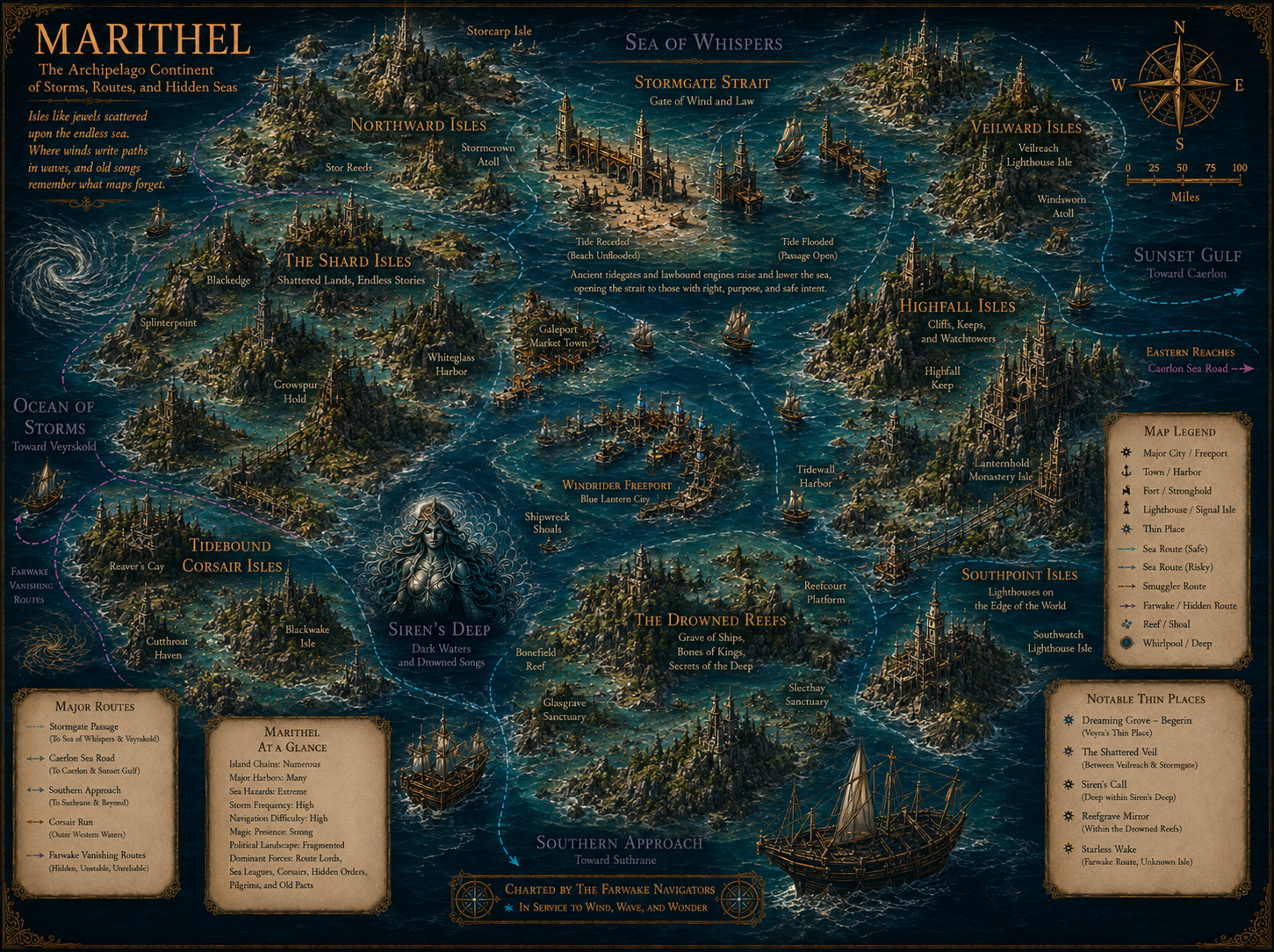
Marithel
Marithel is the western maritime and island continent of Thesalon.
It is a continent of island chains, sea roads, storm passages, reefs, gulfs, deep waters, naval power, freeports, salvage courts, hidden sanctuaries, lighthouse treaties, drowned legal claims, refugee flotillas, privateer letters, map wars, sea temples, island principalities, route registries, storm scholars, and harbors whose laws can matter as much as armies.
Marithel is not a minor island region.
It is not simply “the pirate continent.”
It is not a scattering of colorful ports on the edge of the real world.
Marithel is one of Thesalon’s six major continents, but unlike a land-bound continent, its geography is not defined by one continuous mass of earth. Its land is broken, scattered, reefed, storm-cut, tide-shaped, and politically stitched together by routes. Its true connective tissue is the sea.
In Marithel, the sea is the road.
A harbor can matter more than a city. A lighthouse can be a fortress. A route can be territory. A ship can be a household. A manifest can decide who exists. A storm warning can close a nation’s throat. A salvage claim can become a family war. A false name can save a life or destroy a port’s trust. A buoy line can be more frightening than a wall. A map can be more dangerous than a sword.
Marithel’s people build civilization from movement.
They live by wind, hull, reef, bell, current, contract, shrine, witness, chart, lamp, harbor court, and tide. They form families aboard ships, hold court on platforms, preserve names in drowned registries, argue law in fish halls, trade beneath storm shutters, smuggle people through dead coves, and measure power by who can move safely when others cannot.
The broad central question of Marithel is:
What kind of civilization forms when the sea is not a border, but the main road?
The campaign-driving question is:
When the sea changes, who is allowed to redraw the map?
And at the beginning of many Marithel campaigns, one city asks the question everyone else wants answered:
Can Windrider Freeport remain neutral when every faction needs it to choose a side?
Page Index
- Marithel at a Glance
- What Players Should Know
- The Central Questions of Marithel
- First Impressions
- The Shape of Marithel
- Why Campaigns Begin in Marithel
- Campaign Movement Rings
- Maritime Identity Basics
- Common Harbor Infrastructure
- The Maritime Legality Spectrum
- Supply, Provisioning, and Why Harbors Matter
- Major Regions
- Major Powers and Maritime Institutions
- Windrider Freeport
- Major Ports, Harbors, Sea-Forts, Reefs, and Important Sites
- Life in Marithel
- Ship Law, Harbor Law, Route Law, and Salvage Law
- Roads of Water: Travel, Trade, Pilots, and Storms
- Faith, Sea Temples, Lighthouse Saints, and Drowned Rites
- Magic, Storms, Reefs, Dreams, Charts, and Hidden Routes
- Peoples, Ancestries, and Languages
- Maritheli Character Origins
- Public Factions
- Important Public NPCs
- Common Rumors and Misconceptions
- Adventure Hooks
- How to Play a Maritheli Character
- Marithel Quick Reference
- Settlement Index by Region
- Common Ship, Harbor, and Maritime Services
- Common Marithel Encounters by Region
- Marithel Route and Storm Complications
- Marithel Downtime Ideas
- Marithel Character Name and Identity Notes
- Player Safety and Spoiler Boundary
- Page Use Guide
- Related Pages
Marithel at a Glance
| Topic | Marithel |
|---|---|
| World Role | The western maritime and island continent of Thesalon. |
| Core Identity | A route-based archipelago civilization shaped by ships, harbors, sea roads, reefs, storms, freeports, salvage law, hidden anchorages, and maps as power. |
| Defining Features | Island chains, storm straits, deep waters, reef courts, freeports, lighthouse lines, shipholds, drowned registries, pilot houses, privateers, sea temples, hidden routes. |
| Major Waters and Routes | Windrider Gulf, Stormgate Strait, Siren’s Deep, Drowned Reefs, Shard Isles channels, Farwake Routes, Lighthouse Isles, Caerlon-bound sea lanes, Outer Storm Roads. |
| Political Mood | Mobile, legalistic, mercantile, factional, pragmatic, hospitable under rules, suspicious of fixed borders, shaped by neutrality disputes. |
| Major Tensions | Who controls routes, who gets safe harbor, who may claim salvage, who counts as drowned, who may use false names, who redraws maps when currents change. |
| Common Conflicts | Ship papers, refugee sanctuary, privateer letters, route closures, false lighthouse signals, salvage claims, quarantine, smuggling, pilot secrecy, reef law, storm warnings. |
| Best Known For | Windrider Freeport, the Shard Isles, Stormgate Strait, Siren’s Deep, the Drowned Reefs, lighthouse politics, ship-as-household culture, hidden coves. |
| Player Character Fit | Sailors, pilots, freeport citizens, refugees, shipwrights, smugglers, privateers, salvage divers, lighthouse runners, sea-priests, mapmakers, fishers, false-name exiles, harbor advocates. |
What Players Should Know
Marithel is a continent where movement is civilization.
To understand Marithel, do not imagine a single kingdom surrounded by islands. Imagine a web of harbors, anchorages, reefs, courts, buoys, lighthouse lines, merchant houses, storm routes, fishing grounds, hidden coves, sea temples, shipyards, freeport wards, and laws that exist because people must cross dangerous water to survive.
A person in Marithel may belong to a port, a ship, a family, a fleet, a freeport compact, a pilot house, a reef canton, a lighthouse order, a salvage crew, a refugee flotilla, a privateer company, a fishing council, a route tradition, or a shiphold that has no permanent land at all.
Land matters, but access matters more.
A fertile island is valuable. A safe harbor is more valuable. A harbor with legal neutrality, repair docks, pilot access, sanctuary law, and route records can become more important than an island with better soil.
Most Maritheli people understand at least the basics of harbor law, ship papers, guest rights, storm signals, manifest truth, salvage claims, and which routes require a pilot. Even people who never sail far know that ships bring food, news, refugees, coin, danger, letters, disease, rumors, and war.
Marithel is a place where ordinary life can become legal and political very quickly.
A fishing boat lands with no crew but a valid manifest.
A refugee family claims sanctuary under a false name.
A lighthouse flashes the wrong color before a convoy wrecks.
A dead sailor appears alive in a freeport registry.
A ship declared drowned returns with passengers no one remembers boarding.
A pilot refuses a route everyone else says is safe.
A salvage bell is found in a reef where no wreck is recorded.
A storm moves in a way no chart permits.
These are not side curiosities. They are the kinds of events that reveal how Marithel works.
Not Just Pirates
Marithel has pirates, corsairs, smugglers, and privateers.
It also has fisher councils, shipwright syndicates, lawful salvage courts, refugee sanctuaries, lighthouse orders, merchant leagues, sea-priests, quarantine houses, storm scholars, pilot families, harbor advocates, market towns, island farmers, reef cantons, glassmakers, courtly principalities, and ordinary dock workers trying to keep their families fed.
Reducing Marithel to piracy misses the heart of the continent.
Piracy is one response to a world where routes are wealth.
So are convoy law, pilot secrecy, freeport neutrality, salvage tribunals, lighthouse treaties, naval blockades, privateer letters, smuggling networks, refugee coves, shiphold kinship, and drowned-declared registries.
The Starting Assumption
For many campaigns, player characters can begin in or near Windrider Freeport, the central starting harbor of Marithel.
Windrider Freeport is not the whole continent. It is the first playable node in a larger maritime network. It is where the players can learn Marithel through action: finding work, dealing with harbor law, meeting factions, securing ship access, taking dock jobs, negotiating with patrons, helping refugees, getting entangled in salvage claims, and deciding whose route claims to trust.
Problems that begin in Windrider Freeport often lead outward to Galeport Market Town, Tidewall Harbor, Stormgate Strait, Reefcourt Platform, Dead-Name Cove, Whiteglass Harbor, Shardcrown Waters, Caerlon-bound routes, or hidden anchorages no official map admits.
Islands Are Not All Nations
Marithel’s islands do not all function the same way.
Some islands are sovereign principalities.
Some are freeports.
Some are lighthouse rocks.
Some are fishing villages.
Some are privately held by merchant families.
Some belong to reef cantons.
Some are sacred sites.
Some are shipyard dependencies.
Some are military batteries.
Some are refugee settlements.
Some are hidden by choice.
Some matter only because they have fresh water, safe anchorage, good timber, a court platform, a deep repair beach, or a lighthouse that every ship trusts.
This is why Marithel maps can be misleading. A large island may be politically minor if it lacks a harbor. A barren rock may be priceless if it holds a beacon. A reef platform may decide whether millions in cargo can be lawfully recovered. A cove too small for a town may save hundreds of refugees if no official chart names it.
The Central Questions of Marithel
Marithel has three linked questions.
The broad civilizational question is:
What kind of civilization forms when the sea is not a border, but the main road?
The campaign-driving question is:
When the sea changes, who is allowed to redraw the map?
The starting-harbor question is:
Can Windrider Freeport remain neutral when every faction needs it to choose a side?
These questions are not abstract.
They appear in ordinary disputes.
A pilot house says a route has shifted and old charts are now dangerous.
A merchant league insists the route has not changed because its contracts depend on the old line.
A refugee ship claims sanctuary in a Freeport ward under a name that cannot be verified.
A Stormgate officer says neutrality does not apply during crisis.
A salvage court declares a wreck open property.
A reef canton says the wreck is an ancestor site and must not be touched.
A lighthouse order warns that a beacon was falsified.
A shipwright syndicate asks who benefits when ships need repairs.
A sea temple demands quarantine for survivors whose ship should have sunk weeks ago.
A privateer intermediary offers work that is technically legal in one harbor and piracy in another.
A mapmaker quietly sells three versions of the same sea.
In Marithel, the map is not passive. It is a claim.
The Sea Is the Road
Most continents think of roads as things built over land.
Marithel thinks of routes as living systems.
A sea road depends on wind, current, reef, season, pilotage, lighthouse signal, harbor law, storm warning, sanctuary rights, and whether the people who know the passage are willing to speak.
A route can open, close, shift, vanish, or become too politically dangerous to use.
A route can be inherited.
A route can be stolen.
A route can be lied about.
A route can be hidden to save lives or hidden to profit from danger.
Ships Are Households
Many Maritheli people treat ships as more than vehicles.
A ship may be a household, workplace, legal identity, refuge, inheritance, family, debt, sanctuary, weapon, business, or moving village.
A person may be shipborn, ship-sworn, manifest-born, adopted by crew, or legally tied to a vessel whose name matters almost as much as a family name.
This creates powerful bonds.
It also creates complicated legal problems when a ship sinks, changes hands, takes refugees, loses its captain, hides a passenger, is declared drowned, or returns after being recorded dead.
Harbors Are Courts
A harbor is not just a dock.
A harbor is a legal organism.
It records arrivals, hears disputes, marks deaths, checks manifests, enforces quarantine, recognizes sanctuary, assigns berths, taxes cargo, licenses pilots, permits repairs, judges salvage, regulates false names, and decides whether a ship may leave.
Different harbors have different laws.
A person safe in Windrider Freeport may be arrested in Stormgate Strait.
A salvage claim accepted in a League harbor may be rejected at Reefcourt Platform.
A false name tolerated under Blue Lantern rules may fail under Tidewall inspection.
Maps Are Power
Maps in Marithel are political tools.
A chart may show safe passages, hidden reefs, smuggling routes, old wrecks, sanctuary coves, storm lanes, forbidden waters, lighthouse ranges, privateer patrols, or routes to islands not visible under ordinary conditions.
Accurate maps are valuable.
False maps can kill.
Incomplete maps can be more dangerous than lies because they give confidence without wisdom.
A chart can also define ownership. If a route appears on a League registry, a merchant may claim lawful use. If a reef is marked as empty water, a salvage crew may strip what a reef canton considers sacred. If an island is omitted, its people may remain safe, erased, or trapped depending on who benefits from silence.
First Impressions
A traveler arriving in Marithel rarely sees the whole continent.
They see fragments.
A line of islands like broken teeth against the sunset.
A harbor filled with sails from six regions and flags from three more.
A lighthouse flashing through rain.
A reef glowing blue-green under shallow water.
A fish market shouting beneath storm shutters.
A harbor court arguing while dockworkers unload salted cod.
A refugee ship tied to a sanctuary buoy.
A pilot refusing passage despite a merchant waving coin.
A privateer captain drinking beside a temple healer.
A child repairing net floats while listening to sailors argue over whether Siren’s Deep sings in dreams.
A freeport street where people speak their birth names, ship names, false names, and no names at all.
Common first impressions include:
- Masts thick as a winter forest in crowded harbors.
- Color-coded harbor lanterns showing quarantine, sanctuary, storm warning, market open, court day, or naval closure.
- Rope bridges between dock platforms.
- Shipwright sheds ringing with hammers and saws.
- Fish scales glittering in street water.
- Shrine buoys bobbing beyond harbor walls.
- Painted route boards updated every morning by pilots.
- Wreck bells hanging outside salvage courts.
- Freeport identity offices with lines of refugees, sailors, debtors, and disguised nobles.
- Lighthouse mirrors polished under armed guard.
- Sea-temple steps wet with offerings.
- Market halls selling salt fish, sailcloth, glass lenses, rope, shells, ink, charts, lamp oil, driftwood, and small charms against bad wind.
- Narrow stairs climbing island cliffs to villages above storm surge.
- Hidden coves where hulls are scraped under canvas to hide their names.
- Court platforms built over reef shallows.
- Storm towers watching clouds like enemy armies.
- Children who can tie harbor knots before they can write.
- Old sailors who refuse to say certain waters aloud.
- Manifest clerks checking whether a person is passenger, crew, guest, prisoner, or cargo.
- Dock watches standing between sanctuary claimants and armed pursuers.
- Salvage divers carrying bells, slate boards, knives, and breath-charms.
- Shiphold families cooking on deck because they have no land home left.
Marithel feels open because the sea is everywhere.
It feels claustrophobic because every safe route is known by someone, owned by someone, watched by someone, or hidden by someone.
The Shape of Marithel
Marithel lies west of Caerlon and is connected to the Sea of Whispers, the Ocean of Storms, western sea routes, Caerlon-bound passages, northern waters toward Veyrskold, and southern crossings that may eventually reach Suthrane.
Its geography is archipelagic.
Power is distributed across island chains, harbors, straits, reef systems, sea forts, lighthouse networks, market towns, hidden anchorages, and route traditions.
Marithel’s most important places are not always its largest islands.
A shallow reef platform can decide salvage law for a hundred wrecks.
A lighthouse island can determine which fleets move during storm season.
A freeport can become more important than a principality because it recognizes false names and neutral berths.
A hidden cove can save refugees or shelter smugglers.
A storm strait can make a military power unavoidable.
A deepwater buoy line can terrify even veteran captains.
The continent’s major named features include:
- The Shard Isles
- Stormgate Strait
- Windrider Gulf
- Siren’s Deep
- The Drowned Reefs
- Many island routes
Later player-facing development also recognizes the practical regions and route-systems that make Marithel playable:
- The Blue Lantern Freeports
- The League Harbor Chain
- The Farwake Routes
- The Saltglass Principalities
- The Lighthouse Isles
- Hidden Anchorages
- The Outer Storm Roads
- The Caerlon-Bound Routes
- Thin Places and mythic sea-sites
Geography by Movement
A land continent can often be understood by walking from region to region.
Marithel must be understood by asking:
- Which routes connect these places?
- Which routes are safe only in season?
- Which require pilots?
- Which are controlled by harbor law?
- Which are hidden?
- Which are forbidden?
- Which are disputed?
- Which routes are changing?
- Which maps are lying?
- Which harbors will accept the ship if something goes wrong?
This means Marithel’s geography is practical before it is scenic.
A beautiful island may be nearly irrelevant if no safe anchorage exists.
A bare rock with a lighthouse may be politically priceless.
A cove with fresh water may be the difference between lawful voyage and desperation.
The Known and the Unknown
Most outsiders know Marithel exists. Many know the Shard Isles, Stormgate Strait, Windrider Gulf, Siren’s Deep, and the Drowned Reefs by reputation.
That does not mean they know how to move through them.
Institutional knowledge is scattered among pilots, lighthouse orders, sea temples, merchant leagues, shipwrights, salvage exchanges, reef cantons, hidden navigators, refugee captains, privateers, and old families who know routes they do not put on public charts.
Some islands are missing from common maps.
Some routes only open under rare winds or tides.
Some reefs hide drowned structures.
Some storm roads appear only during dangerous seasons.
Some charts are true only if read with the correct local calendar.
Some maps are deliberately wrong because the truth would bring fleets, taxes, tomb robbers, slavers, pirates, or war.
Why Campaigns Begin in Marithel
Marithel is a strong campaign-start continent because it gives player characters immediate access to movement, faction conflict, legal ambiguity, danger, and choice.
A party does not need to begin as heroes of a kingdom or soldiers in a war. They can begin as people in a harbor with reasons to need work, passage, protection, papers, coin, repair, testimony, identity, or a way out.
Windrider Freeport, in particular, supports many starting situations:
- A character needs legal identity after fleeing another place.
- A ship needs crew.
- A refugee family needs protection.
- A salvage claim needs witnesses.
- A pilot refuses to speak unless paid or protected.
- A harbor court needs neutral investigators.
- A privateer intermediary offers dangerous work.
- A sea temple asks for aid before quarantine becomes panic.
- A map changes hands in a market.
- A ship returns under a name already declared drowned.
- A faction needs someone expendable, deniable, or honest.
- A character inherits a share in a vessel they have never seen.
- A false-name dispute threatens to expose someone.
- A route problem in the city requires the party to leave by sea.
The campaign does not need to force departure.
Marithel works best when players learn the Freeport first: docks, markets, laws, factions, shrines, shipyards, courts, refugee wards, inns, records, and rumors. Then, when they choose to leave the city, the sea feels like an opening created by their own decisions.
The guiding campaign movement principle is:
What happens when the only way to solve a city problem is to leave the city by sea?
How Characters Gain Sea Access
Windrider Freeport and nearby Marithel waters should give player characters several believable ways to get on the water without requiring them to already own a ship.
Common starting methods include:
- Taking hired crew berths on a merchant, fishing, salvage, temple, refugee, courier, or patrol vessel.
- Joining a chartered expedition funded by a patron.
- Inheriting a disputed shipshare.
- Working off repair debt for a captain or shipwright syndicate.
- Accepting a salvage contract that requires neutral witnesses.
- Traveling as guards for a refugee convoy.
- Carrying testimony or sealed papers for a harbor court.
- Taking a temple mercy mission to a ship, reef, or quarantine site.
- Receiving a privateer commission with legal complications.
- Serving as deckhands on a pilot escort vessel.
- Being court-ordered to accompany an investigation.
- Fleeing under Blue Lantern protection.
- Being hired by a mapmaker, sea-priest, League factor, dock watch, or Farwake intermediary.
A ship is not only a reward in Marithel.
A ship is a political situation.
Campaign Movement Rings
Marithel benefits from being understood in movement rings around the starting hub. This helps the DM and players know how the continent opens outward.
Circle 1: Windrider Freeport
The first circle is the city itself.
This includes docks, markets, inns, shipyards, freeport courts, sanctuary offices, refugee wards, sea temples, salvage houses, ship brokers, pilot boards, covered-name docks, and faction neighborhoods.
Problems in this circle are immediate and social: identity disputes, dock violence, cargo theft, refugee protection, ship access, faction pressure, salvage hearings, false names, missing crew, and local rumors.
Circle 2: Windrider Harbor and Immediate Waters
The second circle is the harbor environment around Windrider Freeport.
This includes the sanctuary buoy line, mooring fields, repair beaches, nearby shrines, gulf patrol routes, dock watch jurisdiction, Northwatch Battery, small fishing waters, harbor quarantine zones, and short boat crossings.
Problems in this circle are active but contained: a buoy moved, a ship trying to leave under dispute, a covered-name vessel attacked, a quarantine line breached, a pilot missing, or a refugee raft cut loose.
Circle 3: Windrider Gulf
The third circle expands to nearby gulf locations.
This includes Galeport Market Town, Galeport Repair Beaches, Gullhook Fishery Waters, Mooring Islands of the Inner Gulf, Pilot House of the Honest Wind, and route links toward Tidewall, Stormgate, and the Caerlon-bound passages.
Problems in this circle introduce maritime travel without requiring deep-ocean expedition: fishing disputes, market pressure, food supply, short-route piracy, pilot refusal, storm warnings, repair debt, refugee movement, or League interference.
Circle 4: Regional Specialized Zones
The fourth circle leads to major specialized regions:
- Stormgate Strait for hard law, naval inspection, chain closures, and route control.
- Drowned Reefs for salvage law, reef memory, diving, wreck bells, and tide courts.
- Shard Isles for hidden coves, local pilots, mythic sites, and island politics.
- Lighthouse Isles for beacon law, false lights, keeper families, and storm signals.
- Saltglass Principalities for lenscraft, refined court intrigue, visibility law, and signal glass.
- Farwake Routes for hidden passages, dead-name ships, refugees, and smuggling.
- Siren’s Deep approaches for mystery, quarantine, exclusion buoys, and forbidden charts.
Problems in this circle are factional and regional. They pull the party into systems larger than the starting city.
Circle 5: Wider Marithel and Beyond
The fifth circle includes the Outer Storm Roads, far island routes, Caerlon-bound sea lanes, northern and southern long routes, and strange thin places where dream, storm, reef, and fey tide complicate ordinary geography.
Problems in this circle may connect to campaign arcs: changing sea roads, false maps, war consequences, hidden powers, mythic sites, vanished ships, foreign politics, and questions of who gets to redraw the map.
Maritime Identity Basics
Marithel’s social categories are shaped by ships, harbors, manifests, and whether a person’s name can be proven.
These terms are useful for character creation and for understanding legal disputes.
Shiphold
A shiphold is a ship treated as a household, legal community, workplace, and moving home.
A shiphold may include blood relatives, adopted crew, apprentices, passengers under protection, refugees, debt-bound workers, officers, cooks, children, healers, guards, and people with no other home.
Some shipholds are stable for generations.
Some form after disaster.
Some are exploited by captains who use family language to hide abuse.
Manifest-Born
A manifest-born person is someone whose birth, adoption, or legal identity was first recorded on a ship manifest rather than in a land registry.
This status can be honorable, ordinary, or legally complicated depending on the harbor.
A manifest-born character may feel tied to a ship name as strongly as a family name.
Deck-Sworn
A deck-sworn person has sworn legal, personal, or professional loyalty aboard a ship.
This may be a crew oath, rescue oath, shiphold adoption, privateer commitment, pilgrimage vow, or temporary survival pact made at sea.
Deck-sworn obligations can become complicated when they conflict with harbor law.
Keel-Kin
Keel-kin are people considered family through shared shiphold life rather than blood.
A sailor saved from drowning, a refugee child raised aboard, an apprentice taken after a wreck, or an orphaned deckhand may become keel-kin.
Keel-kin disputes often appear in inheritance, shipshare, and drowned-declared cases.
Drowned-Declared
A drowned-declared person has been legally declared dead or lost at sea.
This may allow inheritance, remarriage, debt settlement, funeral rites, and transfer of property.
If the person returns alive, their status becomes a serious legal problem.
Covered-Name Crew
A covered-name crew serves or docks under concealed ship or personal names while legal review is pending.
This may be lawful under Blue Lantern Freeport protections, criminal under stricter harbors, or tolerated during emergency sanctuary.
Harbor-Adopted
A harbor-adopted person has been accepted into a harbor community through law, public witness, temple care, shipwreck recovery, refugee settlement, or civic oath.
Harbor adoption is especially important in Freeports and refugee wards.
Freeport-Naturalized
A Freeport-naturalized person has received recognized Freeport civic identity, often after sanctuary review, false-name hearing, shipwreck recovery, refugee intake, or long residence.
This can be a lifeline for people whose original legal identities are unsafe, destroyed, or disputed.
Shipshare Heir
A shipshare heir inherits part ownership, debt, responsibility, or legal interest in a vessel.
A shipshare may be valuable, worthless, cursed by debt, contested by family, or tied to a vessel declared drowned.
Common Harbor Infrastructure
Marithel’s harbors differ widely, but many share recognizable institutions.
Players should expect these places to appear repeatedly.
Harbor Courts
Harbor Courts hear disputes involving dock violence, berth rights, passenger claims, shipboard abuse, guest law, cargo conflicts, quarantine, ship departure, and local jurisdiction.
A harbor court can determine whether a person may step ashore, whether a ship may leave, or whether a captain has authority over those aboard.
Manifest Houses
Manifest Houses record cargo, crew, passengers, ship names, declared routes, origin ports, destination ports, and legal claims.
A manifest error can be a mistake, fraud, smuggling, rescue concealment, or evidence of murder.
Pilot Boards
Pilot Boards post route warnings, required pilotage, weather updates, refused passages, reef conditions, lighthouse changes, and route closures.
A pilot board is often the first place sailors check in the morning.
Sanctuary Buoys
Sanctuary Buoys mark harbor boundaries where Blue Lantern protection or local guest-law claims may begin.
Moving, damaging, or falsely invoking a sanctuary buoy can trigger serious legal conflict.
Drowned-Declared Offices
Drowned-Declared Offices record missing-at-sea petitions, ship death, returned-person hearings, inheritance disputes, and legal questions involving people or ships presumed dead.
These offices are quiet, crowded, and emotionally brutal.
Salvage Bells
Salvage Bells mark wreck claims, recovered cargo, named wrecks, no-claim sites, or tribunal-supervised salvage.
In reef communities, a bell may be ancestor marker, legal warning, and sacred boundary.
Quarantine Steps
Quarantine Steps are arrival points for sick crews, strange survivors, suspect cargo, plague ships, Siren’s Deep returnees, and vessels from dangerous waters.
A quarantine order can be mercy, caution, imprisonment, or political abuse.
Route Registries
Route Registries preserve official charts, buoy records, closure logs, pilot testimony, hazard updates, convoy schedules, and disputed map changes.
A route not recorded may be treated as legally nonexistent.
Storm Signal Towers
Storm Signal Towers display warnings through flags, lamps, bells, mirrors, horns, or magical signals.
A false signal can wreck ships or alter trade.
Guest-Law Benches
Guest-Law Benches are public places where protected arrivals, passengers, false-name petitioners, witnesses, and shipboard claimants sit under legal protection while their case is heard.
Covered-Name Docks
Covered-Name Docks are berths where a ship’s name, ownership, origin, or crew identity may be temporarily concealed under legal review.
These docks are essential to Freeport law and infuriating to stricter authorities.
Shiphold Witness Tables
Shiphold Witness Tables hear internal ship community disputes: adoption, crew oaths, abuse claims, inheritance, deck-sworn status, shipshare disputes, and whether someone belongs to a vessel’s legal household.
The Maritime Legality Spectrum
Marithel’s maritime conflicts often happen because different activities look similar from a distance.
The law cares about distinctions.
So do the people harmed by those distinctions.
Piracy
Piracy is unlawful predation at sea.
It includes seizure, violence, kidnapping, extortion, forced labor, theft of vessel or cargo, and attacks outside recognized legal authority.
Pirates may claim politics, hunger, revenge, or old grievance, but Maritheli harbors generally treat piracy as a direct attack on route civilization.
Privateering
Privateering is licensed violence recognized by some ports, states, or authorities.
A privateer may carry letters of marque, convoy disruption orders, anti-pirate commissions, or wartime permissions.
The problem is that a privateer letter valid in one harbor may be piracy in another.
This makes privateering legally dangerous and politically useful.
Smuggling
Smuggling is illegal movement of goods, people, maps, relics, weapons, letters, bodies, sacred objects, or identities around harbor law.
Smuggling can be exploitative, greedy, violent, or humanitarian.
A smuggled person may be cargo in one story and a rescued witness in another.
Farwake Movement
Farwake movement uses hidden routes and unregistered passages.
It may be illegal, humanitarian, secret, sacred, criminal, or all of these at once.
A Farwake navigator may save refugees, move stolen relics, protect witnesses, evade tyrants, or conceal predators. The route itself does not decide the morality. The use does.
Salvage
Salvage is the lawful recovery of wreckage, cargo, vessels, bodies, or goods after maritime disaster.
It becomes unlawful when done without proper claim, before survivor rights are resolved, against reef law, from sacred wrecks, from no-claim fields, or while concealing evidence.
Rescue
Rescue can become legally complicated.
A rescuer may become a witness, salvage claimant, harbor guest, shiphold protector, or suspect. A rescued ship may owe debt. A rescued passenger may claim sanctuary. A rescued cargo may be contested by owners, insurers, courts, temples, or families.
In Marithel, the person who records an event first can shape what the event legally becomes.
Supply, Provisioning, and Why Harbors Matter
Marithel’s harbors matter because ships need more than water under the hull.
A ship requires food, fresh water, rope, sailcloth, timber, pitch, lamp oil, salt, medicine, metal fittings, repair labor, pilots, charts, legal papers, crew, ballast, cargo clearance, and somewhere safe to wait out weather.
A harbor that provides these reliably becomes powerful.
A harbor that cannot provision ships may still be beautiful, sacred, or defensible, but it will not dominate routes.
Food
Food moves through fish markets, salt houses, grain contracts, island farms, reef fisheries, seaweed harvests, dried fruit trade, preserved meat imports, ship biscuit bakeries, and temple kitchens.
The League of Nine Harbors controls or influences many large food contracts, especially grain and preserved staples.
Galeport is especially important because ordinary food movement makes extraordinary politics possible.
Fresh Water
Fresh water determines route survival.
Some islands are valuable mainly because they have reliable springs or cisterns.
Hidden freshwater points are among the most guarded secrets of Farwake Navigators and hidden anchorages.
A poisoned spring, seized cistern, or false water chart can endanger whole convoys.
Timber and Ship Materials
Ship timber comes from larger islands, mainland-linked trade, imported cargo, salvaged hulls, managed groves, and specialized shipyard contracts.
Sailcloth, rope, tar, pitch, nails, pumps, anchors, glass, lanterns, and spare spars move through dedicated harbor supply systems.
Shipwright syndicates depend on these flows. So do privateers, fishers, refugees, and temples.
Lamp Oil and Signal Supplies
Lighthouses, ships, shrines, markets, and night watches depend on lamp oil.
Seal oil, fish oil, whale oil, vegetable oils, rendered fats, and special signal fuels are all politically important.
A shortage of lamp oil can darken a harbor, delay convoys, or make a lighthouse vulnerable.
Medicine and Mercy Supplies
Sea-temples, quarantine houses, refugee wards, and ships need bandages, herbs, clean water, salt, alcohol, bedding, fever treatments, healing charms, and skilled hands.
A harbor with strong healing infrastructure becomes a refuge.
A harbor without it becomes a place people fear during plague, Siren’s Deep returns, or storm disasters.
Legal Provisioning
A ship may also need papers before it can safely depart.
These include:
- Manifests.
- Crew lists.
- Passenger declarations.
- Harbor clearance.
- Pilot contracts.
- Route registry stamps.
- Quarantine release.
- Salvage permits.
- Privateer letters.
- Freeport protections.
- Sanctuary transfers.
- Drowned-declared reviews.
- Cargo tax records.
- Shipshare documents.
This is why Marithel’s bureaucracy is not flavor. It is travel infrastructure.
Major Regions
The regions below are player-facing geographic, political, legal, and travel divisions. They are not all formal borders. Some are water bodies, some are archipelagos, some are institutions, some are route networks, and some are legal-cultural zones.
Each region includes notable settlements and sites by name. Deeper descriptions appear later in the Windrider Freeport and Major Ports, Harbors, Sea-Forts, Reefs, and Important Sites sections.
Windrider Gulf
Windrider Gulf is Marithel’s most important starting region for play.
It is a broad, navigable gulf of strong winds, crowded routes, fishing towns, freeport law, pilot families, repair beaches, market settlements, wind shrines, mooring islands, convoy points, refugee pressure, and shifting political neutrality.
The Gulf is not the safest water in Marithel, but it is one of the most connected. It is where ordinary maritime life and high maritime politics overlap.
Fishers, pilots, shipwrights, freeport clerks, refugees, League factors, lighthouse runners, smugglers, sea-priests, route brokers, privateer intermediaries, market councils, and dock militias all work the same waters.
Windrider Gulf’s identity comes from the tension between openness and regulation.
Ships come here because the Gulf offers access.
Factions come here because access is power.
What Defines Windrider Gulf
- Windrider Freeport as the starting hub.
- Galeport Market Town as the grounded ordinary neighbor.
- Fishing fleets and fishery disputes.
- Pilot houses and local route knowledge.
- Repair beaches and shipwright syndicates.
- Freeport neutrality and its limits.
- Blue Lantern sanctuary practice.
- Refugee ships and false-name disputes.
- Convoy points, mooring islands, and short gulf routes.
- Market law, food movement, and dock labor.
- Routes leading toward Tidewall, Stormgate, the Drowned Reefs, and Caerlon-bound passages.
Common Sights
Travelers in Windrider Gulf may see:
- Sails leaning hard under steady gulf wind.
- Fishers arguing with market clerks about moved shoals.
- Pilot houses posting morning wind boards.
- Refugee ships tied near sanctuary lanterns.
- Shipwrights scraping hulls on tidal repair beaches.
- Children selling fresh line, hooks, bait, and lamp oil near dock stairs.
- Blue Lantern witnesses seated near identity offices.
- Market boats moving between Freeport and Galeport.
- Sea-priests blessing departing crews under storm-gray sky.
- Privateer agents pretending to be ordinary trade brokers.
- Smugglers watching harbor patrols from tea stalls.
- Freeport officials insisting neutrality still holds while everyone tests it.
Settlements and Sites in Windrider Gulf
- Windrider Freeport — opening hub, Blue Lantern Freeport, legal-gray city, faction crossroads.
- Galeport Market Town — closest ordinary market settlement, rooted in food, labor, fish, and gulf politics.
- Galeport Repair Beaches — tidal beaches used for hull scraping, sail repair, and small-vessel maintenance.
- Pilot House of the Honest Wind — major pilot house with routes through the Gulf and approaches to Stormgate.
- The Market of Currents — fish, food, trade, route rumor, and labor negotiation network.
- The Wind Shrine Islets — small shrines where local crews ask for favorable wind and safe return.
- Freeport Sanctuary Buoy Line — marked harbor boundary where sanctuary claims begin.
- Blue Lantern Guest Houses — legal and charitable houses for protected travelers, refugees, and false-name petitioners.
- Mooring Islands of the Inner Gulf — small islands used for convoy waiting, repair pauses, and discreet meetings.
- Northwatch Battery — Freeport defensive and dock militia position watching the gulf approach.
- The Honest Wind Route Board — public board where pilots post route warnings, delays, and refusals.
- The Refugee Raft Quarter — floating and dockside district of temporary households, disputed identities, and humanitarian pressure.
- Gullhook Fishery Waters — productive but shifting fishing grounds whose movement can cause economic crisis.
- The Broken Boom Chain — old harbor defense line, partly functional and politically symbolic.
The Shard Isles
The Shard Isles are one of Marithel’s defining archipelagos.
They are a broken island region of jagged coasts, narrow channels, sharp cliffs, volcanic remnants, hidden coves, reef shelves, cliff villages, old wreck sites, storm-carved stone, isolated shrines, small harbors, and routes that require local knowledge.
The Shard Isles are not one nation, culture, or political body.
They are a region of many local powers, island councils, sea families, pilot traditions, ruin sites, hidden sanctuaries, reef claims, and dangerous passages. Some islands are friendly to outsiders. Some require formal approach. Some are privately controlled. Some appear on maps only as warnings. Some are omitted because their inhabitants prefer it.
The Shard Isles are where Marithel’s beauty and danger become inseparable.
What Defines the Shard Isles
- Fragmented island geography.
- Jagged channels and cliff harbors.
- Hidden coves and small-scale island polities.
- Volcanic or storm-shattered coastlines.
- Reef hazards and tide-dependent approaches.
- Local pilot traditions.
- Hidden routes, private anchorages, and old wrecks.
- Occasional thin places and mythic sea-sites.
- Cultural variety across short distances.
- Political difficulty for any power trying to control every channel.
Common Sights
Travelers in the Shard Isles may see:
- Cliffs rising directly from blue-black water.
- Rope lifts carrying goods to cliff villages.
- Bright sailcloth drying between stone houses.
- Pilots reading surf against knife-edged rocks.
- Sea caves used as storm shelters or smuggler holds.
- Island shrines painted with shells, glass, and salt.
- Goat paths above hidden harbors.
- Reef markers made from bone, bronze, or colored rope.
- Fisher families who speak three harbor dialects but distrust every mainland official.
- Abandoned beacon platforms on rocks no one wants to maintain.
- Old carved steps leading from the sea to empty terraces.
- Ships waiting offshore for permission to enter a channel.
Settlements and Sites in the Shard Isles
- Shardcrown Waters — central broken-water region where many Shard routes converge.
- Begerin — beautiful island near the sacred Dreaming Grove.
- Blath na Speirghorm — Veyra-linked Dreaming Grove on a rock off Begerin’s shore.
- The Sapphire Reef — legendary gemstone reef that surviving sailors rarely find twice.
- Knifechannel Villages — cliff settlements built along narrow, dangerous passages.
- Shardcrown Pilot Stairs — stepped pilot houses overlooking converging channels.
- The Glass-Tide Coves — coves where water clarity reveals wreckage, reefs, and old foundations.
- Crescent Moon Mistwater — waters associated with fey tide and the Tomb of Twinkles Tekan.
- The Broken Lantern Rocks — old failed lighthouse platforms used as route warnings.
- Three-Sail Refuge — small harbor used by storm-caught ships and people who do not want questions.
- The Split Keel Inlet — dangerous repair anchorage with excellent timber access and poor law.
- Old Shardwatch Ruins — abandoned watch posts overlooking channels no current faction fully controls.
- The Saltgoat Steps — cliff path connecting goat-herding villages with hidden boat landings.
- Pearlknife Anchorage — beautiful but treacherous cove where pilots charge high fees for safe entry.
Stormgate Strait
Stormgate Strait is a major maritime chokepoint and one of the hardest-law regions of Marithel.
It is a dangerous passage of storm winds, military signals, toll chains, engineered crossings, lighthouse authority, naval courts, emergency closures, and arguments over when safety becomes control.
Stormgate does not feel like Windrider Freeport.
Windrider negotiates.
Stormgate commands.
The Strait matters because ships must pass through or around it to reach certain major waters efficiently. Whoever controls Stormgate can delay convoys, inspect vessels, demand tolls, close routes, enforce quarantine, interrupt sanctuary claims, and decide whether a storm warning is enough to halt trade.
Its defenders argue that without hard law, the Strait becomes a grave.
Its critics argue that Stormgate turns weather into authority.
What Defines Stormgate Strait
- Militarized maritime chokepoint.
- Storm warnings and emergency closures.
- Naval courts and toll-chain control.
- Lighthouse and signal law.
- Stormgate Admiralty presence.
- Route inspection and passage permits.
- Tension with Blue Lantern sanctuary law.
- Engineered tidal crossings.
- Legal contrast with Windrider Freeport.
- Crisis law that can override ordinary harbor practice.
Common Sights
Travelers in Stormgate Strait may see:
- Tall signal towers flashing through rain.
- Chain booms stretched across narrow channels.
- Armed inspection boats rowing toward incoming ships.
- Lighthouse mirrors turning under storm shutters.
- Captains waiting in line while officials check papers.
- Sea-priests arguing with naval clerks about sanctuary ships.
- Pilots watching clouds more carefully than soldiers.
- Bells sounding closure patterns before a squall hits.
- Ships stranded on exposed tidal flats after misjudged passage.
- Admiralty officers insisting that delay is mercy.
- Merchants counting losses while storm flags rise.
Settlements and Sites in Stormgate Strait
- Stormgate Harbor-Fortress — fortified harbor and Admiralty authority center.
- The Gate of Wind and Law — tidal-beach crossing and engineered flood-route system.
- Tidewall Harbor / Highfall Isles — fortified route-watch harbor and lighthouse-political pressure point.
- North Chain Battery — defensive chainhouse controlling one passage arm.
- South Chain Battery — paired fortification used during closures and inspections.
- Stormgate Admiralty Court — naval and emergency route-law court.
- The Closure Bell Towers — signal towers that announce storm, quarantine, military, or legal closure.
- Highfall Lighthouse Court — lighthouse office where signal disputes become legal cases.
- The Flooded Gatehouse — engineered structure sometimes dry, sometimes deep enough for ship passage.
- The Exposed Sand Court — low-tide legal site used to prove whether a ship was unlawfully stranded.
- The Storm Ledger House — record office preserving closures, tolls, warnings, and crisis orders.
- The Pilot Protest Quay — dock where independent pilots gather to challenge Admiralty route decisions.
- Thalara’s Gate Shrine — sea-storm shrine used before difficult passage.
- The Broken Toll Chain Museum — public reminder of a past disaster or rebellion, depending on who tells the story.
Siren’s Deep
Siren’s Deep is one of the most feared deep-water regions of Marithel.
It is not defined by one island or one monster. It is a vast oceanic danger-zone of strange sound, survivor testimony, vanished ships, forbidden charts, deepwater quarantine, exclusion buoys, rescue failures, suppressed logs, and myths that even skeptical sailors hesitate to mock.
Most captains do not enter Siren’s Deep.
Many will not sail near its boundary without checking buoy lines, shrine warnings, weather logs, and whether anyone aboard has begun hearing music in dreams.
Siren’s Deep works best in player-facing knowledge as a mystery boundary. People know enough to fear it. They do not agree on what it is.
Some say there are singers beneath the water.
Some say the sound is current through drowned stone.
Some say it is a planar echo.
Some say it is nothing but sailor panic weaponized by authorities.
Most sailors answer: if it is nothing, go prove it without my ship.
What Defines Siren’s Deep
- Deep-water danger.
- Forbidden or restricted routes.
- Sirenward Exclusion Buoy Line.
- Survivor testimony and missing crews.
- Confiscated logs and disputed charts.
- Deepwater quarantine.
- Rescue failures.
- Sea-temple warnings.
- Farwake curiosity and secrecy.
- Lighthouse and Compact enforcement.
- Fear of sound, dreams, and false navigation.
Common Sights
Most travelers do not enter Siren’s Deep, but near its approaches they may see:
- Buoys painted with warning marks and temple seals.
- Rescue boats turned back by official order.
- Sailors refusing to sleep aboard certain ships.
- Logs confiscated by quarantine officers.
- Farwake navigators arguing in whispers.
- Sea-priests listening to shells, bells, or wind.
- Survivors unable to agree how many days they were gone.
- Lighthouse signals dimmed to avoid drawing ships closer.
- Captains making offerings before crossing nearby waters.
- Empty water that looks harmless, which makes it worse.
Settlements and Sites near Siren’s Deep
- Sirenward Exclusion Buoy Line — boundary of dangerous deepwater mystery.
- Sirenward Compact Watchboats — patrol vessels enforcing restricted approach.
- The Confiscated Log House — record office holding survivor logs and forbidden charts.
- Deepward Survivor Quay — quarantine dock for ships that came too close or returned wrong.
- The Silent Bell Buoy — warning buoy said to ring only below the water.
- Thalara’s Deep Listening Chapel — shrine for storm, sea, warning, and restraint.
- The Last Rescue Marker — buoy marking where a rescue ship vanished or turned back.
- The Blue Sound Shoal — shallow approach where sailors report hearing voices before entering deep water.
- The Farwake Listening Sloop Moorings — discreet anchorages used by navigators studying the boundary.
- The No-Song Court — legal chamber where testimony must be spoken plainly, without chant or sailor’s meter.
- The Black Water Glasshouse — small lens station watching surface changes over deep currents.
- Dreamwake Infirmary — Veyra-Morvane Compact healing and quarantine house for survivors with sleep disturbances.
The Drowned Reefs
The Drowned Reefs are a major reef system of Marithel and one of the continent’s most legally complicated regions.
They are hazardous, beautiful, shallow, shifting, and full of memory.
The Reefs contain shipwreck zones, tide channels, submerged structures, fishing grounds, reef cantons, hidden passages, living coral courts, ancestral wrecks, salvage disputes, and places where the line between property, grave, witness, and taboo becomes fiercely contested.
Outsiders often see wrecks and think treasure.
Reef communities often see names.
A wreck may be a ship. It may be a tomb. It may be evidence. It may be a crime scene. It may be kin. It may be a reef foundation now inhabited by living communities who owe it protection.
Reef law is not Freeport law.
This difference matters.
What Defines the Drowned Reefs
- Dangerous reef navigation.
- Tide-dependent passages.
- Salvage-law disputes.
- Reef cantons and local courts.
- Ancestral wreck claims.
- Hidden channels.
- Fishing and diving communities.
- Wreck bells and marker theft.
- Outsider access restrictions.
- Living reefs and drowned structures.
- Conflict between Freeport property law and reef memory law.
Common Sights
Travelers near the Drowned Reefs may see:
- Shallow water flashing green and white over coral heads.
- Marker poles hung with bells, shells, and colored cloth.
- Reef pilots standing barefoot on platform edges to read water.
- Divers carrying knives, slate boards, and breath-charms.
- Salvage crews waiting angrily for legal permission.
- Families placing offerings at wreck markers.
- Court platforms raised above shallow water.
- Boats with shallow keels and quiet oars.
- Outsider ships forced to anchor far from channels.
- Children who can identify wreck bells by sound.
- Reef wardens removing illegal claim flags before dawn.
Settlements and Sites in the Drowned Reefs
- Reefcourt Platform — Drowned Reef legal node and salvage-law counterpoint.
- The Drowned Reef Edge — dangerous boundary between open water and reef channels.
- Marrel Reefcourt — adjudication house for reef law and outsider disputes.
- Sulara Bellcoral’s Claim Hall — ancestor claim and wreck-bell record house.
- Tovran Bloodreef Warden Posts — reef protection stations and patrol moorings.
- Odrisa Tidecairn Guide Steps — compromised or contested guide access point.
- The Wreck Bell Garden — field of bells marking named wrecks.
- The Living Keel Reef — reef structure formed through and around old hulls.
- The White Coral Hearing Stands — public tide court platforms.
- The Shallow Knife Channels — narrow reef routes requiring expert pilots.
- The Blue Breath Diving Houses — diver lodges, training halls, and recovery rooms.
- The No-Claim Wreckfield — wreck zone where salvage is forbidden.
- The Tidecairn Villages — small reef communities built on platforms, sandbars, and anchored hulls.
- The Red Marker Gap — dangerous passage where markers are often stolen or moved.
The Blue Lantern Freeports
The Blue Lantern Freeports are a recognized network of neutral or semi-neutral harbors that preserve sanctuary law, false-name registration, protected berths, witness rights, and emergency arrival protections.
They are not fully centralized. Their shared identity comes from law, custom, mutual recognition, and the blue lantern symbol that marks protected arrival.
Some Blue Lantern Freeports are large civic harbors. Some are small sanctuary ports. Some are tolerated because every faction eventually needs a place where people can arrive before their papers make sense.
Blue Lantern law exists because the sea produces people who need shelter before every question can be answered. Shipwreck survivors, refugees, fleeing witnesses, escaped debtors, defecting sailors, privateer deserters, wrongly accused passengers, or people carrying dangerous testimony may arrive without reliable papers.
The Blue Lantern idea is simple in principle and difficult in practice:
A person in immediate need can be protected long enough for law to become possible.
This makes Freeports beloved, exploited, hated, and politically necessary.
The Major Blue Lantern Freeports
| Freeport | Region | Freeport Role |
|---|---|---|
| Windrider Freeport | Windrider Gulf | Primary campaign-start hub, largest Blue Lantern node, sanctuary and faction crossroads. |
| Lanternfall Quay | Lighthouse Isles | Freeport tied to lighthouse law, storm survivors, signal witnesses, and keeper disputes. |
| Mercywake Harbor | Caerlon-Bound Routes | Refugee intake port, relief convoy harbor, protected witness transfer point. |
| Bluehook Haven | Shard Isles | Small but important freeport for islanders, hidden-route arrivals, and disputed ship identities. |
| Grey Lantern Anchorage | Hidden Anchorages / Farwake Routes | Semi-recognized freeport used for false-name ships, protected extractions, and legally delicate arrivals. |
| Seabell Refuge | Drowned Reefs edge | Freeport-adjacent sanctuary harbor negotiating between reef law and outside salvage law. |
| Openwake Mooring | Outer Storm Roads | Deep-route freeport for storm survivors, damaged long-distance ships, and questionable maps. |
What Defines the Blue Lantern Freeports
- Neutral or semi-neutral harbor status.
- Guest law and sanctuary claims.
- False-name registration.
- Refugee protection and processing.
- Ship access and temporary berths.
- Legal ambiguity.
- Harbor identity offices.
- Conflict with stricter powers.
- Protected witnesses.
- Freeport citizenship and belonging.
- Negotiated neutrality.
- Faction crossroads.
Common Sights
Travelers in Blue Lantern Freeports may see:
- Blue lanterns hanging over guest-law doors.
- Sanctuary buoys marking where claims begin.
- People waiting under assumed names.
- Harbor advocates arguing with military officers.
- Refugee children learning dock knots.
- Clerks comparing ship manifests with spoken testimony.
- Sea-temple healers treating exhausted arrivals before courts question them.
- Smugglers pretending to be sanctuary workers.
- Freeport guards standing between a ship and foreign agents.
- Ships with covered nameboards awaiting legal review.
- Market stalls selling food to people who cannot yet legally work.
Settlements and Sites in the Blue Lantern Network
- Windrider Freeport — campaign starting harbor and central Blue Lantern node.
- Lanternfall Quay — lighthouse-linked freeport for signal disputes and storm survivors.
- Mercywake Harbor — protected harbor for Caerlon-bound refugees and relief convoys.
- Bluehook Haven — Shard Isles freeport for islanders, hidden-route arrivals, and contested ship identities.
- Grey Lantern Anchorage — semi-recognized Farwake-linked anchorage for delicate arrivals.
- Seabell Refuge — reef-edge sanctuary port balancing Freeport protections and reef law.
- Openwake Mooring — Outer Storm Road refuge for damaged deep-route vessels.
- Blue Lantern Guest Houses — sanctuary lodgings for protected travelers and petitioners.
- False-Name Registry Offices — legal identity offices that record declared hidden names.
- Freeport Assembly Hall — civic body defending Freeport neutrality.
- Sanctuary Buoy Lines — harbor boundaries where protection claims are marked.
- The Witness Lantern Courts — courts for protected testimony and identity disputes.
- The Refugee Raft Quarter — floating district of temporary households and contested belonging.
- The Covered Name Docks — berths where ship names may be concealed pending legal review.
- The Blue Lantern Compact House — legal center for Freeport compacts and sanctuary enforcement.
- The Mercy Intake Steps — Veyra-linked arrival area for sick, exhausted, or injured arrivals.
- The Drowned-Declared Review Office — investigates people or ships recorded as dead who later appear.
- The Neutral Mooring Field — protected anchorage for ships under temporary legal shield.
The League Harbor Chain
The League Harbor Chain is the commercial spine of much of Marithel.
It is a network of major harbors, warehouse districts, convoy routes, merchant factors, cargo courts, grain contracts, credit offices, ship insurance houses, customs tables, harbor militias, and legal agents tied to the League of Nine Harbors and associated trade powers.
The League is not everywhere, but its influence is felt in any port where contracts matter.
League agents often present themselves as order, reliability, and civilized commerce. Their critics describe them as a net thrown over the sea.
In practice, both views can be true.
League harbors move food, timber, oil, glass, salt, cloth, metal, tools, letters, refugees, passengers, and political leverage. They stabilize routes, fund convoys, standardize contracts, and punish fraud. They also pressure smaller ports, buy up repair capacity, manipulate credit, enforce harsh debt terms, and prefer maps that make trade profitable.
The Nine Harbors of the League
The League of Nine Harbors is a formal commercial compact of nine major harbor powers, each with its own political personality, trade specialty, legal weight, and internal factional conflicts.
| Harbor | Region | League Role |
|---|---|---|
| Highharbor Vey | League Harbor Chain / Caerlon-Bound Routes | Senior counting-house harbor and main Caerlon-facing contract port. |
| Galeport | Windrider Gulf | Food market, fish trade, labor contracts, and gulf provisioning. |
| Whiteglass Harbor | Saltglass Principalities | Lens contracts, signal glass, lighthouse optics, refined diplomacy. |
| Tidewall Harbor | Stormgate Strait / Lighthouse Isles | Route watch, lighthouse courts, fortified signal control. |
| Brinecourt Quay | League Harbor Chain | Cargo law, insurance houses, manifest courts, and debt arbitration. |
| Saltmere Exchange | League Harbor Chain | Grain, preserved food, warehouse credit, and famine contracts. |
| Copperwake Port | League Harbor Chain | Metal fittings, ship hardware, coin exchange, and convoy finance. |
| Lanternhook Harbor | Lighthouse Isles approach | Lamp oil contracts, beacon supply, signal logistics, and keeper provisioning. |
| Pearlmarket Sound | Shard Isles edge | Luxury goods, shellwork, island trade, reef-adjacent commerce, and diplomatic brokerage. |
These nine harbors do not always agree.
The League is powerful because they cooperate on contracts, convoy standards, insurance, cargo law, credit, and route expectations, but each harbor competes for advantage. Their unity is commercial, not sentimental.
Highharbor Vey wants stable Caerlon-facing contracts.
Galeport wants food movement to remain profitable without being swallowed by Freeport politics.
Whiteglass Harbor wants lenscraft and signal glass treated as strategic commodities.
Tidewall Harbor wants route control respected as safety law.
Brinecourt Quay wants every dispute turned into enforceable paper.
Saltmere Exchange wants storage and famine contracts centralized.
Copperwake Port wants metal, coin, and convoy finance to define maritime trust.
Lanternhook Harbor wants lighthouse supply to remain essential.
Pearlmarket Sound wants island luxury, reef-adjacent trade, and diplomacy to stay in League hands instead of Freeport courts or reef cantons.
What Defines the League Harbor Chain
- Major commercial harbor network.
- Convoy contracts and trade protection.
- Warehouse and customs authority.
- Merchant credit and debt.
- Cargo courts and contract enforcement.
- Grain factors and supply movement.
- Formal ship insurance.
- Tension with Freeport neutrality.
- Tension with local fisher and market councils.
- Competition with smugglers, privateers, and reef law.
Common Sights
Travelers in League-influenced harbors may see:
- Warehouses with nine-mark seals.
- Cargo clerks checking manifests under armed watch.
- Convoy flags posted in market squares.
- Merchant factors arguing with dock laborers.
- Grain shipments guarded like treasure.
- Ship insurers inspecting hull repairs.
- Free captains complaining about League fees.
- Debt notices nailed beside tide tables.
- Harbormasters balancing local need against League pressure.
- Quiet rooms where maps are bought before ports learn routes have changed.
Settlements and Sites in the League Harbor Chain
- Highharbor Vey — senior League counting-house harbor and main Caerlon-facing contract port.
- Galeport — Windrider Gulf market harbor, food source, and labor-contract center.
- Whiteglass Harbor — Saltglass-linked League member tied to optics and signal law.
- Tidewall Harbor — fortified League member tied to Stormgate and lighthouse control.
- Brinecourt Quay — cargo law harbor and center of manifest courts.
- Saltmere Exchange — grain, preserved food, warehouse credit, and famine-contract harbor.
- Copperwake Port — metal fittings, ship hardware, coin exchange, and convoy finance port.
- Lanternhook Harbor — lamp oil, beacon supply, and lighthouse provisioning harbor.
- Pearlmarket Sound — Shard Isles edge harbor for luxury goods, reef commerce, and diplomacy.
- Nine Harbors Exchange House — commercial office coordinating League credit and contracts.
- Long Quay Warehouse Districts — storage zones for grain, oil, fish, timber, rope, and sailcloth.
- The Manifest Courts — legal chambers for cargo fraud, missing goods, false passengers, and debt.
- Convoy Bell Offices — route scheduling and convoy departure centers.
- The Nine-Seal Granaries — controlled food stores tied to merchant contracts.
- The Chainledger Scriptorium — copies of contracts, shipping debt, insurance, and cargo claims.
- Harbor Factor Row — offices of agents representing distant houses.
- The Debtwater Steps — public legal area where maritime debts are posted or appealed.
- The Merchant Chapel of Selari — trade shrine where bargain and profit are both blessed and questioned.
- The Dock Labor Hiring Stones — public hiring sites often contested by worker crews and League agents.
The Farwake Routes
The Farwake Routes are the hidden, semi-secret, disputed, and specialist passages used by navigators who know that the official map is never the whole sea.
Farwake Navigators do not merely travel far. They travel where ordinary charts fail, where legal routes are closed, where refugees need escape, where witnesses must disappear, where smugglers pay well, where old currents move strangely, and where a route may exist only under certain conditions.
Some Farwake routes are criminal.
Some are humanitarian.
Some are ancient.
Some are profitable.
Some should not be used.
The same hidden cove can save a hunted family, conceal contraband, shelter a damaged ship, or hide a witness from people who would kill them.
This ambiguity is the heart of the Farwake problem.
What Defines the Farwake Routes
- Hidden and unofficial routes.
- Dead-name ships and erased registries.
- Refugee escape paths.
- Smuggling networks.
- Pilot secrecy.
- Disputed legal status.
- Hidden anchorages.
- Routes that open only under rare conditions.
- Links between Freeport law and criminal concealment.
- Dangerous knowledge bought, sold, inherited, or protected.
Common Sights
Travelers encountering Farwake activity may see:
- A chart with blank spaces deliberately left unmarked.
- A ship’s nameboard covered in gray canvas.
- A pilot refusing to speak while standing under open sky.
- Dock children carrying coded shell strings.
- A hidden cove with fresh water and no official record.
- Refugees moved at night with no questions spoken.
- Smugglers using sanctuary language too well.
- A dead ship appearing in harbor records under another sail.
- Farwake navigators who answer route questions with weather stories.
- A mapmaker burning the edge of a chart before handing it over.
Settlements and Sites on the Farwake Routes
- Dead-Name Cove — hidden anchorage and Farwake expansion node.
- The Covered Keel Slips — secret repair slips for ships that cannot dock openly.
- Farwake Ledger Caves — hidden record stores for erased routes and protected names.
- The Gray Canvas Moorings — anchorages where ship names are concealed.
- The Child’s Map Stair — rumored route clue passed through drawings, toys, or dock chalk.
- The Quiet Water Cut — narrow passage not recognized on public charts.
- The Refuge Lantern Hollow — hidden landing used for protected extractions.
- The No-Questions Freshwater Pool — essential supply point whose location is guarded.
- The Dead Registry Locker — secret office where dead ships are tracked by those who know they still sail.
- The Farwake Knife Market — discreet night market for papers, tools, and unregistered cargo.
- The Blue-Lipped Cave Route — sea cave passage said to open only on certain tides.
- The Three False Stars Marker — navigation sign used by those trained to read reflected light, not sky.
The Saltglass Principalities
The Saltglass Principalities are a refined, wealthy, politically dangerous region of lenswrights, harbor courts, glass contracts, elegant diplomacy, lighthouse optics, spyglass makers, visibility magic, mirror treaties, white harbors, and families whose power comes from deciding what can be seen clearly.
Their identity is not simply glassmaking.
They produce lenses for lighthouses, signal towers, navigators, observatories, harbor courts, mapmakers, storm watchers, and military powers. A Saltglass lens can make a harbor safer. It can also make a port dependent.
Saltglass politics are graceful on the surface and sharp underneath.
A contract for lighthouse glass may change naval balance.
A flawed lens may wreck a convoy.
A lens that sees too much may violate temple, harbor, or personal law.
A harbor made dependent on Saltglass optics may find itself politely controlled.
What Defines the Saltglass Principalities
- Glass and lens production.
- Lighthouse optics.
- Elegant maritime courts.
- Spyglass and signal technology.
- White harbors and refined diplomacy.
- Contractual dependency.
- Tension with temples over forced vision magic.
- Competition with League map buyers and Stormgate observers.
- High-value craft guilds.
- Courtly intrigue tied to practical navigation.
Common Sights
Travelers in Saltglass waters may see:
- Whitewashed harbor walls bright enough to hurt the eyes.
- Lens towers polished every dawn.
- Glassmakers carrying padded boxes under armed escort.
- Courtiers speaking softly beside signal mirrors.
- Harbor inspectors testing light through colored panes.
- Ships waiting for certified lenses before convoy departure.
- Temple critics protesting devices that “compel sight.”
- Map buyers studying reflected coastlines in silvered rooms.
- Glass dust glittering in market alleys.
- Saltglass nobles treating a broken spyglass like a diplomatic incident.
Settlements and Sites in the Saltglass Principalities
- Whiteglass Harbor — Saltglass-linked harbor and refined maritime intrigue node.
- The Whiteglass Lens Court — political and craft court controlling major optics contracts.
- Saltglass Mirror Quay — dock where lenses, mirrors, and signal glass are shipped.
- The Prism Contract House — legal office for lighthouse, naval, and harbor glass agreements.
- The Clear Eye Tower — lighthouse-optics testing tower.
- The Glasswright Collegium — school and guildhouse for lenswrights and glass artificers.
- The Court of Proper Visibility — court deciding when seeing is lawful, forced, sacred, or forbidden.
- The Spyglass Arcade — market for legal, military, and questionable viewing tools.
- The Broken Lens Chapel — shrine where failed signals and wrecks are remembered.
- The Saltwhite Gardens — courtly negotiation grounds overlooking bright water.
- The Hidden Flaw Workshop — rumored illicit shop that alters or sabotages lenses.
- The Lantern Color Registry — office standardizing signal glass and beacon colors.
The Lighthouse Isles
The Lighthouse Isles are a chain of rocky islands, signal towers, shrine lights, storm bells, lens houses, keeper families, sea-temple outposts, warning archives, and route authority.
They are not powerful because they are large.
They are powerful because ships trust their lights.
A lighthouse can open or close the sea. A false signal can wreck a convoy. A missing lamp can strand a fleet. A keeper’s testimony can overturn a captain’s claim. A shrine light can become a legal boundary.
Many Maritheli people treat lighthouse keepers with a mixture of respect, suspicion, and fear. They are isolated, disciplined, politically pressured, and often the first to know when the sea is wrong.
What Defines the Lighthouse Isles
- Signal towers and warning lights.
- Lighthouse Orders.
- Sea-temple maintenance.
- Storm bells and route warnings.
- Keeper families.
- Lens contracts and lamp oil supply.
- Signal law.
- Maritime testimony.
- Route authority without large territory.
- Tension with Stormgate, League, Saltglass, and privateers.
Common Sights
Travelers in the Lighthouse Isles may see:
- Towers rising from rocks barely large enough for houses.
- Keeper children polishing mirrors under supervision.
- Signal flags drying beside temple cloth.
- Lamp oil sealed in guarded cisterns.
- Storm bells chained against theft.
- Sea-priests blessing lenses before bad weather.
- Supply boats landing under strict schedules.
- Keepers recording every light seen on the horizon.
- Ruined towers maintained as memorials.
- Sailors leaving offerings after surviving a false signal.
Settlements and Sites in the Lighthouse Isles
- Tidewall Harbor / Highfall Isles — fortified route-watch harbor and lighthouse-political pressure point.
- Highfall Lighthouse Court — legal center for signal disputes.
- Thalara’s Sentinel — storm tower and thin place tied to planar storm passage.
- Lanternfall Quay — Blue Lantern Freeport tied to lighthouse law and storm survivors.
- Lanternhook Harbor — League harbor for lamp oil, beacon supply, and keeper provisioning.
- The Seven Wick Isles — small chain of keeper settlements and lamp houses.
- The Keeper-Family Terraces — cliffside homes of hereditary lighthouse crews.
- The Signal Oil Vaults — guarded stores of lamp oil, colored glass, and storm fuel.
- The False Light Tribunal — court for forged, altered, or negligent signals.
- The Storm Bell Archive — records of warnings, missed signals, and route closures.
- The Lenswright Landing — dock where Saltglass lenses arrive under escort.
- The Dark Tower Memorial — ruined lighthouse left unlit as warning.
- The Sea-Priest Lantern Steps — shrine stairs where Thalara’s attendants bless warning lights.
- The Northwatch Beacon Line — defensive and warning lights watching Windrider approaches.
Hidden Anchorages
Hidden Anchorages are the unlisted spaces of Marithel: coves, cave routes, reef holes, private moorings, smuggler beaches, refugee landings, dead-name slips, storm shelters, outlaw repair sites, secret shrines, and small communities that survive because official maps do not admit them.
Not every hidden anchorage is criminal.
Some are hidden because they protect refugees.
Some preserve sacred sites.
Some keep small communities safe from taxation, raids, slavers, pirates, naval conscription, or merchant monopoly.
Some are criminal because secrecy is profitable.
Most are morally complicated.
An anchorage that hides a hunted witness may also hide stolen cargo. A cove used for refugee escape may also be used by privateers. A secret repair beach may save a ship the law would impound. A hidden shrine may protect a route no faction should control.
What Defines Hidden Anchorages
- Secret or unofficial moorings.
- Smuggling and refugee movement.
- False-name protection.
- Dead ships and covered hulls.
- Private repair beaches.
- Hidden freshwater.
- Local knowledge not on maps.
- Legal danger if discovered.
- Humanitarian and criminal uses intertwined.
- Farwake Navigator influence.
Common Sights
Travelers who find a hidden anchorage may see:
- A ship with its name painted over.
- Ropes hung to hide a cave mouth from passing vessels.
- Children told not to answer strangers.
- A freshwater spring covered with netting and driftwood.
- Hull scrapers working by shielded lantern.
- Cargo stacked under sailcloth with no markings.
- A small shrine to Veyra, Thalara, Selari, or Istravell.
- Refugees sleeping under overturned boats.
- A local lookout using bird calls as signal.
- A map nailed upside down as warning to outsiders.
Settlements and Sites among Hidden Anchorages
- Dead-Name Cove — first major hidden anchorage for campaign discovery.
- Grey Lantern Anchorage — semi-recognized Blue Lantern anchorage tied to Farwake routes.
- Three-Sail Refuge — small storm harbor with quiet rules and no formal registry.
- The Covered Keel Slips — secret hull-repair sites.
- No-Questions Spring — hidden freshwater source guarded by local oath.
- Istravell’s Masked Mooring — shrine and landing for false-name travelers.
- The Refuge Lantern Hollow — hidden extraction point for protected witnesses and families.
- The Saltblind Cave Dock — sea cave landing invisible from common approach.
- Graywake Smuggler Beach — contraband landing with shifting ownership.
- The Unmarked Mercy Pier — Veyra-linked landing for sick or wounded arrivals.
- Old Net Sanctuary — abandoned fishing station turned refuge.
- The Broken Anchor School — hidden place where children from refugee ships are taught quietly.
- The Quiet Hull Yard — repair yard that asks no legal questions but charges heavily.
The Outer Storm Roads
The Outer Storm Roads are the dangerous long-distance passages that connect Marithel to wider ocean routes, distant islands, deep-water lanes, and parts of Thesalon beyond ordinary harbor traffic.
They are not roads in a stable sense.
They are storm windows, seasonal currents, pressure patterns, old sea songs, lighthouse chains, captain traditions, star readings, and desperate decisions.
Some captains build reputations on knowing them.
Others die proving they did not.
The Outer Storm Roads matter because they allow movement beyond local politics. They also bring danger back into local harbors: strange wreckage, foreign cargo, unknown illnesses, storm-touched survivors, missing fleets, impossible charts, and rumors from seas no one nearby can verify.
What Defines the Outer Storm Roads
- Long-distance oceanic passages.
- Seasonal storm windows.
- Dangerous deepwater travel.
- Foreign routes and distant trade.
- High-risk exploration.
- Storm towers and weather scholars.
- Thalara-linked rites.
- Planar or magical weather anomalies.
- Route songs, star charts, and captain traditions.
- Wreckage from beyond known waters.
Common Sights
Travelers preparing for Outer Storm Roads may see:
- Captains waiting weeks for one wind shift.
- Sea-priests refusing blessing until repairs are complete.
- Sailors sewing storm cloth over old scars.
- Charts weighted with knives so no one steals them.
- Barrels sealed with wax against salt and panic.
- Passengers writing letters before departure.
- Weather scholars arguing with old captains.
- Lighthouse keepers sending private warnings.
- Ships taking on more water than cargo.
- Crew members quietly deciding whether to desert.
Settlements and Sites of the Outer Storm Roads
- Openwake Mooring — Blue Lantern deep-route freeport for storm survivors and damaged long-distance ships.
- Thalara’s Sentinel — storm tower thin place moving through planar storm conditions.
- The Outer Gale Moorings — waiting anchorage for ships bound beyond ordinary routes.
- Stormchart Hall — chart house preserving dangerous seasonal route records.
- The Last Blessing Quay — departure dock where crews receive final rites before deep passage.
- The Broken Mast Cemetery — shore where storm wreckage is gathered and named.
- The Weather Enthusiasts’ Tower Records — surviving notes tied to Yanton Hibishmani’s storm experiment.
- The Far Horizon Market — small market in rare goods from outer routes.
- The No-Return Ledger Office — registry of ships overdue beyond ordinary rescue range.
- The Blueblack Squall Line — feared storm boundary used as navigational marker.
- The Stormwake Refuge Buoy — distant emergency buoy maintained by contested agreement.
- The Half-Chart Inn — gathering place for captains who admit they do not know enough.
- The Wind-Dead Sounding Post — offshore station where crews test whether wind is natural, magical, or wrong.
The Caerlon-Bound Routes
The Caerlon-Bound Routes connect Marithel to Caerlon and to the wider consequences of the Crownless Age.
These routes carry refugees, envoys, salvage claims, war wreckage, trade contracts, relief convoys, news, political blame, military rumors, displaced families, and people who cannot go home but have not yet found a new one.
For Marithel, Caerlon is not just a neighboring continent across the water. It is a source of urgent human movement and political instability.
The Vorrak invasion, Caerlon’s damaged institutions, refugee flows, postwar salvage, and broken legitimacy all affect maritime life. A war fought on land can leave wrecks at sea, debts in ports, missing manifests, contested cargo, and families searching every harbor for names.
What Defines the Caerlon-Bound Routes
- Refugee movement.
- Postwar salvage and wreck claims.
- Relief convoys.
- Caerlonian envoys and political agents.
- Highharbor contracts and maritime credit.
- Blue Lantern sanctuary pressure.
- League trade and grain politics.
- Farwake extractions.
- Temple relief routes.
- Disputes over war cargo and missing people.
Common Sights
Travelers on Caerlon-bound routes may see:
- Refugee ships flying improvised flags.
- Relief convoys guarded by nervous crews.
- Caerlonian envoys arguing over jurisdiction.
- Salvage crews searching war wreckage.
- Temple healers exhausted before arrival.
- Children clutching papers that may no longer matter.
- League agents calculating debt from disaster.
- Farwake pilots moving witnesses quietly.
- Freeport clerks overwhelmed by names.
- Ships carrying goods, grief, and blame in equal measure.
Settlements and Sites along Caerlon-Bound Routes
- Highharbor Vey — senior League harbor controlling many Caerlon-facing contracts.
- Mercywake Harbor — Blue Lantern refugee intake and protected witness transfer port.
- Caerlon-Bound Relief Quays — departure docks for food, medicine, and refugee ships.
- Highharbor Contract Office — maritime contract desk tied to Caerlonian trade and postwar obligations.
- The War Wreck Ledger — salvage registry for vessels lost during or after the invasion crisis.
- Blue Lantern Refugee Berths — protected moorings for displaced families and witnesses.
- Farwake Extraction Points — hidden routes used to move vulnerable people from Caerlon-linked danger.
- The Broken Chain Convoy Marker — route marker tied to dangerous crossings and war memory.
- The Witness from the East House — guest house for Caerlonian testimony and protected arrivals.
- The Ash-Sail Anchorage — holding point for ships damaged by war, fire, or blockade.
- The Relief Bell Shrine — Veyra-Halven linked shrine for aid convoys.
- The Crownless Cargo Court — legal chamber for cargo whose owners, states, or contracts collapsed.
- The Returned Soldier’s Quay — dock where veterans, deserters, and displaced fighters arrive.
- The Lost Family Board — public wall of names, sketches, ship records, and pleas for information.
Thin Places and Mythic Sea-Sites
Marithel’s seas contain places where ordinary geography becomes unreliable.
These sites are player-facing as rumors, sacred places, warnings, or strange destinations. Their deeper truths remain for the DM to decide during play.
Maritheli people do not treat every strange site the same way. Some are shrines. Some are hazards. Some are illegal to approach. Some are dream-healing sanctuaries. Some are reef mysteries. Some are fey-tide traps. Some are storm experiments gone wrong. Some exist reliably. Some do not.
Blath na Speirghorm, the Dreaming Grove
Just off the shore of the beautiful island of Begerin lies a sacred grove dedicated to Veyra.
The grove stands atop a large rock jutting from the sea between the lands of Ilyr and Marithel. The caretakers’ homes are carved into the cliffside, and unless they lower their vine ladder, the grove is nearly impossible to reach.
Those allowed up enter a place filled with cerulean blossom trees said to be tied to Veyra’s own garden. The caretakers dry the leaves into a tea that lulls drinkers into deep sleep. When multiple people drink the tea within the grove, their dreams may become shared, allowing the caretakers to perform healing within the mind.
Player-facing truth: Blath na Speirghorm is known as a rare, beautiful, difficult-to-access place of dream healing, sacred privacy, and Veyran mercy.
Thalara’s Sentinel
Thalara’s Sentinel is a storm tower built by weather enthusiasts led by the eccentric abjuration wizard Yanton Hibishmani.
The tower was designed to withstand a hurricane so its builders could witness the eye of a great storm. It was magically anchored against the wind, but stories claim it was not properly anchored to the Material Plane itself. When the storm took it, the tower became trapped in the eye, moving with a magical storm through places ordinary sailors cannot chart.
Player-facing truth: sailors and storm scholars speak of Thalara’s Sentinel as a wonder, warning, and possible rescue problem. Some say it can be seen in impossible stormlight. Some say those inside still seek ingredients, aid, or a way home.
The Sapphire Reef
The Sapphire Reef was discovered after the merchant ship The Hurworth crashed into a three-foot sapphire jutting from a reef in the Shard Isles.
Survivors claimed the reef glittered with gemstones and was patrolled by strange three-foot crustaceans with three eyes, many legs and claws, and a hunger for gems and anything in their way. The surviving crew became rich from what they carried away, but no one has reliably found the reef again.
Player-facing truth: the Sapphire Reef is a sailor’s dream, a merchant’s obsession, and a navigator’s humiliation. It may be a real place, a moving reef, a planar overlap, a false story, or all of those depending on who profits from believing it.
The Tomb of Twinkles Tekan
The Tomb of Twinkles Tekan is an island tomb said to have been made by a faerie lord in honor of his favorite jester, the satyr puck Twinkles Tekan.
Stories say Tekan loved to dance while mocking the Court of the Lord of the Crescent Moon and Lady of the Falling Stars. To reach the tomb, visitors must dance while mocking their fellow crew well enough to please Tekan’s old lord, who may reveal the resting place hidden in fey mists.
Those who entertain the fey too well may be invited back to perform at a feast. Returning from that feast may take hours, days, years, or far longer than expected.
Player-facing truth: sailors treat the Tomb as a joke until someone vanishes into mist after telling a better joke than they intended.
Why These Sites Matter
Thin places make Marithel larger than its charts.
They remind players that Marithel’s sea roads are not only economic routes. They can cross dream, storm, reef, fey mist, memory, and divine presence.
They also reinforce the practical Maritheli lesson:
A route is not safe just because someone has sailed it once.
Major Powers and Maritime Institutions
Marithel is not ruled by one throne.
It is ruled, contested, negotiated, and interrupted by institutions that control movement.
A land kingdom may measure power by borders, farms, castles, roads, tax districts, and armies. Marithel measures power by harbors, pilots, hulls, routes, charts, lighthouse signals, convoy rights, storm warnings, sanctuary law, ship papers, salvage claims, privateer letters, quarantine authority, and who can make a vessel welcome or unwanted.
A faction in Marithel does not need to own much land to matter.
If it controls a lighthouse, it can shape routes.
If it controls pilots, it can decide which ships arrive.
If it controls salvage law, it can turn disaster into wealth.
If it controls identity papers, it can decide who exists.
If it controls refuge berths, it can protect the desperate and infuriate the powerful.
If it controls maps, it can create or erase the world others sail through.
The institutions below are public-facing and suitable for player contacts, rivals, patrons, complications, debts, backgrounds, and early campaign entanglements.
The League of Nine Harbors
Type: Merchant league, convoy authority, cargo-law network, and harbor-credit power
Primary Regions: League Harbor Chain, Windrider Gulf, Caerlon-Bound Routes, Saltglass Principalities, Lighthouse Isles, Shard Isles edge
Public Identity: Trade order, convoy reliability, contract enforcement, cargo standards, maritime credit
Common Reputation: Efficient, wealthy, stabilizing, predatory when unopposed
The League of Nine Harbors is the most influential commercial institution in Marithel.
It is not a single city-state. It is a compact of major harbor houses, merchant factors, ship insurers, convoy organizers, credit offices, warehouse authorities, cargo judges, and trade families whose reach extends across many ports. Some members are old maritime houses with ancestral docks. Some are newer merchant powers that rose after war, famine, route change, or the collapse of older powers. Some are respectable in public and ruthless in private.
The League’s great argument for itself is simple: trade needs trust.
Ships need standardized manifests. Cargo needs recognized measures. Captains need insurance. Warehouses need predictable fees. Convoys need schedules. Harbor courts need enforceable rulings. Food must move from where it exists to where it is needed. Credit must survive storms. If every port invents its own law every morning, trade collapses and people starve.
The League is correct often enough to remain powerful.
Its critics answer that the League defines “order” as whatever protects its contracts. A harbor that depends on League credit may lose independence without a single warship appearing offshore. A fishing town that accepts League storage may find its food priced beyond local reach. A captain who signs convoy debt may become less free than they were under pirate threat.
The League does not need to conquer a harbor if it can own the warehouses, insure the ships, finance the repairs, hire the guards, certify the manifests, and decide which convoy passes first.
The Nine Harbors
| Harbor | Region | League Role |
|---|---|---|
| Highharbor Vey | League Harbor Chain / Caerlon-Bound Routes | Senior counting-house harbor and main Caerlon-facing contract port. |
| Galeport | Windrider Gulf | Food market, fish trade, labor contracts, and gulf provisioning. |
| Whiteglass Harbor | Saltglass Principalities | Lens contracts, signal glass, lighthouse optics, refined diplomacy. |
| Tidewall Harbor | Stormgate Strait / Lighthouse Isles | Route watch, lighthouse courts, fortified signal control. |
| Brinecourt Quay | League Harbor Chain | Cargo law, insurance houses, manifest courts, and debt arbitration. |
| Saltmere Exchange | League Harbor Chain | Grain, preserved food, warehouse credit, and famine contracts. |
| Copperwake Port | League Harbor Chain | Metal fittings, ship hardware, coin exchange, and convoy finance. |
| Lanternhook Harbor | Lighthouse Isles approach | Lamp oil contracts, beacon supply, signal logistics, and keeper provisioning. |
| Pearlmarket Sound | Shard Isles edge | Luxury goods, shellwork, island trade, reef-adjacent commerce, and diplomatic brokerage. |
These nine harbors cooperate because cooperation makes them rich and difficult to challenge. They do not always like one another.
Highharbor Vey thinks in ledgers, long contracts, and Caerlon-facing obligation. Galeport thinks in food, fish, workers, and ordinary market survival. Whiteglass Harbor thinks in precision, optics, and elegant leverage. Tidewall Harbor thinks in signal control and passage discipline. Brinecourt Quay thinks every dispute can be turned into paper, debt, or precedent. Saltmere Exchange thinks food storage is civilization. Copperwake Port thinks metal and coin are the bones of sea power. Lanternhook Harbor thinks no lighthouse shines without supply. Pearlmarket Sound thinks culture, luxury, island diplomacy, and reef access are softer forms of command.
Their unity is commercial, not sentimental.
What the League Controls
The League’s influence may appear through:
- Convoy contracts.
- Cargo manifests.
- Warehouse seals.
- Maritime credit.
- Ship insurance.
- Grain and food contracts.
- Harbor factors.
- Merchant courts.
- Debt ledgers.
- Cargo arbitration.
- Route risk pricing.
- Standardized cargo measures.
- Quarantine cost guarantees.
- War-wreck salvage investment.
- Trade intelligence networks.
- Repair-credit approvals.
- Dock labor contracts.
- Convoy guard hiring.
- Long-distance letters of credit.
- Food relief priced as debt.
A League factor may not command a navy, but they can decide whether a ship receives repair credit, whether a warehouse opens, whether cargo is legally sellable, or whether a captain is treated as trustworthy in the next five ports.
Why People Respect the League
The League prevents chaos.
It funds convoys, stabilizes prices, records cargo, pays for harbor defenses, sponsors ship repairs, supports some lighthouses, and keeps trade flowing after storms, war, and piracy.
Many ordinary people eat because League contracts move grain and fish.
Many small captains survive because League insurance pays after wrecks.
Many harbors remain open because League credit rebuilds docks after disaster.
The League is also one of the few powers capable of moving supplies at continental scale. When famine, war, reef closure, or storm damage interrupts local supply, League warehouses and convoy offices may be the only reason distant towns receive food before hunger becomes violence.
Why People Distrust the League
The League turns necessity into leverage.
It can buy silence, bury claims, pressure courts, manipulate debt, monopolize warehouse space, starve competitors, exploit refugees as labor, and declare a route “unsafe” only after securing a profitable alternative.
The League rarely needs to lie openly.
It can simply make the legal truth too expensive for anyone else to use.
The poorest people in Marithel often know the League by its storehouse locks, not its convoy banners.
Common League Conflicts
League-centered adventures may involve:
- Cargo manifests that do not match what was loaded.
- Food stores redirected during refugee crisis.
- A convoy route changed for profit, not safety.
- Ship insurance denied after a suspicious wreck.
- Debt contracts binding a captain beyond fair terms.
- A warehouse sealed while people go hungry.
- A League factor bribing a salvage court.
- A smaller port resisting League standardization.
- A map bought before a route change is made public.
- A League-backed “relief” convoy that creates dependency.
- A worker strike at Galeport that threatens the Windrider food supply.
- A false cargo measure used to cheat island farmers.
- A League court declaring reef goods legal despite local objection.
- A captain pressured to sign away shipshare after emergency repairs.
- A famine contract that profits if a route remains closed.
Character Connections
A character tied to the League might be:
- A harbor factor’s clerk.
- A convoy guard.
- A warehouse runner.
- A ship insurer’s investigator.
- A cargo court witness.
- A debt-bound captain.
- A dock worker organizing against League terms.
- A merchant family heir.
- A smuggler who learned League paperwork too well.
- A refugee whose labor was contracted through League offices.
- A sailor whose ship was abandoned because the numbers did not justify rescue.
- A failed factor who knows where the League hides embarrassing ledgers.
- A ship cook who understands food politics better than merchants do.
- A courier carrying a letter of credit that can save or ruin a harbor.
The Blue Lantern Freeports
Type: Freeport compact, sanctuary network, identity-law system, and neutral harbor tradition
Primary Regions: Windrider Gulf, Blue Lantern Freeport network, hidden and refugee routes, Caerlon-Bound Routes, Lighthouse Isles, Drowned Reefs edge
Public Identity: Neutral berth, sanctuary, false-name registration, protected witnesses, freeport citizenship
Common Reputation: Merciful, useful, exploited, legally infuriating
The Blue Lantern Freeports exist because the sea produces emergencies faster than formal law can process them.
A storm does not wait for a passport. A refugee ship does not arrive with tidy documents. A sailor pulled from wreckage may not know whether their captain survived. A witness fleeing a warlord may need shelter before explaining who they are. A child born aboard a ship between jurisdictions still needs a name. A person declared drowned may return alive and find their property, marriage, debt, or citizenship already reassigned.
Blue Lantern law gives such people a temporary legal place to stand.
The symbol is a blue lantern hung over doors, docks, buoys, offices, and guest houses where protected arrival can begin. It means: the person may be questioned, but not seized without process. The name may be hidden, but not ignored. The ship may be disputed, but not taken by force.
Windrider Freeport is the best-known Blue Lantern harbor for many campaigns, but it is part of a wider tradition of neutral berths, sanctuary buoys, false-name courts, witness-protection procedures, and emergency identity review.
The Major Blue Lantern Freeports
| Freeport | Region | Freeport Role |
|---|---|---|
| Windrider Freeport | Windrider Gulf | Primary campaign-start hub, largest Blue Lantern node, sanctuary and faction crossroads. |
| Lanternfall Quay | Lighthouse Isles | Freeport tied to lighthouse law, storm survivors, signal witnesses, and keeper disputes. |
| Mercywake Harbor | Caerlon-Bound Routes | Refugee intake port, relief convoy harbor, protected witness transfer point. |
| Bluehook Haven | Shard Isles | Small but important freeport for islanders, hidden-route arrivals, and disputed ship identities. |
| Grey Lantern Anchorage | Hidden Anchorages / Farwake Routes | Semi-recognized freeport used for false-name ships, protected extractions, and legally delicate arrivals. |
| Seabell Refuge | Drowned Reefs edge | Freeport-adjacent sanctuary harbor negotiating between reef law and outside salvage law. |
| Openwake Mooring | Outer Storm Roads | Deep-route freeport for storm survivors, damaged long-distance ships, and questionable maps. |
These Freeports do not operate identically.
Windrider is large, crowded, political, and constantly tested. Lanternfall Quay is smaller and more focused on lighthouse testimony, storm survivors, and signal-law disputes. Mercywake Harbor is a moral and logistical pressure point because Caerlon-bound refugees arrive faster than clerks can process them. Bluehook Haven protects islanders and ships whose identities are disputed by Shard law. Grey Lantern Anchorage exists in the gray space between sanctuary and secrecy. Seabell Refuge must constantly negotiate with reef communities that do not accept outside salvage assumptions. Openwake Mooring handles deep-route survivors, damaged ships, strange maps, and crews who may not yet understand what happened to them.
What Blue Lantern Law Controls
Blue Lantern authorities may oversee:
- Sanctuary claims.
- False-name registration.
- Temporary harbor identity.
- Protected testimony.
- Neutral berths.
- Refugee intake.
- Shipboard births.
- Drowned-declared reviews.
- Guest-law disputes.
- Freeport citizenship petitions.
- Witness relocation.
- Covered-name ship berths.
- Inter-harbor safe conduct.
- Emergency medical intake.
- Legal holds against foreign seizure.
- Ship household recognition.
- Name-sealing procedures.
- Pursuer challenges.
- Harbor adoption.
- Protected departure.
Blue Lantern law does not make someone innocent. It prevents powerful pursuers from deciding guilt before a harbor can hear the matter.
Why People Respect the Freeports
Freeports save lives.
They protect witnesses, refugees, shipwreck survivors, defectors, debt-abused sailors, falsely accused passengers, and people caught between collapsing legal systems.
They create neutral space in a world where every harbor is tempted to sell people back to whoever claims them.
Many families in Marithel exist because a Blue Lantern clerk once accepted a trembling person’s hidden name and wrote it down properly.
The Freeports are also one of the few systems capable of turning arrival into belonging. A person who has lost nation, family, ship, papers, and true name may eventually become Freeport-naturalized. That does not erase their past, but it gives them a lawful future.
Why People Distrust the Freeports
The same protections that save the innocent can shelter criminals.
Pirates, spies, smugglers, deserters, assassins, debt-breakers, war criminals, privateer agents, and relic thieves all know the language of sanctuary.
Freeports are constantly accused of protecting the guilty, undermining extradition, weakening naval authority, enabling smuggling, and turning compassion into legal fog.
The accusation is sometimes true.
That is why Freeports need courts, witnesses, advocates, clerks, dock watches, sea-temple healers, and investigators.
Common Blue Lantern Conflicts
Blue Lantern adventures may involve:
- A false-name petitioner whose pursuers arrive with valid papers.
- A refugee ship carrying someone dangerous.
- A covered-name vessel that may be stolen.
- A sanctuary buoy claim made outside the legal boundary.
- A Freeport clerk accused of selling protected identities.
- A witness murdered before testimony.
- A child born at sea claimed by multiple households.
- A drowned-declared sailor returning to find their life reassigned.
- Foreign agents demanding extradition.
- A harbor riot after sanctuary law protects someone unpopular.
- A Freeport-naturalized citizen accused of using a stolen past.
- A Grey Lantern captain refusing to explain where refugees came from.
- A Mercywake intake house overwhelmed by ships from Caerlon.
- A Lanternfall keeper seeking sanctuary after being accused of false signaling.
- A Seabell Refuge court split between reef law and Freeport mercy.
Character Connections
A character tied to the Blue Lantern Freeports might be:
- A Freeport citizen.
- A false-name clerk.
- A sanctuary guard.
- A refugee ward worker.
- A harbor advocate.
- A covered-name sailor.
- A protected witness.
- A person born under Blue Lantern papers.
- A former smuggler using sanctuary law for good.
- A privateer deserter hiding under lawful protection.
- Someone whose true name is sealed in a Freeport office.
- A Freeport-naturalized orphan.
- A dock watch member assigned to sanctuary buoys.
- A court translator who knows too many hidden names.
- A person whose pursuer has just arrived in harbor.
The Stormgate Admiralty
Type: Naval route authority, storm-law court, military harbor power, and chokepoint command
Primary Region: Stormgate Strait
Public Identity: Passage control, storm closure, toll chains, naval inspection, emergency authority
Common Reputation: Disciplined, necessary, authoritarian, convinced it is saving everyone
The Stormgate Admiralty controls Stormgate Strait, one of the most important and dangerous chokepoints in Marithel.
The Admiralty’s public argument is practical: ships die when captains treat storms as inconvenience. Routes through the Strait require discipline. Tolls fund chains, rescue boats, towers, charts, emergency shelters, pilots, and repair crews. When the Closure Bells ring, ships stop because the sea does not negotiate.
Stormgate is where Marithel’s flexible harbor culture becomes hard metal.
Chains stretch across channels. Inspection boats approach under authority flags. Lighthouse courts coordinate with naval clerks. Admiralty judges hear emergency passage disputes. Storm ledgers preserve every closure, every toll, every lost ship, and every captain who claimed the warning was unnecessary.
The Admiralty is often right.
It is also often resented.
What the Admiralty Controls
The Admiralty may oversee:
- Strait passage permits.
- Toll chains.
- Naval inspections.
- Storm closure orders.
- Quarantine enforcement.
- Harbor-fortress defenses.
- Emergency route law.
- Convoy timing through Stormgate.
- Military signal towers.
- Admiralty courts.
- Ship seizure under crisis law.
- Unauthorized passage punishment.
- Rescue command during strait disasters.
- Route restriction during war or panic.
- Chainhouse crews.
- Passage pilots.
- Inspection warrants.
- Emergency prisoner holds.
- Stormgate naval charts.
- Closure bell records.
Why People Respect the Admiralty
Stormgate kills the undisciplined.
The Admiralty has prevented wrecks, stopped disease ships, organized rescues, fought pirates, maintained towers, and kept the Strait functioning when private captains would have turned it into a graveyard.
Its officers are trained, its records are thorough, and its signal discipline is admired even by people who curse its fees.
Why People Distrust the Admiralty
Stormgate power is easy to abuse.
A closure can ruin merchants. An inspection can expose refugees. A toll increase can starve smaller ports. A quarantine can become detention. A naval emergency can override Freeport sanctuary. A storm warning can be exaggerated to delay rivals.
Critics say the Admiralty uses weather as law and law as a chain.
Blue Lantern advocates especially distrust Admiralty officers who treat sanctuary claims as smuggling until proven otherwise. Farwake Navigators avoid Stormgate when they can. League factors hate closures until they profit from them. Lighthouse keepers resent being ordered to confirm signals they did not send.
Common Stormgate Conflicts
Stormgate adventures may involve:
- A closure order based on a false storm report.
- A ship seized under emergency authority.
- A sanctuary claimant trapped before reaching Freeport waters.
- A toll chain sabotaged before convoy passage.
- A lighthouse signal contradicting Admiralty orders.
- A quarantine that hides political prisoners.
- An officer selling early passage.
- A captain accused of reckless transit after a wreck.
- A storm ledger altered after disaster.
- A military inspection revealing cargo no one was supposed to find.
- A Closure Bell Tower ringing without authorization.
- A pilot protest at the Pilot Protest Quay turning violent.
- A Chain Battery refusing an order from Stormgate Harbor-Fortress.
- A Freeport ship demanding passage under neutrality.
- A tide window closing while courts argue.
Character Connections
A character tied to the Stormgate Admiralty might be:
- A former inspection officer.
- A closure bell runner.
- A naval clerk.
- A toll-chain engineer.
- A harbor-fortress guard.
- A pilot forced into Admiralty service.
- A deserter who saw too much.
- A merchant ruined by a closure.
- A refugee stopped at the Strait.
- A loyal officer torn between order and mercy.
- A chainhouse mechanic.
- A storm ledger copyist.
- A prisoner released after unlawful quarantine.
- A captain who once defied a closure and survived.
The Farwake Navigators
Type: Hidden-route pilots, unofficial chart keepers, refugee extractors, and route secrecy network
Primary Regions: Farwake Routes, Hidden Anchorages, Windrider Gulf, Caerlon-Bound Routes, Shard Isles, Grey Lantern Anchorage
Public Identity: Secret passages, dead-name coves, gray routes, impossible pilotage
Common Reputation: Brilliant, untrustworthy, lifesaving, criminal depending on who is asking
The Farwake Navigators are the people who know the routes not found on public charts.
They are not one guild in the open sense. They are a tradition, network, profession, rumor, family inheritance, and sometimes criminal conspiracy. Some Farwake pilots operate as smugglers. Some move refugees. Some extract witnesses. Some hide ships. Some serve Freeport advocates quietly. Some sell their knowledge to the highest bidder. Some refuse to reveal routes even under threat.
The Farwake tradition exists because public maps are never neutral.
A harbor omitted from official charts may remain free. A refugee cove kept secret may save families. A hidden freshwater pool can keep a ship alive. A dead-name route may allow a witness to escape. But the same secrecy can move contraband, killers, stolen relics, privateer loot, or people being trafficked.
Farwake knowledge is therefore both precious and dangerous.
What Farwake Navigators Control
Farwake influence may appear through:
- Hidden anchorages.
- Unregistered routes.
- Dead-name ship records.
- Refugee extractions.
- Smuggling passages.
- False route markers.
- Secret freshwater points.
- Covered hull repairs.
- Concealed identity transport.
- Unofficial chart traditions.
- Tide-dependent cave routes.
- Coded shell strings and route songs.
- Harbor avoidance methods.
- Emergency escape paths.
- Grey Lantern negotiations.
- Dead registry lockers.
- Unmarked mercy piers.
- No-questions repair yards.
- Map burning customs.
- Route silence oaths.
Why People Respect Them
When formal law fails, Farwake routes can save lives.
They can move witnesses past corrupt officials, carry refugees beyond pursuit, guide ships through blockades, find hidden shelter during storms, and preserve route knowledge that powerful institutions would rather monopolize.
Many people in Freeport wards owe their lives to a Farwake navigator they never saw clearly.
A hidden route can be the only difference between sanctuary and capture.
Why People Distrust Them
Secrecy corrupts easily.
Farwake routes carry contraband, stolen relics, escaped criminals, forged papers, undeclared passengers, illegal salvage, privateer loot, and sometimes people whose consent is uncertain.
A Farwake pilot who asks for trust may be a rescuer, profiteer, idealist, or predator.
No harbor court can fully regulate a route it cannot find.
Common Farwake Conflicts
Farwake adventures may involve:
- A hidden cove exposed by a stolen chart.
- A refugee extraction that also hides contraband.
- A Farwake pilot murdered for route knowledge.
- A dead-name ship appearing in a public harbor.
- A secret freshwater point poisoned or occupied.
- A route that opens only under strange tide.
- A child carrying a map no adult admits drawing.
- A Farwake navigator refusing to reveal a route even to save lives.
- A Freeport official using illegal routes for legal mercy.
- A smuggling ring copying Farwake symbols incorrectly and causing wrecks.
- A hidden anchorage asking for help without revealing its location.
- A route once used for mercy now controlled by predators.
- A Grey Lantern judge forced to decide whether secrecy is still protection.
- A Farwake chart leading too close to Siren’s Deep.
- A route that exists only if the ship carries no official light.
Character Connections
A character tied to the Farwake Navigators might be:
- A hidden-route pilot.
- A refugee courier.
- A smuggler with a moral code.
- A map burner.
- A covered-keel shipwright.
- A dead-name clerk.
- A child raised in hidden anchorages.
- A person whose family was saved by Farwake passage.
- A navigator hunted by Stormgate, the League, or worse.
- Someone who knows a route that should not be used.
- A Grey Lantern intermediary.
- A Farwake apprentice whose teacher vanished.
- A former trafficker trying to break a route open for victims.
- A Freeport advocate who publicly condemns Farwake methods and privately uses them.
The Drowned Reef Cantons
Type: Reef communities, local salvage authorities, tide courts, and ancestral wreck guardians
Primary Region: The Drowned Reefs
Public Identity: Reef law, wreck memory, diving houses, salvage limits, ancestor claims
Common Reputation: Protective, stubborn, legally difficult, impossible to navigate without
The Drowned Reef Cantons are the communities of the Drowned Reefs: platform villages, shallow-keel boat families, reef pilots, divers, bell wardens, tide court speakers, ancestor claimants, and guardians of wreck fields.
They do not accept the outside assumption that a wreck is simply abandoned property.
In reef law, a wreck may be an ancestor place, legal evidence, grave, reef foundation, danger marker, community resource, or sacred obligation. Salvage is not automatically theft, but it must be witnessed, limited, and understood.
The Cantons are not unified in all matters. Different reefs have different customs, rivalries, and claims. Some cantons favor limited outside trade. Some resist outsiders almost completely. Some cooperate with Seabell Refuge. Some accuse Seabell of allowing Freeport mercy to weaken reef memory. But they tend to unite quickly against outside crews who cut bells, move markers, steal from forbidden wrecks, or enter channels without proper pilots.
Major Canton Authorities
The most commonly encountered Drowned Reef authorities include:
- Marrel Reefcourt — the best-known adjudication house for reef law and outsider disputes.
- Sulara Bellcoral’s Claim Hall — ancestor claim and wreck-bell record house.
- Tovran Bloodreef Warden Posts — reef protection stations and patrol moorings.
- Odrisa Tidecairn Guide Steps — contested guide access point tied to disputes over who may enter reef waters.
- The White Coral Hearing Stands — public tide court platforms.
- The Blue Breath Diving Houses — training, recovery, and diver-family lodges.
- The No-Claim Wreckfield Wardens — guardians of wrecks where salvage is forbidden.
- The Tidecairn Village Councils — local platform and sandbar governments with strong oral law.
What the Cantons Control
The Drowned Reef Cantons may oversee:
- Reef pilot access.
- Wreck-bell markers.
- Salvage permissions.
- No-claim wreckfields.
- Diving house training.
- Reef channel maps.
- Ancestor claims.
- Tide court hearings.
- Living reef protection.
- Marker maintenance.
- Outsider anchorage rights.
- Fishing territories.
- Recovery of named remains.
- Disputes between salvage law and memory law.
- Breath-charm use.
- Reef platform residence.
- Shallow-keel certifications.
- Bellcoral inheritance.
- Wreck-garden rituals.
- Marker theft punishments.
Why People Respect Them
Without reef pilots and local law, the Drowned Reefs would kill more ships than they shelter.
The Cantons preserve wreck memory, prevent reckless salvage, rescue stranded crews, protect living reef systems, and maintain channels outsiders cannot read.
They also keep a kind of history that no League ledger understands. A wreck bell may preserve the name of a ship, a family, a captain, a crime, and a current all at once.
Why People Distrust Them
Outside merchants call them obstructionist. Salvage crews accuse them of inventing ancestor claims to block lawful recovery. Freeport lawyers complain that reef law is inconsistent. League agents dislike any court that treats cargo as less important than memory.
Sometimes the Cantons do weaponize tradition to control valuable wrecks.
Sometimes they are the only reason graves are not stripped for coin.
Common Reef Conflicts
Drowned Reef adventures may involve:
- A stolen wreck bell.
- A salvage crew accused of cutting a named hull.
- A diver returning with an object from a no-claim field.
- A reef marker moved to wreck an outsider ship.
- A tide court split over whether a wreck is grave or property.
- A reef canton accused of hiding survivors.
- A living reef growing through a ship’s hold.
- A Freeport salvage ruling rejected by reef law.
- A named wreck appearing in a place it should not be.
- A reef pilot guiding ships wrong under pressure.
- A Seabell Refuge court unable to reconcile sanctuary and reef obligation.
- A League insurer demanding access to cargo beneath an ancestor bell.
- A reef child finding a cargo seal from a ship not yet wrecked.
- A diving house refusing to recover bodies from a forbidden hull.
- A tide court hearing interrupted by shifting water that reveals a new wreck.
Character Connections
A character tied to the Cantons might be:
- A reef pilot.
- A salvage diver.
- A tide court witness.
- A wreck-bell keeper.
- A platform villager.
- A no-claim field guard.
- A diver accused of theft.
- A person descended from a famous wreck.
- A reef advocate in Freeport courts.
- Someone who knows which wrecks are not truly dead.
- A Seabell Refuge interpreter.
- A shallow-keel boat builder.
- A Tidecairn child raised between reef law and Freeport law.
- A former outside salvager adopted into reef community.
The Sirenward Compact
Type: Restricted-water enforcement compact, survivor quarantine authority, deepwater warning network
Primary Region: Siren’s Deep and its approaches
Public Identity: Exclusion buoys, rescue limits, confiscated logs, deepwater quarantine
Common Reputation: Necessary, secretive, frightening, accused of hiding truth
The Sirenward Compact exists because Siren’s Deep is not treated as ordinary dangerous water.
The Compact is a coalition of patrol captains, sea-priests, lighthouse witnesses, quarantine healers, survivor clerks, buoy tenders, and route authorities who maintain the Exclusion Buoy Line and enforce restrictions around the Deep.
Publicly, the Compact says its purpose is to prevent captains from mistaking myth for opportunity.
It keeps reckless ships out, quarantines survivors, records testimony, confiscates dangerous charts, marks rescue limits, and studies patterns of disappearance, dreams, sound reports, false navigation, and ships that return with impossible inconsistencies.
Critics say the Compact does not protect the public from Siren’s Deep.
It protects the public from knowing what the Compact knows.
What the Compact Controls
The Sirenward Compact may oversee:
- Exclusion buoy maintenance.
- Restricted-water patrols.
- Survivor quarantine.
- Confiscated logs.
- Forbidden charts.
- Dreamwake infirmaries.
- Rescue refusal orders.
- Deepwater testimony.
- No-song court procedures.
- Boundary warnings.
- Patrol boat assignments.
- Investigation of false navigation.
- Lighthouse dimming protocols.
- Deepwater sickness reports.
- Survivor sleep monitoring.
- Sound report archives.
- Deepwater salvage prohibition.
- Return-date review.
- Memory-consistency hearings.
- Route contamination warnings.
Why People Respect the Compact
Ships vanish near Siren’s Deep.
Survivors return changed, confused, contradictory, or not at all.
The Compact prevents thrill-seeking captains, treasure hunters, cultists, desperate merchants, and foolish explorers from causing disasters that rescue crews would then die trying to fix.
Many sailors hate the Compact but still check its buoys before sailing anywhere near the Deep.
Why People Distrust the Compact
The Compact confiscates evidence.
It suppresses logs, seals survivor testimony, refuses rescue, and sometimes treats survivors as hazards rather than people.
Some sailors believe the Compact knows the truth and uses fear to control routes. Others suspect the Compact is protecting something within the Deep or serving forces no harbor court understands.
Families of vanished crews often hate the Compact most, because the Compact’s answer is frequently: no rescue beyond the line.
Common Sirenward Conflicts
Sirenward adventures may involve:
- A survivor escaping quarantine.
- A confiscated log stolen from the Log House.
- A buoy line moved without authorization.
- A rescue ship stranded near the Deep.
- A sailor hearing forbidden music before departure.
- A Compact officer falsifying testimony.
- A Farwake route passing too close to restricted water.
- A sea-priest demanding mercy for quarantined survivors.
- A No-Song Court hearing that draws unwanted attention.
- A deepwater chart appearing in a market under a child’s drawing.
- A Dreamwake patient speaking in the voice of a missing captain.
- A lighthouse ordered dimmed when it should have warned ships away.
- A patrol boat returning with more names than crew.
- A family hiring adventurers after lawful rescue is denied.
- A Compact clerk asking outsiders to recover evidence before superiors seal it.
Character Connections
A character tied to the Sirenward Compact might be:
- A patrol sailor.
- A survivor clerk.
- A quarantine healer.
- A buoy tender.
- A confiscated log courier.
- A No-Song Court witness.
- A survivor of the Deep.
- A relative of someone denied rescue.
- A Compact deserter.
- Someone who heard the song and still remembers it.
- A Dreamwake infirmary attendant.
- A buoy painter who noticed a mark changing.
- A sea-priest who believes the Compact has forgotten mercy.
- A captain barred from the Deep after surviving too much.
The Tidebound Corsairs
Type: Privateer companies, legal raiders, naval contractors, and gray-war captains
Primary Regions: Windrider Gulf, Stormgate approaches, League routes, Outer Storm Roads, hidden anchorages
Public Identity: Licensed raiding, convoy disruption, anti-pirate contracts, plausible deniability
Common Reputation: Dashing in tavern songs, complicated in court records, terrifying when unpaid
The Tidebound Corsairs occupy the murky legal space between navy, pirate, mercenary, patriot, smuggler, and hired knife.
A corsair is not always a pirate. Many operate under letters of marque, harbor licenses, war contracts, anti-piracy charters, convoy disruption orders, or emergency commissions from ports that cannot openly wage war.
The trouble is that Marithel’s laws vary by harbor.
A letter recognized in one court may be worthless in another. A ship captured under one faction’s legal authority may be piracy under another’s. A privateer captain can be hero, criminal, contractor, or war criminal depending on where they dock and who wins the dispute.
Corsairs thrive when politics becomes deniable.
What Corsairs Control
Corsair power may appear through:
- Privateer letters.
- Armed ships.
- Prize courts.
- Captured cargo.
- Convoy disruption.
- Anti-pirate patrols.
- Hidden anchorages.
- Naval deniability.
- Recruitment taverns.
- Black-market repairs.
- Political intimidation.
- Harbor bribes.
- Prisoner exchanges.
- False flags.
- Prize crew assignments.
- Shipboard ransoms.
- Secret refits.
- Wartime rumors.
- Maritime hostage law.
- Letters that expire at inconvenient moments.
Why People Respect Them
Corsairs can protect small harbors when navies cannot.
They strike pirates, escort vulnerable ships, disrupt hostile powers, rescue captured crews, and provide work to sailors who would otherwise turn pirate or starve.
Some corsair captains are disciplined and respected.
Some have saved towns that later pretended they never hired them.
Why People Distrust Them
A corsair out of contract looks much like a pirate.
Even under contract, corsairs blur law, profit from violence, take prisoners, seize cargo, provoke retaliation, and create diplomatic disasters.
Freeports especially distrust corsairs who treat sanctuary law as inconvenience. League factors hire corsairs quietly and condemn them loudly. Stormgate officers may tolerate them one season and chain them the next. Farwake Navigators often know which corsairs are privateers and which are simply pirates with better paper.
Common Corsair Conflicts
Corsair adventures may involve:
- A privateer letter forged or expired.
- Prize cargo claimed by multiple courts.
- A captured ship carrying refugees.
- A corsair captain seeking Freeport protection.
- A privateer crew unpaid and turning desperate.
- A harbor secretly funding raids it publicly condemns.
- A prisoner exchange at hidden anchorage.
- A League convoy attacked under legal pretext.
- A player ship offered a commission with ugly implications.
- A corsair accused of piracy for actions legal elsewhere.
- A prize court refusing to recognize captured cargo.
- A privateer crew split over releasing prisoners.
- A hidden refit yard exposed by dock watch investigators.
- A corsair letter signed by someone who no longer holds office.
- A captain asking the party to prove they are lawful before execution.
Character Connections
A character tied to the Tidebound Corsairs might be:
- A former privateer.
- A prize court witness.
- A captured sailor.
- A deck fighter.
- A ship’s surgeon.
- A letter courier.
- A deserter from a corsair crew.
- A harbor official who issued a questionable commission.
- A refugee harmed by legal raiding.
- Someone deciding whether paid violence can ever remain lawful.
- A prize crew officer.
- A hostage exchanged at sea.
- A Freeport advocate defending a corsair they hate.
- A sailor who knows the difference between a raider’s flag and a lie.
The Saltglass Principalities
Type: Maritime principalities, lenswright courts, signal-glass powers, and refined harbor states
Primary Region: Saltglass Principalities
Public Identity: Lenscraft, lighthouse optics, elegant courts, mirror contracts, visibility law
Common Reputation: Beautiful, precise, expensive, manipulative without raising their voices
The Saltglass Principalities are wealthy island courts whose power comes from glass, light, and controlled visibility.
They produce lenses, signal mirrors, beacon glass, spyglasses, storm prisms, courtroom clarity devices, lighthouse optics, navigation tools, and glassworks that many Maritheli harbors depend upon.
In Marithel, seeing clearly is not neutral.
A lighthouse lens can guide a convoy. A spyglass can reveal a hidden ship. A signal glass can confirm quarantine. A court mirror can expose false markings. A flawed lens can cause wreckage. A sabotaged lamp can change history.
Saltglass politics therefore turn craft into diplomacy.
Their courts are elegant, bright, and careful. Their letters are polite. Their contracts are traps with beautiful handwriting.
Principal Houses and Public Institutions
The Saltglass Principalities are not a single monarchy. Their power is distributed among courtly houses, craft bodies, and legal institutions, including:
- The Whiteglass Lens Court — political and craft court controlling major optics contracts.
- The Glasswright Collegium — school and guildhouse for lenswrights and glass artificers.
- The Prism Contract House — legal office for lighthouse, naval, and harbor glass agreements.
- The Court of Proper Visibility — court deciding when seeing is lawful, forced, sacred, or forbidden.
- The Lantern Color Registry — office standardizing signal glass and beacon colors.
- The Saltglass Mirror Families — noble and craft lineages controlling different glass secrets.
- The Hidden Flaw Inspectors — official investigators who hunt lens sabotage, whether or not they admit how often it happens.
What the Principalities Control
Saltglass influence may appear through:
- Lighthouse lens contracts.
- Signal glass production.
- Spyglass sales.
- Mirror courts.
- Visibility law.
- Glasswright training.
- Beacon color standardization.
- Lens repair monopolies.
- Courtly maritime diplomacy.
- Optical devices for maps and storms.
- Sabotage investigations.
- Naval observation tools.
- Glass export credit.
- Control over certified visibility equipment.
- Prism-based storm study.
- Signal mirror treaties.
- Courtroom revealing devices.
- Lens certificates.
- Spyglass restrictions.
- Glass debt.
Why People Respect Them
Their work saves lives.
A good Saltglass lens can keep ships from reefs. A certified beacon color can prevent signal confusion. A storm prism may warn of dangerous weather. A court lens may reveal a forged mark.
Saltglass artisans are among the finest in Thesalon.
Even people who distrust Saltglass politics often trust Saltglass craft.
Why People Distrust Them
Dependency breeds resentment.
Harbors that rely on Saltglass optics may become politically vulnerable. Principalities can delay lens delivery, raise repair fees, refuse certification, or sell superior tools to favored factions.
There are also moral questions around visibility magic. Who has the right to see through fog, disguise, darkness, hidden hull paint, or sanctuary concealment?
Saltglass courts prefer to answer those questions when they own the lens.
Common Saltglass Conflicts
Saltglass adventures may involve:
- A flawed lighthouse lens causing a wreck.
- A sabotaged signal mirror.
- A court fight over whether forced visibility violates sanctuary.
- A stolen prism contract.
- A harbor dependent on Saltglass repair during storm season.
- A spyglass revealing a covered-name ship.
- A hidden flaw introduced into military lenses.
- A glasswright apprentice fleeing court control.
- A Saltglass noble funding map theft.
- A false lens certificate circulating in Freeport markets.
- A lighthouse order refusing to install a Saltglass lens with political conditions.
- A court mirror revealing something no one asked to see.
- A privateer using stolen signal glass.
- A reef canton claiming Saltglass survey tools violate ancestral wreck privacy.
- A glass shipment vanishing before Stormgate storm season.
Character Connections
A character tied to the Saltglass Principalities might be:
- A lenswright apprentice.
- A mirror-court clerk.
- A lighthouse glass inspector.
- A spyglass maker.
- A disgraced glass noble.
- A signal color registrar.
- A sabotage investigator.
- A courier carrying delicate optics.
- A person harmed by a failed lens.
- Someone who knows what a certain glass was designed to reveal.
- A court servant who overheard prism negotiations.
- A runaway from the Glasswright Collegium.
- A harbor pilot who distrusts optical tools.
- A Saltglass heir trying to escape polite control.
The Lighthouse Orders
Type: Keeper families, sea-temple signal authorities, beacon-maintenance orders, and warning-law institutions
Primary Regions: Lighthouse Isles, Stormgate Strait, Windrider Gulf approaches, Outer Storm Roads
Public Identity: Safe lights, warning signals, storm bells, route testimony, beacon law
Common Reputation: Trusted, isolated, pressured, terrifying when their lights go wrong
The Lighthouse Orders maintain the lights that ships trust.
Some are hereditary keeper families. Some are temple-linked. Some answer to harbor compacts. Some are funded by merchant leagues or principalities but claim operational independence. Some are tiny island communities whose only political power is that every ship watches their tower.
A lighthouse is not just a lamp.
It is a legal statement.
Its color, rhythm, timing, and direction tell captains whether routes are open, closed, quarantined, storm-threatened, militarized, reef-dangerous, or sanctified. In poor weather, a lighthouse can be the difference between survival and wreck. In politics, it can be the difference between lawful passage and disputed blame.
Major Lighthouse Authorities
Important lighthouse-linked bodies include:
- Highfall Lighthouse Court — legal center for signal disputes near Tidewall.
- The Seven Wick Isles — small chain of keeper settlements and lamp houses.
- The False Light Tribunal — court for forged, altered, or negligent signals.
- The Storm Bell Archive — records of warnings, missed signals, and route closures.
- The Signal Oil Vaults — guarded stores of lamp oil, colored glass, and storm fuel.
- The Keeper-Family Terraces — hereditary keeper homes and training grounds.
- Lanternfall Quay — Blue Lantern Freeport where lighthouse testimony and sanctuary law often collide.
- Lanternhook Harbor — League supply harbor for lamp oil and beacon provisioning.
- The Sea-Priest Lantern Steps — shrine stairs where Thalara’s attendants bless warning lights.
What Lighthouse Orders Control
Lighthouse Orders may oversee:
- Beacon maintenance.
- Signal timing.
- Storm bells.
- Warning archives.
- Lens cleaning and certification.
- Lamp oil stores.
- Keeper testimony.
- False-light investigations.
- Route closure signals.
- Sea-temple light rites.
- Emergency distress codes.
- Signal color standards.
- Wreck responsibility records.
- Remote island supply schedules.
- Lighthouse apprenticeships.
- Storm-window warnings.
- Beacon range records.
- Keeper-family succession.
- Lighthouse sanctuary requests.
- Memorial dark towers.
Why People Respect Them
Lighthouse keepers save lives from isolated rocks no one else wants to inhabit.
They maintain discipline under storm, hunger, loneliness, political pressure, and sometimes attack. Their testimony can prove whether a captain ignored warnings or whether a harbor issued a false signal.
Many sailors trust a keeper’s log more than a merchant contract.
Why People Distrust Them
A light can lie.
A keeper can be bribed. A lens can be swapped. A color glass can be altered. A lamp can fail at a politically convenient moment. A lighthouse funded by one faction may “misread” the needs of another.
Even an honest keeper may be pressured by Stormgate, the League, Saltglass courts, pirates, privateers, or local rulers.
Common Lighthouse Conflicts
Lighthouse adventures may involve:
- A false signal wrecking a convoy.
- Lamp oil stores sabotaged before storm season.
- A keeper family missing from an island tower.
- A Saltglass lens swapped with a flawed copy.
- A sea-temple dispute over whether a warning should be lit.
- A lighthouse darkened to hide a secret convoy.
- A keeper’s testimony contradicting Admiralty records.
- A storm bell ringing without anyone pulling the rope.
- A privateer crew trying to seize a signal tower.
- A child keeper sending an unauthorized distress light.
- A Lanternhook oil shipment arriving watered down.
- A False Light Tribunal threatened by League witnesses.
- A lighthouse claiming sanctuary for a pursued survivor.
- A dark tower memorial suddenly lit.
- A keeper accused of saving the wrong ship.
Character Connections
A character tied to Lighthouse Orders might be:
- A keeper’s child.
- A lamp runner.
- A sea-temple attendant.
- A lens cleaner.
- A storm bell keeper.
- A remote island supply sailor.
- A false-light investigator.
- A survivor saved by a beacon.
- A person blamed for a failed light.
- Someone who saw a signal no official record admits.
- A Lanternfall court witness.
- A keeper-family heir who abandoned the tower.
- A supply boat captain.
- A Saltglass-trained lens inspector.
Shipwright Syndicates
Type: Shipbuilders, repair guilds, drydock authorities, hull inspectors, sailmakers, and maritime craft houses
Primary Regions: Windrider Gulf, League harbors, Stormgate Strait, hidden repair coves, Saltglass harbors
Public Identity: Hulls, repairs, ship certification, labor, drydock access, craft secrecy
Common Reputation: Essential, proud, expensive, capable of making or breaking captains
Shipwright Syndicates build and repair the physical foundation of Marithel’s civilization.
Every route, law, convoy, sanctuary claim, privateer letter, fishing season, and rescue mission depends on hulls that float, sails that hold, ropes that do not snap, rudders that answer, pumps that work, and crews who trust the craftsmanship beneath their feet.
Shipwrights are not just carpenters.
They are engineers, labor organizers, inspectors, ritual workers, salvage assessors, contract negotiators, apprentices, hull-singers, tar boilers, sail cutters, rope splicers, metal fitters, and keepers of craft knowledge.
A shipwright can save a vessel. A corrupt shipwright can doom one.
Important Shipwright Centers
Major shipwright activity is found at:
- Windrider Freeport Shipyards — large mixed yards serving Freeport ships, refugees, merchants, and politically complicated vessels.
- Galeport Repair Beaches — tidal beaches for hull scraping, small-vessel repair, and practical working-class ship maintenance.
- The Covered Keel Slips — secret Farwake-linked repair slips for ships that cannot dock openly.
- Copperwake Port Fitting Yards — metal fittings, anchors, braces, fasteners, pumps, and hull hardware.
- Stormgate Dry Chains — military and emergency repair yards near the Strait.
- Shard Isles Split Keel Inlet — rough but useful repair anchorage with poor legal oversight.
- Openwake Mooring Deep-Route Yards — emergency repair for ships damaged beyond ordinary routes.
What Shipwright Syndicates Control
Shipwright power may appear through:
- Dockyard access.
- Hull repair priority.
- Ship certification.
- Drydock scheduling.
- Sailmaking.
- Ropework.
- Pump installation.
- Keel repair.
- Damage assessment.
- Salvage refit.
- Emergency patch crews.
- Ship naming rites.
- Apprentice labor.
- Repair debt.
- Hidden hull modification.
- Covered compartments.
- Hull identity disputes.
- Rebuilt ship classification.
- Labor strikes.
- Refit secrecy.
Why People Respect Them
No ship, no Marithel.
Shipwrights keep fishers fed, refugees moving, merchants trading, pilots employed, sea temples supplied, and rescue boats afloat.
A good shipwright is often trusted more than a captain because the captain commands after the hull survives.
Why People Distrust Them
Repair access is power.
Syndicates may favor wealthy ships, refuse politically troublesome vessels, hide sabotage, overcharge desperate crews, report covered-name ships to authorities, or secretly repair privateers and smugglers.
A shipwright who knows how a hull was modified may know more than the captain wants revealed.
Common Shipwright Conflicts
Shipwright adventures may involve:
- A repair queue manipulated for political reasons.
- A ship sabotaged during refit.
- A covered-name vessel discovered in drydock.
- A syndicate strike before storm season.
- A hull certified safe despite hidden rot.
- A refugee ship denied repair credit.
- A privateer refit disguised as fishing work.
- A shipwright apprentice vanishing after seeing a hidden compartment.
- A salvage hull rebuilt under another name.
- A dispute over whether a vessel remains legally the same ship after major reconstruction.
- A repair-debt contract trapping a captain in service.
- A hidden Farwake slip exposed to Stormgate authorities.
- A League insurer refusing to honor non-certified repairs.
- A shipyard fire that destroys only one vessel’s records.
- A shipwright accused of building a vessel designed for piracy.
Character Connections
A character tied to Shipwright Syndicates might be:
- A shipwright apprentice.
- A sailmaker.
- A ropeworker.
- A hull inspector.
- A dockyard guard.
- A repair-debt enforcer.
- A former syndicate worker turned smuggler.
- A refugee who learned repair work in Freeport.
- Someone who knows where a ship’s false compartment lies.
- A captain whose ship is legally trapped by unpaid repairs.
- A ship carpenter carrying a forbidden hull plan.
- A Copperwake fittings clerk.
- A hull-singer whose rituals are mocked until ships survive.
- A worker who can identify a ship by scars under paint.
Salvage Tribunals
Type: Maritime courts, wreck-claim authorities, evidence registries, and disaster-property judges
Primary Regions: Windrider Freeport, Drowned Reefs, League Harbor Chain, Stormgate approaches, Caerlon-Bound Routes
Public Identity: Wreck claims, recovered cargo, survivor rights, named dead, lawful salvage
Common Reputation: Necessary, corruptible, emotionally brutal, always surrounded by argument
Salvage Tribunals decide what happens after disaster.
When a ship wrecks, sinks, burns, vanishes, returns broken, loses its crew, or washes cargo across three jurisdictions, someone must determine ownership, responsibility, survivor rights, family claims, cargo value, sacred obligations, and whether recovery is lawful at all.
This is not simple property law.
A wreck may contain bodies, refugees, stolen cargo, secret passengers, sacred objects, military goods, private letters, plague risk, cursed relics, or evidence of murder. A salvaged chest may belong to a dead sailor, their shiphold, a merchant house, an insurer, a refugee family, a temple, a government, no one, or someone who would kill to prevent it being opened.
Major Salvage Venues
Important salvage venues include:
- Windrider Salvage Tribunal — Freeport court balancing property law, sanctuary, and witness rights.
- Reefcourt Platform — reef-law counterpoint where wreck memory can override outside salvage claims.
- Brinecourt Quay Insurance Courts — League-aligned salvage and cargo arbitration center.
- The War Wreck Ledger — Caerlon-bound registry for ships lost during or after the invasion crisis.
- Stormgate Wreck Responsibility Bench — Admiralty-linked court for wrecks caused by closure, negligence, or unauthorized passage.
- Seabell Refuge Hearing Dock — sanctuary-linked venue where reef law and Freeport law collide.
- The No-Claim Wreckfield Wardens — reef authorities who prevent salvage entirely in forbidden wreck zones.
What Salvage Tribunals Control
Salvage authority may include:
- Wreck registration.
- Salvage licensing.
- Recovery rights.
- Cargo ownership.
- Survivor testimony.
- Drowned-declared review.
- Body identification.
- Insurance claims.
- Reef law conflicts.
- No-claim wreck enforcement.
- War wreck disputes.
- Privateer prize review.
- Salvage auctions.
- Evidence preservation.
- Penalties for grave stripping.
- Recovery crew payment.
- Cargo quarantine.
- Sacred wreck restrictions.
- Ship identity after refit.
- Return-of-vessel hearings.
Why People Respect Them
Without salvage courts, every wreck becomes violence.
Tribunals provide process, preserve evidence, return bodies, compensate rescuers, and prevent the strongest crew from simply taking everything.
A good tribunal can turn disaster into testimony rather than looting.
Why People Distrust Them
Salvage is wealth pulled from grief.
Tribunals can be bribed by merchant houses, manipulated by insurers, rushed by hungry ports, or pressured to treat bodies and sacred sites as obstacles to cargo recovery.
Reef communities especially distrust tribunals that ignore memory law.
Refugees distrust tribunals that treat their belongings as abandoned cargo.
Common Salvage Conflicts
Salvage adventures may involve:
- A wreck declared open despite family objections.
- Cargo recovered before bodies.
- A salvage diver hiding evidence.
- A tribunal judge bribed by insurers.
- A no-claim wreck stripped at night.
- A survivor testifying that the ship was wrecked deliberately.
- A vessel returning after its cargo was legally sold.
- A disputed privateer prize.
- A reef canton rejecting Freeport salvage authority.
- A war wreck containing politically dangerous documents.
- A recovered chest listed under three different manifests.
- A ship rebuilt from salvaged parts whose legal identity is disputed.
- A tribunal refusing to hear testimony from a false-name passenger.
- A salvage bell stolen to erase a claim.
- A reef diver asking adventurers to recover evidence before outsiders destroy it.
Character Connections
A character tied to Salvage Tribunals might be:
- A salvage diver.
- A tribunal clerk.
- A wreck witness.
- A recovery crew guard.
- A ship insurer’s investigator.
- A reef law advocate.
- A person whose family was denied a body.
- A sailor declared drowned and legally replaced.
- A smuggler using salvage auctions.
- Someone who found evidence no tribunal wants entered.
- A War Wreck Ledger copyist.
- A Freeport salvage advocate.
- A privateer prize witness.
- A diver who knows a wreck was not caused by storm.
Pilot Houses
Type: Route experts, harbor approach authorities, local-navigation families, and safe-passage witnesses
Primary Regions: Windrider Gulf, Shard Isles, Stormgate Strait, Drowned Reefs, Lighthouse Isles
Public Identity: Safe passage, local waters, route refusal, pilotage fees, route testimony
Common Reputation: Expensive, proud, lifesaving, impossible to fully replace with maps
Pilot Houses preserve the local knowledge that charts cannot carry.
They know the moods of reefs, the timing of channels, the difference between two nearly identical winds, where currents shear near hidden stones, how a harbor sounds in fog, which lighthouse signal is visible from which angle, and when a passage that looks safe has become deadly.
A pilot is not a passenger.
When a pilot boards, law often gives them specific authority over approach, departure, and hazard response. Captains resent this until the pilot saves the ship.
Pilot Houses are often family-based, apprenticeship-based, shrine-linked, or court-certified. Their knowledge is valuable enough to invite bribery, kidnapping, coercion, and murder.
Major Pilot Houses and Traditions
Important pilot authorities include:
- Pilot House of the Honest Wind — major Windrider Gulf pilot house with public route boards.
- Shardcrown Pilot Stairs — Shard Isles pilots trained in jagged channels and cliff approaches.
- Stormgate Passage Pilots — Admiralty-certified pilots who work under hard law and chain authority.
- Reefcourt Tide Pilots — Drowned Reef pilots who read shallow water, living reef, and wreck-bell fields.
- Highfall Signal Pilots — Lighthouse Isles pilots trained in beacon ranges and false-light warnings.
- Farwake Navigators — unofficial pilots whose hidden routes may be illegal, merciful, or both.
What Pilot Houses Control
Pilot Houses may oversee:
- Harbor approach pilotage.
- Reef navigation.
- Storm route advice.
- Local route boards.
- Pilot refusal records.
- Channel timing.
- Escort through dangerous waters.
- Route testimony in court.
- Training apprentices.
- Harbor entry recommendations.
- Emergency anchorage advice.
- Safe-conduct through hidden hazards.
- Disputes between maps and local conditions.
- Pilotage fees.
- Route closure recommendations.
- Sounding traditions.
- Channel memory.
- Weather refusal logs.
- Pilot inheritance.
- Passenger safety testimony.
Why People Respect Them
Pilots save ships where charts are not enough.
A good pilot knows when not to sail, which is often more important than knowing where to go.
In Marithel, a pilot’s refusal may be the only thing standing between a captain’s pride and a wreck.
Why People Distrust Them
Pilots can manipulate access.
A pilot house may refuse rivals, inflate fees, hide routes, favor kin, exaggerate danger, or sell knowledge quietly.
A corrupt pilot can wreck a ship without ever drawing a weapon.
A jealous pilot house can make a harbor seem more dangerous than it is or conceal that it has become dangerous at all.
Common Pilot Conflicts
Pilot House adventures may involve:
- A pilot refusing a route under pressure.
- A route board altered overnight.
- A pilot kidnapped before a convoy.
- A ship wrecked after rejecting pilot authority.
- Rival pilot houses accusing each other of false warnings.
- A young apprentice knowing a route elders deny exists.
- A pilot murdered for hidden-channel knowledge.
- A mapmaker trying to replace local pilotage.
- A pilot hiding political refugees in a false route.
- A lighthouse signal contradicting pilot testimony.
- A pilot accused of deliberately wrecking a League ship.
- A reef pilot refusing to guide a salvage tribunal.
- A Stormgate pilot asking Freeport for sanctuary.
- A Shard Isles pilot charging impossible fees for emergency entry.
- A pilot board listing a route as closed in handwriting no one recognizes.
Character Connections
A character tied to Pilot Houses might be:
- A pilot apprentice.
- A route board clerk.
- A harbor approach guide.
- A reef pilot.
- A family pilot whose route was stolen.
- A captain who ignored a pilot and regrets it.
- A person whose parent vanished after refusing a passage.
- A mapmaker trying to earn pilot trust.
- Someone who hears water differently than others.
- A Freeport investigator sent to determine whether a pilot lied.
- A Stormgate-certified pilot who hates Admiralty law.
- A Shard Isles channel runner.
- A reef child trained to read water before letters.
- A Farwake-adjacent pilot who knows one hidden route and fears it.
Harbor Guest-Law Courts
Type: Local courts for arrival rights, guest protection, sanctuary, shipboard disputes, and harbor conduct
Primary Regions: Windrider Freeport, League Harbor Chain, Stormgate Strait, island harbors, Blue Lantern Freeports
Public Identity: Guest rights, host duties, dock conduct, harbor protection, lawful arrival
Common Reputation: Practical, crowded, emotionally intense, easy to underestimate
Harbor Guest-Law Courts hear the disputes that begin the moment strangers arrive.
On land, guest law may begin at a hearth or gate. In Marithel, it often begins at a dock, buoy, gangplank, quarantine line, or harbor stair.
A ship enters with passengers. Who is guest? Who is crew? Who is prisoner? Who is hidden? Who may leave? Who must be sheltered? Who is contagious? Who is lying? Who has a right to pursue them? Who has authority aboard a ship whose captain is dead?
Harbor guest law matters because ships compress society into small spaces. Abuse, protection, debt, kinship, employment, smuggling, sanctuary, and coercion can all occur under the same sail.
What Guest-Law Courts Control
Harbor guest-law authority may include:
- Arrival protection.
- Shipboard guest disputes.
- Passenger status.
- Crew abuse claims.
- Temporary shelter.
- Sanctuary overlap.
- False-name hearings.
- Pursuer challenges.
- Dock violence.
- Guest debt.
- Protected witness seating.
- Harbor conduct penalties.
- Boarding disputes.
- Gangplank jurisdiction.
- Emergency ship abandonment.
- Guest-bench testimony.
- Shiphold status.
- Harbor adoption.
- Passenger coercion claims.
- Legal right to disembark.
Why People Respect Them
Guest-law courts prevent harbors from becoming hunting grounds.
They give strangers a place to speak, protect hosts from bad-faith guests, and clarify rights before violence begins.
A good guest-law court can stop a captain from treating passengers as cargo, stop a pursuer from dragging someone away without process, and stop a false guest from abusing sanctuary.
Why People Distrust Them
They can be slow, manipulated, sentimental, or politically pressured.
A court that protects the wrong guest may shelter a predator. A court that refuses protection may hand an innocent person to enemies. A court that delays too long may trap everyone in danger.
Guest-law courts are often where Marithel’s ideals become crowded, sweaty, and painful.
Common Guest-Law Conflicts
Guest-law adventures may involve:
- A passenger claiming they were held aboard unlawfully.
- A captain claiming a refugee is actually crew property or debtor labor.
- A pursuer arriving with foreign arrest papers.
- A guest refusing to reveal a name.
- A dock fight over who may step ashore.
- A ship abandoned with passengers still aboard.
- A false illness claim used to hold people in quarantine.
- A Freeport guest court challenged by Stormgate officers.
- A child listed as cargo in a manifest.
- A guest bench witness murdered before hearing.
- A shiphold refusing to release a deck-sworn member.
- A false-name traveler accused of being a pirate.
- A harbor advocate asking the party to escort a witness between courts.
- A League court trying to treat guests as labor debt.
- A temple claiming mercy rights before court questioning.
Character Connections
A character tied to Harbor Guest-Law Courts might be:
- A harbor advocate.
- A guest bench guard.
- A dock witness.
- A former protected guest.
- A court interpreter.
- A shipboard abuse investigator.
- A refugee whose case became precedent.
- A captain sued by passengers.
- A clerk who noticed a person listed incorrectly.
- Someone hiding under guest law while deciding whether to tell the truth.
- A witness whose testimony saved a stranger.
- A person denied guest protection in another harbor.
- A Freeport legal runner.
- A shiphold mediator.
Route Registry Offices
Type: Chart and route records, convoy scheduling offices, pilot testimony archives, and sea-road legal registries
Primary Regions: Windrider Gulf, League Harbor Chain, Stormgate Strait, Lighthouse Isles, Saltglass Principalities
Public Identity: Official routes, chart updates, pilot warnings, convoy records, lawful sea roads
Common Reputation: Dry, bureaucratic, vital, quietly political
Route Registry Offices record the sea as law understands it.
They preserve charts, route warnings, buoy positions, lighthouse ranges, convoy schedules, pilot refusals, reef updates, seasonal closures, storm patterns, harbor approach changes, and route ownership disputes.
Their work sounds dull until a route changes.
When the sea road moves, everyone asks: who recorded it first, who knew, who failed to warn, and who benefits from the old map remaining official?
A registry clerk with ink on their fingers may control the financial fate of captains, ports, and entire routes.
Important Registry Centers
Important registry offices include:
- The Honest Wind Route Board — Windrider Gulf pilot warnings and route refusals.
- Stormgate Storm Ledger House — closure records, tolls, crisis warnings, and strait passage data.
- Highfall Lighthouse Court Archives — signal disputes and beacon range records.
- Brinecourt Manifest Registry — cargo and route filings for League claims.
- Saltglass Lantern Color Registry — signal-glass and beacon-color standards.
- Farwake Ledger Caves — unofficial hidden-route records.
- Reefcourt Tide Records — reef channel, tide court, and wreck-bell route testimony.
- The No-Return Ledger Office — Outer Storm Road registry of overdue ships.
What Route Registries Control
Route registries may oversee:
- Official chart updates.
- Route warnings.
- Convoy records.
- Pilot refusal logs.
- Lighthouse range notes.
- Buoy placement records.
- Hazard notifications.
- Seasonal passage calendars.
- Route ownership claims.
- Harbor approach changes.
- Storm closure copies.
- Map correction requests.
- Disputed route hearings.
- Registry stamps for lawful passage.
- Old route archives.
- Public hazard boards.
- Secret map annexes.
- Tide correction filings.
- Lighthouse contradiction notes.
- Legal recognition of new routes.
Why People Respect Them
Registries create shared truth.
A captain in one port can know what another port has declared. A pilot can prove a warning was posted. A merchant can plan convoy timing. A court can determine whether a ship ignored hazard records.
Without route registries, every route dispute becomes memory against money.
Why People Distrust Them
A registry can make lies official.
If a hazard is not recorded, courts may pretend it did not exist. If a route is listed as safe for political reasons, captains may die. If a route is removed from public charts, a community may be erased.
Registries are fought over because maps are claims.
Common Registry Conflicts
Route registry adventures may involve:
- A chart correction suppressed by merchants.
- A buoy position altered in official records.
- A pilot refusal log missing.
- A route declared open despite warnings.
- A hidden anchorage added to public maps by betrayal.
- A Lighthouse Order contradicting registry data.
- A registry clerk threatened after updating a reef.
- A false map stamped as official.
- A route ownership dispute between League and local pilots.
- A storm pattern record stolen by privateers.
- A Saltglass color standard altered to hide a signal.
- A dead route reappearing in the No-Return Ledger.
- A Farwake map fragment matching official registry ink.
- A new route discovered by refugees before merchants can claim it.
- A registry office burned after one page is removed.
Character Connections
A character tied to Route Registry Offices might be:
- A chart clerk.
- A map copyist.
- A pilot testimony recorder.
- A convoy scheduler.
- A buoy record keeper.
- A whistleblower.
- A map thief.
- A navigator trained on outdated charts.
- Someone whose home island was deliberately omitted.
- A player character who knows the registry is wrong.
- A Saltglass signal color assistant.
- A Lighthouse archive runner.
- A Farwake route memorist.
- A clerk who can prove a powerful captain ignored warnings.
Drowned-Declared Registries
Type: Legal death offices, missing ship records, returned-person review boards, and maritime identity institutions
Primary Regions: Windrider Freeport, League harbors, Caerlon-Bound Routes, Blue Lantern Freeports, Siren’s Deep approaches
Public Identity: Drowned status, missing-at-sea declarations, returned persons, ship death, inheritance
Common Reputation: Necessary, heartbreaking, legally dangerous
The Drowned-Declared Registries answer one of Marithel’s most painful questions:
When is someone lost at sea legally dead?
Maritime life creates uncertainty. Ships vanish. Bodies are not recovered. Survivors return months late. Crews change names. Captains hide passengers. Refugees travel without papers. War wrecks scatter records. Storms carry wreckage to distant coasts. Magic and strange waters complicate everything.
A drowned declaration allows families to inherit, remarry, settle debt, transfer ship shares, claim wages, close contracts, and hold rites.
It can also erase the living.
When a person declared drowned returns, the law does not simply undo itself. Property may have moved. Spouses may have remarried. Debts may have transferred. Children may have been adopted. Ship shares may have been sold. Criminal charges may have been dropped or reassigned. Someone may have benefited from declaring them dead.
Major Drowned-Declared Offices
Important offices include:
- Windrider Drowned-Declared Review Office — Freeport center for returned people and covered-name complications.
- The War Wreck Ledger — Caerlon-bound registry for ships and crews lost in wartime routes.
- Brinecourt Life and Cargo Office — League-linked registry tying death status to inheritance, insurance, and cargo claims.
- Mercywake Returned Persons Desk — refugee-facing office for people whose old legal identities collapsed.
- Deepward Survivor Quay Records — Sirenward-adjacent registry for ships that returned from forbidden or questionable waters.
- Reefcourt Bell-Name Records — reef alternative to outside drowned declarations, tied to wreck bells and ancestor markers.
What Drowned Registries Control
Drowned-declared offices may oversee:
- Missing-at-sea petitions.
- Ship death declarations.
- Crew lists.
- Returned-person review.
- Survivor testimony.
- Inheritance status.
- Maritime marriage disputes.
- Wage claims.
- Debt transfer.
- Ship share reassignment.
- Funeral recognition.
- False death investigations.
- War wreck identity cases.
- Drowned-but-returned legal status.
- Manifest-born identity.
- Shiphold adoption after presumed death.
- Legal restoration.
- Name correction.
- Bodyless burial.
- Returned property disputes.
Why People Respect Them
Without drowned declarations, families remain legally frozen forever.
Registries allow mourning, inheritance, remarriage, debt settlement, and closure.
They also preserve names that might otherwise vanish into the water.
A careful registry can protect a family from endless uncertainty.
Why People Distrust Them
A drowned declaration can be weaponized.
A person may be declared dead for profit, convenience, revenge, political silence, debt clearing, or identity theft. A returned sailor may find their own life occupied by others.
Registries are emotionally devastating because they turn uncertainty into law.
They are also dangerous because Marithel has too many ways for the dead to return: late, changed, misnamed, falsely declared, or carried back by ships that should not exist.
Common Drowned-Declared Conflicts
Drowned registry adventures may involve:
- A sailor returning after their spouse remarried.
- A ship declared drowned appearing under another name.
- A registry clerk bribed to accelerate death status.
- A family resisting return because inheritance has changed.
- A missing captain’s shares transferred fraudulently.
- A survivor unable to prove they are alive under their old name.
- A war wreck with conflicting crew lists.
- A Blue Lantern review protecting a returned person.
- A shiphold split over whether to accept someone back.
- A drowned declaration hiding murder.
- A Siren’s Deep returnee listed as dead before they left.
- A child inheriting a shipshare from someone now alive.
- A manifest-born person discovering their recorded parent never existed.
- A reef bell naming someone a registry refuses to declare dead.
- A returned crew unable to agree how many people were aboard.
Character Connections
A character tied to Drowned-Declared Registries might be:
- A returned sailor.
- A registry clerk.
- A drowned-name witness.
- A family member who inherited too soon.
- A person declared dead by mistake.
- A fraudulent survivor.
- A shiphold advocate.
- A funeral singer for missing crews.
- A refugee whose old identity was drowned intentionally.
- Someone investigating why the living keep appearing in dead books.
- A Mercywake identity worker.
- A War Wreck Ledger copyist.
- A person whose spouse is legally married to someone else.
- A child whose inheritance depends on whether the sea has finished answering.
Sea Temple Authorities
Type: Temple networks, harbor shrines, drowned rites, storm warnings, healing and quarantine bodies
Primary Regions: All major harbors, Lighthouse Isles, Siren’s Deep approaches, Caerlon-Bound Routes, Windrider Gulf
Public Identity: Sea blessing, storm rites, healing, drowned dead, quarantine, mercy, safe passage
Common Reputation: Comforting, political, indispensable, sometimes more practical than holy
Marithel’s sea temples are not one unified church.
They include Thalara storm shrines, Veyra mercy houses, Morvane drowned-dead rooms, Selari trade chapels, Olyrra name archives, Bravik shipwright shrines, Halven dock kitchens, Istravell masked moorings, Myrrakai chart sanctums, and local saint cults tied to lighthouses, rescues, shipwrecks, and impossible returns.
Sea temples matter because maritime life produces crisis: storms, wounds, fever, drowning, missing persons, shipboard births, quarantine, grief, false names, and moral disputes over who deserves passage.
A sea-priest may bless a voyage one morning, treat refugees by noon, testify in harbor court by afternoon, and prepare rites for recovered dead at night.
Major Sea-Temple Functions
Marithel’s temple authorities often appear through:
- Thalara’s storm and lighthouse shrines — weather, wave, route warning, and safe return.
- Veyra’s mercy houses — healing, refugee intake, dream care, and restoration.
- Morvane’s drowned-dead rooms — death rites, recovered bodies, missing crews, and proper passage.
- Selari’s merchant chapels — bargains, trade fairness, risk, luck, and contract morality.
- Olyrra’s name niches — identity, memory, missing persons, and historical records.
- Bravik’s shipwright shrines — craft, tools, hulls, invention, and repair.
- Halven’s dock kitchens — food, shelter, family, workers, and shiphold survival.
- Istravell’s masked moorings — false names, hidden selves, escape, and transformation.
- Myrrakai’s chart sanctums — maps, stars, strange routes, and dangerous knowledge.
What Sea Temples Control
Sea temple authorities may oversee:
- Voyage blessings.
- Drowned-dead rites.
- Storm warnings.
- Mercy intake.
- Quarantine healing.
- Refugee aid.
- Shipboard birth records.
- Shrine buoys.
- Lighthouse blessings.
- Funeral names.
- Survivor care.
- Ritual testimony.
- Sacred wreck restrictions.
- Saint procession routes.
- Moral challenges to harbor law.
- Dream-healing rites.
- Missing family boards.
- Temple kitchens.
- Recovery rites for bodies without names.
- Prayer marks on ship papers.
Why People Respect Them
Sea temples care for people at their most vulnerable.
They receive the sick before courts are ready. They name the drowned when registries lag. They feed refugees when merchants argue. They warn sailors when profit speaks louder than weather.
Many Maritheli people trust sea-priests because temples are often the first hands on the dock after disaster.
Why People Distrust Them
Temple authority can become political.
A shrine can declare a wreck sacred to block salvage. A priest can accuse a court of cruelty in public. A temple can protect false-name petitioners too aggressively or reveal them under pressure. A quarantine house can become a prison.
Different gods’ temples may disagree sharply about law, mercy, trade, death, and secrecy.
Common Sea Temple Conflicts
Sea temple adventures may involve:
- A temple refusing to bless a convoy.
- A Veyra house sheltering refugees against harbor orders.
- Morvane attendants disputing salvage access to a wreck with bodies aboard.
- Thalara priests warning against a route the League insists is safe.
- Selari merchants funding a shrine in exchange for favorable contract rites.
- An Istravell shrine helping false-name travelers escape.
- A quarantine house hiding a survivor from Siren’s Deep.
- A lighthouse blessing interrupted by sabotage.
- A drowned-dead rite revealing the wrong name.
- A temple kitchen running out of food while merchant stores remain sealed.
- A Myrrakai chart sanctum refusing to release a dangerous map.
- A Bravik shipwright shrine declaring a hull unsafe after a syndicate certified it.
- A Halven dock kitchen becoming a center of refugee organizing.
- A Morvane priest insisting a wreck cannot be salvaged until all names are spoken.
- A Veyra dream-healer asking for transport to Blath na Speirghorm.
Character Connections
A character tied to sea temples might be:
- A dock healer.
- A storm shrine attendant.
- A drowned-dead singer.
- A mercy intake worker.
- A quarantine assistant.
- A lighthouse ritual runner.
- A shipboard birth witness.
- A shrine buoy keeper.
- A temple critic.
- A sailor saved by temple mercy.
- Someone whose false name was protected by a masked shrine.
- A Halven kitchen worker.
- A Morvane body registrar.
- A Myrrakai chart keeper.
- A Veyra dream-healing apprentice.
Harbor Militias and Dock Watches
Type: Local armed harbor forces, dock patrols, militia crews, berth guards, and civic emergency responders
Primary Regions: Windrider Gulf, League harbors, Freeports, market towns, Stormgate outskirts, refugee wards
Public Identity: Dock order, berth defense, riot response, fire control, harbor patrol
Common Reputation: Necessary, underpaid, bribable in places, brave during disaster
Harbor Militias and Dock Watches are the people who keep ordinary violence from overwhelming maritime life.
They are not always formal soldiers. Many are local workers, freeport guards, dock crews, night watch volunteers, retired sailors, berth wardens, fire crews, chain teams, market guards, and harbor runners trained to respond to fights, fires, riots, theft, quarantine breaches, refugee pressure, and storm emergencies.
In Marithel, a dock fire can become a city crisis. A brawl on a gangplank can become an international dispute. A quarantine breach can close a harbor. A crowd at a sanctuary office can turn violent if rumors spread.
Dock Watches stand in the middle of these pressures.
Important Dock Watch Roles
Common harbor security roles include:
- Berth wardens — assign, guard, and inspect docks.
- Sanctuary buoy guards — protect Blue Lantern boundaries.
- Fire crews — respond to dock, ropewalk, warehouse, and ship fires.
- Market watches — prevent riot, theft, and food panic.
- Quarantine line guards — enforce health boundaries.
- Gangplank witnesses — watch disputes over who may leave or board.
- Night lantern patrols — walk piers and floating districts after dark.
- Refugee ward defenders — prevent violence against temporary shipholds.
- Harbor runners — carry urgent court, temple, pilot, and militia messages.
What Dock Watches Control
Dock Watch duties may include:
- Berth patrol.
- Night watch.
- Fire response.
- Riot control.
- Dock theft investigation.
- Quarantine line enforcement.
- Sanctuary buoy protection.
- Crowd management.
- Harbor gate checks.
- Market guard duty.
- Shipboard violence response.
- Refugee ward protection.
- Gangplank dispute intervention.
- Emergency evacuation.
- Dock curfew enforcement.
- Ship departure holds.
- Arrest under harbor law.
- Witness protection.
- Fire-lane clearing.
- Protection of court messengers.
Why People Respect Them
Dock Watches are often the first to run toward smoke, screams, loose lines, collapsing piers, or mobs.
They know the harbor’s ordinary people and usually understand local tensions better than distant officials do.
A good dock watch can keep a sanctuary dispute from becoming a massacre.
Why People Distrust Them
They can be underpaid, factional, bribed, intimidated, or used as political muscle.
A Dock Watch loyal to Freeport law may protect refugees. A Dock Watch bought by merchants may break strikers. A Dock Watch fearful of pirates may harass innocent sailors.
In crowded harbors, law is often only as honorable as the people holding the line.
Common Dock Watch Conflicts
Dock Watch adventures may involve:
- A dock fire started during a legal hearing.
- A militia refusing to hand over a protected witness.
- A gangplank fight turning into harbor court case.
- A quarantine riot.
- A berth guard murdered before a ship vanishes.
- Dock workers striking during convoy preparation.
- Watch captains taking bribes from smugglers.
- Refugee ward defense.
- A ship trying to leave during closure.
- A Freeport patrol caught between sanctuary and foreign pressure.
- A market panic after grain warehouses are sealed.
- A privateer crew recruiting from taverns under false papers.
- A night patrol finding a body with three identities.
- A fire crew discovering sabotage in a shipyard.
- A sanctuary buoy cut loose before dawn.
Character Connections
A character tied to Dock Watches might be:
- A harbor guard.
- A fire crew member.
- A night patrol runner.
- A former dock militia captain.
- A refugee ward defender.
- A bribe-taking guard trying to reform.
- A market watch child.
- A sailor arrested unfairly.
- A dock striker.
- Someone who knows which patrol routes are never watched.
- A sanctuary buoy guard.
- A gangplank witness.
- A harbor runner who saw a message no one else received.
- A Freeport guard whose oath is tested by politics.
Mapmakers, Chart Houses, and Weather Scholars
Type: Cartographers, route theorists, storm readers, chart copyists, and maritime knowledge brokers
Primary Regions: Windrider Freeport, Saltglass Principalities, Outer Storm Roads, Stormgate, Farwake-adjacent markets
Public Identity: Charts, route theories, storm records, map corrections, weather prediction
Common Reputation: Useful, arrogant, dangerously confident, worth guarding
Mapmakers and Weather Scholars turn observation into power.
A good chart can make a route profitable. A bad chart can kill a crew. A storm record can prove negligence. A route theory can open new trade. A stolen map can expose hidden anchorages. A weather scholar can save a convoy or convince it to sail into disaster.
Marithel’s mapmakers range from official chart houses to dockside sketchers, Saltglass-assisted surveyors, Farwake map burners, lighthouse archivists, League-sponsored cartographers, and eccentric scholars who track storm behavior that may not be natural.
Weather scholarship is especially contested because Marithel’s storms can behave politically: closing routes, exposing wrecks, isolating harbors, revealing thin places, or making certain maps true only under certain skies.
Major Chart and Weather Institutions
Important knowledge centers include:
- Stormchart Hall — chart house preserving dangerous seasonal route records.
- The Weather Enthusiasts’ Tower Records — surviving notes tied to Yanton Hibishmani’s storm experiment.
- Saltglass Survey Rooms — optical charting chambers using lenses, mirrors, and visibility devices.
- The Half-Chart Inn — informal gathering place for captains, mapmakers, and route skeptics.
- The Wind-Dead Sounding Post — offshore station where crews test whether wind is natural, magical, or wrong.
- The Farwake Ledger Caves — unofficial hidden-route archives.
- The Route Registry Offices — official record houses where maps become law.
- Myrrakai’s Chart Sanctums — shrine-scholar spaces for stars, routes, and dangerous knowledge.
What Chart Houses Control
Maritime knowledge institutions may oversee:
- Chart copying.
- Weather logs.
- Storm calendars.
- Route theory.
- Map correction.
- Reef surveys.
- Harbor approach sketches.
- Pilot testimony integration.
- Lighthouse sightline records.
- Outer route studies.
- False-map detection.
- Chart licensing.
- Map auctions.
- Dangerous knowledge storage.
- Storm-window prediction.
- Star-route calculations.
- Map authentication.
- Hidden-route suppression.
- Survey funding.
- Weather anomaly reporting.
Why People Respect Them
They make the sea intelligible.
A precise chart, accurate storm warning, or corrected reef line can prevent disaster and open prosperity.
A weather scholar who is right once can save a fleet.
Why People Distrust Them
The sea resents arrogance.
Scholars may overtrust models, ignore pilots, sell maps too widely, erase communities, or claim ownership of routes locals preserved for generations.
Some maps should not be public. Some should not exist.
Farwake Navigators often distrust chart houses because every published line may be a betrayed refuge.
Common Chart Conflicts
Chart-house adventures may involve:
- A mapmaker murdered for a new route.
- A false reef line causing wrecks.
- A weather scholar predicting an impossible storm.
- A Farwake cove appearing on a public chart.
- A Saltglass survey revealing hidden ships.
- A League-sponsored chart omitting a poor island.
- A pilot house suing a cartographer.
- A chart that changes when wet.
- A map auction attacked by privateers.
- A weather record tied to Yanton Hibishmani’s storm experiment.
- A Myrrakai scholar refusing to release a star-route.
- A map showing Windrider’s sanctuary line in the wrong place.
- A storm pattern repeating words in old chart notation.
- A false map circulating among refugee captains.
- A chart house asking adventurers to prove the sea has moved.
Character Connections
A character tied to chart houses might be:
- A map copyist.
- A weather apprentice.
- A route theorist.
- A false-map inspector.
- A lighthouse record clerk.
- A Farwake chart thief.
- A Saltglass surveyor.
- A pilot’s child who distrusts maps.
- A scholar whose prediction caused a wreck.
- Someone carrying a chart they cannot afford to let anyone read.
- A Myrrakai star-route student.
- A League-funded cartographer with doubts.
- A dockside sketcher whose crude map is more accurate than official charts.
- A survivor of a storm no one believes occurred.
Refugee Flotillas and Displaced Shipholds
Type: Displaced maritime households, protected convoys, improvised communities, and survival networks
Primary Regions: Windrider Gulf, Blue Lantern Freeports, Caerlon-Bound Routes, hidden anchorages
Public Identity: Floating households, sanctuary claims, contested belonging, emergency settlement
Common Reputation: Sympathetic, burdensome, resilient, politically explosive
Refugee Flotillas are a visible part of current Marithel.
War, storm, debt, piracy, political collapse, island loss, route closure, famine, and postwar displacement from Caerlon-linked events have pushed people onto ships, rafts, barges, fishing craft, damaged merchant hulls, and temporary dock communities.
Some flotillas are organized. Some are desperate. Some are protected by Blue Lantern law. Some are exploited by merchants, smugglers, privateers, or harbor politicians. Some eventually become legal shipholds or Freeport wards. Others vanish into Farwake routes.
A displaced shiphold is more than a crowd.
It may have its own elders, cooks, guards, teachers, grief keepers, hidden names, trade skills, debt records, children born at sea, and disputes over whether it is temporary or becoming a people.
Important Refugee Centers
Refugee and displaced shiphold life is especially visible in:
- The Refugee Raft Quarter — Windrider Freeport’s floating and dockside temporary community.
- Mercywake Harbor — Blue Lantern refugee intake and protected witness transfer point.
- Blue Lantern Refugee Berths — protected moorings along Caerlon-bound routes.
- The Lost Family Board — public wall of names, sketches, ship records, and pleas for information.
- The Witness from the East House — protected guest house for Caerlonian testimony.
- Old Net Sanctuary — abandoned fishing station turned refuge.
- The Broken Anchor School — hidden school for children from refugee ships.
- The Relief Bell Shrine — Veyra-Halven linked shrine for aid convoys.
What Refugee Networks Control
Refugee and displaced shiphold networks may oversee:
- Shared food.
- Shipboard schooling.
- False-name protection.
- Sanctuary petitions.
- Dock labor bargaining.
- Missing family boards.
- Internal mediation.
- Hidden-route payment.
- Work assignments.
- Child protection.
- Memory of destroyed homes.
- Testimony from war or disaster.
- Aid distribution.
- Mutual defense.
- Shiphold recognition.
- Refugee convoy leadership.
- Internal justice.
- Skill exchange.
- Temporary worship spaces.
- Burial and mourning without land.
Why People Respect Them
They survive what would break many institutions.
Refugee flotillas preserve families, skills, songs, witness, and hope under terrible conditions. They often become labor networks, fishing crews, repair teams, and civic communities in their own right.
Many Freeport neighborhoods began as temporary arrivals that refused to disappear.
Why People Distrust Them
Harbors fear scarcity, disease, crime, political infiltration, unpaid debt, dock overcrowding, and permanent obligation.
Powerful factions may claim that refugees are spies, smugglers, labor threats, or legal burdens. Sometimes such accusations hide cruelty. Sometimes danger is real.
Refugee flotillas test every law Marithel claims to value.
Common Refugee Conflicts
Refugee-centered adventures may involve:
- A flotilla denied Blue Lantern protection.
- Missing family boards altered.
- A child born aboard claimed by multiple legal systems.
- Aid supplies stolen or redirected.
- A refugee ship hiding a war witness.
- A displaced shiphold offered dangerous labor.
- Harbor residents protesting dock crowding.
- Farwake pilots moving families at night.
- A disease scare used to justify eviction.
- A refugee leader accused of selling names.
- A League contract turning aid into debt.
- A Freeport court deciding whether a flotilla counts as one shiphold or many.
- A privateer crew recruiting desperate refugees.
- A hidden Caerlonian officer endangering everyone nearby.
- A refugee child recognizing a supposedly drowned sailor.
Character Connections
A character tied to refugee flotillas might be:
- A displaced sailor.
- A Freeport ward child.
- A flotilla cook.
- A missing-family board keeper.
- A refugee guard.
- A protected witness.
- A former noble under false name.
- A dock labor organizer.
- A healer in a mercy ward.
- Someone who has no land home left and must decide whether a ship is enough.
- A child born between harbors.
- A Farwake-assisted evacuee.
- A teacher in the Broken Anchor School.
- A person whose real name could endanger the whole flotilla.
Free Captains and Independent Shipholds
Type: Independent vessels, ship households, small captains, family crews, and mobile communities
Primary Regions: All maritime routes, especially Windrider Gulf, Shard Isles, Farwake Routes, Outer Storm Roads
Public Identity: Independent movement, small trade, shiphold autonomy, personal reputation
Common Reputation: Useful, stubborn, unreliable to institutions, loyal to their own
Not every ship belongs to a League house, navy, temple, Freeport office, or corsair company.
Free Captains and independent shipholds form the living middle of Marithel: fishing boats, courier ships, family traders, small cargo vessels, salvage crews, pilgrim craft, reef boats, island ferries, repair barges, and wandering ships that survive by taking work where they can.
Many adventuring parties first encounter Marithel through a free captain because independent ships have reason to hire unusual people. They cannot always afford official guards, legal specialists, magical aid, divers, translators, or investigators, but they often need them.
A free captain’s power is personal reputation. A shiphold’s law may be informal but deeply felt. A small ship can be more honest than a League office or more dangerous than a pirate, depending on who holds the helm.
What Free Captains Control
Independent shipholds may control:
- Small cargo movement.
- Local passenger passage.
- Fishing routes.
- Salvage attempts.
- Courier work.
- Temple errands.
- Secret transport.
- Family trade.
- Island ferry service.
- Shiphold adoption.
- Deck-sworn contracts.
- Crew shares.
- Small-scale smuggling.
- Emergency rescue.
- Reputation networks.
Why People Respect Them
Free captains keep Marithel moving where large institutions are too slow, too expensive, or too political.
They carry messages, ferry people, bring supplies to small islands, rescue ships, and connect communities that League convoys ignore.
A trustworthy free captain is a treasure.
Why People Distrust Them
Independent ships are hard to regulate.
A free captain can vanish with cargo, hide passengers, dodge harbor law, falsify manifests, or sell loyalty by the voyage.
A shiphold may protect its own even when its own have done wrong.
Common Free Captain Conflicts
Free captain adventures may involve:
- A captain hiring the party because official guards are too expensive.
- A shiphold refusing to surrender a crew member accused of crime.
- A small vessel carrying cargo that becomes politically dangerous.
- A family ship facing repair debt.
- A captain choosing between rescue and contract.
- A shiphold adoption disputed by land family.
- A free ship pressured to join League convoy standards.
- A deck-sworn oath conflicting with harbor law.
- A vessel becoming the party’s first reliable way to leave Windrider.
- A captain who knows more about a hidden route than they admit.
Character Connections
A character tied to free captains might be:
- A deckhand.
- A ship cook.
- A free captain’s child.
- A courier sailor.
- A small-boat pilot.
- A shiphold adoptee.
- A crew-share claimant.
- A fisher turned adventurer.
- A person who inherited debt with a ship.
- Someone whose entire family is a vessel and a name.
Harbor Councils and Island Assemblies
Type: Local civic governments, island councils, fisher assemblies, port elders, and small harbor courts
Primary Regions: Shard Isles, Windrider Gulf, small League-adjacent towns, fishing harbors, free settlements
Public Identity: Local law, fishery rights, dock maintenance, island identity, harbor custom
Common Reputation: Practical, parochial, stubborn, more important than outsiders expect
Beneath Marithel’s great institutions are hundreds of local councils that decide ordinary life.
A harbor council may control fishery boundaries, dock repair, market fees, waste rules, shrine support, storm shelters, guest benches, local militia, tax collection, well access, anchorage rights, and whether a stranger is welcomed, watched, or refused.
Island assemblies often know their waters better than any League factor or Stormgate officer. They may lack large ships, but they control local legitimacy. A powerful faction can occupy a dock and still fail to command a village if the council refuses pilots, labor, food, and silence.
These councils are often where campaign problems become personal.
What Local Councils Control
Local councils may oversee:
- Fishery rights.
- Dock fees.
- Market days.
- Local guest law.
- Island shrines.
- Well and cistern access.
- Small harbor pilots.
- Local militia.
- Storm shelter rules.
- Waste and bilge restrictions.
- Public repair labor.
- Mooring permission.
- Marriage and household records.
- Local trade weights.
- Festival routes.
- Conflict mediation.
- Burial or sea-rite sites.
- Small salvage claims.
- Harbor curfews.
- Outsider access.
Why People Respect Them
They know what actually keeps a harbor alive.
A local council understands which dock boards are rotten, which family lost three boats, which spring is low, which pilot is lying, which shrine is owed repairs, and which outsiders will leave damage behind.
Why People Distrust Them
Local councils can be insular, corrupt, petty, fearful, or captured by families.
They may exclude outsiders, punish rivals, hide crimes, resist needed change, or use tradition to protect local abuses.
Common Local Council Conflicts
Local council adventures may involve:
- A fisher council refusing a League warehouse.
- An island assembly hiding refugees.
- A local well poisoned before convoy arrival.
- A council split over whether to accept Blue Lantern protections.
- A harbor elder selling pilot rights.
- A market town resisting Freeport influence.
- A village refusing to repair a lighthouse supply dock.
- A fishing boundary dispute becoming violent.
- A council asking adventurers to solve a problem before outsiders arrive.
- A local law contradicting Stormgate or League paper.
Character Connections
A character tied to local councils might be:
- A fisher council child.
- A market clerk.
- A small harbor advocate.
- A dock repair worker.
- A local militia member.
- A village pilot.
- A shrine treasurer.
- A person exiled by a small council.
- A council runner carrying urgent news.
- Someone trying to prove their island matters before larger powers erase it.
How Marithel’s Powers Interlock
Marithel’s institutions rarely act alone.
A single incident can pull many powers into conflict.
A refugee ship arrives at Windrider Freeport under storm damage.
- The Blue Lantern Freeport must decide whether sanctuary applies.
- The Dock Watch must prevent violence at the berth.
- A Sea Temple treats the sick before papers are checked.
- A Route Registry Office asks why the ship used a closed route.
- A Pilot House denies guiding it.
- The League of Nine Harbors wants to inspect cargo because debt may be involved.
- A Drowned-Declared Registry finds half the crew listed as dead.
- A Salvage Tribunal hears that the ship stripped wreckage on the way in.
- A Farwake Navigator may know where the vessel truly came from.
- The Stormgate Admiralty may demand custody if it crossed restricted waters.
- A Refugee Flotilla may claim the passengers as kin.
- A Lighthouse Order may testify that the ship ignored warning lights.
- A Mapmaker may possess a chart proving the route changed.
- A Shipwright Syndicate may discover the hull has been rebuilt under another name.
- A Harbor Council may threaten unrest if more refugees are landed nearby.
- A Tidebound Corsair may claim the ship as legal prize.
This is why Marithel is ideal for campaign play.
Every maritime problem creates choices.
The question is not only “who is right?”
The question is:
Which law applies when the sea carries everyone into the same harbor?
Windrider Freeport
Region: Windrider Gulf
Primary Identity: Largest Blue Lantern Freeport, campaign-start harbor, sanctuary city, maritime crossroads
Known For: Neutral berths, false-name law, refugee wards, ship access, harbor courts, salvage claims, faction pressure, starting adventures
Windrider Freeport is the most important starting location in Marithel.
It is not the largest city in the world.
It is not the richest port in Marithel.
It is not the strongest fortress, oldest shrine, most refined court, or most lawful harbor.
It matters because everyone can reach it, everyone can use it, and everyone wants it to remain useful on their terms.
Windrider sits on a broad sheltered curve of the Windrider Gulf, where steady winds, deep anchorage, repair beaches, nearby markets, pilot routes, sanctuary law, and political neutrality have made it one of the most crowded and contested harbors in western Thesalon. Ships from the Shard Isles, League harbors, Caerlon-bound routes, Stormgate Strait, Saltglass courts, lighthouse islands, reef cantons, and hidden anchorages all pass through its waters.
A person can arrive in Windrider Freeport with papers, without papers, under a false name, under a ship name, as cargo, as crew, as refugee, as prisoner, as witness, as debtor, as heir, as smuggler, as pilgrim, as privateer, as survivor, or as someone declared dead somewhere else.
The Freeport’s first civic principle is not innocence.
It is process.
No one is supposed to be seized from its protected docks without lawful hearing. No ship under covered-name review is supposed to be boarded by foreign agents without Freeport warrant. No person seated under a Blue Lantern guest claim is supposed to be dragged away because a more powerful harbor says so.
This makes Windrider Freeport a sanctuary.
It also makes it a target.
Every major maritime power has reason to use Windrider. Every major maritime power has reason to fear it. Every major maritime power has, at some point, tried to bend it.
Windrider’s neutrality is not passive. It is an active, exhausting civic labor performed by clerks, guards, dock workers, sea-priests, advocates, pilots, shipwrights, market councils, refugee ward leaders, lighthouse witnesses, and ordinary residents who know that if the Freeport becomes someone’s possession, many people will lose the only harbor where they can arrive alive.
Why Windrider Freeport Works as a Starting Hub
Windrider Freeport is designed for immediate campaign play because it gives player characters reasons to be present and reasons to leave.
A campaign can begin with the party already in Windrider, arriving by ship, seeking work, fleeing danger, hired by a patron, looking for someone, caught in a legal dispute, or attached to a vessel that needs repair, crew, clearance, or protection.
The city supports many starting conditions at once:
- A character needs new papers.
- A ship needs crew.
- A refugee family needs protection.
- A salvage case needs neutral witnesses.
- A harbor advocate needs investigators.
- A pilot refuses a route.
- A League factor is buying silence.
- A sea temple is overwhelmed by arrivals.
- A privateer offer is too profitable to ignore.
- A drowned-declared person returns.
- A map enters the market under suspicious terms.
- A covered-name ship is attacked.
- A sanctuary buoy is moved.
- A route board changes overnight.
- A shipyard debt traps a captain.
- A Freeport court sends the party outside the city to find proof.
Windrider Freeport can begin with dockside problems, legal problems, humanitarian problems, commercial problems, criminal problems, or strange maritime problems. It can keep a campaign local for several sessions, then naturally push outward into the Windrider Gulf, Stormgate Strait, the Drowned Reefs, the Shard Isles, the Caerlon-bound routes, or hidden Farwake waters.
The key play principle is:
Windrider gives the party a reason to care before the sea gives them a reason to move.
Windrider Freeport at a Glance
| Topic | Windrider Freeport |
|---|---|
| Settlement Type | Major freeport city, Blue Lantern sanctuary harbor, campaign-start hub |
| Region | Windrider Gulf |
| Primary Law | Freeport law, Blue Lantern sanctuary law, harbor guest law, shiphold recognition, salvage court procedure |
| Political Status | Neutral by compact, pressured by every major maritime power |
| Core Conflict | Can the Freeport remain neutral when every faction needs it to choose a side? |
| Known For | Sanctuary buoys, false-name offices, covered-name docks, refugee raft quarter, salvage tribunal, shipyards, faction crossroads |
| Major Powers Present | Blue Lantern Freeport authorities, League factors, pilot houses, sea temples, shipwright syndicates, dock watches, Farwake intermediaries, privateer agents, refugee ward councils |
| Player Uses | Starting location, ship access, jobs, legal identity, faction contacts, rumors, downtime, court cases, travel hub |
| Common Jobs | Dock guard, investigator, salvage witness, crew hire, refugee escort, pilot protection, ship repair work, court runner, temple errand, map recovery |
| Common Dangers | Legal traps, faction pressure, smuggling, false identities, dock violence, sanctuary abuse, privateer recruitment, route manipulation |
The Freeport’s Civic Identity
Windrider Freeport is built on four public ideas.
First, arrival must be possible.
The Freeport believes that people and ships must have somewhere to arrive before the law decides what to do with them. If every harbor refuses the uncertain, then the wounded, shipwrecked, displaced, falsely accused, pursued, and nameless die at sea or fall into the hands of whoever is strongest.
Second, names can be complicated without being meaningless.
A person may hide a true name for cause. A ship may conceal its name pending review. A refugee may arrive with documents that cannot be verified. A sailor may have been declared dead elsewhere. A child may be manifest-born. A crew may be deck-sworn to a shiphold whose captain is gone. The Freeport does not pretend this is simple. It creates process so complexity does not become immediate violence.
Third, neutrality is work.
Windrider does not stay neutral because everyone respects it. It stays neutral because dock watches enforce boundaries, advocates fight in court, clerks preserve records, sea temples keep people alive, shipwrights resist political repair queues, pilots refuse dangerous orders, and ordinary residents object when factions behave like they already own the harbor.
Fourth, the harbor exists to move people forward.
Windrider is not meant to be a prison of paperwork. It is meant to decide enough law that ships can sail, refugees can settle or move on, witnesses can testify, cargo can be claimed, bodies can be named, repairs can be made, and routes can reopen.
When Windrider fails, people get trapped.
When it succeeds, people leave with obligations.
What Windrider Protects
Windrider Freeport protects:
- Lawful arrival.
- Emergency sanctuary.
- False-name registration.
- Protected witness seating.
- Shiphold recognition.
- Covered-name ship review.
- Refugee intake.
- Drowned-declared review.
- Neutral berths.
- Ship repair access under court order.
- Temple mercy before interrogation.
- Harbor guest-law claims.
- Disputed salvage evidence.
- Passenger rights against captains.
- Crew rights against abandonment.
- Freedom from immediate foreign seizure.
These protections do not guarantee safety forever. They create time, process, and witnesses.
What Windrider Does Not Promise
Windrider does not promise:
- That every false-name petitioner is innocent.
- That every ship under review is lawful.
- That every refugee claim is true.
- That every sanctuary claimant may stay indefinitely.
- That every pursuer is wrong.
- That every faction will obey without pressure.
- That every clerk is honest.
- That every dock watch is incorruptible.
- That every court ruling is merciful.
- That neutrality will survive every crisis.
Freeport law is not perfection.
It is a harbor wall against immediate lawlessness.
Arrival in Windrider Freeport
Arriving in Windrider Freeport is not a single experience.
A wealthy merchant convoy arrives through formal pilotage, files manifests at the proper houses, pays berth fees, and sends representatives to Harbor Factor Row.
A fishing boat comes in before dawn, sells catch at the Market of Currents, and argues over dock tax with the same clerk it has cursed for twenty years.
A refugee raft is intercepted by dock watch crews and guided toward the Mercy Intake Steps.
A ship with a covered name is placed under blue-and-gray flags and escorted to the Covered Name Docks.
A privateer enters with polished legal papers and half the harbor quietly checks whether those papers are valid here.
A Farwake vessel arrives at night and pretends to be ordinary.
A ship from Sirenward waters may be directed to quarantine before anyone boards it.
A vessel with dead crew and live cargo may trigger harbor court before unloading one crate.
A character entering Windrider should immediately feel that the city is generous and suspicious at the same time.
The Harbor Approach
Windrider’s approach is marked by:
- The Freeport Sanctuary Buoy Line.
- The Northwatch Battery.
- The Honest Wind Pilot Markers.
- The Blue Lantern Approach Flags.
- The Storm Bell Piers.
- The Quarantine Red Steps.
- The Covered Name Channel.
- The Market Docks.
- The Shipwright Tidal Ways.
- The Refugee Raft Moorings.
Ships are expected to signal status before entering the inner harbor.
Common approach signals include:
| Signal | Meaning |
|---|---|
| White pennant | Ordinary trade or passenger arrival. |
| Blue lantern / blue flag | Sanctuary claim or protected arrival requested. |
| Gray-covered nameboard | Ship identity under dispute or legal review. |
| Red harbor cloth | Illness, quarantine, or unsafe boarding status. |
| Black salvage bell | Wreck recovery, recovered bodies, or salvage evidence aboard. |
| Green pilot mark | Local pilot aboard and responsible for approach. |
| Yellow storm strip | Weather damage, urgent repair need, or storm-driven arrival. |
| No visible signal | Suspicious, damaged, ignorant, or intentionally evasive. |
Ships that fail to signal are not always hostile. They may be damaged, crewed by inexperienced refugees, fleeing danger, or under threat. But the Dock Watch treats signal failure seriously because one unclear ship can endanger the whole harbor.
First Legal Questions on Arrival
Windrider officials often begin with practical questions:
- What is the ship’s name?
- Is the ship’s name disputed?
- Who commands aboard?
- Is the captain alive, absent, missing, or contested?
- Who is crew?
- Who is passenger?
- Who is guest?
- Who is prisoner?
- Is anyone aboard sick?
- Is anyone aboard seeking sanctuary?
- Is anyone hiding a name for cause?
- Is there cargo that requires immediate declaration?
- Is there salvage aboard?
- Are there bodies aboard?
- Has anyone been declared drowned elsewhere?
- Does any faction, court, or foreign agent claim the ship or passengers?
- Does the vessel need repair before it can safely move?
These questions are not flavor. They determine which district, court, temple, dock, office, or faction gets involved first.
Major Districts of Windrider Freeport
Windrider Freeport is not arranged like a tidy planned capital.
It grew from harbor need.
Its districts follow docks, cliffs, shipyards, old walls, market routes, sanctuary boundaries, legal offices, repair beaches, shrine steps, and the practical fact that ships bring problems faster than architects can plan streets.
The city is usually described by function rather than noble neighborhood.
A person does not say, “I live in the western quarter,” as often as they say, “I am from the Raft Quarter,” “I work the Salvage Bells,” “I sleep above the Ropewalk,” “I clerk in the False-Name House,” or “my family has a stall under the Market of Currents.”
The districts below are the first major places players are likely to use.
The Great Harbor Basin
Primary Function: Main anchorage, arrival control, trade movement, first view of the city
Common Users: Captains, dock crews, pilots, harbor guards, fishers, merchants, refugees, sea-priests, court runners
The Great Harbor Basin is the heart of Windrider Freeport.
It is a wide protected anchorage crowded with masts, buoys, patrol boats, ferries, barges, fishing craft, refugee rafts, market boats, ship tenders, pilot skiffs, and vessels waiting for court rulings or repair space.
No one truly owns the Basin. Everyone depends on it.
The Basin is divided by function through buoys, flags, chains, patrol routes, and water lanes rather than walls. A ship may be directed to ordinary trade berths, quarantine steps, neutral mooring, covered-name docks, refugee intake, salvage holding, temple emergency piers, or repair queues depending on its declared status.
The Freeport’s famous blue lanterns hang from the harbor towers and buoy posts. At night, the Basin glows with ordinary lamps, blue sanctuary lights, red quarantine markers, green pilot signals, and the occasional white flare of emergency.
What Happens Here
The Great Harbor Basin is where campaigns can begin without explanation.
A character may be unloading cargo, arriving as passenger, being questioned under sanctuary law, watching a ship refused entry, guarding a witness, waiting for crew hire, or seeing a vessel drift in with no one at the helm.
The Basin is always active, and because it is always active, it is always close to crisis.
Key Sites in the Great Harbor Basin
- Freeport Sanctuary Buoy Line — marked boundary where sanctuary claims may begin.
- Northwatch Battery — defensive and watch position overlooking the main approach.
- The Green Pilot Chain — buoy-marked route for ships with recognized local pilots.
- The Yellow Damage Moorings — temporary anchorages for storm-damaged ships.
- The Neutral Mooring Field — protected anchorage for vessels under temporary legal shield.
- The Red Quarantine Steps — controlled arrival point for sickness, strange cargo, or restricted waters.
- The Blue Arrival Piers — docks where Blue Lantern intake begins.
- The Harbor Bell Raft — floating warning platform used during fire, storm, riot, or attack.
- The Tide Clerk Towers — small harbor towers where arrivals are logged by watch clerks.
- The Ferry Knot Web — dense network of ferries moving people between anchored ships and districts.
Common Encounters
- A ship with no visible signal crosses the Sanctuary Buoy Line.
- A dock watch patrol refuses to let foreign agents board a covered-name vessel.
- A pilot claims a ship’s stated route is impossible.
- A sea-priest demands medical intake before harbor questioning.
- A refugee raft breaks loose in crowded water.
- A salvage bell sounds from a ship that declared no wreck recovery.
- A vessel flies both sanctuary and privateer marks.
- A captain asks the party to carry papers before officials board.
- A child points to a ship and says it arrived yesterday under a different name.
- The harbor bells ring closure, but no storm has been announced.
Blue Lantern Ward
Primary Function: Sanctuary, false-name law, protected arrival, refugee processing, Freeport identity
Common Users: Refugees, false-name petitioners, advocates, clerks, guards, sea-temple healers, witnesses, pursued travelers
Blue Lantern Ward is the moral and legal heart of Windrider Freeport.
It begins near the Blue Arrival Piers and climbs inland through guest houses, court steps, identity offices, witness benches, legal shelters, temple kitchens, and crowded streets where people wait for the law to decide whether they can become someone safe enough to live.
The Ward is not peaceful.
It is loud with crying children, clerks calling names, advocates arguing, translators working, healers moving between benches, dock guards managing crowds, and angry pursuers shouting that the Freeport is sheltering criminals.
It is also one of the few places in Thesalon where a person can say, “My true name will get me killed,” and expect a lawful procedure instead of immediate suspicion.
Blue Lantern Ward is where the Freeport proves whether its ideals can survive contact with panic.
The False-Name Principle
Windrider allows a person to declare that their true name is hidden for cause, not deceit.
This does not allow someone to simply lie without consequence. A hidden-name petitioner must submit to witness procedures, temporary identity marks, advocate review, and often temple or court questioning.
The Freeport records the declared hidden status even if it does not publicly reveal the name.
This creates a legal middle state:
The person is not nameless.
The person is not fully known.
The person is under process.
That process can save lives. It can also be abused.
Key Sites in Blue Lantern Ward
- The Blue Lantern Compact House — main legal center for sanctuary compacts and Freeport protections.
- False-Name Registry Offices — offices recording hidden names, declared names, and temporary identities.
- The Witness Lantern Courts — protected testimony courts.
- Blue Lantern Guest Houses — legal shelters for protected arrivals.
- The Mercy Intake Steps — Veyra-linked arrival point for sick, wounded, exhausted, or traumatized arrivals.
- The Drowned-Declared Review Office — office for people or ships recorded as dead who return.
- The Guest-Bench Arcade — long public arcade of protected seating for petitioners and witnesses.
- The Name-Seal Vault — secured record vault where hidden-name declarations are preserved.
- The Blue Bread Kitchens — Halven-linked food kitchens serving protected arrivals and ward residents.
- The Advocate Stairs — steep street lined with legal advocates, translators, scribes, and petition writers.
- The Pursuer’s Rail — public barrier where outside claimants may present accusations but may not seize people.
- The Temporary Citizenship Hall — office for Freeport-naturalization review.
Common Blue Lantern Ward Tensions
- Sanctuary versus extradition.
- Hidden names versus public safety.
- Refugee need versus limited space.
- Freeport courts versus foreign agents.
- Temple mercy versus legal questioning.
- Genuine asylum claims versus criminals exploiting process.
- Children born aboard ships versus absent or disputed parents.
- Drowned-declared returnees versus families who moved on.
- Advocates versus dock watch impatience.
- Clerks preserving names that others want erased.
Common Encounters
- A petitioner collapses before giving their hidden-name statement.
- A foreign officer demands a person seated at the Guest-Bench Arcade.
- A child can identify a privateer who claims never to have seen them.
- A clerk discovers a hidden name has already been sealed under another face.
- A refugee family refuses to leave a ship that is legally impounded.
- A returned sailor finds their spouse at the Drowned-Declared Review Office.
- A Blue Lantern advocate hires the party to retrieve proof from outside the city.
- A false-name petitioner is murdered with their court hearing hours away.
- Someone steals a page from the Name-Seal Vault.
- A Freeport guard recognizes a protected arrival and must decide whether to speak.
The Refugee Raft Quarter
Primary Function: Floating settlement, temporary shipholds, displaced communities, aid politics
Common Users: Refugee families, displaced sailors, dock healers, food crews, Freeport clerks, ward leaders, smugglers, labor brokers
The Refugee Raft Quarter began as an emergency measure.
It has become a neighborhood.
It consists of lashed rafts, damaged ships, repaired barges, floating walkways, scaffold platforms, tents, rope bridges, old fishing craft, aid boats, cooking platforms, school decks, shrine corners, laundry lines, and improvised homes tied along the protected margins of the harbor.
Some residents have been there for weeks.
Some for years.
Some still insist they are leaving as soon as papers clear, repairs finish, a missing person is found, or a route becomes safe.
The rest have begun building a life without admitting the old one is gone.
The Quarter is one of Windrider’s most emotionally important districts because it makes displacement visible. It is also one of the most politically dangerous because every faction has an opinion about it.
The League sees labor.
The Freeport sees obligation.
The Dock Watch sees risk.
Sea temples see hunger.
Privateers see recruits.
Smugglers see desperation.
Farwake Navigators see people who may need to vanish before the law finishes speaking.
Internal Life
The Refugee Raft Quarter is not only suffering.
It has cooks, teachers, singers, repair crews, child watchers, guards, midwives, storytellers, fishers, tailors, deck-priests, language circles, tool-sharing benches, mourning platforms, and informal councils. Some raft communities organize by old homeland. Some by ship of arrival. Some by language. Some by shared disaster. Some by the legal office handling their claims.
A person from the Quarter may have deep pride in having survived. They may also resent being treated as a problem instead of a neighbor.
Key Sites in the Refugee Raft Quarter
- The Raft Council Ring — floating meeting circle of ward leaders and shiphold representatives.
- Broken Anchor School — school for children from refugee ships and temporary households.
- Blue Bread Floating Kitchen — food platform supported by Halven kitchens and local donations.
- The Lost Family Board — wall of names, sketches, ship records, and pleas for information.
- The Net-Mender Walk — work platform for repairs, fishing gear, and small barter.
- The Mercy Barge — Veyra-linked healing barge.
- The Quiet Names Shrine — Olyrra-Morvane memory corner for those lost without bodies.
- The Labor Hiring Float — contested work-assignment platform watched by advocates.
- The Night Rope Line — outer boundary often targeted by smugglers or hostile crews.
- The Shiphold Witness Deck — place where temporary shipholds declare internal agreements.
- The Rainwater Cloths — stretched catchment systems that collect fresh water during storms.
- The Gray Boat Path — discreet passage rumored to connect the Quarter to Farwake extraction.
Common Raft Quarter Tensions
- Temporary shelter becoming permanent settlement.
- Aid versus dependency.
- Labor opportunity versus exploitation.
- Freeport residents resenting crowded docks.
- Refugee councils resisting outside control.
- Missing family searches.
- Children growing up with no land citizenship.
- Smugglers hiding among desperate people.
- Privateers recruiting the hungry.
- League agents offering food contracts with harsh terms.
- Sea temples trying to feed more people than donations allow.
Common Encounters
- A raft breaks loose during political sabotage, not weather.
- A child from the Broken Anchor School has a map tattooed into a toy sail.
- A labor broker is accused of selling refugee names.
- A Mercy Barge healer asks the party to find medicine before quarantine spreads panic.
- The Lost Family Board gains a name no one admits posting.
- A refugee council hides a witness from both Freeport law and foreign agents.
- A privateer recruiting party turns into a riot.
- A Farwake boat arrives silently at the Gray Boat Path.
- A shiphold declares independence from its old captain.
- A League factor offers food if the Quarter accepts debt terms.
The Market of Currents
Primary Function: Food, fish, small trade, route rumor, dock labor, ordinary Maritheli commerce
Common Users: Fishers, cooks, traders, laborers, sailors, small merchants, League factors, smugglers, gossip brokers, ship cooks
The Market of Currents is where Windrider Freeport eats, argues, hires, bargains, gossips, and learns what the sea did overnight.
It sprawls from the ordinary docks inland through covered fish halls, salt stalls, rope awnings, produce alleys, cookshops, oil sellers, shell counters, labor stones, cheap taverns, and market shrines. The market is washed constantly because fish, mud, rainwater, salt, and crowding are part of its life.
The Market is less formal than the League warehouses and less protected than Blue Lantern Ward, but it is often more honest about what the city is feeling.
If fish prices rise, people here know first.
If a route is closed, ship cooks know before merchants admit it.
If a refugee convoy arrived hungry, the kitchens feel it before the Assembly debates it.
If a privateer crew has coin, taverns know.
If a pilot refuses a route, the rumor reaches the Market before the route board dries.
Why the Market Matters
The Market of Currents is not simply shopping.
It is Windrider’s practical nervous system.
Food supply, dock labor, rumor, local politics, crew hire, small debts, fishery disputes, refugee hunger, and faction influence all pass through it.
A party looking for work, witnesses, gossip, cheap equipment, labor trouble, suspicious cargo, missing people, or ordinary Freeport atmosphere should come here.
Key Sites in the Market of Currents
- The Fish-Bell Hall — central covered fish market where daily catch is sold and disputed.
- The Dock Labor Hiring Stones — public hiring area for porters, guards, deckhands, rope crews, and repair labor.
- Selari’s Bargain Shrine — small but busy trade shrine where contracts are blessed, mocked, and renegotiated.
- The Salt Rows — preserved fish, salt blocks, pickled goods, dried seaweed, and ship rations.
- The Ropewalk Awnings — rope sellers, net makers, knot teachers, and rigging repair.
- The Lamp Oil Steps — fish oil, seal oil, lantern supplies, wicks, and signal fuel.
- The Gull-Cry Cookshops — cheap dock food, hot broth, fried fish, and rumor.
- The Small Cargo Tables — unofficial trade in goods too minor or too suspicious for formal warehouses.
- The Weather Chalk Wall — public wall where sailors write crude storm signs, warnings, and insults.
- The Crew Cup Taverns — row of taverns used for hiring, boasting, cheating, and private meetings.
- The Net Tax Booth — unpopular office regulating fishery taxes and dock sale fees.
- The Market Watch Post — small watch station frequently overwhelmed by market disputes.
Common Market Tensions
- Fishers versus tax clerks.
- League factors versus small sellers.
- Dock laborers versus hiring agents.
- Refugee hunger versus price increases.
- Smugglers hiding cargo in ordinary trade.
- Temple kitchens buying food on credit.
- Privateers flooding taverns with coin.
- Pilots using market rumor to influence routes.
- Market councils resisting warehouse monopolies.
- Price panic after storm closure.
Common Encounters
- A fish seller finds a sealed message inside a catch.
- A labor hiring stone is painted with a symbol from a hidden anchorage.
- A League agent buys all salt fish before a refugee intake.
- A dock worker offers the party a job before explaining it is illegal.
- The Weather Chalk Wall predicts a storm no official tower has announced.
- A crew brawl reveals two ships hired the same navigator.
- A market shrine contract turns out to be binding in another harbor.
- A refugee child recognizes a cargo seal from a war wreck.
- A privateer officer is recruiting under a false commission.
- A fish bell rings for no sale, but everyone in the market goes quiet.
The Covered Name Docks
Primary Function: Berths for ships under identity review, legal protection, disputed ownership, or sanctuary process
Common Users: Freeport clerks, dock watch, covered-name crews, foreign claimants, shipwright inspectors, harbor advocates
The Covered Name Docks are among the most famous and controversial places in Windrider Freeport.
Ships berthed here have their nameboards covered with gray canvas, blue seal cord, or Freeport paint while their legal status is reviewed. Some are refugee ships whose original names could endanger those aboard. Some are stolen. Some are wrongly accused. Some changed names after disaster. Some are privateers trying to become respectable. Some are Farwake vessels hiding routes. Some are ships declared drowned elsewhere. Some are not legally ships at all, according to one court or another.
The Freeport’s position is that a disputed vessel must not be seized, renamed, sold, boarded, or destroyed until process determines its status.
This infuriates nearly everyone at some point.
A merchant house may claim the ship is stolen property.
A shiphold may claim it as home.
A foreign harbor may claim it committed crime.
A refugee family may claim it saved them.
A salvage court may claim it is technically wreckage.
A Drowned-Declared Office may claim it is legally dead.
The Covered Name Docks exist because all of these claims can be true enough to require hearing.
Key Sites in the Covered Name Docks
- The Gray Canvas Berths — protected docks where ship names are physically covered.
- The Ship Identity Table — court table for vessel name, ownership, and shiphold status.
- The Hullmark Inspection Shed — shipwright office inspecting hull scars, rebuilds, and hidden modifications.
- The Pursuer’s Gallery — raised walkway where claimants may observe but not board.
- The Deck-Sworn Witness Bench — hearing place for crews claiming shiphold rights.
- The Covered Cargo Lockhouse — secured warehouse for cargo that cannot yet be assigned.
- The Blue Cord Gangplanks — controlled boarding points watched by Freeport guards.
- The Drowned Keel Registry Desk — office checking whether a vessel was declared lost elsewhere.
- The Shipshare Heir Room — small legal chamber for inheritance and ownership disputes.
- The Silent Figurehead Yard — place where removed or covered figureheads are stored during review.
Common Covered Name Tensions
- Ship as property versus ship as household.
- Foreign seizure versus Freeport process.
- Crew testimony versus ownership papers.
- Salvage claim versus living shiphold.
- Privateer history versus present sanctuary.
- Hidden compartments versus privacy rights.
- Shipwright evidence versus captain claims.
- Drowned-declared status versus visible return.
- Passengers who cannot leave because the vessel itself is evidence.
Common Encounters
- A ship under covered name begins taking on water after inspection.
- A crew member asks the party to smuggle out a figurehead before court.
- Foreign agents hire thugs to board before hearing.
- A shipwright finds a second name carved under the keel.
- A covered-name ship matches a vessel from a child’s dream or drawing.
- A captain claims the ship is alive enough to choose its name.
- A shiphold refuses to leave even after the court awards ownership elsewhere.
- A hidden compartment contains passenger records instead of contraband.
- A Drowned Keel clerk recognizes the ship as one declared lost with all hands.
- The gray canvas covering a name is cut away during the night.
The Salvage Bell District
Primary Function: Salvage claims, wreck evidence, recovered cargo, disputed bodies, tribunal hearings
Common Users: Salvage divers, tribunal clerks, ship insurers, reef advocates, Morvane priests, League agents, grieving families
The Salvage Bell District is where wreckage becomes law.
It lies near the working docks but slightly apart from the ordinary market because no one wants recovered bodies, disputed cargo, reef bells, broken hull parts, and grieving families mixed too casually with fish sales and tavern songs.
The district is named for the bells hung outside tribunal houses. Each bell indicates a type of claim: open salvage, named wreck, recovered body, no-claim dispute, survivor testimony, war wreck, reef objection, or sealed evidence.
The sound of a salvage bell can change a day’s mood across the harbor.
Salvage is never only treasure in Windrider. It is property, grief, evidence, debt, insurance, memory, and accusation.
Key Sites in the Salvage Bell District
- Windrider Salvage Tribunal — primary Freeport court for salvage claims and wreck disputes.
- The Bell-Hung Evidence Yard — secured yard for recovered hull pieces, marked crates, and disputed objects.
- Morvane’s Drowned Room — temple chamber for recovered dead and bodyless rites.
- The Reef Advocate Table — legal desk for Drowned Reef representatives challenging Freeport salvage assumptions.
- The Wreck Witness Benches — protected seating for survivors, divers, and ship crews giving testimony.
- The Insurance Knife Hall — harshly nicknamed office where ship insurers contest claims.
- The Saltwater Vaults — storage for goods that must remain wet, sealed, or ritually contained.
- The War Wreck Annex — registry space for Caerlon-bound wreckage and politically sensitive cargo.
- The Auction Rail — public sale area for cleared salvage.
- The Bellcoral Shrine Niche — small reef-linked memory shrine for named wrecks.
Common Salvage Bell Tensions
- Cargo value versus recovered bodies.
- Freeport law versus reef law.
- Survivors versus insurers.
- Salvage crews versus families of the drowned.
- League claims versus temple objections.
- War wreck evidence versus political pressure.
- Privateer prize claims versus piracy accusations.
- Recovered relics whose ownership cannot be safely determined.
- Ships declared wrecked that later return.
- Salvage bells stolen, silenced, or rung falsely.
Common Encounters
- A salvage bell rings for a ship not yet reported wrecked.
- A diver refuses to testify unless protected by Blue Lantern law.
- A Morvane priest blocks the auction of cargo recovered with bodies.
- A reef advocate asks the party to prove a wreck is ancestral.
- A League insurer hires investigators to discredit a survivor.
- The Bell-Hung Evidence Yard is broken into, but only one worthless plank is stolen.
- A recovered chest contains fresh water, not treasure, and everyone becomes afraid.
- A war wreck document names a person now hiding in the Freeport.
- A ship’s bell rings by itself in the Saltwater Vaults.
- A salvage crew asks the party to escort evidence to Reefcourt Platform.
The Shipwright Tidal Yards
Primary Function: Ship repair, hull inspection, dry work, refit, ship certification, repair debt
Common Users: Shipwright syndicates, captains, refugees, free crews, privateers, League inspectors, dock workers
The Shipwright Tidal Yards occupy the long slope where Windrider’s harbor shallows into repair beaches, tidal slips, scaffolds, rope sheds, timber stacks, tar pits, sail lofts, pump shops, metal fitting stalls, and hull inspection platforms.
The Yards are never quiet.
At low tide, damaged vessels rest on supports while workers swarm their hulls. At high tide, small craft move between slips, barges deliver timber, and captains shout over invoices. The smell of tar, salt, sawdust, fish oil, hot metal, wet rope, and human sweat hangs over the district.
The Yards are one of the main ways player characters can gain access to ships.
A vessel may need guards while under repair. A captain may need money. A shipwright may need materials. A repair debt may trap a crew. A hidden compartment may be discovered. A supposedly seaworthy hull may fail inspection. A ship under covered-name review may need discreet work before court.
Key Sites in the Shipwright Tidal Yards
- The Windrider Main Slip — largest public repair slip under syndicate and Freeport oversight.
- The Tidal Cradle Lines — framework where ships are settled for low-tide repair.
- The Sail Loft Stairs — tall lofts where sailcloth is cut, patched, marked, and sometimes searched.
- The Tar and Pitch Rows — hot, smoky work area for sealing hulls and waterproofing rope.
- The Hullmark Inspection Shed — office identifying vessel scars, rebuilds, and legal hull identity.
- The Pumpwright Alley — makers and repairers of bilge pumps and emergency pumps.
- The Keel Debt Office — legal desk for repair debt, ship liens, and debt-bound crews.
- Bravik’s Keel Shrine — craft shrine for hulls, tools, invention, and safe repair.
- The Apprentice Rope Yard — training ground for young shipwrights and ropeworkers.
- The Quiet Refit Curtain — screened-off work area for politically sensitive vessels.
- The Broken Mast Yard — storage of salvaged spars, figureheads, and usable wreck timber.
- The Night Hammer Watchpost — dock watch station assigned to prevent sabotage after dark.
Common Shipwright Tensions
- Repair access versus political pressure.
- Ship certification versus hidden damage.
- Free crews versus repair debt.
- Refugee vessels versus wealthy merchants.
- Privateer repairs disguised as lawful refit.
- Shipwright secrecy versus court testimony.
- Salvaged timber with disputed origin.
- Hull identity after major reconstruction.
- Sabotage during repair.
- Apprentices discovering dangerous secrets.
Common Encounters
- A ship’s hull shows signs of being rebuilt from a vessel declared drowned.
- A repair-debt contract forces a crew into dangerous work.
- A shipwright apprentice vanishes after inspecting a covered-name ship.
- A privateer offers the party coin to guard a “merchant refit.”
- Bravik’s Keel Shrine refuses blessing through a local omen.
- A ship is declared unsafe hours before it must carry refugees.
- Saboteurs set fire to the Tar and Pitch Rows.
- The Hullmark Inspection Shed receives two identical ship scars from different vessels.
- A captain asks the party to steal their own ship from debt seizure.
- A quiet refit reveals a hidden compartment filled with children’s names.
Harbor Factor Row
Primary Function: Merchant offices, League factors, contracts, credit, cargo dispute, convoy negotiation
Common Users: League agents, merchants, scribes, captains, smugglers, labor representatives, advocates, debtors
Harbor Factor Row is where commerce wears clean clothes.
It is a line of counting houses, contract rooms, shipping offices, insurance desks, cargo agencies, convoy brokers, debt clerks, and polite reception halls facing the harbor from above the working docks. Flags hang from balconies. Guards stand beside carved doors. Scribes write behind shutters. Messengers move constantly between Row, Market, Warehouses, and Courts.
The Row is not officially a League district, but the League of Nine Harbors is heavily present. Highharbor Vey, Galeport, Brinecourt Quay, Saltmere Exchange, Copperwake Port, and other League interests all maintain agents here. Independent merchants, smaller island houses, and foreign factors maintain offices as well, but everyone knows who can afford the best rooms.
Harbor Factor Row is where polite voices decide whether a ship sails, whether food moves, whether debt is enforced, whether salvage is financed, whether refugees become workers, and whether a route problem becomes public knowledge.
Key Sites in Harbor Factor Row
- Nine Harbors Exchange House — League coordination office for credit, convoy standards, and major contracts.
- Highharbor Vey Counting Room — Caerlon-facing contracts, war-debt claims, and relief convoy financing.
- Galeport Provision Desk — fish, grain, food labor, and gulf provisioning office.
- Brinecourt Insurance Hall — cargo insurance, wreck claims, and ship risk pricing.
- Copperwake Coin Table — coin exchange, metal fittings credit, and convoy finance.
- Saltmere Granary Office — food storage contracts, famine pricing, and preserved staples.
- The Small Captain’s Petition Door — humble side entrance where independent captains seek credit.
- The Debtwater Notary Stairs — public stair where maritime debts are posted and witnessed.
- The Closed Map Room — private room where route changes are bought before becoming public.
- Selari’s Brass Balance Shrine — trade shrine where bargains are blessed, challenged, or exposed.
- The Labor Complaint Bench — contested bench where dock crews bring grievances against factors.
- The Quiet Auction Chamber — invitation-only sale room for cargo, salvage shares, route rights, and shipshares.
Common Factor Row Tensions
- League credit versus Freeport independence.
- Small captains versus warehouse monopolies.
- Food as commodity versus food as necessity.
- Refugee labor contracts.
- Insurance investigators suppressing evidence.
- Route changes bought before public warning.
- Convoy priorities decided by wealth.
- Salvage financing tied to hidden ownership.
- Merchant agents using charity for leverage.
- Labor organizing against debt terms.
Common Encounters
- A factor offers the party legal work that becomes morally ugly.
- A small captain begs for witnesses before signing away shipshare.
- A League office is robbed, but only route notes are missing.
- The Closed Map Room contains a chart showing a hidden anchorage.
- A labor complaint is dismissed until dockworkers threaten strike.
- A Selari priest refuses to bless a contract everyone else wants signed.
- A food convoy is delayed because profit improves if panic rises.
- A cargo insurer asks the party to prove a survivor is lying.
- A merchant house hires privateers through a respectable agent.
- A debt notice names one of the player characters.
The Sea-Temple Steps
Primary Function: Harbor religion, healing, drowned rites, voyage blessings, moral pressure
Common Users: Sailors, refugees, sea-priests, healers, mourners, captains, pilots, dock workers, temple cooks
The Sea-Temple Steps are not one temple. They are a tiered district of shrines, chapels, kitchens, healing rooms, offering stairs, ritual wash basins, small bell towers, and open platforms overlooking the harbor.
Marithel’s gods are honored here through maritime life.
Thalara receives storm offerings and voyage prayers. Veyra’s mercy houses treat the sick and wounded. Morvane’s drowned rooms receive recovered bodies. Selari’s bargain shrines challenge unfair contracts. Olyrra’s name niches preserve missing persons. Bravik’s keel shrines bless repair work. Halven’s dock kitchens feed workers and refugees. Istravell’s masked alcoves receive those whose names cannot safely be spoken. Myrrakai’s chart rooms preserve dangerous knowledge under oath.
The Steps are one of the few places in Windrider where every class of person may stand side by side: captain, refugee, criminal, clerk, fisher, privateer, priest, child, grieving spouse, and adventurer.
The sea makes everyone dependent eventually.
Key Sites in the Sea-Temple Steps
- Thalara’s Wind-and-Wave Shrine — central storm and safe-passage shrine.
- Veyra’s Mercy House of the Open Hand — healing house for arrivals, refugees, and shipwreck survivors.
- Morvane’s Drowned Room — chamber for recovered dead, missing crews, and bodyless rites.
- Selari’s Brass Balance Shrine — trade and bargain shrine tied to fair risk.
- Olyrra’s Wall of Returning Names — memory wall for missing, drowned, returned, and disputed names.
- Bravik’s Keel Shrine — craft shrine connected to shipwrights and repair crews.
- Halven’s Dockside Kitchen — public food service for workers, refugees, and people under guest law.
- Istravell’s Masked Mooring Alcove — hidden-name shrine and confession space.
- Myrrakai’s Salt-Star Chart Room — small guarded archive for strange maps, stars, and route omens.
- The Bell of Safe Return — public bell rung when overdue ships arrive.
- The Last Cup Fountain — farewell place where crews drink before dangerous routes.
- The Witness Wash Basins — ritual washing before legal testimony tied to death, wreck, or sanctuary.
Common Sea-Temple Tensions
- Mercy before law.
- Drowned rites before salvage.
- Temple kitchens versus food prices.
- Hidden-name confession versus court disclosure.
- Trade blessing versus exploitative contracts.
- Strange maps versus public safety.
- Healing quarantine versus harbor fear.
- Privateers seeking absolution.
- Refugees needing food faster than donations arrive.
- Priests disagreeing over whether a ship should sail.
Common Encounters
- A Veyra healer asks the party to protect a witness too sick to testify.
- Morvane’s attendants refuse to release a body to a salvage tribunal.
- The Bell of Safe Return rings for a ship still visible as wreckage in the harbor.
- A masked petitioner leaves a true name hidden under Istravell’s shrine.
- A Selari priest publicly condemns a League famine contract.
- Halven’s kitchens run out of food before a refugee convoy arrives.
- Myrrakai’s chart room discovers a map that changes under starlight.
- A privateer captain seeks blessing and is refused.
- Olyrra’s Wall of Returning Names adds a name by itself.
- Thalara’s shrine orders a route delayed despite clear weather.
Windrider Freeport as a Campaign Engine
Windrider Freeport should not feel like a static city description.
It should create motion.
Every district contains reasons for player characters to become involved. Every law creates a possible loophole or moral conflict. Every faction has a legitimate reason to be present and an illegitimate temptation. Every ship in harbor can become a job, threat, clue, home, or escape.
The city is especially useful because it supports different campaign starts without changing the setting.
Starting from the Docks
Characters begin as dock workers, sailors, guards, fishers, refugees, market runners, shipwright apprentices, court messengers, temple helpers, or people waiting for passage.
The first adventure may involve a ship arrival, dock fight, missing crew member, suspicious cargo, route-board change, or sanctuary claim.
Starting from Legal Trouble
Characters begin with a court case, false name, salvage claim, drowned-declared dispute, passenger abuse claim, shipshare inheritance, privateer accusation, or witness protection problem.
The first adventure may involve gathering proof from a ship, finding a pilot, recovering records, protecting testimony, or leaving the city under court order.
Starting from a Patron
Characters begin hired by a League factor, Freeport advocate, sea temple, pilot house, shipwright syndicate, refugee council, salvage tribunal, or private captain.
The first adventure may appear straightforward, then become complicated when another institution has a valid opposing claim.
Starting from a Ship
Characters begin attached to a vessel: crew, guards, passengers, debt-workers, shiphold members, refugees, or partial owners.
The first adventure may involve getting the ship cleared, repaired, protected, renamed, released, crewed, or legally recognized.
Starting from Displacement
Characters begin as people who arrived under pressure: refugees, returned sailors, false-name petitioners, shipwreck survivors, deserters, exiles, or people whose former legal identities no longer protect them.
The first adventure may involve surviving the Freeport process, helping others in the same situation, or deciding whether Windrider is temporary shelter or a new home.
The Windrider Promise
Windrider Freeport promises players a specific kind of campaign beginning:
You can arrive here with nothing settled.
You can find work before you find certainty.
You can gain allies before you gain status.
You can get a ship before you understand the sea.
And when the time comes to leave harbor, the city will make sure you are already entangled enough to care where the route leads.
Windrider Freeport, Continued
Part 3 established Windrider Freeport’s arrival logic, harbor identity, core districts, and immediate campaign-start functions.
This section continues the Freeport gazetteer with the civic infrastructure that makes the city fully playable: courts, assemblies, pilot houses, inns, faction offices, identity law, ship access, local NPC anchors, shops, services, and recurring tensions.
Windrider should feel like a place where player characters can begin with almost any problem and find both an opportunity and a complication within walking distance.
A player should be able to ask:
- Where do I sleep?
- Where do I find work?
- Where do I get papers?
- Where do I hire a pilot?
- Where do I find a ship?
- Where do I sell salvage?
- Where do I get healed?
- Where do refugees go?
- Where do privateers recruit?
- Where do smugglers whisper?
- Where do dock workers gather?
- Where does the Freeport government meet?
- Where do I get in trouble?
- Where do I get out of trouble?
Windrider should have answers for all of these.
The Freeport Assembly District
Primary Function: Civic government, compact law, public hearings, faction pressure, Freeport neutrality
Common Users: Assembly speakers, harbor advocates, dock representatives, Freeport clerks, faction envoys, petitioners, witnesses, guards
The Freeport Assembly District sits above the main harbor on a broad rise of stone terraces, old sea walls, civic halls, open steps, public benches, and record offices. It is close enough to see the masts in the harbor and high enough to remind every speaker that law in Windrider is always looking at the sea.
The district is not grand in the style of royal capitals. It is practical, layered, crowded, and visibly repaired. Its halls have been expanded, rebuilt, braced, and reinforced over generations as the Freeport’s responsibilities grew beyond what its founders expected.
Windrider is governed by assembly, compact, court, and office rather than crown. Its civic structure is imperfect, political, and vulnerable to pressure, but it gives many groups a voice that would otherwise be ignored.
The Assembly District is where neutrality becomes argument.
Every faction claims to respect Freeport law until that law protects someone inconvenient.
League factors argue that order requires stricter cargo control. Blue Lantern advocates argue that sanctuary must not become decoration. Dock representatives demand wages and repair funds. Sea temples demand mercy before process. Shipwright syndicates demand material access. Pilot houses demand route authority. Refugee ward speakers demand legal recognition. Stormgate envoys demand inspection rights. Reef advocates demand that salvage not erase the dead. Free captains demand that the Freeport not become another League harbor in blue lantern paint.
The Assembly hears all of them.
It does not satisfy all of them.
How the Freeport Is Governed
Windrider’s civic government is built around several overlapping bodies:
- The Freeport Assembly — the public civic body that debates laws, emergency measures, budgets, compacts, and major disputes.
- The Compact Bench — senior legal body interpreting Blue Lantern obligations and Freeport neutrality.
- The Harbor Office — administrative authority over berths, signals, docks, clearances, and day-to-day harbor function.
- The Dock Watch Command — civic guard leadership responsible for harbor order.
- The Witness Lantern Courts — courts focused on protected testimony, false names, sanctuary, and identity disputes.
- The Salvage Tribunal — court for wreckage, recovered cargo, bodies, and salvage law.
- The Drowned-Declared Review Office — registry and hearing office for returned people and lost ships.
- The Shiphold Tables — legal hearings for ship-as-household recognition, deck-sworn disputes, and shipshare claims.
- The Ward Speaker Circle — recognized speakers for major neighborhoods, including the Refugee Raft Quarter.
- The Harbor Compact Scribes — clerks who preserve rulings, compacts, petitions, protests, and official copies.
No single body controls every question.
This is intentional and frustrating.
A ship can be under Harbor Office hold, Blue Lantern protection, Salvage Tribunal review, Drowned-Declared inquiry, Shiphold Table dispute, and Assembly political pressure at the same time.
That complexity is one reason Windrider survives. It is also one reason people try to exploit it.
Key Sites in the Assembly District
- Freeport Assembly Hall — central public hall where major civic debates and emergency votes occur.
- The Compact Bench Chamber — legal chamber interpreting Freeport compacts and sanctuary obligations.
- The Public Tide Steps — open-air steps where petitioners, protestors, advocates, and faction speakers gather.
- Harbor Office of Arrival and Clearance — administrative center for ship entry, departure, berth assignments, and harbor flags.
- The Blue Record Vault — secured civic archive for sanctuary records, compact rulings, and sensitive legal copies.
- The Ward Speaker Gallery — assembly gallery reserved for recognized neighborhood speakers.
- The Witness Bell Porch — public porch where witnesses are called into legal protection before hearings.
- The Scribe-Warrens — cramped maze of record rooms, petition desks, copyists, notaries, and exhausted clerks.
- The Neutral Banner Court — ceremonial courtyard where Freeport neutrality is publicly reaffirmed each year.
- The Emergency Lantern Room — crisis chamber used during storm closure, plague scare, attack, riot, or mass arrival.
- The Petition Rope — long rope hung with written pleas from residents, sailors, refugees, and crews waiting for hearing.
- The Salt Oath Basin — ritual basin where officials swear to uphold Freeport process before taking office.
Common Assembly District Tensions
- Neutrality versus security.
- Public process versus emergency action.
- Sanctuary law versus extradition demands.
- Refugee representation versus old citizen resentment.
- League pressure versus Freeport independence.
- Dock labor rights versus merchant contracts.
- Sea-temple mercy versus legal caution.
- Salvage evidence versus political suppression.
- Pilot warnings versus merchant losses.
- Records as protection versus records as danger.
Common Encounters
- An Assembly vote is delayed because a key witness vanished.
- The Petition Rope catches fire, but only one petition burns completely.
- A foreign envoy demands the Freeport surrender a protected person.
- A clerk asks the party to escort legal copies to a court before they are stolen.
- Refugee ward speakers occupy the Public Tide Steps.
- Dock Watch Command receives two contradictory lawful orders.
- A League factor offers emergency food in exchange for voting concessions.
- A sea-priest publicly accuses the Assembly of hiding a quarantine problem.
- The Salt Oath Basin turns red during an oath-taking ceremony.
- A player character’s name appears on a petition they never signed.
The Witness Lantern Courts
Primary Function: Protected testimony, false-name hearings, sanctuary disputes, identity claims
Common Users: Witnesses, advocates, false-name petitioners, court guards, translators, clerks, pursuers, foreign envoys
The Witness Lantern Courts are where Windrider Freeport’s ideals are tested case by case.
These courts hear disputes involving hidden names, protected witnesses, foreign pursuit, sanctuary claims, shipboard coercion, false identity, returned persons, disputed passengers, and people who need the law before they can safely explain themselves.
The courts are called “lantern courts” because each hearing room contains a blue-shielded lantern above the witness seat. The lantern signals that the person seated beneath it cannot be removed from the court by outside force while testimony is underway.
In practice, this protection depends on guards, advocates, clerks, public attention, and political will. The lantern is symbol and law, not magic that solves every problem.
Court Procedure in Play
A Witness Lantern hearing usually begins with status.
The court first asks what kind of protection is being claimed:
- Emergency sanctuary.
- Hidden-name status.
- Protected witness status.
- Shipboard guest status.
- Pursuer challenge.
- Returned-person review.
- False accusation.
- Passenger coercion.
- Shiphold abuse.
- Wrongful detention.
- Freeport-naturalization petition.
Once status is declared, the court determines whether the claimant receives temporary protection while evidence is gathered.
This creates immediate adventure structure.
A court may need proof from a ship, testimony from a pilot, records from a route registry, a missing manifest, a sea-temple healer’s report, a salvage object, a witness hidden in another district, or confirmation from another harbor.
The party can be hired to obtain, protect, carry, verify, or challenge that proof.
Key Sites in the Witness Lantern Courts
- The First Lantern Room — emergency hearing room for new sanctuary claims.
- The Hidden Name Chamber — closed court for declared hidden-name status.
- The Pursuer’s Hearing Hall — public court where outside claimants must present lawful challenge.
- The Translator’s Gallery — area for language experts, ship dialect speakers, and sign interpreters.
- The Sealed Statement Vault — secure archive for testimony that cannot yet be public.
- The Witness Sleep Rooms — guarded rooms where protected witnesses stay during active hearings.
- The Blue Ink Desk — clerk station for temporary identity papers and witness tokens.
- The False Paper Table — examination room for forged documents, altered manifests, and suspect seals.
- The Child Witness Nook — protected hearing space for children, shipborn minors, and vulnerable arrivals.
- The Advocate Bench — public roster of court-approved advocates.
- The Pursuer’s Rail — barrier separating outside claimants from protected persons.
- The Lantern Guard Post — dock watch unit assigned specifically to witness protection.
Common Witness Court Tensions
- A true name may endanger the witness.
- A false name may endanger the harbor.
- A pursuer may have valid papers and evil intent.
- A claimant may be guilty but still entitled to process.
- A court may need evidence from waters too dangerous to enter.
- A witness may be too traumatized, sick, or magically altered to testify clearly.
- A shiphold may refuse to release someone the court needs.
- A foreign power may threaten trade or war over one protected person.
- A child may know something adults would kill to hide.
- A written document may be less trustworthy than dockside memory.
Common Encounters
- A witness begins testimony but speaks in a ship dialect no translator admits knowing.
- A pursuer presents valid papers from a harbor known for corruption.
- A child draws a route map while refusing to speak.
- A protected witness disappears from a locked sleep room.
- The False Paper Table identifies a forged seal that should not be forgeable.
- A court guard recognizes the accused and asks to be removed from duty.
- A sea-temple healer claims the witness cannot survive questioning.
- A hidden-name petitioner admits they are not hiding from enemies, but from family.
- A foreign envoy offers trade concessions if the court drops a case.
- The blue lantern above a witness seat goes out during testimony.
The Pilot House of the Honest Wind
Primary Function: Local route authority, pilot contracts, route warnings, gulf navigation, passage refusal
Common Users: Pilots, captains, couriers, Freeport officials, fishers, smugglers, adventurers seeking passage
The Pilot House of the Honest Wind stands near the harbor approach, built partly over water and partly into an old wind-cut stone shelf. Its outer walls are hung with route flags, storm boards, carved current marks, wind chimes, shell strings, and painted wooden maps of the Windrider Gulf.
The pilots of Honest Wind are famous for a simple rule:
A paid pilot may guide, but an honest pilot may refuse.
This refusal right is the source of their authority and the reason many powerful people dislike them. If the Pilot House marks a route unsafe, the Harbor Office may delay departure. If it refuses to certify a passage, insurers may raise costs. If it contradicts a League factor, a convoy may stall. If it contradicts Stormgate, political pressure follows. If it contradicts a desperate refugee captain, moral pressure follows.
The Pilot House does not claim to know every route in Marithel. It specializes in Windrider Gulf, approaches to Stormgate, nearby Shard channels, local storm behavior, fishery shifts, and the routes most likely to matter at the beginning of a campaign.
The Honest Wind Route Board
The most visible part of the Pilot House is the Honest Wind Route Board, updated at dawn, noon, and whenever conditions change.
It lists:
- Open local routes.
- Closed local routes.
- Routes requiring pilots.
- Pilot refusals.
- Storm warnings.
- Reef concerns.
- Fishery movement.
- Unsafe harbor approaches.
- Suspected false lights.
- Reports from incoming captains.
- Disputed warnings awaiting confirmation.
- Routes under political pressure.
The Board is public, which makes it powerful.
Anyone can read it.
Anyone can argue with it.
Everyone knows when it changes.
Key Sites in the Pilot House
- The Honest Wind Route Board — public board of route warnings and pilot decisions.
- The Refusal Bell — bell rung when pilots formally refuse a route despite pressure.
- The Map Loft — restricted upper room of annotated local charts.
- The Wet Table — basin-table where pilots model currents using sand, dye, shells, and water.
- The Apprentice Knot Wall — training wall of knots, route marks, and old pilot mistakes.
- The Captain’s Complaint Bench — public bench where captains challenge pilot decisions.
- The Storm Listening Balcony — wind-facing balcony where senior pilots read weather by sound and pressure.
- The Green-Sash Locker — storage for official pilot sashes worn when boarding vessels.
- The Lost Pilot Shrine — small Thalara-Olyrra shrine to pilots who refused and died right.
- The Quiet Chart Cupboard — cabinet rumored to hold routes the Pilot House refuses to post.
Common Pilot House Tensions
- Safety versus profit.
- Pilot refusal versus captain authority.
- Public warnings versus hidden knowledge.
- League convoy schedules versus weather truth.
- Refugee urgency versus dangerous passage.
- Farwake secrecy versus Freeport process.
- Young pilots trusting new signs before elders do.
- Old pilots refusing to admit the sea has changed.
- Political powers attempting to buy route certification.
Common Encounters
- The Refusal Bell rings and a League convoy threatens legal action.
- A young pilot asks the party to investigate a route elders marked safe.
- A captain claims the Route Board changed after they checked it.
- A pilot vanishes before guiding a court-ordered voyage.
- The Wet Table shows a current moving backward.
- A Farwake symbol appears on the public Route Board.
- A refugee ship begs for a pilot to a route everyone knows is unsafe.
- The Lost Pilot Shrine receives an offering from someone not yet dead.
- A storm warning appears on the board in handwriting no one recognizes.
- A player character is offered passage if they protect a pilot from pressure.
Northwatch Battery and the Dock Watch Command
Primary Function: Harbor defense, civic guard, sanctuary enforcement, dock order, emergency response
Common Users: Dock watch officers, harbor guards, militia crews, fire teams, sanctuary guards, court runners
Northwatch Battery watches the main approach to Windrider Freeport.
It is not large enough to defeat a major fleet by itself, but it is strong enough to matter. Its signal guns, chain points, warning towers, fire crews, and dock watch barracks give the Freeport the ability to enforce its own harbor rules long enough for law to function.
The Dock Watch Command is headquartered below the Battery in a practical fortress of stone, timber, and old ship beams. It smells of wet wool, oil, smoke, rope, ink, and tired people.
The Dock Watch is not a royal guard. It is civic muscle.
Its job is to keep the harbor from becoming a hunting ground, firestorm, riot, smuggling paradise, faction battlefield, or graveyard of failed process.
Dock Watch Duties
Dock Watch crews handle:
- Sanctuary buoy enforcement.
- Berth patrol.
- Covered-name dock protection.
- Quarantine line guard.
- Fire response.
- Market riot prevention.
- Refugee ward protection.
- Court witness escort.
- Gangplank disputes.
- Night patrols.
- Harbor signal response.
- Ship departure holds.
- Dock theft investigation.
- Emergency evacuation.
- Foreign agent monitoring.
- Privateer disorder.
- Harbor closure enforcement.
- Missing person searches.
This makes Dock Watch members some of the most useful NPCs in the city.
They see everything first and understand less than they wish.
Key Sites at Northwatch and Dock Watch Command
- Northwatch Battery Guns — defensive artillery overlooking the harbor approach.
- The Chain Wheel House — mechanism controlling older harbor chain sections.
- The Blue Buoy Guardroom — watch station for sanctuary boundary patrols.
- The Firehook Yard — equipment yard for dock fires and shipboard firefighting.
- The Night Lantern Barracks — barracks for night patrols.
- The Harbor Runner Desk — messenger office carrying urgent legal, temple, and pilot notices.
- The Foreign Agent Ledger — unofficial but widely used watch record of known outside operatives.
- The Holding Net Cells — temporary detention cells for dock violence, not long-term imprisonment.
- The Riot Rope Store — nonlethal crowd-control gear, barricade rope, and signal flags.
- The Lost Child Bench — public bench where found children, confused arrivals, and separated families are brought.
- The Weather Alarm Tower — signal tower connected to pilot warnings and storm bells.
- The Watch Captain’s Map Table — working map of patrol routes, faction incidents, and dangerous berths.
Common Dock Watch Tensions
- Enforcing law without becoming a faction’s weapon.
- Protecting sanctuary claimants who may be criminals.
- Containing riot without crushing protest.
- Respecting temple mercy while preventing disease spread.
- Accepting poor pay while bribes are everywhere.
- Knowing which captains are dangerous but lacking proof.
- Protecting refugees while Freeport residents grow resentful.
- Holding a ship when delay may kill those aboard.
- Deciding whether a foreign officer is guest, envoy, pursuer, or threat.
Common Encounters
- A Dock Watch patrol asks the party to help control a crowd before blood spills.
- A sanctuary buoy guard is found tied beneath the pier, alive but unable to speak.
- The Chain Wheel House jams during an unauthorized departure.
- A foreign agent vanishes from the Foreign Agent Ledger and the city.
- A fire breaks out in the shipyards while the Watch is distracted by a court protest.
- A child at the Lost Child Bench knows the name of a ship not in harbor.
- A privateer crew tests the Watch by provoking dock fights.
- A watch captain hires the party unofficially because official channels are compromised.
- Someone opens the Holding Net Cells from the outside.
- The Weather Alarm Tower signals closure while the Pilot House denies sending warning.
The Quarantine Steps and Mercy Houses
Primary Function: Health screening, strange survivor care, plague prevention, mercy before interrogation
Common Users: Sea-temple healers, quarantine guards, sick sailors, refugees, Sirenward survivors, court clerks, families
The Quarantine Steps lie at the edge of the harbor where incoming vessels can be isolated without being abandoned.
They are painted red and white, washed constantly with saltwater and sharp-smelling herbs, and watched by both Dock Watch guards and temple healers. A ship directed to the Steps may not unload freely. Passengers may be examined before questioning. Cargo may be sealed. Crew may be divided between ordinary illness, dangerous exposure, magical contamination, and simple exhaustion.
Windrider’s quarantine system is one of the most contested parts of the city because it sits between mercy and fear.
The Freeport knows disease can destroy a harbor.
It also knows quarantine can be abused to imprison refugees, hide witnesses, delay legal hearings, or isolate people whose testimony is inconvenient.
Veyra’s mercy houses argue that healing comes before suspicion.
Dock Watch argues that one sick ship can kill a district.
The Witness Lantern Courts argue that quarantine must not become secret detention.
The Sirenward Compact argues that some survivors are not safe for ordinary process.
Everyone has a point.
Key Sites at the Quarantine Steps
- The Red Quarantine Steps — controlled arrival stairs for sick or suspect vessels.
- Veyra’s Mercy House of the Open Hand — primary healing house for arrivals and refugees.
- The Salt Wash Rooms — cleansing rooms for exposed sailors, divers, and passengers.
- The Fever Lantern Hall — monitored sick ward lit by red-shaded lanterns.
- The Dreamwake Annex — small ward for survivors with disturbed dreams, memory gaps, or Sirenward concerns.
- The Sealed Cargo Shed — storage for goods held pending health or magical review.
- The Family Waiting Wall — place where relatives and shipholds wait for news from quarantine.
- The Mercy Witness Desk — legal desk ensuring quarantined people are not erased from process.
- The White Cloth Laundry — temple-run washing house for contaminated bedding, clothing, and sailcloth.
- The Last Breath Niche — Morvane-linked space for those who die before full rites can be arranged.
- The Healer’s Bell Post — signal point calling additional healers, guards, or court officials.
Common Quarantine Tensions
- Public health versus individual liberty.
- Mercy treatment versus legal questioning.
- Sirenward secrecy versus Freeport oversight.
- Refugee fear of being trapped.
- Families demanding access.
- Cargo owners demanding release.
- Healers refusing armed interference.
- Magical symptoms no one understands.
- False quarantine used for political delay.
- True danger dismissed as faction panic.
Common Encounters
- A quarantined sailor begs the party to carry a message to someone in Blue Lantern Ward.
- A sealed cargo crate is leaking seawater though it was unloaded dry.
- A healer discovers a disease only affects people listed on one manifest.
- A Sirenward survivor draws the same symbol every time they sleep.
- A family at the Waiting Wall hires the party to prove their loved one is alive inside.
- A court clerk discovers a quarantined witness has been transferred without record.
- The Fever Lantern Hall empties overnight, but guards saw no one leave.
- A cargo owner bribes workers to move goods before inspection.
- A child in quarantine speaks with the voice of a drowned captain.
- Veyra’s Mercy House refuses to release a patient to foreign agents.
The Free Captain’s Quarter
Primary Function: Inns, crew hire, independent captains, taverns, small jobs, ship gossip
Common Users: Free captains, sailors, adventurers, hirelings, privateers, pilots, dock workers, smugglers, recruiters
The Free Captain’s Quarter sits between the Market of Currents and the older dock streets. It is the district most likely to feel like classic maritime adventure: taverns, boarding houses, cheap rooms, hiring boards, chart sellers, small shrines, crew brokers, music halls, argument pits, knife games, and back rooms where jobs are offered before anyone says the word “legal.”
It is also more socially complex than tavern songs admit.
Independent captains come here because League offices are too expensive, Freeport courts are too slow, and shipyard debts are always waiting. Sailors come here to find berths. Adventurers come here to find rumors. Refugees come here looking for work before their papers clear. Privateers come here pretending not to recruit. Smugglers come here because everyone else is already lying about something.
The Free Captain’s Quarter is one of the best places for players to find a ship.
It is also one of the best places for a ship to find them.
Key Sites in the Free Captain’s Quarter
- The Half-Tide Inn — reliable but noisy inn used by free captains and traveling crews.
- The Cup and Keel Tavern — famous hiring tavern where crews are recruited by cup tokens.
- The Salt Cat Boarding House — cheap rooms, shared bunks, and rumor-rich common room.
- The Crewshare Board — public board listing crew openings, guard work, escort jobs, and dubious opportunities.
- The Captain’s Black Table — back-room meeting table for jobs requiring discretion.
- The Small Charter Office — broker for short voyages, courier work, and passenger contracts.
- The Knife-and-Compass Music Hall — entertainment venue and privateer recruitment ground.
- Old Tamma’s Rope Cellar — basement shop selling rope, hooks, climbing gear, and information.
- The Drunken Figurehead Yard — outdoor drinking area decorated with salvaged figureheads.
- The Three Wrong Maps Stall — map seller known for cheap charts, useful lies, and occasional truth.
- The Deck-Sworn Notary Niche — tiny legal booth where crew oaths and short contracts are witnessed.
- The Wake Dice Steps — gambling steps where sailors bet coin, rumors, and future labor.
Common Free Captain’s Quarter Tensions
- Honest work versus illegal work.
- Privateer recruitment versus piracy.
- Crew contracts versus exploitation.
- Maps as useful lies.
- Refugees seeking work without papers.
- Independent captains avoiding League control.
- Dock watch looking the other way until it cannot.
- Adventurers being hired because no respectable crew will take a job.
- Sailors who know too much and drink too loudly.
- Ship access as opportunity and trap.
Common Encounters
- A captain offers the party passage in exchange for guarding a silent passenger.
- A Crewshare Board posting changes every time someone reads it.
- A privateer recruiter carries a letter valid in one harbor and criminal in another.
- A map seller insists the cheapest chart is the only honest one.
- A sailor loses a shipshare in a dice game and begs for help getting it back.
- A boarding house guest is found with three different crew contracts.
- The Cup and Keel goes silent when a supposedly drowned captain enters.
- A deck-sworn contract binds the party to a voyage before they understand the terms.
- A musician sings a Farwake route song and is dragged away by frightened sailors.
- A free captain asks the party to help steal their own ship from a debt office.
The Old Cliff and Upper Streets
Primary Function: Older residences, civic families, small shrines, schools, retired sailors, overlooks
Common Users: Long-term Freeport citizens, retired captains, clerks, teachers, families, small artisans, neighborhood elders
The Old Cliff is the oldest settled height above Windrider’s harbor. Its streets are narrow, steep, and wind-polished. Houses are built into stone terraces and braced with old ship timbers. Laundry snaps between balconies. Shrine lamps burn in wall niches. Children run stair routes faster than adults can follow. Retired sailors sit where they can see the harbor and judge every ship that enters.
The Old Cliff gives Windrider continuity.
Many families here remember when the Freeport was smaller, when Blue Lantern law was less formal, when the Refugee Raft Quarter did not exist, when the League had fewer offices, and when the harbor’s neutrality felt less fragile. Some Old Cliff residents are proud of the Freeport’s mercy. Others believe the city has become too open, too crowded, too legalistic, too soft, or too easily manipulated.
This district is useful for grounding Windrider as a home, not only a port.
Player characters may find mentors, landlords, retired captains, old witnesses, local children, family politics, hidden records, and ordinary civic life here.
Key Sites in the Old Cliff
- The Windcut Stairs — steep main stair connecting docks to upper civic streets.
- Old Lantern Row — old homes where early Freeport families still keep blue lanterns in windows.
- The Retired Captain’s Rail — overlook where old sailors watch and gossip about every arrival.
- The Little School of Knots and Letters — school teaching children literacy, harbor signals, and basic knots.
- Olyrra’s Small Name Shrine — neighborhood shrine preserving local dead, old ship names, and family memory.
- The Widow’s Rain Cistern — public water source maintained by an old civic trust.
- The Stone Net Court — small neighborhood court for local disputes.
- The Broken Mast Playground — children’s play yard built from old ship parts.
- The Old Blue Lantern House — historic building tied to the founding of Freeport sanctuary custom.
- The Cliffside Signal Garden — public garden where retired sailors maintain small signal flags for teaching.
- The Upper Rope Bridge — swaying bridge connecting terraces, often used by children and couriers.
- The Quiet Shutter Lane — lane known for private meetings, old secrets, and houses with too many locked rooms.
Common Old Cliff Tensions
- Old citizens versus new arrivals.
- Memory of Freeport ideals versus fear of change.
- Civic pride versus resentment of refugee pressure.
- Retired sailors holding old route knowledge.
- Children learning dangerous harbor truths early.
- Old families hiding past smuggling, sanctuary, or privateer ties.
- Neighborhood water rights.
- Disputes over whether Freeport citizenship should expand.
- Old records that contradict current legal claims.
- Homes above the harbor becoming politically valuable.
Common Encounters
- A retired captain recognizes a ship the records say was lost decades ago.
- Children from the Little School find a sealed message in a practice knot.
- An Old Cliff family asks the party to recover a blue lantern stolen from their window.
- The Widow’s Rain Cistern is poisoned or cursed before a drought.
- A neighborhood elder remembers the original name of a covered-name ship.
- A child courier vanishes on the Upper Rope Bridge.
- Olyrra’s Small Name Shrine gains a fresh name no one carved.
- An old Freeport founder’s compact copy is found behind a shutter.
- A retired sailor offers the party a route in exchange for a promise never to map it.
- The Old Blue Lantern House is targeted by arson during a sanctuary dispute.
Faction Presence in Windrider Freeport
Windrider Freeport is not controlled by any one faction, but nearly every major maritime power has a presence there.
Some operate openly.
Some operate through clerks, taverns, charities, temples, shipyards, warehouses, or private rooms.
Some deny operating there at all.
Blue Lantern Freeport Authorities
The Freeport’s own civic authorities are the most visible faction: Assembly speakers, court clerks, harbor guards, advocates, sanctuary officials, and civic scribes.
They are not unified. Some are hard legalists, some are mercy-first reformers, some are exhausted pragmatists, some are corrupt, and some are true believers in Freeport neutrality.
Players may work for them as investigators, escorts, court runners, witness guards, or temporary deputies.
League of Nine Harbors
The League is strongest in Harbor Factor Row, warehouses, credit offices, grain contracts, repair financing, and cargo courts.
In Windrider, the League rarely acts like an occupying power. It acts like a helpful institution that happens to own the solution to every problem.
Players may work for League agents, oppose them, uncover their pressure tactics, or depend on them for ship repairs and convoy access.
Pilot House of the Honest Wind
The Pilot House controls practical movement through the Gulf.
It is one of the city’s most trusted and most pressured institutions. Players may need its pilots, defend its refusal rights, investigate false route warnings, or discover that a pilot knows more than they admit.
Shipwright Syndicates
The syndicates control ship repair, certification, hull identity, and repair debt.
They are essential to any campaign involving ships. Players may earn ship access through shipyard work, get trapped by repair debt, uncover sabotage, or discover a vessel has been rebuilt under a false identity.
Sea Temples
The Sea-Temple Steps are a powerful moral force.
Temples feed, heal, bless, witness, mourn, and challenge civic law. Players may work for Veyra healers, Thalara storm-priests, Morvane drowned-dead attendants, Selari contract critics, Halven dock kitchens, Myrrakai chart keepers, or Istravell masked confessors.
Dock Watch Command
The Dock Watch is the practical enforcement arm of the city.
It is stretched thin, often underpaid, and constantly placed between legal ideals and crowd reality. Players may work with individual watch captains or become temporary trusted problem-solvers.
Farwake Intermediaries
Farwake Navigators do not maintain an official office, but they are present in taverns, hidden piers, refugee routes, map stalls, and the gray edges of Blue Lantern law.
Players may encounter them when ordinary routes are impossible, when a witness must vanish, or when a smuggling job has humanitarian stakes.
Tidebound Corsair Agents
Privateer recruiters, prize brokers, and deniable naval agents use the Free Captain’s Quarter, Harbor Factor Row, and hidden rooms.
They are careful not to call themselves pirates.
Players may be offered legal violence, illegal violence, or work that changes status depending on which harbor hears the case.
Drowned Reef Advocates
Reef advocates maintain legal desks near salvage courts and sometimes in Seabell-linked guest houses.
They challenge Freeport salvage assumptions, protect wreck memory, and often accuse outsiders of treating reef graves as cargo.
Players may work with them during salvage disputes or be challenged by them after recovering goods.
Stormgate Envoys
Stormgate keeps official envoys and unofficial watchers in Windrider.
They monitor sanctuary claims, privateer movement, route closures, and ships that should have passed inspection. Their presence creates constant tension with Freeport law.
Saltglass Representatives
Saltglass agents appear as lens merchants, signal experts, glass inspectors, court observers, and polite buyers of information.
They are less loud than League factors and often more dangerous because they rarely seem urgent until the contract is already signed.
Windrider Freeport Public NPC Anchors
These NPCs are public-facing anchors for early campaign play. They are suitable as contacts, patrons, rivals, witnesses, local authorities, employers, or recurring complications.
Magistrate Elian Voss-Tide
Role: Compact Bench magistrate
Primary Location: Compact Bench Chamber
Public Reputation: Precise, calm, difficult to intimidate, sometimes accused of caring more for process than mercy
Elian Voss-Tide is one of the Freeport’s most respected interpreters of Blue Lantern law. They are known for forcing powerful pursuers to follow procedure even when the harbor crowd wants swift action.
Elian believes process is the only thing standing between sanctuary and mob rule.
They are useful when players need lawful protection, but they will not bend procedure just because the party believes they are right.
Marra Bluewick
Role: Senior false-name registrar
Primary Location: False-Name Registry Offices
Public Reputation: Tired, sharp-eyed, protective of vulnerable petitioners, feared by liars
Marra Bluewick has recorded more hidden names than most people have heard spoken aloud.
She can detect panic, rehearsed lies, noble arrogance, smuggler tricks, and genuine terror with uncomfortable speed. She does not believe every petitioner. She does believe everyone deserves a first hearing.
Players may need her help to protect someone’s identity, correct a record, or discover whether a name has appeared before.
Captain Orvane Kell
Role: Dock Watch captain
Primary Location: Northwatch Battery / Dock Watch Command
Public Reputation: Practical, blunt, hard to bribe, stretched too thin
Captain Kell commands several harbor patrols and is often seen where arguments are about to become violence.
He is not sentimental, but he dislikes bullies and foreign agents who think Windrider’s law is decorative. He will work with adventurers if they reduce chaos without humiliating the Watch.
He is a strong early ally for parties who prove useful.
Sera Wind-Reads-True
Role: Senior pilot of the Honest Wind
Primary Location: Pilot House of the Honest Wind
Public Reputation: Unnervingly accurate, politically inconvenient, respected by sailors
Sera Wind-Reads-True has refused more profitable passages than some captains have sailed.
She believes the Gulf has changed in subtle ways and that several route boards across Marithel are being pressured into false confidence. She may hire or test the party if she needs proof from outside the harbor.
Her refusal can halt a major voyage.
Tavin Hull-Marked
Role: Shipwright inspector
Primary Location: Hullmark Inspection Shed
Public Reputation: Quiet, obsessive, able to identify ships by old scars
Tavin Hull-Marked inspects vessels whose names, ownership, or history are disputed.
He can tell when a ship has been rebuilt, renamed, patched from another hull, or fitted with concealed spaces. Captains hate him until they need him.
He is an excellent source for ship mysteries.
Sister Pel Veyranna
Role: Veyra mercy healer
Primary Location: Mercy House of the Open Hand
Public Reputation: Gentle until challenged, then immovable
Sister Pel runs intake for sick arrivals, wounded refugees, and traumatized survivors.
She frequently clashes with Dock Watch, Sirenward officials, and court clerks over whether questioning must wait for healing. She is not naive. She has treated enough dangerous people to know mercy carries risk.
Players may be asked to retrieve medicine, protect patients, or escort someone too weak to survive ordinary custody.
Old Hask of the Bell
Role: Salvage bell keeper
Primary Location: Salvage Bell District
Public Reputation: Superstitious, knowledgeable, impossible to hurry
Old Hask maintains several tribunal bells and knows the sound of each claim type.
He claims some bells ring differently when a wreck is wrong. Many dismiss this until they need his memory. He knows which salvage crews are honest, which insurers are cruel, and which bells should never have been hung.
Dela Nine-Fish
Role: Market council speaker
Primary Location: Market of Currents
Public Reputation: Loud, practical, fiercely protective of food access
Dela Nine-Fish represents fish sellers, small cooks, dock food stalls, and market workers.
She distrusts League food contracts and Freeport politicians who speak of hunger as an abstraction. She can mobilize a market crowd faster than most factions can hire guards.
Players may need her support during food, labor, or refugee crises.
Joren Ash-Sail
Role: League factor from Highharbor Vey
Primary Location: Harbor Factor Row
Public Reputation: Polite, generous, always calculating
Joren Ash-Sail specializes in Caerlon-facing contracts, relief convoys, and war-wreck obligations.
He presents himself as a stabilizing force and often is one. He also believes every crisis must be financed, and financing must be repaid.
He is useful, dangerous, and rarely openly villainous.
Vessa Graywake
Role: Farwake intermediary
Primary Location: Free Captain’s Quarter / unknown hidden routes
Public Reputation: Unofficial, deniable, known to people who need her
Vessa Graywake arranges passage when official routes fail.
She has moved refugees, witnesses, contraband, and people who may not deserve rescue. She speaks carefully and rarely gives the same meeting place twice.
She may be a lifeline, a criminal contact, or both.
Rul Marric
Role: Free captain
Primary Location: The Cup and Keel Tavern
Public Reputation: Honest about risk, dishonest about debt, beloved by their crew
Rul Marric captains a small, battered vessel called The Second Promise.
They are exactly the sort of captain who might hire player characters: not wealthy enough to solve problems cleanly, not foolish enough to sail without help, and tangled in enough debt to accept dangerous work.
Ina Bellcoral
Role: Drowned Reef advocate
Primary Location: Reef Advocate Table, Salvage Bell District
Public Reputation: Soft-spoken, relentless, hated by careless salvagers
Ina Bellcoral represents reef claimants, wreck-bell families, and no-claim field objections in Freeport salvage disputes.
She believes Windrider courts treat reef memory too lightly. She may oppose the party if they recover goods improperly or become an ally if they respect the dead.
Corren Salt-Eye
Role: Privateer recruiter
Primary Location: Knife-and-Compass Music Hall
Public Reputation: Charming, dangerous, legally flexible
Corren Salt-Eye recruits for privateer work under letters that may or may not remain valid by the time a ship reaches its target.
He is not stupid enough to call it piracy. He is not honest enough to explain every consequence.
He is a useful early temptation.
Halla Rain-Barrel
Role: Refugee Raft Quarter council voice
Primary Location: Raft Council Ring
Public Reputation: Exhausted, direct, trusted by displaced shipholds
Halla Rain-Barrel coordinates food, childcare, work rotation, and dispute mediation among several raft communities.
She has little patience for officials who tour the Quarter for sympathy and leave before the rain. She may ask the party for help when the law is too slow or too public.
Olan Three-Maps
Role: Dubious map seller
Primary Location: The Three Wrong Maps Stall
Public Reputation: Fraud, genius, drunk, prophet, depending on the day
Olan sells cheap charts, bad charts, partial charts, and occasional truths he does not understand.
Sailors mock him, buy from him, and sometimes vanish after doing so. His stall is a useful place for rumors, false leads, and accidental revelations.
Common Shops and Services in Windrider Freeport
Windrider’s shops and services should support actual campaign play.
The city should make it easy for players to prepare for sea travel, legal trouble, investigation, salvage, survival, and faction work.
Ship and Travel Services
| Service | Where to Find It | Notes |
|---|---|---|
| Crew hire | Crewshare Board, Cup and Keel Tavern, Dock Labor Hiring Stones | Jobs range from honest deck work to suspicious private contracts. |
| Pilot contracts | Pilot House of the Honest Wind | Required or strongly advised for many Gulf routes. |
| Short voyage charters | Small Charter Office | Useful for trips to Galeport, nearby moorings, repair beaches, or minor islands. |
| Ship repair | Shipwright Tidal Yards | Repair access may involve debt, politics, or inspection. |
| Hull inspection | Hullmark Inspection Shed | Needed for covered-name vessels, insurance, and ship identity disputes. |
| Shipshare records | Shipshare Heir Room, Harbor Office | Used for inherited vessels, disputed shares, and shiphold claims. |
| Harbor clearance | Harbor Office of Arrival and Clearance | Required for lawful departure. |
| Route papers | Route Registry desks, Pilot House | Prove lawful route, closure awareness, and pilot status. |
| Passenger contracts | Small Charter Office, Deck-Sworn Notary Niche | Useful when the party travels aboard someone else’s ship. |
Legal and Identity Services
| Service | Where to Find It | Notes |
|---|---|---|
| False-name registration | False-Name Registry Offices | Allows hidden-name status under process. |
| Sanctuary claim filing | Blue Lantern Compact House | Protects arrivals while hearings proceed. |
| Protected testimony | Witness Lantern Courts | Used for dangerous witnesses and political cases. |
| Drowned-declared review | Drowned-Declared Review Office | Handles returned people and lost-at-sea status. |
| Shiphold recognition | Shiphold Witness Tables | Determines whether a ship functions as legal household. |
| Salvage claims | Windrider Salvage Tribunal | Needed before selling or transferring recovered wreck goods. |
| Cargo dispute filing | Manifest Houses, Harbor Factor Row | Used for lost cargo, false cargo, and contract claims. |
| Advocates and petition writers | Advocate Stairs | Essential for poor, foreign, hidden-name, or refugee petitioners. |
Equipment and Supplies
| Service | Where to Find It | Notes |
|---|---|---|
| Rope and rigging | Ropewalk Awnings, Old Tamma’s Rope Cellar | Includes climbing rope, dock rope, rigging line, fog line. |
| Ship rations | Salt Rows, Market of Currents | Salt fish, hard bread, dried seaweed, preserved goods. |
| Lamp oil and lanterns | Lamp Oil Steps | Needed for night travel, ship use, and signal lamps. |
| Weather gear | Market stalls, Free Captain’s Quarter | Cloaks, oilcloth, boots, gloves, waterproof bags. |
| Maps and charts | Three Wrong Maps Stall, Route Registry, private chart sellers | Quality varies from official to dangerously false. |
| Tools and repair kits | Shipwright Tidal Yards, Bravik shrine stalls | Useful for shipboard repair and salvage. |
| Diving gear | Salvage Bell District | Basic weighted lines, knives, breath-charms, slate boards. |
| Medicines and healing | Mercy House, market herb stalls | Includes mundane care, temple healing, and quarantine review. |
Social and Information Services
| Service | Where to Find It | Notes |
|---|---|---|
| Rumors | Market of Currents, Free Captain’s Quarter, Retired Captain’s Rail | Rumors travel faster than official signals. |
| Crew gossip | Cup and Keel Tavern, Salt Cat Boarding House | Useful for finding missing sailors or ship reputations. |
| Faction contacts | Harbor Factor Row, Sea-Temple Steps, Assembly District | Public faction offices and private intermediaries. |
| Refugee information | Lost Family Board, Raft Council Ring | Missing persons, ship arrivals, protected names. |
| Court records | Scribe-Warrens, Blue Record Vault by permission | Official records may require advocates or favors. |
| Route warnings | Honest Wind Route Board, Weather Chalk Wall | Public and informal warnings may disagree. |
| Secret passage leads | Farwake intermediaries, hidden tavern rooms, map sellers | Often illegal, expensive, or morally complicated. |
Common Windrider Freeport Jobs for Player Characters
Windrider Freeport should make it easy to put an adventuring party to work.
The city creates jobs that are small enough to start immediately and large enough to open into the wider continent.
Dock and Harbor Jobs
- Guard a ship under covered-name review.
- Escort a witness from the Blue Arrival Piers to the Witness Lantern Courts.
- Stop a ship from leaving before its hearing.
- Investigate a moved sanctuary buoy.
- Protect a pilot on the way to a disputed route.
- Recover stolen harbor signal flags.
- Find out who cut a refugee raft loose.
- Search the harbor for a missing dock watch runner.
- Carry emergency papers through a riot.
- Help secure ships during a sudden storm alarm.
Legal and Court Jobs
- Retrieve evidence before a Witness Lantern hearing.
- Locate a missing passenger from a disputed manifest.
- Prove a person declared drowned is alive.
- Investigate whether a false-name petitioner is lying.
- Escort court records to another harbor.
- Find a shipwright willing to testify about hull identity.
- Protect a refugee witness from foreign agents.
- Determine whether a privateer letter is valid.
- Recover a stolen page from the Name-Seal Vault.
- Serve as neutral witnesses in a salvage dispute.
Ship and Sea Jobs
- Join a short voyage to Galeport.
- Guard a repair crew at the Tidal Yards.
- Crew a vessel through a risky but local Gulf route.
- Escort a temple healer to a quarantined ship.
- Carry supplies to a lighthouse or mooring island.
- Dive a shallow wreck under tribunal supervision.
- Locate a missing pilot boat.
- Protect a small captain from debt enforcers.
- Help a ship pass inspection before a deadline.
- Sail with a free captain whose cargo is not what it seems.
Faction Jobs
- Work for a League factor investigating cargo fraud.
- Work for a Blue Lantern advocate protecting a hidden-name petitioner.
- Work for a sea temple recovering medicine.
- Work for the Dock Watch during a crowd crisis.
- Work for a reef advocate preserving a wreck bell.
- Work for a privateer recruiter and regret the terms.
- Work for a Farwake intermediary moving someone quietly.
- Work for the Pilot House proving a route has changed.
- Work for a shipwright syndicate exposing sabotage.
- Work for the Freeport Assembly during a neutrality crisis.
Strange Jobs
- Investigate a ship bell ringing under water.
- Follow a map that changes when exposed to salt.
- Find out why a child knows the name of a ship that has not arrived.
- Protect a survivor whose dreams match Sirenward testimony.
- Recover a figurehead that whispers names.
- Determine why a storm warning appeared in no one’s handwriting.
- Escort a person who has been legally dead for seven years.
- Discover why a covered-name ship casts the wrong reflection.
- Find the missing contents of a cargo crate that was sealed in court.
- Follow a Farwake clue hidden in a children’s knot lesson.
Ways Player Characters Can Get a Ship
A Marithel campaign does not need to give the party a ship immediately, but Windrider Freeport should always make ship access possible.
The party does not need to own a vessel to begin maritime play.
Hired Berth
The party joins an existing ship as guards, deckhands, specialists, passengers, investigators, healers, translators, or temporary crew.
This is the simplest early option.
It allows the DM to introduce shipboard life without making the players responsible for every cost.
Charter
The party pays or persuades a captain to take them somewhere.
A charter creates tension because the captain remains in command, but the party may drive the mission.
Charters are common for short trips to Galeport, mooring islands, nearby Shard routes, or specific wreck sites.
Patron Vessel
A faction provides a vessel for a mission.
This may come from a Blue Lantern advocate, sea temple, League factor, Pilot House, Salvage Tribunal, Dock Watch, or private captain.
The ship solves one problem and creates obligation.
Salvage Share
The party gains partial rights in a damaged or recovered vessel through a salvage case.
This can lead to ship ownership, repair debt, legal dispute, and enemies who believe the ship should belong to them.
Inherited Shipshare
A character inherits a legal share in a vessel.
The ship may be damaged, missing, debt-bound, under covered-name review, declared drowned, or claimed by a shiphold.
This is excellent for campaign hooks.
Repair Debt Arrangement
The party helps a captain or shipwright pay off repair debt in exchange for passage, influence, or eventual shares.
This connects players to the Shipwright Tidal Yards and Keel Debt Office.
Court-Ordered Voyage
A court orders or authorizes the party to travel as witnesses, investigators, escorts, or evidence bearers.
This works well for legal campaigns beginning in Windrider.
Refugee Convoy Escort
The party joins a convoy carrying refugees, medicine, food, testimony, or protected passengers.
This ties moral stakes to travel immediately.
Privateer Commission
The party receives a legal raiding offer.
This should always be complicated. The letter may be valid in one harbor and criminal in another. The target may not be what the recruiter claims.
Farwake Passage
The party uses a hidden route.
This is useful when official travel is impossible, but it should always carry secrecy, moral complexity, and future cost.
Ways Player Characters Can Get in Trouble
Windrider Freeport should also make trouble easy.
This is useful because starting campaigns often need immediate pressure.
Legal Trouble
- Their name appears in a court record unexpectedly.
- A ship they boarded is placed under covered-name review.
- A privateer letter they accepted is invalid in Windrider.
- They carry salvage without proper claim.
- A false-name petitioner names them as witness.
- A drowned-declared person claims one of them inherited wrongly.
- A harbor advocate says they cannot leave until they testify.
- Their cargo is sealed as evidence.
- Their route papers are stamped with the wrong destination.
- They are mistaken for crew of a wanted ship.
Faction Trouble
- A League factor believes they know too much.
- A Dock Watch captain wants their help but cannot protect them officially.
- A Farwake intermediary decides they are useful.
- A privateer recruiter will not accept refusal.
- A sea temple asks them to choose mercy over law.
- A reef advocate accuses them of handling wreck goods improperly.
- A pilot refuses their intended route.
- A shipwright discovers their vessel has a hidden past.
- A Stormgate envoy marks them for inspection.
- A refugee council asks them for help that will anger the Freeport Assembly.
Street-Level Trouble
- They are robbed in the Market of Currents.
- They insult the wrong shiphold.
- They buy a false map.
- They win a debt marker in a dice game.
- They shelter someone under pursuit.
- They are hired for a job that becomes illegal halfway through.
- They break a harbor signal without understanding it.
- They enter the wrong dock at night.
- They are caught near a cut sanctuary buoy.
- They drink with a crew whose captain is legally dead.
Strange Trouble
- Their reflection appears on a ship’s covered nameboard.
- A route board displays their destination before they choose it.
- A drowned name matches one of them.
- A sea-temple bell rings when they pass.
- A map seller gives them a chart for free and begs them not to open it.
- A quarantined survivor recognizes them from a dream.
- A ship’s bell rings in their sleep.
- A child from the Raft Quarter draws them aboard a vessel they have never seen.
- A pilot claims the wind is following them.
- A salvage object refuses to dry.
Windrider Freeport Local Tensions
The city’s main tensions should remain visible during play.
These tensions are not hidden secrets. Residents argue about them openly.
Freeport Neutrality Is Under Pressure
Windrider’s neutrality is useful to everyone until it protects someone they want.
The League wants predictability.
Stormgate wants inspection.
Blue Lantern advocates want process.
Privateers want deniability.
Sea temples want mercy.
Refugees want belonging.
Dock workers want food and wages.
Reef advocates want memory respected.
Farwake Navigators want hidden routes protected.
The Freeport Assembly must constantly decide whether neutrality means refusing everyone equally or serving the vulnerable first.
The Refugee Raft Quarter Is Becoming Permanent
Many residents still speak as if the Refugee Raft Quarter is temporary.
It is not.
Children are growing up there. Schools have formed. Work crews exist. Families are being born, married, separated, and buried. Some shipholds no longer have any realistic return destination.
The political question is whether Windrider will recognize this as part of the city or keep pretending it is a waiting room.
The League Is Buying Practical Control
The League does not need to conquer Windrider if it can control repair credit, food contracts, convoy access, insurance, and warehouse space.
Many Freeport officials know this.
Many also depend on League support to keep the harbor functioning.
This makes every generous League offer suspicious and every refusal dangerous.
The Sea Routes Are Changing
Pilots, fishers, refugees, and strange survivors all report that some routes no longer behave as expected.
Currents shift.
Fish move.
Storms arrive wrong.
Known channels become difficult.
Hidden paths appear in rumor.
Official powers disagree about whether this is normal maritime variation, political manipulation, divine warning, magical disturbance, or the beginning of something larger.
Law Is Being Used by Both the Vulnerable and the Guilty
Freeport law protects people who would otherwise be crushed.
It also protects some people long enough for them to do harm.
Windrider’s civic challenge is not deciding whether sanctuary is good or bad. It is deciding how to preserve mercy without becoming a shield for predators.
Everyone Needs Ships
Every major story eventually touches ship access.
Who owns ships?
Who repairs them?
Who crews them?
Who gets passage?
Who has papers?
Who can leave?
Who is trapped?
Who can move when the law says wait?
In Windrider, freedom often looks like a seaworthy hull and someone willing to risk departure.
Windrider Freeport Adventure Starters
These are immediate player-facing hooks suitable for session starts or early campaign development.
The Cut Sanctuary Buoy
A sanctuary buoy is found drifting loose before dawn. A refugee ship claims it crossed the line before the buoy moved. Foreign agents say it did not.The Covered Name Ship
A vessel arrives with its nameboard covered in gray canvas. Three factions claim it. The crew refuses to speak unless the party is present.The Drowned Captain Returns
A captain declared drowned five years ago walks into the Cup and Keel Tavern while their shipshare heirs are arguing in court.The Route Board Lie
The Honest Wind Route Board lists a route as safe. The senior pilot insists she marked it closed.The Refugee Ledger Theft
A page is stolen from the Lost Family Board and replaced with names of people no one remembers arriving.The Salvage Bell Rings Wrong
A salvage bell rings for a wreck that has not happened yet.The Shipyard Fire
A fire in the Tidal Yards destroys only one vessel’s inspection records.The Mercy House Patient
A quarantined survivor from questionable waters recognizes a player character from a dream.The League Offer
A League factor offers food for the Raft Quarter in exchange for a small legal concession that seems harmless.The Privateer Letter
A charming recruiter offers the party well-paid work under a privateer letter that is valid only if no one checks it in Stormgate.The Missing Pilot
A pilot vanishes before guiding a court-ordered voyage. Their apprentice says the pilot hid something in a route knot.The False-Name Murder
A hidden-name petitioner is killed before hearing. Their sealed statement names a ship still in harbor.The Reef Advocate’s Warning
A Drowned Reef advocate claims cargo in a Freeport warehouse came from a no-claim wreck.The Map That Gets Wetter
A cheap chart from the Three Wrong Maps Stall begins dripping seawater whenever pointed toward one district.The Child with the Ship Bell
A child from the Refugee Raft Quarter carries a bell from a ship that is officially still at sea.
How to Use Windrider Freeport at the Table
Windrider Freeport works best when the city is not treated as background.
It should be active.
Every day in the Freeport should feel like ships arrived overnight and changed someone’s life.
Use the Harbor as a Clock
Ships arrive, depart, wait, break, burn, vanish, and return.
The harbor clock creates urgency.
A court hearing may happen before tide turns. A ship may depart before the party finds proof. A route may close at sunset. A witness may be moved at dawn. A storm may force every unresolved problem into the same shelter.
Use Law as Adventure Structure
Windrider’s laws should create quests, not stop them.
If a court needs evidence, send the party to get it.
If a ship is under review, let the party inspect, guard, question, or investigate it.
If a false-name petitioner needs proof, make that proof exist in another district or on another island.
If salvage is disputed, let the party dive, testify, escort, or negotiate.
Use Factions as Pressure, Not Alignment
Most Windrider factions should have reasonable arguments.
The League may exploit crisis but also feed people.
The Dock Watch may be harsh but prevent chaos.
The Freeport courts may be slow but protect the weak.
Farwake Navigators may break law but save lives.
Sea temples may be merciful but politically disruptive.
Privateers may be dangerous but sometimes necessary.
This makes choices more interesting than simply identifying the villain.
Use Ships as Relationships
A ship in Windrider should not be just transportation.
It should have a name, crew, debts, damage, reputation, papers, secrets, and people who care whether it sails.
Even a small vessel can become a campaign anchor.
Use the City to Push Outward
Windrider should naturally lead to:
- Galeport for food, market, labor, and ordinary Gulf politics.
- Tidewall Harbor for lighthouse law and Stormgate pressure.
- Stormgate Strait for hard route authority and naval conflict.
- Reefcourt Platform for salvage law and reef memory.
- Dead-Name Cove for hidden routes and Farwake trouble.
- Whiteglass Harbor for Saltglass intrigue and visibility law.
- Mercywake Harbor for Caerlon-bound refugee pressure.
- Shard Isles for island politics, hidden coves, and mythic sites.
- Siren’s Deep approaches for mystery, quarantine, and forbidden charts.
Windrider is the beginning because it contains doors.
The campaign opens when the players choose which one to sail through.
Major Ports, Harbors, Sea-Forts, Reefs, and Important Sites
The places below form the first major outward ring of play from Windrider Freeport.
They are not background dots on a map.
Each one answers a specific campaign need.
Galeport Market Town shows what ordinary Windrider Gulf life looks like outside Freeport politics.
Tidewall Harbor / Highfall Isles shows controlled maritime authority without the full severity of Stormgate.
Stormgate Harbor-Fortress shows hard law, inspection, tolls, and crisis command.
The Gate of Wind and Law shows Marithel’s engineering, ritual passage, and legal geography at its strangest.
Whiteglass Harbor shows Saltglass elegance, optical power, and visibility politics.
Reefcourt Platform shows that Freeport salvage law is not universal and that wrecks can be kin, testimony, grave, or living memory.
These locations are especially important because they give the campaign routes away from Windrider without losing the continent’s core themes.
Each should be playable as a destination, conflict zone, faction stage, and source of future voyages.
Galeport Market Town
Region: Windrider Gulf
Settlement Type: Gulf market town, food harbor, repair beach community, Windrider neighbor
Known For: Fish halls, repair beaches, practical councils, food movement, market law, labor disputes, gulf provisioning
Primary Function in Play: First ordinary settlement outside Windrider Freeport
Galeport Market Town is the closest ordinary harbor settlement to Windrider Freeport.
That word matters: ordinary.
Galeport is not ordinary because it is unimportant. It is ordinary because its life is built around the work that makes every extraordinary Freeport argument possible: fish brought ashore before dawn, nets mended by tired hands, small boats repaired in tidal mud, grain unloaded under market awnings, ship cooks bargaining for rations, dock workers hiring out by the day, children carrying water, pilots eating breakfast before route calls, and market councils arguing over prices with people they have known since childhood.
Where Windrider Freeport is legal-gray, crowded, factional, and full of people arriving from elsewhere, Galeport is rooted.
It has families who remember who owned which boat three generations ago. It has fishery arguments older than current law. It has market elders who can smell when a League factor is lying about shortage. It has repair crews who know every local hull by patch and scar. It has temple cooks who can tell whether the Freeport is in trouble by how many emergency food orders arrive before noon.
Galeport matters because Marithel cannot function on court rulings alone.
People need to eat.
Ships need ordinary repair.
Fish need to be salted.
Labor needs to be hired.
Small boats need to move between harbor and market.
And when Windrider Freeport becomes too political to see clearly, Galeport often shows what the crisis means in practical terms.
The Feel of Galeport
Galeport smells of fish, wet rope, wood smoke, salt, bread, tar, gulls, and rain on market canvas.
Its buildings are lower than Windrider’s civic halls and less crowded than the Freeport’s wards. The town stretches along a protected curve of the Gulf, with fish halls facing the water, repair beaches beyond the ordinary docks, market streets climbing slightly inland, and small shrines tucked wherever work needs blessing.
The town wakes early.
Before sunrise, fishers return, bells ring, market clerks weigh catch, cooks light stoves, children run errands, pilots check wind, and repair crews drag boats higher on the beach. By midmorning, arguments begin: price, tax, spoilage, labor, debt, route rumors, missing boats, refugee supply orders, and whether the Freeport’s problems are becoming Galeport’s burden.
Galeport is less tolerant of abstraction than Windrider.
A Freeport advocate may speak of sanctuary.
A League factor may speak of contracts.
A Galeport fishwife may ask who is paying for salt, barrels, and hands to move the food before it rots.
Why Galeport Matters
Galeport gives the campaign a grounded neighbor to Windrider.
It is where the players can see how Freeport decisions affect ordinary communities. If Windrider accepts another refugee flotilla, Galeport feels it in food prices. If the League buys up preserved fish, Galeport hears the anger first. If fishery waters shift, Galeport’s boats suffer before route registries update. If a pilot vanishes, Galeport families know who last saw them. If repair labor is redirected to a wealthy ship, small fishers lose days they cannot afford.
The town also provides one of the most natural first voyages from Windrider. A short trip to Galeport can introduce ship travel, weather, market politics, local councils, and route stakes without forcing the campaign into deep ocean immediately.
Districts and Local Sites
Fish-Bell Hall
Fish-Bell Hall is the center of Galeport’s daily life.
The bell rings at dawn when the first catch is ready for market, again when public weighing begins, and a third time if a dispute threatens to spoil the day’s sale. The hall is broad, wet-floored, noisy, and roofed in overlapping weathered tiles weighted with rope and stone. Fish scales glitter in the drainage channels. Market clerks stand on raised platforms. Buyers shout from marked lanes. Temple cooks, ship cooks, fishwives, salt sellers, and League provision agents all watch the same tables.
A fish dispute in Galeport is not small.
If the catch is undercounted, families lose money. If fish is spoiled, ships lose food. If a buyer corners the market, the Freeport feels hunger. If a fishery has moved, old route assumptions may be wrong.
Common hooks here include false weights, sudden fishery collapse, a catch containing strange objects, fish marked by unnatural wounds, or a public argument between local sellers and League buyers.
Galeport Repair Beaches
The repair beaches are wide tidal flats where small and medium vessels are dragged, braced, scraped, patched, tarred, and blessed.
Unlike Windrider’s larger Shipwright Tidal Yards, Galeport’s repair beaches are practical and community-rooted. Many repairs are performed by families who have worked together for years. Payment may be coin, food, shared catch, labor trade, or debt recorded by witness rather than formal office.
The beaches are politically important because Windrider often depends on Galeport overflow during crisis. When Freeport yards are full, damaged refugee boats, fishing craft, and small cargo vessels may be sent to Galeport. This creates resentment when local boats are pushed aside.
Possible adventures include sabotage disguised as poor workmanship, a missing pilot’s boat found under repair, a hull scar showing a vessel came from a forbidden route, or a local repair crew refusing to work on a ship they believe is cursed or criminal.
The Market Council House
The Market Council House is a low, timber-braced building near Fish-Bell Hall where local elders, worker speakers, fishery representatives, repair families, and temple food stewards argue policy.
It is not elegant. It is effective.
Galeport’s council has little patience for distant powers, but it cannot ignore them. The Freeport needs food. The League needs supply contracts. Pilots need local reports. Refugee networks need provisions. Shipwrights need labor. Sea temples need kitchens stocked.
The Council House is a strong place for early negotiation scenes. Players might represent Windrider, a refugee ward, a League buyer, a temple kitchen, a captain, or local families whose waters have shifted.
The Salt Rows of Galeport
Galeport’s Salt Rows preserve fish, seaweed, shellfish, and other staples for ships and winter stores.
The Rows are narrow, hot, sharp-smelling streets lined with drying racks, salt bins, covered sheds, smokehouses, and guarded storage rooms. Workers here know exactly how much food can be produced, how much has been promised, and who is lying about shortage.
The Salt Rows are vulnerable to theft, fire, spoilage, mold, tax fraud, and contract manipulation. A single contaminated salt shipment can endanger dozens of ships.
The Wind Shrine of Returning Nets
This small shrine to Thalara, Halven, and local pilot saints stands where boats return from the fishery waters.
Crews touch net weights to the shrine stones before departing and again when returning. Families hang small cords for boats overdue at sea. The shrine’s attendants are often the first to know when fear is spreading.
A campaign can use the shrine for omens, missing boats, storm warnings, or disputes over whether fishing should continue in waters that have begun behaving strangely.
The Gullhook Fishery Waters
The Gullhook Fishery Waters lie outside Galeport and supply much of the town’s economy.
Recently, locals increasingly complain that shoals are moving strangely, nets are returning torn, and familiar markers no longer align with catch patterns. This may be ordinary maritime change, overfishing, reef disturbance, magical shift, route alteration, divine warning, or deliberate manipulation.
The important player-facing fact is that fishery movement creates immediate consequences.
If the fish move, food prices change.
If food prices change, Windrider politics changes.
If Windrider politics changes, every faction notices.
The Labor Stones
The Labor Stones are a public hiring place for dockhands, repair workers, fish processors, boat crews, guards, loaders, and short-voyage hands.
Unlike Windrider’s Crewshare Board, the Labor Stones are deeply local. Outsiders can find work here, but they are watched. Refugees can find work here, but locals may resent them. League agents can hire here, but only if they do not insult the town’s sense of fairness.
The Labor Stones are an excellent place for player characters to learn rumors, find short jobs, witness labor exploitation, or become involved in a dispute before they understand its politics.
Public Faction Presence
| Faction or Group | Galeport Role |
|---|---|
| Market Council | Local authority over food, labor, market order, and community disputes. |
| League Grain and Provision Factors | Buy food, finance storage, and attempt to standardize contracts. |
| Windrider Freeport Officials | Request supplies, labor, repairs, and refugee provisions. |
| Pilot House of the Honest Wind | Uses Galeport reports to update Gulf route knowledge. |
| Shipwright Syndicates | Maintain repair relationships and compete for labor. |
| Temple Food Charities | Purchase and distribute food to Freeport wards and shipholds. |
| Refugee Supply Networks | Seek food, work, and safe movement through local contacts. |
| Fishery Families | Hold practical authority through labor, knowledge, and local legitimacy. |
Public NPC Anchors
Galira Netmender is one of Galeport’s most useful mediators. Her authority comes from repair beaches, fish halls, sail lofts, militia musters, and market councils rather than noble office. She is called when a dispute is too practical to wait for distant law and too important to leave to shouting.
Dela Nine-Fish often travels between Windrider’s Market of Currents and Galeport’s Fish-Bell Hall. She is loud, practical, and fiercely protective of food access. If food politics becomes part of the campaign, Dela can connect Windrider and Galeport immediately.
Tavira Ropecant may appear in Galeport when dock-cant, labor knots, market warnings, and worker signals need interpretation. She is useful when a written contract says one thing but rope marks, dock slang, and local signals say another.
Adventure Uses
Galeport is ideal for:
- First short voyage from Windrider.
- Food politics and supply pressure.
- Labor disputes.
- Missing pilot investigations.
- Fishery movement mysteries.
- League pressure on ordinary communities.
- Repair beach sabotage.
- Refugee provisioning conflicts.
- Local council negotiation.
- Discovering that a route change has practical consequences before official powers admit it.
Galeport Adventure Starters
The Fishery Moved Overnight
Boats return nearly empty from traditional waters while one small crew finds impossible abundance in a place no one fishes.The Salt Rows Spoil
Preserved fish meant for Windrider’s refugee wards rots in sealed barrels. The salt supplier insists the shipment was pure.The Missing Pilot’s Boat
A pilot missing from Windrider is found in Galeport’s repair beach records, but no one remembers the boat arriving.The League Purchase
A League factor buys most of Galeport’s preserved food before a refugee convoy arrives in Windrider.The Net-Marked Body
A drowned person is pulled from the Gullhook waters wrapped in a net pattern used only by one old Galeport family.The Repair Refusal
Galeport shipwrights refuse to repair a vessel sent from Windrider because its hull carries marks from a hidden anchorage.The Labor Stone Riot
Local workers and refugee crews clash after a hiring agent posts different wages for the same voyage.The Returning Nets Shrine Goes Silent
The shrine bells stop ringing even when touched, and every fisher in town refuses to sail until someone explains why.
Tidewall Harbor / Highfall Isles
Region: Stormgate Strait / Lighthouse Isles edge
Settlement Type: Fortified route-watch harbor, lighthouse authority town, signal-law center
Known For: Beacon courts, signal discipline, fortified docks, storm warnings, route patrols, Highfall lighthouse politics
Primary Function in Play: Controlled counterweight to Windrider Freeport and gateway to stricter maritime law
Tidewall Harbor sits among the Highfall Isles where the waters narrow, rise, chop, and turn toward Stormgate’s harder authority.
It is not as severe as Stormgate Harbor-Fortress, but it is far more controlled than Windrider Freeport.
Tidewall’s citizens describe their harbor as disciplined.
Windrider sailors describe it as suspicious.
Stormgate officers describe it as useful but occasionally too independent.
Lighthouse keepers describe it as a place where signals become politics too quickly.
Tidewall exists because ships approaching Stormgate, Lighthouse Isles, or dangerous eastern passages need reliable signal coordination. The harbor manages warning lights, patrol boats, beacon reports, lighthouse supply, storm signals, and passage observation. Its cliffs and towers are positioned so that ships approaching from multiple waters can be seen, marked, and instructed before they enter more dangerous routes.
The harbor’s motto is commonly rendered as:
A light ignored is a wreck chosen.
Tidewall believes visibility saves lives.
Its critics answer that Tidewall sometimes treats visibility as ownership.
The Feel of Tidewall
Tidewall is a vertical harbor of wet stone, cliff stairs, signal towers, narrow military docks, lighthouse offices, patrol slips, lens stores, bell rooms, and houses built into wind-sheltered terraces. It is cleaner than Galeport, more controlled than Windrider, and less overwhelming than Stormgate.
The harbor is full of signals.
Flags, bells, shutters, colored lamps, horn codes, mirror flashes, tide marks, and tower calls structure daily life. Children learn signal colors early. Tavern keepers can identify ships by approach lights. Dock guards ask not only who you are, but what signal brought you in.
The soundscape is bells, gulls, surf against high rocks, signal horns, bootsteps on wet stairs, and shouted code from tower to dock.
Why Tidewall Matters
Tidewall lets a campaign explore a form of authority that is not purely mercantile or military.
It is a harbor built around warning.
Its people genuinely believe they prevent death by controlling light, route, and approach. But because signal control is route control, Tidewall is politically powerful. If it marks a route unsafe, ships delay. If it confirms a light, courts listen. If it accuses a ship of ignoring warnings, insurers and admiralties act. If it refuses sanctuary on technical grounds, Blue Lantern advocates may accuse it of killing by procedure.
Tidewall is the place to use when the campaign needs false signals, lighthouse disputes, route-defense pacts, missing oil, beacon sabotage, storm warnings, or conflict between Freeport process and controlled maritime authority.
Districts and Local Sites
Highfall Lighthouse Court
The Highfall Lighthouse Court is Tidewall’s most important legal institution.
It hears cases involving false signals, missed warnings, altered lenses, beacon negligence, route-light disputes, storm-bell failures, and testimony from keepers. The court chamber is built with an open view of the main signal tower, so that legal speech occurs beneath the instruments whose truth is being argued.
The court is respected because its records save lives.
It is feared because a ruling here can ruin a captain, condemn a harbor, or prove that a convoy was deliberately misled.
Common cases include:
- Was the correct warning lit?
- Did the captain see it?
- Was the lens altered?
- Was the signal oil contaminated?
- Did the keeper falsify the record?
- Did another harbor pressure the tower?
- Did a ship ignore sanctuary signals?
- Did a route closure apply to the vessel in question?
The Highfall Signal Terraces
The Signal Terraces are stepped platforms where apprentices, keepers, and military signal crews train.
Every platform teaches a different kind of message: flags, bells, shutters, lantern colors, mirror flashes, smoke, storm horns, and emergency distress marks. The terraces also serve as public demonstration space. When a signal dispute becomes politically heated, Tidewall may perform the signal sequence publicly to prove what was or was not visible.
This can become a powerful scene location: crowds watching a replay of the signal that caused a wreck.
The Fortified Watch Docks
Tidewall’s docks are narrow, controlled, and guarded.
Ships do not wander into berth. They are assigned approach lanes and watched by tower crews. Patrol boats inspect vessels that display unclear lights or contradict tower instruction. Cargo movement is secondary to route safety.
For players, the Watch Docks are a place of inspection, tension, and possible delay. A Freeport ship arriving here may feel watched. A refugee vessel may feel unwelcome. A privateer may feel hunted. A lighthouse courier may feel at home.
The Signal Oil Vaults
Signal oil is a strategic supply.
Without lamp oil, storm fuel, colored glass maintenance, and proper wick treatment, beacon systems fail. Tidewall’s Signal Oil Vaults are guarded, audited, and politically sensitive.
Missing oil can mean theft. Watered oil can mean sabotage. Delayed oil can mean League pressure. Contaminated oil can mean a false-light disaster waiting to happen.
Thalara’s High Warning Shrine
Thalara’s shrine at Tidewall is not gentle.
It honors warning, humility before storm, and the duty to speak danger even when merchants and captains hate the message. Its attendants bless signal crews, patrol boats, lighthouse keepers, and sometimes court witnesses.
The shrine is a place where a route warning can become religious obligation.
If Thalara’s attendants say a light must be lit, and the harbor refuses, the conflict can become public very quickly.
Saltglass Lenswright House
The Saltglass presence in Tidewall is visible through lenswright workshops, inspection rooms, mirror repair chambers, and guarded crates from Whiteglass Harbor.
Tidewall depends on Saltglass optics but fears dependency. Saltglass representatives insist their work saves lives. Tidewall officials know a delayed lens delivery can become political leverage.
This is a strong location for refined intrigue inside a disciplined harbor.
The Blue Lantern Guest Niche
Tidewall is not a Blue Lantern Freeport, but it maintains a small guest-law niche for emergency arrivals and sanctuary disputes that may need transfer to Windrider or Lanternfall Quay.
The niche is controversial.
Tidewall hardliners believe it invites legal fog. Freeport advocates believe it is the minimum mercy required of a civilized harbor. Stormgate envoys believe it is often abused.
Public Faction Presence
| Faction or Group | Tidewall Role |
|---|---|
| Lighthouse Orders | Primary authority over signals, towers, and keeper testimony. |
| Tidewall Harbor Council | Civic and defensive authority over harbor policy. |
| Stormgate Envoys | Push for stricter inspection, closure compliance, and Admiralty coordination. |
| Temple of Thalara | Moral authority over warnings, storms, and safe passage. |
| Saltglass Lenswrights | Maintain and certify optics, mirrors, and beacon glass. |
| League Convoy Offices | Pressure the harbor over delays and route closures. |
| Dock Militia | Enforce harbor signals, inspection lanes, and watch discipline. |
| Blue Lantern Advocates | Challenge Tidewall when sanctuary and signal law conflict. |
Public NPC Anchors
Odrial Signwake is one of Tidewall’s most important signal-code teachers. He trains young pilots, convoy officers, lighthouse apprentices, and shipboard runners. He understands that a wrong flag can scatter a convoy and that a late bell can kill a rescue boat.
Torlan Rainward often appears at Tidewall when official forecasts, lighthouse logs, pilot testimony, barometer slates, and wreck reports disagree. His work can prove that a storm warning was forged, ignored, or politically delayed.
Ilyra Cloudmere tends a weather shrine visited by pilots, captains, fishers, lighthouse keepers, and families. Her shrine is modest, but her warnings are taken seriously by those who know storms speak before towers do.
Elaris Whitebell may appear in Tidewall when families pursue wrongful-death cases after a false signal, missed warning, or negligent route decision.
Adventure Uses
Tidewall is ideal for:
- False lighthouse signal investigations.
- Missing signal oil.
- Storm warning disputes.
- Lighthouse court testimony.
- Saltglass lens intrigue.
- Blue Lantern sanctuary conflict outside a Freeport.
- Route-defense pact inspection.
- Patrol boat disappearance.
- Signal-code puzzles.
- Comparison between Windrider neutrality and controlled harbor authority.
Tidewall Adventure Starters
The Wrong Light
A convoy wrecks after following a beacon pattern Tidewall insists it never displayed.The Missing Oil Shipment
The Signal Oil Vaults are short before storm season. Lanternhook Harbor records say the shipment arrived.The Sanctuary Niche
A pursued witness claims emergency protection in Tidewall’s Blue Lantern Guest Niche, but Stormgate envoys demand immediate transfer.The Public Signal Replay
The Highfall Lighthouse Court orders a public recreation of a disputed signal. During the replay, the tower displays a signal no one sent.The Saltglass Crack
A newly installed Saltglass lens contains a flaw that only appears during rain.The Keeper’s Silence
A lighthouse keeper refuses to testify, claiming the light told them not to.The Route-Defense Pact
Tidewall asks the party to inspect an old pact with Windrider before Stormgate uses a loophole to seize more authority.The Bell That Rang Late
A storm bell rings minutes after a ship is wrecked. Records show it should have rung before impact.
Stormgate Harbor-Fortress
Region: Stormgate Strait
Settlement Type: Militarized harbor-fortress, Admiralty seat, crisis-law center
Known For: Toll chains, inspection docks, naval courts, storm closure, crisis authority, hard passage law
Primary Function in Play: Hard-law escalation zone and major contrast to Windrider Freeport
Stormgate Harbor-Fortress is where Marithel stops negotiating and starts commanding.
Built into the stone shoulders of Stormgate Strait, the harbor-fortress controls one of the most important maritime chokepoints in western Thesalon. Its walls, chain towers, inspection piers, signal platforms, fortified warehouses, military dry slips, naval courts, and storm ledgers all exist to answer one question with force:
Who may pass?
Stormgate’s defenders say this authority saves lives.
They are often correct.
Stormgate’s critics say this authority can become blockade, extortion, imprisonment, and political control.
They are often correct too.
The harbor-fortress is not evil by default. It is dangerous because its reasons are strong. Storms do kill reckless captains. Disease ships do need quarantine. Pirates do use false flags. Smugglers do exploit sanctuary law. Convoys do need timing. A strait without discipline becomes a wreck field.
But Stormgate’s crisis law can also override mercy, delay rescue, expose refugees, enrich officials, suppress testimony, and turn temporary emergency into permanent control.
The Feel of Stormgate
Stormgate smells of rain, iron, wet stone, lamp oil, military tar, and old rope under strain.
Everything is louder and more formal than Windrider: chain wheels grinding, inspection horns sounding, boots striking stone, officers calling deck orders, signal flags snapping, clerks reading warrants, and storm bells rehearsed with military precision.
Ships entering Stormgate do not feel welcomed.
They feel processed.
Even lawful captains lower their voices here.
Why Stormgate Matters
Stormgate is the campaign’s hard-law mirror.
When players have learned Windrider’s flexible process, Stormgate shows what happens when maritime law is built around command rather than sanctuary. It is the best place for adventures involving inspection, tolls, forged closure orders, chain sabotage, military courts, storm warnings, sanctuary violations, prisoner transfers, mutiny defenses, and the cost of keeping dangerous waters open.
Stormgate is also a strong place to reveal that law can be both necessary and frightening.
Districts and Local Sites
The Toll Chain Docks
The Toll Chain Docks are where ships wait before passage.
Massive chains, some old and some recently reinforced, stretch from tower to tower across controlled sections of the Strait. Not every chain blocks the same passage. Some regulate ordinary movement, some close during storms, some protect military channels, and some exist as much for symbolism as function.
Ships awaiting passage are inspected, logged, taxed, and assigned timing.
Captains hate waiting here because time at Stormgate is expensive. The longer a ship waits, the more food it consumes, the more crew become restless, the more cargo spoils, and the more likely another authority finds a reason to interfere.
The Inspection Piers
Stormgate’s inspection piers are long, wet, disciplined, and watched by armed sailors.
Inspection officers check manifests, crew lists, cargo declarations, route papers, pilot records, quarantine marks, privateer letters, salvage bells, and whether any person aboard is wanted by an authority recognized by Stormgate.
This is where Windrider-style complexity becomes dangerous.
A false-name passenger may be treated as suspect.
A refugee ship may be treated as unverified risk.
A privateer letter may be accepted, rejected, or used as evidence.
A covered-name vessel may be seized.
The Admiralty Court
The Stormgate Admiralty Court hears cases involving passage violation, closure defiance, toll evasion, naval discipline, mutiny, unauthorized rescue, quarantine breach, privateering status, false signals, and wreck responsibility.
The court is respected for speed and record discipline. It is feared for the same reasons.
A case that might take days of petition in Windrider may be decided in hours at Stormgate if the court declares crisis jurisdiction.
The Storm Ledger House
The Storm Ledger House preserves closure orders, storm warnings, toll records, wreck reports, signal confirmations, officer logs, and crisis rulings.
Many people think ledgers are boring until a forged warning kills a ship.
The Storm Ledger House is one of the best places for investigation in Stormgate. A single altered page can prove corruption, negligence, sabotage, or unlawful closure.
The Chain Wheel Houses
The Chain Wheel Houses contain the machinery that raises, lowers, locks, and releases major strait chains.
They are guarded, noisy, dangerous, and essential. Engineers, chain crews, military guards, and signal officers work together under strict timing.
A malfunction here can strand ships, crush hulls, open the Strait to attack, or falsely imprison a vessel.
The Mutineer’s Defense Bench
This bench in the Admiralty Court is infamous because Stormgate law recognizes that survival at sea can produce actions that look criminal from shore.
A sailor who seizes a helm from a mad captain, disobeys a suicidal closure order, or mutinies to save passengers may still face trial. The bench exists because some crimes at sea are also rescues.
This is where defenders such as Ralen Brinecourt become important.
The Military Quarantine Hold
Stormgate’s quarantine hold is more severe than Windrider’s Mercy House system.
It is efficient, guarded, and difficult to challenge. It has saved the Strait from disease. It has also been used to isolate inconvenient witnesses and delay sanctuary claims.
The Officer’s Rainwalk
A high stone walkway connects signal towers, officer quarters, court chambers, and the Storm Ledger House.
From here, officers can see the Strait, the chains, the waiting ships, and the weather. Important conversations happen on the Rainwalk because rain and wind make eavesdropping difficult.
Public Faction Presence
| Faction or Group | Stormgate Role |
|---|---|
| Stormgate Admiralty | Primary authority over passage, inspection, closure, and naval courts. |
| Admiralty Court Defenders | Legal defenders arguing survival cases, mutiny context, and complex maritime facts. |
| Lighthouse Orders | Coordinate signals, closure confirmation, and storm warning. |
| Temple of Thalara | Blesses warning systems and challenges reckless or corrupt closure use. |
| Blue Lantern Compact Advocates | Defend sanctuary claims and protected passengers caught at Stormgate. |
| League Factors | Lobby over delays, convoy costs, and passage priority. |
| Ship Engineers and Chain Crews | Maintain passage machinery and know when “accidents” are not accidents. |
| Stormgate Harbor Watchers | Record arrivals, wakes, reflections, and signals that officers may overlook. |
Public NPC Anchors
Halric Stormchain is a Stormgate crisis commander whose name is associated with hard decisions, chain closures, and the belief that delayed mercy can be better than mass death. He is respected, feared, and often opposed by Freeport advocates.
Galwyn Stormledger is tied to Stormgate’s legal records and compact disputes. She keeps more than one ledger and is known for understanding how storm warnings become law.
Ralen Brinecourt is a naval tribunal defender who argues that survival at sea often produces facts Admiralty law was never built to handle. He is ideal for cases involving mutiny, unauthorized rescue, or crews accused of violating orders to save lives.
Naezara Stillwake records arrivals, wakes, signal flags, and docking reflections along military quays. Her dull records may reveal when reality or testimony is lying.
Torlan Rainward may appear when official forecasts, lighthouse logs, and wreck reports do not match.
Adventure Uses
Stormgate Harbor-Fortress is ideal for:
- Inspection scenes.
- Hard legal consequences.
- Toll-chain sabotage.
- Crisis-law debate.
- Mutiny defense.
- Closure order investigation.
- Quarantine abuse.
- Privateer legality.
- Sanctuary conflict.
- Storm warning forgery.
- Naval discipline versus survival ethics.
Stormgate Adventure Starters
The Forged Closure
A closure order delays one convoy and clears another. The Storm Ledger House says the order is valid, but the ink is wrong.The Sanctuary Ship at the Chain
A refugee vessel reaches the Toll Chain Docks but is stopped before it can claim Blue Lantern transfer.The Chain Malfunction
A chain rises without command beneath a passing ship, tearing its hull open.The Mutiny That Saved Passengers
A crew is on trial for mutiny after seizing control from a captain who ignored storm warnings.The Quarantine Prisoner
A witness needed in Windrider is held in military quarantine under questionable justification.The Reflection Record
Naezara Stillwake’s harbor reflection logs show a ship docking before it arrived.The Privateer Letter Test
The party’s employer carries a letter valid in Windrider but criminal under Stormgate interpretation.The Third Ledger
Galwyn Stormledger asks the party to recover a ledger that proves an old Stormgate compact has been violated.
The Gate of Wind and Law
Region: Stormgate Strait
Site Type: Engineered tidal crossing, legal passage ritual, old compact structure, controlled flood-route system
Known For: Exposed tidal beach, flood gates, ship passage over controlled channels, legal crossing ceremonies, old route bargains
Primary Function in Play: Physical symbol of Marithel’s route law and one of the continent’s most distinctive set-piece locations
The Gate of Wind and Law is not simply a wall, arch, canal, bridge, or fort.
It is a tidal-beach crossing and engineered flood-route system built into the logic of Stormgate Strait.
At low tide, portions of the Gate stand over exposed sand, stone ribs, bronze rails, sluice teeth, tide channels, old compact markers, inspection platforms, and gatehouse foundations. At controlled flood, water rises through engineered cuts, gates open, sluices redirect current, and channels deep enough for vessels appear where moments before people could walk.
This makes the Gate visually and legally strange.
One structure may stand over dry beach while another nearby is submerged deeply enough for a ship to pass.
A witness can stand on sand beneath a stone arch and watch a vessel cross through a flooded channel thirty yards away.
A ship may be lawful while afloat and unlawful if grounded on the wrong side of the exposed line.
A toll may apply only when the tide reaches a carved mark.
An old compact may require a captain, pilot, judge, and temple witness to all acknowledge passage before the Gate opens.
The Gate is engineering, ritual, law, and threat in one place.
Why the Gate Matters
The Gate of Wind and Law is one of Marithel’s clearest examples of geography turned into legal machinery.
It exists because the Strait’s tides, sandbars, storm channels, and ship traffic required a controlled system for passage. Over time, that system became law. Over more time, law became ritual. Now the Gate is both practical and symbolic.
To pass through the Gate is not only to sail.
It is to be recognized by authority.
This makes the Gate an excellent place for set-piece adventures: passage disputes, sabotage, old compact records, sudden flooding, exposed ruins, stranded ships, ritual witnesses, and the question of whether the Gate serves safety or control.
Major Sections of the Gate
The Exposed Law Beach
At low tide, the Law Beach emerges.
This is a wide, dangerous stretch of packed sand, slick stone, tide pools, bronze markers, old anchors, carved legal lines, and half-buried foundations. Officials, pilots, witnesses, and engineers move across it quickly because the tide does not respect argument.
Legal ceremonies occur here because the beach is visible proof that passage depends on timing.
A ship stranded on the Law Beach may be guilty of reckless passage, victim of sabotage, or trapped by false timing.
The Flood Channels
The Flood Channels are engineered routes that fill when sluices and gates redirect water.
Some are wide enough for small ships. Others guide current beneath larger passage channels. Certain channels are used only during specific tides, seasons, or emergency conditions.
A channel flooding without command is a serious crisis.
A channel failing to flood can strand ships and expose old structures.
The Bronze Sluice Teeth
The sluice teeth are massive bronze-and-stone mechanisms that regulate water direction.
They are beautiful, ancient in parts, frequently repaired, and heavily guarded. Engineers claim every tooth has a number, maintenance history, and legal function.
Older workers quietly insist some teeth are older than the current Admiralty and answer to old bargains no one fully understands.
The Dry Gatehouse
The Dry Gatehouse stands over a section of beach that only floods during rare tides or deliberate emergency release.
It contains old compact records, ceremonial rooms, engineer offices, weather slates, and sealed lower chambers. It is the best place for investigations involving ancient law, missing records, or old route bargains.
The Flooded Gatehouse
The Flooded Gatehouse is partly submerged during controlled passage.
It contains observation galleries, tide mark windows, underwater chain locks, and platforms where engineers and pilots monitor moving ships. During certain tides, lower rooms can only be reached by boat or diving.
The Witness Span
The Witness Span is a raised stone-and-bronze walkway where legal witnesses observe passage.
Blue Lantern advocates, Stormgate officers, pilots, temple witnesses, League observers, or foreign envoys may stand here during disputed crossings.
It is one of the most tense public spaces in Stormgate because everyone present knows that what they see may become legal truth.
Thalara’s Flood Shrine
This shrine stands where sea water first enters the controlled channels.
Its attendants bless the tide gates, warn against arrogance, and insist that no engineering frees mortals from humility before storm and sea.
The shrine sometimes conflicts with Admiralty engineers who treat the Gate as machinery first and sacred duty second.
Public Faction Presence
| Faction or Group | Gate Role |
|---|---|
| Stormgate Admiralty | Controls passage timing, inspection, and military security. |
| Gate Engineers | Maintain sluices, channels, tide marks, mechanisms, and emergency systems. |
| Lighthouse Orders | Provide signal confirmation and visibility support. |
| Temple of Thalara | Blesses flood operations and challenges unsafe arrogance. |
| Blue Lantern Witnesses | Observe crossings involving sanctuary ships or protected passengers. |
| Pilot House Observers | Confirm whether passage conditions match route claims. |
| League Observers | Monitor convoy timing and financial consequences. |
| Compact Advocates | Argue old route bargains and legal precedent. |
Public NPC Anchors
Galwyn Stormledger is especially important at the Gate because her compact knowledge and hidden ledgers may contain references to old Stormgate agreements.
Halric Stormchain may command crisis operations if the Gate malfunctions, if a ship is trapped, or if passage becomes a security issue.
Ralen Brinecourt may defend captains or crews accused of violating Gate procedure for survival reasons.
Ilyra Cloudmere may warn that a flood should not be opened despite clear mechanical readings.
Adventure Uses
The Gate of Wind and Law is ideal for:
- Dramatic passage scenes.
- Tidal puzzles.
- Legal witnessing.
- Engineering sabotage.
- Old compact discovery.
- Sudden flooding.
- Stranded ships.
- Underwater access.
- Stormgate political pressure.
- Ritual and machinery in conflict.
Gate Adventure Starters
The Uncommanded Flood
One section of the Law Beach floods without any engineer opening the sluices.The Stranded Sanctuary Ship
A ship carrying protected passengers is grounded on the wrong side of the legal line as tide falls.The Old Compact Room
A sealed Dry Gatehouse chamber opens after a storm, revealing records that predate current Admiralty authority.The Bronze Tooth Theft
Someone steals or alters a small but essential part of a sluice mechanism, delaying passage.The Witness Span Lie
Every witness on the Span sees something different during the same crossing.The Flooded Gatehouse Body
A corpse appears in a lower chamber that was sealed before the tide came in.The Wrong Tide Mark
Tide marks show a lawful crossing, but pilots insist the water never rose that high.The Shrine Refusal
Thalara’s attendants refuse to bless passage, and the Admiralty orders the Gate opened anyway.
Whiteglass Harbor
Region: Saltglass Principalities
Settlement Type: Refined harbor city, lenscraft court, League member harbor, visibility-law center
Known For: Saltglass lenses, signal glass, mirror courts, lighthouse optics, elegant contracts, visibility politics
Primary Function in Play: Courtly intrigue and optical power within a maritime campaign
Whiteglass Harbor is one of the most beautiful places in Marithel and one of the least comfortable.
The harbor is built from pale stone, whitewashed walls, glass-tiled roofs, mirror-bright balconies, signal towers, lens houses, formal quays, salt gardens, and court terraces overlooking clear water. Sunlight moves through the city like a political actor. Windows catch it. Lenses bend it. Signal mirrors flash it. Courtrooms filter it through colored panes. At sunset, the entire harbor can glow as if built from shell and flame.
Whiteglass is wealthy because Marithel needs to see.
Its lenses guide lighthouses, focus signal mirrors, magnify distant sails, examine forged hull marks, verify quarantine colors, inspect reef hazards, study storms, and support mapmaking. Every harbor that depends on Saltglass optics depends, in some way, on Whiteglass Harbor.
Whiteglass does not need to shout.
It can delay a lens shipment.
It can refuse certification.
It can sell superior glass to a rival.
It can ask whether your harbor’s lights are still trustworthy.
The Feel of Whiteglass
Whiteglass is polite, bright, expensive, and watchful.
People dress carefully because courtly presentation matters. Dock workers wear practical clothing, but even their tools are well kept. Lenswright apprentices carry padded boxes as if transporting sleeping infants. Court officials speak softly in rooms designed to make whispers travel. Merchants smile before delivering threats through contract clauses. Priests debate whether certain forms of sight violate mercy, privacy, or sacred concealment.
The city’s beauty is not softness.
It is precision.
A wrong word in Whiteglass can be preserved in a contract.
A reflected image can become evidence.
A glance through the wrong lens can reveal something a person had legal right to hide.
Why Whiteglass Matters
Whiteglass expands a Marithel campaign into refined political danger.
It is the place to use when the players need to investigate a false lens, negotiate lighthouse contracts, recover a stolen spyglass, expose signal sabotage, question forced visibility, or learn that what a harbor can see may be as important as what it can command.
Whiteglass also gives the League of Nine Harbors a more elegant face. As a League member, it participates in trade and contract networks, but its deepest power comes from craft, certification, and dependency.
Districts and Local Sites
The Whiteglass Lens Court
The Lens Court is both political chamber and craft authority.
It certifies major lighthouse lenses, hears disputes over optical failure, arbitrates lens contracts, and determines whether a device is lawful for court, harbor, military, or private use.
A lens that guides ships may be public good.
A lens that reveals hidden-name markings may be legal violation.
A lens that sees through fog may save lives.
A lens that sees through sanctuary concealment may endanger them.
The Lens Court decides where usefulness becomes abuse.
Saltglass Mirror Quay
Mirror Quay is the main dock for shipping certified glass, signal mirrors, lighthouse lenses, spyglasses, storm prisms, and delicate optical equipment.
Cargo here is guarded carefully. A stolen lens can alter route politics. A sabotaged mirror can cause false signal. A cracked prism can ruin a storm prediction.
Unlike ordinary cargo docks, Mirror Quay is quiet. People do not jostle lens crates.
The Glasswright Collegium
The Collegium trains lenswrights, glasscutters, polishers, signal technicians, prism scholars, and optical artificers.
It is part school, part guild, part prison for talented apprentices born into contracts they did not choose. Students learn craft, mathematics, signal law, politics, and the etiquette of serving powerful harbors without appearing to serve them.
A runaway apprentice from the Collegium can become a campaign hook. So can a student who discovers a flaw in a lens no one wants recalled.
The Court of Proper Visibility
This court hears moral and legal cases about seeing.
It decides whether certain optical tools may be used in court, harbor inspection, sanctuary review, private property, ship search, lighthouse operation, military observation, or quarantine.
The court’s guiding question is:
Does clarity serve justice, safety, profit, curiosity, or violation?
Whiteglass prefers to believe these can be distinguished cleanly.
They rarely can.
The Prism Contract House
The Contract House writes and enforces lens agreements.
Its contracts cover delivery, maintenance, certification, liability, replacement, storm damage, sabotage responsibility, signal-color use, and political noninterference clauses that everyone knows are political.
Adventures here often begin with an elegant contract and end with a shipwreck somewhere else.
The Saltwhite Gardens
These white-walled gardens overlook the harbor and serve as negotiation grounds.
Their beauty is famous. Their private conversations are more famous. A person invited to the Saltwhite Gardens is being treated with honor or measured for use.
The Broken Lens Chapel
This chapel remembers failed signals, shattered lenses, misread lights, and wrecks caused by optical failure.
Its attendants are often critics of Whiteglass arrogance. They insist every lenswright should spend time among names of those who died because someone thought precision was certainty.
Public Faction Presence
| Faction or Group | Whiteglass Role |
|---|---|
| Saltglass Principalities | Primary local power through court families and lenswright houses. |
| League of Nine Harbors | Whiteglass is a member harbor and commercial optics power. |
| Glasswright Collegium | Trains and controls the city’s most valuable craft workers. |
| Lighthouse Orders | Purchase, certify, dispute, and inspect lenses. |
| Stormgate Observers | Seek reliable optics for military and closure authority. |
| Temple Critics | Challenge forced visibility, privacy violations, and arrogant seeing. |
| Map Buyers and Chart Houses | Use Saltglass tools to survey routes, reefs, and hidden coastlines. |
| Private Agents | Seek spyglasses, hidden flaws, false certificates, and illegal optics. |
Public NPC Anchors
Mavriel Chartsong may appear in Whiteglass when route songs, charts, and optical surveys intersect. She understands that not all navigation belongs to instruments.
Odrial Signwake may be involved when signal-code training depends on certified glass and beacon color standards.
Torlan Rainward may challenge Saltglass storm-prism readings when weather records and optical predictions do not match.
Vaelric Seaaccord may be called if a lens contract threatens to destabilize relations between harbors.
Adventure Uses
Whiteglass Harbor is ideal for:
- Courtly maritime intrigue.
- Lens theft.
- Signal sabotage.
- Forced-visibility ethics.
- Lighthouse contracts.
- Runaway apprentices.
- False certification.
- Spyglass politics.
- Elegant negotiation.
- Discovering that clarity can be weaponized.
Whiteglass Adventure Starters
The False Lens
A certified lighthouse lens caused a wreck. Whiteglass insists the lens was flawless when shipped.The Runaway Apprentice
A Glasswright Collegium apprentice flees to Windrider carrying proof of deliberate hidden flaws.The Sanctuary Spyglass
A device reveals covered-name markings at a distance, threatening Blue Lantern law.The Prism Contract
A storm-prism agreement gives Whiteglass access to weather data from half the Gulf.The Broken Lens Chapel List
A new name appears in the chapel before the person dies.The Mirror Quay Theft
A crate stolen from Mirror Quay contains not a lens, but records of who requested illegal optics.The Court of Proper Visibility
The party must testify whether a magical lens saved lives or violated sanctuary protections.The Saltwhite Invitation
A polite noble invites the party to the gardens to discuss a matter everyone else calls blackmail.
Reefcourt Platform
Region: Drowned Reefs
Settlement Type: Tide court platform, reef-law node, salvage counter-authority, living-wreck legal center
Known For: Reef law, ancestor wrecks, salvage disputes, tide hearings, wreck bells, outsider access disputes
Primary Function in Play: Shows that Freeport law is not universal and that salvage can be memory, grave, kin, or taboo
Reefcourt Platform is not a city in the ordinary sense.
It is a legal settlement built over shallow reef water, tide stone, anchored platforms, small docks, court rafts, bell frames, diver houses, witness stones, coral markers, and boats so shallow they seem to skim rather than sail.
At high tide, Reefcourt appears to float.
At low tide, its legs, reef shelves, tide stairs, old hull bones, and coral growths become visible. The court changes shape with the water. Some hearings can only occur when certain stones are exposed. Some bells can only be rung when the tide reveals their chains. Some channels are safe only when reef pilots say the water has opened.
Reefcourt is where outsiders learn that a wreck is not automatically property.
A wreck may be ancestor, grave, reef-body, witness, evidence, taboo, shelter, or danger.
To a Freeport salvage crew, a hull may be valuable timber and cargo.
To a reef family, it may be grandmother’s ship, legal proof of murder, a named grave, and the foundation of living coral that protects a village.
Both may be telling the truth.
The Feel of Reefcourt
Reefcourt is bright, wet, tense, beautiful, and difficult for outsiders to read.
Water moves underfoot. Bells hang from frames in the tide. Court speakers pause when waves strike certain stones. Reef children use hand signs faster than visitors can follow. Divers enter and leave the water with slate boards, knives, breath-charms, shell cords, and expressions that make surface people nervous.
Outsiders tend to speak too loudly here.
Reefcourt locals tend to let them.
Then the tide court begins, and outsiders realize they have missed half the conversation.
Why Reefcourt Matters
Reefcourt Platform is the first major destination for campaigns involving salvage, reef law, wreck memory, diving, hidden channels, ancestral claims, stolen markers, or conflict between Freeport legal process and local maritime culture.
It challenges player assumptions.
If the party recovered cargo lawfully in Windrider, Reefcourt may still object.
If the party was hired by a salvage tribunal, Reefcourt may demand they stop.
If the party thinks the dispute is about ownership, reef witnesses may reveal it is about names.
Reefcourt is also an excellent place to introduce non-land-based settlement design. The platform, tide, reef, bells, and boats all shape law.
Districts and Local Sites
Marrel Reefcourt
The central court is associated with Marrel Reefcourt, a Drowned Reefs adjudicator whose court is not a conventional building but a tide-marked platform, three witness stones, and a bell that may only be rung when the tide exposes its chain.
Salvage captains call him a reef partisan.
Reef houses call him too willing to hear outsiders.
Marrel considers both accusations proof that he is still useful.
Hearings at Marrel Reefcourt depend on tide, witnesses, and whether the matter belongs to property, memory, grave, reef damage, living channel, or outsider harm.
The White Coral Hearing Stands
The Hearing Stands are pale coral-and-wood platforms where parties present claims.
Outsiders expect benches and gavels. Reefcourt uses bells, stones, tide marks, witness positions, and spoken formulae. The order in which people stand can matter. Whether a witness stands above water, in water, or beside a bell can matter. Whether a reef child signs agreement before an elder speaks can matter.
This is a strong location for roleplay scenes where legal procedure itself teaches culture.
Sulara Bellcoral’s Claim Hall
Sulara Bellcoral keeps ancestor claims and wreck-bell records.
Her hall is filled with bells, shell tags, driftwood plaques, old sailcloth strips, name cords, reef maps, family marks, and records that do not look like records to outsiders.
Sulara speaks for wrecks that cannot appear in harbor court.
She is especially important in cases where a Freeport salvage ruling treats a wreck as property while reef memory treats it as kin.
Tovran Bloodreef Warden Posts
The Warden Posts protect channels, marker fields, no-claim wrecks, and living reef structures.
Tovran Bloodreef is one of the most feared wardens, marked by coral-like red ridges along his hands and throat. He calls the mark a receipt: the reef has taken blood from his line for generations, and his family has defended it in return.
Warden Posts are not decorative. They stop illegal salvage, remove false markers, rescue fools when possible, and sometimes threaten outsiders who mistake patience for weakness.
Odrisa Tidecairn Guide Steps
The Guide Steps are where visitors seek reef pilots and legal access to inner channels.
Odrisa Tidecairn is a young reef warden and guide who knows hidden turns, false-marker patterns, sacred channels, reef hand-signs, and which wrecks are still spoken to as family. She also once sold the location of a sacred passage to Farwake agents.
This makes her useful, controversial, and dangerous.
She may guide the party, oppose them, deceive them, or try to repair damage she helped cause.
The Wreck Bell Garden
The Wreck Bell Garden is a field of bells hung from poles, reef frames, old masts, stone hooks, coral arches, and half-submerged markers.
Each bell means something.
Some mark named wrecks. Some mark forbidden salvage. Some mark recovered bodies. Some mark unresolved testimony. Some mark channels where a ship died because a marker was moved. Some bells are never rung. Some are rung only by kin.
If a bell is stolen, moved, silenced, or rung falsely, Reefcourt reacts with alarm.
The Blue Breath Diving Houses
These houses train divers, store gear, treat pressure injuries, preserve breath-charms, and record underwater testimony.
Divers are not treated as simple labor. They are witnesses. They see what surface courts cannot.
A diver returning with an object, mark, body, or refusal to speak may alter an entire legal case.
The No-Claim Wreckfield
This forbidden wreck zone is not open to salvage.
Outsiders often assume no-claim means unclaimed.
In reef law, no-claim can mean the opposite: too claimed by memory, grief, danger, sacredness, or unresolved harm for any living person to profit from it.
The No-Claim Wreckfield is one of the strongest places to show the difference between legal vocabulary and cultural meaning.
The Living Keel Reef
The Living Keel Reef has grown through and around old hull structures.
It is both reef and wreck, both ecosystem and memory, both hazard and protector. Some say the reef remembers the ships that formed it. Others say that is poetic language. Reef locals do not always distinguish between those statements.
The Living Keel Reef can anchor adventures involving ecology, sacred law, salvage, magical growth, underwater ruins, or ships that are not fully dead.
Public Faction Presence
| Faction or Group | Reefcourt Role |
|---|---|
| Drowned Reef Cantons | Primary reef-law communities and local authorities. |
| Marrel Reefcourt | Central adjudication authority for reef disputes and outsider claims. |
| Reef-Warden Houses | Protect channels, markers, no-claim wrecks, and living reef structures. |
| Ancestor Claim Keepers | Preserve names, bells, family claims, and wreck memory. |
| Salvage Exchange Representatives | Seek lawful access to wrecks and recovered cargo. |
| Freeport Advocates | Argue Windrider rulings, survivor rights, and disputed property claims. |
| League Insurers | Press for cargo recovery and claim settlement. |
| Farwake Navigators | Sometimes know hidden channels locals wish they did not. |
| Sea Temples | Support drowned rites, reef shrines, and disputes over grave versus property. |
Public NPC Anchors
Marrel Reefcourt is the central adjudicator most likely to hear outsiders without surrendering reef law.
Sulara Bellcoral speaks for ancestor claims and wrecks that cannot appear in harbor court.
Tovran Bloodreef represents the wardens who defend channels, wreck ancestors, and living reef.
Odrisa Tidecairn is a compromised but skilled guide whose past mistake can become a major campaign complication.
Yselda Sleepwake may appear if a dispute touches the Reef Gate of Sleeping Captains or other places where old maritime witnesses are treated as more than dead history.
Rhoswen Driftbell may assist when death notices, missing ships, and wreck bells must be heard before anyone is declared gone.
Adventure Uses
Reefcourt Platform is ideal for:
- Salvage-law disputes.
- Ancestral wreck claims.
- Reef diving.
- Hidden channel negotiation.
- Stolen marker investigations.
- No-claim wreckfield conflict.
- Living reef mysteries.
- Freeport law versus reef law.
- Outsider access hearings.
- Drowned memory and legal testimony.
Reefcourt Adventure Starters
The Stolen Wreck Bell
A bell marking a named wreck is stolen and later appears in Windrider’s Salvage Bell District.The Freeport Ruling Rejected
The party arrives with legal salvage rights from Windrider. Reefcourt declares the wreck kin and refuses access.The Compromised Guide
Odrisa Tidecairn offers to guide the party through a hidden channel, but another warden accuses her of selling sacred routes.The Living Keel Moves
The Living Keel Reef shifts overnight, opening a channel to a wreck no one has seen for generations.The No-Claim Diver
A diver returns from the No-Claim Wreckfield with evidence that could save an innocent person in Freeport court.The Bell That Will Not Ring
A wreck bell tied to a recent disaster remains silent no matter who pulls it.The League Cargo Claim
League insurers demand recovery of cargo beneath an ancestor marker. Reefcourt demands the cargo remain where it lies.The Sleeping Captain’s Testimony
Yselda Sleepwake says an old captain may testify, but only if the party earns the right to ask a question.
Using These Locations Together
The locations in this part are strongest when they are not isolated.
A Windrider problem can move naturally through several of them.
A false signal case may begin in Windrider, require testimony from Tidewall, reveal forged records in Stormgate, and depend on a Saltglass lens from Whiteglass.
A salvage dispute may begin in Windrider’s Salvage Bell District, be challenged at Reefcourt Platform, financed by Brinecourt or Highharbor Vey, and complicated by a wreck marker stolen in the Drowned Reefs.
A refugee supply crisis may begin in the Refugee Raft Quarter, require food from Galeport, convoy approval through Tidewall, and legal protection from a Blue Lantern advocate.
A ship identity dispute may begin at the Covered Name Docks, require hullwork records from Galeport, inspection at Stormgate, visibility tools from Whiteglass, and reef testimony from a wreck bell.
The major principle is:
Every harbor solves one kind of problem and creates another.
Windrider offers process.
Galeport offers food and practical grounding.
Tidewall offers warning and controlled visibility.
Stormgate offers command and hard passage law.
The Gate of Wind and Law offers ritualized movement through engineered geography.
Whiteglass offers clarity at a political price.
Reefcourt offers memory where others see property.
Together, they make Marithel feel like a continent of connected legal, maritime, and moral systems rather than a list of ports.
Major Dangerous, Mythic, and Hidden Sites
The places in this section are not ordinary harbors.
They are the locations where Marithel becomes stranger, older, more dangerous, or more difficult to explain through ordinary maritime law. Some are hidden anchorages. Some are sacred sites. Some are restricted waters. Some are fey-touched. Some are reef mysteries. Some are storm phenomena. Some are legal problems because they do not behave like normal places.
These sites should be used differently from Windrider, Galeport, Tidewall, Stormgate, Whiteglass, and Reefcourt.
A major harbor asks:
Who has jurisdiction?
A mythic sea-site asks:
Does jurisdiction still mean anything here?
A hidden anchorage asks:
Who survives because this place is not on the map?
A dangerous reef asks:
What does treasure cost when the dead still have claims?
A restricted deepwater boundary asks:
Who decides what knowledge is too dangerous to pursue?
These locations are especially useful once the campaign has established Windrider Freeport as home base. They let the party leave ordinary maritime politics without abandoning Marithel’s core logic of routes, names, law, and survival.
Shardcrown Waters
Region: The Shard Isles
Site Type: Broken-water route region, island-channel convergence, pilot challenge zone
Known For: Jagged channels, cliff villages, hidden coves, local pilots, old wrecks, island politics, shifting approach routes
Primary Function in Play: The first major island-route expansion beyond Windrider Gulf
Shardcrown Waters are not a single bay.
They are a convergence of channels, cliff islands, reef shelves, knife-stone passages, pocket harbors, storm-cut arches, hidden beaches, small villages, old watch ruins, and island routes that require local pilots unless a captain is reckless or desperate.
Outsiders sometimes call the Shardcrown “beautiful.”
Local sailors answer, “From a distance.”
The waters glitter in sunlight and turn black in storm. Cliffs rise directly out of the sea. Narrow passages echo with surf. Birds wheel over rocks that may or may not break the surface at high tide. Villages cling to cliffs or sit hidden behind sea arches. A ship can sail within sight of smoke and still be unable to find the harbor that made it.
Shardcrown Waters are one of the places where Marithel’s map becomes visibly unreliable.
A route may look open and be deadly.
A cove may appear closed until the tide shifts.
A village may be less than a mile away and politically farther than Stormgate.
A pilot may be worth more than a cargo hold.
Why Shardcrown Matters
Shardcrown Waters are ideal for introducing island-scale Marithel.
Windrider teaches the party how harbor law works. Shardcrown teaches them that every island has its own memory, guest customs, pilots, grudges, shrines, and routes.
The region is especially useful for:
- Hidden coves.
- Local political disputes.
- Island guest law.
- Pilot negotiation.
- Wreck discovery.
- Small harbor diplomacy.
- Fey mist routes.
- Storm shelter choices.
- Pirates or privateers hiding among ordinary islanders.
- Treasure rumors that are also community dangers.
Shardcrown is not lawless. It is locally lawful.
That difference matters.
The Shape of the Waters
Shardcrown is organized by channels, not roads.
The main routes are known to trained pilots and shown on some public charts, but even the safer routes depend on tide, weather, visibility, and whether local communities have kept their markers where outsiders expect them.
Common Shardcrown features include:
- Knife Channels — narrow water lanes between sharp rock shelves.
- Glass-Tide Coves — clear-water coves where wreckage and reef structures can be seen beneath the surface.
- Cliff Villages — settlements reached by rope lifts, stair cuts, hidden landings, or difficult paths.
- Storm Arches — natural stone arches used as route markers and storm shelters.
- Old Shardwatch Ruins — abandoned watch stations from earlier maritime powers.
- Hidden Goat Paths — cliff paths connecting villages to concealed boat landings.
- Pearlknife Anchorage — beautiful but treacherous cove requiring careful pilotage.
- Three-Sail Refuge — small harbor used by ships that need shelter without many questions.
Local Law and Custom
Shardcrown law is personal, local, and specific.
A village may recognize guest law only after a ship waits offshore and displays proper approach marks. Another may allow landing at the water stair but forbid entry above the second terrace. Another may require tribute in fresh water, rope, or news rather than coin. Another may accept Freeport papers but distrust League cargo seals. Another may treat all privateers as pirates no matter what letters they carry.
The most important rule is:
Do not assume a safe landing means welcome.
Island communities survive by controlling approach. A hidden harbor is not merely a convenience. It may be a defense, inheritance, sacred boundary, or collective secret.
Key Sites in Shardcrown Waters
Shardcrown Pilot Stairs
The Pilot Stairs are a series of cliffside landings, training terraces, and rope-ladder stations where local pilots learn to read the channels.
Apprentices train by watching water strike rock from above. They learn the difference between foam caused by wind and foam caused by hidden stone. They memorize bird patterns, echo changes, reef shadows, and which villages will accept which signals.
Outsiders often dislike the pilots’ fees.
Then they see what happens to a ship that refuses them.
Knifechannel Villages
The Knifechannel Villages are small cliff communities built along dangerous routes.
They are not politically unified, but they share a strong interest in preventing outsiders from treating their waters as open passage. Each village has its own signal customs, shrine days, landing rules, and local disputes.
A campaign can use a Knifechannel village for small-scale politics: a missing fisher, a disputed marriage, a privateer hiding kin, a wronged pilot, a shrine theft, or a hidden witness whose protection matters more than official law.
Old Shardwatch Ruins
Old Shardwatch Ruins stand on high rocks overlooking routes no current power fully controls.
Some are empty. Some are used by smugglers, children, signal watchers, privateers, hermits, or local councils during emergencies. Some contain old route carvings that contradict modern charts.
The ruins are excellent for exploration scenes, hidden map fragments, old warning systems, or forgotten compact markers.
Pearlknife Anchorage
Pearlknife Anchorage is famous among sailors for being beautiful enough to kill the unwary.
The water appears clear and inviting. The beach is pale. The cliffs curve like a shell. But the approach is cut by stone ridges that become visible only at certain tide angles, and the best anchoring spots are known only to local pilots.
Pearlknife is a strong site for ambushes, secret meetings, stranded ships, or a beautiful refuge that becomes dangerous when the tide turns.
Three-Sail Refuge
Three-Sail Refuge is a small storm harbor used by ships that need shelter but do not want formal questions.
It is not officially criminal. It is not entirely lawful either.
Local custom says that a ship taking refuge during storm is not interrogated until the weather clears. Smugglers, refugees, privateers, and ordinary fishers all rely on that custom.
The danger is obvious: bad people can hide beneath the same mercy that saves good people.
Public NPC Anchors
Mavriel Chartsong is valuable in Shardcrown because she understands that navigation here may be sung, remembered, watched, and locally performed rather than written cleanly on a chart. She may help the party interpret route songs, island warnings, or old chart fragments.
Odrial Signwake may appear if signal codes between Shardcrown villages and larger harbor systems become important.
Tavira Ropecant can interpret dock knots, rope marks, labor signals, and channel warnings that outsiders mistake for decoration.
Adventure Uses
Shardcrown Waters are ideal for:
- First island expedition after Windrider.
- Pilot-dependent travel.
- Hidden village politics.
- Channel navigation scenes.
- Small-scale diplomacy.
- Search for hidden coves.
- Wreck discovery.
- Fey-touched waters near Crescent Moon Mistwater.
- Privateers hiding under local protection.
- Local law versus Freeport expectations.
Shardcrown Adventure Starters
The Pilot Who Refuses Home
A Shardcrown pilot refuses to return to their own village, but the party needs that village’s route knowledge.The Wrong Landing Signal
The party is told to display a safe landing mark. Locals react with hostility because the mark means something else entirely.The Watch Ruin Light
An abandoned Shardwatch ruin begins flashing signals at night.The Three-Sail Guest
A ship shelters at Three-Sail Refuge during storm. When weather clears, every crew member denies knowing the passenger aboard.The Pearlknife Anchor
A beautiful anchorage traps ships as the tide falls, exposing old wrecks beneath them.The Missing Rope Lift
A cliff village’s only safe lift is cut before a hearing involving outsiders.The Glass-Tide Body
A body is visible beneath clear water, standing upright beside a wreck no one can identify.The Local Chart Lie
A map from Windrider is accurate by coastline but wrong by custom, sending the party toward a forbidden landing.
Dead-Name Cove
Region: Hidden Anchorages / Farwake Routes
Site Type: Secret anchorage, dead-name ship refuge, hidden repair and extraction point
Known For: Covered hulls, false papers, Farwake passage, refugee extraction, unregistered repair, ships that should not exist
Primary Function in Play: Moral-gray hidden harbor for secrecy, rescue, smuggling, and ship identity complications
Dead-Name Cove is not supposed to be easy to find.
It does not appear on ordinary charts. On some charts, the coast where it lies is drawn incorrectly. On others, rocks conceal the approach. On Farwake route fragments, the Cove may be marked only by three false stars, a hooked shell, a child’s drawing of a sleeping gull, or no mark at all.
Dead-Name Cove is where ships go when their names cannot safely be spoken.
Some vessels are fleeing political seizure. Some are refugee carriers. Some are smuggling craft. Some are privateers between flags. Some are ships declared drowned elsewhere. Some are stolen. Some are being protected from people who would abuse the law. Some are being hidden by people abusing mercy.
Dead-Name Cove is not a villain lair.
It is worse and better than that.
It is a place that saves lives by breaking rules.
It is also a place where broken rules can become a business.
The Approach
The approach to Dead-Name Cove is intentionally difficult.
The visible coastline offers no obvious harbor. A ship must follow tide, wind angle, reflected starlight, and a sequence of rock shapes that do not look meaningful from the wrong direction. Local pilots sometimes use ordinary language to describe the approach, but Farwake navigators prefer cues that cannot be easily written into court evidence.
Common approach cues include:
- Three stars reflected where no stars appear overhead.
- A wave pattern that breaks before touching stone.
- A gull nesting on a cliff face shaped like a broken hook.
- A pale stripe of mineral visible only near dusk.
- A hollow sound beneath the hull when the tide is rising.
- A false reef that is safe only if approached slowly.
- A cave mouth visible only after lanterns are covered.
The Cove’s secrecy depends on more than geography. It depends on people refusing to describe what they know.
The Cove Itself
Dead-Name Cove is larger inside than its approach suggests.
It contains a sheltered basin, hidden repair slips, freshwater seepage, cliff caves, covered moorings, rope bridges, low warehouses, masked shrines, lookout niches, and hull-screening curtains made from patched sailcloth. Its residents and temporary crews avoid full names unless trust has been earned.
Ships in the Cove often have their nameboards removed, covered, reversed, or replaced with temporary marks. Some carry no flag. Some carry too many. Some are painted to look smaller, older, poorer, or less important than they are.
At night, light is shielded carefully. A careless lantern can expose the Cove from outside waters under the right conditions.
Dead-Name Law
Dead-Name Cove does not have formal law in the Freeport sense.
It has customs.
The most important are:
- Do not speak a ship’s hidden name aloud without permission.
- Do not ask why a child is traveling unless you can protect the answer.
- Do not draw the approach.
- Do not sell freshwater locations.
- Do not bring pursuers through the passage.
- Do not cut another ship’s cover cloth.
- Do not mark a hull for outside claim.
- Do not use the Cove to traffic unwilling people.
- Do not hide plague.
- Do not betray a rescue for cargo.
These customs are enforced unevenly.
That unevenness is the danger.
A noble rescue, a smuggling operation, and a predatory crime can all use the same cover of silence until someone chooses to ask the questions everyone fears.
Key Sites in Dead-Name Cove
The Gray Canvas Moorings
The Gray Canvas Moorings are covered berths where ships hide names, figureheads, cargo marks, or hull scars.
The canvas is practical, symbolic, and legal camouflage. A ship under gray canvas is not necessarily criminal. It is unresolved.
Players may first arrive here aboard a vessel that cannot safely enter Windrider or after being told that an official route is impossible.
The Covered Keel Slips
These hidden repair slips allow ships to be scraped, patched, renamed, or modified without public shipyard records.
Some repairs are humanitarian: refugee ships, witnesses, damaged lifeboats, vessels fleeing corrupt seizure.
Some are criminal: smuggler holds, privateer refits, stolen hull alterations.
A shipwright who works here knows dangerous things.
Farwake Ledger Caves
The Ledger Caves hold records that are not written like ordinary records.
Shell cords, carved driftwood, knot strings, painted stones, partial charts, memory songs, and sealed scraps preserve hidden routes, rescued names, dead-name ships, and debts owed by people who cannot safely appear in court.
Burning one ledger may save lives.
It may also erase evidence.
No-Questions Spring
This freshwater seep feeds the Cove.
Its location is the anchorage’s most valuable secret. Without it, Dead-Name Cove becomes only a hiding place, not a refuge. The Spring is guarded by custom, fear, and local watchers who do not forgive betrayal.
Control of the Spring could make or break the Cove.
Istravell’s Masked Mooring
This small shrine to Istravell stands under a cliff overhang where ships first cover their names.
People leave masks, broken nameplates, dyed rope, and sealed confessions. Some come to hide. Some come to change. Some come to escape the person they were.
The shrine’s attendants, if present, rarely ask direct questions.
The Quiet Hull Yard
The Quiet Hull Yard performs small, fast, deniable repairs.
It is run by workers who know how to fix a leak without asking why the hull was pierced. Their prices are high, their work is good, and their silence is not guaranteed if someone violates Cove custom.
The Refuge Lantern Hollow
This hidden landing is used for protected extractions.
People moved through the Hollow may be witnesses, refugees, fugitives, or criminals. The difference may not be clear until later.
Public NPC Anchors
Vessa Graywake is the most likely Farwake intermediary connected to Dead-Name Cove. She can arrange passage, refuse passage, or test whether the party understands the cost of secrecy.
Tavin Hull-Marked may recognize ships that have passed through the Covered Keel Slips, even when their names have changed.
Marra Bluewick may know when a hidden-name petitioner came through routes no official court can acknowledge.
Olan Three-Maps may possess one partial route to Dead-Name Cove and have no idea which parts are true.
Adventure Uses
Dead-Name Cove is ideal for:
- Hidden-route travel.
- Moral-gray rescue.
- Smuggling investigations.
- Refugee extraction.
- Ship identity disputes.
- Farwake contact.
- Secret repairs.
- Betrayal of hidden communities.
- Recovering someone before official law can reach them.
- Discovering that secrecy protected both victims and predators.
Dead-Name Cove Adventure Starters
The Cove Is Sold
A partial approach route to Dead-Name Cove appears in a Windrider market.The Wrong Refugee
A protected extraction brings someone to the Cove, but another refugee ship insists the person is a dangerous war criminal.The Freshwater Betrayal
The No-Questions Spring is poisoned or mapped.The Ship Without Old Scars
A vessel repaired in the Covered Keel Slips has had every identifying scar removed except one.The Ledger Fire
Someone burns part of the Farwake Ledger Caves, erasing both criminal debts and rescue records.The Masked Mooring Confession
A sealed confession at Istravell’s shrine names a person currently under Blue Lantern protection.The Gray Canvas Child
A child living in the Cove knows the true name of every ship under cover.The Pursuers Arrive Correctly
Foreign agents find the Cove using a route no outsider should know.
The Sapphire Reef
Region: Shard Isles / uncertain waters
Site Type: Legendary gemstone reef, moving or hidden reef, treasure hazard, sailor’s obsession
Known For: Gemstone growths, three-eyed crustaceans, vanished routes, the wreck of The Hurworth, impossible rediscovery
Primary Function in Play: Treasure temptation that questions greed, navigation, and truth
The Sapphire Reef is one of Marithel’s most famous sailor stories because it has exactly enough proof to be dangerous.
The merchant ship The Hurworth is said to have crashed into a three-foot sapphire jutting from a reef in the Shard Isles. Survivors claimed the reef glittered with gemstones and was patrolled by strange three-foot crustaceans with three eyes, many legs and claws, and a hunger for gems and anything in their way.
The surviving crew became rich from what they carried away.
No one has reliably found the Reef again.
That combination has ruined more lives than a simple lie ever could.
If the Sapphire Reef were obviously fictional, only fools would chase it. If it were easy to find, it would already be stripped, guarded, or destroyed. Instead, it lives in the space between sailor testimony, greed, map obsession, Farwake rumor, Shard Isles local silence, and the possibility that some places in Marithel move, hide, or appear only under conditions no ordinary chart can preserve.
What People Believe
Different groups tell different versions.
Merchants say the Reef is a lost fortune.
Shard Isles pilots say outsiders always mistake warning for invitation.
Reef wardens say gemstone hunger is still hunger.
Farwake Navigators say the route exists but not for people who ask directly.
Sea-priests say the Reef is a test of desire.
Mapmakers say it may be a moving reef, tide-locked route, planar overlap, or fraud built around a real wreck.
Sailors say they would like to disbelieve it but would still look over the side if water turned blue enough.
The Hurworth Story
The Hurworth’s survivors returned with gemstones, injuries, inconsistent route accounts, and a shared insistence that the reef was real.
Their descriptions agreed on several points:
- A sapphire spike breached the water just before impact.
- The reef glittered beneath shallow water.
- The creatures guarding it were crustacean-like, three-eyed, aggressive, and drawn to gems.
- The ship’s hull was pierced by something harder than ordinary stone.
- The water around the reef seemed clearer than it should have been.
- At least one survivor claimed the Reef was visible only after someone aboard spoke of profit.
- Another claimed the Reef appeared after the navigator corrected the chart.
- Another claimed the ship had been sailing under a false name.
These contradictions are part of why the story persists.
Every treasure hunter chooses the version that supports their plan.
The Gem-Crabs
The so-called gem-crabs are usually described as three-foot crustaceans with three eyes, many legs, multiple claws, and bodies crusted with mineral growth. Stories say they hoard gemstones, eat gemstones, defend gemstones, or are themselves part gemstone.
Some scholars suggest they are ordinary reef creatures warped by mineral magic.
Some suggest they are guardians.
Some suggest the Reef creates them.
Some suggest sailors invented them to explain why more treasure was not recovered.
The important play point is simple: if the party reaches the Sapphire Reef, the treasure should not be unattended.
Why the Sapphire Reef Matters
The Sapphire Reef is not just treasure.
It is temptation shaped like geography.
It asks what players will risk for wealth, whether they trust survivor stories, whether they respect local warnings, whether they treat a living reef as mine, and whether they understand that some places become more dangerous when named.
The Reef is ideal when the campaign needs a lure strong enough to make sensible people behave foolishly.
Possible Access Conditions
The Sapphire Reef might be found only when one or more conditions are met:
- A specific Shard Isles tide aligns with a false star reflection.
- The ship carries a gemstone recovered from The Hurworth.
- A navigator uses a chart known to be wrong in exactly the right way.
- A crew member speaks a vow of profit, then breaks it.
- A Farwake pilot refuses to guide the party but leaves a route song.
- The party follows gem-crabs seen in an ordinary reef.
- The Reef appears near a ship carrying stolen salvage.
- The route opens after a storm exposes old Shardwatch markers.
- The Reef is visible only from below the water.
- The Reef moves toward greed rather than being found by travel.
A DM does not need to decide the truth until the campaign needs it.
Key Features of the Sapphire Reef
The Sapphire Spike
The famous three-foot sapphire spike may be the same object that wrecked The Hurworth.
It could be a natural mineral formation, magical growth, lure, anchor point, tooth of something larger, or simply the most visible sign of the Reef.
Removing it should not be simple. It may be load-bearing, sacred, alive, cursed, guarded, or legally impossible to claim without consequences.
The Glittering Shelf
The shallow reef shelf appears to glitter with sapphire, blue crystal, mineral veins, shell iridescence, or something that only resembles treasure until touched.
The shelf should be beautiful enough to distract from danger.
The Three-Eyed Pools
Small pools among the reef shelves are said to reflect three images of anyone who looks into them: who they are, who they pretend to be, and who they would become if they took what they wanted.
Sailors disagree whether this is metaphor.
The Hurworth Keel Scar
Somewhere on or near the Reef may remain evidence of The Hurworth’s wreck: a keel scar, broken timber, cargo nail, bell fragment, or coral-grown hull piece.
Finding it can prove the story true.
It can also prove that the published story was incomplete.
The Gem-Crab Warrens
Under the reef ledges are holes, tunnels, and mineral dens where the gem-crabs retreat.
Entering them should be claustrophobic, glittering, sharp, and extremely foolish without preparation.
Adventure Uses
The Sapphire Reef is ideal for:
- Treasure hunts.
- Greed tests.
- Rival expeditions.
- Shard Isles pilot bargains.
- Living reef hazards.
- Strange creatures.
- False maps.
- Salvage disputes involving The Hurworth.
- Moral questions about extraction.
- Mystery routes that may not stay open.
Sapphire Reef Adventure Starters
The Hurworth Survivor’s Map
A dying sailor sells a map that contradicts every known version of the Reef story.The Gem That Points
A sapphire recovered from an old estate rolls toward water whenever the tide turns.The Rival Expedition
A League-backed treasure party hires the characters as guards but refuses to disclose the route.The Reef Court Objection
A Drowned Reef advocate claims the Sapphire Reef is not treasure but a living court of the sea.The Crab in the Market
A three-eyed crustacean appears in the Windrider Market of Currents clutching a blue gem.The Hurworth Bell
A ship bell said to belong to The Hurworth rings whenever someone lies about why they seek the Reef.The False Reef
The party finds a glittering reef that is almost the Sapphire Reef, but something is deliberately imitating the legend.The Cost of Taking
Every gem removed from the Reef causes another navigational marker somewhere in Shardcrown Waters to vanish.
Blath na Speirghorm, the Dreaming Grove
Region: Near Begerin, between Ilyr and Marithel
Site Type: Sacred Veyra grove, dream-healing sanctuary, cliffside holy site
Known For: Cerulean blossoms, shared dream healing, cliffside caretakers, sacred privacy, difficult access
Primary Function in Play: Healing, memory, trauma, shared dreams, sacred consent, mercy outside ordinary medicine
Blath na Speirghorm is one of the most beautiful and difficult-to-reach sacred places associated with Marithel.
It lies atop a large rock jutting from the sea just off the shore of Begerin, a beautiful island known for its cliffs, blue-green water, flowering wind, and difficult approaches. The grove itself is dedicated to Veyra, goddess of mercy, healing, birth, restoration, and renewal.
The caretakers’ homes are carved into the cliffside. Unless they lower their vine ladder, the grove is nearly impossible to reach.
This is intentional.
Blath na Speirghorm is not a public clinic.
It is a place of sacred consent, difficult healing, and guarded privacy.
The Grove
Atop the sea rock grows a grove of cerulean blossom trees said to be tied to Veyra’s own garden. Their leaves are harvested carefully, dried by the caretakers, and brewed into a tea used in dream-healing rites.
The trees are not treated as ingredients.
They are treated as living participants in healing.
The grove is quiet except for wind, leaves, distant surf, and the voices of people speaking softly because the place itself seems to punish harshness.
Those allowed into the grove often describe feeling as if the sea below is far away and very close at the same time.
Dream Healing
When multiple people drink the grove’s tea within the sacred space, they may enter shared dreams.
The caretakers use this shared dream state to help people confront trauma, restore broken memory, reconcile internal wounds, speak with parts of themselves they have hidden, or allow loved ones to participate in healing when ordinary speech fails.
This is not mind reading.
This is not forced confession.
This is not interrogation.
The caretakers are extremely clear on this point: a shared dream without consent is violation, not healing.
This makes Blath na Speirghorm powerful in a campaign where hidden names, trauma, drowned-declared return, Sirenward memory gaps, refugee loss, and shipwreck survival are common.
Why the Dreaming Grove Matters
Marithel is full of people who survive things they cannot easily explain.
A witness may remember too much.
A refugee child may remember in fragments.
A Sirenward survivor may dream in another voice.
A drowned-declared sailor may return with years missing.
A captain may need to face guilt before sailing again.
A party member may carry a hidden-name past that ordinary court cannot safely touch.
Blath na Speirghorm offers healing, but it also creates narrative risk. Shared dreams can reveal truths, mislead participants, awaken grief, attract spiritual attention, or force players to decide what healing means when truth hurts.
Access and Consent
The caretakers do not lower the vine ladder for everyone.
They may require:
- A petition from a Veyra mercy house.
- Proof that the person seeking healing consents.
- A vow not to use the grove for interrogation.
- A gift of service rather than coin.
- Escort for a patient who cannot travel safely.
- Recovery of stolen blossom leaves.
- Mediation with Begerin locals.
- Evidence that the dreamer is not carrying a danger into the grove.
- A promise to accept that healing may not produce useful testimony.
Attempts to force access are treated as sacrilege.
Key Sites of Blath na Speirghorm
The Vine Ladder
The vine ladder is lowered by caretakers from cliffside openings.
It is the most famous symbol of the grove because it means the grove chooses when arrival becomes possible. The climb is dangerous enough to discourage casual visitors, but not meant to be a test of athletic superiority. The real test is whether the caretakers permit access.
The Cliffside Caretaker Homes
The caretakers live in homes carved into the rock below the grove.
These homes contain drying rooms, tea stores, healing chambers, patient rooms, small shrines, rope bridges, and windows facing the sea. They are simple but carefully maintained.
The Cerulean Blossom Grove
The grove itself is small, luminous, and deeply protected.
The blossoms are blue enough to seem unreal. Falling petals may cling to wounds, cups, hair, or old scars. Some people claim the petals gather near those who need healing most. The caretakers neither confirm nor deny this.
The Dreaming Circle
The Dreaming Circle is a soft clearing where participants drink tea and enter shared dream under caretaker supervision.
No weapons are permitted in the Circle except ritual knives used by caretakers to cut dream-cords if a healing turns dangerous.
The Waking Basin
A basin of rainwater and sea mist is used to bring dreamers back fully.
Those who wake are asked three questions:
- Do you know your name?
- Do you know where your body is?
- Do you know what you consent to carry back?
The Silent Blossom Room
This room is used for patients who need rest after dream healing.
No one asks questions there.
Public NPC Anchors
Sister Pel Veyranna may send patients from Windrider to the grove when ordinary healing is not enough.
Ilyra Cloudmere may understand weather signs around Begerin and warn whether passage to the grove is safe.
Yselda Sleepwake may have knowledge of dream states, sleeping witnesses, and the boundary between healing and testimony.
Marra Bluewick may seek the grove’s help in rare cases where a hidden-name petitioner cannot speak safely while awake.
Adventure Uses
Blath na Speirghorm is ideal for:
- Trauma healing.
- Shared dream sequences.
- Restoring damaged memory.
- Protecting a patient.
- Ethical questions about consent.
- Divine mercy scenes.
- Sirenward survivor care.
- Hidden-name complications.
- Spiritual puzzles.
- Escorting someone who cannot survive ordinary court process.
Dreaming Grove Adventure Starters
The Stolen Leaves
Dried blossom leaves are stolen and sold in Windrider as truth-forcing tea.The Patient Who Refuses to Wake
A refugee child enters shared dream healing and will not return unless someone enters after them.The Court Wants Testimony
A Witness Lantern Court wants the grove to recover memories. The caretakers refuse unless the patient consents freely.The Vine Ladder Cut
The vine ladder is severed while a healer, patient, and witness remain above.The Dream Includes a Ship
Everyone in the healing dream sees the same covered-name ship none of them has seen awake.The False Caretaker
Someone impersonates a grove caretaker in Windrider to lure vulnerable people away.The Blossom Blight
The cerulean blossoms begin turning white after a survivor from Siren’s Deep is brought near.The Waking Basin Name
A patient wakes and gives a name from the Drowned-Declared Registry instead of their own.
Thalara’s Sentinel
Region: Outer Storm Roads / moving storm phenomenon
Site Type: Storm tower, planar-thin phenomenon, moving magical structure
Known For: Hurricane experiment, Yanton Hibishmani, tower trapped in storm eye, impossible appearances
Primary Function in Play: Storm mystery, rescue problem, planar weather, hubris and wonder
Thalara’s Sentinel is a storm tower that should not still exist in the way sailors describe it.
It was built by weather enthusiasts led by the eccentric abjuration wizard Yanton Hibishmani, who wanted to withstand a hurricane from within its eye. The tower was magically anchored against the wind, but stories say it was not properly anchored to the Material Plane itself.
When the storm came, the tower did not fall.
It vanished with the eye.
Now sailors speak of a storm tower trapped in a moving magical hurricane, appearing under impossible skies, crossing routes where no tower could be, and sometimes showing lights from windows no one should be able to reach.
Some call it miracle.
Some call it warning.
Some call it the perfect monument to scholars who wanted to witness a storm more than they respected it.
What Sailors Know
Sailors and storm scholars tell several common claims:
- The tower appears only within or near a storm eye.
- It may move across Marithel’s waters without obeying ordinary geography.
- It can be seen from ships during storms that should not contain calm centers.
- Lights sometimes appear in the windows.
- Signal flags have been seen from the tower, though no one agrees what they mean.
- Some claim the original researchers survive inside.
- Some claim the tower moves through planar storm conditions.
- Some claim it is now one of Thalara’s warnings against arrogance.
- Some claim it can rescue ships or lure them.
- Some claim Yanton Hibishmani is still trying to complete the experiment.
The truth can remain flexible until the campaign reaches it.
Why Thalara’s Sentinel Matters
Thalara’s Sentinel is the best Marithel site for storm wonder.
It ties together weather scholarship, divine warning, magical hubris, planar thinness, Outer Storm Roads, lighthouse sightings, and the practical terror of being caught in a storm that behaves as if it has intentions.
It can be used as:
- A distant omen.
- A rescue target.
- A moving dungeon.
- A storm shelter.
- A planar crossing.
- A warning signal.
- A source of impossible weather data.
- A prison for people who tried to master the sea.
- A place that appears when the campaign’s storms become stranger.
Approaching the Sentinel
The Sentinel cannot usually be approached by choosing a route on a map.
A ship may reach it by:
- Entering a storm that should be avoided.
- Following impossible lighthouse signals.
- Chasing weather records from Stormchart Hall.
- Using Yanton’s surviving notes.
- Being pulled into the eye during disaster.
- Following a distress flag seen only through Saltglass optics.
- Entering a storm while carrying a particular instrument from the original experiment.
- Sailing after Thalara’s shrine attendants refuse to bless the voyage.
- Trying to rescue someone who disappeared into the storm.
Approaching the tower should feel dangerous before combat begins.
The sea may flatten suddenly. Sound may drop. Rain may stand in a circular wall. Lightning may flash outward instead of down. Compasses may spin. Voices may carry from impossible distances.
Key Areas of Thalara’s Sentinel
The Storm Eye Approach
The approach is a ring of violent weather surrounding a zone of unnatural calm.
Ships may enter through a break, magical channel, or desperate accident. The transition should feel physically and spiritually wrong. A crew may go from screaming storm to silence in one breath.
The Lower Flood Galleries
The lower levels of the tower may be flooded, partly submerged, or filled with rainwater that falls upward, sideways, or in repeating loops.
These galleries can contain broken equipment, drowned stores, storm-cracked wards, and notes preserved by abjuration magic.
The Weather Enthusiasts’ Hall
This hall contains the remains of Yanton’s experiment: barometer arrays, wind tubes, lightning rods, pressure bells, storm maps, arcane anchors, and observation chairs bolted to the floor.
It should feel ridiculous and brilliant at the same time.
The Eye Chamber
The Eye Chamber is the tower’s main observation platform.
From here, the storm wall can be seen in every direction. Sometimes the view outside is Marithel. Sometimes another sea. Sometimes clouds lit from below. Sometimes the surface of a world that is not Thesalon.
This chamber is the best place for revelation, rescue, or terrible choice.
The Broken Anchor Room
The Broken Anchor Room contains the failed planar anchoring system.
If repaired, it might return the tower to ordinary geography, move it elsewhere, stabilize it as a storm refuge, or make things worse. Any repair should require rare materials, dangerous knowledge, and decisions about who gets to control such a place.
Yanton’s Upper Study
If Yanton Hibishmani survives, has left records, or has become something stranger, the Upper Study is where traces of him remain.
The study may contain journals, unfinished letters, apology drafts, storm equations, requests for ingredients, or cheerful notes that become more concerning the longer they continue.
Public NPC Anchors
Yanton Hibishmani is central to the Sentinel’s origin. Whether he is alive, dead, transformed, trapped, or absent, his ambition shapes the site.
Torlan Rainward may seek the Sentinel’s records to understand storms behaving wrongly.
Ilyra Cloudmere may treat the Sentinel as a sacred warning rather than a research opportunity.
Mavriel Chartsong may understand route songs that describe the tower’s appearances.
Odrial Signwake may be needed to interpret impossible flags seen from the tower.
Adventure Uses
Thalara’s Sentinel is ideal for:
- Storm survival.
- Moving magical location.
- Planar weather.
- Rescue mission.
- Wizard hubris.
- Divine warning.
- Outer Storm Road mystery.
- Weather records.
- High-danger exploration.
- Campaign escalation when the sea itself changes.
Thalara’s Sentinel Adventure Starters
The Tower Light
During a storm, the party sees a tower lantern flashing a Windrider distress code from inside the clouds.Yanton’s Shopping List
A bottle washes ashore containing a cheerful request for supplies from Yanton Hibishmani, dated last week and sixty years ago.The Storm Record Theft
Stormchart Hall hires the party to recover records from the Sentinel before Saltglass agents do.The Rescue That Repeats
A ship rescued from a storm claims the party already saved them aboard the Sentinel tomorrow.The Broken Anchor
The tower can be stabilized, but only by anchoring it to a harbor that does not consent.The Calm That Kills
Ships begin vanishing in unnatural calm spots, not storms.The Window Witness
A lighthouse keeper sees someone in the tower window holding a sign with the keeper’s childhood name.The Storm Eye Court
A legal dispute must be witnessed aboard the Sentinel because the event happened there and no ordinary court has jurisdiction.
The Tomb of Twinkles Tekan
Region: Crescent Moon Mistwater / Shard Isles-adjacent fey tide
Site Type: Fey island tomb, performance challenge, time-distortion site
Known For: Satyr jester, mocking dances, fey mist, impossible feast, altered return times
Primary Function in Play: Fey humor, risk, social performance, time distortion, temptation to entertain dangerous powers
The Tomb of Twinkles Tekan is one of Marithel’s strangest and most dangerous jokes.
It is said to be an island tomb made by a faerie lord in honor of his favorite jester, the satyr puck Twinkles Tekan, who delighted in dancing while mocking the Court of the Lord of the Crescent Moon and Lady of the Falling Stars.
To reach the tomb, visitors must dance while mocking their fellow crew well enough to please Tekan’s old lord, who may reveal the resting place hidden in fey mists.
This sounds absurd.
It is also terrifying.
Because those who entertain the fey too well may be invited back to perform at a feast. Returning from that feast may take hours, days, years, or far longer than expected.
Maritheli sailors laugh about the Tomb until someone they know returns older, younger, unchanged after decades, or not at all.
The Nature of the Tomb
The Tomb is not found by coordinates alone.
It appears in fey mist, crescent moonlight, falling-star reflections, or strange laughter heard over still water. A ship may sail into the Mistwater and see an island that was not there moments before. The shoreline may be white sand, dark grass, silver shell, polished bone, or stage floor depending on who describes it.
The Tomb itself is part memorial, part theater, part trap, part invitation.
It honors a jester, but not with solemnity.
It demands wit, cruelty, courage, rhythm, self-mockery, and the ability to understand that fey humor may draw blood without admitting violence occurred.
The Performance Requirement
The famous requirement is to dance while mocking one’s fellow crew.
This should not be treated as simple comedy. It is a social test.
The mockery must be sharp enough to amuse the fey but not so hateful that it breaks the crew. It must expose truth without destroying trust. It must show vulnerability, timing, and willingness to be mocked in return.
A cruel crew may pass the performance and fail the lesson.
A kind crew may struggle to mock.
A proud crew may be unable to laugh at themselves.
A divided crew may reveal fractures the fey can exploit.
Why the Tomb Matters
The Tomb is a good site when a campaign needs fey danger that is not just whimsy.
It can test party dynamics, reveal hidden tensions, create time complications, offer information at strange cost, and remind players that not all sea routes are governed by harbor law.
No Freeport court can easily process a person who left yesterday and returned twelve years later.
No Drowned-Declared Registry is built for someone who returns before they departed.
No shiphold is unchanged after a fey feast takes one member for a season and returns them after a generation.
Key Areas of the Tomb
Crescent Moon Mistwater
The approach waters are covered in low silver mist. Reflections show crescent moons even when the sky does not. Falling-star lights appear beneath the water. Laughter carries without direction.
A ship in Mistwater may lose track of its wake.
The Mocking Shore
The shore is where the performance begins.
Footprints may appear before anyone lands. Shells may click in rhythm. Driftwood may arrange itself like an audience. The fey may respond to weak mockery with silence, applause, thrown flowers, or a sudden storm of insults in the voices of absent friends.
The Jester’s Steps
The path to the Tomb is a series of uneven steps carved with dancing figures, satyr faces, crescent moons, falling stars, and crew members who may or may not be the party themselves.
A person who climbs without participating may find themselves descending instead.
The Laughing Tomb
The Tomb chamber is bright, echoing, and never the same size twice.
It may contain bells, masks, painted bones, cups, satyr pipes, impossible banquet crumbs, and murals depicting Twinkles Tekan insulting powers no mortal should name casually.
The Tomb may answer questions through jokes, songs, riddles, or cruel imitation.
The Feast Door
The Feast Door appears only if the fey are sufficiently entertained.
Entering is never required.
Refusing politely may be wise.
Refusing badly may be dangerous.
Accepting may lead to reward, information, music, dance, gifts, time loss, bargains, or becoming part of someone else’s story.
Public NPC Anchors
Twinkles Tekan is the honored jester of the Tomb. He may be dead, not dead, memorialized, laughing elsewhere, or embodied through the Tomb’s responses.
Mavriel Chartsong may recognize songs associated with Crescent Moon Mistwater.
Olan Three-Maps may possess a chart that shows the Tomb but only when folded incorrectly.
Yselda Sleepwake may understand the aftereffects of time distortion, dreamlike memory, or fey feast return.
Adventure Uses
The Tomb of Twinkles Tekan is ideal for:
- Fey-touched maritime adventure.
- Party social challenge.
- Time distortion.
- Strange bargains.
- Information hidden in performance.
- Comedy with danger.
- Crew relationship tests.
- Satyr and fey lore.
- Return-time complications.
- Drowned-declared paradoxes.
Tomb Adventure Starters
The Returned Performer
A sailor returns from the Tomb after forty years, still carrying food warm from the feast.The Joke Map
A map to the Tomb is written entirely as insults. Reading it sincerely makes it useless.The Missing Crew Laughs
The party hears a missing crew member laughing from the mist before the island appears.The Performance Debt
A ship’s crew once promised to return for another performance. The fey have come to collect.The Feast Gift
A gift from the feast solves one problem and creates a legal impossibility in Windrider.The Crew Mockery Breaks Truth
During the required performance, one character accidentally reveals a secret no one knew they knew.The Tomb Refuses Cruelty
A cruel captain performs brilliantly, but the Tomb opens only for the crew member who mocks with mercy.The Time-Lost Witness
A witness needed in a Windrider trial is found at the Tomb, but they have not yet experienced the crime.
Sirenward Exclusion Buoy Line
Region: Siren’s Deep approaches
Site Type: Restricted-water boundary, buoy network, quarantine and warning line
Known For: Forbidden approach, survivor quarantine, confiscated logs, rescue limits, deepwater fear
Primary Function in Play: Boundary between known maritime danger and mysteries authorities actively suppress
The Sirenward Exclusion Buoy Line marks the edge of waters most captains do not willingly cross.
It is a chain of warning buoys, patrol routes, shrine markers, signal floats, anchor bells, painted hazard posts, and restricted-water signs maintained by the Sirenward Compact. Some buoys are ordinary. Some are ritually marked. Some carry bells that ring only under water. Some are painted with symbols that crews are told not to copy. Some are replaced often because they drift, vanish, or return altered.
The Line is not a wall.
It is a warning backed by patrol authority.
Beyond it lies Siren’s Deep, a region of vanished ships, strange sound, survivor contradictions, forbidden charts, dream disturbances, and rescue orders that sometimes say no one may go farther.
The Line is one of the most emotionally difficult sites in Marithel because it is where rescue may be refused.
Why the Buoy Line Matters
The Exclusion Buoy Line is where authority says:
Past this point, curiosity kills rescuers too.
Families of missing sailors hate the Line.
Captains respect it.
Treasure hunters resent it.
Farwake Navigators study it.
Sea-priests argue over it.
The Sirenward Compact maintains it with discipline, secrecy, and fear.
A campaign can use the Line to explore the ethics of restricted knowledge, rescue limits, survivor quarantine, and whether authorities are protecting people from danger or protecting themselves from truth.
The Line in Practice
Ships approaching the Line may encounter:
- Patrol boats ordering course correction.
- Warning bells that sound below the hull.
- Buoys painted with temple seals.
- Compact officers recording names of crew.
- Lighthouse signals dimmed or shifted away from the Deep.
- Sea-priests performing restraint rites.
- Families aboard small boats begging for rescue.
- Farwake craft watching from beyond official lanes.
- Charts confiscated on suspicion of deepwater mapping.
- Survivors kept from speaking to ordinary sailors.
Crossing without authorization is treated as serious offense in most nearby harbors.
Returning after unauthorized crossing may be treated as danger before testimony.
Key Sites Along the Buoy Line
The Silent Bell Buoy
This buoy is famous because its bell is said to ring only under water.
Divers claim the sound is physically felt rather than heard. Some say it rings when ships beyond the Line are still alive. Others say it rings when the Deep notices attention.
The Compact officially denies supernatural interpretation.
Sailors ignore that denial.
The Last Rescue Marker
This marker commemorates a rescue attempt that failed or was ordered to turn back depending on the version told.
Families leave offerings here.
Compact patrols remove some offerings if they interfere with buoy maintenance, creating resentment.
The Marker is a powerful scene location for grief and anger.
Deepward Survivor Quay
Survivors recovered near the Line are taken to Deepward Survivor Quay for quarantine, testimony, and review.
It is not a prison in official language.
Many survivors experience it as one.
The Quay contains guarded docks, medical rooms, sealed testimony chambers, sleep wards, and confiscated belongings storage.
The Confiscated Log House
The Log House stores records taken from ships that approached or crossed the Line.
Some logs are sealed for safety. Some are sealed for political convenience. Some may contain maps, songs, coordinates, repeated phrases, or descriptions that affect readers in strange ways.
Dreamwake Infirmary
This infirmary treats survivors with nightmares, memory gaps, shared dreams, altered speech, or sleepwalking toward the water.
Veyra healers, Morvane attendants, Sirenward clerks, and sometimes Myrrakai scholars all argue over proper care.
The No-Song Court
The No-Song Court hears testimony under strict speech rules. Witnesses are instructed not to chant, hum, sing, repeat rhythmic phrases, or describe certain sounds too precisely.
Whether this is superstition, caution, or hard-earned procedure is left unresolved.
Public NPC Anchors
Naezara Stillwake may have records showing a ship’s reflection or wake behaving impossibly near restricted waters.
Torlan Rainward may be called when official weather data fails near the Deep.
Sister Pel Veyranna may challenge Sirenward procedures when survivors are treated as hazards before patients.
Yselda Sleepwake may be involved in dream disturbances linked to returned crews.
Rhoswen Driftbell may be asked to issue death notices when the Compact refuses rescue but families refuse closure.
Adventure Uses
The Sirenward Exclusion Buoy Line is ideal for:
- Restricted-water tension.
- Rescue ethics.
- Survivor quarantine.
- Forbidden charts.
- Strange sound and dreams.
- Authority secrecy.
- Family grief.
- Patrol conflict.
- Farwake temptation.
- Escalating sea mystery.
Sirenward Adventure Starters
The Unauthorized Rescue
A family hires the party to cross the Line after the Compact refuses further rescue.The Buoy Returns
A missing buoy drifts back into Windrider Harbor with names carved into it.The Confiscated Log
A sailor asks the party to steal a log before the Compact seals it forever.The Silent Bell Rings Above Water
The Silent Bell Buoy rings audibly across the sea, and every nearby ship loses wind.The Survivor Who Sings
A quarantined survivor cannot speak except in a tune the No-Song Court forbids.The False Boundary
A Farwake navigator claims the Buoy Line has been moved inward to conceal something.The Rescue Boat Light
A vanished rescue boat’s lantern appears beyond the Line every night.The Deepward Escape
A survivor escapes Deepward Survivor Quay and seeks Blue Lantern protection in Windrider.
The Drowned Reef Edge
Region: Boundary of the Drowned Reefs
Site Type: Dangerous reef boundary, legal threshold, pilotage transition zone
Known For: Shifting markers, wreck bells, shallow-keel pilots, outsider mistakes, reef law beginning before outsiders expect it
Primary Function in Play: Transition from open water law into reef law and living wreck memory
The Drowned Reef Edge is where ships learn they have entered a different legal world before they understand the water has changed.
The Edge is not a single line.
It is a broad transition of shallowing water, reef shadows, marker poles, tide bells, platform boats, shifting channels, colored shell strings, and warning signs whose meaning depends on local knowledge.
Outsider captains often believe reef law begins at the first visible platform or court.
They are wrong.
Reef law begins when a ship’s choices can endanger the reef, its markers, its wrecks, and its people.
By the time a careless captain sees coral beneath the hull, they may already have violated a boundary.
Why the Drowned Reef Edge Matters
The Reef Edge is the best place to stage initial contact with reef law.
It allows tension before reaching Reefcourt Platform. A ship may be stopped by wardens, challenged over markers, required to take a pilot, accused of disturbing wreck bells, or ordered to anchor outside channels.
It is especially useful when a party carries salvage rights from Windrider and assumes those rights will be accepted.
The Reef Edge teaches that Marithel’s laws overlap but do not erase one another.
Features of the Reef Edge
Marker Fields
Marker fields show channels, wrecks, taboo areas, fishing rights, living reef growth, and dangerous stone.
Some markers are obvious poles. Others are colored shell strings, floating gourds, bell frames, carved driftwood, submerged posts, or reef-specific signs outsiders may miss.
Moving a marker can be sabotage, theft, murder, or sacrilege depending on context.
Warden Skiffs
Drowned Reef wardens patrol in shallow skiffs that move easily where deeper ships cannot follow.
They may appear suddenly from channels that looked impassable. They are armed more often with authority, local knowledge, and the ability to strand outsiders than with heavy weapons.
First Bell Posts
These posts hold bells marking the beginning of named wreck zones, no-claim fields, disputed channels, or ancestor waters.
If a bell rings as a ship passes, the crew may have triggered notice, warning, or accusation.
Outer Pilot Platforms
Reef pilots wait at small platforms near safe approach routes.
A vessel that refuses a reef pilot may be denied entry, watched, or allowed to proceed only so wardens can document its failure.
Drift Test Pools
Shallow pools near the Edge are used to demonstrate local currents, reef hazards, and why outsider charts are insufficient.
Reef elders sometimes use them in legal hearings to embarrass overconfident captains.
Public NPC Anchors
Tovran Bloodreef may patrol the Reef Edge when tensions rise.
Odrisa Tidecairn may guide the party through the Edge or be accused of leading outsiders into places they should not go.
Ina Bellcoral may represent reef claims in Windrider and later meet the party at the Edge to show them what paper rulings missed.
Adventure Uses
The Drowned Reef Edge is ideal for:
- First reef-law contact.
- Pilot negotiations.
- Marker sabotage.
- Salvage claim conflict.
- Shallow-water hazard.
- Warden confrontation.
- Legal education through danger.
- Transition from Windrider assumptions to reef realities.
Drowned Reef Edge Adventure Starters
The Marker Was Moved
A ship wrecks after following a marker field that wardens insist was altered.The Refused Pilot
A captain refuses a reef pilot, then blames the reef when the hull tears open.The Bell Accusation
A first bell rings as the party passes, marking them as witnesses or violators before they know why.The Salvage Papers Fail
Windrider salvage rights are rejected at the Reef Edge by wardens who call the wreck ancestral.The Silent Warden Skiff
A warden skiff drifts empty, its pole marks scratched away.The Hidden Channel Opens
A new channel appears at low tide, revealing wreckage tied to a missing ship.The Shell String Code
Colored shell strings spell a warning in reef law, but an outsider merchant reads them as decoration.The Outer Platform Trial
Before the party can reach Reefcourt, they must prove they understand what not to touch.
Thalara’s Sentinel, the Sapphire Reef, the Tomb, and the Deep as Campaign Escalation
These mythic and dangerous sites should not all be used at once unless the campaign is deliberately becoming a high-mystery sea saga.
Each one escalates Marithel in a different direction.
Shardcrown Waters escalate from city play into island-route play.
Dead-Name Cove escalates from law into secrecy.
The Sapphire Reef escalates from trade into temptation.
Blath na Speirghorm escalates from injury into dream and mercy.
Thalara’s Sentinel escalates from weather into planar storm.
The Tomb of Twinkles Tekan escalates from travel into fey time.
The Sirenward Exclusion Buoy Line escalates from danger into forbidden knowledge.
The Drowned Reef Edge escalates from salvage into memory law.
The DM can choose which direction best fits the campaign’s emerging identity.
If the campaign begins with refugee protection, Dead-Name Cove, Mercywake Harbor, Blath na Speirghorm, and the Sirenward boundary may become central.
If the campaign begins with salvage, Reefcourt Platform, the Drowned Reef Edge, the Sapphire Reef, and the Salvage Bell District may become central.
If the campaign begins with route changes, Shardcrown Waters, Thalara’s Sentinel, Tidewall, Stormgate, and chart houses may become central.
If the campaign begins with hidden names and legal identity, Dead-Name Cove, Blue Lantern Ward, the Tomb of Twinkles Tekan, and Drowned-Declared Registries may become central.
The rule for Marithel remains:
The sea is never just distance. It is law, memory, hunger, mercy, secrecy, and danger in motion.
Life in Marithel
Marithel is not only a continent of dramatic storms, hidden coves, sanctuary law, and dangerous reefs.
It is also a place where people wake before dawn to mend nets, scrape hulls, bake ship biscuit, polish lenses, haul water, copy manifests, patch sails, argue over fish prices, teach children knot signs, cook for refugees, carry court messages, bless departing boats, and watch the horizon because someone they love is late.
Daily life in Marithel is shaped by the simple fact that the sea is never background.
It brings food.
It brings work.
It brings strangers.
It brings danger.
It brings letters from the dead, bodies without names, ships without flags, children without papers, cargo without owners, storms without warning, and opportunities that can change a family’s fortunes before sunset.
A Maritheli person may live on land, but they rarely live apart from the sea.
Even inland island farmers care about harbors because crops must move by boat. Even cliff villagers care about pilots because their relatives travel channels. Even glasswrights care about storms because a broken lens can become a wreck. Even clerks care about tides because hearings depend on arrivals, departures, quarantine, and whether a witness made it across the water alive.
The most important fact about ordinary Marithel is this:
Movement is normal, but safe movement is never guaranteed.
The Rhythm of a Maritheli Day
A day in Marithel usually begins with conditions.
Before people speak of politics, profit, or faith, they ask practical questions:
- What is the wind doing?
- What did the tide expose?
- Which ships arrived overnight?
- Which ships failed to arrive?
- What route warnings were posted?
- Did the lighthouse change its signal?
- Are fish running?
- Did the market bells ring?
- Is the harbor open?
- Is quarantine in effect?
- Did any court hold a ship?
- Did any sanctuary buoy move?
- Did anyone hear storm bells before dawn?
In a land city, weather may be inconvenience.
In Marithel, weather is logistics, law, food, and omen.
Morning
Morning belongs to fishers, pilots, market clerks, ship cooks, lighthouse runners, dock laborers, temple kitchens, and harbor officials.
Fish is landed before the sun is high. Catch is weighed. Prices are argued. Pilots post or revise route warnings. Dock workers gather at hiring stones. Clerks compare overnight arrivals against manifest claims. Sea-priests bless departures, examine the sick, and feed those who cannot yet legally work.
In Freeports, morning also means lines: lines for papers, food, testimony, hidden-name review, repair petitions, work assignments, court notices, and missing-family boards.
Midday
Midday belongs to markets, courts, shipyards, councils, and cargo.
Cargo moves in heat and noise. Salvage hearings begin after evidence is cleaned and sorted. Assembly steps fill with petitioners. Shipwrights inspect hulls while tides allow. Merchant factors meet in shaded rooms. Children run messages between docks, courts, and shops. Temple bells call meals. Private deals happen behind awnings.
By midday, everyone knows what official notices say.
They also know what dock rumor says.
The two rarely match perfectly.
Evening
Evening belongs to crews, families, taverns, kitchens, shrines, and watch rotations.
Ships not departing before night settle into lantern patterns. Dock Watch patrols increase. Crew taverns fill. Refugee rafts cook together. Families climb from market streets to cliff homes. Sea-temples ring safe-return bells if overdue vessels arrive. Pilots compare the day’s reports. Smugglers watch which guards are tired. Privateer agents buy drinks. Old sailors judge young captains.
Evening is when secrets are offered quietly.
It is also when people count who did not come home.
Night
Night in Marithel is never silent.
Ropes creak. Hulls knock against docks. Bells mark watch changes. Water moves under platforms. Lighthouse beams sweep. Sailors sing softly or argue loudly. Storm shutters rattle. Dock patrols carry hooded lanterns. Refugee children whisper in crowded bunks. Distant ships signal in colors most people cannot read.
Night is when hidden arrivals happen.
A covered-name ship may slip in.
A Farwake boat may approach without lights.
A witness may be moved.
A body may be landed quietly.
A map may be sold.
A sanctuary buoy may be cut.
A ship may depart before its legal hold is discovered.
In Marithel, night does not stop the harbor.
It only changes who admits they are working.
Homes and Households
Maritheli households are diverse because geography makes a single model impossible.
Some people live in stone homes above harbors. Some live in cliff villages reached by rope lifts. Some live in stilt houses over shallow water. Some live on reef platforms. Some live in lighthouse towers. Some live in merchant compounds. Some live in floating raft wards. Some live aboard ships for months or years. Some never sleep in the same harbor two seasons in a row.
The home is not always where the land is.
The home is where people recognize your return.
Harbor Homes
Harbor homes are usually compact, practical, and built around storage.
A family house may include hanging nets, oilskins, salt bins, water jars, rope hooks, spare planks, ledger shelves, shrine niches, storm shutters, and sleeping alcoves for relatives who arrive unexpectedly by ship.
In poorer districts, several families may share a building, courtyard, rain cistern, cooking hearth, or repair space.
In wealthier districts, homes may include enclosed gardens, private docks, rooftop signal poles, guest rooms, and secure document cabinets.
A Maritheli home often has at least one visible sign of maritime identity: a ship bell, a painted oar, a broken figurehead, a net weight, a lighthouse charm, a salvage token, a shell mark, a wind cord, or a name board from a vessel no longer sailing.
Shipholds
A shiphold is a ship treated as household, workplace, legal identity, and emotional home.
A shiphold may include blood relatives, adopted crew, paid sailors, deck-sworn members, apprentices, protected passengers, refugees, healers, cooks, guards, and children born aboard. Some shipholds are stable and honorable. Others use the language of kinship to hide exploitation.
Shiphold life is intimate.
People sleep close, work close, argue close, grieve close, and depend on each other’s competence. A lazy sailor endangers more than convenience. A cruel captain can turn a shiphold into a prison. A good cook can hold morale together. A child raised aboard may know sail repair before street geography. A deckhand may feel more loyalty to the vessel than to any island.
Shipholds create legal questions:
- Who may speak for the ship if the captain dies?
- Can a crew member leave if debt remains?
- Is an adopted child shiphold kin or passenger?
- Who inherits a vessel if the legal owner is drowned-declared?
- Can a shiphold refuse to surrender someone accused by a harbor?
- Does a rebuilt ship remain the same household?
- Does a refugee shiphold dissolve after landing?
- Who owns cargo if everyone aboard pooled survival stores?
These questions are why Windrider Freeport has Shiphold Witness Tables.
Floating and Temporary Homes
Refugee flotillas, repair rafts, fishing platforms, and temporary ship clusters are common in crisis.
Some are short-lived. Some become permanent neighborhoods while officials continue calling them temporary. Such communities are often poor in coin but rich in practical cooperation. People share cooking, childcare, guard duty, mending, songs, stories, and rumors.
A floating neighborhood may have no formal streets, but it will have paths everyone knows: the safe plank, the bad rope, the quiet corner, the sick barge, the teaching deck, the hidden boat, the old woman who knows everyone’s names.
Lighthouse Households
Lighthouse households are isolated, disciplined, and strange to outsiders.
A keeper family may spend weeks or months on a rock where every routine matters. Oil must be checked. Lenses must be cleaned. Storm shutters must be secured. Signals must be logged. Children must learn not to play near machinery. Food must be rationed. Visitors must be recorded.
Lighthouse children often grow up watchful, patient, and socially intense. They may know more about weather and signal discipline than adults from large harbors.
A keeper who falsifies a signal can kill strangers. A keeper who refuses pressure can save them.
Food, Water, and Survival
Marithel’s food culture is practical, varied, and shaped by preservation.
Fresh food exists, especially in fertile islands and market towns, but ships require food that travels. Storms interrupt supply. Refugee arrivals strain stores. Route closures change prices. Salt, smoke, drying, pickling, oil preservation, hard baking, and barrel storage are part of ordinary life.
A good meal in Marithel is not only pleasure.
It is evidence that routes are functioning.
Common Foods
Maritheli food varies by island and harbor, but common staples include:
- Salt fish.
- Smoked shellfish.
- Dried seaweed.
- Hard ship biscuit.
- Fish broth.
- Pickled vegetables.
- Island roots.
- Stewed beans.
- Flatbread.
- Sea greens.
- Dried fruit.
- Gull eggs or seabird eggs in some communities.
- Shellfish cakes.
- Fish oil sauces.
- Rice, grain, or millet imported through trade.
- Preserved citrus or sour fruit used against shipboard illness.
- Spiced stews from Suthrane-linked trade routes.
- Caerlon grain when routes allow.
- Veyrskold smoked goods in northern passages.
Food is political.
A rich household may eat fresh reef fish, imported fruit, and sweet wine while a refugee raft survives on thin broth. A League warehouse may hold enough grain to calm a riot but refuse release without contract. A temple kitchen may feed hundreds until donations fail. A fishing town may starve if shoals move.
Fresh Water
Fresh water is one of the most important resources in Marithel.
A small island with good anchorage but no water cannot support long stays without cisterns or trade. A hidden spring can make a cove strategically valuable. A rain cistern can become a sacred trust. A poisoned well can become an act of war.
Many Maritheli communities maintain:
- Rainwater cloths.
- Stone cisterns.
- Clay water jars.
- Temple wells.
- Public fountains.
- Private roof catchments.
- Shipboard barrels.
- Hidden freshwater points.
- Water ledgers during dry seasons.
- Salt-removal rituals or magic where available.
Water theft is treated seriously.
So is falsifying a water source on a chart.
Preservation and Ship Rations
Shipboard food must survive damp, heat, insects, rats, salt air, and rough handling.
Common ship provisions include:
- Hard biscuit.
- Salt fish.
- Dried beans.
- Pickled onions or roots.
- Dried seaweed.
- Fish oil.
- Smoked meat where available.
- Preserved fruit.
- Vinegar.
- Strong tea.
- Water barrels.
- Emergency broth cakes.
- Temple mercy packets.
- Cheap rum or fermented drink where culturally common.
Poor ships stretch rations dangerously.
Refugee ships often arrive underfed.
Privateers may eat well after prizes and badly between them.
Sea temples and Halven kitchens are often the difference between hunger and riot.
Feast and Celebration Food
Marithel also knows joy.
Festival meals may include fresh fish grilled with herbs, shellfish stews, honeyed island bread, spiced rice, fruit wine, festival cakes shaped like ships, bright pickles, sweet sea-salt candies, fried dough, roasted root vegetables, and communal cauldrons fed by many households.
A safe-return feast is one of the most important communal meals. It may be held when a ship returns overdue, a survivor is restored, a child is born aboard and brought ashore, or a storm season ends without expected loss.
Work and Social Class
Marithel’s class structure is shaped by control of movement, skill, law, and risk.
Wealth matters, but not only coin. A poor pilot with essential route knowledge can command respect a rich outsider cannot buy. A lighthouse keeper on a barren rock may have testimony that ruins a merchant house. A refugee child with the right memory may be more politically important than a noble envoy. A shipwright who can identify a hull scar may hold a captain’s fate.
Still, Marithel is not egalitarian by default.
Power accumulates around ships, credit, cargo, courts, charts, and legal recognition.
Common Maritime Professions
Ordinary Maritheli work includes:
- Fisher.
- Sailor.
- Pilot.
- Dock worker.
- Shipwright.
- Sailmaker.
- Ropeworker.
- Net mender.
- Market clerk.
- Cargo porter.
- Harbor guard.
- Court runner.
- Manifest clerk.
- Lighthouse keeper.
- Lamp oil supplier.
- Sea-temple healer.
- Drowned-dead attendant.
- Salvage diver.
- Reef warden.
- Ship cook.
- Ferry operator.
- Weather watcher.
- Chart copyist.
- Privateer crew.
- Free captain.
- Smuggler.
- Refugee ward organizer.
- Water carrier.
- Fish salter.
- Warehouse guard.
- Contract scribe.
Most people do more than one thing over a lifetime. A fisher may become a pilot. A refugee may become a dock worker. A dock worker may become a ship guard. A sailor may become a temple attendant after surviving a wreck. A smuggler may become a Freeport advocate after seeing what hidden routes cost.
The Powerful
Marithel’s powerful people include:
- Merchant factors.
- Harbor magistrates.
- Shipowners.
- Fleet captains.
- Admiralty officers.
- Senior pilots.
- Lens court nobles.
- Lighthouse order heads.
- Shipwright masters.
- Salvage tribunal judges.
- Major sea-priests.
- Reefcourt adjudicators.
- Freeport assembly speakers.
- Privateer captains.
- Farwake route keepers.
- Warehouse owners.
- Credit houses.
- Chart masters.
Their power comes from deciding who moves, who waits, who pays, who is believed, who is recorded, and who remains invisible.
The Vulnerable
Marithel’s vulnerable people include:
- Refugees without papers.
- Shipwreck survivors.
- Drowned-declared returnees.
- Debt-bound sailors.
- Children born between jurisdictions.
- Crew trapped by abusive captains.
- Small fishers under contract pressure.
- Harbor workers without guild protection.
- Pilots under political coercion.
- Witnesses fleeing powerful pursuers.
- People whose true names are dangerous.
- Small island communities omitted from maps.
- Families dependent on one ship.
- Quarantined survivors.
- People accused under foreign law.
Freeport systems exist partly to protect these people.
They do not always succeed.
Mobility and Reputation
Reputation travels by ship.
A captain known as fair may find crew even in hard seasons. A pilot known as honest may be hated by merchants but trusted by sailors. A shipwright known to hide rot may be quietly ruined. A salvage diver known to steal from bodies may be barred from reef waters. A clerk known to sell names may be killed or protected depending on who paid them.
Maritheli people often ask not only “who are you?” but:
- Who sailed with you?
- Who witnessed your oath?
- What ship carried you?
- What harbor recorded you?
- What route brought you?
- Who will speak for you if you drown?
- Who refuses to speak for you, and why?
Childhood and Education
Children in Marithel learn early that the world moves.
Some grow up in stable harbor homes. Some grow up aboard ships. Some grow up on refugee rafts. Some grow up in lighthouse towers, cliff villages, market streets, shipyards, or reef platforms. Their education depends on community, class, and danger.
Even children who never become sailors usually learn maritime basics.
Common Childhood Lessons
Maritheli children may learn:
- Basic knots.
- Harbor signals.
- What storm bells mean.
- Which docks are dangerous.
- How to carry water.
- How to mend nets.
- How to read simple manifests.
- How to recognize sanctuary lanterns.
- Which ships not to approach.
- How to behave near quarantine.
- How to swim or at least float.
- How to stay quiet during court business.
- How to find temple kitchens.
- How to read wind enough to know when adults are worried.
- How to remember names of the missing.
- How to distinguish crew, passenger, guest, and prisoner.
- How to avoid being taken aboard without witness.
A child in Windrider Freeport may know three legal categories before they know multiplication.
A child in the Shard Isles may know five landing signals before they can write.
A child in the Drowned Reefs may know which bells not to touch before they know why.
A lighthouse child may know signal discipline before they know other children.
Schools
Formal schools vary.
Harbor schools teach reading, sums, route basics, civic law, and practical skills. Temple schools teach mercy, rites, language, healing basics, songs, memory, and moral law. Shipboard education is informal but intense. Apprentice systems teach craft, pilotage, glasswork, ship repair, court copying, and lighthouse maintenance.
Important educational spaces include:
- The Little School of Knots and Letters in Windrider.
- Broken Anchor School in the Refugee Raft Quarter.
- Pilot apprenticeships at the Pilot House of the Honest Wind.
- Lenswright training at the Glasswright Collegium.
- Signal training at Highfall Signal Terraces.
- Diving instruction at Blue Breath Diving Houses.
- Temple kitchens and healing rooms.
- Shipwright apprentice yards.
- Free captain shipholds.
- Farwake route families, though they may not call it schooling.
Children as Witnesses
Children are important in Marithel stories because they see things adults dismiss.
A child may remember a ship name. A child may know which refugee raft someone came from. A child may recognize a privateer who thinks no one noticed. A child may carry a route song without understanding it. A child may reveal that a supposedly temporary community has become a real home.
Courts are cautious with child testimony but do not ignore it.
Some of Windrider’s strongest cases have turned on a child who knew what adults refused to see.
Names, Identity, and Belonging
Names are complicated in Marithel.
A person may have a birth name, ship name, deck name, hidden name, trade name, false name, prayer name, refugee name, Freeport name, and the name other people call them because of one event at sea.
This is not always deception.
Sometimes it is survival.
Sometimes it is affection.
Sometimes it is law.
Sometimes it is grief.
Common Naming Patterns
Maritheli names may reference:
- Ships.
- Weather.
- Tides.
- Fish.
- Nets.
- Bells.
- Reefs.
- Harbors.
- Colors.
- Route events.
- Survival incidents.
- Family trades.
- Shipholds.
- Saints.
- Gods.
- Lost places.
- Legal status.
- Personal vows.
Examples of name forms include:
- Elian Voss-Tide
- Marra Bluewick
- Sera Wind-Reads-True
- Tavin Hull-Marked
- Dela Nine-Fish
- Joren Ash-Sail
- Vessa Graywake
- Rul Marric
- Ina Bellcoral
- Corren Salt-Eye
- Halla Rain-Barrel
- Olan Three-Maps
- Tovran Bloodreef
- Odrisa Tidecairn
- Sulara Bellcoral
- Naezara Stillwake
- Rhoswen Driftbell
- Mavriel Chartsong
Not every Maritheli name follows this style. Many people use names from other cultures, ancestries, languages, families, shipholds, or former homelands. Marithel is a place of arrival, so naming diversity is expected.
Ship Names
Ship names matter almost as much as personal names.
A ship name can carry reputation, debt, shame, pride, legal status, and family identity. Some ships are named for saints, winds, jokes, lost homes, vows, victories, grief, or deliberate misdirection.
A ship may be renamed after major repair, ownership change, salvage, disgrace, miracle, or Freeport ruling. Some shipholds resist renaming because they believe the ship remains itself. Others rename vessels to survive.
Common ship names might include:
- The Second Promise
- Blue Gull Mercy
- Three Knots Late
- The Honest Wake
- Salt Widow
- The Lantern Child
- Storm-Refused
- The Little Defiance
- Red Keel Morning
- The Ninth Cup
- Wind Before Judgment
- Mended Bell
- The Unclaimed
- Bright Knife
- After Rain
- The Wrong Map
- Veyra’s Cup
- Thalara Laughs
- No King Here
- The Quiet Cargo
A covered-name ship is not simply unnamed.
It is a ship whose name is legally dangerous.
Hidden Names
A hidden name is a name withheld for cause.
In Blue Lantern law, the distinction between hidden name and false name matters. A hidden name is concealed under process. A false name may be deception, protection, habit, or crime depending on context.
A person may hide a name because:
- A tyrant seeks them.
- They are a witness.
- Their family is endangered.
- Their old identity was destroyed.
- They were wrongly declared dead.
- They escaped debt bondage.
- They deserted a cruel ship.
- They were involved in a crime and now seek protection.
- Their name is tied to political violence.
- They were born under uncertain status.
- They carry a name that triggers magical or religious danger.
Hidden-name law is one of Marithel’s strongest identity themes.
Belonging
Belonging in Marithel is not always land-based.
A person may belong to:
- A shiphold.
- A harbor.
- A freeport.
- A reef canton.
- A lighthouse family.
- A pilot house.
- A shipwright yard.
- A temple kitchen.
- A refugee flotilla.
- A market council.
- A Farwake route family.
- A privateer crew.
- A named wreck.
- A court record.
- A memory wall.
- A future they have not reached yet.
This creates strong character possibilities.
A Maritheli character may be deeply loyal to people without having a homeland in the usual sense.
Language and Communication in Marithel
Marithel is multilingual because it is maritime, commercial, displaced, and connected to many routes.
Common is widely used in trade, law, and inter-harbor communication, but many people also speak languages tied to ancestry, profession, origin, faith, or route.
Languages are practical tools.
A sailor who speaks only one language can survive in a small harbor. A sailor who travels far benefits from many forms of speech.
Common Languages and Communication Forms
Marithel commonly uses:
- Common for trade, courts, mixed crews, and general communication.
- Aquan or Primordial-derived sea speech among some sailors, sea-priests, elemental scholars, and water-touched communities.
- Elvish in some island, old-route, artistic, religious, or scholarly communities.
- Dwarvish among shipwrights, metalworkers, engineers, fortification crews, and some harbor craft guilds.
- Gnomish among lenswrights, artificers, chartmakers, signal technicians, and inventors.
- Halfling in family trade, market networks, ship kitchens, small-route communities, and traveling households.
- Thieves’ Cant in smuggling networks, privateer taverns, black markets, and some dockside criminal circles.
- Nautical code systems using flags, lanterns, knots, bells, shell strings, and sail marks.
- Dock cant for labor signals, warnings, work offers, insults, and quiet coordination.
- Pilot marks for route warnings and approach conditions.
- Reef signs used by Drowned Reef communities.
- Lighthouse signal codes standardized partly through Tidewall, Lanternhook, and Saltglass influence.
- Farwake route signs deliberately difficult for outsiders to identify.
A Marithel campaign should treat nonverbal communication as important.
Flags, knots, bells, and lights can matter as much as spoken words.
Miscommunication as Adventure
Miscommunication is not only comedy. It can be dangerous.
A wrong flag can cause a ship to enter quarantine.
A rope mark can identify a labor action or hidden threat.
A bell can mark salvage, death, warning, or claim.
A shell string can forbid entry.
A covered lantern can indicate sanctuary, secrecy, or trap.
A joke in one ship dialect can be a grave insult in another.
A privateer may use lawful signal codes while committing unlawful violence.
A Farwake sign may look like decoration until someone follows it.
Translators and Interpreters
Translators in Marithel are important professionals.
They may work in courts, markets, shipyards, refugee wards, pilot houses, temples, salvage hearings, and hidden negotiations. A poor translation can change status, ownership, guilt, or identity.
Player characters who know languages, codes, or cultural signals can be extremely valuable in Marithel.
Useful interpreter roles include:
- Court translator.
- Ship dialect interpreter.
- Refugee language helper.
- Lighthouse signal reader.
- Dock cant reader.
- Reef sign interpreter.
- Farwake symbol reader.
- Temple song translator.
- Merchant contract translator.
- Pilot mark specialist.
Clothing and Appearance
Maritheli clothing is shaped by weather, work, salt, status, and mobility.
Practical clothing dominates dock, reef, market, and ship life. Formal clothing appears in courts, Saltglass negotiations, temple ceremonies, League offices, and Freeport Assembly hearings.
Clothing often signals profession before wealth.
A pilot’s sash, dock guard’s lantern cord, shipwright’s tool belt, salvage diver’s slate pouch, lenswright’s padded sleeve, reef warden’s shell marks, or Blue Lantern advocate’s blue-trimmed cloak may tell locals more than jewelry would.
Practical Clothing
Common practical clothing includes:
- Oilcloth coats.
- Wool wraps.
- Salt-stiff trousers.
- Short working tunics.
- Headscarves.
- Wide belts.
- Waterproof satchels.
- Rope sandals or heavy dock boots.
- Fingerless gloves.
- Storm cloaks.
- Layered shirts.
- Knife sheaths.
- Sailcloth aprons.
- Tool harnesses.
- Weather hoods.
Most working clothing has repairs.
A well-patched garment may signal responsibility, not poverty.
Court and Harbor Dress
Court dress depends on context.
In Witness Lantern Courts, Blue Lantern advocates may wear blue trim, lantern pins, or sealed document cords. League factors wear clean fabrics, house colors, fine belts, and contract cases. Stormgate officers dress in disciplined rain gear and metal fastenings. Saltglass representatives favor pale fabrics, reflective buttons, careful gloves, and lens cases. Reef advocates may wear shell cords, bell tokens, coral beads, or tide-dyed cloth.
A person’s clothing may declare which law they trust.
Shipboard Marks
Crew members often wear signs of ship identity:
- Small ship pins.
- Painted cord.
- Shiphold tattoos.
- Sleeve knots.
- Deck-sworn bracelets.
- Captain’s tokens.
- Sailcloth badges.
- Figurehead charms.
- Rope rings.
- Shared scarf colors.
A covered-name crew may remove or conceal such marks.
A shiphold that has lost its vessel may continue wearing the mark in mourning.
Jewelry and Tokens
Common tokens include:
- Shell beads.
- Bell fragments.
- Driftwood charms.
- Polished glass.
- Small anchors.
- Lighthouse tokens.
- Salt crystals in wire.
- Fishbone pins.
- Miniature oars.
- Blue lantern pins.
- Wreck-bell tags.
- Temple cords.
- Map-case clasps.
- Pilot whistles.
- Storm knots.
- Name-seal cords.
Jewelry often has story value.
A cheap shell token may matter more than silver if it came from a ship’s last voyage.
Faith in Daily Life
Faith in Marithel is practical, plural, local, and constant.
People do not necessarily belong to one single temple. A sailor may pray to Thalara before departure, Veyra during illness, Morvane after recovering a body, Selari before signing cargo shares, Bravik while repairing a pump, Halven when feeding crew, Olyrra when writing missing names, Istravell when hiding a name, and Myrrakai when reading strange stars.
This is not seen as contradiction.
The sea requires many forms of help.
Common Daily Rites
Maritheli rites may include:
- Touching a net weight to a shrine before fishing.
- Pouring the first cup of water for safe return.
- Tying storm knots before departure.
- Marking ship biscuit with a hearth sign.
- Whispering names of the missing at Olyrra niches.
- Ringing a small bell when a body is recovered.
- Blessing new rope through Bravik’s craft rites.
- Lighting blue candles for protected arrivals.
- Carrying a shell from home waters.
- Hanging driftwood over a child’s berth.
- Washing hands before witness testimony.
- Leaving coin, salt, or fish at Selari shrines after fair trade.
- Covering mirrors during drowned-declared hearings.
- Singing low songs while mending sails.
- Asking Thalara not for calm seas, but honest warning.
Local Saints and Sea Figures
Marithel has many local saints, not all formally recognized across the continent.
These may include:
- Lighthouse keepers who kept lamps burning through impossible storms.
- Pilots who refused unsafe passage and died hated, then proven right.
- Ship cooks who fed survivors through famine voyages.
- Reef divers who recovered names instead of treasure.
- Freeport advocates who protected witnesses at great cost.
- Children who rang storm bells before adults believed danger.
- Shipwrights who died holding a hull together long enough for rescue.
- Captains who chose rescue over profit.
- Smugglers who used hidden routes for mercy and never took payment.
- Drowned singers who preserved the names of crews no one else recorded.
A local saint may be honored in one harbor and unknown elsewhere.
Sea-Temple Disagreements
Temples often cooperate, but they do not always agree.
Thalara’s priests may say a route must close.
Selari’s merchants may argue contracts require departure.
Veyra’s healers may demand sanctuary for the sick.
Morvane’s attendants may forbid salvage until bodies are named.
Istravell’s masked attendants may protect hidden names the courts want revealed.
Myrrakai’s chart keepers may refuse to publish dangerous knowledge.
Halven’s kitchens may shame merchants into opening stores.
Bravik’s craft priests may declare a ship unsafe after owners insist it is seaworthy.
These disagreements make faith active in public life.
Festivals and Public Rituals
Marithel’s festivals follow tides, storm seasons, fishing cycles, safe returns, lighthouse maintenance, ship launches, and memorial calendars.
Some are joyous. Some are solemn. Many are both.
Safe Return Nights
Safe Return Nights are held when overdue ships return, when storm season ends, or when a harbor survives a dangerous period without expected loss.
Families hang lanterns. Sea-temples ring bells. Food is shared. Names of those who did not return are spoken between songs. Crews may march with patched sails. Children are allowed to stay up late to hear voyage stories.
The mood is relief sharpened by grief.
A Safe Return Night can be an excellent session opening because the whole harbor is emotionally exposed.
The Blue Lantern Vigil
The Blue Lantern Vigil honors protected arrivals, hidden names, refugees, witnesses, and those who reached harbor before violence could claim them.
Blue lanterns are hung across Freeport districts. Advocates read old cases. Sea-temples feed arrivals. People who were once protected may choose to reveal old names publicly, keep them hidden, or speak only the name they live under now.
The Vigil can be hopeful, politically tense, or dangerous if enemies use it to identify people.
First Sail Blessing
When a new ship launches, crews may invite Bravik shipwrights, Thalara storm-priests, Veyra healers, Selari trade witnesses, and family members to mark the vessel.
The blessing may include:
- Water poured over the prow.
- Bread broken on deck.
- Rope tied by the youngest crew member.
- A bell rung by the oldest.
- A list of dead ships not to be forgotten.
- A coin placed beneath the mast.
- A promise that the ship will not abandon those it takes aboard.
A failed blessing can delay launch.
Wreck Bell Day
Wreck Bell Day is solemn.
Bells from named wrecks are cleaned, rung, or left silent depending on local custom. Families gather. Salvage crews are watched carefully. Morvane attendants speak names. Reef communities may send bell cords or protest if outsiders mishandle memory.
This festival is especially important near the Drowned Reefs and in Windrider’s Salvage Bell District.
Storm Opening
Before storm season, harbors prepare publicly.
Roofs are checked. Ships are secured. Lighthouse supplies are audited. Pilots update warnings. Temple rites ask not for safety without cost, but for honest signs and the humility to heed them.
Storm Opening can become tense if supplies are missing, politics interferes, or omens are bad.
Market Tide Fair
Market Tide Fair is a trade festival tied to favorable tides and seasonal movement.
It includes fish contests, rope races, song duels, cooking competitions, small cargo auctions, pilot boasting, children’s knot games, and public contract ceremonies.
Smugglers, privateers, and spies also love it because crowds hide everything.
The Day of Uncovered Names
In some Blue Lantern Freeports, people who once arrived under hidden names may choose to publicly declare who they were, who they are, or who they refuse to be again.
Some declarations are joyful.
Some are dangerous.
Some are symbolic: a person may burn an old name, ring a bell, throw a sealed paper into the tide, or ask witnesses to record a new life.
Crime, Smuggling, and Violence
Marithel has crime because Marithel has routes, hunger, law, and profit.
The sea makes movement possible, and movement creates opportunities for theft, concealment, trafficking, fraud, rescue, piracy, smuggling, and escape.
Not every illegal act is morally identical.
This is one of the continent’s central tensions.
A person who smuggles medicine through a blockade is not the same as a person who smuggles prisoners in a cargo hold. A Farwake route may save refugees or move stolen relics. A privateer may be lawful in one harbor and murderer in another. A false name may protect the innocent or hide the guilty.
Marithel’s best crime stories should ask what the law does, who benefits, who is harmed, and what happens when all available choices are compromised.
Common Crimes
Common maritime crimes include:
- Cargo theft.
- Manifest fraud.
- False passenger listing.
- Ship theft.
- Hull identity fraud.
- Salvage theft.
- Grave stripping.
- Marker moving.
- Lighthouse sabotage.
- Signal forgery.
- Water source poisoning.
- Privateer letter forgery.
- Passenger coercion.
- Debt bondage.
- Forced crew service.
- Smuggling.
- Piracy.
- Bribery.
- Court record alteration.
- Name-seal theft.
- Quarantine evasion.
- Wreck-bell theft.
- False sanctuary claims.
- Kidnapping under legal disguise.
- Route map betrayal.
Smuggling
Smuggling in Marithel can involve:
- Food.
- Weapons.
- People.
- Medicine.
- Letters.
- Maps.
- Relics.
- Bodies.
- Ship parts.
- Stolen lenses.
- Forbidden charts.
- Privateer letters.
- False seals.
- Drowned-declared records.
- Rare magical materials.
- Temple objects.
- Salvaged cargo.
- Unregistered passengers.
Smugglers may be villains, allies, rivals, desperate workers, or people filling gaps law refuses to fill.
Piracy
Piracy is unlawful predation at sea.
Maritheli people generally hate pirates because piracy threatens the basic premise that ships can move. Pirates steal cargo, seize ships, kidnap passengers, force crew service, destroy trust, and make every small vessel more vulnerable.
However, not every accused pirate is guilty.
Sometimes powerful institutions call privateers pirates when convenient. Sometimes pirates hide behind privateer papers. Sometimes desperate fishers become raiders after being crushed by debt. Sometimes a “pirate attack” is staged for insurance or politics.
Violence in Harbors
Harbor violence is dangerous because it can spread quickly.
A tavern fight may become a shiphold feud. A gangplank stabbing may become foreign incident. A dock riot may close markets. A fire may destroy an entire quarter. A murder in Blue Lantern Ward may threaten sanctuary law. A body in quarantine may disappear before testimony.
Harbor authorities therefore respond strongly to violence near:
- Sanctuary buoys.
- Court steps.
- Quarantine lines.
- Shipyards.
- Market food stores.
- Lighthouse supply docks.
- Salvage evidence yards.
- Refugee wards.
- Covered-name ships.
- Pilot houses.
Criminal Adventure Tones
Crime stories in Marithel can be:
- Street-level dock mystery.
- Legal thriller.
- Smuggling moral dilemma.
- Pirate hunt.
- Court evidence investigation.
- Hidden-route rescue.
- Labor exploitation story.
- Privateer ambiguity.
- Salvage theft case.
- Lighthouse sabotage.
- Identity fraud.
- Refugee protection mission.
The most Maritheli version usually combines several.
Health, Healing, and Harm
Marithel’s health problems are shaped by water, crowding, weather, ships, and trauma.
Common dangers include drowning, infection, salt sores, fever, bad water, malnutrition, storm injuries, rope burns, broken bones, reef cuts, pressure injuries, shipboard disease, exhaustion, and psychological harm after wrecks, displacement, or strange sea events.
Ordinary Medicine
Most harbors have practical healers: temple attendants, ship surgeons, herbalists, midwives, bone setters, fishers skilled in reef wounds, ship cooks who know fever broths, and old sailors who know which remedies are nonsense.
Sea-temples are central to healing, especially Veyra’s mercy houses.
A harbor without healing infrastructure is feared.
Quarantine
Quarantine is a fact of maritime life.
It can save a city.
It can also imprison the vulnerable.
Good quarantine systems provide:
- Food.
- Clean water.
- Healing.
- Witness records.
- Family notification.
- Legal oversight.
- Safe disposal of contaminated goods.
- Protection from exploitation.
- Clear release process.
Bad quarantine systems become cages.
Windrider’s Quarantine Steps are contested because they try to be both safe and humane. Stormgate’s quarantine holds are more disciplined and more feared. Sirenward quarantine is stranger because survivors may be dangerous in ways no healer can easily prove.
Mental and Spiritual Harm
Marithel has many forms of trauma:
- Shipwreck survival.
- Drowning.
- Loss at sea.
- Being declared dead.
- Returning after others moved on.
- Refugee displacement.
- Witnessing piracy.
- Surviving privateer capture.
- Losing a shiphold.
- Being trapped under a cruel captain.
- Hearing forbidden sound near Siren’s Deep.
- Time distortion from fey waters.
- Dream contamination.
- Failing to rescue another ship.
- Causing wreck through error.
Healing may involve Veyra’s mercy, Morvane’s rites, Olyrra’s memory work, community care, dream healing, shiphold reconciliation, confession, or simply time.
Blath na Speirghorm exists partly because not every wound is visible.
Death, Mourning, and the Drowned
Death at sea is complicated.
A body may not be recovered.
A ship may vanish.
A person may return after rites are held.
A body may wash ashore far from home.
A wreck may become reef.
A name may be preserved without remains.
Marithel’s mourning practices reflect uncertainty.
Drowned Rites
Morvane’s attendants are central to drowned rites.
Common practices include:
- Speaking the person’s known names.
- Ringing a small bell.
- Washing recovered objects.
- Hanging cords for missing ships.
- Marking empty cups.
- Recording last known vessel.
- Lighting tide candles.
- Leaving bread or fish for the journey beyond.
- Returning a token to the sea.
- Holding bodyless funerals.
- Reopening rites if the person returns alive.
A bodyless funeral is not considered lesser. It is considered harder.
The Missing
Families of the missing often live between hope and law.
A missing person may be mourned spiritually but not legally declared drowned. Or legally declared drowned while relatives still believe they live. Or returned while others resent the disruption their survival causes.
The Drowned-Declared Registries exist because grief must eventually meet practical life.
This does not make the process less painful.
Memorial Objects
Maritheli memorials often use:
- Bells.
- Rope knots.
- Shell tags.
- Driftwood plaques.
- Ship nameboards.
- Oars.
- Net weights.
- Lanterns.
- Water cups.
- Figurehead fragments.
- Sailcloth strips.
- Reef markers.
- Painted stones.
- Name cords.
A small object can carry enormous meaning.
Taking such an object as treasure is a serious violation in many communities.
Returning After Death
A drowned-declared person who returns alive faces more than surprise.
They may find:
- Their spouse remarried.
- Their property inherited.
- Their debts transferred.
- Their shipshare sold.
- Their children adopted.
- Their name used by another.
- Their legal identity sealed.
- Their funeral completed.
- Their old crew unwilling to speak.
- Their survival treated as fraud.
This is one of Marithel’s richest character and adventure themes.
Travel and Distance in Daily Life
Travel in Marithel is common but not casual.
People may take short boat trips between markets, islands, moorings, fishing waters, shrines, and repair beaches. Longer voyages require preparation, route knowledge, weather attention, and legal papers.
A person might travel often but still fear certain waters.
Short Travel
Short travel includes:
- Harbor ferries.
- Market boats.
- Fishing trips.
- Pilot skiffs.
- Repair beach crossings.
- Shrine visits.
- Small cargo runs.
- Lighthouse supply trips.
- Reef platform movement.
- Cliff village landings.
Short trips can still be dangerous if weather changes, signals fail, or local knowledge is ignored.
Long Travel
Long travel requires:
- Shipworthy hull.
- Crew.
- Water.
- Rations.
- Route papers.
- Pilot or navigator.
- Weather window.
- Harbor clearance.
- Cargo declaration.
- Emergency plan.
- Destination berth.
- Knowledge of intermediate anchorages.
- Awareness of political risks.
A voyage is not simply “we go there.”
It is an arrangement of risk.
Travel News
News travels by ship.
This means rumor moves unevenly. A harbor may know a distant wreck before it knows a nearby political change. A false story may outrun correction. A ship delayed by storm may carry old news into a new crisis. Refugee testimony may be the first report of events other powers deny.
Information in Marithel has tides too.
Art, Music, and Story
Maritheli culture is full of songs, stories, visual marks, carved objects, painted sails, and performance traditions.
Art is often portable because people move.
A song travels better than a mural. A knot pattern can carry memory. A painted sail can declare shiphold pride. A bell tone can identify a wreck. A carved oar can tell a family history. A route song can preserve navigation. A joke can open a fey tomb if told dangerously well.
Songs
Common song types include:
- Work songs.
- Hauling chants.
- Route songs.
- Mourning songs.
- Safe-return songs.
- Privateer boasting songs.
- Dock satire.
- Lullabies for shipborn children.
- Storm warning songs.
- Reef memory songs.
- Hidden-route fragments.
- Market insult songs.
- Fey-touched performance songs.
- Drowned name recitations.
Songs may be entertainment, memory, code, prayer, or map.
A song can be illegal if it preserves a hidden route.
Visual Arts
Common visual forms include:
- Painted sails.
- Hull carvings.
- Figureheads.
- Rope patterns.
- Shell mosaics.
- Lighthouse color glass.
- Saltglass lenses.
- Driftwood carvings.
- Wreck memorial plaques.
- Name cords.
- Market chalk walls.
- Tattooed route marks.
- Fish-scale festival art.
- Signal flag designs.
A ship’s appearance is part identity, part advertisement, part prayer, part legal claim.
Stories
Maritheli stories often involve:
- The ship that returned too late.
- The pilot who refused and was proven right.
- The captain who chose rescue over cargo.
- The hidden cove that saved a people.
- The lighthouse keeper who burned their own house to keep the lamp lit.
- The privateer who became a pirate one harbor too soon.
- The child who rang the bell.
- The map that lied because it loved someone.
- The reef that remembered a name.
- The storm that brought a dead ship home.
- The fey feast that lasted one song and seven years.
- The gem reef that finds greedy hearts.
- The Freeport clerk who wrote a hidden name and died protecting it.
Stories are not simply entertainment. They teach survival.
Maritheli Values and Social Expectations
No society has one set of values shared by everyone, but several expectations appear broadly across Marithel.
Keep Watch
Whether aboard ship, in lighthouse, at dock, or in court, someone must keep watch.
Failing to watch is moral failure when others depend on you.
Respect Arrival
A person who arrives from danger deserves process before seizure.
Not everyone agrees how far this principle should go, but it is central to Freeport culture.
Do Not Waste Fresh Water
Wasting fresh water is socially offensive in many Maritheli communities and criminal in some.
Pay What You Owe, But Question Cruel Debt
Marithel respects obligations, crew shares, repair debts, cargo contracts, and witness oaths.
It also has strong traditions against debt that becomes bondage, especially in Freeports and temple circles.
Know When Not to Sail
Courage is respected.
Recklessness that endangers crew is despised.
A captain who sails into known danger for pride may lose reputation even if they survive.
Names Matter
Names preserve identity, memory, law, and grief.
Misnaming the dead, exposing hidden names, or erasing ship names can become grave offense.
Feed the Ship
The person who controls food has responsibility.
A captain, cook, merchant, temple, or warehouse that withholds food unjustly is condemned.
Rescue Has Weight
Maritheli people honor rescue, but rescue creates obligation.
The rescued may owe testimony, gratitude, debt, or simply the duty to survive well.
The rescuer may gain rights, responsibility, or legal complications.
The Sea Is Not Owned Cleanly
Maritheli people understand claims, routes, harbors, and law, but many distrust anyone who speaks as if the sea can be fully owned.
A route can be maintained.
A harbor can be governed.
A reef can be protected.
A passage can be controlled.
But the sea always remains more than paperwork.
How Outsiders Experience Marithel
Outsiders often misunderstand Marithel in predictable ways.
They Think Islands Are Isolated
Many outsiders see scattered islands and assume fragmentation means weakness.
Marithel is fragmented, but routes create connection. A small harbor may be tied into networks of trade, kinship, temple, pilotage, and law stronger than a land road.
They Think Law Is Loose
Windrider’s flexibility can look like lawlessness.
It is not.
Freeport law is complex, procedural, and often stricter than outsiders expect. It allows hidden names and protected arrival, but it records everything carefully.
They Think Pirates Explain Everything
Pirates matter.
They do not explain Marithel.
Food contracts, pilot refusals, salvage courts, lighthouse signals, refugee law, route registries, ship repair, and hidden anchorages shape more daily life than dramatic raiders do.
They Think Maps Are Enough
Maps are useful.
They are not enough.
Local pilotage, seasonal conditions, social permission, hidden markers, lighthouse trust, route politics, and current warnings matter just as much.
They Think Hospitality Means Trust
A Maritheli harbor may feed, shelter, and protect a stranger under guest law while still watching every move they make.
Mercy and suspicion coexist.
They Think Ships Are Objects
A ship may be property, but it may also be household, witness, corpse, inheritance, legal personhood-adjacent community, or sacred memory.
Treating a ship as only a vehicle can offend people quickly.
Playing Daily Life in Marithel
For the DM and players, Marithel’s daily life should create constant usable detail.
A scene in Marithel can almost always include:
- Weather.
- Water.
- A signal.
- A ship name.
- Someone watching the horizon.
- A legal category.
- A rumor from another harbor.
- A food or supply concern.
- A name spoken carefully.
- A route that may or may not be safe.
- A bell, lantern, rope, knot, mark, or chart.
- Someone trying to leave.
- Someone trying to arrive.
- Someone who cannot do either yet.
The ordinary details should support adventure rather than delay it.
A fish price can reveal a route crisis.
A child’s knot can hide a Farwake sign.
A lantern color can expose a false signal.
A cook’s shortage can reveal League manipulation.
A shipwright’s scar reading can reveal a covered-name ship.
A temple meal can introduce refugees.
A court queue can introduce witness danger.
A festival can become a riot.
A safe-return bell can ring for the wrong vessel.
Marithel is deepest when its daily life and adventures are not separate.
The same dock that sells breakfast can receive a drowned captain by noon.
The same court that records a hidden name can decide a ship’s fate by sunset.
The same child who carries fish at dawn can hold the clue that opens a route by night.
Ship Law, Harbor Law, Route Law, and Salvage Law
Marithel’s laws exist because the sea creates problems land law cannot easily solve.
A person may be born between jurisdictions.
A ship may vanish with no body recovered.
A crew may survive by mutiny.
A captain may die before naming successor.
Cargo may wash ashore in another harbor.
A refugee may arrive without papers.
A passenger may be listed as crew to hide abuse.
A ship may be property, household, evidence, weapon, sanctuary, grave, or all of these at once.
A route may change before the registry admits it.
A lighthouse may lie.
A salvage crew may recover wealth from a place others consider a tomb.
Maritheli law is not one unified code. It is a layered collection of local harbor custom, Freeport compact law, League contract law, Stormgate Admiralty law, reef law, lighthouse law, temple obligation, shiphold custom, privateer authorization, pilot testimony, and whatever desperate people can prove before the tide changes.
This makes Marithel legally complex.
It also makes it highly playable.
Law in Marithel should not be treated as a barrier to adventure. It should create motives, deadlines, witnesses, patrons, conflicts, and reasons to leave harbor.
A court needs proof.
A ship needs clearance.
A witness needs protection.
A route needs confirmation.
A salvage claim needs inspection.
A refugee needs papers.
A captain needs a pilot.
A bell needs to be returned.
A map needs to be challenged.
A person declared drowned needs someone to prove they are alive.
That is adventure.
The Basic Legal Principle: Arrival Before Judgment
The most important legal idea in much of Marithel is that arrival must be possible before final judgment can occur.
A ship in distress cannot be expected to solve every legal question before reaching harbor. A refugee cannot always prove identity before being protected from pursuit. A sick sailor may need healing before testimony. A witness may need a hidden name before speaking. A damaged ship may need emergency mooring before ownership is settled.
This principle is strongest in the Blue Lantern Freeports, especially Windrider.
It is weaker in Stormgate.
It is different in the Drowned Reefs.
It is often ignored by pirates, exploited by smugglers, and resented by merchant houses when it delays cargo.
The principle does not mean “anything is allowed.”
It means the first question is often:
How do we prevent immediate harm while deciding what law applies?
Arrival Status Categories
When a ship or person arrives in a Maritheli harbor, officials may classify them under one or more temporary statuses.
| Status | Meaning |
|---|---|
| Ordinary Arrival | Ship or person arrives with expected papers and no immediate dispute. |
| Guest Arrival | Person is under local guest-law protection while status is determined. |
| Sanctuary Arrival | Person or ship requests Blue Lantern or similar emergency protection. |
| Covered-Name Arrival | Ship or person’s name is concealed or disputed under lawful review. |
| Quarantine Arrival | Illness, contamination, strange exposure, or restricted waters require isolation. |
| Salvage Arrival | Ship carries recovered cargo, wreckage, bodies, or evidence needing tribunal review. |
| Drowned-Declared Review | Person or ship may have been legally declared dead or lost elsewhere. |
| Pursuer Challenge | Outside claimant or authority demands custody, cargo, person, or ship. |
| Emergency Damage Mooring | Vessel is allowed temporary berth because it cannot safely remain at sea. |
| Court-Held Vessel | Ship may not depart until a specific legal issue is resolved. |
A single arrival may trigger several statuses at once.
A refugee ship damaged by storm, carrying recovered wreck cargo, with sick passengers and a false-name witness aboard, could involve sanctuary, quarantine, salvage, guest law, drowned-declared review, and pursuer challenge before the first meal is served.
This is why Marithel creates adventuring parties.
No single clerk can solve everything.
Ship Law
Ship law governs vessels as property, workplace, household, route actor, legal body, and sometimes evidence.
A ship in Marithel is rarely “just a vehicle.”
A ship can carry identity. It can preserve family. It can bind debt. It can create legal belonging. It can commit crimes. It can be inherited. It can be declared drowned. It can be renamed. It can be rebuilt. It can become sacred. It can become haunted by memory even if no magic is involved.
Ship Identity
Every lawful ship has a name, hull description, home harbor or registry association, known captain or managing shiphold, and some form of recognized record.
Common identifiers include:
- Ship name.
- Figurehead.
- Hull scars.
- Keel marks.
- Sail patterns.
- Registration marks.
- Harbor seals.
- Crew lists.
- Cargo manifests.
- Shipshare records.
- Repair history.
- Pilot logs.
- Insurance records.
- Blessing marks.
- Shiphold witness records.
- Prior names.
A ship that changes too many identifiers at once becomes legally suspicious.
A ship that hides identifiers may have good reason.
A ship with no identity may be wreckage, contraband, refugee craft, pirate vessel, Farwake ship, or something stranger.
Shiphold Recognition
A shiphold is a ship treated as a legal and social household.
Not every ship is a shiphold. Some are simply commercial vessels, naval craft, temporary charters, fishing boats, ferries, or private property. But when a vessel carries a stable community with shared obligations, courts may recognize shiphold status.
Shiphold recognition can matter for:
- Adoption.
- Inheritance.
- Passenger protection.
- Crew rights.
- Shipshare claims.
- Internal dispute.
- Responsibility for children.
- Distribution of wages.
- Burial and mourning.
- Legal standing in court.
- Drowned-declared petitions.
- Refugee community status.
- Whether the vessel can be seized.
A shiphold may argue that a ship cannot be treated purely as property because people live through it.
A creditor may argue that sentiment does not cancel debt.
A Freeport court may have to decide both.
Captain Authority
A captain has practical authority aboard a ship, but not unlimited authority.
A lawful captain may:
- Direct navigation.
- Assign watches.
- Manage ordinary discipline.
- Protect cargo.
- Decide emergency action.
- Speak for the ship in harbor.
- Hire or dismiss crew under contract.
- Request pilotage.
- Represent the vessel in many legal matters.
A captain may not lawfully:
- Murder crew.
- Abandon passengers unlawfully.
- Conceal disease.
- Force passengers into crew status.
- Sell free persons as cargo.
- Falsify manifest under oath.
- Ignore lawful quarantine.
- Hide bodies to preserve cargo value.
- Claim salvage before rescue duties are met.
- Use debt to create unlawful bondage.
- Defy pilot authority during recognized hazard without cause.
At sea, the line between necessary command and abuse can become contested.
That is where ship law becomes adventure.
Mutiny and Survival
Maritheli law does not treat all mutiny the same.
A crew that seizes command for greed, piracy, or cowardice commits grave crime.
A crew that seizes command because a captain is mad, incapacitated, murderous, magically controlled, catastrophically negligent, or endangering passengers may have a defense.
Stormgate Admiralty law is stricter than Freeport law, but even Stormgate recognizes that survival at sea can produce facts land judges dislike.
A mutiny defense may require proof:
- Witness testimony.
- Ship logs.
- Injury reports.
- Pilot warnings.
- Temple records.
- Weather data.
- Crew votes.
- Captain’s orders.
- Physical evidence aboard ship.
- Magical or divine examination where accepted.
- Survivor statements.
- Route conditions.
This creates natural adventure hooks: the party must recover the log, protect witnesses, prove the captain ignored warning, or inspect the ship before evidence is destroyed.
Ship Names and Renaming
Renaming a ship is serious.
Ships are renamed after:
- Ownership change.
- Major refit.
- Disgrace.
- Miracle.
- Salvage recovery.
- Shiphold adoption.
- Drowned-declared return.
- Privateer conversion.
- Freeport ruling.
- Religious vow.
- Attempt to escape a cursed reputation.
- Criminal concealment.
Some harbors require public witness for lawful renaming.
Some shipholds believe renaming without proper rites invites bad luck.
Reef communities may object if a ship name tied to a wreck bell is reused carelessly.
A ship with hidden or contested names may be placed under covered-name review.
Covered-Name Ships
A covered-name ship is a vessel whose name, ownership, route, or legal identity is concealed or disputed under lawful process.
Covered-name status may protect:
- Refugee vessels.
- Witness ships.
- Ships fleeing corrupt seizure.
- Ships whose old names endanger passengers.
- Vessels with disputed ownership.
- Ships declared drowned but returned.
- Ships rebuilt from salvage.
- Ships under sanctuary transfer.
- Ships connected to privateer accusations.
Covered-name status may also hide:
- Stolen ships.
- Pirate vessels.
- Smuggler craft.
- Trafficking ships.
- Illegal privateer refits.
- Fraudulent salvage claims.
- Ships escaping debt.
This ambiguity is the reason covered-name docks are guarded and controversial.
Ship Law Adventure Starters
The Captain Is Dead, But Still Giving Orders
A ship arrives with written orders from a captain who died before departure.The Shiphold Refuses Seizure
Creditors claim a vessel. The families living aboard claim shiphold protection.The Legal Mutiny
A crew asks the party to prove their mutiny saved passengers.The Wrong Name Under Paint
A shipwright discovers an old name beneath the current hull paint.The Passenger Listed as Cargo
A manifest lists a living person under cargo classification.The Rebuilt Vessel
A ship rebuilt from three wrecks is claimed by three different families.The Covered Name Expires
A ship’s covered-name protection is about to end, and every claimant is waiting.The Figurehead Identifies the Ship
A removed figurehead speaks, bleeds, or simply carries old carving marks that prove the ship is not who it claims to be.
Harbor Law
Harbor law governs arrival, docking, markets, guest rights, court process, quarantine, cargo, ship repair, violence, and departure.
In Marithel, a harbor is a legal organism.
It is not just a place where ships stop.
A harbor decides who may come ashore, who may leave, who must wait, who pays, who is protected, who is watched, who is healed, who is heard, and who may be taken away.
Harbor law differs widely by settlement.
Windrider Freeport prioritizes process and protected arrival.
Stormgate prioritizes inspection and passage control.
Galeport prioritizes food, market order, and local labor.
Tidewall prioritizes signal discipline and route warning.
Whiteglass prioritizes contract, visibility, and certification.
Reefcourt prioritizes memory, reef protection, and wreck law.
A player character who says “the law” in Marithel should be ready to answer:
Whose law? Which harbor? Which tide? Which status? Which witness?
Berth Rights
A berth is more than a parking space.
Berth assignment determines what law touches a ship first.
A ship may be sent to:
- Ordinary trade dock.
- Fishing quay.
- Passenger pier.
- Quarantine steps.
- Covered-name dock.
- Salvage holding berth.
- Neutral mooring field.
- Refugee intake.
- Military inspection pier.
- Repair slip.
- Temple emergency pier.
- Tide court platform.
- Outer anchorage.
A ship forced to the wrong berth may suffer legal consequences.
A ship that bribes its way to the wrong berth may endanger the harbor.
Harbor Clearance
A ship usually needs clearance before lawful departure.
Clearance may require:
- Paid fees.
- Valid manifest.
- Crew list.
- Cargo declaration.
- Passenger status.
- Pilot contract.
- Quarantine release.
- Salvage review.
- Repair certification.
- Court hold removal.
- Route warning acknowledgment.
- Debt review.
- Privateer letter inspection.
- Ship identity confirmation.
- Weather approval in strict harbors.
Leaving without clearance may be smuggling, piracy, flight, emergency action, or survival depending on circumstances.
Guest Law
Guest law protects people who arrive in a harbor, especially when their status is uncertain.
A guest is not necessarily a citizen, passenger, refugee, or prisoner. Guest status means the person has some temporary protection while the harbor determines what obligations apply.
Guest law may include:
- Shelter.
- Food.
- Protection from immediate seizure.
- Right to speak before court.
- Right to medical care before interrogation.
- Right to translator.
- Duty not to commit violence.
- Duty not to flee hearing.
- Duty to identify status if able.
- Duty to respect host harbor rules.
Guest law is older than Blue Lantern law in many places, but Blue Lantern Freeports expanded it into a stronger legal tradition.
Sanctuary Law
Sanctuary law is guest law under crisis pressure.
A sanctuary claimant says:
If I am taken before process, I may be unjustly harmed.
Sanctuary claims may involve:
- Political persecution.
- False accusation.
- War crimes testimony.
- Abuse aboard ship.
- Debt bondage.
- Forced marriage.
- Privateer desertion.
- Refugee flight.
- Witness protection.
- Religious danger.
- Hidden-name need.
- Corrupt harbor pursuit.
- Returned-person status.
Sanctuary does not erase guilt.
It creates time to determine truth.
Quarantine Law
Quarantine law protects the harbor from disease, contamination, magical exposure, restricted waters, or unknown danger.
Good quarantine law includes oversight.
Bad quarantine law becomes imprisonment.
Quarantine may apply to:
- Fever ships.
- Plague reports.
- Strange cargo.
- Rotting food.
- Sirenward survivors.
- Dead bodies aboard.
- Magical contamination.
- Unknown parasites.
- Dream disturbances.
- Poisoned water.
- Foreign illness.
- Reef infection.
- Planar storm exposure.
The key legal question is whether quarantine protects the public or hides a person, ship, or fact.
Harbor Violence
Violence in harbor is treated seriously because crowded maritime spaces are fragile.
A fire can spread through rope, sailcloth, tar, oil, wood, and hulls.
A gangplank fight can become shiphold feud.
A dock riot can close markets.
A killing in Blue Lantern Ward can undermine sanctuary law.
A fight near quarantine can spread illness.
A brawl between privateers and dock watch can become political crisis.
Harbor law often punishes violence more harshly near:
- Court steps.
- Sanctuary buoys.
- Quarantine lines.
- Shipyards.
- Food markets.
- Lighthouse supply docks.
- Salvage evidence yards.
- Covered-name ships.
- Refugee wards.
- Pilot houses.
- Assembly halls.
Harbor Law Adventure Starters
The Wrong Berth
A ship is deliberately assigned to the wrong dock so the wrong law applies first.The Clearance Theft
A ship’s departure clearance is stolen, altered, or issued before it should exist.The Guest Who Was Prisoner
A passenger claims guest law after escaping a captain who listed them as crew.The Quarantine Delay
A witness is held in quarantine until a court deadline passes.The Sanctuary Riot
A hated sanctuary claimant is protected by law, and a crowd forms outside the court.The Foreign Warrant
A foreign officer presents valid papers in a harbor that does not trust the issuing authority.The Fire at the Ropewalk
A small act of arson threatens ships, markets, and court evidence at once.The Harbor That Refuses Landing
A small island harbor refuses a damaged refugee vessel. The harbor claims it lacks food and water to help.
Route Law
Route law governs passage, pilotage, charts, warnings, signals, closures, tolls, hidden routes, and responsibility when ships move through dangerous waters.
In Marithel, routes are not merely lines on maps.
They are legal claims, economic arteries, cultural knowledge, family inheritance, strategic assets, sacred obligations, and sometimes secrets kept to save lives.
A route can be:
- Public.
- Restricted.
- Seasonal.
- Closed.
- Hidden.
- Forbidden.
- Sacred.
- Military.
- Private.
- Disputed.
- Unregistered.
- False.
- Newly changed.
- Known locally but not legally recognized.
- Legally recognized but practically unsafe.
Route law asks:
Who knew the route, who warned about it, who controlled it, who profited from it, and who died because of it?
Public Routes
Public routes are recognized by route registries, pilot boards, merchant contracts, or harbor law.
They usually include:
- Known hazards.
- Expected travel windows.
- Pilot requirements.
- Harbor clearances.
- Lighthouse references.
- Toll points.
- Safe anchorages.
- Emergency shelters.
- Seasonal warnings.
- Closure authority.
Public does not mean safe. It means recorded.
Restricted Routes
Restricted routes require permission, pilotage, military approval, temple blessing, reef access, or special conditions.
Stormgate passages, Sirenward approaches, reef channels, lighthouse maintenance routes, and certain Saltglass or League convoy lanes may be restricted.
Entering a restricted route without authority may be crime, emergency, ignorance, or necessity.
Hidden Routes
Hidden routes are not always criminal.
Some are preserved by Farwake Navigators, refugee networks, local pilots, reef communities, smugglers, or island families.
A hidden route may protect:
- Refugees.
- Sacred sites.
- Small communities.
- Freshwater points.
- Witnesses.
- Escape from tyrants.
- Rare ecological zones.
- Local independence.
- Shipholds under threat.
A hidden route may also conceal:
- Smuggling.
- Piracy.
- Trafficking.
- Stolen cargo.
- Illegal salvage.
- Privateer refits.
- Murder.
- Political betrayal.
The moral status of a hidden route depends on use, consent, and harm.
Route Closure
A route may be closed because of:
- Storm.
- Reef shift.
- War.
- Quarantine.
- Piracy.
- False lights.
- Missing markers.
- Military operation.
- Sacred observance.
- Salvage hazard.
- Deepwater warning.
- Tide failure.
- Lighthouse damage.
- Pilot refusal.
- Magical anomaly.
- Legal dispute.
The authority to close routes is highly contested.
Stormgate uses closure as command.
Pilot houses use refusal as warning.
Lighthouse orders use signals.
Sea temples may use moral authority.
League offices may pressure route decisions through contracts.
Freeports may resist closures that trap sanctuary ships.
Pilot Authority
A recognized pilot has authority over local navigation during approach, passage, or hazard transit.
Pilot authority may include:
- Ordering speed reduction.
- Refusing passage.
- Choosing approach channel.
- Requiring anchor.
- Demanding signal compliance.
- Warning of hidden hazards.
- Testifying in court.
- Overruling captain during local hazard under certain laws.
A captain who ignores a pilot may be responsible for wreck, injury, cargo loss, or unlawful hazard.
A corrupt pilot who misleads a ship may be guilty of murder without drawing a weapon.
Lighthouse Testimony
Lighthouse testimony can decide route cases.
A keeper’s log may prove:
- A warning was lit.
- A warning was not lit.
- A ship ignored signal.
- A signal was impossible to see.
- A lens was damaged.
- A color was wrong.
- Weather concealed the light.
- A false light appeared elsewhere.
- A route was closed.
- A ship passed at a specific time.
This makes lighthouse keepers politically powerful.
Chart Liability
A chart can be evidence.
A false or outdated chart can cause disaster.
A mapmaker, registry, harbor, pilot house, or merchant may be liable if they knowingly sold, stamped, or enforced a dangerous chart.
But charts are not absolute. Courts ask:
- Was the chart official?
- Was it current?
- Was the route seasonal?
- Was a pilot required?
- Were warnings posted?
- Did the captain check the route board?
- Was a lighthouse signal available?
- Was the chart altered?
- Did local markers contradict it?
- Was the danger newly changed?
- Was information suppressed?
Route Law Adventure Starters
The Chart Was Official and Wrong
A ship wrecks using a stamped chart from a respected registry.The Pilot Refusal
A pilot refuses a route, but a court orders the ship to depart anyway.The Hidden Route Exposed
A Farwake route appears on a public map, endangering refugees and smugglers alike.The Closure No One Sent
A route is marked closed in three harbors, but no authority admits issuing the closure.The False Lighthouse
Ships follow a light that appears where no tower exists.The Sacred Tide
A reef community closes a route for ancestral rites, and a League convoy demands passage.The Route That Moved
A known route now leads somewhere different under certain winds.The Pilot Was Right Too Late
A pilot’s warning is found in records only after a wreck. Someone hid it.
Salvage Law
Salvage law governs the recovery of wrecked ships, cargo, bodies, evidence, relics, and abandoned goods.
It is one of Marithel’s richest and most dangerous legal systems because salvage sits at the intersection of wealth, grief, crime, rescue, memory, and survival.
A wreck may be:
- Property.
- Grave.
- Crime scene.
- Sacred site.
- Environmental hazard.
- Legal evidence.
- Refugee vessel.
- War wreck.
- Privateer prize.
- Insurance claim.
- Ancestor marker.
- Living reef foundation.
- Smuggler cache.
- Magical danger.
- Returned ship waiting to be recognized.
Salvage law asks:
Who may touch what disaster left behind?
Rescue Before Salvage
The first rule honored by most respectable maritime courts is that rescue comes before salvage.
A crew that strips cargo while survivors drown is not a salvage crew. It is criminal.
A crew that saves lives may later have salvage claims, but rescue duty comes first.
The order matters:
- Preserve life.
- Prevent further danger.
- Mark the site.
- Notify proper authority if possible.
- Recover bodies with respect.
- Preserve evidence.
- File salvage claim.
- Recover goods under witness.
- Resolve ownership.
- Distribute lawful shares.
In practice, storms, greed, fear, and politics often disrupt this order.
Salvage Claim Types
| Claim Type | Meaning |
|---|---|
| Open Salvage | Wreck or cargo may be recovered under ordinary law. |
| Witnessed Salvage | Recovery must occur with court, temple, reef, or harbor witnesses. |
| Restricted Salvage | Recovery limited by danger, ownership, sacred status, or investigation. |
| No-Claim Wreck | Salvage forbidden due to grave, memory, sacred, reef, or legal reasons. |
| War Wreck | Vessel lost in war or political violence, often carrying sensitive claims. |
| Ancestor Wreck | Wreck claimed by descendants, reef communities, shipholds, or memory law. |
| Evidence Wreck | Wreck may prove crime, negligence, false signal, piracy, or sabotage. |
| Prize Claim | Captured vessel or cargo claimed under privateer or naval authority. |
| Returned Wreck | Vessel once treated as lost appears again, complicating prior salvage. |
| Living Reef Wreck | Wreck integrated into reef ecology or community protection. |
Salvage Shares
When lawful salvage is recognized, shares may go to:
- Discoverers.
- Recovery crew.
- Ship owner.
- Cargo owner.
- Survivors.
- Families of the dead.
- Insurers.
- Harbor authority.
- Reef community.
- Temple rites.
- Court costs.
- Debt holders.
- Prior claimants.
- Shiphold members.
- Original owner’s heirs.
Who receives what depends heavily on jurisdiction.
A Freeport tribunal may distribute differently than a League court or Reefcourt Platform.
Bodies and Names
Recovered bodies change salvage status.
A wreck with bodies aboard is not just cargo. Morvane attendants, family representatives, reef memory keepers, or shiphold witnesses may halt salvage until names are spoken, remains are recovered, or rites are performed.
Removing valuables from a body without proper process is grave offense.
Failing to report bodies is worse.
A ship that hid bodies to preserve cargo value can become the center of major scandal.
Reef Law and Salvage
The Drowned Reefs complicate salvage because reef communities do not accept that outside property law automatically applies.
A wreck in reef waters may belong to:
- Living descendants.
- A reef canton.
- A named wreck field.
- No one living.
- The reef itself.
- A court that has not yet heard testimony.
- A memory practice rather than ownership.
Outsiders often misunderstand “no-claim.”
In reef law, no-claim may mean no living person may profit because the wreck belongs to memory, grave, taboo, or unresolved harm.
War Wrecks
War wrecks are politically dangerous.
They may contain:
- Military orders.
- Prisoners.
- Refugees.
- Stolen goods.
- Forbidden weapons.
- Bodies from multiple sides.
- Evidence of betrayal.
- Cargo whose owner no longer exists.
- Relics taken during war.
- Dispatches that could change politics.
- Debts tied to collapsed authorities.
Caerlon-bound routes have many such disputes in the Crownless Age.
Salvage Law Adventure Starters
The Survivors Were Hidden
A salvage crew claimed no survivors existed. One appears under Blue Lantern protection.The No-Claim Field
The party is offered wealth to recover cargo from a no-claim wreck.The War Wreck Orders
A wrecked ship contains sealed orders that several factions want destroyed.The Wrong Bell
A wreck bell marks open salvage, but reef families say it was stolen from an ancestor field.The Prize That Was Refuge
A privateer claims a captured ship as lawful prize. The ship was carrying refugees.The Living Reef Claim
A wreck has become part of a living reef. Removing cargo may damage the reef and expose old bodies.The Returned Ship
Cargo from a wreck was legally sold years ago. The ship returns and asks for it back.The Body with Two Names
A recovered body carries papers under one name and shiphold marks under another.
Drowned-Declared Law
Drowned-declared law determines when a missing person, ship, crew, or shiphold is legally treated as dead, lost, dissolved, or returned.
This is necessary because the sea does not always return bodies.
Without drowned-declared law, families can be trapped forever. Property cannot move. Children cannot inherit. Spouses cannot remarry. Debts cannot settle. Shipshares cannot transfer. Funeral rites remain uncertain.
But a drowned declaration can also erase the living.
Marithel’s drowned-declared law is therefore treated with caution, grief, and fear.
Stages of Drowned-Declared Process
Different harbors vary, but a typical process includes:
Missing Report
A person, ship, or crew is reported overdue, vanished, or lost.Last Known Route
Clerks identify the last known route, harbor, captain, pilot, cargo, and witnesses.Witness Collection
Survivors, pilots, lighthouse keepers, market clerks, dock watch, and families may testify.Delay Period
Time passes before legal death is declared, unless circumstances are overwhelming.Provisional Drowned Status
The person or ship may be treated as likely lost but not fully settled.Formal Drowned Declaration
Legal death or loss allows inheritance, transfer, rites, and debt settlement.Return Review
If the person or ship returns, a court must determine restoration, fraud, identity, and consequences.
Drowned-Declared Ships
Ships can be declared drowned or lost.
A ship declared lost may later become:
- Salvage property.
- Insurance claim.
- Inheritance matter.
- Shipshare transfer.
- Wreck memory.
- Reef claim.
- Privateer prize.
- Legal ghost if it returns.
A returned ship may not automatically regain old status.
Too many people may have lawful claims based on its loss.
Drowned-Declared People
A returned drowned-declared person may face:
- Identity proof.
- Property dispute.
- Marriage complication.
- Inheritance reversal.
- Debt revival.
- Criminal record confusion.
- Shiphold reintegration.
- Family rejection.
- Fraud accusation.
- Religious reopening of rites.
- Psychological trauma.
- Political danger if someone benefited from their declared death.
Freeports are often more willing to hear complicated return cases than stricter harbors.
False Death
False death can be crime or survival.
A person may falsely arrange drowned status to:
- Escape debt.
- Flee abuse.
- Avoid prosecution.
- Protect family.
- Hide political identity.
- Commit fraud.
- Begin again.
- Avoid forced service.
- Conceal murder.
- Join a hidden route network.
The law treats motive seriously but does not ignore harm.
Drowned-Declared Adventure Starters
The Returned Spouse
A drowned-declared person returns after their spouse lawfully remarried.The Ship Came Back Empty
A ship declared lost returns with no crew but fresh food on the table.The Fraud That Saved a Life
A false death was used to escape an abusive shiphold. Now the survivor is accused of fraud.The Insurance Murder
Someone pushed for early drowned declaration to claim payment before a survivor returned.The Child Heir
A child inherits shipshare from a drowned parent who appears alive the next day.The Reef Bell Contradiction
Reef law says a person is not drowned because their bell has not rung. Freeport law says they are dead.The Returned Person Is Younger
A sailor returns younger than when they vanished near fey waters.The Wrong Funeral
Morvane attendants discover a bodyless rite was performed for someone still alive, and the rite may have legal or spiritual consequences.
Privateer Law and Piracy
Privateering and piracy are deliberately close together in Marithel.
That is why they cause so much trouble.
A pirate is an unlawful predator.
A privateer is a licensed predator whose violence is recognized by some authority under specific conditions.
The problem is that authorities disagree.
A privateer letter valid in Highharbor Vey may be rejected in Windrider. A Stormgate court may consider a commission expired. A Freeport advocate may argue that protected passengers made the capture unlawful. A League factor may fund privateer activity while publicly condemning it. A captured captain may call privateering piracy because the distinction does not repair a broken hull.
Privateer Letters
A privateer letter may specify:
- Issuing authority.
- Authorized captain.
- Authorized ship.
- Target powers or vessels.
- Valid route region.
- Duration.
- Prize rules.
- Prisoner treatment.
- Protected cargo exceptions.
- Neutral harbor restrictions.
- Reporting requirements.
- Court of prize review.
- Revocation conditions.
A letter missing any of these may be challenged.
A forged letter can get a crew hanged in one harbor and paid in another if no one checks carefully.
Prize Claims
A privateer who captures a vessel usually files a prize claim.
The claim may be challenged if:
- The target was neutral.
- The target carried refugees.
- The cargo was protected.
- The letter expired.
- The issuing authority lacked power.
- The capture occurred in forbidden waters.
- Prisoners were mistreated.
- The vessel had sanctuary status.
- The privateer flew false colors unlawfully.
- The ship surrendered under terms later violated.
Prize courts are where privateering becomes paperwork.
That paperwork decides who was heroic and who was criminal.
Piracy
Piracy includes:
- Unlawful ship seizure.
- Cargo theft by force.
- Kidnapping.
- Forced crew service.
- Murder at sea.
- False distress traps.
- Unlawful ransom.
- Attacks under no valid authority.
- Harbor raids.
- Wreck luring.
- Enslavement or trafficking.
- Ship identity theft.
- Privateer activity beyond letter terms.
Piracy threatens Marithel’s core premise that ships can move and harbors can trust arrival.
Privateer Law Adventure Starters
The Valid Letter, Invalid Target
A privateer letter is real, but the captured ship carried Blue Lantern protected passengers.The Expired Commission
A privateer returns with prize cargo one day after the commission expired.The Issuer Is Dead
A privateer letter was signed by an official who was drowned-declared before the attack.The Pirate with Better Papers
A known pirate arrives with flawless privateer authorization from a desperate harbor.The Prize Court Witness
The party must testify whether a captured ship surrendered before being boarded.The Refugee Prize
A privateer claims a refugee vessel because it carried enemy cargo.The False Flag Trap
A ship stages a pirate attack to collect insurance and justify privateer retaliation.The Crew Vote
A privateer crew wants to abandon the commission and become legitimate free sailors, but the captain refuses.
Contract, Debt, and Crew Share
Marithel respects contracts because ships depend on trust.
But contracts can become cruelty when power is unequal.
A hungry sailor signing repair debt is not the same as a merchant house negotiating convoy insurance. A refugee accepting work without papers may not understand the terms. A shiphold may sign as one body while individuals suffer. A captain may bind a crew to obligations they never heard read aloud.
This makes contract law a major field of conflict.
Crew Share
Crew share is the portion of profit, pay, salvage, catch, or prize owed to people aboard.
A crew share agreement should specify:
- Who counts as crew.
- Who counts as passenger.
- Who receives hazard bonus.
- Who receives salvage share.
- What happens if someone dies.
- What happens if cargo is lost.
- Whether healers, guards, cooks, pilots, or passengers receive share.
- Whether shiphold members receive family pool.
- Whether debts are deducted before or after share.
- Which harbor hears disputes.
Crew share fraud is common.
So are misunderstandings.
Repair Debt
Repair debt is one of the most common ways free crews lose autonomy.
A ship needs repair. A shipwright or creditor offers terms. The crew accepts. The terms bind future cargo, labor, route choice, or shipshare.
Repair debt can be fair.
It can also become a chain.
Passage Debt
A person who cannot pay for passage may accept debt.
This can be legitimate when terms are clear and limited.
It can become abuse when passage debt turns into forced labor, withheld papers, or crew status without consent.
Freeport courts pay close attention to passage debt when refugees or vulnerable passengers are involved.
Contract Adventure Starters
The Share That Vanished
A crew’s profit share disappears through deductions no one remembers accepting.The Repair Debt Chain
A ship cannot leave its creditor’s control until it performs one dangerous voyage.The Passenger Debt Abuse
A captain lists passengers as crew to enforce labor.The Contract in Dock Cant
A contract’s written terms are fair, but its rope marks reveal a hidden agreement.The Shiphold Signature
A shiphold elder signed for everyone, but half the crew says they never consented.The Salvage Deduction
A creditor claims repair debt applies to salvage share before survivor compensation.The Temple Challenge
A Selari priest refuses to bless a contract and publicly calls it bondage.The Debt Sold at Sea
A sailor’s debt is sold to another ship while they are away.
Harbor Legal Procedure as Gameplay
Marithel’s laws can become simple play procedures without slowing the campaign.
Use these as recurring structures.
Simple Sanctuary Procedure
- Claim — A person or ship requests sanctuary, guest protection, or hidden-name status.
- Hold — Dock Watch or harbor officials prevent immediate seizure.
- Status Hearing — Court determines temporary protection.
- Evidence Need — Court identifies what proof is missing.
- Action — Player characters retrieve, protect, investigate, escort, or challenge evidence.
- Ruling — Court grants, limits, denies, or extends protection.
- Consequence — Factions respond.
Simple Salvage Procedure
- Discovery — Wreck, cargo, body, or object is found.
- Marking — Site is marked or evidence secured.
- Rescue Check — Survivors and bodies are prioritized.
- Claim Filing — Salvage claim is entered with proper authority.
- Objection Window — Families, reef communities, owners, insurers, temples, or states object.
- Investigation — Cause, ownership, and status are determined.
- Recovery — Lawful recovery proceeds under witness.
- Distribution — Shares, rites, evidence, and compensation are settled.
- Complication — Something recovered changes the case.
Simple Route Dispute Procedure
- Route Claim — A route is declared safe, closed, changed, hidden, or disputed.
- Authority Check — Determine who claims authority: pilot, registry, lighthouse, harbor, temple, admiralty, reef, or Farwake source.
- Evidence Conflict — Charts, signals, witnesses, weather, and local knowledge disagree.
- Risk Decision — Someone wants passage despite uncertainty.
- Field Verification — Party investigates route, marker, pilot report, lighthouse, or wreck site.
- Public Update — Route board, registry, or signal authority updates or suppresses truth.
- Consequence — Trade, refugees, privateers, or local communities are affected.
Simple Drowned-Declared Procedure
- Loss Report — Person or ship is reported missing.
- Last Known Evidence — Route, ship, cargo, witnesses, and weather are gathered.
- Waiting Period or Crisis Exception — Time passes unless evidence is overwhelming.
- Declaration — Legal drowned status is granted or denied.
- Property and Identity Effects — Marriage, debt, inheritance, shipshare, and rites proceed.
- Return or Contradiction — Person, ship, bell, body, or witness reappears.
- Review — Court determines restoration, fraud, or revised status.
Simple Privateer Challenge Procedure
- Commission Presented — Privateer letter or authority is shown.
- Validity Review — Issuer, date, ship, captain, target, route, and terms are checked.
- Conduct Review — Prisoner treatment, surrender, cargo, passenger status, and violence are examined.
- Jurisdiction Challenge — Harbor decides whether it recognizes the letter.
- Prize or Piracy Ruling — Cargo and ship status are determined.
- Diplomatic Consequence — Issuer, target, Freeport, League, or Admiralty reacts.
Legal Themes for Marithel Campaigns
Marithel’s legal systems should repeatedly return to several themes.
Law Can Protect the Weak
Freeport law, guest law, sanctuary, shiphold recognition, drowned-declared review, and temple witness can all prevent powerful people from acting immediately.
This is one of Marithel’s moral strengths.
Law Can Be Weaponized
The same procedures can delay rescue, hide evidence, protect criminals, trap refugees, enforce debt, bury claims, and make truth too expensive.
This is one of Marithel’s dangers.
Witnesses Matter
A person who saw something may be more important than a noble.
Children, cooks, pilots, divers, clerks, lighthouse keepers, dock workers, refugees, and dying sailors can all change legal truth.
Records Matter
Manifests, route boards, ship logs, witness statements, salvage bells, drowned registries, signal ledgers, contracts, and hidden-name seals are adventure objects.
They can be stolen, altered, protected, copied, burned, forged, or revealed.
Names Matter
A name can protect, condemn, restore, erase, inherit, or kill.
Marithel should make names feel weighty without making every identity secret a conspiracy.
The Sea Complicates Certainty
Bodies vanish.
Ships return late.
Routes shift.
Storms erase evidence.
Wrecks move.
Survivors disagree.
Maps lie.
Law in Marithel exists because certainty is rare.
The Best Ruling May Still Hurt Someone
A fair salvage ruling may still grieve a family.
A correct quarantine may still imprison an innocent witness.
A valid privateer letter may still represent violence.
A justified route closure may still starve a harbor.
A hidden-name protection may still shelter someone guilty.
Marithel is strongest when law creates hard choices rather than simple answers.
Roads of Water: Travel, Trade, Pilots, and Storms
Marithel’s roads are made of water.
That does not make them open.
A land road may be blocked by mud, bandits, toll gates, war, or collapsed bridges. A Maritheli sea road may be blocked by storm, reef, false light, missing pilot, closed harbor, quarantine, hostile privateers, military chain, shifted current, unpaid debt, sacred tide, hidden marker, changed map, or a court order that prevents one person aboard from leaving.
Travel in Marithel is common but rarely casual.
A person may cross from one dock to another every day. A fisher may know local waters better than any scholar. A free captain may sail between three harbors in a week. A refugee may arrive after weeks of terror. A League convoy may plan one route for months. A Farwake Navigator may refuse to describe a passage at all.
The sea connects Marithel.
It also forces every traveler to negotiate with conditions, law, and people who know more than they do.
The basic truth is:
A route is not safe because it exists. A route is safe when weather, hull, crew, law, pilotage, supplies, and permission align long enough for passage.
How Voyages Are Planned
A voyage in Marithel begins before a ship leaves dock.
Even a short passage requires decisions. Who is aboard? What is being carried? Which harbor will accept the ship? Is pilotage required? Are route warnings current? Is the ship repaired enough? Are papers valid? Is anyone aboard wanted, sick, hidden, drowned-declared, under contract, or carrying salvage?
A captain who ignores these questions may still sail.
They may not arrive lawfully.
The Standard Voyage Questions
Before departure, a competent Maritheli captain or party should ask:
- What is the destination?
- Which route is intended?
- Is the route public, restricted, hidden, seasonal, or disputed?
- Is a pilot required?
- What is the weather window?
- What tide matters?
- What lighthouses, buoys, or markers define the route?
- What harbors or anchorages are available if trouble occurs?
- How much food and water are required?
- What repair condition is the ship in?
- What cargo is aboard?
- Who is crew?
- Who is passenger?
- Who is guest?
- Is anyone under sanctuary, hidden-name, or court process?
- Is anyone sick?
- Is any cargo salvage, relic, body, restricted good, or evidence?
- Are privateers, pirates, or patrols active along the route?
- Does any faction benefit if the ship fails to arrive?
- Does any authority have reason to stop the ship?
- Is there a reason not to use the obvious route?
In Marithel, the last question is often the most important.
Voyage Documents
Common voyage documents include:
- Harbor clearance.
- Cargo manifest.
- Crew list.
- Passenger list.
- Pilot contract.
- Route warning acknowledgment.
- Quarantine release.
- Salvage permit.
- Ship repair certification.
- Privateer letter if applicable.
- Freeport protection token.
- Witness transfer order.
- Temple mission papers.
- Cargo insurance.
- Shipshare proof.
- Drowned-declared review notice.
- Restricted route permission.
- Lighthouse supply authorization.
- Reef pilot approval.
- Farwake debt token, if traveling unofficially.
Not every ship has every document.
Small fishers often rely on local knowledge and custom. Free captains carry only what is necessary for the next harbor. Smugglers carry forged papers. Refugees may carry almost nothing. League convoys carry too much paper and guards who resent being asked for it.
Voyage Planning as Adventure
Planning a voyage can itself create play.
The party may need to:
- Hire a pilot.
- Find a captain.
- Secure a ship.
- Get clearance.
- Bribe no one, despite pressure.
- Avoid a faction watching the obvious route.
- Learn why a pilot refuses passage.
- Obtain medical release for a passenger.
- Protect papers before departure.
- Replace spoiled food.
- Repair the hull.
- Recover a stolen map.
- Convince a harbor to recognize a destination.
- Hide someone lawfully under covered-name process.
- Choose between a safe route and a fast route.
- Sail before the court changes its mind.
The voyage begins when preparation creates consequences.
Common Types of Maritime Travel
Marithel contains many scales of travel. Not every voyage is epic. Some are ordinary. Some are desperate. Some become legendary only because something goes wrong.
Harbor Crossing
A harbor crossing moves people or goods within a city’s own waters.
Examples include ferrying from an anchored ship to dock, crossing from market pier to shipyard, moving a patient from quarantine to temple, or carrying court papers from harbor office to a ship under hold.
Risks include crowding, theft, dock violence, sudden weather, quarantine breach, mistaken identity, and small sabotage.
Short Gulf Passage
A short gulf passage connects nearby settlements such as Windrider Freeport and Galeport.
These voyages are common, but they still require weather attention, local pilotage, and awareness of political trouble. A short route can become dangerous if storm, fire, sickness, pursuit, or sabotage appears.
Short passages are excellent for early campaigns because they introduce ship travel without requiring a long expedition.
Island-Hopping Route
Island-hopping travel moves through chains like the Shard Isles.
The route depends on local landings, guest customs, hidden rocks, water sources, and pilot knowledge. Island routes are socially complex because each landing may have different rules.
Risks include wrong signal, local hostility, false markers, bad anchorage, privateer hiding, or sacred boundary violation.
Reef Passage
Reef passages require special pilotage.
A chart is not enough. Tide, water color, marker fields, living reef growth, wreck bells, and local law all matter. A reef route may be physically shallow and legally deep.
Risks include hull damage, accusations of marker violation, salvage temptation, reef warden confrontation, and entering a no-claim field.
Chokepoint Transit
Chokepoint transit applies to places like Stormgate Strait.
The main danger is not only nature. It is inspection, tolls, closure, quarantine, chain control, and hard authority. A ship can be seaworthy and still trapped by law.
Risks include seizure, false papers, delayed passage, forged closure, privateer challenge, and exposure of hidden passengers.
Convoy Travel
Convoys gather multiple ships for safety, trade, or political movement.
Convoys require timing, signals, discipline, supply, and agreed leadership. A convoy can protect ships from piracy but create vulnerability to disease, fire, confusion, false signals, or betrayal.
Convoys also raise legal questions. If one ship carries contraband or sickness, how much risk falls on the rest?
Hidden-Route Passage
Hidden-route travel uses Farwake knowledge, secret coves, unregistered channels, false lights, and private marks.
This may save lives or conceal crimes. It is often faster through danger and slower through trust. Payment may be coin, secrecy, favor, rescue debt, or future silence.
Risks include betrayal, route exposure, moral compromise, pursuing agents, hidden communities endangered by the party’s presence, and discovering why the route was hidden.
Deepwater Passage
Deepwater passage crosses outer roads, storm routes, or dangerous waters near Siren’s Deep.
These voyages require strong hulls, skilled crew, careful supplies, weather knowledge, and spiritual nerve. Deepwater voyages are where Marithel becomes vast.
Risks include storm, isolation, food failure, crew fear, strange sound, wrong stars, impossible weather, and the terrible fact that no harbor may be close enough to help.
Ships of Marithel
Marithel uses many vessel types, from tiny skiffs to large merchant ships and war craft.
A campaign does not need technical naval precision, but ships should feel different in use, cost, culture, and legal role.
Harbor Skiffs
Small boats used for harbor crossings, message carrying, inspection, fishing near shore, and quick movement between anchored ships.
They are fast, cheap, fragile, and everywhere.
Fishing Boats
Local working vessels used by families and crews.
They may be humble, but their captains often know local waters better than famous navigators. Fishing boats are good for early scenes, rescues, and ordinary stakes.
Pilot Cutters
Fast, agile boats used to place pilots aboard larger ships or scout conditions.
Pilot cutters are respected because they go out when others are waiting to know whether going out is wise.
Reef Skimmers
Shallow-draft craft used in the Drowned Reefs.
They can move through waters where deeper ships would tear open. Outsiders often underestimate them because they are small.
Market Barges
Flat or broad cargo craft used for food, barrels, rope, timber, and short-haul goods.
They are vital to harbor life and easy targets for theft or sabotage.
Free Captain Sloops
Small to medium independent vessels used for cargo, passengers, courier work, and opportunistic jobs.
These are excellent player-party ships or early campaign vessels because they can go many places without feeling like a warship.
Merchant Carracks and Cogs
Larger cargo vessels used by League houses, merchant families, and convoy trade.
They carry serious cargo, many crew, valuable manifests, and political attention.
Salvage Craft
Specialized vessels carrying divers, cranes, bells, ropes, pumps, cutting tools, and evidence storage.
They often attract arguments before they arrive.
Temple Mercy Ships
Ships operated by sea temples for healing, rescue, refugee aid, quarantine support, and supply missions.
They may be protected by custom, but not always by enemies.
Lighthouse Supply Boats
Reliable vessels built for hard landings, oil transport, lens crates, food deliveries, and keeper relief.
A missing lighthouse supply boat can become a major crisis.
Privateers
Armed ships operating under letters of marque or dubious commissions.
They may be sleek, intimidating, or deliberately disguised as trade vessels. Their legality changes by harbor.
Patrol Cutters
Dock Watch, Stormgate, Lighthouse Orders, or Sirenward Compact vessels used for inspection, enforcement, and warning.
They are not always large, but their flags matter.
Refugee Hulls
Damaged, overcrowded, improvised, patched, or repurposed vessels carrying displaced people.
They are often barely seaworthy and legally complicated. A refugee hull is never just a ship. It is a crisis afloat.
Farwake Boats
Hidden-route vessels designed for low visibility, shallow entries, quiet movement, or disguised identity.
They may look ordinary on purpose. Their most important feature is often not the hull, but who knows where it can go.
Crew Roles
A Maritheli ship is a working community. Even small vessels require more roles than a single captain.
For campaign play, crew roles are useful because they create NPCs, social bonds, responsibilities, and consequences when someone goes missing.
Common Shipboard Roles
| Role | Function |
|---|---|
| Captain | Commands vessel, represents ship in law, makes major decisions. |
| First Mate | Manages crew discipline, work rotation, and ship operations. |
| Pilot | Handles dangerous local navigation and approach routes. |
| Navigator | Plots longer routes, reads charts, stars, currents, and records. |
| Boatswain | Oversees deck work, rigging, maintenance, and crew labor. |
| Ship Cook | Manages food, morale, water discipline, and often medical basics. |
| Carpenter / Shipwright | Repairs hull, pumps, spars, fittings, and emergency damage. |
| Sailmaster | Maintains sails, rigging performance, and wind response. |
| Quartermaster | Manages supplies, cargo distribution, and crew shares. |
| Lookout | Watches sea, sky, ships, reefs, signals, and danger. |
| Signal Runner | Handles flags, lamps, horns, and communication. |
| Healer / Surgeon | Treats wounds, sickness, drowning, and shipboard injury. |
| Clerk / Purser | Maintains manifest, contracts, wages, debts, and papers. |
| Deckhands | Perform general ship labor, line handling, cleaning, hauling, and watch. |
| Guard / Marine | Defends vessel, cargo, passengers, and officers. |
| Diver | Performs underwater work, salvage, hull checks, and reef recovery. |
| Passenger Speaker | Informal or formal representative of passengers or refugees. |
| Shiphold Elder | Community voice on vessels that function as households. |
A party can fill these roles, hire NPCs for them, or discover consequences when one is absent.
Crew Conflict
Crew conflict is common and should be playable.
Possible conflicts include:
- Captain versus pilot.
- Crew versus passengers.
- Shiphold family versus hired sailors.
- Cook versus quartermaster over rations.
- Navigator versus old route song.
- Clerk versus smuggler.
- Healer versus quarantine order.
- Guard versus sanctuary claimant.
- Privateer officers versus reluctant crew.
- Deck-sworn obligation versus harbor law.
- Crew share dispute.
- Fear after strange weather.
- Hidden passenger discovered.
- Mutiny brewing.
- Ship spirit or superstition affecting morale.
Crew problems are not distractions from maritime adventure.
They are maritime adventure.
Pilots and Navigators
Pilots and navigators are not interchangeable in Marithel.
A navigator may know charts, stars, instruments, route records, and long-distance planning. A pilot knows local danger: the reef under this color water, the hidden rock near that bell, the false calm before this storm, the harbor approach no chart captures, the village signal that means wait, and the channel that kills arrogant captains.
A good ship may need both.
Pilot Authority
A recognized pilot may have legal authority during specific waters.
A captain who hires a pilot is not merely buying advice. They may be accepting a temporary transfer of navigational authority in the relevant approach, reef, strait, or harbor channel.
This authority can create tension.
Captains dislike being overruled aboard their own ships.
Pilots dislike being ignored by people who will blame them after the wreck.
Pilot Refusal
Pilot refusal is one of the most important Maritheli travel mechanics.
A pilot may refuse to guide a route because:
- Weather is wrong.
- Tide is wrong.
- Markers are missing.
- Lighthouse signal is suspect.
- Reef growth has changed.
- Current behavior is unfamiliar.
- Crew is unfit.
- Ship is damaged.
- Captain is reckless.
- Cargo is dangerous.
- Route is sacred or closed.
- Political pressure is too obvious.
- The pilot knows something they cannot say publicly.
A refusal can halt departure, raise insurance, anger merchants, protect lives, or hide corruption.
Navigators
Navigators handle the broader voyage.
They use:
- Charts.
- Stars.
- Wind.
- Current.
- Compass or magical equivalents.
- Pilot reports.
- Lighthouse ranges.
- Weather records.
- Route registries.
- Oral route songs.
- Dead reckoning.
- Tide tables.
- Seasonal records.
- Farwake fragments.
- Divine or magical signs when trusted.
A navigator who relies only on official charts may fail.
A navigator who relies only on instinct may fail differently.
Route Knowledge Types
| Knowledge Type | Who Holds It | Risks |
|---|---|---|
| Official Charts | Registries, captains, League houses | May be outdated, politicized, incomplete. |
| Pilot Memory | Local pilots, fisher families | May be personal, secret, or hard to verify. |
| Route Songs | Sailors, islanders, Farwake lines | May be coded, altered, or misunderstood. |
| Lighthouse Records | Keepers, Tidewall, Stormgate | May be forged, pressured, or incomplete. |
| Reef Marks | Drowned Reef cantons | Outsiders may misread them. |
| Farwake Signs | Hidden navigators | May require trust or debt. |
| Weather Records | Scholars, pilots, temples | May fail when storms are strange. |
| Temple Warnings | Sea-priests, shrines | May be moral, divine, or political. |
| Crew Experience | Ordinary sailors | May be anecdotal but vital. |
A strong Marithel campaign lets these knowledge types disagree.
Weather and Storms
Weather in Marithel is not scenery.
It is route authority.
A storm can close courts, delay convoys, reveal wrecks, destroy food stores, force enemies into the same shelter, isolate islands, move buoys, expose reefs, sink ships, open hidden passages, and make every faction show what it values most.
Maritheli people respect weather even when they do not fear it.
Only fools mock storm warnings.
Common Weather Conditions
Common maritime conditions include:
- Clear steady wind.
- Dead calm.
- Heavy fog.
- Sudden squall.
- Crosswind.
- Cold rain.
- Warm storm front.
- Lightning storm.
- High swell.
- Unseasonal tide.
- Strong current.
- False calm.
- Reef haze.
- Salt mist.
- Whitewater chop.
- Storm wall.
- Blue-black squall line.
- Wind shift.
- Tide delay.
- Red dawn warning.
- Pressure drop.
Any of these can become meaningful if tied to route, law, or survival.
Storm Seasons
Storm seasons vary across Marithel’s many regions, but all maritime communities track dangerous periods.
Before storm season:
- Ships are repaired.
- Lighthouses are supplied.
- Lamp oil is audited.
- Pilots revise route boards.
- Food is stored.
- Roofs are secured.
- Refugee rafts are reinforced.
- Storm shrines hold rites.
- Harbor courts clear urgent cases.
- Privateers prepare to exploit confusion.
- Smugglers test hidden routes.
- League factors adjust prices.
- Free captains decide whether risk is worth pay.
Storm season reveals inequality.
Wealthy ships repair early. Poor ships pray repairs hold. Refugee rafts trust rope and mercy. Lighthouse keepers count oil. Harbor guards sleep less. Temple kitchens brace for loss.
Strange Weather
Marithel also has weather that may be magical, divine, planar, or not yet understood.
Examples include:
- Storms moving against prevailing wind.
- Calm spots that trap ships.
- Rain falling upward near a thin place.
- Lightning striking the same water repeatedly.
- Fog carrying voices.
- Wind that fills only one ship’s sails.
- Tide that arrives late.
- Stars visible through storm clouds.
- Clouds forming route symbols.
- Storm walls with clear eyes where no hurricane exists.
- Water spouts that reveal submerged ruins.
- Dreams shared across ships during certain rains.
- Storms that return lost wreckage.
- Siren’s Deep sound carried by clear weather.
Strange weather should not appear constantly. It matters more when rare enough to frighten experienced sailors.
Storm as Clock
Storms are excellent campaign clocks.
A storm can create deadlines:
- Depart before storm closes route.
- Find witness before harbor lockdown.
- Repair ship before tide and wind change.
- Move refugees before raft quarter floods.
- Recover cargo before wreck breaks apart.
- Reach lighthouse before lamp oil runs out.
- Clear quarantine before storm traps sick ship.
- Leave hidden cove before approach closes.
- Cross Gate of Wind and Law before flood window ends.
- Choose whether to rescue a ship as storm approaches.
Storms force decisions.
They should not only punish players. They should reveal priorities.
Storm Complications Table
| d12 | Storm Complication |
|---|---|
| 1 | A route board is updated too late for ships already departing. |
| 2 | A sanctuary buoy breaks loose and drifts into dangerous water. |
| 3 | A lighthouse signal is visible but the color is wrong. |
| 4 | A refugee raft quarter begins taking damage faster than crews can reinforce it. |
| 5 | A covered-name ship tries to leave during storm confusion. |
| 6 | A salvage wreck begins breaking apart before evidence can be recovered. |
| 7 | A privateer uses weather to approach under false distress. |
| 8 | A pilot refuses passage while a patron demands immediate departure. |
| 9 | A ship in quarantine breaks mooring and drifts toward the market docks. |
| 10 | A Farwake route opens briefly and someone begs the party to use it. |
| 11 | A storm exposes an old wreck, ruin, marker, or body. |
| 12 | The storm becomes strangely calm at its center, and a tower light appears within it. |
Trade and Cargo
Trade in Marithel is practical, political, and constant.
Everything moves by ship eventually.
Food, rope, oil, timber, cloth, glass, medicine, coin, letters, people, tools, fish, salt, metal, relics, maps, contracts, and lies all move along sea roads.
Cargo is never just cargo if someone needs it badly enough.
Common Trade Goods
Common Maritheli trade goods include:
- Salt fish.
- Fresh fish.
- Shellfish.
- Dried seaweed.
- Salt.
- Lamp oil.
- Fish oil.
- Rope.
- Sailcloth.
- Timber.
- Tar and pitch.
- Metal fittings.
- Nails.
- Anchors.
- Pumps.
- Glass lenses.
- Signal mirrors.
- Spyglasses.
- Charts.
- Ink.
- Paper.
- Preserved fruit.
- Grain.
- Medicine.
- Herbs.
- Barrels.
- Pottery.
- Water casks.
- Fine shellwork.
- Pearls.
- Coral carvings where legal.
- Salvaged goods.
- Religious offerings.
- Luxury island goods.
- Foreign spices.
- Caerlonian tools.
- Suthrane goods through southern routes.
- Veyrskold smoked or cold-preserved goods through northern exchange.
Strategic Goods
Some goods matter more than their price suggests.
Lamp Oil
Without lamp oil, lighthouses fail, night signals weaken, ships risk darkness, and harbor watch becomes vulnerable.
Lamp oil shortages can become political crisis.
Fresh Water
Water can decide routes, sieges, hidden anchorage survival, and refugee protection.
Water maps are sensitive.
Timber
Ship timber is a strategic resource. A harbor with repair timber can recover from storms. One without it may lose ships for a season.
Rope and Sailcloth
Rope and sailcloth are boring until a storm season arrives.
Shortages can strand fleets.
Lenses and Signal Glass
Saltglass optics can determine whether routes remain safe, who sees whom, and which warnings are trusted.
Preserved Food
Food stores decide whether harbors survive closures and refugee arrivals.
A warehouse full of grain can become more powerful than a warship.
Cargo Documents
Cargo documents can be adventure objects.
They include:
- Manifests.
- Bills of lading.
- Warehouse receipts.
- Insurance notes.
- Cargo seals.
- Quarantine tags.
- Salvage permits.
- Prize declarations.
- Temple protection marks.
- Customs stamps.
- Tax records.
- Route-specific cargo permissions.
- Perishable goods timing sheets.
- Owner letters.
- Debt liens.
- Hazard declarations.
A single missing seal can stop a ship.
A forged manifest can hide a person.
A cargo document can prove who knew what before disaster.
Trade Disputes
Common trade disputes include:
- Short-count cargo.
- Spoiled food.
- False weights.
- Illegal salvage.
- Hidden passengers.
- Unpaid crew share.
- Damaged goods.
- Insurance fraud.
- Contraband.
- Misdeclared relics.
- Stolen lenses.
- Water fraud.
- Double-sold cargo.
- Privateer prize disagreement.
- Refugee aid converted to debt.
- Warehouse release refusal.
- Route closure losses.
- Labor exploitation.
- Cargo ownership after owner death.
Trade disputes should often lead to wider story because goods connect institutions.
A fish barrel dispute may reveal route change.
A lens delay may reveal political pressure.
A water cask fraud may expose an attack on hidden refugees.
Convoys and Fleet Movement
Convoys are the main way Marithel moves large amounts of cargo, people, or political power safely.
A convoy is not just several ships traveling together.
It is a temporary society.
It has leaders, signals, formation rules, emergency procedures, arguments, cooks, healers, guards, cargo priorities, route timing, and legal agreements about what happens if one ship fails.
Why Convoys Form
Convoys form because of:
- Piracy risk.
- Storm season.
- Refugee movement.
- War danger.
- Valuable cargo.
- Lighthouse supply.
- Relief mission.
- Privateer threat.
- Sirenward restrictions.
- Dangerous route closure windows.
- Need for shared pilots.
- League scheduling.
- Temple mission.
- Political symbolism.
Convoy Roles
Common convoy roles include:
- Lead ship.
- Rear guard.
- Signal ship.
- Mercy ship.
- Repair vessel.
- Cargo priority ship.
- Passenger ship.
- Patrol escort.
- Pilot cutter.
- Water carrier.
- Fire response craft.
- Scout boat.
- Decoy vessel.
- Record ship.
A convoy can fail if any key role is compromised.
Convoy Problems
Convoy adventures may involve:
- One ship secretly carrying contraband.
- A signal ship displaying wrong flags.
- A mercy ship overloaded with sick passengers.
- A rear guard vanishing in fog.
- A pilot refusing passage for all vessels.
- A privateer claiming only one ship as lawful prize.
- A storm forcing the convoy to split.
- A refugee ship unable to maintain speed.
- A League cargo ship demanding priority over lives.
- A temple ship refusing to abandon a damaged vessel.
- A convoy contract that hides who bears loss.
- A false lighthouse signal scattering formation.
- A hidden route that can save only part of the convoy.
- A captain breaking formation for profit or rescue.
Convoy Adventure Starters
The Slowest Ship
A refugee vessel cannot keep up, and the convoy must choose between safety and abandonment.The Wrong Signal Ship
The ship assigned to signal begins displaying commands no captain recognizes.The Convoy Contract
The party discovers the contract allows the lead ship to abandon the others under certain conditions.The Mercy Vessel Disease
The convoy’s healing ship becomes quarantined mid-route.The Privateer Claim
A privateer claims one ship in the convoy as lawful prize and offers to let the rest pass.The Hidden Passenger
Every ship is searched for a protected witness. The witness is not aboard any manifest.The Split Storm
Weather forces the convoy into two routes. Both need the party’s help.The Rear Bell
The rear guard rings distress in clear weather and vanishes before anyone turns.
Harbors as Travel Nodes
In Marithel, a harbor is a route decision.
A ship chooses harbors based on safety, law, supplies, politics, repair, and whether people aboard can survive the legal consequences of arrival.
Choosing a Harbor
A captain may choose a harbor because it offers:
- Fresh water.
- Food.
- Repair.
- Pilotage.
- Neutrality.
- Sanctuary.
- Strong law.
- Weak law.
- Cargo market.
- Temple healing.
- Salvage court.
- Hidden mooring.
- Storm shelter.
- Friendly officials.
- Bribable officials.
- Distance from pursuers.
- Access to next route.
A good harbor for one ship may be dangerous for another.
A privateer may prefer a harbor that recognizes its letter. A refugee may need a Freeport. A salvage crew may want a League tribunal. A reef claimant may need Reefcourt. A sick ship may need a Mercy House. A smuggler may need Dead-Name Cove.
Harbor Reputation
Harbors have reputations that affect travel decisions.
Examples:
- Windrider Freeport — flexible, crowded, protective, politically dangerous.
- Galeport — practical, food-rich, locally watchful.
- Tidewall Harbor — disciplined, signal-focused, suspicious.
- Stormgate Harbor-Fortress — strict, efficient, risky for hidden passengers.
- Whiteglass Harbor — elegant, expensive, watchful.
- Reefcourt Platform — culturally difficult for outsiders, essential for reef law.
- Dead-Name Cove — hidden, morally gray, not for careless tongues.
- Mercywake Harbor — compassionate but overwhelmed.
- Openwake Mooring — useful for damaged deep-route ships, unsettling.
- Lanternfall Quay — lighthouse-linked sanctuary with strong keeper politics.
Harbor Arrival Complications Table
| d12 | Arrival Complication |
|---|---|
| 1 | The harbor recognizes the ship under a different name. |
| 2 | A passenger aboard is under guest-law claim before they step ashore. |
| 3 | The harbor has closed due to quarantine. |
| 4 | A route warning makes departure impossible without court order. |
| 5 | The ship is assigned to a suspicious berth. |
| 6 | A local faction claims part of the cargo. |
| 7 | A lighthouse signal contradicts harbor instructions. |
| 8 | Dock workers refuse to unload because of a labor dispute. |
| 9 | A sanctuary claimant appears from among the crew. |
| 10 | The harbor demands a pilot fee the party cannot afford. |
| 11 | A drowned-declared notice names someone aboard. |
| 12 | The harbor bells ring as if the ship is already a wreck. |
Navigation Hazards
Marithel’s hazards should combine physical danger with social or legal consequence.
A reef is not only damage. It may be a legal boundary.
A storm is not only weather. It may trigger closure.
A false light is not only trickery. It may implicate a lighthouse order.
A hidden cove is not only safe. It may expose refugees.
Physical Hazards
Common physical hazards include:
- Reefs.
- Shoals.
- Sudden squalls.
- Fog.
- Rocks.
- Tide races.
- Strong currents.
- Dead calm.
- Lightning.
- Waterspouts.
- Floating wreckage.
- Fire aboard.
- Hull rot.
- Spoiled water.
- Broken rudder.
- Torn sails.
- Loose cargo.
- Ice in northern routes.
- Heat and thirst in southern passages.
Social Hazards
Common social hazards include:
- Mutiny.
- Passenger panic.
- Crew share dispute.
- Hidden passenger discovery.
- Faction agents aboard.
- Smuggled cargo.
- Privateer recruitment.
- False papers.
- Disguised pursuers.
- Language conflict.
- Religious disagreement.
- Refugee overcrowding.
- Debt conflict.
- Quarantine fear.
- Shiphold abuse.
Legal Hazards
Common legal hazards include:
- Invalid clearance.
- Missing pilot contract.
- Wrong cargo declaration.
- Privateer letter challenge.
- Salvage without permit.
- Person declared drowned aboard.
- Sanctuary claim mid-route.
- Foreign warrant.
- Route closure violation.
- Harbor refusal.
- Reef law breach.
- Lighthouse signal dispute.
- Quarantine order.
- Court hold on ship.
- Ship identity challenge.
Strange Hazards
Common strange hazards include:
- Voice in fog.
- Stars in wrong place.
- Map changing when wet.
- Ship bell ringing underwater.
- Dream shared by crew.
- Wind following one passenger.
- Reflection showing another ship.
- Storm eye containing a tower.
- Reef that moves.
- Song heard below hull.
- Dead captain’s orders appearing fresh.
- Time discrepancy after fey mist.
- Water that will not dry.
- Cargo that grows heavier near certain routes.
- Buoy returning with new names.
Route Examples for Early Campaign Play
These sample routes can be used to structure early adventures from Windrider Freeport.
Windrider Freeport to Galeport
Travel Type: Short gulf passage
Difficulty: Low to moderate unless weather or politics intrudes
Themes: Food, labor, market politics, fishery shifts, ordinary maritime life
Likely Complications: Fishery dispute, League pressure, spoiled provisions, missing pilot, refugee supply
This is the best first route for a grounded campaign.
Windrider Freeport to Tidewall Harbor
Travel Type: Gulf-to-watch harbor passage
Difficulty: Moderate
Themes: Signal law, lighthouse testimony, controlled harbor authority
Likely Complications: Wrong signal, inspection delay, storm warning, sanctuary dispute, Saltglass lens issue
This route introduces stricter maritime systems without full Stormgate severity.
Windrider Freeport to Stormgate Strait
Travel Type: Major controlled passage
Difficulty: Moderate to high
Themes: Hard law, toll chains, inspection, crisis authority
Likely Complications: Closure order, false papers, privateer challenge, quarantine, chain malfunction
This route escalates legal pressure.
Windrider Freeport to Reefcourt Platform
Travel Type: Gulf to reef-law transition
Difficulty: Moderate to high
Themes: Salvage law, reef memory, pilotage, cultural boundaries
Likely Complications: Marker dispute, reef pilot refusal, salvage challenge, no-claim field, living reef hazard
This route is ideal after a salvage case begins in Windrider.
Windrider Freeport to Dead-Name Cove
Travel Type: Hidden-route passage
Difficulty: Variable and secrecy-dependent
Themes: Farwake movement, refugee extraction, smuggling, hidden identity
Likely Complications: Betrayal, route exposure, pursuit, wrong passenger, moral compromise
This route should feel like crossing from law into trust.
Windrider Freeport to Shardcrown Waters
Travel Type: Island-hopping route
Difficulty: Moderate
Themes: Local law, hidden coves, pilotage, island politics
Likely Complications: Wrong landing signal, local feud, wreck discovery, fey mist, privateer shelter
This route expands the campaign into island culture.
Windrider Freeport to Whiteglass Harbor
Travel Type: Political and commercial passage
Difficulty: Moderate
Themes: Lenscraft, visibility law, refined intrigue, signal politics
Likely Complications: Stolen lens, contract trap, spyglass issue, Saltglass court summons
This route suits intrigue and investigation.
Windrider Freeport to Sirenward Exclusion Buoy Line
Travel Type: Restricted-water approach
Difficulty: High
Themes: Forbidden knowledge, survivor quarantine, rescue ethics, deepwater fear
Likely Complications: Compact patrol, unauthorized rescue, dream disturbance, confiscated log, false boundary
This route should feel like approaching a line many people believe should not be crossed.
Travel Complication Tables
These tables can be used when a voyage needs a Marithel-specific complication.
General Voyage Complications
| d20 | Complication |
|---|---|
| 1 | A passenger is missing at dawn, but their wet footprints lead upward from the hold. |
| 2 | The route board at departure contradicts the chart already aboard. |
| 3 | A crew member recognizes the ship that is following at a distance. |
| 4 | A water barrel is full of saltwater despite being sealed. |
| 5 | The ship’s bell rings at the wrong watch. |
| 6 | A hidden passenger claims sanctuary mid-route. |
| 7 | A privateer approaches under a valid but troubling flag. |
| 8 | A reef marker appears in open water. |
| 9 | The cook discovers food stores are short by exactly one person’s ration for the whole trip. |
| 10 | A pilot refuses to continue after seeing a familiar bird in the wrong waters. |
| 11 | Fog carries voices from the destination before arrival. |
| 12 | A cargo crate is heavier each time it is moved. |
| 13 | The lookout reports a lighthouse where no island should be. |
| 14 | A passenger is listed on the manifest under a drowned-declared name. |
| 15 | The compass, stars, and current disagree. |
| 16 | A child aboard draws the ship already wrecked. |
| 17 | The ship passes wreckage from itself. |
| 18 | A Farwake sign appears carved into the mast overnight. |
| 19 | The sea becomes calm in a perfect circle. |
| 20 | The intended destination sends a signal refusing arrival before the ship can be seen. |
Trade Route Complications
| d12 | Complication |
|---|---|
| 1 | Cargo seals match a harbor that claims never to have handled the goods. |
| 2 | The cargo owner is drowned-declared before arrival. |
| 3 | A warehouse refuses delivery because the route was officially closed. |
| 4 | The cargo includes hidden relief goods marked as commercial property. |
| 5 | Dock workers refuse to unload unless back wages are paid. |
| 6 | The cargo spoils only when inspected by one faction. |
| 7 | A League factor offers to buy the entire cargo for suspiciously generous terms. |
| 8 | A privateer claims the cargo as prize from a previous voyage. |
| 9 | A temple declares the goods necessary for mercy relief. |
| 10 | The manifest lists one crate more than the ship carries. |
| 11 | The cargo is legal in departure harbor and illegal at destination. |
| 12 | Someone aboard knows the cargo is evidence, not trade. |
Passenger Route Complications
| d12 | Complication |
|---|---|
| 1 | A passenger refuses to disembark because they recognize the harbor guard. |
| 2 | A child is listed under two different families. |
| 3 | A passenger becomes ill with symptoms from a restricted-water quarantine notice. |
| 4 | A hidden-name traveler’s sealed papers are stolen. |
| 5 | Two passengers claim the same identity. |
| 6 | A passenger says the ship is taking the wrong route but cannot explain how they know. |
| 7 | A refugee elder asks the party not to let the captain sell their labor contract. |
| 8 | A passenger is legally dead in the destination harbor. |
| 9 | A foreign warrant names someone aboard but gives the wrong description. |
| 10 | The shiphold votes to protect someone the captain wants surrendered. |
| 11 | A passenger hears music no one else hears near open water. |
| 12 | No one remembers one passenger boarding. |
Hidden Route Complications
| d12 | Complication |
|---|---|
| 1 | The route guide refuses to speak once aboard. |
| 2 | The hidden cove is occupied by people who were not supposed to find it. |
| 3 | A freshwater point has been mapped by outsiders. |
| 4 | A Farwake marker has been copied incorrectly, leading toward danger. |
| 5 | The ship must extinguish all lights while pursued. |
| 6 | A protected passenger is not who the rescuers claimed. |
| 7 | The route opens only if the ship jettisons something valuable. |
| 8 | The guide insists a person aboard must not hear the destination name. |
| 9 | A hidden anchorage has vanished behind ordinary coastline. |
| 10 | The party sees a ship under gray canvas following the same route. |
| 11 | The route passes near a no-claim wreckfield. |
| 12 | The guide admits this route was last used by a ship that never returned. |
Using Maritime Travel in Play
Marithel travel should not become empty distance.
Every voyage can include three kinds of pressure:
- Practical pressure — weather, supplies, hull, crew, navigation, repair.
- Social pressure — passengers, crew conflict, faction agents, shiphold obligations.
- Legal pressure — papers, route status, sanctuary, salvage, privateer claims, harbor arrival.
A short trip may only need one pressure.
A major voyage may use all three.
Keep the Route Visible
Before a voyage, make the route concrete.
Tell players:
- Where they are departing from.
- What route they plan to take.
- Who says the route is safe.
- Who disagrees.
- What the ship needs.
- Who is aboard.
- What could go wrong.
- What harbor receives them if they succeed.
This makes travel feel like choice rather than transition.
Give Ships Names and Problems
Every ship should have:
- A name.
- A captain or acting authority.
- A visible condition.
- A crew mood.
- A legal status.
- A reason it is sailing.
- Something it needs.
- Something it fears.
Even a small ferry becomes memorable if it has a patched hull, a nervous pilot, a passenger hiding a sealed name, and a cook who knows the destination is short on food.
Let Weather Change Decisions
Weather should not simply deal damage.
It should create choices:
- Continue or turn back.
- Rescue or protect cargo.
- Trust pilot or captain.
- Shelter in a suspicious cove or risk open water.
- Delay and miss court deadline or sail dangerously.
- Save one ship or keep convoy together.
- Enter quarantine harbor or hide illness.
- Use hidden route or wait for public route.
Make Arrival Matter
A voyage does not end when the ship reaches land.
Arrival creates consequences:
- Which berth is assigned?
- Who boards first?
- Are papers accepted?
- Is anyone detained?
- Is cargo sealed?
- Is sanctuary claimed?
- Is quarantine imposed?
- Does the harbor welcome, inspect, refuse, or exploit the ship?
- Did the destination change while the ship was at sea?
In Marithel, arrival is often the beginning of the next problem.
Marithel Travel Principles
Use these principles whenever designing routes, voyages, and sea travel.
The Sea Connects, But Never Neutrally
Every route benefits someone and burdens someone.
Safe Passage Is Social
Charts matter. So do pilots, trust, permission, signals, and local custom.
Weather Is Authority
A storm can overrule captains, courts, merchants, and plans.
Ships Are Places
Treat ships as locations with people, moods, secrets, and stakes.
Harbors Are Consequences
Where a ship arrives determines which law and faction touch the story next.
Hidden Routes Have Costs
A hidden route may save lives, but secrecy always creates debt.
Cargo Is Story
Every cargo has an owner, use, destination, and reason someone else might want it.
The Short Route Is Rarely Simple
Fast routes are dangerous because someone else would be using them if they were easy.
A Good Pilot Is Worth More Than Pride
Ignoring local knowledge should be possible, costly, and memorable.
The Map Is Never the Whole Truth
The most important thing about a route may be what the map does not show.
Faith, Sea Temples, Lighthouse Saints, and Drowned Rites
Faith in Marithel is practical, public, plural, and inseparable from the sea.
Maritheli people do not usually treat the gods as distant abstractions. They treat them as powers whose domains touch daily survival: wind, wave, mercy, death, trade, craft, hidden names, maps, memory, hunger, storm warning, safe return, and the terrible uncertainty of those lost at sea.
A sailor may pray to Thalara before departure, Veyra after injury, Morvane when a body is recovered, Selari before a bargain, Bravik during hull repair, Halven over shared food, Olyrra when names must be remembered, Istravell when a name must be hidden, and Myrrakai when stars and charts disagree.
This is not contradiction.
It is maritime realism.
The sea has many kinds of danger, so Marithel has many kinds of prayer.
There is no single global church ruling Marithel. Temples, shrines, saint cults, keeper rites, shiphold prayers, lighthouse orders, freeport mercy houses, reef memorials, hidden-name alcoves, and local traditions overlap. Some cooperate. Some argue. Some refuse one another’s authority. Some are loved by common sailors and distrusted by courts. Some are funded by merchant houses and criticized by dock workers. Some are tiny shrines on rocks no map bothers to name.
Marithel’s faith is strongest when it is useful at the table.
A temple should feed someone, shelter someone, name someone, warn someone, heal someone, accuse someone, refuse someone, or send the party somewhere dangerous because law alone cannot solve the problem.
The Gods at Sea
All gods may be honored in Marithel, but several have especially visible maritime roles.
This does not mean they are region-locked. It means their domains are constantly invoked by Maritheli life.
Thalara, Lady of Sea and Storm
Domains in Marithel: Sea, storms, tides, navigation, warning, shipwreck, humility before water
Common Symbols: Wave, storm shell, blue-black sail, warning bell, gull wing, lightning over water
Common Worshippers: Sailors, pilots, lighthouse keepers, fishers, storm scholars, captains, rescue crews, coastal families
Thalara is the most visibly invoked deity across Marithel.
She is not worshipped only for calm seas. Many Maritheli prayers to Thalara ask for honest danger: a visible storm, a true wind, a warning bell heard in time, a wave that reveals the reef before the hull strikes it.
Maritheli sailors often say:
Do not ask Thalara to make the sea harmless. Ask her to make danger speak clearly.
Thalara’s temples can be stern. Her priests often oppose reckless voyages, false signals, arrogant captains, ignored pilot warnings, and officials who suppress storm reports to preserve profit. They are not anti-trade. They are anti-hubris.
Thalaran Sites in Marithel
- Thalara’s Wind-and-Wave Shrine in Windrider Freeport.
- Thalara’s Gate Shrine near Stormgate Strait.
- Thalara’s High Warning Shrine in Tidewall.
- Thalara’s Sentinel, the storm tower tied to Yanton Hibishmani’s failed anchoring experiment.
- Sea-Priest Lantern Steps in the Lighthouse Isles.
- Storm Opening platforms in many harbors.
- Fisher shrines near small landings and net houses.
- Storm-bell towers where priests bless warning signals.
Thalaran Conflicts
Thalaran priests often clash with:
- League factors who want routes declared safe.
- Captains who ignore pilot refusals.
- Stormgate officers who use weather as political tool.
- Saltglass officials who overtrust instruments.
- Privateers who sail under false distress.
- Freeport courts that delay warnings while process unfolds.
- Farwake Navigators who hide routes even when storms change.
Thalaran Adventure Hooks
- A Thalaran shrine refuses to bless a voyage despite clear skies.
- A storm bell rings before any weather sign appears.
- A priest claims a lighthouse signal is spiritually false even though technically correct.
- A captain is accused of ignoring Thalara’s warning after a wreck.
- A storm survivor insists the sea tried to warn them in a language no one knows.
- A Thalaran rite at the Gate of Wind and Law is interrupted when the tide arrives early.
- A priest asks the party to recover a warning bell stolen from a wreck.
- A weather scholar claims Thalara’s priests are mistaking magical interference for divine warning.
Veyra, Lady of Mercy and Restoration
Domains in Marithel: Healing, mercy, birth, restoration, refuge, trauma care, recovery, dream healing
Common Symbols: Open hand, blue blossom, healing cup, white cloth, sheltered flame, sleeping eye
Common Worshippers: Healers, refugees, midwives, ship surgeons, sanctuary workers, trauma survivors, caregivers, temple cooks
Veyra’s worship is woven through every harbor that receives the wounded.
Her mercy houses treat sailors, refugees, shipwreck survivors, the sick, the traumatized, the drowned-but-revived, and those whose minds have broken under storm, war, hunger, or strange waters.
Veyran temples often insist that healing comes before interrogation.
This creates friction with courts, Dock Watch, Stormgate inspectors, and Sirenward authorities.
A Veyran healer may shelter someone dangerous because the person is bleeding. A court may demand testimony. A harbor may fear disease. A foreign pursuer may claim lawful custody. Veyra’s attendants answer: a body must survive before law can ask anything of it.
Veyran Sites in Marithel
- Veyra’s Mercy House of the Open Hand in Windrider Freeport.
- The Mercy Intake Steps in Blue Lantern Ward.
- The Mercy Barge in the Refugee Raft Quarter.
- Dreamwake Infirmary near Sirenward waters.
- Blath na Speirghorm, the Dreaming Grove, near Begerin.
- Mercywake Harbor on the Caerlon-Bound Routes.
- Unmarked mercy piers in hidden anchorages.
- Shipboard birthing shrines maintained by midwives and cooks.
Dream Healing
Veyra’s dream-healing tradition is especially important in Marithel because many wounds are not visible.
Survivors may return with memory gaps, nightmares, guilt, false names, voices from the Deep, fey time distortion, or trauma that ordinary testimony cannot safely reach.
At Blath na Speirghorm, caretakers use cerulean blossom tea to guide consenting participants into shared dream spaces where healing can occur.
This is sacred and ethically strict.
Dream healing is not interrogation.
A Veyran healer who uses dream access to force confession violates the heart of the rite.
Veyran Conflicts
Veyran temples often clash with:
- Quarantine authorities.
- Courts demanding testimony from the wounded.
- Stormgate officers holding survivors as hazards.
- League factors treating refugee aid as debt.
- Privateers abandoning injured prisoners.
- Families demanding miraculous restoration.
- Dream scholars who want access without consent.
- Freeport officials balancing mercy against public danger.
Veyran Adventure Hooks
- A patient refuses to wake from shared dream healing.
- A Veyra healer asks the party to move medicine through a closed route.
- A wounded witness cannot testify until trauma is treated at Blath na Speirghorm.
- A mercy house is accused of sheltering a pirate.
- A refugee child remembers a ship only while asleep.
- Someone sells stolen cerulean blossom leaves as truth-forcing tea.
- A quarantine official tries to seize a patient before Veyran healers release them.
- A returned sailor is physically healed but spiritually unable to recognize their own name.
Morvane, Lord of Death and Proper Passage
Domains in Marithel: Death, burial, drowned dead, souls, mourning, proper passage, recovered bodies, names of the lost
Common Symbols: Black bell, white shell, closed eye, tide candle, funeral cord, bone oar
Common Worshippers: Drowned-dead attendants, mourners, salvage witnesses, reef communities, funeral singers, registry clerks, shipwreck survivors
Morvane is honored wherever the sea takes bodies and returns uncertainty.
Death at sea is rarely clean. Bodies may never return. A ship may vanish. A crew may be declared drowned without proof. A person may return after funeral rites. A body may wash ashore far from home with no name. A wreck may be grave, evidence, and property at once.
Morvane’s attendants insist that the dead are not obstacles to commerce.
A recovered body is not cargo.
A wreck with remains aboard is not merely salvage.
A name omitted from rites is not a clerical inconvenience.
Morvane’s temples are often quiet, stern, and deeply respected by ordinary sailors. Even smugglers and privateers may hesitate before interfering with drowned rites.
Morvanic Sites in Marithel
- Morvane’s Drowned Room in Windrider Freeport.
- The Last Breath Niche at the Quarantine Steps.
- Wreck Bell Garden in the Drowned Reefs.
- Reefcourt Bell-Name Records.
- The Quiet Names Shrine in the Refugee Raft Quarter.
- The War Wreck Ledger on Caerlon-bound routes.
- Bodyless funeral platforms in many harbors.
- Morvane’s small bell shrines aboard ships and salvage craft.
Drowned Rites
Morvanic drowned rites vary by harbor, but commonly include:
- Speaking every known name of the dead.
- Washing recovered objects.
- Ringing a black or shell bell.
- Marking an empty cup.
- Tying a funeral cord.
- Recording the last known ship.
- Asking whether any witness has been silenced.
- Returning a token to the sea.
- Holding bodyless rites when no remains return.
- Reopening rites if the person returns alive.
Morvanic priests often work with Drowned-Declared Registries but do not always agree with them.
A court may declare a person drowned.
A Morvanic attendant may say the rite is not complete because the name is not complete.
Morvanic Conflicts
Morvane’s temples often clash with:
- Salvage crews eager to recover cargo before bodies.
- League insurers who treat remains as delay.
- Drowned-declared offices pressured to close cases quickly.
- Reef communities over whose rites apply to certain wrecks.
- Families who want closure before evidence supports it.
- Freeport courts when returned persons reopen old deaths.
- Privateers who hide prisoners killed at sea.
- Sirenward authorities that refuse rescue or body recovery.
Morvanic Adventure Hooks
- A Morvane priest blocks a salvage auction because body rites were not completed.
- A bodyless funeral is interrupted when the drowned person walks in.
- A recovered body carries two names and two ship marks.
- A black bell rings for someone not yet missing.
- A war wreck contains bodies from both sides and a cargo someone wants removed first.
- A drowned-declared office asks Morvane’s temple to certify closure; the priest refuses.
- A reef community claims the dead belong to ancestor waters, not Freeport rites.
- A funeral cord tied to a vanished ship begins dripping seawater.
Selari, Lady of Trade, Roads, Luck, and Bargains
Domains in Marithel: Trade, contracts, luck, routes, bargains, fair risk, dock markets, convoy deals
Common Symbols: Coin and compass, crossed roads, open purse, trade scale, knotted cord
Common Worshippers: Merchants, captains, fishers, smugglers, market sellers, contract scribes, gamblers, convoy organizers
Selari is honored wherever trade depends on risk.
Marithel’s merchants do not pray to Selari because they expect every bargain to be kind. They pray because a bargain should be understood, witnessed, and not poisoned by hidden cruelty.
Selari’s shrines are found in markets, harbor factor rows, ship cabins, small trade boats, gambling steps, convoy offices, and places where people sign documents that may decide their future.
Selari is not only the goddess of profit.
She is also invoked against bad bargains, false weights, predatory debt, hidden terms, and luck manipulated by those with more power.
A Selari priest may bless a contract.
A Selari priest may also refuse blessing and publicly shame it.
Selari Sites in Marithel
- Selari’s Brass Balance Shrine in Windrider.
- Selari’s Coin-and-Compass chapels in trade harbors.
- Market Tide Fair shrines in Galeport and Windrider.
- Convoy Bell Offices with trade offerings.
- Deck-Sworn Notary niches in Free Captain districts.
- Small luck shrines aboard fishing boats.
- Gambling-step icons where sailors risk coin and future labor.
Selari Conflicts
Selari’s followers often clash with:
- League contracts that become debt bondage.
- Captains hiding crew share deductions.
- Smugglers who call exploitation “trade.”
- Freeport courts over whether a bargain was freely made.
- Temple kitchens when merchants hoard food.
- Privateers claiming lawful prize under unfair papers.
- Shipwright creditors enforcing cruel repair debt.
- Market councils over fair weights and emergency pricing.
Selari Adventure Hooks
- A Selari priest refuses to bless a League famine contract.
- A contract reads differently under shrine light.
- A crew share agreement hides deductions in dock cant.
- A gambler wins a shipshare no one knew was legally transferable.
- A market shrine scale refuses to balance with one cargo aboard.
- A convoy contract allows abandonment of the slowest ship.
- A smuggler claims Selari favors clever bargains; the shrine says otherwise.
- A fish market’s weights all become accurate at once, exposing years of fraud.
Bravik, Lord of Craft, Forge, Invention, and Tools
Domains in Marithel: Shipbuilding, repair, tools, invention, pumps, engines, hulls, lenses in craft aspect, practical genius
Common Symbols: Hammer, forge flame, gear, keel nail, tool bundle, bright spark
Common Worshippers: Shipwrights, ropeworkers, sailmakers, engineers, lenswrights, metalworkers, dock builders, pumpwrights
Bravik is honored in shipyards, dry slips, ropewalks, pump shops, anchor foundries, sail lofts, and anywhere someone trusts a tool with their life.
Maritheli Bravik worship is practical.
A prayer before repair does not replace good work. It demands good work. A shipwright who asks Bravik to bless a rotten hull is insulting the god, not honoring him.
Bravik’s craft-priests may inspect ships, bless tools, settle apprenticeship disputes, condemn unsafe work, preserve invention records, and mediate between tradition and innovation.
They are especially important when magical engineering, storm devices, Saltglass optics, or experimental hulls enter play.
Bravik Sites in Marithel
- Bravik’s Keel Shrine in Windrider’s Shipwright Tidal Yards.
- Copperwake Port fitting shrines.
- Pumpwright Alley tool niches.
- Ship launch blessing platforms.
- Anchor foundry altars.
- Stormgate chain mechanism shrines.
- Glasswright Collegium craft chapels.
- Repair-beach tool racks in Galeport.
- Hidden shipwright alcoves in Dead-Name Cove.
Bravik Conflicts
Bravik’s priests and craftspeople often clash with:
- Shipowners demanding false safety certification.
- League insurers pressuring inspectors.
- Privateers hiding illegal refits.
- Saltglass courts over invention ownership.
- Stormgate engineers who ignore old warnings.
- Farwake shipwrights modifying hulls without records.
- Free captains who cannot afford repairs but sail anyway.
- Magical experimenters whose work endangers crews.
Bravik Adventure Hooks
- A Bravik shrine refuses blessing to a ship declared seaworthy.
- A pump design from Thalara’s Sentinel appears in a Windrider shop.
- A shipwright apprentice discovers sabotage and vanishes.
- A hidden compartment was built with sacred craft marks.
- A chain mechanism at the Gate of Wind and Law shows tool marks from the wrong century.
- A lenswright claims their craft belongs to Bravik, not the Saltglass court.
- A repair yard strike begins after a master orders unsafe work.
- A tool used in a famous rescue is stolen before a ship launch.
Halven, Lord of Hearth, Harvest, Family, and Shelter
Domains in Marithel: Food, kitchens, family, shelter, shiphold care, refugees, shared meals, domestic survival
Common Symbols: Hearth flame, bread, bowl, roof beam, family cord, cooking spoon
Common Worshippers: Cooks, families, refugees, shipholds, farmers, dock kitchens, market food sellers, caregivers
Halven’s worship in Marithel centers on food, shelter, and shared survival.
Because many Maritheli households are mobile, floating, temporary, or ship-based, Halven’s domain is not limited to land hearths. A ship galley can be a hearth. A refugee raft kitchen can be a hearth. A dockside soup line can be a hearth. A shared barrel stove beneath storm cloth can be a hearth.
Halven’s attendants often run kitchens, shelters, child-care circles, food distribution, and family mediation. They are among the most politically important “ordinary” religious workers in Freeports because hunger turns law into violence.
A Halven cook can shame a merchant more effectively than a judge if the city is watching.
Halven Sites in Marithel
- Halven’s Dockside Kitchen in Windrider.
- Blue Bread Kitchens in Blue Lantern Ward.
- Blue Bread Floating Kitchen in the Refugee Raft Quarter.
- Shiphold cooking shrines aboard family vessels.
- Galeport market food shrines.
- Safe Return feast halls.
- Storm shelter kitchens.
- Hidden anchorage hearth circles.
- Child feeding stations in refugee districts.
Halven Conflicts
Halven’s followers often clash with:
- League food hoarding.
- Warehouse release refusal.
- Captains cutting crew rations unfairly.
- Refugee exploitation.
- Market price manipulation.
- Harbor councils denying shelter.
- Privateers recruiting the hungry.
- Freeport officials treating food as secondary to law.
- Stormgate quarantine that fails to feed detainees properly.
Halven Adventure Hooks
- Halven’s kitchen runs out of food while a warehouse remains locked.
- A ship cook discovers the captain has been selling crew rations.
- A refugee child claims a food barrel whispers names.
- A Safe Return feast is sabotaged to start a riot.
- A Halven shelter hides a person every faction wants.
- A famine contract forces temple kitchens into debt.
- A shiphold breaks apart over control of the galley.
- A family cord tied during a storm begins pointing toward a missing ship.
Olyrra, Lady of Memory, Ancestors, History, and Time
Domains in Marithel: Names, records, missing persons, ancestry, returned dead, memory walls, old routes, time-touched events
Common Symbols: Open book, memory cord, hourglass, ancestor mask, tide-mark stone
Common Worshippers: Archivists, registry clerks, mourners, historians, ship families, lighthouse record keepers, refugees, reef memory keepers
Olyrra is honored wherever names must not be lost.
Marithel produces missing people constantly: drowned sailors, refugees, shipborn children, hidden-name witnesses, people declared dead, ships that vanish, families split by storm or war, and entire communities omitted from maps.
Olyrra’s attendants preserve records, memory cords, ancestor marks, missing boards, ship histories, old route testimonies, and names of those who might otherwise be erased.
Olyrra is also invoked when time behaves strangely: fey return, dream healing, ships arriving before they departed, people returning younger, or ledgers recording impossible dates.
Olyrran Sites in Marithel
- Olyrra’s Wall of Returning Names in Windrider.
- The Lost Family Board in the Refugee Raft Quarter.
- Olyrra’s Small Name Shrine on Old Cliff.
- Storm Ledger House archives in Stormgate.
- Lighthouse keeper logs in the Lighthouse Isles.
- Reefcourt Bell-Name Records.
- Drowned-Declared offices.
- Old Shardwatch route carvings.
- Time-affected records tied to the Tomb of Twinkles Tekan.
Olyrran Conflicts
Olyrra’s followers often clash with:
- People who want records erased.
- Freeport courts sealing names for safety.
- Farwake Navigators burning route evidence.
- League offices altering ledgers.
- Families who prefer comforting lies.
- Drowned-declared offices closing cases too soon.
- Fey-touched events that make time records unstable.
- Saltglass courts that believe sight is better than memory.
- Sirenward Compact authorities confiscating logs.
Olyrran Adventure Hooks
- A missing family board gains names in handwriting from the future.
- A memory cord proves a person existed despite every official record denying it.
- A lighthouse log records the same ship arriving every year for fifty years.
- A refugee elder carries the oral history of an island omitted from all maps.
- An Olyrra shrine refuses to accept a drowned declaration.
- A time-lost sailor returns before their ship departs.
- A registry clerk asks the party to protect records from lawful destruction.
- A name erased for safety must be restored to save someone else.
Istravell, Lord of Masks, Thieves, Transformation, Lies, and Hidden Selves
Domains in Marithel: Hidden names, masks, smugglers, transformation, secrecy, escape, deception, reinvention
Common Symbols: Mask, moonlit key, hidden door, split face, black ribbon, reversed nameplate
Common Worshippers: False-name travelers, smugglers, actors, spies, thieves, hidden witnesses, exiles, people changing identity
Istravell’s worship is controversial in Marithel because hidden names are both sacred protection and dangerous deception.
Istravell’s shrines are rarely central public temples. They are alcoves, masked moorings, private rooms, hidden doors behind taverns, sea caves, traveling actors’ shrines, and small spaces where a person can admit they cannot safely be who the world says they are.
Some Istravell attendants help victims escape.
Some enable criminals.
Some insist that transformation is holy only when it frees the trapped.
Others argue that lies are tools and tools take the shape of the hand that uses them.
Blue Lantern law and Istravell worship overlap uneasily.
A hidden name filed in court is process.
A hidden name whispered at a masked shrine is something more personal, dangerous, and spiritually charged.
Istravell Sites in Marithel
- Istravell’s Masked Mooring Alcove in Windrider’s Sea-Temple Steps.
- Istravell’s Masked Mooring in Dead-Name Cove.
- Hidden shrine rooms in Free Captain taverns.
- Actor shrines tied to the Tomb of Twinkles Tekan.
- False-name candle niches in Blue Lantern guest houses.
- Smuggler mask marks in hidden anchorages.
- Reversed-name shrines near covered-name docks.
Istravell Conflicts
Istravell’s followers often clash with:
- Witness Lantern Courts.
- Dock Watch investigators.
- Blue Lantern registrars.
- Foreign pursuers.
- Morvane attendants who need true names for rites.
- Olyrra archivists who resist erasure.
- Selari priests when lies poison bargains.
- Farwake Navigators over whether secrecy belongs to route or person.
- Sea temples that distrust hidden identity.
Istravell Adventure Hooks
- A masked shrine protects a person the court believes is dangerous.
- A hidden-name petitioner receives a mask with someone else’s memories.
- A smuggler claims Istravell’s blessing for an act of mercy; victims disagree.
- A covered-name ship’s figurehead changes face overnight.
- A false-name registry seal appears at an illegal shrine.
- A thief steals names, not objects.
- A player character is invited to destroy an old identity in ritual.
- An Istravell priest refuses to reveal a true name even to save a trial.
Myrrakai, Lord of Magic, Knowledge, Stars, and Arcane Mystery
Domains in Marithel: Charts, stars, strange routes, forbidden knowledge, magical weather, sea mysteries, arcane navigation
Common Symbols: Star over water, open eye, silver compass, arcane chart, dark-blue flame
Common Worshippers: Mapmakers, navigators, scholars, wizards, chart keepers, storm researchers, Saltglass theorists, curious pilots
Myrrakai is honored by those who seek knowledge beyond ordinary sight.
In Marithel, this includes chartmakers, star readers, magical navigators, storm scholars, route theorists, dream interpreters, Saltglass investigators, Farwake scholars, lighthouse archivists, and people who cannot stop asking what lies beyond the next wrong horizon.
Myrrakai’s followers are useful and dangerous.
They preserve knowledge that saves lives.
They also seek knowledge that others believe should remain sealed.
A Myrrakai chart sanctum may protect a forbidden map from reckless use, or hide a truth that the public deserves. A scholar may reveal why storms have changed, or cause storms to change by studying them too aggressively.
Yanton Hibishmani’s storm tower is often cited as a cautionary tale among Myrrakai worshippers: knowledge pursued without humility can become a prison.
Myrrakai Sites in Marithel
- Myrrakai’s Salt-Star Chart Room in Windrider.
- Stormchart Hall on the Outer Storm Roads.
- Weather Enthusiasts’ Tower Records tied to Thalara’s Sentinel.
- Saltglass survey chambers in Whiteglass Harbor.
- Lighthouse archives in the Lighthouse Isles.
- Forbidden chart lockers near Sirenward waters.
- Star-route shrines aboard long-distance vessels.
- Hidden route study circles among Farwake-adjacent scholars.
Myrrakai Conflicts
Myrrakai’s followers often clash with:
- Sirenward Compact authorities.
- Thalara priests who warn against storm arrogance.
- Farwake Navigators who refuse to publish routes.
- Olyrra archivists over whether dangerous records should be preserved or sealed.
- Saltglass courts over ownership of optical knowledge.
- Freeport officials when knowledge endangers hidden names.
- Reef communities when surveys expose sacred wrecks.
- League map buyers who turn knowledge into monopoly.
Myrrakai Adventure Hooks
- A star chart shows a route through water no ship has survived.
- A Myrrakai scholar asks the party to recover Yanton Hibishmani’s notes.
- A forbidden chart causes dreams when unfolded.
- A Saltglass lens reveals a constellation below the sea.
- A chart room seals itself after someone speaks a route aloud.
- A scholar can prove the sea road changed but refuses to say how.
- A lighthouse archive contains magical weather records the Sirenward Compact wants destroyed.
- A map to a hidden refuge becomes public through careless research.
Lighthouse Saints and Local Holy Figures
Marithel’s local saints are often more immediate to ordinary people than distant temple hierarchies.
A saint may be formally recognized by a temple, locally honored by a harbor, remembered by a shiphold, or disputed by scholars. Some saints are associated with gods. Some are heroic dead. Some are folk figures whose historical existence is uncertain but whose stories teach survival.
Lighthouse saints are especially important because lighthouse work is lonely, disciplined, dangerous, and essential.
A keeper who keeps a light burning through impossible storm may save people who never learn their name. A child who rings a storm bell may become a harbor saint. A pilot who refuses unsafe passage and dies hated may be honored years later when the wreck proves them right.
Common Types of Maritime Saints
Marithel honors many kinds of local holy figures:
- Lighthouse saints who kept lights burning.
- Storm saints who warned before disaster.
- Pilot saints who refused deadly routes.
- Drowned saints whose bodies returned with warnings.
- Mercy saints who saved refugees or healed plague ships.
- Shipwright saints who held hulls together through storm.
- Cook saints who fed survivors during famine.
- Reef saints who protected ancestor wrecks.
- Freeport saints who died protecting hidden names.
- Child saints who saw danger adults ignored.
- Farwake saints who moved people to safety and never took credit.
- Bell saints who preserved names of the drowned.
Examples of Maritheli Saint Traditions
Saint Elowen of the Last Wick
A lighthouse keeper said to have burned her own house beams, furniture, and finally her funeral shroud to keep a beacon lit through a storm. Sailors invoke her when lamp oil runs low and duty remains.
The Child of Three Bells
A child from an unnamed harbor is said to have rung three different bells during a night storm: one for fire, one for reef, one for false light. Adults ignored the first two and listened to the third. A convoy survived because the child refused to stop ringing.
Old Baran Keelhand
A shipwright who died bracing a cracked hull from inside the bilge while passengers escaped. Bravik shrines sometimes keep small wooden wedges in his honor.
The Blue-Cloth Advocate
A Freeport advocate whose true name is hidden by tradition. They died rather than reveal a protected witness to foreign pursuers. Blue Lantern clerks sometimes tie blue cloth around court pens in their memory.
Mara of the Empty Cup
A Halven kitchen saint associated with feeding refugees during a famine season by watering soup until everyone survived and no one was full. Her story is invoked when officials ask temple kitchens to “do more with less.”
Reef-Singer Tola
A drowned-name singer who memorized the names of an entire wrecked crew when all written records were lost. Reef communities honor her when bells are cleaned.
Saint Cult Conflicts
Local saint cults can create conflict.
A saint honored in one harbor may be unknown or mocked elsewhere. A merchant may exploit a saint festival. A temple may refuse to recognize a folk saint. A court may reject saint testimony. A shrine may preserve politically dangerous memory.
Common conflicts include:
- Who controls offerings?
- Is the saint story historically true?
- Does truth matter if the rite preserves survival?
- Can a saint be invoked in court?
- Did a saint belong to one god, several, or none?
- Is a miracle being faked for profit?
- Does a saint shrine protect a hidden route?
- Is a saint’s relic actually salvage?
Lighthouse Saint Adventure Hooks
- Saint Elowen’s lamp relights itself during clear weather.
- A saint festival is used to hide a privateer recruitment drive.
- The relic of a pilot saint proves a modern route warning is false.
- A child hears the Three Bells before a disaster occurs.
- A merchant house tries to trademark a saint’s festival colors.
- A shrine to the Blue-Cloth Advocate is vandalized with a protected person’s true name.
- Reef-Singer Tola’s song includes names not yet drowned.
- A lighthouse keeper claims a saint ordered them to darken the tower.
Drowned Rites in Detail
Drowned rites are among the most important religious practices in Marithel.
They exist because the sea often denies certainty.
A family may have no body. A body may have no name. A ship may have many names. A person may return after rites are completed. A recovered object may carry more truth than a witness. A wreck may be both tomb and evidence.
Drowned rites give form to grief when the sea refuses form.
Bodyless Rites
Bodyless rites are held when no remains are recovered.
They usually include:
- Naming the missing person.
- Naming the ship.
- Naming the last known route.
- Naming witnesses if any exist.
- Pouring water into an empty cup.
- Ringing a bell once for the known life and once for the unknown passage.
- Tying a cord that may be cut if the person returns.
- Recording the rite in temple or family memory.
- Feeding mourners.
- Leaving space for uncertainty.
Bodyless rites do not always mean legal drowned declaration has occurred.
A family may mourn spiritually while law waits.
Returned Rites
If a drowned-declared or ritually mourned person returns, rites must be addressed.
This may involve:
- Cutting the funeral cord.
- Washing the person’s hands in living water.
- Asking whether they reclaim their name.
- Reopening family records.
- Speaking apology for rites performed in absence.
- Asking Morvane to release what was wrongly closed.
- Asking Veyra to restore what can be restored.
- Asking Olyrra to preserve both loss and return.
Returned rites are emotionally difficult.
Some families rejoice. Some feel anger. Some cannot accept the returned person. Some have built new lives around absence.
Unknown Body Rites
When a body is recovered without identity, Morvanic attendants and Olyrran record keepers work together.
They document:
- Clothing.
- Marks.
- Ship tokens.
- Injuries.
- Cargo traces.
- Jewelry.
- Language scraps.
- Tattoos.
- Rope burns.
- Salt damage.
- Religious objects.
- Teeth or bone marks where relevant.
- Location found.
- Tide condition.
- Who recovered the body.
The body may be given temporary name such as Unknown of the East Tide, Blue-Coat Drowned, Child of the Broken Oar, or One Found at Third Bell until proper identity is discovered.
These names are treated with respect.
Wreck Rites
A wreck may receive rites even without bodies if it was a shiphold, carried families, or became an important marker of death.
Wreck rites may include:
- Hanging a bell.
- Tying a name cord.
- Pouring oil on water.
- Marking no-salvage status.
- Recording crew names.
- Inviting survivors to speak.
- Asking reef communities whether the wreck has entered their memory law.
- Declaring whether salvage may proceed.
A wreck rite can affect legal claims.
This is why salvage crews sometimes resent them.
Drowned Rite Adventure Hooks
- A funeral cord cannot be cut when the returned sailor asks for restoration.
- An unknown body’s temporary name appears in an old registry.
- A wreck rite is interrupted by someone claiming the ship still sails.
- A no-salvage bell hung during rites is stolen.
- A family refuses returned rites because accepting the person back would undo inheritance.
- A Morvane attendant discovers recovered bodies were moved before being recorded.
- A shiphold asks for rites for a vessel, not a person.
- A bodyless rite calls a voice from the water that answers in the wrong name.
Temple Conflicts and Religious Law
Marithel’s temples often cooperate during disaster, but their priorities can conflict sharply.
These conflicts are useful because they create moral decisions without requiring villains.
Mercy Versus Quarantine
Veyra’s healers want to treat the sick and wounded immediately.
Quarantine authorities want to protect the harbor.
Both may be right.
The conflict becomes urgent when a patient is also a witness, refugee, privateer prisoner, Sirenward survivor, or hidden-name petitioner.
Drowned Rites Versus Salvage
Morvane’s attendants may halt salvage until bodies are recovered or names are spoken.
Salvage crews may argue that cargo will be lost if they wait.
Reef communities may add that the wreck is not merely a death site but ancestor memory.
Trade Blessing Versus Exploitation
Selari’s priests may refuse to bless contracts that technically obey law but exploit desperation.
Merchant houses may accuse them of political interference.
Halven kitchens may join the dispute if food is involved.
Hidden Names Versus Memory
Istravell’s attendants may protect hidden names.
Olyrra’s record keepers may insist names must be preserved.
Blue Lantern courts may need both secrecy and records.
This conflict is central to Freeport identity.
Warning Versus Profit
Thalara’s priests and pilots may demand route closure.
League factors, private captains, or desperate refugees may demand passage.
The question becomes: who has authority to say danger is too great?
Knowledge Versus Restraint
Myrrakai scholars may seek forbidden charts, storm data, Sirenward logs, or Farwake routes.
Thalara priests, Farwake Navigators, Sirenward authorities, or reef communities may insist some knowledge must not be spread.
Temple Law Adventure Starters
- Veyra’s Mercy House refuses to release a patient to quarantine officers.
- Morvane’s priests forbid salvage from a wreck needed as evidence in court.
- Selari’s shrine publicly condemns a contract signed by the Freeport Assembly.
- Istravell’s masked attendant hides a name Olyrra’s shrine needs to restore memory.
- Thalara’s priests declare a route unsafe while refugees beg to sail before pursuers arrive.
- Myrrakai’s chart keeper releases a dangerous map in the name of truth.
- Halven’s kitchens seize warehouse food and dare the courts to stop them.
- Bravik’s craft shrine declares Stormgate’s chain mechanism unsafe on the day of a major convoy.
Cults, Fringe Rites, and Dangerous Devotions
Marithel’s religious life also includes fringe movements, dangerous cults, extremist interpretations, false saints, exploitative miracle sellers, and desperate rites born from fear.
Not every fringe practice is evil.
Some are local, misunderstood, or protective.
Some are dangerous.
Common Fringe Movements
The No-Return Lanterns
A grief cult that believes drowned-declared people should never be restored to legal life because the sea has already claimed their first self.
They may oppose returned-person hearings or harass drowned-declared returnees.
The Deep Choir
A dangerous group fascinated by Siren’s Deep, forbidden sound, survivor songs, and the idea that the sea speaks through disappearance.
They may try to cross the Exclusion Buoy Line or steal confiscated logs.
The Blue Mask Mercy
An Istravell-Veyra fringe movement that hides people without asking whether they are victims or predators.
Some cells save lives. Some enable terrible harm.
The Last Coin Compact
A distorted Selari cult that treats any bargain accepted under desperation as sacred and unbreakable.
They defend cruel debt as divine contract.
The Dry Bell Mourners
A Morvane-adjacent sect that refuses bodyless rites, claiming no death is real until the sea returns proof.
They can trap families in endless waiting.
The Perfect Lens Society
A Saltglass-Myrrakai fringe society that believes all hidden things should be revealed if instruments can reveal them.
They are especially dangerous to Blue Lantern law and hidden-name protections.
The Storm-Welcomers
A Thalara-adjacent ecstatic movement that believes storms should not be avoided because storm judgment reveals truth.
Most Thalaran priests consider them reckless heretics.
Dangerous Devotion Adventure Hooks
- The Deep Choir steals a survivor from Dreamwake Infirmary.
- The Perfect Lens Society unveils a device that can expose hidden-name marks.
- The No-Return Lanterns attack a returned sailor’s hearing.
- The Last Coin Compact enforces repair debt with religious violence.
- The Dry Bell Mourners steal a body to prevent closure.
- Storm-Welcomers sabotage a route closure and invite ships into danger.
- Blue Mask Mercy hides someone who is genuinely dangerous.
- A false saint cult begins ringing wreck bells for profit.
Faith as Player Character Background
Marithel’s religious life gives many strong player-character origins.
A character does not need to be a cleric or paladin to be shaped by faith.
Possible Faith-Touched Origins
- Raised in a lighthouse keeper family honoring Thalara.
- Trained in a Veyra mercy house.
- Served as a Morvane drowned-dead attendant.
- Worked in Halven’s dock kitchens.
- Learned contracts under a Selari trade shrine.
- Apprenticed in a Bravik shipwright shrine.
- Preserved missing names for Olyrra.
- Hid under Istravell’s masked protection.
- Studied strange maps in a Myrrakai chart room.
- Survived because a local saint shrine protected your ship.
- Grew up during Blue Lantern Vigil.
- Lost family in a wreck and became a bell keeper.
- Escaped debt through temple advocacy.
- Saw a lighthouse miracle no one believes.
- Returned from a storm after making a vow.
- Carried a shrine token from a hidden anchorage.
- Helped feed a refugee raft under Halven’s rites.
- Refused to reveal a true name because a masked priest told you the cost.
- Learned that a god’s mercy can conflict with a court’s law.
Faith Questions for Characters
A Maritheli character might answer:
- Which god did your family call first in danger?
- Do you trust temples, or did one fail you?
- Have you ever made a vow at sea?
- Is there a name you pray for but cannot speak publicly?
- Did a saint story shape your childhood?
- Have you witnessed a miracle, omen, or false miracle?
- Which rite comforts you?
- Which rite frightens you?
- Would you hide someone from lawful pursuit?
- Would you delay salvage until the dead are named?
- Would you sail after a Thalaran warning?
- Would you accept healing if it revealed memory you fear?
How to Use Faith in Marithel Campaigns
Faith in Marithel should be active, not decorative.
Temples are places where people ask for help, hide from danger, argue law, feed the hungry, prepare voyages, name the dead, heal trauma, preserve memory, and challenge power.
A sea-temple scene should often contain at least one practical issue:
- Someone needs healing.
- Someone needs food.
- Someone needs a name recorded.
- Someone needs a voyage blessed or refused.
- Someone needs a body protected from salvage.
- Someone needs a hidden identity respected.
- Someone needs a contract condemned.
- Someone needs a map sealed.
- Someone needs a storm warning believed.
- Someone needs a witness kept alive.
Keep the Gods Real but Local
The gods are real, but religious practice is local.
Thalara’s shrine in Tidewall may not behave exactly like Thalara’s shrine in Windrider. Veyra’s Dreaming Grove has different customs from a crowded Freeport mercy house. Morvane’s Drowned Room may disagree with Reefcourt bell law. Selari’s shrine in a market may be more confrontational than a League-funded trade chapel.
Local variation makes Marithel feel alive.
Let Temples Disagree
Disagreement between temples is useful.
It shows that faith is not one voice. It also gives players meaningful choices among legitimate values: mercy, safety, memory, truth, secrecy, trade, survival, and warning.
Make Rituals Affect Law
Rites should matter.
A drowned rite may delay salvage.
A voyage blessing may influence crew morale.
A Selari contract refusal may shift public opinion.
A Thalaran warning may pressure a route board.
A Veyran healing refusal may block interrogation.
An Istravell hidden-name vow may complicate court testimony.
An Olyrran record may restore someone erased.
A Bravik safety declaration may keep a ship in harbor.
Use Saints to Ground Communities
Local saints make small places memorable.
A fishing village, lighthouse rock, raft quarter, repair beach, or hidden anchorage can become distinct through the saint it honors and the story that saint preserves.
Tie Faith to the Sea’s Core Questions
Faith in Marithel should repeatedly return to the same questions as the continent:
- Who gets to arrive?
- Who gets to leave?
- Who must be remembered?
- Who may hide?
- Who has the right to warning?
- Who profits from risk?
- Who bears the cost of rescue?
- Who decides when danger is too great?
- Who speaks for the drowned?
- Who redraws the map when the sea changes?
In Marithel, religion is not separate from maritime life.
It is one of the ways people survive it.
Magic, Storms, Reefs, Dreams, Charts, and Hidden Routes
Magic in Marithel is shaped by water, weather, distance, memory, and uncertainty.
Maritheli magic is not only spellfire, temple miracle, or wizardry performed in formal halls. It is also the charm tied to a mast before storm season. The bell that rings when a wreck has been disturbed. The dream tea brewed beneath Veyra’s cerulean blossoms. The lighthouse lens that reveals a false signal. The chart that changes when wet. The reef that grows through an old hull without consuming the names carved into it. The route song that guides a ship through fog. The false-name seal that protects a person until court can hear them. The storm tower that appears inside a hurricane eye.
Magic in Marithel is practical before it is spectacular.
It helps people sail, survive, warn, heal, remember, hide, recover, and return.
It also creates new dangers. A magical chart can be wrong with confidence. A storm charm can delay a warning people need to hear. A hidden-name rite can protect a victim or conceal a murderer. A reef spirit can guard the dead or lure the living. A dream healing can restore memory or reveal a truth no court is ready to process.
Maritheli people do not all trust magic equally.
A sailor may wear three charms and still distrust a wizard. A shipwright may accept a Bravik blessing but reject magical hull alterations. A pilot may respect weather omens but trust water color more. A Saltglass lenswright may insist optical truth is safer than divination. A Farwake Navigator may use route songs that scholars would call magical while denying that there is any magic involved.
The sea makes humility practical.
A Maritheli saying captures the local attitude:
Magic is a fine sail, but a poor hull.
How Maritheli People Understand Magic
Most ordinary Maritheli people divide magic by use rather than academic school.
They ask:
- Does it help ships move?
- Does it warn before danger?
- Does it heal?
- Does it preserve names?
- Does it hide someone?
- Does it reveal something hidden?
- Does it change weather?
- Does it touch the dead?
- Does it affect maps or routes?
- Does it disturb the sea?
- Does it make someone too confident?
The same spell or rite may be welcomed in one context and feared in another.
A fog-clearing charm is useful near harbor.
The same charm may be illegal near a hidden anchorage.
A truth-seeking ritual may help a court.
The same ritual may violate hidden-name protection.
A magical lighthouse lens may save ships.
The same lens may expose refugees trying to reach sanctuary.
Maritheli magic is judged by consequence.
Practical Shipboard Magic
Most shipboard magic is small, repetitive, and woven into work.
A ship may carry a few powerful enchantments, but most vessels depend on mundane skill supported by minor charms, blessings, inherited practices, and sailor custom.
Common shipboard magical practices include:
- Storm knots tied before departure.
- Mast charms carved beneath the main spar.
- Bilge wards against rot, vermin, and foul water.
- Cook’s hearth blessings for ration stretching and morale.
- Water-cask marks against spoilage.
- Lantern-glass prayers for steady light.
- Name cords tied near crew bunks.
- Keel nails blessed by Bravik’s attendants.
- Thalara tokens hung near the helm.
- Morvane bells kept for body recovery.
- Veyra cups used after injury or childbirth aboard.
- Selari coin knots tied to cargo contracts.
- Olyrra memory strips for missing crew.
- Istravell masks or ribbons used when someone aboard cannot safely be named.
- Myrrakai star marks used by navigators during night passage.
Many of these may or may not be mechanically magical in every case.
To Maritheli sailors, that distinction is less important than whether the practice has been witnessed, inherited, trusted, and respected by those who sail.
Shipboard Magical Tensions
Practical magic creates tension when:
- A charm fails and crew morale collapses.
- A captain uses magic to conceal unsafe conditions.
- A shipwright finds unauthorized warding carved into the hull.
- A passenger’s hidden-name seal interferes with court papers.
- A water charm hides contamination instead of purifying it.
- A storm knot is cut during sabotage.
- A ship refuses a blessing.
- A sailor removes another crew member’s protective token.
- A magical repair holds the hull together but hides structural failure.
- A folk charm turns out to be an actual binding.
Shipboard Magic Adventure Hooks
- A storm knot unties itself whenever the ship turns toward one route.
- A mast charm bears the name of a ship that sank before this vessel was built.
- A water-cask blessing keeps water fresh but causes everyone who drinks it to dream of the same reef.
- A cook’s hearth charm prevents starvation by making people forget hunger rather than feeding them.
- A ship’s bilge ward begins trapping voices beneath the deck.
- A hidden-name ribbon tied near a bunk changes color when a pursuer comes aboard.
- A Bravik keel nail falls out of a ship that has no hole where it should have been.
- A Morvane bell rings every time a certain passenger lies about who died.
Storm Magic and Weather Rites
Storm magic is respected and feared in Marithel.
The sea already has weather enough. Anyone who claims to command storm is watched carefully.
Most accepted storm magic focuses on warning, endurance, interpretation, and survival rather than control. Thalara’s priests, weather scholars, pilots, lighthouse keepers, and some wizards all maintain traditions of storm-reading. They may disagree fiercely over what their readings mean.
Maritheli storm magic includes:
- Reading pressure through water bowls.
- Listening to rigging pitch.
- Interpreting storm bells.
- Blessing warning towers.
- Charting lightning patterns.
- Using wind cords to detect unnatural shifts.
- Recording storm memory through marked slates.
- Calling crew into readiness dreams.
- Preserving lighthouse lamps through impossible weather.
- Binding loose cargo with charm knots.
- Calming panic rather than calming weather.
- Seeking divine warning before sailing.
Storm-control magic is far more controversial.
A spell that stills wind can save a ship from wrecking.
It can also strand another ship that needs that wind to escape.
A charm that redirects lightning may protect one mast and strike a lighthouse.
A ritual that calms a storm front may delay rain needed by a cistern island.
A wizard who claims to master weather is often asked:
Who gave you authority over every ship beneath that sky?
Storm Scholars
Storm scholars in Marithel are not all temple workers.
Some are Myrrakai researchers, Saltglass instrument readers, lighthouse record keepers, pilots, naval officers, free captains, or eccentric experimenters like Yanton Hibishmani.
They collect:
- Wind logs.
- Barometer slates.
- Lightning marks.
- Rain timing.
- Lighthouse visibility reports.
- Wreck locations.
- Pilot refusals.
- Fishery movement.
- Cloud-shape records.
- Storm-eye testimony.
- Sailor dreams.
- Route-board revisions.
Their work saves lives when done humbly.
It creates danger when pride outruns respect.
Thalara’s Sentinel and Storm Hubris
Thalara’s Sentinel is the great cautionary tale of storm magic in Marithel.
Yanton Hibishmani and his weather enthusiasts built a tower to withstand a hurricane from within its eye. They magically anchored it against wind, but not properly to the Material Plane. The tower vanished with the storm and now appears in impossible storm eyes.
The lesson depends on who tells it.
Thalara’s priests say: do not confuse witnessing with mastery.
Myrrakai scholars say: incomplete anchoring is not proof that research itself is sinful.
Pilots say: if a storm has a tower in it, turn around unless someone you love is inside.
Storm Magic Adventure Hooks
- A weather scholar asks the party to retrieve storm records from Thalara’s Sentinel.
- A storm-calming ritual saves Windrider but causes drought on a nearby island.
- A lightning charm redirects a strike into a lighthouse lens.
- A pilot claims a storm has been trained to follow one ship.
- Storm bells ring in harbors that cannot hear one another.
- A sailor’s dream predicts the exact shape of tomorrow’s squall.
- A Saltglass storm prism contradicts Thalara’s shrine warning.
- A wizard offers to open a safe passage through storm, but only one ship can use it.
Reef Magic and Living Wrecks
Reef magic is subtle, communal, and often misunderstood by outsiders.
The Drowned Reefs are not simply coral, stone, wreck, and shallow danger. They are memory-bearing waters where wrecks, names, ancestor claims, living reef structures, tide courts, bells, and local rites overlap.
Outsiders often ask whether reef magic is divine, primal, ancestral, druidic, elemental, necromantic, or simply cultural practice shaped by generations of survival.
Reef communities often answer:
It is reef law. Learn that first.
Common reef magical phenomena include:
- Wreck bells ringing without visible hand.
- Coral growing around names without covering them.
- Marker shells changing color when moved wrongly.
- Divers hearing old ship songs underwater.
- Living reef structures closing around stolen cargo.
- Tide pools reflecting past wrecks.
- Ancestor bells remaining silent until proper witness arrives.
- Reef cuts that heal only after apology.
- Wreck timber refusing to burn.
- No-claim fields repelling greedy divers.
- Tide stones exposing court marks only at proper hearing times.
- Reef animals gathering near unresolved bodies.
Not every reef event is supernatural.
But enough are that even skeptical captains behave carefully.
Living Wrecks
A living wreck is a wreck that has become part of a reef ecosystem, legal memory, or spiritual pattern.
It may be:
- Coral-grown but still recognizable.
- Home to sea life.
- An ancestor marker.
- A legal witness.
- A grave.
- A navigational hazard.
- A protective reef structure.
- A sacred no-claim site.
- A source of strange dreams or songs.
- A place where the ship is not entirely dead in local understanding.
Removing cargo from a living wreck may be theft, grave robbery, ecological harm, or spiritual violence.
It may also be necessary if the wreck contains evidence that could save the living.
That tension makes reef magic playable.
Reef Magic Adventure Hooks
- A living wreck opens a passage only when the names of the dead are spoken correctly.
- A stolen wreck bell rings from inside a Windrider warehouse.
- A diver returns with coral growing over a wound in the shape of a ship name.
- A no-claim field releases one object and refuses all others.
- Reef animals gather around a salvage crew before any blood is spilled.
- A tide pool shows a wreck that has not yet happened.
- A reef warden asks the party to return cargo because the reef is dying around the theft.
- A living keel reef begins moving toward Stormgate.
Dream Healing and Memory Magic
Dream magic in Marithel is most publicly associated with Blath na Speirghorm, Veyra’s Dreaming Grove near Begerin.
Dream magic is also found in shipboard trauma rites, Olyrran memory practices, Sirenward survivor care, fey-touched waters, and some Myrrakai studies of sleep, prophecy, and shared vision.
Maritheli dream magic is treated with caution because dreams can heal, reveal, deceive, or harm.
A dream may contain:
- Trauma memory.
- Symbolic truth.
- Divine mercy.
- Fey intrusion.
- Deepwater song.
- Shared shiphold guilt.
- A hidden name.
- A drowned person’s image.
- A false comfort.
- A route clue.
- A warning that makes no sense until too late.
Consent in Dream Magic
The most important ethical rule is consent.
Veyran dream healing is not interrogation. A patient must not be forced into shared dream so a court can extract testimony. A witness may choose healing and still refuse to make every memory public.
This creates conflict with courts, investigators, and desperate families.
A dream can restore a person.
It should not make them property of the law.
Common Dream-Magic Uses
Dream magic may be used to:
- Treat trauma.
- Restore fragmented memory.
- Help a survivor speak safely.
- Reconcile a shiphold after disaster.
- Address guilt from failed rescue.
- Help a drowned-declared returnee reconnect with self.
- Understand fey time distortion.
- Identify harmful magical influence.
- Recognize recurring Sirenward symptoms.
- Preserve a memory that waking mind cannot bear.
Dangerous Dream Phenomena
Dream magic becomes dangerous when:
- Multiple people share the same dream without consent.
- A dream continues after waking.
- A person wakes with another person’s memory.
- A hidden name speaks itself aloud in sleep.
- A ship appears in dreams before arriving.
- A dead person gives instructions.
- Sirenward sound enters dreams as music.
- Fey dreams alter time.
- A healer cannot exit the dream.
- A court treats dream-symbol as simple fact.
Dream Magic Adventure Hooks
- A patient at Blath na Speirghorm will not wake until someone retrieves their name from a dream ship.
- A Witness Lantern Court asks for dream testimony, and Veyra’s caretakers refuse.
- A Sirenward survivor dreams in the voice of everyone lost aboard their ship.
- A party member appears in another person’s healing dream before meeting them.
- A hidden-name petitioner speaks their true name while asleep, and every lantern in the room breaks.
- A dream tea batch is stolen and sold as a truth potion.
- A fey feast memory spreads from one sailor to an entire crew.
- An Olyrra memory rite preserves a dream that begins changing the official record.
Chart Magic and Map Hazards
Maps are powerful in Marithel because routes are power.
A chart can feed a harbor, expose a hidden refuge, open a trade route, reveal a reef, support a salvage claim, guide privateers, prove negligence, or destroy a community that survived by being absent from maps.
Magical charts are therefore never merely interesting.
They are politically dangerous.
Common magical chart phenomena include:
- Routes appearing only when wet.
- Ink that changes with tide.
- Coastlines that shift to match current conditions.
- Hidden anchorages appearing under moonlight.
- Dangerous routes erased when read by the uninvited.
- Ship names appearing beside wreck sites.
- False safe passages drawn by hostile magic.
- Reef boundaries visible only through certain lenses.
- Star routes shown on cloudy nights.
- Deepwater lines that cause dreams.
- Maps that show where a person wants to go instead of where they should go.
- Charts that refuse to show sanctuary sites.
Official Map Fear
Most governments want maps.
Most hidden communities fear them.
This creates one of Marithel’s core magical and political conflicts.
A Myrrakai scholar may argue that knowledge saves lives.
A Farwake Navigator may answer that publication kills refugees.
A League factor may say public routes lower cost.
A Shard Isles village may say public routes invite raiders.
A Saltglass court may claim visibility is safety.
A Blue Lantern advocate may ask who becomes visible to whom.
Map Ownership
A magical map raises difficult questions:
- Who made it?
- Who may read it?
- Does it reveal hidden communities?
- Does it change by intent?
- Can it be copied?
- Is copying theft, safety, or betrayal?
- Does it show legal routes or true routes?
- Does it lie?
- Can a court use it as evidence?
- Can a map be guilty of causing a wreck?
Chart Magic Adventure Hooks
- A map from Olan Three-Maps becomes accurate only after being folded wrong.
- A route to Dead-Name Cove appears on a public chart and then disappears after one person sees it.
- A court accepts a magical chart as evidence, but the chart changes during testimony.
- A Saltglass lens reveals hidden ink that should have remained protected.
- A Myrrakai scholar publishes a safer route that exposes a refugee anchorage.
- A chart shows a route through Siren’s Deep and hums when unfolded.
- A ship’s map redraws itself to avoid one passenger.
- A map found in a wreck shows tomorrow’s coastline.
Lighthouse, Signal, and Saltglass Magic
Light is law in Marithel.
A lighthouse signal may open a route, close a harbor, warn of storm, identify quarantine, mark sanctuary, expose a false approach, or prove negligence in court. Magical or semi-magical light systems are therefore heavily regulated.
Saltglass Principalities and Whiteglass Harbor are central to optical magic because they craft lenses, mirrors, signal glass, storm prisms, and inspection devices trusted across much of Marithel.
But trust in Saltglass is not universal.
A lens can save ships.
A lens can also reveal what should remain hidden.
Common Signal Magic
Signal magic may include:
- Lamps that burn through storm.
- Glass that holds color despite fog.
- Beacon mirrors that focus moonlight.
- Lanterns visible only to specific ships.
- Sanctuary lights that mark protected berths.
- Quarantine lights that cannot be hidden.
- Signal bells that ring when light is blocked.
- Fog-piercing lens arrays.
- Storm prisms that read pressure and light.
- Reef-safe lamps that do not disturb certain waters.
- False-light detection mirrors.
- Message lanterns that encode limited phrases.
Whiteglass Control
Whiteglass and Saltglass institutions often certify:
- Lighthouse lenses.
- Signal mirrors.
- Spyglasses.
- Court inspection lenses.
- Storm prisms.
- Harbor lantern glass.
- Quarantine color glass.
- Route-survey tools.
- Magical or semi-magical optical devices.
Certification creates safety.
It also creates dependency.
If Whiteglass refuses certification, a harbor may lose credibility.
If Whiteglass certifies a flawed lens, ships may die.
Visibility Ethics
Not all seeing is acceptable.
A lens that detects hidden reef may be good.
A lens that exposes a hidden-name mark from a distance may be violation.
A spyglass that identifies privateer flags may protect ships.
A spyglass that reveals sanctuary passengers may endanger them.
A fog-piercing tower may save a convoy.
It may also reveal Dead-Name Cove.
The Court of Proper Visibility exists because Marithel understands that sight can be weaponized.
Signal Magic Adventure Hooks
- A lighthouse lens shows a ship that is not visible to the naked eye.
- A Saltglass certification seal appears on a lens Whiteglass denies making.
- A sanctuary lantern becomes visible to pursuers outside the harbor.
- A false-light detector identifies a real lighthouse as false.
- A storm prism predicts calm during a visible hurricane.
- A hidden anchorage is exposed by a new signal mirror.
- A keeper claims the beacon changed color on its own.
- A court inspection lens reveals a covered name that the law says must remain hidden.
Hidden-Route and Farwake Magic
Farwake Navigators are famous for routes that are not on ordinary maps.
Whether Farwake routecraft is magic, inherited skill, coded memory, divine luck, old compact knowledge, or something else depends on who is speaking.
Farwake Navigators tend not to answer directly.
Hidden-route practices may include:
- Route songs with missing verses.
- Knot maps readable only by touch.
- False-star bearings.
- Shell markers that seem decorative.
- Dead-name ledgers encoded in objects.
- Lanterns covered at precise moments.
- Memory routes taught through story rather than chart.
- Tide listening.
- Wakes read like handwriting.
- Coastlines approached from wrong angles.
- Names omitted so a route cannot be called by pursuers.
- Bargains made with hidden communities to preserve secrecy.
Farwake magic, if magic, is often relational.
A route may open because the traveler is trusted, because the guide knows who is aboard, because the hidden community permits it, or because the ship carries a debt owed to someone who once survived there.
This makes Farwake travel difficult to formalize.
A stolen Farwake map may not work because the map was never the whole route.
The Ethics of Hidden Routes
Hidden routes save lives.
They also conceal crimes.
This is the Farwake tension.
A Blue Lantern advocate may rely on Farwake passage to save a witness.
A Dock Watch captain may condemn the same route after discovering it moved trafficked prisoners.
Farwake Navigators often answer that routes are tools and users carry guilt.
Their critics answer that refusing oversight protects predators.
Both may be right in different cases.
Hidden-Route Magic Adventure Hooks
- A Farwake knot map burns anyone who reads it without being owed passage.
- A hidden route refuses a ship carrying a person under false sanctuary claim.
- A Dead-Name Cove approach appears in a child’s song.
- A Farwake guide forgets a route after betraying someone who trusted them.
- A route opens only when no one aboard speaks the destination.
- A hidden anchorage moves because too many outsiders learned its name.
- A shell marker copied onto an official map causes every ship using it to vanish.
- A Farwake debt token begins bleeding seawater before a rescue is requested.
Siren’s Deep Phenomena
Siren’s Deep is not understood well enough for ordinary magical categories.
This is part of why the Sirenward Compact is feared and resented.
The Compact restricts charts, logs, testimony, songs, and survivor contact because it believes some information is hazardous. Critics accuse it of hiding truth, protecting power, or mistaking trauma for danger.
The player-safe truth is simple:
Experienced maritime authorities treat Siren’s Deep as dangerous beyond ordinary storm, reef, or piracy.
Reported phenomena include:
- Ships vanishing without wreckage.
- Survivors returning with shared dreams.
- Logs repeating phrases.
- Sound heard below the hull in calm water.
- Crew members speaking in rhythms they do not recognize.
- Maps becoming unreadable after Deep exposure.
- Bells ringing underwater.
- Rescue lights appearing beyond the Exclusion Buoy Line.
- Sleepwalking toward the sea.
- Names appearing on buoys.
- Cargo arriving without ships.
- Ships returning with no one aboard and meals still warm.
- Witnesses unable to describe what they heard without humming.
- Compass and star disagreement.
- Memory loss tied to sound.
Not every story is true.
Enough are true that sailors listen.
Sound as Hazard
The Sirenward Compact’s No-Song Court exists because certain sound patterns are considered dangerous.
This does not mean every song from the Deep is magical domination. It may be trauma, resonance, curse, planar effect, divine warning, old creature, psychic hazard, or something no public source can define safely.
In play, Siren’s Deep should remain frightening because it resists easy explanation.
Sirenward Magic Adventure Hooks
- A survivor can only testify by singing, but the No-Song Court forbids the tune.
- A confiscated log hums when opened near seawater.
- A buoy returns from beyond the Line with the party’s names carved into it.
- A rescue light appears every night, closer to shore each time.
- A child in Windrider dreams the exact layout of Deepward Survivor Quay.
- A ship’s crew all lose the same hour and gain the same memory.
- A Saltglass lens shows words moving beneath calm water.
- A Farwake navigator claims the Exclusion Buoy Line has been moved to hide something worse than the Deep.
Magical Objects and Charms of Marithel
Maritheli magical objects are often small, portable, and tied to maritime life.
Not every item needs to be powerful. Many are valuable because of story, reputation, and legal meaning.
Common Minor Charms
- Storm Knot: A cord tied to warn of incoming weather by tightening.
- Keel Coin: Coin placed beneath a mast or keel for luck and witness.
- Blue Lantern Pin: Marks connection to sanctuary law or protected arrival.
- Memory Cord: Olyrran cord preserving a name, date, or missing person.
- Drowned Bell: Small bell used in rites or salvage warning.
- Reef Shell Token: Marker of reef permission, warning, or kinship.
- Pilot Whistle: Used for approach signals or emergency calls.
- Hidden-Name Ribbon: Cloth tied under Istravell or Freeport protection.
- Veyra Cup: Healing cup used in mercy houses or shipboard care.
- Selari Balance Coin: Coin used to witness fair risk in contracts.
- Bravik Nail: Blessed nail used in ship repair or launch rites.
- Saltglass Shard: Lens fragment used for inspection, light, or signal.
- Farwake Debt Token: Object proving passage, favor, or silence owed.
- Water-Truth Pebble: Stone said to sink near lies about drowning.
- Safe Return Cord: Cord tied by family before departure and cut upon return.
More Dangerous Objects
- Changing Chart: Map that redraws routes based on tide, intent, or fear.
- False-Light Lens: Lens that creates or reveals deceptive lighthouse signals.
- No-Claim Bell: Bell that marks forbidden salvage and may curse theft.
- Sirenward Log: Confiscated record that affects readers through rhythm or repetition.
- Storm Prism: Saltglass device that predicts weather through light and pressure.
- Dead-Name Figurehead: Removed figurehead that remembers a ship’s old identity.
- Dreaming Blossom Leaves: Veyran grove leaves used properly for healing or improperly for violation.
- Gem-Crab Sapphire: Gem from the Sapphire Reef that attracts hunger, greed, or reef creatures.
- Anchor of the Wrong Shore: Magical anchor that holds a ship near a place it did not sail to.
- Drowned-Declared Seal: Legal-magical seal that recognizes death, return, or disputed identity.
Magic Complications Table
| d20 | Magic Complication |
|---|---|
| 1 | A protective charm works, but protects the wrong person. |
| 2 | A chart becomes accurate only after someone lies about the destination. |
| 3 | A storm knot tightens around the wrist of someone who should not sail. |
| 4 | A lighthouse lens reveals a hidden anchorage during a public ceremony. |
| 5 | A dream-healing rite pulls in an uninvited witness. |
| 6 | A reef bell rings whenever a salvage claim is spoken aloud. |
| 7 | A hidden-name ribbon displays an old name in moonlight. |
| 8 | A Bravik repair blessing exposes sabotage but damages the ship further. |
| 9 | A Farwake token opens a route for everyone except the person who paid for it. |
| 10 | A Saltglass prism predicts two incompatible storms. |
| 11 | A drowned bell rings for someone still alive aboard the ship. |
| 12 | A Veyra cup heals injury but restores a traumatic memory. |
| 13 | A map refuses to show Windrider Freeport. |
| 14 | A ship’s figurehead speaks only when submerged. |
| 15 | A sanctuary lantern becomes visible from beyond the horizon. |
| 16 | A reef shell token turns black after the party enters lawful harbor. |
| 17 | A storm warning appears on every mirror aboard. |
| 18 | A dream from Blath na Speirghorm includes Sirenward sound. |
| 19 | A magical object recognizes the ship under a covered name. |
| 20 | The sea returns an object the party threw away in another region. |
Peoples, Ancestries, and Languages
Marithel is a mixed maritime continent.
No ancestry, culture, class, language, religion, or magical tradition is locked to Marithel, and no Maritheli identity belongs to only one ancestry. The continent is shaped by movement, trade, shipholds, refugees, hidden routes, island communities, reef settlements, lighthouse families, League harbors, Blue Lantern Freeports, and generations of people arriving from elsewhere.
A Maritheli person may be human, elf, dwarf, halfling, gnome, dragonborn, tiefling, orc, goblin, firbolg, genasi, aasimar, mixed-heritage, or any other ancestry suitable for the campaign.
What makes a person Maritheli is not species.
It is relationship to sea, route, harbor, shiphold, law, memory, and movement.
A character may be Maritheli because:
- They were born on an island.
- They were born aboard ship.
- They were raised in Windrider Freeport.
- They grew up in a reef canton.
- They come from a lighthouse family.
- They belong to a shiphold.
- They were adopted by a Freeport ward.
- They work in a League harbor.
- They know Farwake signs.
- They survived a refugee route.
- They were declared drowned and returned.
- They learned to read signal lights before road signs.
- Their family has no homeland except the ship that carries them.
Marithel’s cultures are water-connected, not ancestry-bound.
Marithel as a Mixed Maritime Continent
Marithel’s population is diverse because sea roads connect communities.
Trade brings merchants. War brings refugees. Storms bring survivors. Hidden routes bring those who cannot travel openly. Shipholds adopt members from many peoples. Freeports naturalize arrivals. Reef cantons preserve old families while also absorbing castaways and marriages. Lighthouse families may include generations from different origins joined by duty. Saltglass courts recruit talent from many ancestries. Farwake Navigators may preserve route traditions through kinship, oath, apprenticeship, or rescue debt rather than blood alone.
This means most Maritheli communities are accustomed to difference, but not free of prejudice or tension.
Maritheli prejudice usually attaches less to ancestry alone and more to:
- Harbor of origin.
- Ship reputation.
- Legal status.
- Debt.
- Whether a person respects local signals.
- Whether they are thought to bring danger.
- Whether they are a known privateer.
- Whether they are associated with hidden routes.
- Whether they are under false-name protection.
- Whether they ignore local water law.
- Whether they treat ships as disposable.
- Whether their faction harmed the community.
A dragonborn pilot from a respected Shard Isles line may be trusted more than a human League factor with predatory contracts.
A halfling smuggler may be despised in one harbor and honored in another for saving refugees.
An elf lighthouse keeper may be treated as local authority because their family maintained the lamp for generations.
A dwarf shipwright may be trusted because hulls they certify survive storms.
A tiefling advocate may be feared by foreign pursuers because no one breaks their cross-examination.
The important question is not “what ancestry lives here?”
The important question is:
Who does the harbor trust, and why?
Major Cultural Groups and Maritime Identities
The categories below are not rigid ethnic groups. They are common social, cultural, legal, and regional identities that player characters may come from or encounter.
A person can belong to more than one.
Windrider Freeport Citizens
Common Homes: Windrider Freeport, nearby Gulf settlements, Blue Lantern wards
Common Identities: Freeport-born, naturalized arrivals, dock families, court workers, market folk, shipwrights, refugee-descended citizens
Known For: Legal flexibility, strong opinions about sanctuary, practical suspicion, multilingual streets, faction awareness
Windrider Freeport citizens grow up around complexity.
They know that a person may have more than one name. They know that a ship may be held by court. They know that someone under sanctuary may be innocent, guilty, or both in different ways. They know that League factors, sea temples, Dock Watch, refugee councils, shipwrights, pilots, privateers, and Farwake intermediaries all use the same streets.
A Windrider-born character may be streetwise in legal process before ever sailing far.
They might know:
- How to read sanctuary lanterns.
- Which dock watch officers are fair.
- Where refugees seek food.
- Which taverns recruit privateers.
- How to find a petition writer.
- Why a covered-name ship matters.
- Which shipwrights can be trusted.
- Which court steps to avoid during protest.
- How to listen for when a market rumor is really a route warning.
Windrider citizens can be compassionate, cynical, idealistic, exhausted, opportunistic, or fiercely protective of Freeport process.
Character Ideas
- A court runner who knows too many sealed cases.
- A dock child grown into an adventurer.
- A refugee-descended citizen protecting new arrivals.
- A shipwright apprentice from the Tidal Yards.
- A market worker with contacts in every district.
- A former Dock Watch runner who knows the harbor’s weak points.
- A Blue Lantern advocate’s assistant.
- A tavern-born free captain’s child.
Shiphold People
Common Homes: Ships, floating communities, Freeport docks, merchant vessels, refugee hulls, fishing boats
Common Identities: Deck-sworn, manifest-born, keel-kin, shipshare heirs, ship-adopted, crew-family
Known For: Loyalty to vessel and crew, practical skills, strong internal obligations, complicated legal status
Shiphold people treat a vessel as household, identity, duty, and memory.
A shiphold may be a loving family or a coercive trap. Most are somewhere between: close, complicated, dependent, and shaped by danger.
A shiphold character may have grown up sleeping near cargo, learning knots before letters, hearing route songs at night, and knowing exactly which plank creaks before a storm. They may feel uncomfortable in large land settlements and deeply loyal to anyone who has survived a voyage with them.
Shiphold culture values competence.
A person who can cook, mend, steer, climb, calm children, speak three dock dialects, or keep watch through exhaustion is respected.
Character Ideas
- A manifest-born child now grown and seeking legal identity.
- A deck-sworn crew member whose ship is under covered-name review.
- A shipshare heir whose inheritance is disputed.
- A shiphold survivor after the vessel was wrecked.
- A cook whose galley held a crew together.
- A former passenger adopted by the crew.
- A young sailor fleeing a cruel captain.
- A shiphold elder’s chosen messenger.
Shard Isles Communities
Common Homes: Shardcrown Waters, Knifechannel Villages, Begerin, cliff settlements, hidden coves
Common Identities: Islander, cliff-village kin, local pilot families, cove-keepers, channel watchers
Known For: Local pilotage, guest customs, hidden landings, route songs, guarded hospitality
Shard Isles communities are shaped by difficult approaches and local knowledge.
A person from the Shard Isles may grow up knowing that a map is less useful than watching foam, birds, echoes, and tide shadows. They may be hospitable once proper approach is observed and hostile when outsiders assume every visible shore is available.
Shard communities often preserve small-scale customs fiercely because those customs keep people alive.
A Shard Isles character might know:
- Local landing signals.
- Which coves are safe only at certain tides.
- How to judge outsiders by approach behavior.
- Route songs not written on charts.
- Which ruins are harmless and which should be avoided.
- Which families feud over pilot rights.
- Where hidden freshwater can be found.
- How fey mist changes the rules.
Character Ideas
- A Shardcrown pilot apprentice.
- A cliff-village messenger.
- A Begerin-born healer tied to the Dreaming Grove.
- A local guide exiled after revealing a hidden cove.
- A fisher who survived Pearlknife Anchorage.
- A route singer whose songs contain old warnings.
- A person who returned from Crescent Moon Mistwater changed.
- A village defender suspicious of Windrider law.
Drowned Reef Cantons
Common Homes: Reefcourt Platform, Tidecairn villages, shallow reef settlements, Drowned Reef Edge
Common Identities: Reef kin, bell-keepers, shallow pilots, divers, wardens, ancestor-claim keepers
Known For: Reef law, wreck memory, diving, marker fields, living reef respect, suspicion of careless salvage
Drowned Reef communities understand wrecks differently from most outsiders.
To them, a wreck may be grave, ancestor, legal witness, reef foundation, warning, or living memory. A character from the Drowned Reefs may be deeply offended by people who speak of salvage as if it is only treasure.
Reef canton life is shaped by tide, shallow craft, diving, bells, marker fields, and precise local law. Children learn what not to touch. Divers learn to see without disturbing. Wardens learn when to warn and when to stop outsiders by force.
A reef character may know:
- Shell-string warnings.
- Marker meanings.
- Safe shallow channels.
- Wreck bell customs.
- How to read water color over reef.
- Which wrecks are no-claim.
- How to speak before tide court.
- Which outsiders have earned trust.
- Which salvage crews are hated.
- How to dive without angering a site.
Character Ideas
- A reef warden sent to watch Freeport salvage courts.
- A diver who recovered evidence from a no-claim field.
- A bell-keeper whose family name is tied to a wreck.
- A reef advocate traveling outside the cantons.
- A guide carrying guilt over revealing a sacred channel.
- A child of a living wreck community.
- A healer specializing in reef wounds.
- A former salvage worker who changed sides.
Saltglass Court Communities
Common Homes: Whiteglass Harbor, Saltglass Mirror Quay, Glasswright Collegium, lens courts
Common Identities: Lenswright, court apprentice, mirror clerk, visibility advocate, signal-glass artisan, Saltglass noble-client
Known For: Precision, optical craft, elegant politics, contracts, visibility law, refined intrigue
Saltglass communities are defined by craft, court, clarity, and control.
A person from Whiteglass or related Saltglass circles may be trained to speak carefully, dress deliberately, record precisely, and understand that what people see can become legal truth.
Saltglass characters are often comfortable with instruments, contracts, and formal etiquette. They may be less comfortable with Freeport ambiguity or reef refusal to reduce truth to evidence.
Saltglass culture values precision, but its critics say it confuses clarity with justice.
A Saltglass character may know:
- Lens certification marks.
- Signal color standards.
- Court etiquette.
- Contract phrasing.
- How to detect flawed glass.
- Which devices are illegal in sanctuary contexts.
- How visibility can be manipulated.
- Which houses control which crafts.
- How to hide truth in plain sight.
Character Ideas
- A runaway Glasswright Collegium apprentice.
- A lens inspector who found a flaw no one wants revealed.
- A Saltglass courtier exiled over a contract dispute.
- A spyglass maker who regrets what their work exposed.
- A signal scholar traveling to Tidewall.
- A noble-born character trying to escape court expectation.
- A contract scribe who saw an impossible reflection.
- A visibility-law advocate questioning their own system.
Lighthouse Families and Keeper Orders
Common Homes: Lighthouse Isles, Tidewall, Lanternhook Harbor, isolated towers, Highfall Isles
Common Identities: Keeper-born, signal apprentice, lamp steward, tower child, route-warning witness
Known For: Discipline, isolation, signal law, weather watching, public duty, stubbornness
Lighthouse families live under duty.
A missed lamp can kill people they never meet. A false signal can become crime. A keeper child may grow up learning that boredom, precision, and fear are all part of survival.
Lighthouse culture values routine, honesty, endurance, and service. It can also produce insularity, severity, and social awkwardness. Keepers often spend long periods in isolation and develop intense loyalty to tower, light, and log.
A lighthouse character may know:
- Signal codes.
- Lamp maintenance.
- Storm signs.
- Lens cleaning.
- Keeper logs.
- Emergency rationing.
- Tower defense.
- How to live in isolation.
- Which signal colors are never to be confused.
- How to testify in route court.
Character Ideas
- A keeper’s child leaving the tower for the first time.
- A signal apprentice accused of displaying the wrong light.
- A lamp steward whose tower saw Thalara’s Sentinel.
- A lighthouse supply runner.
- A keeper who refused a false order.
- A Tidewall-trained signal interpreter.
- A believer in a lighthouse saint.
- A survivor of a darkened tower.
Farwake Route Families and Hidden-Route People
Common Homes: Dead-Name Cove, hidden anchorages, unregistered routes, Free Captain districts, refugee passages
Common Identities: Route keeper, hidden pilot, extraction guide, dead-name witness, cove child, deniable sailor
Known For: Secrecy, hidden routes, rescue and smuggling ambiguity, memory maps, distrust of official records
Farwake identities are not always public.
Some Farwake Navigators are members of route families. Some are trained by oath. Some are rescued people who owe passage. Some are smugglers who developed conscience. Some are refugees who learned hidden marks because official routes failed them.
Farwake culture is defined by secrecy under pressure.
A Farwake character may believe that not all truth should be recorded and not all law deserves obedience. They may also carry guilt over what secrecy allowed.
They may know:
- Hidden approach marks.
- Dead-name customs.
- How to move without being logged.
- Which routes are rescue routes.
- Which routes are criminal routes.
- How to read knot maps.
- Where freshwater hides.
- How to identify a false guide.
- What not to say in court.
- How silence can protect and harm.
Character Ideas
- A hidden-route guide trying to go legitimate.
- A refugee rescued by Farwake passage.
- A cove-born child who knows too many ship names.
- A smuggler who refuses trafficking.
- A Farwake courier carrying a debt token.
- A route singer whose memory is more valuable than any chart.
- A former privateer hidden by Dead-Name Cove.
- A guide accused of selling a sanctuary route.
Refugee Flotillas and Displaced Communities
Common Homes: Refugee Raft Quarter, Blue Lantern wards, Mercywake Harbor, shipholds, temporary camps, Freeport guest houses
Common Identities: Displaced, raft-born, protected arrival, guest-law claimant, naturalized Freeporter, convoy survivor
Known For: Resilience, legal uncertainty, mutual aid, grief, practical organization, pressure from every faction
Refugee flotillas are not a single culture, but prolonged displacement creates shared practices.
People in refugee communities learn how to queue for food, protect children, preserve names, share labor, avoid exploitative recruiters, interpret court notices, patch floating homes, and tell newcomers which officials are kind or dangerous.
A refugee character may come from any ancestry, homeland, language, or class. Their Maritheli identity may be recent but intense.
They may know:
- Blue Lantern procedures.
- Guest-law language.
- Which kitchens feed without questions.
- How to sleep in crowded conditions.
- How to protect documents from water.
- How to maintain dignity under suspicion.
- Which labor offers are traps.
- How to find missing family boards.
- How to move as group when law sees individuals.
- How survival becomes community.
Character Ideas
- A refugee ward organizer.
- A raft-born youth seeking permanent status.
- A convoy survivor who knows why the route failed.
- A protected witness traveling under false name.
- A former noble now dependent on temple kitchens.
- A child of two displaced shipholds.
- A person naturalized by Windrider but still searching for old kin.
- A healer trained in the Raft Quarter.
League Harbor Families and Merchant Communities
Common Homes: Highharbor Vey, Galeport, Whiteglass Harbor, Brinecourt Quay, Saltmere Exchange, Copperwake Port, League offices
Common Identities: Merchant house member, factor, convoy clerk, warehouse family, contract scribe, provision broker
Known For: Trade discipline, contracts, convoy organization, food movement, debt systems, practical power
League-linked communities understand movement through goods, credit, and contract.
They are not all exploitative. Many keep people fed, ships supplied, and routes organized. But League systems concentrate power, and that power is often felt most harshly by people with fewer choices.
A League harbor character may be proud of order, logistics, and reliability while also aware of how easily contracts become chains.
They may know:
- Cargo documents.
- Warehouse procedure.
- Convoy contracts.
- Insurance terms.
- Merchant etiquette.
- Debt law.
- How food moves.
- Which shortages are real.
- Which shortages are profitable.
- How to negotiate without appearing to threaten.
Character Ideas
- A factor’s child rejecting merchant expectations.
- A warehouse clerk who found false famine records.
- A convoy scribe who saw a contract allow abandonment.
- A provision broker trying to feed refugees despite League pressure.
- A merchant guard with doubts.
- A debt notary who became a Selari reformer.
- A small trader crushed by League terms.
- A contract negotiator seeking redemption.
Free Captains and Independent Crews
Common Homes: Free Captain districts, small ships, charter routes, taverns, hidden anchorages, border harbors
Common Identities: Free captain, independent sailor, charter guard, small trader, opportunist, shipshare holder
Known For: Mobility, flexibility, risk-taking, debt, informal reputation, practical independence
Free captains live between big powers.
They are too small to dictate terms to the League, too visible to hide like Farwake, too independent to love Admiralty law, and too dependent on harbors to ignore legality entirely.
Independent crews can be heroic, desperate, reckless, honorable, predatory, or simply hungry.
A free captain character may know:
- How to find work fast.
- Which jobs are too good.
- How to judge ship condition.
- How to negotiate passage.
- Which taverns recruit.
- How privateer offers sound before they become regret.
- How repair debt traps ships.
- How reputation spreads by rumor.
- How to survive without a patron.
Character Ideas
- A free captain without a ship.
- A sailor who inherited one shipshare and three debts.
- A charter guard between employers.
- A former privateer trying to become legitimate.
- A small trader whose cargo was seized.
- A deckhand who knows every hiring tavern.
- A cook from an independent crew.
- A gambler who won passage to the wrong place.
Languages and Communication in Marithel
Marithel is multilingual because it is maritime, commercial, displaced, and connected.
Common is widely used in trade, courts, mixed crews, and inter-harbor communication. But many people also speak languages tied to ancestry, profession, faith, route, home harbor, or hidden community.
A Marithel campaign should treat communication as more than spoken language.
Flags, bells, knots, lanterns, shell strings, sail marks, route songs, legal seals, and dock cant can all carry meaning.
Recommended Languages by Origin
| Character Origin | Useful Languages or Communication Forms |
|---|---|
| Windrider Freeport | Common, a trade language, dock cant, basic legal terms, lantern signals |
| Shiphold | Common, shipboard slang, signal flags, knots, possibly several crew languages |
| Shard Isles | Common, local island speech, route songs, landing signals, pilot marks |
| Drowned Reefs | Common, reef signs, shell-string codes, diver gestures, local language |
| Saltglass / Whiteglass | Common, Gnomish or Dwarvish for craft contexts, contract language, signal colors |
| Lighthouse Family | Common, lighthouse signal code, storm bells, mirror marks |
| Farwake Route Family | Common, hidden-route signs, knot maps, coded songs, thieves’ cant if appropriate |
| Refugee Flotilla | Common, home language, Blue Lantern legal phrases, food-line and aid signals |
| League Harbor | Common, contract language, merchant codes, warehouse marks |
| Free Captain Crew | Common, nautical slang, tavern signs, privateer flags, crew contracts |
| Sea Temple Background | Common, temple liturgy, mourning rites, blessing formulas, witness language |
| Stormgate Background | Common, inspection commands, Admiralty terms, signal discipline |
| Sirenward Contact | Common, restricted terms, no-song procedures, quarantine marks |
Nonverbal Communication
Maritheli nonverbal systems are practical and important.
Flags
Flags can communicate arrival status, distress, quarantine, pilot aboard, privateer authority, cargo hazard, sanctuary request, storm warning, route closure, or surrender.
A wrong flag can become crime.
Lanterns
Lantern colors and patterns matter at night.
Blue may mean sanctuary. Red may mean quarantine. Green may mean pilotage. White may mean ordinary approach. Certain covered lights may mark hidden or restricted passage.
Bells
Bells can mark storm, death, salvage, fire, false light, court witness, safe return, route closure, or reef warning.
A bell’s tone, timing, and location all matter.
Knots
Knots can record labor status, shiphold oath, hidden route, warning, debt, contract, or personal memory.
Dock workers may read knots as messages outsiders miss.
Shell Strings
Common in reef communities and some island cultures.
Shell strings may indicate safe water, no-entry, wreck status, family claim, mourning, tide condition, or legal warning.
Sail Marks
Sails may show ship identity, harbor origin, religious vow, privateer status, merchant house, or deliberate deception.
A covered-name ship may alter or remove sail marks.
Route Songs
Songs can preserve navigation, danger, history, warning, satire, or hidden routes.
Some songs are not meant for outsiders.
Communication Adventure Hooks
- A flag code is correct in Windrider but insulting in a Shard Isles village.
- A shell string warning is mistaken for decoration by a merchant crew.
- A route song contains a verse no one remembers learning.
- A lantern signal asks for sanctuary from a ship that appears empty.
- A bell rings a salvage claim in the rhythm of a child’s skipping song.
- A dock-cant phrase reveals a contract is fraudulent.
- A lighthouse signal is translated differently by Tidewall and Stormgate.
- A hidden-route knot appears on a League cargo seal.
Maritheli Character Origins
Marithel is one of the easiest continents for player characters to come from because it supports many starting identities.
A Maritheli character does not need to be a pirate, sailor, or merchant.
They might be a dock worker, refugee, shipwright, advocate, healer, pilot apprentice, reef diver, lighthouse child, market cook, hidden-name petitioner, salvage witness, privateer deserter, Saltglass apprentice, Farwake courier, Stormgate clerk, temple attendant, free captain, or drowned-declared returnee.
The strongest Maritheli characters usually have answers to three questions:
- What is your relationship to the sea?
- What is your relationship to names, law, or belonging?
- What would make you leave harbor?
Marithel Character Origin Table
| d20 | Origin |
|---|---|
| 1 | You were born aboard a ship and have never been sure which harbor has the strongest claim on you. |
| 2 | You grew up in Windrider Freeport and learned court categories before sword forms. |
| 3 | Your family belongs to a shiphold whose vessel is now under covered-name review. |
| 4 | You were raised in the Refugee Raft Quarter and know how temporary shelter becomes home. |
| 5 | You trained as a pilot apprentice in the Shard Isles but left after a route dispute. |
| 6 | You come from a Drowned Reef canton and believe outsiders misunderstand wrecks. |
| 7 | You were a lighthouse child who saw a signal no one else admits was sent. |
| 8 | You apprenticed in Whiteglass Harbor and discovered that clarity can be weaponized. |
| 9 | You served in a Veyra mercy house and treated survivors from waters people fear to name. |
| 10 | You worked in Galeport’s markets and know food politics better than nobles do. |
| 11 | You were declared drowned and returned to find your life legally changed. |
| 12 | You carried hidden-route messages for Farwake contacts and now owe someone silence. |
| 13 | You were crew on a privateer ship and left before the law caught up. |
| 14 | You worked salvage and recovered something that should have stayed beneath the water. |
| 15 | You were a contract scribe for a League factor and saw how hunger becomes debt. |
| 16 | You were raised near a sea-temple and know how mercy, law, and mourning collide. |
| 17 | You inherited a shipshare that several factions now dispute. |
| 18 | You were hidden under a false name and are not sure whether you want the old one back. |
| 19 | You survived a storm in which Thalara’s Sentinel appeared. |
| 20 | You followed a map that changed when wet and have been trying to find the same route again ever since. |
Shiphold Origin
You were raised aboard, adopted by, or bound to a vessel treated as household.
You may know how to sleep through rigging noise, cook in rough weather, climb before walking well, or read the moods of crew like weather. You may feel that land homes are too still or too private.
Questions:
- What was the ship’s name?
- Was the ship loved, feared, or mocked?
- Who spoke for the shiphold?
- Did you leave willingly?
- Is the ship still sailing?
- Is the ship under debt, claim, curse, court hold, or covered-name review?
- Who from the shiphold would protect you?
- Who would sell you out?
Possible hooks:
- Your shiphold is accused of piracy.
- The vessel has returned without its crew.
- You inherited a share no one wants you to claim.
- Your ship’s old name appears in a drowned registry.
- Someone else is using your shiphold mark.
Windrider Freeport Origin
You grew up in or were naturalized by Windrider Freeport.
You understand sanctuary lines, dock rumor, court delay, faction pressure, and the difference between mercy and naivety. You may be idealistic about Freeport law or bitter from watching it fail.
Questions:
- Which district shaped you most?
- Did your family arrive under protection?
- Do you trust Blue Lantern law?
- Which faction helped or harmed you?
- What court case do you remember?
- Which dock, tavern, temple, or market still feels like home?
- Who in Windrider would recognize you immediately?
Possible hooks:
- A hidden-name petitioner asks for you personally.
- Your old district is threatened by a League contract.
- A Dock Watch captain knows you owe a favor.
- A court record names you as witness.
- Someone from your childhood arrives under sanctuary.
Drowned Reef Origin
You come from the Drowned Reefs or were adopted into reef law.
You know that wrecks are not just treasure and that water can carry memory. You may be a diver, warden, bell-keeper, guide, advocate, healer, or someone who left after disagreement with canton law.
Questions:
- Which wreck, bell, or reef marker shaped your family?
- Do you trust outsiders near reef waters?
- Did you ever enter a no-claim field?
- Which reef law do you wish outsiders understood?
- Did you leave by choice or exile?
- What object should never have been taken from the reefs?
Possible hooks:
- A wreck bell tied to your family is stolen.
- A Freeport salvage case misuses reef law.
- A guide from your past sold a sacred route.
- A living reef begins changing near your home.
- You recognize a shell string in a place it should not be.
Shard Isles Origin
You come from cliff villages, hidden coves, Begerin, Shardcrown Waters, or nearby island routes.
You know that arrival must be done properly and that maps are useless without local respect. You may be proud of island independence and suspicious of outsiders who call your home remote.
Questions:
- What signal means welcome where you are from?
- Which route was forbidden to you as a child?
- What did outsiders misunderstand about your community?
- Did you know the Dreaming Grove, Crescent Moon Mistwater, or old Shardwatch ruins?
- Which pilot, fisher, or elder taught you the sea?
- What made you leave your island route?
Possible hooks:
- A village refuses the party because of an old signal mistake.
- A route song from your home appears in Windrider.
- A hidden cove is exposed.
- Someone impersonates a pilot from your island.
- Your family’s landing mark is found on a wreck.
Lighthouse Origin
You grew up among lighthouse keepers, signal towers, Highfall Isles, Tidewall, or keeper supply routes.
You understand discipline, loneliness, and the weight of a light seen by people you will never meet.
Questions:
- Which tower or signal station shaped you?
- Was your family respected, isolated, disgraced, or forgotten?
- Did you ever see a false light?
- Which signal do you fear most?
- Did you leave because of duty, failure, curiosity, or exile?
- What did the logs record that people denied?
Possible hooks:
- Your old tower sends an impossible signal.
- A keeper log has been altered.
- A Saltglass lens tied to your family caused a wreck.
- A lighthouse saint’s relic is stolen.
- Your testimony can ruin a powerful captain.
Saltglass Origin
You come from Whiteglass Harbor, the Saltglass Principalities, Glasswright Collegium, mirror courts, or optical craft families.
You were trained to value precision, presentation, and the politics of seeing.
Questions:
- Were you artisan, courtier, apprentice, clerk, noble client, or servant?
- What did you learn to see that others miss?
- What did you see that you wish you had not?
- Do you believe visibility creates justice?
- Why did you leave Whiteglass?
- Who wants you returned, silenced, hired, or discredited?
Possible hooks:
- You carry proof of a flawed lens.
- A device you helped make violates sanctuary law.
- A Saltglass contract names you.
- A runaway apprentice seeks your aid.
- You recognize illegal optics in another harbor.
Farwake Origin
You were raised near hidden routes, trained by Farwake contacts, rescued by them, or drawn into their work.
You know that official maps omit things for good and terrible reasons.
Questions:
- Were you guide, courier, rescued passenger, smuggler, or route child?
- What route do you know but refuse to describe?
- Who did you help vanish?
- Who was harmed by your silence?
- What debt token do you carry?
- Which harbor would arrest you if your past became public?
Possible hooks:
- A hidden route you know appears on an official map.
- Someone uses your old route for trafficking.
- Dead-Name Cove calls in a debt.
- A Farwake guide accuses you of betrayal.
- A rescue you helped arrange was not what it seemed.
Refugee or Displaced Origin
You came to Marithel by flight, disaster, war, shipwreck, famine, persecution, or route collapse.
You may now belong to Windrider, a raft quarter, a shiphold, a temple ward, or no place fully.
Questions:
- What did you flee?
- Who came with you?
- Who did not arrive?
- What name did you use on arrival?
- Which institution helped you first?
- Which institution tried to use you?
- What would make you risk leaving safety?
Possible hooks:
- A missing family name appears on a new arrival list.
- Someone who harmed your people reaches sanctuary.
- Your old homeland’s cargo appears in market.
- A refugee convoy needs your knowledge.
- A court asks you to testify about the route that brought you.
Privateer or Ex-Privateer Origin
You served aboard a privateer, prize ship, naval auxiliary, or legally ambiguous raider.
You know how quickly law changes at sea.
Questions:
- Was your commission valid?
- What did your crew capture?
- Why did you leave?
- Did you cross the line into piracy?
- Who still thinks you owe them loyalty?
- Who wants revenge?
- What prize claim haunts you?
Possible hooks:
- Your old captain arrives in Windrider.
- A prize ship survivor recognizes you.
- A privateer letter with your name appears in court.
- Your former crew has become pirates.
- A captured cargo was not what the commission claimed.
Salvage Diver Origin
You worked wrecks, reefs, drowned ships, harbor accidents, or tribunal recoveries.
You know that the sea keeps evidence strangely.
Questions:
- What was the first wreck you entered?
- Did you recover cargo, bodies, names, or something stranger?
- Which salvage law do you respect?
- Which salvage law failed you?
- What did you take that you should have left?
- What did you leave that still calls to you?
Possible hooks:
- A wreck you worked is declared no-claim after the fact.
- A recovered object begins changing.
- A family says you failed to recover a name.
- A reef advocate accuses you of theft.
- A salvage bell rings when you enter a harbor.
Pilot Apprentice Origin
You trained to read local water, signal, wind, reef, or storm signs.
You may or may not have completed training. A failed pilot is not necessarily incompetent. They may have refused a route, broken a rule, seen something impossible, or chosen people over procedure.
Questions:
- Who trained you?
- What route do you know best?
- What route do you fear?
- Did you ever refuse passage?
- Did a ship wreck under your watch?
- Which sign do you trust more than charts?
Possible hooks:
- Your old pilot master disappears.
- A route you marked unsafe is declared open.
- A captain blames you for a wreck.
- Your apprentice knot appears on a hidden map.
- You recognize a current that should not exist.
Drowned-Declared Returnee Origin
You were legally declared dead, lost, drowned, or gone.
Then you returned.
You may have been shipwrecked, hidden, captured, time-lost, fey-touched, rescued by Farwake passage, or trapped in waters no one believes exist.
Questions:
- How long were you gone?
- Who declared you drowned?
- Who benefited?
- What did you lose legally?
- Who welcomed you back?
- Who rejected you?
- Did you return changed?
- Do you remember everything?
Possible hooks:
- Your property has been inherited.
- Your spouse, family, or shiphold moved on.
- Someone insists you are an impostor.
- Your funeral cord cannot be cut.
- You returned with knowledge from a place no one survives.
- Another person is using your name.
Covered-Name Origin
Your true name, ship name, family name, or past identity is hidden under process, custom, or necessity.
You may be protected by Blue Lantern law, Istravell rite, Farwake secrecy, personal choice, or danger no one else understands.
Questions:
- What kind of name is hidden?
- Who knows it?
- Who must never know it?
- Is the hidden name shame, protection, evidence, or old life?
- Do you want restoration or reinvention?
- What happens if the name is spoken?
- Which document, object, or person can prove it?
Possible hooks:
- A court demands sealed testimony.
- A pursuer arrives with valid papers.
- A magical lens exposes a mark tied to your old name.
- Someone else commits crimes using your hidden identity.
- A friend needs your old name to save someone else.
Marithel Character Connection Questions
Use these questions to tie any character to Marithel.
Sea and Travel
- What was your first voyage?
- What route do you know by memory?
- What water do you refuse to cross?
- Which harbor feels safest to you?
- Which harbor would you avoid?
- Have you ever been shipwrecked?
- Have you ever failed to rescue someone?
Names and Law
- Do you have more than one name?
- Has your name ever been recorded incorrectly?
- Have you ever used a false name?
- Would you reveal someone else’s hidden name to save your own life?
- Has a court ever helped you?
- Has a court ever failed you?
- Are you legally tied to a ship, debt, case, or witness statement?
Ships and Home
- Did you grow up on land, ship, reef, tower, raft, or market street?
- What ship matters most to you?
- Who taught you knots, signals, or water discipline?
- Do you think a ship can be family?
- What object from home do you carry?
- Who would know you by your shiphold mark?
Faith and Memory
- Which god did your family call first in danger?
- Have you ever made a vow at sea?
- Do you have a drowned person you still speak to?
- Is there a saint story you believe?
- Have you seen a miracle or false miracle?
- What rite comforts you?
- What rite frightens you?
Work and Obligation
- What work can you do aboard ship?
- Who paid for your last passage?
- Do you owe repair debt, rescue debt, court debt, or family debt?
- Who expects you to return?
- Who hopes you never do?
- What would make you leave harbor immediately?
Starting in Windrider Freeport by Origin
Any Marithel character can begin in Windrider Freeport.
Use the table below to connect origin to starting situation.
| Origin | Why You Are in Windrider |
|---|---|
| Shiphold | Your ship is under repair, covered-name review, debt hold, or crew dispute. |
| Freeport Citizen | You live there, work there, or are pulled into a local case. |
| Shard Isles | You came as pilot, witness, trader, guide, or exile. |
| Drowned Reefs | You are challenging a salvage claim or seeking Freeport witness. |
| Saltglass | You are inspecting a lens, fleeing court, or negotiating visibility law. |
| Lighthouse | You carry signal testimony, tower records, or a warning. |
| Farwake | You are arranging passage, hiding someone, or collecting debt. |
| Refugee | You arrived under protection, seek status, or help newer arrivals. |
| League Harbor | You work for or against merchant contracts in Harbor Factor Row. |
| Free Captain | You seek crew, cargo, coin, clearance, or a way out of debt. |
| Privateer | You need legal review before someone calls you pirate. |
| Salvage Diver | You have evidence, cargo, or a body tied to a tribunal case. |
| Pilot Apprentice | You are attached to the Honest Wind or disputing a route warning. |
| Drowned-Declared | You need the Review Office to restore or recognize your life. |
| Covered-Name | You need sanctuary, secrecy, process, or a new beginning. |
Quick Character Concept Seeds
Blue Lantern Court Runner
You carried sealed testimony as a child and now know how dangerous paperwork can be.Reef Warden Abroad
You left the Drowned Reefs to stop outsiders from misusing salvage law.Runaway Lenswright
You fled Whiteglass with proof that a certified lens caused a wreck.Dead-Name Guide
You know one hidden route and wish you did not.Drowned-Declared Heir
You inherited a shipshare, then the person you inherited from returned.Storm-Refused Pilot
You refused a route, were blamed for lost profit, and later proved right too late.Raft Quarter Organizer
You grew up where officials said everyone was temporary.Privateer’s Conscience
You left a legal raiding ship after realizing the papers did not make the work clean.Morvane Bell-Keeper
You preserve names of those recovered from water and heard one bell ring too soon.Halven Kitchen Defender
You learned that hunger can cause riots faster than swords can.Sirenward Survivor
You remember a sound no court will let you describe.Shard Isles Route Singer
You know a song that opens the wrong island under the right moon.Shipwright’s Scar-Reader
You can identify a hull by repairs and recognized a famous ship under another name.Farwake Debt-Bearer
Someone saved you through a hidden route. Now the token has come due.Dreaming Grove Patient
Veyra’s dream healing restored one memory and concealed another.Stormgate Defender’s Clerk
You learned hard law from the inside and know when procedure becomes cruelty.Galeport Market Knife
You protected food stores during a riot and know every shortage has a buyer.Covered-Name Sailor
Your ship’s old name would get everyone aboard killed.False-Light Witness
You saw a lighthouse signal where no tower stands.The Person Who Came Back
You returned from the sea after being mourned, and not everyone is glad.