Appearance
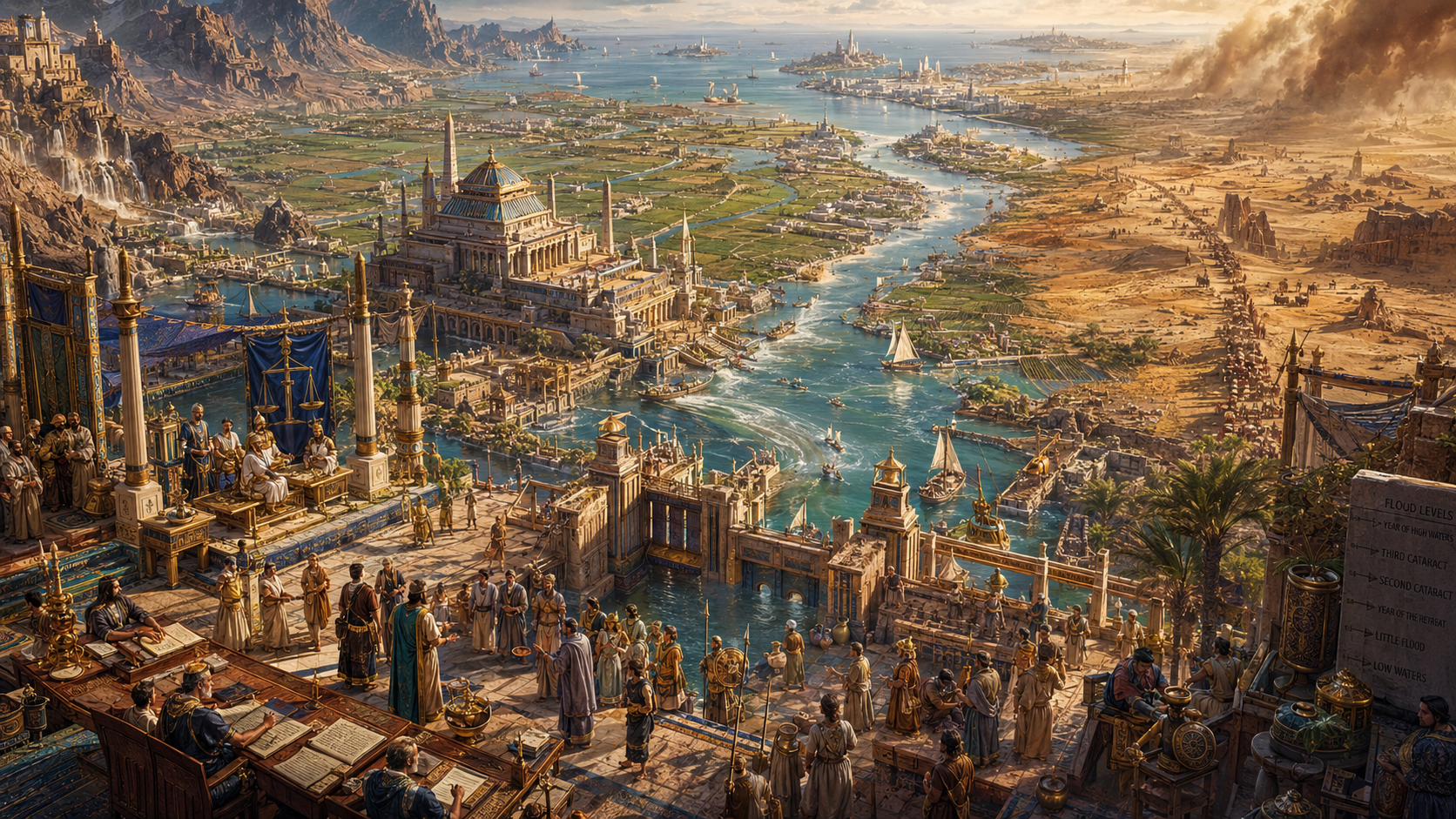
Suthrane
Suthrane is the southern sacred river and arid continent of Thesalon.
It is a land of holy water, temple law, floodplain wealth, desert survival, caravan roads, pilgrimage routes, burial processions, oasis treaties, salt flats, mountain passes, and cities built around the question of who may drink, judge, travel, bury, wash, irrigate, and pray.
Suthrane is not simply desert.
It is river civilization.
It is canal stone and flood silt. It is white temple steps descending into sacred water. It is public cisterns under lock and prayer. It is caravan bells in dry wind. It is priests measuring flood marks with bronze rods. It is farmers arguing over canal gates. It is pilgrims climbing sunlit steps. It is mourners carrying the dead before dawn. It is oasis judges ruling over a cup of water as seriously as other lands rule over crowns.
The heart of Suthrane is the Anointed River.
Where the river flows, cities rise, fields bloom, temples judge, boats gather, and floodplains feed thousands.
Where the river does not reach, survival depends on cisterns, wells, caravans, treaties, shade, memory, and the mercy or greed of those who control water.
In Suthrane, water is never only water.
It is law.
It is wealth.
It is faith.
It is medicine.
It is inheritance.
It is pilgrimage.
It is obligation.
It is life.
Page Index
- Suthrane at a Glance
- What Players Should Know
- The Central Question of Suthrane
- First Impressions
- The Shape of Suthrane
- Major Regions
- Major Polities and Powers
- Cities, Temple-Cities, Oasis Towns, Ports, and Important Sites
- Life in Suthrane
- Water Law, Temple Law, and Sacred Obligation
- Pilgrimage, Burial, and Public Faith
- Roads, Rivers, Canals, Caravans, and Sea Routes
- Faith, Temples, Saints, and Cults in Suthrane
- Magic, Sacred Water, Flood Marks, and Desert Power
- Peoples, Ancestries, and Languages
- Suthrani Character Origins
- Public Factions
- Important Public NPCs
- Common Rumors and Misconceptions
- Adventure Hooks
- How to Play a Suthrani Character
- Suthrane Quick Reference
- Settlement Index by Region
- Common Shops and Services in Suthrane
- Common Suthrane Encounters by Region
- Suthrane Travel Complications
- Suthrane Downtime Ideas
- Suthrane Character Name and Identity Notes
- Player Safety and Spoiler Boundary
- Page Use Guide
- Related Pages
Suthrane at a Glance
| Topic | Suthrane |
|---|---|
| World Role | The southern sacred river and arid continent of Thesalon. |
| Core Identity | A civilization shaped by sacred water, temple authority, floodplain wealth, pilgrimage, caravan survival, and desert law. |
| Defining Feature | The Anointed River. |
| Major Waters | The Anointed River, the Ivory Floodplain, the Inner Sea, temple canals, oasis wells, mountain springs, and public cisterns. |
| Political Mood | Ceremonial, devout, legalistic, practical, unequal, ancient, contested. |
| Major Tensions | Who controls water, who interprets holiness, who may travel, who may bury, who may drink, who may irrigate, who may judge. |
| Common Conflicts | Water access, temple courts, pilgrimage tolls, oasis rights, canal sabotage, burial disputes, caravan protection, desert survival, heresy accusations, drought rationing. |
| Best Known For | River temples, sacred steps, flood markers, pilgrim roads, burial roads, water courts, oasis treaties, caravanserais, dry cities, salt flats, and holy canals. |
| Player Character Fit | Pilgrims, river judges, temple scribes, caravan guards, desert guides, healers, canal workers, Inner Sea sailors, oasis advocates, relic seekers, burial-road mourners, cistern engineers, salt traders. |
What Players Should Know
Suthrane is built around the Anointed River.
The river is treated as sacred by many Suthrani peoples, temples, courts, villages, and pilgrims. Its waters feed the Ivory Floodplain, fill canals, sustain river cities, supply ritual basins, and carry boats, grain, pilgrims, judges, merchants, mourners, and news across the continent.
But Suthrane is not only the river.
Away from the Anointed River, survival becomes harder. Dry cities depend on cisterns and water credit. Oasis cantons guard wells by treaty. Caravan roads cross harsh ground where a broken water jar can matter more than a broken sword. The Scorching Expanse holds ruins, mirages, glass dunes, hidden cisterns, and roads that only experienced guides should attempt. The Southern Salt Flats produce wealth and suffering. The Sundered Mountain Passes guard springs, mines, monasteries, and high roads.
Suthrane is famous for its temples, but temples do not control everything.
Temple courts are powerful. River judges are respected. Pilgrim hosts matter. Burial orders command public reverence. But caravan guilds, oasis assemblies, Inner Sea captains, cistern engineers, floodplain grain houses, dry city councils, mountain monasteries, and salt wardens all hold practical authority.
A visitor should understand three things before traveling in Suthrane:
First, water has law.
Second, law has ritual.
Third, ritual has politics.
A cup of water may be charity, payment, right, tax, blessing, theft, insult, treaty, or crime depending on where it is given, who gives it, and who witnesses it.
The Central Question of Suthrane
Suthrane’s central question is:
When survival depends on sacred water, who has the right to decide what is holy?
This question shapes almost every part of Suthrani life.
A river temple may say the flood is a divine mercy.
A farmer may say the flood is late because the canal gates were mismanaged.
A dry city council may say sacred water cannot belong only to river priests.
An oasis canton may say guest-water belongs to any traveler who arrives under lawful need.
A caravan guild may say no pilgrimage can happen if road guards and water wagons are not paid.
A burial order may say the dead must receive last water no matter the drought.
A canal engineer may say the math matters more than the sermon.
A river judge may answer that the sermon is part of the math.
In Suthrane, survival and holiness are not separate. They touch in every basin, cistern, canal, jar, well, flood mark, and dry throat.
Sacred Water Is Political
Most Suthrani traditions hold that certain waters are sacred.
That does not mean those waters are free of conflict.
People argue over who may draw water, who may carry it, who may sell it, who may deny it, who may bless it, who may store it, and who may punish those who waste it.
The question is rarely whether water matters.
The question is who gets to measure it.
Temple Authority Is Powerful but Not Absolute
Grand temples possess enormous influence. They preserve ritual law, flood records, saint histories, pilgrimage routes, legal formulas, water rites, and public calendars.
But a temple cannot move a caravan alone.
A judge cannot irrigate a field without canal labor.
A priest cannot maintain a cistern without engineers.
A floodplain estate cannot harvest without workers.
An oasis cannot survive if every traveler takes and none return obligation.
Suthrane is full of religious authority, but it is also full of negotiation.
Scarcity Changes Morality
Many Suthrani moral questions become harder during drought.
Is it theft to draw water from a temple cistern to save a child?
Is it murder to sabotage a canal that feeds a wealthy estate but starves a village downstream?
Is refusing water to a criminal lawful justice or an offense against the gods?
Should pilgrims be allowed to travel when local wells are low?
Does the dead person’s right to last water outweigh the living settlement’s need?
Suthrane does not answer these questions with one voice.
It turns them into law, ritual, prayer, protest, and sometimes violence.
First Impressions
A traveler entering Suthrane may first notice the light.
The sun is strong. Stone gleams white. River water throws gold reflections onto temple walls. Heat trembles above roads. Cloth awnings snap in dry wind. Pilgrims carry water jars on their shoulders. Priests mark canal gates with clay seals. Caravan animals wear bells that sound thin in the open air.
Near the Anointed River, Suthrane can feel impossibly alive.
There are temple docks, river steps, laundry terraces, reed boats, grain barges, flood markers, fish stalls, public basins, water courts, canal locks, healing pools, clay jar markets, and pilgrims washing dust from their feet before entering holy streets.
In the Ivory Floodplain, fields stretch wide in ordered green and gold. Floodbell towers stand above villages. Canal gates divide water with public ceremony. Granaries rise like fortresses. Estate walls are painted with old flood lines. Workers sing harvest songs that are also legal memory.
At the Inner Sea, sailors mend nets beside blue shrines. Salt merchants haggle under striped awnings. Temple fleets unload pilgrims. Fishers argue with port judges. Lighthouse bells sound across hot water.
Away from the river, Suthrane changes.
Dry cities are built around cistern towers and shaded plazas. Oasis gates close during scarcity. Caravanserais count skins of water before sacks of coin. Desert guides read wind, stone, thorn, and silence. Burial roads move at dawn and dusk to spare mourners the worst heat. In the salt flats, glare can make the world seem emptied of mercy.
Common first impressions include:
- Broad river steps worn smooth by generations of pilgrims.
- Public water jars sealed with temple clay.
- Flood marks carved into stone walls.
- Canal gates watched by judges, engineers, and farmers.
- Temple scribes writing beneath awnings.
- Pilgrim boats painted with sacred symbols.
- Caravan bells approaching before the caravan is visible.
- White cloth shade canopies over markets.
- Bronze water measures hanging in court squares.
- Burial processions moving before sunrise.
- Salt workers wrapping their faces against glare.
- Oasis guards counting travelers before opening the Dry Gate.
- Children learning water prayers and water law together.
- Priests, engineers, and merchants arguing beside the same basin.
Suthrane often feels ancient and immediate at once.
Every stone seems old.
Every cup of water matters now.
The Shape of Suthrane
Suthrane is organized by water, heat, route, and ritual.
The Anointed River is the continent’s sacred spine. It supports river cities, temple docks, canal networks, healing houses, courts, markets, agriculture, and pilgrimage traffic.
The Ivory Floodplain spreads around the river’s life-giving floods. It is rich, fertile, politically powerful, and deeply tied to grain, temple estates, flood calendars, and canal labor.
The Inner Sea Basin is a broad inland water world of ports, fishing fleets, temple ships, salt trade, sailor courts, and coastal pilgrimage.
The Grand Temple Precincts are not one single city but a constellation of temple complexes, ritual courts, archives, saint shrines, pilgrim cloisters, and legal institutions that shape Suthrane’s religious authority.
The Scorching Expanse is the deep arid interior, where survival depends on wells, caravan routes, hidden cisterns, local guides, and experience.
The Sundered Mountain Passes hold springs, mines, monasteries, watchtowers, ropeways, storm cisterns, and roads that connect Suthrane to highland communities and distant trade.
The Caravan Roads bind dryland settlements, river cities, oasis cantons, salt flats, and pilgrimage sites together.
The Oasis Cantons are local water republics, assemblies, and treaty communities built around wells, palm gardens, guest-water rights, and strict entry customs.
The Burial Roads form sacred routes of mourning, last water rites, ancestral record, funerary trade, and legal obligations to the dead.
The Pilgrim Steps include sacred climbs, confession terraces, hostels, credential gates, public basins, and road shrines used by thousands of travelers.
The Dry Cities are inland urban centers built around cistern systems, water credit, engineering guilds, shade districts, trade, and resentment toward river-temple authority.
The Southern Salt Flats are harsh mineral lands of salt extraction, glare, prison roads, exile settlements, caravan wealth, and danger.
No region in Suthrane is completely independent of water.
Even the driest place is shaped by where water is absent.
Major Regions
The regions below are player-facing geographic and cultural divisions. They are not all formal political borders. Some are religious regions, some are economic zones, some are travel networks, and some are defined by common experience.
Each region includes notable settlements and sites by name. Deeper descriptions appear later in the Cities, Temple-Cities, Oasis Towns, Ports, and Important Sites section.
The Anointed River Corridor
The Anointed River Corridor is the sacred and practical heart of Suthrane.
It follows the Anointed River through river cities, temple docks, canal districts, agricultural towns, water courts, pilgrim landings, flood markers, fish markets, reed beds, clay works, and healing houses.
To many Suthrani traditions, the river is not merely useful. It is blessed, witnessed, named, measured, sung to, argued over, and judged by sacred law.
The river gives life, but it also creates hierarchy. Those close to it often have wealth, ritual prestige, and legal advantage. Those farther away may resent the river cities’ assumption that they speak for Suthrane as a whole.
What Defines the Anointed River Corridor
- Sacred river authority
- Temple docks
- River courts
- Water measures
- Pilgrimage boats
- Canal seals
- Healing basins
- Fish and reed economies
- Flood records
- Irrigation law
- Public washing rites
- Clay jar trade
Common Sights
Travelers along the Anointed River may see:
- Pilgrims washing their feet before climbing temple steps.
- River judges hearing disputes beneath white awnings.
- Water carriers moving in lines with sealed jars.
- Fishers unloading nets beside prayer flags.
- Canal engineers arguing with priests over gate timing.
- Bronze flood rods mounted in public squares.
- Children learning to read flood marks.
- Healing houses where sacred washing is part of treatment.
- Barges painted with temple licenses.
- Clay seals broken in public before water is released.
Settlements and Sites in the Anointed River Corridor
- Anointis — great river temple-city and symbolic heart of water law.
- Rivercourt of the First Measure — major water-law court.
- The Thousand Steps of Pouring — sacred river stair and public water rite site.
- White Jar District — district of water carriers, jar makers, household water offices, and ritual basin suppliers.
- Canal-Seal House — office regulating canals, irrigation schedules, clay seals, and water release authority.
- Saint Veyra’s River Hospital — healing house tied to sacred washing, childbirth, fever treatment, and mercy water.
- The Floodmark Colonnade — public record of historic floods carved into stone pillars.
- Selari’s Bargain Quay — merchant dock and contract shrine for river trade.
- The Pilgrim Boat Yards — docks and workshops for pilgrimage craft.
- The Low Silt Market — river goods market for reeds, fish, clay, salt, grain, dyes, rope, and jars.
- Bronze Measure Landing — official public water-measure pier.
- The River-Scribe Terraces — stepped offices where legal water copies are written and sealed.
- Thalara’s Bend Shrine — river-navigation shrine at a dangerous bend.
- The Reed Child Schools — riverfront schools teaching letters, counting, water law, and flood songs.
The Ivory Floodplain
The Ivory Floodplain is Suthrane’s great fertile region.
It is rich because the river floods.
It is powerful because the flood can be measured, stored, diverted, taxed, blessed, and fought over.
The Floodplain feeds river cities, temple precincts, dryland caravans, pilgrimage hosts, and distant markets. Its grain houses and temple estates are among the most influential powers in Suthrane.
But the Floodplain’s wealth rests on labor and timing. Canal workers, farmers, ox drivers, seed keepers, flood watchers, grain guards, threshers, water clerks, and village priests all hold pieces of the system together.
When floods are generous, the Floodplain sings.
When floods fail, everyone looks for someone to blame.
What Defines the Ivory Floodplain
- Fertile silt fields
- Grain wealth
- Flood calendars
- Temple estates
- Canal gates
- Floodbell villages
- Agricultural courts
- Harvest rites
- Silt taxes
- Labor districts
- Flood memory
- Class tension
Common Sights
Travelers in the Ivory Floodplain may see:
- Green fields bordered by pale canal walls.
- Floodbell towers rising above villages.
- Grain barges loaded under temple seals.
- Workers repairing canal banks with mudbrick and reed mats.
- Estate officials carrying water schedules.
- Children reciting the flood years.
- Farmers arguing over whether a gate opened too early.
- Public granaries guarded like temples.
- Harvest shrines covered in grain, flowers, and wet clay.
- Tenant villages built on raised mounds above flood lines.
Settlements and Sites in the Ivory Floodplain
- Ivoryfield — major floodplain grain city and agricultural court center.
- High Silt Granaries — fortified temple grain reserves.
- Floodbell Villages — villages organized around flood warning bells and canal schedules.
- The White Reed Estates — wealthy temple-linked estates.
- The Silt-Tithe Office — grain and water tax authority.
- Halven’s Flood Table — public harvest shrine and food distribution site.
- The Canal of Seven Gates — major irrigation canal with sacred and legal importance.
- Mudbrick Commons — labor district and floodplain housing.
- The First Seed Court — agricultural dispute court.
- The Reed-Widow Fields — lands held for households lost to floods, canal collapses, or harvest disease.
- Threshing Moon Yard — seasonal labor market and harvest festival ground.
- The White Ox Causeway — raised road crossing the floodplain during wet seasons.
- Siltmother’s Watch — flood observation tower and village shrine.
- The Canal Children’s Home — orphan house for children of flood and canal disasters.
The Inner Sea Basin
The Inner Sea Basin is Suthrane’s inland water world.
It contains ports, fishing villages, salt markets, sailor courts, temple fleets, island shrines, coastal pilgrim roads, glasswater harbors, net-mending quarters, lighthouse shrines, and shipyards.
The Inner Sea connects river culture to maritime culture. It is less politically unified than the Anointed River Corridor, but no less important. Fish, salt, oil, reeds, glass, cloth, pilgrims, sailors, rumors, and court documents move across its waters.
The Inner Sea Basin is where Suthrane looks inward across water instead of outward across desert.
What Defines the Inner Sea Basin
- Inland sea ports
- Fishing fleets
- Temple ships
- Salt and fish trade
- Maritime courts
- Island pilgrimage
- Coastal roads
- Sailor shrines
- Lighthouse bells
- Net quarters
- Boat repair yards
- River-sea transition rites
Common Sights
Travelers in the Inner Sea Basin may see:
- Blue-painted fishing boats pulled onto pale shore.
- Nets drying beside temple flags.
- Salt merchants weighing blocks under shadecloth.
- Sailors touching shrine stones before boarding.
- Port clerks writing cargo records in salt-stained ledgers.
- Pilgrim fleets departing at dawn.
- Children diving from broken piers.
- Lighthouse bells sounding across hot water.
- Fish oil lamps burning in blue glass.
- Temple boats carrying priests, judges, healers, and mourners.
Settlements and Sites in the Inner Sea Basin
- Innersea Port of Luminous Oars — major Inner Sea port and temple fleet city.
- Glasswater Harbor — trade and fishing harbor known for clear shallows and glass craft.
- Blue Shrine Quay — Thalara shrine and sailor court.
- Salt Mirror Market — salt, fish, glass, oils, dyed cloth, and maritime goods market.
- The Lantern Fleet House — temple fleet office.
- Drowned Bell Island — pilgrimage island and warning site.
- Oar-Scribe Row — contract and cargo district.
- The Net-Menders’ Quarter — fisherfolk and boat repair district.
- The Sea-Judgment Steps — maritime dispute court.
- The White Wake Road — coastal pilgrimage route.
- Brightscale Fishery — major fishing village under temple-charter protection.
- The Blue Oil Presses — district producing lamp oil and ritual oil.
- Stormjar Lighthouse — lighthouse shrine storing emergency water and signal lamps.
- The Island of Returning Nets — small pilgrim island where sailors pray after surviving storms.
The Grand Temple Precincts
The Grand Temple Precincts are the greatest concentration of formal religious authority in Suthrane.
They are not one single temple. They are a vast network of temple complexes, courts, archives, cloisters, ritual basins, saint shrines, libraries, water schools, pilgrim hostels, judgment steps, public kitchens, healing houses, funerary gates, and ceremonial streets.
Here, temple law becomes architecture.
The Grand Temple Precincts influence water law, pilgrimage credentials, burial rites, flood interpretation, saint recognition, moral appeals, ritual calendars, temple diplomacy, and public legitimacy across Suthrane.
But even here, unity is not simple. Different temples, priestly houses, saint orders, legal schools, healing institutions, burial authorities, and water judges may disagree.
Suthrane’s faith is powerful because it is real.
It is contested because it matters.
What Defines the Grand Temple Precincts
- Temple authority
- Sacred law
- Ritual basins
- Grand courts
- Temple archives
- Pilgrim cloisters
- Healing houses
- Funerary gates
- Saint recognition
- Heresy hearings
- Flood interpretation
- Water legitimacy
Common Sights
Travelers in the Grand Temple Precincts may see:
- Long white stairways washed at dawn.
- Priests carrying bronze measures and sealed jars.
- Pilgrims waiting barefoot in credential lines.
- Legal advocates rehearsing water-law arguments.
- Healers drawing water from ritual basins.
- Mourners entering Morvane’s gate in silence.
- Saint banners hung between temple towers.
- Temple students copying flood records.
- Heresy hearing crowds whispering under sun cloths.
- Public kitchens feeding pilgrims, witnesses, and the poor.
Settlements and Sites in the Grand Temple Precincts
- The Grand Temple Precinct of the Nine Basins — largest temple complex and ceremonial center.
- Court of Sacred Measures — supreme temple-water court.
- The Basin Archives — ritual, law, flood, pilgrimage, saint, and lineage records.
- Aurelion’s Sun-Judgment Hall — oath, law, judgment, and temple legitimacy.
- Veyra’s House of Open Hands — major healing and mercy temple.
- Morvane’s Gate of Proper Passage — burial and soul-passage temple.
- Thalara’s Tide-Basin Chapel — river-sea transition shrine.
- Olyrra’s Memory Cloister — saint records, ancestry archives, and flood memory.
- The Pilgrim Cloisters — lodging, confession, legal aid, and ritual preparation.
- The Heresy Hearing Steps — public religious dispute court.
- The Ninth Basin of Mercy — public basin used for emergency water appeals.
- The White Robe Courts — court district for temple legal schools.
- Saint Luma’s Hall of Shade — pilgrim mercy hall and rest precinct.
- The Measure-Makers’ Arcade — shops and workshops producing legal water measures, ritual jars, and basin tools.
The Scorching Expanse
The Scorching Expanse is the deep arid interior of Suthrane.
It is not empty.
It contains caravan roads, hidden wells, glass dune camps, old ruins, dry thorn shrines, desert camps, salt wind valleys, mirage fields, buried cisterns, bandit wells, and places where travelers learn that confidence is not the same thing as water.
Most Suthrani children hear warnings about the Scorching Expanse before they are old enough to travel. Do not walk without a guide. Do not trust a shine on the horizon. Do not break a water seal in secret. Do not ignore a thorn marker. Do not mock a desert shrine. Do not assume silence means safety.
The Expanse is harsh, but it has its own knowledge, trade, saints, guides, and law.
What Defines the Scorching Expanse
- Deep desert
- Caravan survival
- Hidden cisterns
- Mirage ruins
- Dangerous wells
- Glass dunes
- Dry thorn shrines
- Bandit routes
- Desert guide families
- Water discipline
- Heat omens
- Buried old settlements
Common Sights
Travelers in the Scorching Expanse may see:
- Canvas tents low against the wind.
- Thorn markers tied with colored cloth.
- Camels kneeling beside sealed water jars.
- Desert guides testing sand with bronze rods.
- Glassy dunes glittering under noon sun.
- Bones arranged as warnings.
- Ruined walls half-buried by sand.
- Pilgrims walking at night to avoid the heat.
- Water skins counted before coin.
- Silent horizons that seem to move.
Settlements and Sites in the Scorching Expanse
- Sunbreak Caravanserai — major desert road shelter and caravan contract hub.
- The Red Shade Wells — contested desert well complex.
- Mirage Court Ruins — ancient ruin visible only in certain heat conditions or atmospheric illusions.
- The Bone-White Road — deadly desert route.
- The Thirst-Marker Stones — warning stones marking waterless stretches.
- Vaelthorn’s Dry Thorn Shrine — survival and wilderness shrine.
- The Last Canvas Market — caravan camp market.
- Glass Dune Camps — glassworkers, desert scavengers, and heat-glass traders.
- The Sunken Cisterns of Marath — buried old water system.
- The Noon Silence — feared desert zone where sound behaves strangely.
- Dust-Lantern Hollow — night camp used by guides avoiding daytime travel.
- The Red Scorpion Toll — dangerous pass-through controlled by armed desert families.
- Saint Oranth’s Noon Post — sun-vigil shrine where travelers confess heat errors.
- The Broken Jar Flats — stretch of desert marked by failed expeditions and shattered pottery.
The Sundered Mountain Passes
The Sundered Mountain Passes cut through the highlands that shape Suthrane’s weather, springs, mining routes, and caravan access.
The mountains are not only barriers. They are sources of water.
Storms break against them. Springs emerge from them. Monasteries guard them. Miners carve into them. Pilgrims climb them. Bandits hide in them. Pass courts tax them. Ropeways cross them. Cisterns gather what the sky gives.
The Sundered Passes are respected because they provide water and feared because they can take travelers without warning.
What Defines the Sundered Mountain Passes
- Mountain springs
- Pilgrimage climbs
- Pass monasteries
- Mining settlements
- Ropeways
- Storm cisterns
- Signal towers
- Bandit paths
- Rockfall law
- High shrines
- Military bastions
- Toll roads
Common Sights
Travelers in the Sundered Mountain Passes may see:
- Prayer flags snapping from rope bridges.
- Monks carrying water down stone stairs.
- Miners with copper dust on their clothes.
- Cisterns built into cliff walls.
- Mule trains moving single-file along narrow ledges.
- Pass guards checking weather before papers.
- Shrines built around mountain springs.
- Old signal towers watching dry roads below.
- Pilgrims climbing barefoot for vows.
- Bells echoing through passes before storms.
Settlements and Sites in the Sundered Mountain Passes
- Highpass of Broken Veils — major mountain crossing and pass court settlement.
- Stonecup Monastery — mountain water monastery.
- Edrun’s Split Gate — mountain shrine and pass court.
- The Sundered Watchtowers — old signal and defense towers.
- Spring-Vow Hold — settlement protecting mountain springs.
- The Copper Step Mines — mining settlement.
- The Pilgrim Ropeway — dangerous pass route used by pilgrims and cargo crews.
- Stormjar Cisterns — mountain water storage works.
- Kharos’ Pass Bastion — military defense site.
- The Echoing Toll Road — caravan toll route.
- The Blue Snowmelt Steps — seasonal stair route opened after high melt.
- The Broken Veil Hostels — shelters for pilgrims and travelers delayed by weather.
- The Copperbell Foundry — bell and basin metalworks using mountain ore.
- Saint Veyra’s Cold Spring — healing spring below Stonecup Monastery.
The Caravan Roads
The Caravan Roads connect the river, floodplain, dry cities, oases, mountains, salt flats, pilgrimage routes, and distant markets.
They are not one road. They are a web of known tracks, chartered routes, toll roads, pilgrim roads, trade paths, seasonal crossings, guarded corridors, and unofficial trails.
Caravan life is practical and ritualized. Before departure, water is counted, animals inspected, contracts sealed, road shrines visited, guards hired, and route rumors compared. The order of a caravan may decide whether it survives.
The Caravan Roads are where Selari’s bargains meet the desert’s indifference.
What Defines the Caravan Roads
- Overland trade
- Pilgrim movement
- Guard contracts
- Road shrines
- Toll stones
- Animal markets
- Water logistics
- Charter law
- Guide families
- Trade codes
- Wayhouses
- Dust markets
Common Sights
Travelers on the Caravan Roads may see:
- Lines of pack animals wearing bells and colored tassels.
- Road scribes writing contracts on portable boards.
- Water jars sealed with wax, clay, or cord.
- Caravan guards checking bowstrings in the shade.
- Pilgrims walking alongside merchants.
- Painted milestone stones marked with temple colors.
- Toll collectors weighing goods and water separately.
- Road shrines covered with cloth strips and coin ties.
- Night markets under canvas.
- Guides listening to wind before choosing a route.
Settlements and Sites on the Caravan Roads
- Road of Blue Jars — major caravan and pilgrim road.
- Three-Tent Junction — caravan market and crossroads.
- Selari’s Windscale House — trade and bargain shrine.
- The Camel-Bell Yards — caravan animal market.
- Dustcoin Tollhouse — road tax and protection station.
- The Painted Milestones — route markers with temple colors.
- Saint’s Shade Wayhouse — pilgrim shelter and caravan rest point.
- The Thousand Rope Corrals — caravan staging grounds.
- The Road-Scribe Pavilion — contracts, travel papers, caravan charters, and route seals.
- The Bandit King’s Dry Well — infamous danger site.
- Blue Jar Milehouse Seven — fortified shelter on a long dry stretch.
- The Sandal-Menders’ Row — roadside repair market for pilgrims and caravan workers.
- The Dust Bell Alarm Post — warning station for raiders, storms, and missing caravans.
- The Night Bargain Market — evening trade market operating when heat falls.
The Oasis Cantons
The Oasis Cantons are Suthrane’s well-centered communities.
They are not merely rest stops. They are local political worlds built around wells, palm gardens, water treaties, guest customs, trade, gardens, cisterns, and strict rules about who may enter during scarcity.
Oasis cantons often guard autonomy fiercely. River temples may claim moral authority over all sacred water, but an oasis council will answer that no distant judge knows the depth of its well.
Oasis law is often practical, hospitable, and severe.
A traveler in lawful need may be owed guest-water.
A traveler who lies about need may be punished harshly.
What Defines the Oasis Cantons
- Wells
- Palm gardens
- Guest-water rights
- Local assemblies
- Water treaties
- Date markets
- Deep cisterns
- Controlled gates
- Desert hospitality
- Scarcity law
- Garden shrines
- Neutral meeting customs
Common Sights
Travelers in the Oasis Cantons may see:
- Palm shadows over public basins.
- Well guards counting arrivals.
- Local judges holding court beside water jars.
- Date sellers under green awnings.
- Garden shrines lit after sunset.
- Children lowering small buckets into practice wells.
- Caravans waiting outside a Dry Gate.
- Guest-water cups marked with canton signs.
- Engineers listening to well echoes.
- Night markets scented with fruit, dust, and lamp oil.
Settlements and Sites in the Oasis Cantons
- Greenveil Oasis — major oasis canton and treaty settlement.
- The Well of Three Oaths — water treaty site.
- Palmshade Canton Hall — local oasis assembly.
- Date-Market of Greenveil — trade in fruit, cloth, water rights, caravan goods, and desert medicines.
- The Deep Rope Wellhouse — guarded well and engineering site.
- Veyra’s Cool Room — healing and rest shrine.
- The Guest-Water Court — dispute court over travelers’ water rights.
- The Palm-Root Cisterns — protected underground water.
- The Night Garden Shrines — evening worship gardens.
- The Dry Gate — controlled entry point during scarcity.
- Glassleaf Pool — small sacred pool used for oath reflection.
- The Green Veil Looms — textile workshops producing shadecloth and water-carrying wraps.
- The Thirst Witness Wall — public record of drought years and emergency rulings.
- Saint Luma’s Date Grove — mercy grove where stranded travelers may receive food and shade.
The Burial Roads
The Burial Roads are sacred routes used for funerary processions, proper passage rites, ancestral journeys, tomb pilgrimages, and legal disputes over the dead.
In Suthrane, burial is not only private grief. It is public law, spiritual duty, family memory, and community identity.
A body must be treated properly.
A name must be preserved.
A last washing may require water even during scarcity.
A procession may have road rights that merchants resent.
A family may travel across regions to bury someone in an ancestral place.
A court may need to decide whether remains are properly identified before a tomb is opened or sealed.
The Burial Roads make death visible.
What Defines the Burial Roads
- Funerary routes
- Proper passage
- Last water rites
- Tomb towns
- Ancestral law
- Mourner markets
- Sacred carts
- Name walls
- Procession rights
- Disputed remains
- Catacombs
- Grief hospitality
Common Sights
Travelers on the Burial Roads may see:
- Processions moving before dawn.
- Black veils tied to cart poles.
- Priests carrying sealed last-water jars.
- Mourners walking barefoot for a mile.
- Name scribes recording the dead at road gates.
- Funeral goods sold in quiet markets.
- Tomb guards watching desert ridges.
- Public benches for final testimony.
- Lamps burning in wind shelters.
- Families arguing softly over where a body belongs.
Settlements and Sites on the Burial Roads
- Morvane’s Long Road — major burial pilgrimage route.
- Black Veil Procession Gate — formal start of a major burial road.
- Tombtown of Quiet Lamps — funerary settlement and burial-road service town.
- The House of Last Water — final washing temple.
- Olyrra’s Name Wall — ancestral record site.
- The Sand-Sealed Catacombs — protected burial complex.
- The Mourner’s Market — burial goods, candles, cloth, memorial tokens, urns, and grave tools.
- The Silent Cart Yards — funerary transport services.
- The Saint of Empty Hands Shrine — humility and grief shrine.
- The Unburied Court — legal court for disputed remains and improper death.
- The Ash-Cloth Hostels — lodging houses for mourning families.
- The Last Bell Pavilion — place where bells are rung for processions leaving settled land.
- The White Bone Registry — identification office for remains found in desert or flood.
- The Road of Folded Names — side route used by families carrying multiple dead.
The Pilgrim Steps
The Pilgrim Steps are Suthrane’s sacred climbs, devotional roads, confession terraces, credential gates, mercy basins, and host networks.
Pilgrimage is one of Suthrane’s most visible practices. Pilgrims travel for healing, forgiveness, thanksgiving, mourning, judgment, oath renewal, saint festivals, river rites, family duty, or personal transformation.
Pilgrims are not all harmless.
Some are sincere. Some are desperate. Some are spies, smugglers, fugitives, false penitents, political messengers, or people hiding under sacred travel customs.
Because pilgrimage is sacred, regulating it is difficult.
Because water is scarce, ignoring it is impossible.
What Defines the Pilgrim Steps
- Sacred climbs
- Pilgrim credentials
- Hostels
- Confession stations
- Public basins
- Mercy water
- Road shrines
- Legal protection
- False pilgrims
- Testimony rites
- Devotional markets
- Processional calendars
Common Sights
Travelers on the Pilgrim Steps may see:
- Barefoot pilgrims climbing white stone in silence.
- Credential clerks checking temple marks.
- Candle sellers under striped awnings.
- Water carriers serving measured cups.
- Confession witnesses seated beneath shadecloth.
- Shrine guards separating pilgrims from merchants.
- Public basins filled at dawn.
- Hostels marked by white sashes.
- Sick travelers waiting for healing water.
- Children selling sandals, prayer strips, and jar cords.
Settlements and Sites on the Pilgrim Steps
- Steps of the First Pilgrim — major pilgrimage ascent.
- Confession Terrace — public ritual and testimony site.
- The White-Sash Hostels — pilgrim lodging network.
- The Credential Gate — temple document checkpoint.
- Saint Luma’s Shade — rest shrine and public water source.
- The Candle Stair Market — candles, sandals, prayer cloths, water jars, and pilgrim supplies.
- The Pilgrim Dispute Court — guest law and pilgrimage conflict court.
- The Barefoot Mile — devotional road stretch.
- The Mercy Basin — public washing and healing basin.
- The Stepwatch Patrol House — pilgrim protection station.
- The Hall of Returned Sandals — place where completed pilgrims hang worn footwear.
- The Lower Confessor’s Well — small well used for oath testimony before ascent.
- The Pilgrim Bell Arch — ceremonial entrance where travelers declare intent.
- The False Credential Office — investigative bureau for forged pilgrim marks and abuses of holy travel.
The Dry Cities
The Dry Cities are inland urban centers away from the direct abundance of the Anointed River.
They survive through cistern systems, aqueducts, wells, water credit, engineering guilds, caravan trade, shade architecture, ration law, and strict civic organization.
Dry city residents often resent the assumption that river temples define Suthrane completely. They may be devout, but their devotion is shaped by scarcity and engineering as much as river ritual.
A dry city prayer may sound like this:
Bless the basin.
Check the seal.
Repair the crack.
Count the jars.
What Defines the Dry Cities
- Cistern systems
- Water credit
- Engineering guilds
- Shade districts
- Dryland markets
- Aqueduct disputes
- Ration law
- Inland trade
- Civic protest
- Drought bells
- Water debt
- Resentment toward river authority
Common Sights
Travelers in the Dry Cities may see:
- Tall cistern towers dominating city skylines.
- Blue-painted doors marking water offices.
- Shadecloth streets strung between buildings.
- Water-debt notices posted in market squares.
- Engineers listening for leaks beneath stone.
- Public fountains left dry except on ritual days.
- Protesters gathering in empty plazas.
- Merchants selling cooling cloth, jar cords, and water skins.
- Children carrying household water tokens.
- Bells rung when ration levels change.
Settlements and Sites in the Dry Cities
- Cisternhold — major dryland city built around deep cistern systems.
- Dustcrown Market — inland trade city and dryland commercial hub.
- The Hollow Aqueduct — broken or contested waterworks.
- Drylaw Court — legal institution challenging river-temple authority.
- The Blue Jar Bank — water credit and storage house.
- Saint Veyra’s Drought House — mercy temple during water shortage.
- The Shadecloth District — textiles, tents, awnings, desert clothing, and cooling architecture.
- The Cistern Engineers’ Guildhall — water engineering authority.
- The Empty Fountain Plaza — civic protest and memory site.
- The Drought Bell Tower — emergency warning and ration marker.
- The Deep Ledger Cistern — secure underground water store tied to water credit.
- The Cracked Basin Court — local court for ration fraud and civic water disputes.
- The Windcatcher Roofs — high ventilation district where wealthier homes collect cool air and dew.
- The Blue Debt Steps — public stairs where water debtors appeal for mercy or extension.
The Southern Salt Flats
The Southern Salt Flats are harsh, bright, dangerous, and valuable.
They produce salt, crystal, mineral dyes, glass-salt, brine, and other materials that river cities, temples, caravans, ports, and foreign traders all need.
The Salt Flats also hold exile camps, labor roads, guard stations, mirage towers, brine pits, sun shrines, and places where the glare can blind the careless or the unlucky.
Many Suthrani people speak of the Salt Flats with discomfort. They know the salt is necessary. They also know that necessary labor is often used to excuse cruelty.
What Defines the Southern Salt Flats
- Salt extraction
- Mineral wealth
- Harsh labor
- Exile settlements
- Prison roads
- Mirage danger
- Guard stations
- Sun-reflection shrines
- Brine pits
- Salt caravans
- Labor contracts
- Water scarcity
Common Sights
Travelers in the Southern Salt Flats may see:
- Workers wrapped head to foot against glare.
- Salt pans shining white under brutal sun.
- Brine pits fenced with warning poles.
- Guard towers watching labor roads.
- Exiles living in low shade camps.
- Salt caravans moving at dawn and dusk.
- Reflective shrines covered in pale cloth.
- Mirage warning bells.
- Traders testing salt blocks for purity.
- Water barrels locked in iron frames.
Settlements and Sites in the Southern Salt Flats
- Saltwake Flatworks — major salt extraction settlement.
- White Crust Road — salt caravan route.
- The Brine Pits — salt labor and mineral site.
- Exile’s Shade Camp — marginal settlement and legal exile site.
- The Salt-Mirror Shrine — sun and reflection shrine.
- The Dry Chain Barracks — guard and labor control station.
- The Glass-Salt Market — salt, crystal, glass, dyes, and mineral trade.
- The Last Brine Well — dangerous water source.
- Malrec’s Cracked Altar — disaster and collapse shrine.
- The Saltblind Watch — tower for mirage and raider warnings.
- White Knife Flats — dangerous salt plain where sharp crust cuts through boots.
- The Brine-Ledger Office — labor, exile, debt, and production record house.
- The Red Glare Mile — road stretch notorious for heat sickness and false horizons.
- The Salt Mourner’s Shed — small funerary shelter for workers who die far from home.
Major Polities and Powers
Suthrane is not ruled by a single crown, temple, river court, caravan guild, or city.
Its authority is layered.
A Grand Temple may define a sacred measure.
A River Court may rule on canal release.
A floodplain grain house may decide whether a town eats through winter.
An oasis canton may close its Dry Gate.
A caravan guild may refuse a route.
A cistern engineer may determine whether a dry city survives drought.
A burial order may halt trade so the dead can pass.
A salt warden may command labor in lands most river priests never visit.
Suthrane’s powers are often ceremonial, but ceremony should not be mistaken for weakness. A clay seal on a canal gate may matter more than a sword. A water token may matter more than a purse. A pilgrim credential may open roads no merchant can buy. A temple ruling may outlive the judge who spoke it.
The powers below are the major public institutions and political structures most Suthrani people would recognize.
The Grand Temple Synods
Type: Temple coalition and religious authority network
Primary Regions: The Grand Temple Precincts, Anointed River Corridor, Pilgrim Steps, Burial Roads
Public Identity: Sacred law, ritual legitimacy, water holiness, pilgrimage, burial, mercy, judgment
Common Reputation: Ancient, powerful, learned, divided, difficult to ignore
The Grand Temple Synods are the highest and most visible religious authorities in Suthrane.
They are not a single church with one voice. They are assemblies of temple houses, water judges, saint orders, healing houses, funerary authorities, pilgrim hosts, legal schools, ritual archivists, and priestly lineages that gather to interpret sacred law and preserve public ritual.
Their influence is enormous because temple authority touches water, burial, pilgrimage, healing, flood interpretation, saint recognition, oath law, and public morality.
But the Synods are not omnipotent. They must negotiate with river courts, oasis cantons, dry city councils, grain houses, caravan guilds, and engineers.
A temple may declare a water measure sacred.
Someone must still repair the canal.
What the Grand Temple Synods Control
- Major ritual calendars
- Temple law interpretations
- Pilgrim credentials
- Burial rite standards
- Saint recognition
- Mercy appeals
- Sacred water declarations
- Heresy hearings
- Temple archives
- Ritual education
- Inter-temple disputes
- Public religious proclamations
Why People Respect Them
The Synods preserve ancient knowledge, ritual continuity, public mercy systems, healing houses, flood records, burial obligations, and moral language that many Suthrani communities trust.
In times of crisis, temple kitchens, healing basins, pilgrim hostels, and mercy courts can save lives.
Why People Distrust Them
Critics say the Synods speak as if holiness and authority are the same thing.
Dry city councils accuse them of river favoritism. Oasis cantons accuse them of overreach. Canal engineers accuse them of ritualizing technical problems. Poor laborers accuse them of protecting temple estates while preaching mercy.
Character Connections
A player character tied to the Grand Temple Synods might be:
- A temple scribe.
- A pilgrim credential clerk.
- A healing acolyte.
- A water-law assistant.
- A saint procession guard.
- A heresy hearing witness.
- A temple courier.
- A disillusioned novice.
- A ritual archivist.
- A person sent to investigate whether a local temple abused water authority.
The River Courts
Type: Water-law judiciary and river authority
Primary Region: The Anointed River Corridor
Public Identity: Water measures, canal rulings, river access, irrigation law
Common Reputation: Precise, sacred, slow, intimidating, essential
The River Courts judge disputes along the Anointed River and its canals.
They are most famous for ruling on water release, irrigation timing, canal gates, river docks, flood boundaries, temple basin rights, boat passage, public washing access, and household water obligations.
River judges are trained in law, ritual, measurement, flood history, and local custom. Many carry bronze measuring rods, clay seal kits, and portable tablets of precedent.
A River Court ruling can decide whether a village lives comfortably, suffers rationing, or loses an entire planting season.
What the River Courts Control
- Water-law rulings
- Canal gate schedules
- River access disputes
- Irrigation rights
- Sacred basin claims
- Public washing law
- Boat landing rights
- Flood boundary records
- Clay seal enforcement
- Appeal procedures
- Witness testimony in water cases
Why People Respect Them
The River Courts prevent water disputes from becoming open violence.
Their rulings preserve consistency in a land where one uncontrolled canal gate can ruin downstream fields.
Why People Distrust Them
The River Courts can favor established temples, wealthy estates, old records, and communities close to the river.
Dryland travelers often complain that a court which has never known thirst should not judge a well.
Character Connections
A player character tied to the River Courts might be:
- A river judge’s aide.
- A canal witness.
- A water-measure apprentice.
- A clay seal carrier.
- A boat landing clerk.
- A legal advocate for a downstream village.
- A farmer wronged by a ruling.
- A person sent to inspect a sabotaged canal gate.
The Floodplain Grain Houses
Type: Agricultural estate powers and grain authorities
Primary Region: The Ivory Floodplain
Public Identity: Grain, flood calendars, temple estates, harvest storage, canal labor
Common Reputation: Wealthy, necessary, pious, exploitative, politically powerful
The Floodplain Grain Houses control much of Suthrane’s agricultural wealth.
Some are temple-linked estates. Some are old landholding families. Some are merchant-grain partnerships. Some are cooperative in name but dominated by powerful floodplain patrons.
They manage fields, canal labor, grain storage, harvest contracts, flood calendars, threshing yards, tenant obligations, seed distribution, and food shipments to river cities, pilgrim hosts, dry cities, caravans, and temple kitchens.
The Grain Houses are respected because they feed people.
They are resented because they know it.
What the Floodplain Grain Houses Control
- Floodplain estates
- Grain storage
- Seed reserves
- Canal labor contracts
- Harvest schedules
- Tenant obligations
- Food shipment charters
- Temple grain tithes
- Flood insurance arrangements
- Granary guards
- Mill rights
- Silt-tax records
Why People Respect Them
Suthrane cannot function without floodplain grain.
The Grain Houses preserve seed, organize labor, fund canal repairs, feed pilgrim networks, and support temple food distributions.
Why People Distrust Them
Critics accuse them of hoarding during drought, manipulating canal schedules, binding tenant families through debt, influencing temple rulings, and confusing generosity with control.
Character Connections
A player character tied to the Floodplain Grain Houses might be:
- A grain guard.
- A tenant farmer.
- A flood bell keeper.
- A harvest scribe.
- A canal laborer.
- A granary inspector.
- A household retainer.
- A runaway debt-worker.
- A food convoy escort.
- A reformer trying to expose grain hoarding.
The Inner Sea Leagues
Type: Port leagues, sailor courts, and maritime trade powers
Primary Region: The Inner Sea Basin
Public Identity: Ports, temple fleets, fishing, salt, cargo law, coastal pilgrimage
Common Reputation: Practical, salt-stained, devout, mercantile, independent
The Inner Sea Leagues are alliances of port councils, fisher guilds, sailor courts, temple fleet officers, salt merchants, boatwrights, lighthouse keepers, and coastal shrine authorities.
They move fish, salt, oil, glass, cloth, pilgrims, court documents, ritual goods, and people across the Inner Sea.
They are tied to the temples but not controlled by them. A temple fleet may bless a voyage, but sailors know winds, shoals, nets, and hulls better than priests who never leave the basin steps.
What the Inner Sea Leagues Control
- Port councils
- Fishing rights
- Temple fleet contracts
- Salt market charters
- Lighthouse maintenance
- Maritime dispute courts
- Pilgrim boat licenses
- Boat repair yards
- Cargo records
- Coastal road tolls
- Rescue obligations
- Sailor witness systems
Why People Respect Them
The Leagues keep the Inner Sea connected.
They feed inland markets, move pilgrims, maintain warning systems, and carry news faster than overland travel.
Why People Distrust Them
Critics accuse the Leagues of price fixing, smuggling, hiding wreck claims, manipulating salt supplies, and using sailor custom to resist temple law.
Character Connections
A player character tied to the Inner Sea Leagues might be:
- A sailor.
- A fisher.
- A port clerk.
- A lighthouse runner.
- A temple fleet guard.
- A salt merchant’s child.
- A boatwright.
- A shrine diver.
- A maritime judge’s assistant.
- A smuggler hiding behind pilgrim traffic.
The Caravan Guilds of the Blue Jar Roads
Type: Trade guilds and overland route authorities
Primary Regions: The Caravan Roads, Scorching Expanse, Oasis Cantons, Dry Cities
Public Identity: Caravans, water logistics, guards, charters, road law, trade
Common Reputation: Useful, expensive, calculating, brave, never sentimental about water
The Caravan Guilds of the Blue Jar Roads organize overland movement across Suthrane.
They handle pack animals, water wagons, guards, route contracts, toll negotiations, caravan insurance, road scribes, desert guides, pilgrim escort agreements, and emergency shelters.
Their symbol is often a blue jar, though each guild marks it differently.
The guilds are practical to the point of coldness. A caravan cannot survive on good intentions. Someone must count jars, judge pace, refuse excess baggage, and decide when a traveler endangers everyone else.
What the Caravan Guilds Control
- Caravan charters
- Pack animal markets
- Road guard contracts
- Water wagon schedules
- Route intelligence
- Wayhouse agreements
- Road-scribe records
- Toll negotiation
- Desert guide hiring
- Caravan insurance
- Trade convoys
- Emergency route closures
Why People Respect Them
Caravan guilds make dryland travel possible.
They know routes, wells, bandit risks, weather signs, and how to keep large groups alive across harsh ground.
Why People Distrust Them
They can abandon the poor, overcharge pilgrims, cut deals with tollhouses, enforce brutal water discipline, and hide route failures to protect guild reputation.
Character Connections
A player character tied to the Caravan Guilds might be:
- A caravan guard.
- A camel handler.
- A water wagon driver.
- A road scribe.
- A guild factor.
- A desert guide.
- A toll negotiator.
- A caravan cook.
- A pilgrim escort.
- A survivor of a guild decision that saved many and doomed a few.
The Oasis Cantons
Type: Local oasis assemblies and well authorities
Primary Region: The Oasis Cantons
Public Identity: Wells, guest-water rights, palm gardens, local treaties, scarcity law
Common Reputation: Hospitable, strict, proud, locally legitimate
The Oasis Cantons are self-governing or semi-autonomous communities built around wells, springs, palm gardens, and cisterns.
Their authority comes from place. They know their water depth, seasonal stress, guest capacity, garden needs, and treaty obligations better than any distant court.
Oasis cantons usually maintain guest-water customs, but those customs are precise. Travelers in lawful need may be protected. Those who lie about need, waste water, or violate entry rules may be punished severely.
What the Oasis Cantons Control
- Local wells
- Guest-water courts
- Dry Gates
- Palm gardens
- Oasis markets
- Water treaties
- Canton assemblies
- Emergency rationing
- Caravan entry records
- Local cisterns
- Drought witness walls
- Neutral meeting customs
Why People Respect Them
Oasis cantons preserve life in difficult places.
Their hospitality is real, and their local knowledge is often superior to temple law or caravan calculation.
Why People Distrust Them
Critics accuse them of hiding water, favoring local families, enforcing harsh punishments, and using guest-water customs to control travelers.
Character Connections
A player character tied to the Oasis Cantons might be:
- A well keeper.
- A palm gardener.
- A guest-water advocate.
- A local judge.
- A Dry Gate guard.
- A date merchant.
- A cistern listener.
- A treaty witness.
- A traveler adopted into a canton.
- A person exiled for violating water law.
The Dry City Councils
Type: Inland civic authorities and cistern governments
Primary Regions: The Dry Cities, Caravan Roads
Public Identity: Cistern systems, water credit, engineering, ration law, dryland trade
Common Reputation: Proud, resentful, inventive, severe, politically ambitious
The Dry City Councils govern cities away from the direct abundance of the Anointed River.
Their power depends on cisterns, aqueducts, water banks, engineers, shade architecture, ration offices, caravan trade, and public trust in technical competence.
Dry cities often resent river temples that speak as though sacred river water is the center of all Suthrani life. Many dry city leaders argue that a repaired cistern is as holy as a river rite.
What the Dry City Councils Control
- Public cisterns
- Water credit systems
- Drought rationing
- Cistern engineers
- Shade districts
- Dryland markets
- Aqueduct maintenance
- Civic water courts
- Debt appeals
- Caravan trade permits
- Ventilation architecture
- Emergency bell systems
Why People Respect Them
Dry city councils keep large populations alive without easy river access.
Their engineers, ration officers, and water clerks are often extraordinarily skilled.
Why People Distrust Them
They can be harsh with water debtors, politically hostile to temples, secretive about reserve levels, and willing to commodify water in ways that many Suthrani people find spiritually offensive.
Character Connections
A player character tied to the Dry City Councils might be:
- A cistern engineer.
- A ration clerk.
- A drylaw advocate.
- A water debtor.
- A shadecloth merchant.
- A public protester.
- A council courier.
- A leak listener.
- A Blue Jar Bank clerk.
- A person who believes engineering is a form of prayer.
The Burial Road Orders
Type: Funerary road authorities and Morvane-linked processional orders
Primary Regions: The Burial Roads, Grand Temple Precincts, Dry Cities, Scorching Expanse
Public Identity: Proper passage, last water, mourning roads, tomb protection, name preservation
Common Reputation: Revered, solemn, inconvenient, politically protected
The Burial Road Orders maintain the sacred routes of the dead.
They protect processions, carry last-water jars, record names, guard tombs, supervise funerary carts, maintain mourning hostels, and argue legal cases involving improper burial, disputed remains, unidentified dead, and ancestral claims.
The living may resent them when a procession delays trade or requires water during scarcity.
Most still step aside.
In Suthrane, denying proper passage to the dead is not done lightly.
What the Burial Road Orders Control
- Burial processions
- Last-water rites
- Funerary carts
- Tomb road hostels
- Name walls
- Remains identification
- Mourner markets
- Procession road priority
- Catacomb entry
- Disputed remains courts
- Tomb guards
- Funerary witness records
Why People Respect Them
They preserve dignity, spiritual order, family memory, and public trust that the dead will not be abandoned.
Why People Distrust Them
They can halt commerce, consume scarce water for rites, become entangled in inheritance disputes, and sometimes protect old tomb privileges over living communities’ needs.
Character Connections
A player character tied to the Burial Road Orders might be:
- A mourner-guard.
- A last-water carrier.
- A funerary cart driver.
- A name recorder.
- A tomb keeper.
- A Morvane acolyte.
- A remains identifier.
- A procession scout.
- A mourner seeking justice.
- A person accused of improper burial.
The Sundered Pass Monasteries
Type: Mountain-water monasteries and pass authorities
Primary Region: The Sundered Mountain Passes
Public Identity: Springs, mountain roads, pilgrims, pass courts, storm cisterns
Common Reputation: Disciplined, remote, practical, holy, difficult to bribe
The Sundered Pass Monasteries guard mountain springs, pass shelters, ropeways, storm cisterns, and high pilgrimage routes.
They are respected because springs feed more than monasteries. Their water may supply caravans, dry cities, pilgrim hostels, and entire lower settlements during certain seasons.
The monasteries often serve as neutral pass courts, weather watchers, rescue organizers, and guardians of high water vows.
What the Sundered Pass Monasteries Control
- Mountain springs
- Pass hostels
- Ropeway schedules
- Storm cisterns
- Pilgrim climbs
- Mountain water vows
- Pass toll mediation
- Rescue parties
- Weather warnings
- High-road shrines
- Monastic records
- Spring access rulings
Why People Respect Them
They protect water at its source and often risk their lives to rescue travelers in dangerous passes.
Why People Distrust Them
They can close passes without appeal, deny access to sacred springs, interfere with mining interests, and treat lowland urgency as spiritual impatience.
Character Connections
A player character tied to the Sundered Pass Monasteries might be:
- A spring monk.
- A pass guard.
- A ropeway worker.
- A mountain pilgrim.
- A miner raised near monastery law.
- A storm cistern keeper.
- A rescue climber.
- A water-vow witness.
- A novice who left the high road.
- A courier carrying a pass closure order.
The Salt Flat Wardens
Type: Salt extraction authorities and labor-road powers
Primary Region: The Southern Salt Flats
Public Identity: Salt production, mineral wealth, labor control, exile roads, mirage warnings
Common Reputation: Harsh, necessary, corruptible, feared, sun-blind to mercy
The Salt Flat Wardens control major extraction sites, brine pits, labor roads, salt caravans, guard stations, exile camps, mirage towers, production ledgers, and water distribution in the Southern Salt Flats.
They argue that Suthrane needs salt, glass-salt, mineral dyes, and brine products. They argue that the work must be organized strictly because the flats are dangerous.
Critics answer that necessity is often the first excuse of cruelty.
What the Salt Flat Wardens Control
- Salt extraction sites
- Brine pits
- Labor camps
- Exile road stations
- Salt caravans
- Mirage watchtowers
- Water rations
- Guard barracks
- Production records
- Mineral trade permits
- Worker discipline
- Death reports in the flats
Why People Respect Them
The Salt Flats are dangerous and valuable.
Wardens maintain production, organize caravans, watch for mirages and raiders, and keep difficult roads functioning.
Why People Distrust Them
They are associated with forced labor, exile abuses, ration cruelty, bribery, hidden deaths, and harsh punishments far from temple oversight.
Character Connections
A player character tied to the Salt Flat Wardens might be:
- A salt worker.
- A warden guard.
- A mirage scout.
- A labor ledger clerk.
- An exile-road survivor.
- A mineral trader.
- A brine pit healer.
- A runaway worker.
- A reform investigator.
- A person sent to recover a body from the flats.
Canal Engineers and Cistern Guilds
Type: Technical water authorities
Primary Regions: Anointed River Corridor, Ivory Floodplain, Dry Cities, Sundered Mountain Passes
Public Identity: Canal gates, cistern systems, aqueducts, flood control, water measurement, repair
Common Reputation: Skilled, blunt, indispensable, arrogant, often right
Canal engineers and cistern guilds are among the most important non-temple powers in Suthrane.
They build, repair, inspect, and maintain the physical systems that make water law possible. They know cracks, gradients, silt, pressure, seepage, stone fatigue, flood timing, pipe angles, basin depth, and cistern echoes.
Some are temple-employed. Some serve dry cities. Some work for grain houses. Some are independent guild experts hired when no one else can solve a water crisis.
They often resent being treated as servants of ritual rather than guardians of survival.
What Canal Engineers and Cistern Guilds Control
- Canal gate repair
- Aqueduct inspection
- Cistern construction
- Basin engineering
- Floodwall maintenance
- Leak detection
- Water measurement tools
- Silt management
- Irrigation design
- Emergency patch crews
- Technical testimony
- Apprentice training
Why People Respect Them
Without them, sacred law would have no working channels.
They keep water moving, stored, measured, and safe.
Why People Distrust Them
They can manipulate technical knowledge, hide failures, favor patrons, sell expertise to powerful interests, or dismiss sacred concerns as superstition.
Character Connections
A player character tied to Canal Engineers and Cistern Guilds might be:
- A canal worker.
- A cistern apprentice.
- A floodwall inspector.
- A leak listener.
- A basin mason.
- A water-measure maker.
- A dry city engineer.
- A technical witness in court.
- A person blamed for a failed gate.
- A builder who believes the gods speak through working stone.
Cities, Temple-Cities, Oasis Towns, Ports, and Important Sites
Suthrani settlements are shaped by water.
A city may be built around river steps.
A temple may be built around a basin.
A market may be built around shade.
A town may exist because a well has never failed.
A port may serve fishers, pilgrims, salt merchants, and sailor judges at once.
A road stop may matter because it has water for one night and no more.
The locations below are player-facing reference entries suitable for character origins, travel planning, rumors, faction contact, shopping, downtime, and adventure hooks.
Anointis
Region: The Anointed River Corridor
Primary Identity: Great river temple-city and symbolic heart of water law
Known For: Sacred river steps, water courts, temple docks, flood marks, river pilgrimage, canal seals
Anointis stands where the Anointed River broadens into a wide ceremonial bend.
It is one of Suthrane’s most important cities and one of the most recognizable religious landscapes in Thesalon: white steps descending into sacred water, bronze flood rods, temple docks, judge terraces, canal gates, water jar markets, pilgrim boatyards, healing basins, and towers whose bells mark flood, trial, procession, and release.
Anointis is beautiful, crowded, devout, practical, and argumentative.
Pilgrims come to wash.
Farmers come to sue.
Merchants come to bargain.
Priests come to judge.
Engineers come to warn that a sacred gate will still break if not repaired.
The city is often called the heart of river law, though dryland Suthrani people may say that river cities call themselves the heart of everything.
Districts of Anointis
The Thousand Steps of Pouring
The Thousand Steps of Pouring are the most famous river steps in Suthrane.
They descend from temple terraces to the Anointed River in broad white tiers worn smooth by generations of pilgrims, judges, mourners, healers, children, and water carriers.
At dawn, the steps are washed and opened for ritual use. At flood season, lower steps disappear beneath rising water. Each submerged step has legal and religious significance.
Rivercourt Terrace
Rivercourt Terrace holds court platforms, judge awnings, witness benches, bronze measuring rods, clay seal tables, and public water-law boards.
The terrace overlooks both the river and the canal gates, reminding everyone that a ruling without water is empty and water without ruling becomes conflict.
Temple Dock Quarter
Temple Dock Quarter handles pilgrim boats, healing boats, court boats, ritual barges, funeral skiffs, and temple inspection craft.
Its docks are painted with color marks indicating which kind of vessel may tie where.
White Jar District
The White Jar District is home to water carriers, jar makers, basin suppliers, seal cord sellers, household water offices, and the guild families that maintain ritual vessels.
Its streets are lined with stacked clay jars, painted amphorae, carrying poles, basin stands, and kilns.
Canal-Seal Ward
The Canal-Seal Ward contains the offices that regulate irrigation schedules, clay seals, canal gate keys, water release witnesses, and accusations of illegal diversion.
The ward is heavily guarded because a forged canal seal can starve a village.
Low Silt Market
Low Silt Market is the working market near the river mud.
It sells fish, reeds, clay, salt, grain, rope, lamp oil, sandals, boat tools, and low-cost pilgrimage goods. It floods regularly and reopens quickly.
Floodmark Colonnade
The Floodmark Colonnade is a long public arcade where flood heights are carved into stone columns.
Children study there. Judges cite it. Priests preach beside it. Farmers curse at it when predictions fail.
Saint Veyra’s River Quarter
This district surrounds Saint Veyra’s River Hospital and includes healing basins, birthing houses, fever wards, mercy kitchens, apothecaries, and quiet courts for families.
Important Landmarks
- The Thousand Steps of Pouring — sacred river stair and public water rite site.
- Rivercourt of the First Measure — major water-law court.
- Canal-Seal House — canal and irrigation authority office.
- The Floodmark Colonnade — public record of historic floods.
- Saint Veyra’s River Hospital — healing house tied to sacred washing and mercy water.
- Selari’s Bargain Quay — merchant dock and contract shrine.
- The Pilgrim Boat Yards — docks and workshops for pilgrimage craft.
- Bronze Measure Landing — official public water-measure pier.
- The River-Scribe Terraces — legal water-copy offices.
- Thalara’s Bend Shrine — navigation shrine at a dangerous river bend.
Temples and Shrines
- Aurelion’s Hall of Right Measure — law, oath, and water judgment temple.
- Veyra’s River Hospital Chapel — mercy, healing, birth, fever care, and restoration.
- Thalara’s Bend Shrine — river navigation, boat safety, currents, and storm warnings.
- Selari’s Bargain Quay Shrine — trade, contracts, luck, and river commerce.
- Olyrra’s Flood Memory Niche — historic flood records, ancestry, and preserved testimony.
- Halven’s Basin Hearth — household water blessing and family rites.
- Morvane’s Last Wash Room — small funerary chamber for last-water rites before river burial processions.
Shops, Inns, and Useful Places
- The White Jar Inn — inn popular with pilgrims, court witnesses, and water-law petitioners.
- Measure & Reed Scriptorium — prepares petitions, water claims, canal complaints, and legal copies.
- Clay Moon Jarworks — clay jars, ritual vessels, basin bowls, seal tablets, and household amphorae.
- Low Silt Provisioners — cheap food, river fish, sandals, rope, lamp oil, and pilgrim supplies.
- Bronze Rod Exchange — legal measuring rods, weights, seal tools, and survey instruments.
- The Floodstep Tea House — meeting place for judges’ aides, engineers, and wealthy petitioners.
- Bendwater Boatwrights — pilgrim skiffs, inspection boats, repair work, and river poles.
- Saint Veyra’s Apothecary of Cool Hands — medicines, fever cloths, birthing herbs, salves, and blessed water flasks.
- The Broken Seal Tavern — favored by canal workers and people angry at court delays.
- Siltglass Map Room — maps of canals, flood zones, river roads, and pilgrim routes.
Water Law and Local Tensions
Anointis is sacred, but not peaceful.
Common tensions include:
- River judges versus canal engineers.
- Temple estates versus downstream villages.
- Pilgrims versus local water needs.
- Merchants versus dock restrictions.
- Poor neighborhoods versus ceremonial water use.
- Dry city advocates versus river-first legal traditions.
- Water carriers versus privatized household cisterns.
- Farmers accusing temples of favoring wealthy fields.
The most dangerous conflicts in Anointis often begin politely beside a basin.
What Adventurers Find Here
Adventurers in Anointis may find:
- Water-law disputes.
- Canal sabotage.
- Pilgrim protection jobs.
- Missing seal investigations.
- River monster rumors.
- Temple court intrigue.
- Flood prediction mysteries.
- Healing house requests.
- Stolen water tokens.
- Forged canal seals.
- Disputes over sacred access.
- Contracts to escort judges, engineers, or witnesses upriver.
Ivoryfield
Region: The Ivory Floodplain
Primary Identity: Major floodplain grain city and agricultural court center
Known For: Grain houses, flood calendars, canal labor, fortified granaries, harvest law, temple estates
Ivoryfield is the great grain city of the Ivory Floodplain.
It stands on raised earth and white stone above flood lines, surrounded by canals, fields, threshing yards, granaries, estate offices, harvest shrines, labor commons, and mudbrick neighborhoods built where the city’s wealth is most visible and least shared.
During flood season, Ivoryfield becomes a city of boats, raised walkways, bells, and floating market platforms. During harvest, it becomes a storm of grain dust, ox bells, wage disputes, temple chants, and guarded wagons.
Ivoryfield feeds Suthrane.
That gives it power.
It also gives it enemies.
Districts of Ivoryfield
High Silt Granary Ring
The High Silt Granary Ring contains fortified grain reserves, weighing houses, temple grain offices, seed vaults, and guard towers.
It is one of the most secure areas in the city. Grain theft is treated as a public survival crime.
First Seed Court
The First Seed Court is the main agricultural legal district.
It hears disputes about seed rights, canal timing, flood damage, tenant obligations, labor contracts, failed harvest claims, and silt taxes.
White Reed Estate Ward
The White Reed Estate Ward contains offices, guest houses, private chapels, and residences of major grain-house families and temple estate managers.
Its buildings are painted in pale colors and surrounded by controlled gardens.
Mudbrick Commons
Mudbrick Commons is the labor district of canal workers, field hands, threshers, brick makers, cart drivers, cooks, repair crews, and tenant families.
It is crowded, lively, politically sharp, and vulnerable during high floods.
Threshing Moon Yard
Threshing Moon Yard is a seasonal labor market, festival ground, and public work allocation space.
During harvest it becomes one of the busiest places in Suthrane.
Canal of Seven Gates
The Canal of Seven Gates passes through and around Ivoryfield’s agricultural zones.
Each gate is both engineered structure and legal symbol. Gate opening ceremonies can draw crowds, protests, guards, priests, and desperate farmers.
Halven’s Flood Table Quarter
This quarter surrounds the public harvest shrine and food distribution site.
It is where charity, temple duty, public image, and real hunger meet.
Important Landmarks
- High Silt Granaries — fortified temple-linked grain reserves.
- The First Seed Court — agricultural dispute court.
- The Canal of Seven Gates — major irrigation canal and legal flashpoint.
- Halven’s Flood Table — public harvest shrine and food distribution site.
- The Silt-Tithe Office — grain and water tax authority.
- Threshing Moon Yard — harvest labor market and festival ground.
- The White Ox Causeway — raised road crossing wet floodplain zones.
- Siltmother’s Watch — flood observation tower and village shrine.
- The Canal Children’s Home — orphan house for children of flood and canal disasters.
- The Reed-Widow Fields Office — office managing lands reserved for households lost to flood or labor tragedy.
Temples and Shrines
- Halven’s Flood Table — harvest, food, family, shelter, and public feeding.
- Veyra’s Mudbrick Mercy House — healing house serving laborers, children, and flood victims.
- Aurelion’s Seed Oath Hall — legal oath shrine for agricultural contracts.
- Olyrra’s Flood-Year Archive — memory shrine preserving flood and harvest records.
- Selari’s Grain Bargain Post — trade shrine for grain contracts and convoy luck.
- Vaelthorn’s Reed Shrine — growth, decay, living fields, pests, and flood ecology.
Shops, Inns, and Useful Places
- The Full Silo Inn — inn used by grain merchants, inspectors, and harvest supervisors.
- Reedknife Tools — sickles, threshing tools, canal knives, baskets, and field gear.
- Seven Gates Sealhouse — canal seal copies, gate schedules, and legal notices.
- Mudbrick Cookshop — cheap meals for laborers and travelers.
- Grainmoon Bakery — bread, travel loaves, festival cakes, and ration biscuits.
- White Ox Cartwrights — carts, wheels, ox harnesses, grain wagons, and repair work.
- Silt-Tithe Advocates — legal office specializing in harvest taxes and canal claims.
- Canal Cord Market — rope, gate chains, reed mats, water markers, and measuring cords.
- The Widowseed Exchange — seed, tools, household goods, and aid for bereaved families.
- Floodbell Brassworks — bells, signal plates, bronze water measures, and gate chimes.
Local Tensions
Ivoryfield’s tensions are public and recurring:
- Grain houses versus tenant farmers.
- Canal laborers versus estate managers.
- Downstream villages versus upstream water use.
- Temple charity versus temple wealth.
- Harvest workers versus wage clerks.
- Floodplain villages versus city granary priorities.
- Engineers versus ritual gate schedules.
- Poor families versus grain export contracts.
What Adventurers Find Here
Adventurers in Ivoryfield may find:
- Granary guard work.
- Canal sabotage investigations.
- Labor dispute mediation.
- Flood rescue missions.
- Missing seed reserves.
- Grain convoy escort contracts.
- Estate intrigue.
- Stolen flood calendars.
- Harsh choices during drought.
- A village accusing Ivoryfield of taking more water than law allows.
Innersea Port of Luminous Oars
Region: The Inner Sea Basin
Primary Identity: Major Inner Sea port and temple fleet city
Known For: Pilgrim ships, fishing fleets, salt trade, sailor courts, blue shrines, temple oars
The Innersea Port of Luminous Oars is one of the great ports of Suthrane’s inland sea.
Its name comes from the temple fleet tradition of painting oars with pale blue and white mineral wash so they catch moonlight during night processions. On holy nights, the harbor seems filled with lines of moving light.
The city serves fishers, sailors, pilgrims, salt merchants, temple fleet captains, boatwrights, cargo scribes, lighthouse keepers, net families, and water-law messengers traveling by sea rather than river or road.
It is less formal than Anointis, less agricultural than Ivoryfield, and less solemn than the burial roads. It is noisy, wet, sunlit, salt-stained, devout, commercial, and alive with gull cries, market bells, fish oil lamps, and dock arguments.
Districts of the Port of Luminous Oars
Luminous Quay
Luminous Quay is the ceremonial and temple fleet harbor.
Pilgrim boats, ritual barges, healer vessels, judge boats, and festival ships launch from this district. Its stone piers are inset with blue glass and pale shell.
At night, lamps beneath the pier arches make the water glow.
Oar-Scribe Row
Oar-Scribe Row is the legal and cargo district.
Here, scribes record cargo, passenger lists, pilgrim passage, salt claims, boat licenses, temple fleet assignments, rescue obligations, and sailor testimony.
The street is narrow, crowded, and full of ink-stained clerks shouting over gulls.
Net-Menders’ Quarter
The Net-Menders’ Quarter is the working district of fishers, net repairers, rope-makers, boat patchers, fish smokers, shell sorters, and oil pressers.
It smells of salt, fish, tar, rope, smoke, and blue lamp oil.
Salt Mirror Market
Salt Mirror Market is the city’s largest trade market.
It sells salt blocks, fish, glass, lamp oil, dyed cloth, shell jewelry, boat tools, pilgrim charms, sea jars, blue mineral pigment, and imported goods from river and caravan routes.
The market is named for polished salt plates used in ritual reflection and sailor fortune rites.
Blue Shrine Quay
Blue Shrine Quay contains Thalara’s major harbor shrine, sailor courts, storm houses, and the offices that supervise rescue obligations and sea blessings.
Sailors often visit before departure, after return, and before testifying in maritime disputes.
Lantern Fleet House
The Lantern Fleet House is the administrative home of the temple fleets.
It assigns boats for pilgrimage, healing missions, burial transport, river-sea ceremonies, and emergency water movement across the Inner Sea.
Stormjar Hill
Stormjar Hill rises above the port.
It contains lighthouse towers, emergency water stores, signal lamps, wind flags, and weather priests who argue constantly with sailors who think they know better.
The Lower Fish Steps
The Lower Fish Steps are the oldest fishing landings in the city.
They are crowded, slippery, loud, and politically important because many fisher families predate the port’s temple fleet institutions.
Important Landmarks
- Luminous Quay — ceremonial harbor and temple fleet dock.
- The Lantern Fleet House — temple fleet office.
- Blue Shrine Quay — Thalara shrine and sailor court.
- Salt Mirror Market — major salt, fish, glass, oil, and cloth market.
- Oar-Scribe Row — cargo and maritime contract district.
- The Net-Menders’ Quarter — fisherfolk and boat repair district.
- The Sea-Judgment Steps — maritime dispute court.
- Stormjar Lighthouse — lighthouse shrine and emergency water store.
- The Island Bell Office — office tracking pilgrim boats to Drowned Bell Island.
- The Moon-Oar Slip — ceremonial launch used during night processions.
Temples and Shrines
- Thalara’s Blue Shrine — navigation, tides, storms, sailors, fishers, and safe return.
- Selari’s Salt Bargain Niche — trade, maritime contracts, cargo luck, and dock negotiations.
- Veyra’s Harbor Mercy House — healing for fishers, sailors, pilgrims, and drowned survivors.
- Morvane’s Drowned Name Chapel — sea death, recovered bodies, and proper naming.
- Olyrra’s Wake Memory Shrine — ship logs, old routes, and sailor ancestry.
- Halven’s Net Hearth — family, household blessing, fisher kitchens, and shared meals.
Shops, Inns, and Useful Places
- The Luminous Oar Inn — well-known inn for pilgrims, sailors, minor temple officials, and traveling adventurers.
- Bluewake Chandlery — ropes, hooks, lamps, sailcloth, oars, tar, and boat tools.
- Salt Mirror Exchange — salt blocks, glass plates, cargo contracts, and ritual mirror goods.
- Oar-Scribe Legal Tables — maritime contracts, passage papers, cargo copies, and sailor testimony.
- Netneedle Hall — net repair, sail stitching, cordage, and rope orders.
- Fishlamp Oil Press — lamp oil, ritual oil, cooking oil, and fish pressings.
- The Weathered Cup — sailor tavern with excellent route rumors and terrible singing.
- Pilgrim Passage Desk — boat tickets, temple credentials, group crossings, and escorted routes.
- Shell & Scale Market Stall — shell jewelry, charms, fishbone needles, scale inlays, and minor curios.
- Stormjar Signal Shop — signal flags, blue lamps, weather ribbons, and waterproof cases.
Local Tensions
The Port of Luminous Oars is shaped by several public disputes:
- Fisher families versus temple fleet offices.
- Salt merchants versus port judges.
- Pilgrims versus cargo captains during festival seasons.
- Lighthouse priests versus practical sailors.
- Drowned families versus ship owners.
- Temple fleets versus private boatwrights.
- Inner Sea leagues versus Grand Temple rulings.
- Poor fishers versus wealthy salt traders.
What Adventurers Find Here
Adventurers in the Port of Luminous Oars may find:
- Pilgrim escort contracts.
- Missing boat investigations.
- Salt smuggling cases.
- Drowned body identification.
- Lighthouse sabotage.
- Sea monster rumors.
- Cargo disputes.
- Temple fleet emergencies.
- Storm warnings that contradict sailor experience.
- A ship that returned with fewer oars than it launched with.
- Passage toward Drowned Bell Island, Glasswater Harbor, or the White Wake Road.
The Grand Temple Precinct of the Nine Basins
Region: The Grand Temple Precincts
Primary Identity: Largest temple complex and ceremonial center of Suthrane
Known For: Sacred law, temple courts, ritual basins, pilgrim credentials, mercy appeals, heresy hearings
The Grand Temple Precinct of the Nine Basins is not merely a temple.
It is a sacred city within a city, a legal maze, a pilgrimage destination, a healing center, a funerary gate, an archive district, a public court, a political theater, and a place where the language of holiness becomes the machinery of governance.
The Nine Basins are each associated with different forms of sacred obligation: judgment, mercy, memory, passage, river, sea, harvest, pilgrimage, and appeal. Different temple schools debate the exact meaning and precedence of each basin, and those debates can decide real cases.
The Precinct is one of the few places in Suthrane where a beggar, prince, pilgrim, judge, mourner, accused heretic, water engineer, foreign envoy, and dying child might all stand in different lines for the same water.
Districts of the Nine Basins
The First Basin of Judgment
The First Basin is associated with Aurelion and the proper measure of law.
It is surrounded by court steps, oath pillars, judgment halls, legal schools, and public testimony platforms.
The Second Basin of Mercy
The Second Basin is associated with Veyra.
It serves healing houses, mercy appeals, drought relief petitions, birth rites, fever washing, and public aid. It is often the most crowded basin.
The Third Basin of Memory
The Third Basin is associated with Olyrra.
It is ringed by archives, ancestry cloisters, saint records, flood histories, pilgrimage rolls, and memory teachers.
The Fourth Basin of Passage
The Fourth Basin is associated with Morvane.
It provides water for last washing, funerary preparation, procession rites, and proper passage declarations.
The Fifth Basin of River
The Fifth Basin links the Precinct to the Anointed River.
River-water judges, canal priests, flood interpreters, and water-law students gather here.
The Sixth Basin of Tide
The Sixth Basin is associated with Thalara and the Inner Sea.
It is used for sailor blessings, river-sea rites, temple fleet preparation, and storm petitions.
The Seventh Basin of Harvest
The Seventh Basin is associated with Halven and floodplain abundance.
Grain houses, harvest priests, food petitioners, and public kitchen workers are often present here.
The Eighth Basin of Pilgrimage
The Eighth Basin prepares pilgrims for sacred roads, confession, credentialing, and ritual entry into major routes.
The Ninth Basin of Appeal
The Ninth Basin is the most politically sensitive.
Those denied water, burial, pilgrimage status, temple recognition, or legal mercy may appeal here. Its rulings are public, slow, and often controversial.
Important Landmarks
- Court of Sacred Measures — supreme temple-water court.
- The Basin Archives — ritual, legal, flood, pilgrimage, saint, and lineage records.
- Aurelion’s Sun-Judgment Hall — oath, law, judgment, and temple legitimacy.
- Veyra’s House of Open Hands — major healing and mercy temple.
- Morvane’s Gate of Proper Passage — burial and soul-passage temple.
- Thalara’s Tide-Basin Chapel — river-sea transition shrine.
- Olyrra’s Memory Cloister — saint records, ancestry archives, and flood memory.
- The Pilgrim Cloisters — lodging, confession, legal aid, and ritual preparation.
- The Heresy Hearing Steps — public religious dispute court.
- The White Robe Courts — court district for temple legal schools.
- Saint Luma’s Hall of Shade — pilgrim mercy hall and rest precinct.
- The Measure-Makers’ Arcade — workshops producing legal water measures, ritual jars, and basin tools.
Temples and Shrines
- Aurelion’s Sun-Judgment Hall — law, oaths, rightful order, and public judgment.
- Veyra’s House of Open Hands — healing, mercy, birth, public aid, and restoration.
- Morvane’s Gate of Proper Passage — death, burial, souls, and last water.
- Thalara’s Tide-Basin Chapel — sea, storms, river-sea transitions, and navigation.
- Olyrra’s Memory Cloister — memory, ancestors, history, saint records, and flood histories.
- Halven’s Seventh Basin Kitchen — harvest, shelter, family, food, and pilgrim meals.
- Selari’s Pilgrim Bargain Post — road luck, fair trade, and lawful pilgrimage exchanges.
- Oranth’s High Sun Lantern — renewal, vigilance, heat, and public confession.
- Istravell’s Veiled Step — officially a shrine of transformation and masks; watched carefully because false pilgrims also leave offerings there.
- Malrec’s Cracked Bowl — disaster, collapse, drought, and necessary endings.
Shops, Inns, and Useful Places
- The White Basin Hostel — pilgrim lodging near the Eighth Basin.
- Nine Measures Scriptorium — legal petitions, temple copies, appeal documents, credential forms.
- Basin Cord and Seal — ritual cords, clay seals, pilgrim tokens, basin tags.
- Mercy Cup Kitchen — public food and water service for the poor, sick, and stranded.
- Sunshade Advocate Tables — legal advocates specializing in temple appeals.
- The Quiet Bell Inn — lodging for mourners, witnesses, and families awaiting rulings.
- Memory Ink Cloister Shop — archival ink, parchment, record tubes, saint cards, ancestry copies.
- Open Hands Apothecary — medicines, cooling cloths, fever herbs, birthing supplies, blessed water flasks.
- The Heresy Steps Tea Stall — unofficial rumor center near public religious hearings.
- Pilgrim Sandal Row — sandals, walking staffs, water jars, prayer cloths, credentials cases.
Temple Law and Local Tensions
The Nine Basins are a center of reverence and conflict.
Common tensions include:
- Mercy appeals versus ration law.
- Burial rights versus water scarcity.
- Heresy accusations versus local tradition.
- Pilgrim access versus public order.
- Temple courts versus dry city councils.
- Water engineers versus ritual precedent.
- River judges versus oasis autonomy.
- Saint recognition disputes.
- Poor petitioners versus wealthy temple patrons.
- Foreign pilgrims misunderstanding sacred law.
What Adventurers Find Here
Adventurers in the Nine Basins may find:
- Temple investigations.
- Pilgrim credential disputes.
- Heresy hearing protection.
- Missing archive records.
- Mercy appeal escort work.
- Theft of sacred measures.
- Saint relic authentication.
- Disputes over last-water rites.
- Canal rulings with political consequences.
- Hidden movement beneath public pilgrimage crowds.
- A ruling that changes who controls a major canal, tomb, or route.
Sunbreak Caravanserai
Region: The Scorching Expanse
Primary Identity: Major desert road shelter and caravan contract hub
Known For: Water counting, guide contracts, desert routes, night markets, survival law
Sunbreak Caravanserai stands where several desert tracks converge before crossing the harsher stretches of the Scorching Expanse.
It is less a town than a fortified survival machine: high walls, shaded courts, water vaults, animal yards, guide houses, guard towers, contract tables, shrine alcoves, emergency rooms, watch platforms, and gates that close before the worst heat.
Every arrival is counted.
Every departure is witnessed.
No one sensible leaves Sunbreak without checking water, animals, weather, guide marks, road rumors, and the condition of every seal.
Districts and Areas of Sunbreak Caravanserai
The Outer Arrival Yard
The Outer Arrival Yard is where caravans first enter, unload, water animals, declare route intentions, and register travelers.
It is loud, dusty, crowded, and full of people pretending not to be worried.
The Water Vault Court
The Water Vault Court contains sealed cisterns, guarded jar rooms, ration ledgers, emergency reserves, and the office of the water-master.
Drawing from the vault without permission is one of the fastest ways to make enemies.
The Guide Houses
The Guide Houses are offices, dormitories, and meeting rooms for desert guide families.
Each house displays route marks, failure tokens, thorn cords, and names of guides lost in the Expanse.
The Last Canvas Market
The Last Canvas Market opens in the late afternoon and evening.
It sells water skins, shadecloth, sandals, dried food, animal feed, route charms, tents, spare wheels, glass goggles, desert cloaks, tools, and rumor.
The Night Court
The Night Court handles disputes after sundown, when the heat finally drops enough for people to argue properly.
Cases often involve broken contracts, disputed water counts, missing animals, false guide marks, and caravan abandonment.
The Thorn Marker Gate
The Thorn Marker Gate leads toward the Bone-White Road and other dangerous routes.
It is covered with old thorn bundles, road warnings, colored route cords, and carved names of those who did not return.
Animal Shade Yards
The Animal Shade Yards house camels, mules, pack lizards, oxen, and other caravan beasts under vast shade awnings.
The animal masters here have more practical power than many merchants like to admit.
Important Landmarks
- The Water Vault Court — guarded water reserve and ration office.
- The Last Canvas Market — caravan camp market.
- The Thorn Marker Gate — desert departure gate and warning site.
- The Guide Houses — route authorities and guide family offices.
- The Night Court — desert contract and survival-law court.
- Saint’s Shade Tower — emergency watchtower and pilgrim rest beacon.
- The Broken Jar Wall — memorial wall made from jars recovered from failed journeys.
- Dust-Lantern Hollow Gate — route gate used for night departures.
- The Sunbreak Signal Mirrors — mirrors used to signal nearby road stations.
- The Caravan Bell Rack — place where caravans hang bells before and after long routes.
Temples and Shrines
- Selari’s Windscale House — trade, road luck, contracts, and caravan bargains.
- Veyra’s Cool Hand Room — healing, heat sickness, mercy water, and exhaustion care.
- Oranth’s Noon Vigil Shrine — sun, vigilance, renewal, confession, and heat discipline.
- Vaelthorn’s Dry Thorn Niche — survival, wilderness, desert signs, and living harshness.
- Halven’s Guest Hearth — food, shelter, guest obligation, and communal meals.
- Morvane’s Empty Skin Bench — memorial for those lost to thirst.
Shops, Inns, and Useful Places
- The Last Skin Inn — inn for merchants, guards, pilgrims, and travelers delaying departure.
- Blue Jar Provisioners — water skins, jar cords, sealed amphorae, rations, salt, and dried fruit.
- Sandaled Moon Outfitters — desert cloaks, sandals, face wraps, goggles, walking staffs, and shade tents.
- Guide-Marked Contracts — legal office for route agreements and survival clauses.
- Thorn Cord Exchange — route cords, guide marks, warning ties, and desert identification tokens.
- The Camel-Bell Yard — pack animals, harness repair, feed, saddles, and bells.
- Dustknife Smith — knives, buckles, tools, animal fittings, cooking iron, and spearheads.
- Cool Clay Jarworks — travel jars, water seals, storage amphorae, and emergency clay plugs.
- The Night Bargain Table — evening market for information, maps, guards, and discreet hiring.
- Sunbreak Wheelwrights — cart repair, spare axles, sand runners, and caravan wheels.
Local Tensions
Sunbreak’s tensions are practical and immediate:
- Guild caravans versus independent travelers.
- Water masters versus desperate pilgrims.
- Guides versus merchants who ignore advice.
- Animal masters versus overloaded caravans.
- Temple mercy houses versus ration law.
- Bandit rumors versus actual road closures.
- Poor pilgrims versus paid caravan priority.
- Desert families versus city-born route scribes.
What Adventurers Find Here
Adventurers in Sunbreak Caravanserai may find:
- Caravan escort contracts.
- Missing expedition searches.
- Water theft investigations.
- False guide mark cases.
- Bandit pursuit jobs.
- Desert ruin rumors.
- Emergency rescue calls.
- Night market intrigue.
- A caravan that returned with the wrong bells.
- A sealed jar that should be full and is not.
- A guide family asking for help before a route is officially closed.
Greenveil Oasis
Region: The Oasis Cantons
Primary Identity: Major oasis canton and water treaty settlement
Known For: Guest-water law, palm gardens, well courts, date markets, Dry Gate customs
Greenveil Oasis is one of the best-known oasis cantons in Suthrane.
It sits around a deep well, palm gardens, underground cisterns, shade streets, guest courts, date markets, night shrines, and a controlled entry called the Dry Gate.
Greenveil is beautiful, but not soft.
Its hospitality is famous because it is disciplined. Travelers who arrive in lawful need may receive guest-water, shade, rest, and judgment. Travelers who lie, steal water, damage the gardens, or ignore canton rules may find that oasis mercy has edges.
Greenveil’s local saying is:
“The well is generous because the gate is not.”
Districts of Greenveil Oasis
The Dry Gate
The Dry Gate controls entry into the oasis during normal and scarcity seasons.
Arrivals are counted here. Water needs are declared here. Caravan size, animals, illness, pilgrim status, trade purpose, and emergency claims are recorded.
Palmshade Canton Hall
Palmshade Canton Hall is the local assembly and judicial hall.
Its open sides face the gardens, reminding officials that law must answer to living roots.
The Deep Rope Wellhouse
The Deep Rope Wellhouse protects the main well.
It is guarded, engineered, ritually maintained, and watched by both local officials and well families.
Date-Market of Greenveil
The Date-Market sells fruit, dried dates, shadecloth, well cords, desert medicines, palm baskets, water jars, caravan goods, and news from routes that never reach river cities.
Guest-Water Court
The Guest-Water Court hears disputes involving travelers, caravans, pilgrims, strangers, and those accused of abusing hospitality.
It is one of the most important institutions in the oasis.
Night Garden Shrines
The Night Garden Shrines open after sunset.
They are quiet places of worship, negotiation, apology, marriage, mourning, and secret meetings.
Palm-Root Cisterns
The Palm-Root Cisterns are underground waterworks beneath and around the gardens.
Only authorized engineers, well families, and canton officials may enter.
Important Landmarks
- The Well of Three Oaths — water treaty site.
- Palmshade Canton Hall — local oasis assembly.
- The Deep Rope Wellhouse — guarded well and engineering site.
- The Guest-Water Court — dispute court over travelers’ water rights.
- The Palm-Root Cisterns — protected underground water.
- The Dry Gate — controlled entry point during scarcity.
- Glassleaf Pool — small sacred pool used for oath reflection.
- The Thirst Witness Wall — public record of drought years and emergency rulings.
- Saint Luma’s Date Grove — mercy grove for stranded travelers.
- The Green Veil Looms — shadecloth and water-wrap workshops.
Temples and Shrines
- Veyra’s Cool Room — healing, rest, fever care, and mercy water.
- Selari’s Guest Road Niche — lawful travel, trade, and guest custom.
- Halven’s Palm Hearth — shelter, household protection, shared food, and family rites.
- Vaelthorn’s Root-Water Shrine — oasis ecology, growth, decay, and survival.
- Aurelion’s Three-Oath Stone — treaty, guest law, and oath judgment.
- Olyrra’s Drought Memory Wall — memory of drought years, lost caravans, and old rulings.
Shops, Inns, and Useful Places
- The Green Veil Guesthouse — respected lodging for travelers under canton protection.
- Date-Market Stalls — fruit, date wine, dried goods, palm sweets, medicine, and trade bundles.
- Deep Rope Supplies — well ropes, buckets, pulleys, jars, hooks, and water tools.
- Palmshadow Clothiers — shadecloth, travel wraps, veils, cooling scarves, and desert clothing.
- Guest-Water Advocates — legal help for travelers accused of violating oasis law.
- The Night Garden Tea House — evening meetings, local gossip, and discreet negotiations.
- Cool Root Apothecary — desert medicine, fever salves, thorn poultices, sleep teas.
- Cistern Listener’s Workshop — leak detection, cistern repair, water echo consultation.
- Three-Oath Sealmakers — local travel marks, guest-water tokens, canton treaty copies.
- Palm Basket Cooperative — baskets, mats, shade screens, jar cradles, and caravan goods.
Local Tensions
Greenveil’s tensions include:
- Local families versus caravan guilds.
- Guest-water law versus scarcity.
- River temples versus oasis autonomy.
- Pilgrims versus trade caravans.
- Canton elders versus younger reformers.
- Well engineers versus ritual guardians.
- Water debtors versus gate officials.
- Hidden fugitives using guest custom as protection.
What Adventurers Find Here
Adventurers in Greenveil Oasis may find:
- Water treaty disputes.
- Guest-right cases.
- Missing caravan investigations.
- Well sabotage fears.
- Desert guide hiring.
- Hidden fugitives.
- Night garden meetings.
- Dry Gate bribery.
- Cistern repair work.
- A traveler accused of lying about need.
- A caravan that arrived with more people than it departed with.
- A well sound that engineers cannot explain.
Cisternhold
Region: The Dry Cities
Primary Identity: Major dryland city built around deep cistern systems
Known For: Cistern towers, water credit, drylaw courts, engineering guilds, shade districts, drought politics
Cisternhold is the greatest of Suthrane’s dry cities.
It rises away from the Anointed River, built around deep cisterns, old aqueduct routes, water banks, shade streets, ventilation towers, ration offices, engineering halls, dry markets, and plazas where public fountains stand empty except on ritual days.
Cisternhold is devout, but it does not bend easily to river authority.
Its people believe water is sacred not only when it flows through temple steps, but also when it is stored, sealed, repaired, rationed, and kept from leaking into stone.
A common Cisternhold saying is:
“A prayer that does not patch the crack is only noise.”
Districts of Cisternhold
The Cistern Crown
The Cistern Crown is the high central district built over the city’s oldest and deepest waterworks.
It contains council chambers, engineering offices, guarded access shafts, ceremonial platforms, and the city’s most important water-measure halls.
The public sees only the upper chambers. The deeper cistern levels are restricted.
The Blue Jar Bank
The Blue Jar Bank is both a financial institution and a water credit authority.
Families, merchants, guilds, temples, caravans, and officials hold water credit here. A Blue Jar note may be worth more than coin during dry months.
Shadecloth District
The Shadecloth District is one of the busiest commercial districts in the city.
It produces awnings, cooling wraps, tents, desert veils, roof screens, windcatcher cloth, and water-carrying wraps used across Suthrane.
Drylaw Court
Drylaw Court hears disputes involving rationing, water debt, cistern access, aqueduct repair, dryland trade, water theft, and river-temple overreach.
Its judges are famous for blunt rulings.
The Empty Fountain Plaza
The Empty Fountain Plaza is a civic protest and memory space.
Its central fountain is filled only during public mercy rites, drought-ending ceremonies, or major political declarations. The rest of the year, its dryness is deliberate.
Cistern Engineers’ Guildhall
The Guildhall trains and governs the engineers, leak listeners, basin masons, aqueduct inspectors, rope workers, and water-measure makers who keep Cisternhold alive.
Windcatcher Roofs
The Windcatcher Roofs are upper residential districts and ventilation structures designed to draw cooler air through buildings.
Wealthier homes have private roof systems, which creates resentment in lower districts.
Blue Debt Steps
The Blue Debt Steps are where water debtors appeal for mercy, extension, labor conversion, or temple aid.
Crowds often gather there during ration changes.
Important Landmarks
- The Cistern Crown — central fortified waterworks and council district.
- The Blue Jar Bank — water credit and storage house.
- Drylaw Court — legal institution challenging river-temple authority.
- The Cistern Engineers’ Guildhall — water engineering authority.
- The Empty Fountain Plaza — civic protest and memory site.
- The Drought Bell Tower — emergency warning and ration marker.
- The Deep Ledger Cistern — secure underground water store tied to water credit.
- The Cracked Basin Court — local court for ration fraud and civic water disputes.
- The Windcatcher Roofs — ventilation and wealthy residential district.
- The Hollow Aqueduct Gate — city-side entrance to disputed old waterworks.
Temples and Shrines
- Saint Veyra’s Drought House — mercy temple during water shortage.
- Aurelion’s Dry Measure Hall — law, ration oaths, debt rulings, and civic order.
- Halven’s Shade Hearth — family, shelter, household water, and communal meals.
- Olyrra’s Cistern Memory Niche — old drought records, family water histories, and city memory.
- Selari’s Blue Note Shrine — trade, bargain, credit, and water exchange.
- Oranth’s High Sun Vigil — heat survival, renewal, warning, and public confession.
Shops, Inns, and Useful Places
- The Deep Cup Inn — respected inn with strict water service rules.
- Blue Jar Counting House — water credit, storage accounts, debt transfers, and sealed notes.
- Shade & Stitch Market — shadecloth, veils, awnings, wraps, tents, and cooling screens.
- Leaklistener’s Tools — listening rods, stone probes, sealing wax, basin tools, and repair kits.
- Drylaw Advocates — legal help for ration disputes, water debt, and cistern access cases.
- The Empty Fountain Tea Stall — political rumor hub in the protest plaza.
- Cisternhold General Measures — jars, scales, water cords, seal tablets, and household cistern tools.
- Windcatcher Masonry — roof vents, stone channels, cooling shafts, and cistern covers.
- Drought House Apothecary — heat salves, fever cloths, sleep teas, salt mixtures, and water-purifying herbs.
- Cracked Basin Pawn — buys water notes, tools, jewelry, and family heirlooms from debtors.
Local Tensions
Cisternhold’s tensions include:
- Dry city councils versus Grand Temple Synods.
- Engineers versus ritual authorities.
- Water credit holders versus water debtors.
- Wealthy roof districts versus lower shade streets.
- Public cistern rights versus private storage.
- River-water doctrine versus dryland survival law.
- Protesters versus ration officers.
- Caravan guilds versus city water limits.
What Adventurers Find Here
Adventurers in Cisternhold may find:
- Aqueduct investigations.
- Water debt disputes.
- Cistern sabotage fears.
- Missing engineer cases.
- Hidden lower-cistern exploration.
- Drylaw hearings.
- Protest protection.
- Black-market water notes.
- Evidence that a public cistern is leaking or being drained.
- A temple mercy appeal that could destabilize ration law.
- A council hiring outsiders because no local faction trusts another.
Tombtown of Quiet Lamps
Region: The Burial Roads
Primary Identity: Funerary settlement and burial-road service town
Known For: Last-water rites, tomb preparation, mourner hostels, name walls, funerary carts
Tombtown of Quiet Lamps stands along Morvane’s Long Road, where several burial routes meet before entering older tomb districts and sand-sealed catacomb lands.
The town is quiet by law during certain hours.
Its streets are lined with lamp niches, black-veiled awnings, funerary workshops, last-water houses, mourner hostels, name offices, tomb-guard barracks, cart yards, and small tea houses where families speak softly because grief has its own etiquette.
Tombtown is solemn, but not lifeless.
People live here. Children are born here. Bread is baked here. Tools are repaired here. Donkeys complain here. Scribes gossip here. Priests laugh quietly in private courtyards. Death is constant, but so is work.
Districts of Tombtown
The Black Veil Gate
The Black Veil Gate marks the formal entry into the town’s funerary precinct.
Processions pause here to declare the name of the dead, the purpose of travel, and whether last water has been granted.
House of Last Water Quarter
This quarter surrounds the House of Last Water.
It contains washing rooms, water-seal offices, mourning chambers, linen stores, priest cells, and quiet courtyards where families wait before rites.
Olyrra’s Name Wall
The Name Wall is both memorial and record.
Names are carved, painted, washed, corrected, disputed, and sometimes removed only after serious legal process.
The Silent Cart Yards
The Silent Cart Yards store and maintain funerary carts, mourning litters, bier frames, shade awnings, wheel covers, and procession animals.
The workers here are skilled and practical.
Mourner’s Market
The Mourner’s Market sells burial cloth, candles, lamps, urns, name plaques, carved stones, incense, sandals, travel food, water flasks, mourning veils, and memory tokens.
It is quiet but busy.
The Unburied Court
The Unburied Court hears disputes involving unidentified bodies, improper burial, disputed remains, contested tomb rights, missing names, and families who cannot agree where someone belongs.
Ash-Cloth Hostels
The Ash-Cloth Hostels house mourning families, priests, guards, witnesses, and travelers carrying the dead.
Their rules are strict. Their hospitality is real.
Sand-Sealed Roadward
This outer district holds tomb guards, desert scouts, catacomb surveyors, and those preparing to escort processions beyond settled safety.
Important Landmarks
- Black Veil Procession Gate — formal start of a major burial road.
- The House of Last Water — final washing temple.
- Olyrra’s Name Wall — ancestral record site.
- The Sand-Sealed Catacombs — protected burial complex beyond town.
- The Mourner’s Market — burial goods and memorial trade.
- The Silent Cart Yards — funerary transport services.
- The Saint of Empty Hands Shrine — humility and grief shrine.
- The Unburied Court — legal court for disputed remains and improper death.
- The Last Bell Pavilion — bell platform for processions leaving settled land.
- The White Bone Registry — identification office for remains found in desert or flood.
Temples and Shrines
- Morvane’s House of Last Water — death, burial, proper passage, and final washing.
- Olyrra’s Name Wall Shrine — memory, ancestors, identity, and recorded grief.
- Veyra’s Mourner’s Room — grief care, exhaustion healing, and family mercy.
- Aurelion’s Final Witness Post — oath and testimony site for death disputes.
- Halven’s Quiet Hearth — food, shelter, and household comfort for mourning families.
- Saint of Empty Hands Shrine — local saint shrine for humility, poverty, and grief without status.
Shops, Inns, and Useful Places
- The Quiet Lamp Inn — mourner lodging with strict silence hours.
- Last Water Linen House — burial cloth, washing linen, veils, and ritual towels.
- Namecarver’s Row — stone plaques, wood markers, urn inscriptions, name corrections.
- Silent Wheelwrights — funerary cart repair, wheel wrapping, bier frames, and procession wagons.
- Mourner’s Candle Stall — candles, lamps, incense, oil, and memory flame jars.
- White Bone Scribes — identification records, death copies, tomb petitions, and family statements.
- Black Veil Tea House — quiet meeting place for families and funerary advocates.
- Grave Salt Apothecary — preserving salts, embalming herbs, sleep draughts, grief teas.
- Ash-Cloth Provisioners — travel food, water flasks, sandals, shade cloth, and mourning supplies.
- The Unburied Advocates — legal help for disputed remains and burial rights.
Local Tensions
Tombtown’s tensions include:
- Burial orders versus caravan schedules.
- Last-water rites versus drought rationing.
- Families versus legal identity offices.
- Tomb guards versus relic hunters.
- Poor mourners versus wealthy burial houses.
- Temple rite standards versus local funeral customs.
- Unidentified dead versus overcrowded records.
- Catacomb access versus public safety.
What Adventurers Find Here
Adventurers in Tombtown may find:
- Escort work for burial processions.
- Tomb-guard contracts.
- Missing remains investigations.
- Disputed identity cases.
- Catacomb access petitions.
- Relic thefts.
- Improper burial accusations.
- Last-water disputes.
- A name carved on the wall before the person has died.
- A funerary cart that returned empty when it should not have returned at all.
Highpass of Broken Veils
Region: The Sundered Mountain Passes
Primary Identity: Major mountain crossing and pass court settlement
Known For: Pilgrim ropeways, spring monasteries, storm cisterns, copper trade, high road law
Highpass of Broken Veils is the most important crossing in the Sundered Mountain Passes.
It is built along terraces, stairs, cliff roads, rope bridges, cistern ledges, mule yards, shrine platforms, and stone courts overlooking deep dry valleys below.
The name comes from the veils of cloud, dust, and prayer cloth that gather around the pass. Travelers say the mountain breaks every veil eventually: weather, pride, secrecy, and false courage.
Highpass serves pilgrims, miners, caravans, monks, soldiers, merchants, water carriers, and desperate people trying to cross before a route closes.
Districts of Highpass
Lower Mule Terrace
The Lower Mule Terrace is the arrival yard for caravans, pilgrims, and miners.
Animals are checked here. Loads are weighed. Road conditions are posted. Guides argue with travelers who think the next stretch “does not look far.”
Broken Veil Stair
The Broken Veil Stair is the main stepped ascent through the settlement.
It is lined with prayer cloths, rest niches, warning plaques, and shrines to those who died from haste.
Pass Court of Edrun’s Split Gate
This court hears disputes involving pass rights, spring access, mining traffic, ropeway use, tolls, weather closures, and rescue debts.
The court is built around a split standing stone sacred to Edrun.
Pilgrim Ropeway Station
The Ropeway Station carries goods, injured travelers, and sometimes pilgrims across a dangerous gap.
Its operators are respected, well-paid, and blamed whenever weather closes the line.
Stormjar Cistern Ledge
This high ledge contains cisterns that gather rain and stormwater.
Access is regulated by monastery law and pass officials.
Copper Step Yard
Copper Step Yard serves miners, metal traders, tool sellers, smiths, muleteers, and laborers tied to the Copper Step Mines.
Broken Veil Hostels
The Hostels shelter travelers delayed by weather, injury, landslide, closed roads, or religious observance.
They are crowded in bad seasons.
Important Landmarks
- Edrun’s Split Gate — mountain shrine and pass court.
- The Pilgrim Ropeway — dangerous pass route and cargo crossing.
- Stormjar Cisterns — mountain water storage works.
- Stonecup Monastery Road — route toward the spring monastery.
- The Sundered Watchtowers — old signal and defense towers.
- The Copper Step Mines Road — mining route and mule trail.
- Kharos’ Pass Bastion — military defense site overlooking the pass.
- The Echoing Toll Road — caravan toll route.
- The Blue Snowmelt Steps — seasonal stair route opened after high melt.
- The Broken Veil Hostels — shelters for pilgrims and travelers delayed by weather.
Temples and Shrines
- Edrun’s Split Gate Shrine — stone, endurance, mountains, and solemn passage.
- Veyra’s Cold Spring Chapel — healing spring, exhaustion care, and safe recovery.
- Selari’s High Road Niche — trade, road luck, bargain, and safe crossing.
- Kharos’ Pass Bastion Shrine — defense, courage, and road protection.
- Olyrra’s Echo Wall — names of those lost to storm, rockfall, or bad judgment.
- Oranth’s High Sun Marker — vigilance, renewal, and clear-sky blessing.
Shops, Inns, and Useful Places
- The Broken Veil Hostel — main traveler lodging, often overcrowded before storms.
- High Rope Outfitters — ropes, hooks, mountain sandals, gloves, cold wraps, climbing kits.
- Copper Step Toolhouse — mining picks, mule shoes, chisels, hammers, lanterns, and copper goods.
- Stormjar Water Office — water rations, spring access records, cistern permissions.
- Split Gate Advocates — legal help for pass disputes, rescue debts, and closure claims.
- Mule Bell Yard — pack animals, feed, tack, and mountain handlers.
- Echo Tea House — meeting place for monks, guides, miners, and travelers waiting out weather.
- Rockfall Smithy — crampons, nails, brackets, hinges, reinforcement tools.
- Prayer Cloth Row — veils, cords, flags, pilgrim markers, and weather charms.
- Cold Spring Apothecary — mountain herbs, salves, fever cloths, and altitude remedies.
Local Tensions
Highpass tensions include:
- Monasteries versus mining interests.
- Pass courts versus caravan urgency.
- Pilgrims versus paid cargo priority.
- Ropeway operators versus weather priests.
- Water access versus spring preservation.
- Military bastion officers versus local pass judges.
- Rescue obligations versus foolish travelers.
- Mountain communities versus lowland officials.
What Adventurers Find Here
Adventurers in Highpass may find:
- Rescue missions.
- Closed pass disputes.
- Ropeway sabotage.
- Missing miners.
- Storm cistern contamination.
- Pilgrim escort contracts.
- Mountain monster rumors.
- Smuggling through old watchtowers.
- A spring that stopped flowing without warning.
- A pass court hiring outsiders because every local witness is compromised.
Saltwake Flatworks
Region: The Southern Salt Flats
Primary Identity: Major salt extraction settlement
Known For: Salt pans, brine pits, exile labor, glare towers, mineral trade, harsh water rationing
Saltwake Flatworks is the largest extraction settlement in the Southern Salt Flats.
It is a hard place of white glare, brine channels, salt pans, labor sheds, guarded wells, production ledgers, mineral warehouses, shade prisons, salt caravans, sun shrines, and low buildings designed to survive wind, heat, and bitterness.
Suthrane needs what Saltwake produces.
That fact is used to justify much.
Workers here include paid laborers, debt workers, skilled salt cutters, exile-road prisoners, mineral traders, brine engineers, warden guards, healers, mirage watchers, caravan crews, and people who came for wages and stayed because leaving became expensive.
Districts of Saltwake Flatworks
The White Pans
The White Pans are the broad salt extraction fields.
Workers move across them wrapped against glare, using rakes, blades, baskets, sledges, and cutting tools. The ground can cut through poor boots.
The Brine Pit Ring
The Brine Pit Ring contains fenced pits, evaporation channels, dangerous pools, brine pumps, and warning poles.
The air is sharp with mineral smell.
Dry Chain Barracks
The Dry Chain Barracks house warden guards, labor overseers, punishment cells, ration rooms, and production officers.
The barracks are hated by many workers and defended as necessary by wardens.
Glass-Salt Market
The Glass-Salt Market trades salt, crystal, glass-salt, mineral dyes, brine products, tools, wrapped cloth, glare lenses, and caravan contracts.
It is one of the few lively parts of Saltwake.
Exile’s Shade Camp
Exile’s Shade Camp is where legal exiles, debt laborers, and marginal workers live under rough shelter.
Some were sent here by courts. Some came voluntarily and lost the means to leave.
Saltblind Watch
Saltblind Watch is a tower used to watch for mirages, raiders, lost workers, and salt storms.
Its watchers often see things others dismiss.
Brine-Ledger Office
The Brine-Ledger Office records production, labor assignments, exile terms, deaths, debts, water rations, and mineral shipments.
A ledger change here can free someone or erase them.
Important Landmarks
- The White Pans — main salt extraction fields.
- The Brine Pits — salt labor and mineral site.
- The Dry Chain Barracks — guard and labor control station.
- The Glass-Salt Market — salt, crystal, glass, dyes, and mineral trade.
- Exile’s Shade Camp — marginal settlement and legal exile site.
- The Salt-Mirror Shrine — sun and reflection shrine.
- The Last Brine Well — dangerous and tightly controlled water source.
- Malrec’s Cracked Altar — disaster and collapse shrine.
- The Saltblind Watch — tower for mirage and raider warnings.
- The Brine-Ledger Office — labor, exile, debt, and production record house.
Temples and Shrines
- Oranth’s Salt-Mirror Shrine — sun, vigilance, reflection, renewal, and heat survival.
- Malrec’s Cracked Altar — disaster, collapse, necessary endings, and warning.
- Veyra’s Brine Mercy Room — wound care, heat sickness, eye treatment, and exhaustion recovery.
- Morvane’s Salt Mourner’s Shed — funerary shelter for workers who die far from home.
- Aurelion’s Chain Oath Post — labor contracts, exile terms, and judgment appeals.
- Selari’s White Crust Niche — caravan trade, salt bargains, and route luck.
Shops, Inns, and Useful Places
- The Glarehouse Inn — hard lodging for traders, wardens, inspectors, and travelers.
- Saltknife Tools — salt blades, rakes, sledges, brine hooks, gloves, and cutting gear.
- White Crust Provisioners — wrapped food, water skins, salt-resistant boots, shade cloth.
- Glass-Salt Exchange — mineral trade, glass-salt, crystal, dyes, and export contracts.
- Brine Eye Apothecary — eye washes, salves, glare veils, burn ointments, heat remedies.
- Dry Chain Ledger Scribes — labor copies, debt terms, exile records, production tallies.
- Saltblind Lens Stall — glare lenses, signal mirrors, sight veils, and watchtower tools.
- Exile’s Bowl Kitchen — cheap food, thin stew, hidden messages, and worker rumor.
- Cracked Altar Charm Table — charms against collapse, heat madness, and bad luck.
- White Pan Cobbler — salt-resistant boot repair and foot wrapping.
Local Tensions
Saltwake tensions include:
- Wardens versus workers.
- Exile labor versus temple mercy.
- Salt profits versus water rationing.
- Mineral traders versus production clerks.
- Labor ledgers versus human truth.
- Mirage watchers versus officials who deny reports.
- Workers injured by salt glare versus employers disputing responsibility.
- Reform priests versus Dry Chain Barracks.
What Adventurers Find Here
Adventurers in Saltwake Flatworks may find:
- Labor abuse investigations.
- Missing worker cases.
- Brine pit sabotage.
- Mirage tower warnings.
- Exile rescue attempts.
- Salt caravan escort work.
- Mineral theft.
- Ledger forgery.
- Heat sickness emergencies.
- A death recorded incorrectly.
- A salt pan that reveals something buried beneath the flats.
Three-Tent Junction
Region: The Caravan Roads
Primary Identity: Major caravan market and crossroads
Known For: Caravan charters, animal yards, road scribes, pilgrim traffic, night bargaining
Three-Tent Junction stands where several major dryland roads meet before splitting toward the Anointed River, the Oasis Cantons, the Scorching Expanse, the Dry Cities, and the Southern Salt Flats.
The settlement began as three seasonal tents: one for water, one for trade, and one for judgment.
It is now a permanent crossroads of canvas roofs, animal yards, road shrines, toll tables, contract stalls, guide houses, food courts, sleeping sheds, supply shops, and guarded caravan lanes.
Three-Tent Junction is loud, temporary-feeling, practical, and full of people who are either arriving from danger or preparing to enter it.
Districts of Three-Tent Junction
The Three Original Tents
The three original ceremonial tents still stand at the center of the settlement.
- The Water Tent records water loads and emergency need.
- The Trade Tent handles contracts, caravan shares, and merchant disputes.
- The Judgment Tent hears road cases, guest disputes, and accusations of fraud.
They have been rebuilt many times, but tradition requires that they remain tents rather than permanent stone halls.
Camel-Bell Yards
The Camel-Bell Yards are the animal-market and caravan staging grounds.
Camels, mules, pack lizards, oxen, riding beasts, feed sellers, farriers, harness makers, and drovers crowd the yards before departure days.
Road-Scribe Pavilion
The Road-Scribe Pavilion handles route charters, toll records, caravan contracts, pilgrim escort papers, wage lists, cargo copies, and emergency declarations.
A traveler without proper papers can still travel, but they will find fewer caravans willing to accept them.
Night Bargain Market
The Night Bargain Market opens after sunset when the heat falls.
It sells food, maps, shadecloth, charms, knives, animal tack, gossip, false documents, legitimate documents, and sometimes the difference between the two.
Thousand Rope Corrals
The Thousand Rope Corrals are enormous staging yards for caravans preparing to depart.
Rope lines divide animals, wagons, cargo, guard groups, pilgrims, and chartered passengers.
Dust Bell Alarm Post
The Dust Bell Alarm Post watches the roads for storms, raiders, missing caravans, uncontrolled animals, and fires.
Its bells sound different patterns for different dangers.
Sandal-Menders’ Row
Sandal-Menders’ Row serves pilgrims, guards, caravan workers, and poor travelers.
It is one of the most socially mixed streets in the settlement.
Important Landmarks
- The Three Original Tents — ceremonial core of the junction.
- The Camel-Bell Yards — caravan animal market.
- The Road-Scribe Pavilion — contract, charter, and travel paper center.
- The Thousand Rope Corrals — caravan staging grounds.
- The Dust Bell Alarm Post — warning station.
- Saint’s Shade Wayhouse — pilgrim shelter and public rest site.
- Selari’s Windscale House — trade and bargain shrine.
- Dustcoin Tollhouse — road tax and protection station.
- Blue Jar Milehouse Seven — fortified shelter on a long dry stretch nearby.
- The Night Bargain Market — evening trade and information market.
Temples and Shrines
- Selari’s Windscale House — trade, luck, contracts, fair bargains, and road deals.
- Halven’s Waybread Hearth — food, shelter, shared meals, and traveler aid.
- Veyra’s Shade Cot Chapel — healing, heat sickness, mercy rest, and roadside care.
- Aurelion’s Road Oath Post — charter oaths, wage promises, and caravan discipline.
- Oranth’s Dawn Departure Shrine — vigilance, renewal, heat endurance, and safe leaving.
- Istravell’s Masked Mile Niche — transformation, false names, disguises, and travelers who need to become someone else.
Shops, Inns, and Useful Places
- The Third Tent Inn — busy inn for merchants, pilgrims, guards, and guides.
- Blue Jar Road Supplies — water jars, skins, seal cord, rations, salt, and travel gear.
- Camel-Bell Tack House — saddles, harness, bells, feed bags, animal blankets, and repair.
- Road-Scribe Tables — charters, cargo copies, wage lists, route licenses, and pilgrim escorts.
- Sandal-Menders’ Row — sandals, boot repair, foot wraps, walking staffs, and blister salves.
- Night Bargain Map Stall — route maps, rumor maps, old maps, false maps, and marked warnings.
- Dustknife Smithy — knives, spearheads, tools, buckles, cooking iron, and wagon fittings.
- Shadecloth Exchange — awnings, tents, travel veils, cooling wraps, and canvas repair.
- The Bell & Bowl Cookyard — common meals, caravan stews, cheap tea, and road gossip.
- Three-Tent Advocates — legal help for road disputes, abandoned cargo, wage theft, and missing travelers.
Local Tensions
Three-Tent Junction’s tensions include:
- Caravan guilds versus independent travelers.
- Pilgrims versus cargo priority.
- Road scribes versus false document sellers.
- Animal masters versus merchants overloading beasts.
- Toll collectors versus smuggling routes.
- Road guards versus desperate refugees or debtors.
- Shrine hosts versus night-market criminals.
- Guide families versus city-born route speculators.
What Adventurers Find Here
Adventurers in Three-Tent Junction may find:
- Caravan escort contracts.
- Missing traveler notices.
- False map investigations.
- Animal theft.
- Tollhouse bribery.
- Pilgrim protection work.
- Smuggling opportunities.
- Road shrine disputes.
- A caravan hiring extra guards after one of its bells was found in the desert.
- A road scribe who recognizes a forged charter no one wants exposed.
- A guide family refusing to take a route that merchants insist is safe.
Dustcrown Market
Region: The Dry Cities
Primary Identity: Inland trade city and dryland commercial hub
Known For: Shade markets, water credit, dryland goods, caravan houses, blue jar brokers, civic rivalry with river cities
Dustcrown Market is a dryland trade city built around commerce rather than temple ceremony.
It sits where caravan routes from Cisternhold, Three-Tent Junction, Greenveil Oasis, the Salt Flats, and the Anointed River approach one another. The city is not as technically dominant as Cisternhold, but it is more mercantile, more cosmopolitan, and more comfortable with ambiguity.
Dustcrown’s wealth comes from knowing what every region needs before that region admits it.
Salt, shadecloth, grain contracts, water notes, caravan animals, glass, desert medicine, pilgrim goods, legal copies, oasis dates, copper, fish oil, and temple surplus all pass through its markets.
Dustcrown respects holiness, but it prices logistics.
Districts of Dustcrown Market
The Crown of Awnings
The Crown of Awnings is the city’s central market district, famous for layered shadecloth canopies stretched across plazas and trade streets.
During high heat, market life continues in filtered light.
Blue Jar Broker Row
Blue Jar Broker Row handles water credit, storage notes, debt transfers, caravan insurance, drought speculation, and emergency water claims.
Its brokers are respected, feared, and widely accused of profiting from thirst.
Dry Goods Maze
The Dry Goods Maze is a sprawling district of narrow lanes selling cloth, tools, preserved food, spices, jar cords, medicines, pottery, leather, and travel supplies.
It is easy to get lost there and easier to be followed.
Caravan House Ring
Major caravan guilds maintain fortified houses around the city’s outer trade lanes.
These include animal yards, guard barracks, cargo stores, contract rooms, and private wells.
The Civic Basin
The Civic Basin is a large public basin filled only during major rituals, public declarations, and emergency rationing.
It is both symbol and political theater.
Dustcrown Exchange Court
The Exchange Court handles commercial disputes, cargo fraud, caravan contracts, water-note manipulation, and arguments between dryland merchants and river authorities.
South Salt Gate
The South Salt Gate controls caravans moving toward Saltwake Flatworks and the Southern Salt Flats.
Its inspectors are known for strict checks and flexible memories.
Important Landmarks
- The Crown of Awnings — central shade market.
- Blue Jar Broker Row — water credit and trade finance district.
- The Civic Basin — public basin and political declaration site.
- Dustcrown Exchange Court — trade and contract court.
- South Salt Gate — caravan gate toward the Salt Flats.
- The Dry Goods Maze — dense commercial quarter.
- Caravan House Ring — fortified caravan guild district.
- The Shade Tax Office — office assessing awning, stall, and market street fees.
- The Jar-Cord Tower — clock and signal tower tied with blue cord markers.
- The Old Empty Well — sealed well used as a public warning against waste.
Temples and Shrines
- Selari’s Market of Honest Weights — trade, luck, contracts, bargains, and fair dealing.
- Veyra’s Heat Mercy House — cooling room, illness treatment, and traveler aid.
- Aurelion’s Contract Hall — law, oath, commercial judgment, and trade discipline.
- Halven’s Common Pot Shrine — food sharing, households, shelter, and public meals.
- Istravell’s Veiled Counter — masks, false identities, hidden bargains, and name changes.
- Olyrra’s Ledger Niche — old trade records, family accounts, and market memory.
Shops, Inns, and Useful Places
- The Crowned Cup Inn — comfortable inn used by merchants, brokers, and visiting officials.
- Blue Jar Brokers’ Hall — water notes, debt transfers, storage claims, drought bonds.
- Shade Tax Clothiers — awnings, tents, city shade permits, cooling wraps, and market banners.
- Dry Goods Maze Stalls — broad market for daily goods, tools, foods, medicine, and travel gear.
- South Salt Provisioners — salt-flat gear, glare veils, water skins, boot wraps, mineral sacks.
- Honest Weights Exchange — scales, contracts, cargo arbitration, and merchant witnesses.
- Veiled Counter Curios — masks, false papers, coded tokens, hidden pockets, and discreet goods.
- Jar-Cord Pottery House — amphorae, sealed jars, basin bowls, cooking pots, and travel vessels.
- Caravan Shield Office — guard hiring, route insurance, and cargo escort contracts.
- The Common Pot Kitchen — public meals, charity bowls, worker food, and market gossip.
Local Tensions
Dustcrown’s tensions include:
- Brokers versus water debtors.
- Merchant houses versus caravan guilds.
- Dry city traders versus river temple inspectors.
- Honest merchants versus document forgers.
- Salt caravan owners versus labor reform advocates.
- Public charity kitchens versus commercial water pricing.
- Market courts versus temple moral appeals.
- Poor workers versus shade taxes.
What Adventurers Find Here
Adventurers in Dustcrown Market may find:
- Trade disputes.
- Water-note fraud.
- Smuggling routes.
- Caravan insurance schemes.
- Market theft.
- False pilgrim documents.
- Salt-flat labor rumors.
- Escort contracts.
- Hidden cult activity behind legitimate trade.
- A water broker buying up notes before an announced drought.
- A merchant who paid for a caravan that never existed.
Other Notable Settlements and Sites
The locations below are smaller, more specialized, or less central than the major gazetteer entries above, but they give Suthrane its playable depth.
They can serve as origins, stops, adventure sites, rumor sources, faction bases, or future subpage anchors.
The Anointed River Corridor Sites
Rivercourt of the First Measure
The Rivercourt of the First Measure is the most prestigious water-law court outside the Grand Temple Precincts.
It hears appeals from canal disputes, river access conflicts, sacred basin claims, and cases where multiple regional authorities disagree.
Judges trained here are known for carrying bronze rods etched with flood years.
The Thousand Steps of Pouring
The Thousand Steps are the best-known public river steps in Anointis.
They are used for pilgrim washing, public rites, legal measurements, flood ceremonies, healing processions, and appeals for sacred water access.
White Jar District
The White Jar District produces and regulates ritual and household water vessels.
Its jar makers, water carriers, seal cord sellers, and basin suppliers are more politically important than outsiders expect.
Canal-Seal House
The Canal-Seal House manages official clay seals for irrigation gates.
Forgery, theft, or unauthorized breaking of a canal seal is treated as a grave public offense.
Saint Veyra’s River Hospital
This healing house serves pilgrims, families, fever victims, river workers, childbirth cases, and those who cannot pay.
It is also a frequent site of disputes over who receives mercy water first.
Selari’s Bargain Quay
Selari’s Bargain Quay is a river trade dock where merchants make contracts before a shrine of fair exchange.
It is famous for resolving cargo disputes through public bargaining rites.
Bronze Measure Landing
Bronze Measure Landing is the official pier where water levels are measured and witnessed.
Farmers, judges, priests, and engineers all watch it during tense flood seasons.
The Reed Child Schools
These riverfront schools teach letters, counting, flood songs, water measures, and basic law.
Many future scribes, canal workers, and court assistants begin there.
The Ivory Floodplain Sites
High Silt Granaries
The High Silt Granaries are fortified grain reserves linked to temples, grain houses, and public relief.
They are both lifesaving institutions and symbols of unequal power.
Floodbell Villages
Floodbell Villages are raised settlements organized around warning bells, canal markers, flood calendars, and communal labor.
Each bell has a distinct tone understood by nearby fields.
The White Reed Estates
The White Reed Estates are wealthy floodplain holdings tied to temple patrons, grain houses, and old land rights.
They are beautiful from the road and tense behind the walls.
The Silt-Tithe Office
The Silt-Tithe Office calculates grain taxes, water shares, flood loss claims, and canal obligations.
It is widely disliked and impossible to ignore.
Halven’s Flood Table
Halven’s Flood Table is a public harvest shrine where food distribution, family rites, grain blessing, and political generosity overlap.
A gift made here is never only a gift.
The Canal of Seven Gates
The Canal of Seven Gates is a major irrigation work.
Each gate has its own local history, legal precedent, maintenance crew, and list of settlements that depend on it.
Mudbrick Commons
Mudbrick Commons is the dense labor district outside Ivoryfield’s wealthy center.
It is a place of field workers, canal crews, cooks, cart drivers, small shrines, debt offices, and sharp political talk.
Reed-Widow Fields
The Reed-Widow Fields are lands set aside for households that lost family members to flood, canal collapse, war, disease, or harvest disaster.
Their management is a recurring source of legal and moral conflict.
Threshing Moon Yard
Threshing Moon Yard is a seasonal labor ground, festival space, hiring market, and public pressure point.
During harvest, it can feel like the whole Floodplain has arrived at once.
The White Ox Causeway
This raised road crosses floodplain territory and remains usable when lower paths disappear under water.
Control of the causeway matters during harvest, flood, and emergency evacuation.
The Inner Sea Basin Sites
Glasswater Harbor
Glasswater Harbor is a clear-shallows trade and fishing harbor known for glass craft, bright water, and skilled divers.
Its glassworkers use local sand, mineral salts, and basin trade materials.
Blue Shrine Quay
Blue Shrine Quay is both a Thalara shrine and a sailor court.
Boat captains, fisher families, lighthouse keepers, and port judges all treat it as serious ground.
Salt Mirror Market
Salt Mirror Market trades salt, polished salt plates, fish oil, glass, dyed cloth, shrine objects, and sea goods.
It is also a major rumor center for the Inner Sea.
The Lantern Fleet House
The Lantern Fleet House administers temple boats, pilgrim ships, emergency water movement, and ritual sea processions.
Its captains are part sailor, part priest, part bureaucrat.
Drowned Bell Island
Drowned Bell Island is a pilgrimage island where a bell tower stands partly submerged.
Pilgrims visit to pray for warnings heeded and warnings ignored.
Oar-Scribe Row
Oar-Scribe Row prepares cargo records, boat licenses, passenger rolls, pilgrim passage marks, and maritime testimony.
Its scribes are notorious for knowing who sailed with whom.
The Sea-Judgment Steps
The Sea-Judgment Steps are a public maritime court.
Cases involve wreck claims, fishing grounds, sailor testimony, drowning responsibility, and cargo loss.
Brightscale Fishery
Brightscale Fishery is a major fishing village under temple-charter protection.
Its fisher families resist port interference while relying on port markets.
Stormjar Lighthouse
Stormjar Lighthouse is a shrine, signal tower, and emergency water store.
Its keepers are expected to warn ships, shelter survivors, and keep the lamps burning.
The Grand Temple Precinct Sites
Court of Sacred Measures
The Court of Sacred Measures is the highest temple-water court.
Its rulings shape how local courts interpret water rights, basin access, sacred denial, and mercy appeals.
The Basin Archives
The Basin Archives preserve flood records, temple law, pilgrimage rolls, saint histories, legal rulings, burial records, and lineage copies.
Access depends on status, need, coin, and patience.
Aurelion’s Sun-Judgment Hall
Aurelion’s Sun-Judgment Hall is the formal heart of oath law and public religious judgment.
Its steps are bright, intimidating, and politically dangerous.
Veyra’s House of Open Hands
Veyra’s House of Open Hands is a major mercy and healing temple.
It treats the sick, the poor, pilgrims, children, and those harmed by heat, drought, birth, and travel.
Morvane’s Gate of Proper Passage
Morvane’s Gate is a funerary temple handling last-water rites, soul-passage declarations, burial disputes, and mourning procession authorization.
Thalara’s Tide-Basin Chapel
This chapel governs ritual transitions between river and sea traditions.
It is especially important to Inner Sea sailors, river pilots, and temple fleet captains.
Olyrra’s Memory Cloister
Olyrra’s Memory Cloister preserves saint records, ancestry lines, flood years, family testimony, and ritual histories.
Its archivists are quiet but powerful.
The Pilgrim Cloisters
The Pilgrim Cloisters house travelers preparing for sacred roads.
They include sleeping halls, confession rooms, legal aid tables, credential offices, kitchens, and washing spaces.
The Heresy Hearing Steps
The Heresy Hearing Steps are public court steps where religious disputes are heard.
Crowds gather there for sincere theology, political theater, and dangerous accusation.
The Measure-Makers’ Arcade
The Arcade produces legal measures, ritual jars, court rods, basin cups, seal tablets, and other objects needed to turn sacred law into daily practice.
The Scorching Expanse Sites
The Red Shade Wells
The Red Shade Wells are a contested well complex marked by red stone outcrops and old shade walls.
Caravans, desert families, pilgrims, and armed groups all claim different rights there.
Mirage Court Ruins
The Mirage Court Ruins appear different depending on heat, light, and distance.
Some say they were once a dryland court. Others say they were never built by mortal hands.
The Bone-White Road
The Bone-White Road is a deadly desert route marked by pale stones, old bones, warning posts, and guide cords.
Only experienced travelers should attempt it.
The Thirst-Marker Stones
The Thirst-Marker Stones warn of waterless stretches.
Moving or defacing one is treated as attempted murder by many desert guide families.
Vaelthorn’s Dry Thorn Shrine
This shrine honors survival, harsh growth, desert beasts, thorn plants, and the living land beyond cultivation.
It is respected by guides who distrust city temples.
Glass Dune Camps
Glass Dune Camps are seasonal settlements of glassworkers, scavengers, heat-glass traders, and desert prospectors.
They are fragile but profitable.
The Sunken Cisterns of Marath
These buried cisterns are remnants of an older water system.
Some chambers are collapsed. Others may still hold water, records, or danger.
The Noon Silence
The Noon Silence is a feared desert zone where sound behaves strangely.
Travelers report bells heard too late, voices heard too far away, or caravans vanishing without cries.
Dust-Lantern Hollow
Dust-Lantern Hollow is a night camp used by guides who prefer to travel under stars.
Its lamps are shielded to avoid drawing attention across the flats.
The Broken Jar Flats
The Broken Jar Flats are marked by shattered pottery from failed expeditions.
Travelers leave small water offerings there when they can afford to.
The Sundered Mountain Pass Sites
Stonecup Monastery
Stonecup Monastery guards a cold mountain spring.
Its monks maintain water vows, rescue routes, and records of travelers who pass through the high roads.
Edrun’s Split Gate
This mountain shrine and pass court is built around a split stone formation.
It is a sacred site for endurance, truth, and passage through difficult ground.
The Sundered Watchtowers
The Watchtowers are old signal and defense towers scattered through the passes.
Some are maintained. Some are abandoned. Some are used by people who do not want to be found.
Spring-Vow Hold
Spring-Vow Hold is a small settlement sworn to protect a mountain spring from overuse, theft, pollution, and political seizure.
The Copper Step Mines
The Copper Step Mines produce copper and related minerals used in bells, basin fittings, measures, and trade goods.
Miners and monks often disagree over expansion.
The Pilgrim Ropeway
The Ropeway carries goods and people across a dangerous gap in the high pass.
When it closes, entire pilgrim and trade schedules can fail.
Stormjar Cisterns
The Stormjar Cisterns collect mountain rain and stormwater.
They are guarded carefully and used during pass closures, rescues, and drought seasons.
Kharos’ Pass Bastion
This military site protects a strategic route through the mountains.
Its soldiers see themselves as road defenders, not temple servants.
The Echoing Toll Road
The Echoing Toll Road is a high caravan route where sound travels strangely between cliffs.
Travelers say the mountain repeats lies differently than truths.
Saint Veyra’s Cold Spring
This spring below Stonecup Monastery is used for healing, recovery, fever care, and blessing water for dangerous descents.
The Caravan Road Sites
Road of Blue Jars
The Road of Blue Jars is one of Suthrane’s most important caravan and pilgrimage routes.
Its blue-painted markers indicate known water points, wayhouses, and legal stopping places.
Selari’s Windscale House
This trade shrine serves caravan masters, merchants, guards, road scribes, pilgrims, and negotiators.
It is famous for resolving disputes without pretending everyone is generous.
Dustcoin Tollhouse
Dustcoin Tollhouse collects road tax and protection fees.
Its reputation depends heavily on which tollmaster is currently in charge.
The Painted Milestones
The Painted Milestones mark routes with temple colors, guild marks, water warnings, distance signs, and local symbols.
Reading them correctly is a practical skill.
Saint’s Shade Wayhouse
This pilgrim shelter provides shade, simple food, water under strict rules, and limited medical care.
It is a common meeting point for sincere pilgrims and suspicious travelers alike.
Blue Jar Milehouse Seven
Milehouse Seven is a fortified shelter on a long dry stretch.
It is famous for surviving a siege, a sandstorm, and three separate court investigations.
The Bandit King’s Dry Well
This infamous dry well marks a dangerous site tied to old bandit rule.
Some caravans avoid it. Others leave offerings so history does not repeat itself.
The Sandal-Menders’ Row
Located in Three-Tent Junction and echoed in smaller road markets, Sandal-Menders’ Row is essential to pilgrims and poor travelers.
People underestimate sandal makers until they cannot walk.
The Dust Bell Alarm Post
This road warning station rings different bell patterns for storms, raiders, fires, missing caravans, and uncontrolled animals.
The Night Bargain Market
A recurring feature of major caravan settlements, the Night Bargain Market is where information becomes a commodity after sunset.
The Oasis Canton Sites
The Well of Three Oaths
The Well of Three Oaths is Greenveil Oasis’s central treaty site.
Local tradition says three communities survived because they swore to share, guard, and remember the well.
Palmshade Canton Hall
Palmshade Canton Hall is the civic and judicial center of Greenveil.
Its open-air design is meant to remind judges that law grows from the living oasis around them.
Date-Market of Greenveil
The Date-Market trades fruit, cloth, medicine, water rights, route news, and caravan goods.
It is one of the best places to hear what is happening in the dry interior.
The Deep Rope Wellhouse
The Wellhouse protects the oasis’s main water source.
Its ropes, pulleys, records, and echo tests are treated with ritual seriousness.
Veyra’s Cool Room
Veyra’s Cool Room is a healing and rest shrine for travelers, children, elders, and the heat-struck.
It is small, beloved, and fiercely protected.
The Guest-Water Court
The Guest-Water Court decides whether travelers received, abused, deserved, or were wrongly denied oasis hospitality.
Its rulings are studied far beyond Greenveil.
The Palm-Root Cisterns
These protected underground waterworks help sustain the oasis gardens.
Unauthorized entry is forbidden.
The Night Garden Shrines
The Night Garden Shrines open after sunset for quiet worship, negotiation, apology, and memory.
Many important agreements in Greenveil happen under palm shade at night.
The Dry Gate
The Dry Gate controls entry during scarcity and records travelers’ lawful need.
Its guards are trained to identify thirst, deceit, illness, and panic.
The Thirst Witness Wall
The Witness Wall records drought years, emergency rulings, deaths, rescues, and controversial denials of water.
The Burial Road Sites
Morvane’s Long Road
Morvane’s Long Road is the most important burial route in Suthrane.
It connects homes, temples, tombtowns, catacombs, ancestral sites, and desert burial grounds.
Black Veil Procession Gate
This gate marks formal entry into a major burial road.
Names are declared there before the dead pass onward.
The House of Last Water
The House of Last Water provides final washing, funerary preparation, and last-water rites.
Its priests often mediate family grief and legal identity disputes.
Olyrra’s Name Wall
The Name Wall records ancestors, the newly dead, disputed names, restored names, and names found after flood or desert death.
A name placed incorrectly can become a major conflict.
The Sand-Sealed Catacombs
These protected catacombs hold old dead, family tombs, sealed chambers, and guarded histories.
Some areas are open to processions. Others require court approval.
The Mourner’s Market
The Mourner’s Market sells burial cloth, lamps, candles, memory tokens, urns, grave tools, procession food, and quiet tea.
It is one of the few markets where shouting is considered shameful.
The Silent Cart Yards
The Cart Yards maintain funerary wagons, litters, shade frames, procession animals, and wrapped wheels for quiet travel.
The Unburied Court
The Unburied Court hears cases involving improper burial, unidentified remains, missing bodies, mistaken names, and contested tomb rights.
The White Bone Registry
The Registry identifies remains found in desert, flood, road, ruin, or salt flat.
Families often wait months for its rulings.
The Road of Folded Names
This side route is used by families carrying multiple dead, especially after disaster, flood, disease, or caravan loss.
The Pilgrim Step Sites
Steps of the First Pilgrim
The Steps of the First Pilgrim are among Suthrane’s most revered sacred climbs.
People come seeking healing, forgiveness, public testimony, or renewal.
Confession Terrace
Confession Terrace is used for public ritual, sworn testimony, and formal declarations before pilgrimage.
It is also a place of political spectacle.
The White-Sash Hostels
The White-Sash Hostels house pilgrims under temple guest law.
They are crowded, sincere, bureaucratic, and vulnerable to abuse by false pilgrims.
The Credential Gate
The Credential Gate checks pilgrim marks, documents, vows, group lists, and travel purposes.
A denied credential can ruin a pilgrimage or expose a lie.
Saint Luma’s Shade
Saint Luma’s Shade is a rest shrine and public water source.
It is especially associated with mercy toward the exhausted and ashamed.
The Candle Stair Market
This market sells candles, sandals, prayer cloths, walking staffs, water jars, credential cases, and small saint tokens.
The Pilgrim Dispute Court
The Pilgrim Dispute Court hears cases involving guest law, stolen credentials, false penance, road fights, missing pilgrims, and abuses of sanctuary.
The Barefoot Mile
The Barefoot Mile is a devotional stretch walked without shoes by many pilgrims.
Sandal sellers wait at both ends.
The Mercy Basin
The Mercy Basin provides public washing and healing water.
It is often crowded and often controversial.
The False Credential Office
This investigative bureau examines forged pilgrim marks, false names, and abuses of holy travel protections.
The Dry City Sites
The Hollow Aqueduct
The Hollow Aqueduct is an old or damaged waterwork claimed by multiple dryland powers.
Some sections are broken. Some may still function. Some may conceal illicit water movement.
Drylaw Court
Drylaw Court challenges river-temple assumptions and defends dry city legal traditions.
Its rulings are popular inland and controversial in river precincts.
The Blue Jar Bank
The Blue Jar Bank turns stored water into notes, credit, debt, and political leverage.
Many Suthrani people use it. Many distrust it.
Saint Veyra’s Drought House
This mercy temple serves the sick, poor, heat-struck, water-debt families, and those denied access elsewhere.
It is often overwhelmed.
The Shadecloth District
The Shadecloth District produces cooling cloth, awnings, tents, veils, market screens, and water-carrying wraps.
Its workers know how architecture can become survival.
The Cistern Engineers’ Guildhall
The Guildhall trains engineers, leak listeners, basin masons, aqueduct inspectors, and water-measure makers.
It is one of the most technically important institutions in Suthrane.
The Empty Fountain Plaza
This plaza serves as protest space, ritual stage, and public memory.
Its fountain is dry most days by design.
The Drought Bell Tower
The Drought Bell Tower announces ration changes, emergency measures, public rulings, and civic danger.
Different bell patterns can change the mood of the city instantly.
The Deep Ledger Cistern
This secure underground cistern is tied to water credit records.
Its existence makes some citizens feel safer and others feel controlled.
The Blue Debt Steps
The Debt Steps are where water debtors appeal for mercy, labor conversion, or temple intervention.
They are among the most emotionally charged public places in Cisternhold.
The Southern Salt Flat Sites
White Crust Road
White Crust Road is the major salt caravan route.
Travelers use glare veils, early starts, strict water counts, and marked rest points to survive it.
The Brine Pits
The Brine Pits are dangerous extraction sites where mineral wealth and labor suffering meet.
Accidents are common, and not all accidents are accidental.
Exile’s Shade Camp
Exile’s Shade Camp houses legal exiles, debt laborers, marginal workers, and people who cannot safely return elsewhere.
It is watched, exploited, and full of quiet resilience.
The Salt-Mirror Shrine
The Salt-Mirror Shrine honors sun, reflection, vigilance, and harsh clarity.
Some come to pray. Others come because the shrine sees what authorities prefer hidden.
The Dry Chain Barracks
The Barracks house guards, overseers, punishment cells, and production offices.
They are one of the most hated symbols of salt flat authority.
The Glass-Salt Market
The Market trades salt, crystal, glass-salt, mineral dyes, glare lenses, brine goods, and caravan contracts.
It is harsh but profitable.
The Last Brine Well
This tightly controlled well provides dangerous but necessary water.
Its use is heavily restricted and often disputed.
Malrec’s Cracked Altar
This shrine acknowledges collapse, disaster, ruin, and the necessary truth that some systems break.
Workers leave offerings there after accidents.
The Saltblind Watch
The Watchtower observes mirages, raiders, salt storms, lost workers, and impossible lights.
Its reports are frequently ignored until they are not.
The Salt Mourner’s Shed
This small funerary shelter serves workers who die far from home.
Its existence is a quiet indictment of the Flatworks.
Life in Suthrane
Daily life in Suthrane is shaped by water, heat, law, route, faith, and memory.
A person’s experience of the continent depends heavily on where they live.
A river child may grow up with boats, flood songs, temple bells, canal gates, and public washing rites.
A floodplain worker may know seed schedules, field chants, grain debts, flood warnings, and the sound of a canal gate opening.
A dry city apprentice may learn cistern math before temple poetry.
An oasis child may know every well rule before learning to read.
A caravan guard may judge distance by water skins rather than miles.
A burial road mourner may understand death as a journey requiring paperwork, prayer, and protection.
Suthrane’s common life is not separated from sacred life. The same basin can be a household utility, a legal object, a healing tool, a ritual vessel, and a political symbol.
Water as Daily Life
Water is counted, carried, stored, blessed, taxed, shared, rationed, argued over, and remembered.
Most Suthrani households know the source of their water and the rules attached to it. In river districts, families may draw from public basins or household delivery routes. In dry cities, they may rely on cistern accounts or ration tokens. In oasis cantons, they may owe service to well maintenance. In caravan life, they may entrust survival to a guild water-master or guide family.
Water is part of ordinary speech.
Someone dependable is “sealed well.”
Someone wasteful is “open jar.”
A promise made lightly is “spilled before noon.”
A hidden debt is “water under stone.”
Food, Floods, and Harvest
The Ivory Floodplain feeds much of Suthrane, but food does not move by blessing alone.
It moves by canal labor, harvest crews, grain houses, carts, boats, barges, guards, mills, tax offices, storage ledgers, and public kitchens.
Floods shape food supply. A good flood can bring abundance. A bad flood can bring rot, disease, collapsed walls, drowned animals, and disputes that last for years.
Common foods vary by region, but may include:
- River fish
- Flatbread
- Dates
- Lentils
- Chickpeas
- Grain porridge
- Millet cakes
- Salted fish
- Goat cheese
- Herb stews
- Palm fruit
- Spiced vegetables
- Festival breads
- Caravan rations
- Floodplain beer
- Inner Sea oil
- Salt-flat preserved foods
Food charity is sacred in many places, but charity has politics. Public meals can build loyalty, hide debt, shame rivals, or become protest.
Family Jars and Household Cisterns
Many Suthrani households keep a family jar or household cistern mark.
A family jar may be blessed at marriage, birth, adoption, inheritance, or after migration. It may bear the household name, a saint mark, a flood year, a canton sign, or a simple scratch denoting ownership.
In dry cities, household cisterns are inspected and sealed. In oasis cantons, local rules determine how much private storage is allowed. In floodplain villages, jars may be kept above flood height. In river cities, water carriers may know every household on a lane by jar color and carrying schedule.
Breaking a household jar can be accident, insult, omen, crime, or disaster depending on circumstance.
Heat, Shade, and Work
Suthrane’s heat shapes work patterns.
Many laborers rise before dawn. Markets may slow during the worst hours. Courts use shade canopies. Pilgrims climb at specific times. Burial processions often move early. Caravan departures are timed around heat, distance, and water.
Shade is infrastructure.
A shadecloth street is not decoration. It is civic mercy. A broken awning can close a market lane. A shade tax can cause protests. Wealthier districts may enjoy cooling roofs and private courtyards, while poorer neighborhoods rely on public cloth, narrow alleys, and prayer for wind.
Pilgrims and Public Hospitality
Pilgrims are everywhere in Suthrane.
They travel for healing, penance, gratitude, burial duty, family vows, saint festivals, legal testimony, water appeals, and personal transformation.
Hospitality toward pilgrims is widely respected, but not unlimited. A pilgrim may receive shelter, food, water, legal protection, or priority passage in some places. However, false pilgrims, forged credentials, smuggling under shrine marks, and abuse of guest law are serious concerns.
A settlement may love pilgrims in theory and resent them in drought.
Temple Calendars
Temple calendars mark more than holy days.
They regulate court sessions, pilgrimage seasons, flood observances, harvest blessings, canal openings, burial rites, saint processions, ration appeals, public mercy days, confession periods, and certain trade closures.
A traveler who ignores temple calendars may find a road closed, court delayed, market transformed, or entire district filled with procession.
In Suthrane, timing is not just practical. It is lawful and sacred.
Markets and Measures
Suthrani markets rely on measures.
Water measures, grain measures, salt measures, cloth lengths, jar sizes, caravan loads, fish weights, basin depths, and flood marks all carry legal meaning.
Markets often include official measure posts where disputes can be settled in public.
Common market goods include:
- Water jars
- Seal cords
- Salt
- Grain
- Dates
- Fish
- Oil
- Shadecloth
- Sandals
- Rope
- Copper tools
- Ritual vessels
- Pilgrim charms
- Burial cloth
- Desert medicine
- Glassware
- Legal copies
- Route maps
- Water notes
- Caravan bells
False measures are treated seriously because they can threaten survival.
River Wealth and Dryland Resentment
Suthrane’s river cities are wealthy and prestigious.
Dryland communities know this.
Many dry city residents, oasis cantons, salt workers, and caravan families believe river institutions confuse abundance with moral superiority. They may respect the Anointed River and still resent those who live beside it.
A dryland proverb says:
“The river priest calls water mercy. The cistern mason calls it maintenance.”
This resentment does not always become rebellion. More often, it appears in legal arguments, local customs, trade disputes, temple criticism, water credit politics, and quiet refusal to accept river-first assumptions.
Water Law, Temple Law, and Sacred Obligation
Water law is Suthrane’s central legal language.
It is not one single code. It is a layered body of temple rulings, river court precedent, oasis treaties, dry city ordinances, caravan contracts, floodplain custom, burial requirements, engineering standards, and emergency decrees.
Water law answers questions like:
- Who may draw from a basin?
- Who may open a canal gate?
- Who receives water in drought?
- Who may deny water to a traveler?
- Who owns stored water?
- What happens when sacred water is sold?
- How much water is owed to the dead?
- Who compensates a village after a failed canal?
- Is a well local, temple, private, public, or sacred?
- What counts as water theft?
The answer depends on region, season, status, witness, and need.
Sacred Water
Sacred water may come from the Anointed River, temple basins, mountain springs, certain wells, mercy cisterns, last-water houses, pilgrimage basins, or ritually recognized sources.
Sacred water is not always free.
Some sacred water is reserved for rites. Some is controlled by public law. Some is distributed as mercy. Some can be bought only in limited form. Some cannot be stored privately. Some must not be wasted. Some must be witnessed when drawn.
Misusing sacred water can be legal offense, religious offense, social scandal, or all three.
Public Cisterns
Public cisterns exist in cities, road stations, caravanserais, dry settlements, and temple precincts.
Access rules vary.
A cistern may be:
- Open during public hours.
- Restricted by household token.
- Reserved for emergencies.
- Controlled by temple wardens.
- Managed by civic engineers.
- Sealed during drought.
- Assigned to pilgrims.
- Set aside for the sick.
- Held for firefighting.
- Protected for burial rites.
Breaking a public cistern seal is dangerous. It can cause panic even when done for good reason.
Guest-Water Rights
Guest-water is the water owed to a lawful traveler under local custom, religious obligation, treaty, or court precedent.
Guest-water does not mean unlimited access.
An oasis may provide enough to prevent death but not enough to refill a caravan for free. A pilgrim hostel may give a measured cup and shelter, not trade water. A dry city may require registration. A temple may provide emergency mercy water but demand testimony later.
Guest-water disputes often ask:
- Was the traveler truly in need?
- Did they lie about their numbers?
- Did they conceal animals?
- Did they waste what was given?
- Did the host wrongfully deny aid?
- Did the traveler claim pilgrim status falsely?
- Did the settlement have enough water to give?
Canal Seals
Canal seals regulate irrigation release.
A clay seal may show:
- Which court authorized release.
- Which engineer inspected the gate.
- Which villages receive water.
- How long a gate may remain open.
- What season the order applies to.
- Who witnessed the seal.
- Whether emergency conditions exist.
Breaking a canal seal early can be necessary during crisis, but it is never casual. A person who breaks a seal must answer to court, temple, engineer, village, and affected fields.
Forged seals are among the most hated crimes in the floodplain.
Flood Claims
Flood claims arise when floodwater changes land, damages homes, drowns livestock, shifts silt, destroys records, or alters access.
Common flood claim disputes include:
- Whether a damaged field remains taxable.
- Whether flood-deposited silt belongs to the landowner or village.
- Whether a canal failure caused avoidable flooding.
- Whether a death occurred through negligence.
- Whether a family may rebuild on unsafe ground.
- Whether a flood boundary changes ownership.
- Whether a grain house owes relief.
- Whether a temple prediction created false confidence.
Flood claims may take years.
Oasis Treaties
Oasis treaties are binding local agreements governing wells, guest-water, palm gardens, caravan entry, emergency rationing, inter-canton marriage rights, and neutral meeting rules.
Many oasis treaties are recited publicly during drought anniversaries.
Violating an oasis treaty can lead to exile, fines, denial of future entry, court action, or blood feud depending on severity.
Oasis cantons often recognize temple law but insist that no distant temple can overrule a well’s actual depth.
Drought Rations
Drought rationing is one of Suthrane’s most painful public systems.
Rations may be allocated by:
- Household size
- Labor role
- Age
- Illness
- Pilgrim status
- Temple service
- Civic registration
- Water credit
- Emergency decree
- Court order
- Local custom
Ration disputes can turn violent. People can forgive many injustices after rain. They remember ration cruelty for generations.
Temple Denial and Mercy Appeals
Temple denial occurs when a temple refuses access to water, ritual, burial, pilgrimage recognition, or mercy service.
A denial may be lawful, corrupt, necessary, mistaken, political, or cruel.
Mercy appeals allow individuals or communities to request reversal, exception, emergency aid, or sacred intervention.
Common mercy appeals include:
- Water for the sick.
- Last water for the dead.
- Pilgrim shelter despite missing credentials.
- Ration relief for children.
- Canal release after failed court order.
- Drought exemption from tax.
- Burial permission for unidentified remains.
- Recognition of a local water custom.
Mercy appeals can save lives. They can also be used by powerful people to bypass ordinary law.
Water Theft
Water theft is not treated as a minor property crime.
It can include:
- Stealing stored water.
- Diverting a canal.
- Breaking a cistern seal.
- Drawing from a well under false need.
- Tampering with water measures.
- Selling contaminated water.
- Forging water notes.
- Draining a temple basin.
- Concealing private storage during rationing.
- Taking water set aside for the dead, sick, or travelers.
Punishments vary widely. Some places impose fines and labor. Others use exile, public shame, loss of water rights, imprisonment, or harsher penalties.
The moral question is complicated when theft saves a life.
Suthrane knows this.
Its courts do not always agree.
Who Judges Water?
Water may be judged by:
- River courts
- Temple courts
- Oasis guest-water courts
- Drylaw courts
- Cistern guild experts
- Canal engineers
- Floodplain agricultural courts
- Caravan contract judges
- Burial road authorities
- Emergency councils
- Local elders
- Saint order advocates
Jurisdiction disputes are common.
A single water case may involve temple law, civic law, engineering testimony, family obligation, pilgrimage status, trade contracts, and local custom.
Pilgrimage, Burial, and Public Faith
Pilgrimage and burial are two of the most visible forms of Suthrani public faith.
Both involve travel.
Both involve water.
Both require witnesses.
Both create obligations beyond family or town.
A pilgrim crossing a region may require hospitality from strangers. A burial procession may require road priority from merchants. A family seeking last water may challenge drought rationing. A false pilgrim may threaten trust. A misidentified body may unsettle inheritance, memory, and soul-passage rites.
In Suthrane, the sacred is mobile.
It walks, sails, rides, climbs, waits, and sometimes blocks the road.
Pilgrimage Credentials
Pilgrimage credentials identify a traveler’s declared route, purpose, temple origin, sponsor, vow, status, and expected obligations.
A credential may be a document, cord, seal, token, sash, marked jar, stamped staff, tattoo, pendant, or combination.
Credentials can grant:
- Hostel access
- Measured water
- Road protection
- Temple entry
- Confession rights
- Escort priority
- Passage on pilgrim boats
- Reduced tolls
- Legal standing in pilgrim courts
- Recognition at mercy basins
Forged credentials are common enough that many regions maintain investigators.
Some false credentials hide crime. Others hide desperation.
Sacred Steps
Sacred steps appear throughout Suthrane.
They may descend to river water, climb toward temples, lead to mountain springs, mark burial gates, or form pilgrimage ascents.
Steps are physical and symbolic. A person moving on them is often moving through social status, legal standing, ritual preparation, or public witness.
Common step customs include:
- Washing before ascent.
- Removing sandals.
- Carrying sealed water.
- Speaking a vow aloud.
- Naming the dead.
- Receiving a witness mark.
- Turning back if denied entry.
- Leaving a cord, candle, or small stone.
- Climbing in silence.
- Descending with changed legal or spiritual status.
Confession and Testimony
Suthrani confession is not always private.
Some confession is spiritual. Some is legal. Some is public testimony. Some is required before pilgrimage, oath renewal, mercy appeal, or burial dispute.
Confession can be used honestly, politically, or coercively.
Temple authorities argue that spoken truth purifies obligation.
Critics argue that public confession can become theater, pressure, or humiliation.
A character may encounter confession as:
- A sacred rite.
- A legal requirement.
- A trap.
- A chance for redemption.
- A tool of public accusation.
- A way to establish identity.
- A condition for water access.
- A prelude to pilgrimage.
Burial Roads
Burial roads are sacred routes of proper passage.
A burial road may connect a household to ancestral tombs, a battlefield to a name wall, a river city to a funerary gate, or a desert death site to a last-water temple.
Burial processions carry legal and spiritual protections, but those protections are not absolute.
Disputes may arise over:
- Procession priority
- Water use
- Road closures
- Identification of remains
- Tomb ownership
- Inheritance timing
- Improper burial
- Exhumation requests
- Family disagreement
- Transport of the dead across jurisdictions
A burial procession is often guarded not because the dead are dangerous, but because the living are.
Last Water Rites
Last water rites prepare the dead for proper passage.
The rite may include washing, naming, sealing, blessing, witnessing, family statements, and recording.
Last water is often considered a sacred obligation, but drought makes it contentious.
Questions arise:
- How much water is required?
- Can symbolic water suffice?
- Who receives full rite during scarcity?
- May criminals receive last water?
- What about unidentified bodies?
- What about those who died far from home?
- What if the body is missing?
- What if the person was resurrected or returned?
Last water disputes can be deeply emotional and legally complex.
Saint Processions
Saint processions move relics, banners, sacred water, ashes, tools, jars, recorded names, or symbolic objects through public space.
They may bless canals, mark drought, honor flood survivors, remember the dead, open pilgrimage seasons, or protest injustice.
Processions can unite communities.
They can also disrupt markets, block roads, incite debate, or become cover for political action.
Improper Burial
Improper burial is a serious accusation.
It may mean:
- Denying last water.
- Concealing a body.
- Misnaming the dead.
- Burying someone in the wrong place.
- Selling burial goods fraudulently.
- Opening a tomb unlawfully.
- Refusing family access.
- Abandoning remains.
- Using the dead for magic without right.
- Recording a death falsely.
Improper burial cases often involve Morvane’s temples, Olyrra’s memory offices, family advocates, local courts, and sometimes adventurers.
Desert Saints
Suthrane has many local saints connected to desert survival, mercy, wells, failed caravans, flood rescue, drought endurance, mourning, and pilgrimage.
Some are officially recognized by Grand Temple Synods. Others are local, beloved, and disputed.
Common desert saint traditions include:
- Leaving water where someone died.
- Tying cloth to thorn markers.
- Lighting lamps at night shelters.
- Sharing dates at mercy groves.
- Repairing wells in a saint’s name.
- Refusing payment for certain rescues.
- Carrying a broken jar shard as reminder.
Local saint traditions can conflict with formal temple law.
Hospitality Obligations
Hospitality in Suthrane is sacred, legal, practical, and limited.
A host may owe food, shade, water, witness, or safe rest. A guest may owe honesty, restraint, gratitude, payment, service, testimony, or departure.
A person who abuses hospitality risks more than personal shame. They damage systems that keep travelers alive.
Hospitality disputes are especially common among pilgrims, caravans, oasis travelers, burial processions, and dryland refugees.
Roads, Rivers, Canals, Caravans, and Sea Routes
Suthrane moves by water and between water.
Travel is not just geography. It is legal status, social trust, supply calculation, ritual timing, and local permission.
A road may be open physically but closed legally.
A canal may flow but be sealed against use.
A pilgrim route may be sacred but unsafe.
A caravan road may be profitable but water-poor.
A sea route may be shorter but blocked by weather, shrine calendar, port court, or lighthouse warning.
River Travel
River travel along the Anointed River is common, efficient, regulated, and sacred.
Boats may carry:
- Pilgrims
- Judges
- Priests
- Grain
- Fish
- Clay
- Reeds
- Legal documents
- Healing supplies
- Funeral goods
- Temple messengers
- Merchants
- Families
- Adventurers
River passage may require docking marks, cargo copies, temple seals, local tolls, or court permission depending on destination and season.
Canal Travel
Canals serve irrigation first, but some are navigable by small boats.
Canal travel is highly regulated because boat movement can interfere with water release, gate work, field access, and village needs.
Unauthorized canal travel may be treated as trespass, water interference, or smuggling.
Canal workers often know local politics better than officials.
Inner Sea Routes
The Inner Sea supports fishing, pilgrimage, port trade, salt movement, temple fleets, and coastal travel.
Routes are shaped by weather, shrine calendars, lighthouse signals, shoals, port rulings, and sailor custom.
Sailors often trust local experience over formal temple schedules, which creates tension during storms and festivals.
Caravan Roads
Caravan roads cross dry regions, connect markets, supply isolated settlements, and carry pilgrims beyond river and sea.
A caravan road may require:
- Guide contracts
- Water counts
- Pack animals
- Guard wages
- Road papers
- Toll payments
- Shrine offerings
- Desert gear
- Medical supplies
- Emergency plans
Traveling alone on major dry routes is considered foolish unless the traveler has unusual skill or strong protection.
Oasis Routes
Oasis routes depend on guest-water rights, local treaties, and accurate reporting of group size.
A caravan that lies about its numbers may be denied future entry to multiple cantons.
Oasis routes can close quickly during drought, disease, political dispute, or well trouble.
Mountain Passes
Mountain routes require weather judgment, pass court permission, ropeway access, spring management, and respect for local closures.
The mountains provide water but punish arrogance.
Travelers should expect delays from storms, rockfalls, ropeway failures, pilgrims, mining traffic, military inspections, and rescue obligations.
Burial Roads
Burial roads are sacred and protected, but not always convenient.
A burial procession may slow travel, claim road priority, require silence, restrict commerce, or demand guards.
Merchants often complain.
Most still yield.
Pilgrim Roads
Pilgrim roads range from broad ceremonial routes to dangerous ascents.
They are supported by hostels, shrines, credential gates, mercy basins, witness stations, and patrol houses.
Pilgrim roads attract sincere seekers, exploiters, smugglers, healers, spies, predators, and people trying to disappear under sacred protection.
Salt Flat Routes
Salt flat routes require glare protection, strict water discipline, early travel, and knowledge of mirage signs.
Salt caravans may be wealthy but dangerous targets. Labor roads may be guarded. Exile roads may be legally restricted.
The glare itself is a hazard.
Travel Documents and Water Tokens
Travelers may carry:
- Pilgrim credentials
- Caravan charters
- Dock permits
- Water tokens
- Guest-water marks
- Oasis entry seals
- Burial procession papers
- Temple letters
- River court orders
- Dry city water notes
- Canal work permits
- Salt flat labor copies
- Mountain pass closures or exemptions
A document can open a gate.
It can also mark a traveler as worth robbing, questioning, or denying.
Faith, Temples, Saints, and Cults in Suthrane
Suthrane’s faith is public, practical, and deeply entangled with survival.
The gods are not abstract ideas here. Their domains appear in water courts, healing houses, flood fields, salt roads, mountain springs, trade contracts, burial processions, pilgrimage steps, desert shrines, and daily household practice.
No single temple controls all Suthrani religion.
The Grand Temple Synods are powerful, but local shrines, saint cults, family rites, oasis traditions, caravan customs, dry city devotions, and burial-road obligations all shape lived faith.
Veyra in Suthrane
Veyra is strongly associated with healing water, mercy basins, childbirth, fever care, drought relief, public kitchens, and the moral duty to preserve life.
Her temples are loved and overwhelmed.
A Veyran healer may be praised for giving water freely and condemned for undermining ration law.
Aurelion in Suthrane
Aurelion appears through law, oath, judgment, right measure, temple courts, water rulings, and public order.
His shrines are common in courts, canal offices, drylaw halls, treaty wells, and contract spaces.
Aurelion’s Suthrani worship can be noble, rigid, merciful, severe, or politically weaponized depending on who invokes it.
Morvane in Suthrane
Morvane governs burial roads, last water, proper passage, souls, mourning, funerary law, and the dignity of the dead.
Morvane’s priests are often quiet, stubborn, and hard to intimidate.
They may halt a caravan, challenge a court, or enter dangerous ground to recover the dead.
Thalara in Suthrane
Thalara is honored along the Inner Sea, river bends, storm shrines, sailor courts, lighthouse towers, temple fleets, and dangerous crossings.
Her worship links river and sea traditions.
Sailors often treat Thalara with practical reverence: respect the water, read the sky, repair the boat, and do not lie about storms.
Halven in Suthrane
Halven is present in floodplain harvests, household jars, public meals, family shelters, pilgrim kitchens, and harvest tables.
Halven’s shrines are often warm, crowded, and politically meaningful.
Feeding people in Suthrane is never merely symbolic.
Selari in Suthrane
Selari’s worship is widespread on caravan roads, docks, trade markets, tollhouses, contract courts, and merchant shrines.
Selari is invoked for fair bargains, safe travel, road luck, honest weights, clever negotiation, and surviving the gap between promise and payment.
Olyrra in Suthrane
Olyrra is honored in flood records, ancestry walls, saint histories, name registries, old calendars, and memory cloisters.
Her temples preserve what water, heat, war, greed, and time would erase.
Olyrra’s archivists often matter more than warriors when identity, inheritance, burial, or precedent is disputed.
Oranth in Suthrane
Oranth is the sun, renewal, vigilance, flame, heat, and warning.
In Suthrane, Oranth is not only comforting. The sun reveals and burns.
His shrines mark noon vigils, desert warnings, lighthouse flames, confession, renewal after drought, and the discipline to see clearly.
Vaelthorn in Suthrane
Vaelthorn’s Suthrani presence is strongest in desert thorn shrines, oasis ecology, floodplain growth and decay, animal life, reed beds, dryland survival, and the living balance of harsh places.
Those who worship Vaelthorn often reject the idea that cultivated river land is more sacred than wild desert.
Malrec in Suthrane
Malrec appears in drought, collapse, salt flat accidents, broken canals, failed cisterns, ruined settlements, flood disaster, and necessary endings.
Respectable temples may not celebrate Malrec, but many Suthrani people leave offerings when systems break and someone must face the truth.
Istravell in Suthrane
Istravell is associated with masks, false pilgrims, smugglers, name changes, hidden selves, transformation, and those who travel under another identity.
Istravell’s shrines are often watched, mistrusted, and quietly visited by people who need to become someone else.
Local Saints and Cults
Suthrane has many local saint traditions.
Some are approved by Grand Temple Synods. Others are tolerated, disputed, suppressed, or ignored until needed.
Common saint figures include:
- Flood rescuers
- Well finders
- Desert guides
- Mourning mothers
- Pilgrim protectors
- Cistern repairers
- Salt worker martyrs
- Honest judges
- Mercy healers
- Caravan cooks
- Children who warned villages
- Engineers who died sealing cracks
Cults in Suthrane may form around false floods, forbidden wells, miracle water, drought prophecies, hidden saints, masked pilgrimage, or attempts to privatize sacred power.
Magic, Sacred Water, Flood Marks, and Desert Power
Magic in Suthrane is often understood through water, heat, reflection, memory, law, and survival.
Arcane, divine, primal, and occult traditions all exist here, but local language often describes magic by what it does to life systems.
A spell that purifies water is not merely useful. It may alter legal standing.
A divination about flood timing may affect food supply.
A ward on a canal gate may become political infrastructure.
A spirit seen on a burial road may trigger legal obligations.
A mirage may be weather, illusion, omen, planar thinness, or trap.
Suthrane does not always separate these categories neatly.
Sacred Water Magic
Sacred water magic appears in healing, purification, blessing, warding, oath rites, childbirth, fever treatment, mercy basins, last-water rites, and public ritual.
Its use may be regulated by temples or local courts.
Important questions include:
- Was the water truly sacred?
- Who blessed it?
- Was it altered?
- Was it sold unlawfully?
- Did it heal, reveal, bind, or transform?
- Was it used without witness?
- Did it replace water owed to someone else?
Flood Divination
Flood divination attempts to read flood timing, height, danger, and meaning.
Methods may include:
- Measuring river marks
- Reading silt patterns
- Dream rites
- Bird flight
- Sacred basins
- Bronze rod ceremonies
- Moon reflections
- Old flood records
- Temple mathematics
- Spirit consultation
- Weather magic
- Primal signs
Flood divination can prevent disaster.
It can also create panic, market manipulation, or accusations when predictions fail.
Canal Wards
Canal wards protect gates, seals, embankments, locks, and water channels.
A ward may detect tampering, repel contamination, mark unauthorized release, preserve structural integrity, or witness who broke a seal.
Canal wards are most trusted when engineers and priests both approve them.
If a ward fails, blame spreads quickly.
Cistern Engineering
Cistern engineering can appear mundane, magical, sacred, or all three.
Some cisterns use clever stonework alone. Others use enchantments, divine blessings, cooling runes, echo wards, purification charms, pressure seals, or memory inscriptions.
A dry city engineer may not describe their work as magic, but outsiders often disagree.
Desert Mirages
Mirages in Suthrane can be natural heat effects, arcane illusions, divine warnings, desert spirit activity, or planar distortions.
Experienced guides do not assume every strange sight is magical.
They also do not assume it is safe.
Some mirage sites are known by name because they recur in the same places. Others appear once and become legend.
Burial Road Spirits
Burial roads attract stories of spirits, unfinished passage, misnamed dead, ancestor echoes, and mourners who hear voices before dawn.
Morvane’s priests caution against superstition, but they also take improper burial seriously.
A spirit on a burial road may be:
- A restless dead person.
- A memory imprint.
- A family guilt.
- A magical trap.
- A saint sign.
- A planar echo.
- A false story used to hide crime.
- A warning that a name, body, or rite is wrong.
Salt and Glass Magic
The Southern Salt Flats and glass dune regions produce materials used in reflective magic, preservation, warding, harsh revelation, heat working, and desert craft.
Salt may preserve, purify, seal, expose, or bind.
Glass may reflect, focus, reveal, distort, or store light.
These traditions are valuable and dangerous. Salt flat workers often know practical secrets scholars overlook.
Mountain Spring Oaths
Mountain springs are associated with vows, endurance, healing, clarity, and passage.
Some pass monasteries require oaths before drawing from certain springs.
Breaking a spring oath can carry legal, spiritual, and social consequences.
Mountain water is often considered strong because it is difficult to reach and easy to lose.
Drought Curses and Mercy Rites
Drought curses are feared accusations.
A drought may be blamed on temple corruption, oath breaking, improper burial, river disrespect, canal sabotage, saint anger, magical theft, or natural cycles.
Mercy rites attempt to preserve life and social trust during scarcity.
They may include public water distribution, debt forgiveness, confession, shared meals, healing basins, symbolic washing, or ritual repair of broken systems.
Planar Thinness in Heat and Reflection
Suthrane has places where heat, water, glass, salt, memory, and ritual make the world feel thin.
These places are not stable planar gates in ordinary public understanding.
They are moments or sites where reality behaves strangely:
- A basin reflects a different sky.
- A salt mirror shows a past procession.
- A desert ruin appears only at noon.
- A burial road repeats a name.
- A cistern echoes with voices before drought.
- A lighthouse lamp burns blue without oil.
- A mountain spring runs warm in winter.
- A flood mark appears before the flood.
Most Suthrani people treat such events with caution, ritual, and local interpretation rather than certainty.
Peoples, Ancestries, and Languages
Suthrane is culturally diverse.
No ancestry is locked to Suthrane, and no Suthrani identity belongs to only one ancestry.
Humans, elves, dwarves, halflings, gnomes, dragonborn, tieflings, half-orcs, orcs, goblinoids, genasi, aasimar, and other peoples may all have Suthrani histories, families, professions, regions, and traditions depending on the campaign’s character options.
A person may be Suthrani because they were born beside the Anointed River, raised in a dry city, sworn to an oasis canton, trained by a caravan guild, adopted by a burial order, educated in a temple precinct, marked by a floodplain village, or shaped by the roads.
Regional Identity
Common Suthrani identities include:
- River-born
- Floodplain-born
- Inner Sea folk
- Temple-raised
- Desert guide families
- Dry city citizens
- Oasis canton members
- Burial road households
- Pilgrim host families
- Mountain pass communities
- Salt flat workers
- Caravan road people
These identities often matter more in daily life than ancestry.
Common Language Use
Common is widely understood in major cities, ports, courts, temples, markets, and caravan routes.
However, Common alone may not provide trust.
Local speech, ritual phrases, hand signs, water-law terms, guest customs, and route codes can matter greatly.
A traveler who knows the right word for guest-water, last water, canal seal, drought appeal, or oath measure may be treated differently than someone who speaks only broad trade Common.
Useful Languages and Codes
Useful languages in Suthrane may include:
- Common — broad communication, cities, markets, courts, travel.
- Celestial — temple scholarship, old hymns, sacred law, formal inscriptions.
- Primordial / Aquan dialects — water rites, old river terms, elemental traditions, specialized magic.
- Dwarvish — engineering, stonework, mountain passes, cistern construction, mining, measures.
- Elvish — old poetry, memory traditions, certain temple archives, desert star songs.
- Halfling — household trade, hospitality networks, caravan kitchens, floodplain family ties.
- Gnomish — engineering, measures, devices, clever waterworks, glass craft, record systems.
- Draconic — old law formulas, arcane inscriptions, desert ruin studies, formal magical contracts.
- Infernal or Abyssal — cult investigations, forbidden contracts, dangerous legal edge cases.
- Thieves’ Cant — smugglers, false pilgrims, water black markets, hidden route messages.
- Local route signs — guide marks, thorn cords, painted milestones, oasis gate symbols.
- Pilgrim credential signs — marks used to identify routes, vows, hostels, and temple authority.
Water-Law Gesture and Sign
Many Suthrani regions use gestures and signs around water.
Examples include:
- Touching two fingers to a jar seal before accepting water.
- Turning a cup slightly before declaring guest need.
- Showing an open palm before approaching a well.
- Knotting a blue cord to request witness.
- Carrying a jar on the left shoulder during mourning.
- Standing below a step when making an appeal.
- Placing a stone beside a basin to mark refusal.
- Hanging sandals after completing pilgrimage.
- Tying thorn cloth at a desert warning marker.
These signs are not universal. Misusing them can cause embarrassment or conflict.
Suthrani Character Origins
Suthrane supports many kinds of characters.
A Suthrani character does not need to be a priest, judge, or desert wanderer, though all of those fit well. They might be a sailor, fisher, salt worker, engineer, baker, mourner, smuggler, pilgrim, drylaw advocate, grain guard, oasis gardener, canal laborer, healer, scribe, route singer, glassworker, or someone whose life was changed by drought, flood, debt, exile, or mercy.
| Origin | You Might Be |
|---|---|
| Anointed River Corridor | River judge’s aide, boat hand, canal scribe, water carrier, temple dock worker, healer, clay jar maker, flood witness. |
| Ivory Floodplain | Farmer, grain guard, canal laborer, estate witness, flood bell keeper, seed clerk, tenant advocate, harvest cook. |
| Inner Sea Basin | Sailor, fisher, port clerk, shrine diver, salt trader, boatwright, lighthouse runner, temple fleet guard. |
| Grand Temple Precincts | Temple scribe, pilgrim guide, legal assistant, acolyte, heresy witness, mercy clerk, archive runner, saint procession guard. |
| Scorching Expanse | Desert guide, glass scavenger, well guard, caravan survivor, thorn-marker reader, ruin seeker, night traveler. |
| Sundered Mountain Passes | Pass guard, spring monk, miner, ropeway worker, storm cistern keeper, rescue climber, mule handler. |
| Caravan Roads | Caravan guard, camel handler, road scribe, trader, toll negotiator, animal master, night-market broker. |
| Oasis Cantons | Well keeper, palm gardener, guest-water advocate, local judge, gate guard, date merchant, cistern listener. |
| Burial Roads | Mourner, funerary guard, cart driver, name recorder, tomb keeper, last-water carrier, remains identifier. |
| Pilgrim Steps | Pilgrim host, credential clerk, confession witness, shrine attendant, sandal seller, mercy basin helper, patrol runner. |
| Dry Cities | Cistern engineer, drylaw advocate, shadecloth merchant, water debtor, ration clerk, leak listener, Blue Jar Bank clerk. |
| Southern Salt Flats | Salt worker, exile-road survivor, mineral trader, mirage scout, brine healer, warden guard, ledger clerk. |
Origin Questions
When creating a Suthrani character, ask:
- What water shaped your childhood?
- Did you grow up near abundance or scarcity?
- Who taught you water law?
- Have you ever been denied water?
- Have you ever denied water to someone else?
- Do you trust temples?
- Do you trust engineers?
- Do you owe a caravan, canton, temple, or grain house?
- Have you completed a pilgrimage?
- Have you carried the dead?
- Did flood or drought change your family?
- What do you believe is truly sacred?
- What would you do if law and mercy disagreed?
Common Suthrani Character Motivations
A Suthrani character might adventure to:
- Repay water debt.
- Find a lost caravan.
- Challenge an unjust water ruling.
- Recover a stolen canal seal.
- Protect a pilgrimage.
- Investigate a false saint.
- Escort a burial procession.
- Escape salt flat labor.
- Restore a broken cistern.
- Prove a family’s right to a well.
- Find a missing flood record.
- Seek sacred healing water.
- Expose grain hoarding.
- Track smugglers using pilgrim credentials.
- Learn whether a desert ruin is real.
- Decide whether temple law deserves obedience.
Public Factions
Suthrane’s factions are rarely separate from water, faith, travel, labor, or recordkeeping.
A faction may be a temple office, guild, court, family network, shrine order, caravan house, engineering body, market association, or local assembly. Many are legal in one place, controversial in another, and quietly necessary almost everywhere.
The factions below are public-facing and suitable for player connections, contacts, rivals, patrons, debts, rumors, and campaign hooks.
Grand Temple Synods
The Grand Temple Synods coordinate Suthrane’s greatest temple authorities.
They shape sacred law, pilgrimage calendars, burial standards, saint recognition, mercy appeals, and high temple judgments.
A character connected to the Synods may have access to archives, temple routes, legal training, pilgrim networks, or dangerous religious politics.
River Judges of the First Measure
The River Judges of the First Measure specialize in water-law cases along the Anointed River.
They are associated with bronze rods, flood records, canal seals, witness testimony, and precise legal language.
They can be allies in lawful disputes or obstacles when emergency action violates procedure.
Canal-Seal Officers
Canal-Seal Officers regulate clay seals, canal gates, irrigation releases, and authorized water movement.
They are feared by farmers, bribed by desperate estate agents, resented by smugglers, and needed by everyone downstream.
A missing or forged seal can start a whole adventure.
White Jar Carriers
The White Jar Carriers are guild families and workers who transport household water, temple water, healing water, and ritual basin supplies.
They know who drinks where, which houses are failing, which temples are hoarding, and whose jars are not being filled.
They are common people with uncommon knowledge.
Floodplain Grain Houses
The Grain Houses control fields, seed stores, granaries, harvest contracts, labor assignments, food shipments, and temple grain tithes.
They may hire guards, investigators, labor negotiators, or discreet problem-solvers.
They may also be the problem.
Inner Sea League Captains
The Inner Sea League Captains coordinate fishing rights, temple fleet contracts, port rules, lighthouse signals, maritime courts, and rescue obligations.
They are valuable contacts for sea travel, cargo disputes, pilgrim boats, and rumors moving across the Inner Sea.
Blue Jar Caravan Guilds
The Blue Jar Caravan Guilds manage overland charters, water wagons, guard contracts, road papers, desert guides, caravan insurance, and travel discipline.
They are practical, wealthy, and often morally complicated.
They can get people across the desert.
They can also decide someone is too expensive to save.
Oasis Canton Assemblies
Oasis Canton Assemblies govern wells, gardens, guest-water rights, Dry Gates, drought rulings, and local treaties.
They are proud of their autonomy and often resist river-temple overreach.
A character with canton ties may be trusted in places where outsiders are counted before they are welcomed.
Dry City Councils
Dry City Councils govern cisterns, ration law, water credit, shade infrastructure, aqueduct repair, and dryland trade.
They are often politically opposed to river-centered temple authority.
They are not necessarily less devout. They simply believe a working cistern can be as holy as a river shrine.
Cistern Engineers’ Guild
The Cistern Engineers’ Guild trains and protects engineers, leak listeners, basin masons, aqueduct inspectors, and water-measure makers.
Guild members may serve temples, dry cities, grain houses, caravanserais, or independent contracts.
Their technical testimony can overturn a sacred argument.
Burial Road Orders
The Burial Road Orders protect funerary processions, maintain last-water rites, guard tomb routes, identify remains, and preserve names.
They are solemn, respected, and occasionally inconvenient to commerce and politics.
A party escorting the dead may find unexpected protection or unexpected enemies.
Pilgrim Host Networks
Pilgrim Host Networks manage hostels, credential checks, confession stations, public basins, pilgrim kitchens, and road protection.
They include sincere caretakers, exhausted officials, legal advocates, informants, and people who have learned that pilgrimage attracts both saints and criminals.
Salt Flat Wardens
Salt Flat Wardens supervise salt extraction, brine pits, labor roads, guard towers, exile camps, water rationing, and salt caravans.
They are publicly necessary and widely distrusted.
They may provide contracts, restrictions, threats, or reasons for rebellion.
Drought Mercy Houses
Drought Mercy Houses are Veyra-linked or locally supported institutions that provide water, medicine, cooling rooms, food, and legal aid during scarcity.
They are loved by the poor and often pressured by authorities who fear that mercy undermines ration systems.
Heresy Hearing Advocates
Heresy Hearing Advocates represent accusers, accused persons, temples, local shrines, saint cults, and communities in religious disputes.
Some are principled defenders of truth. Others are professional weapons in temple politics.
Saint Procession Keepers
Saint Procession Keepers maintain relic routes, shrine banners, festival schedules, water offerings, procession music, and public ritual order.
They often know which local saints are loved, which are disputed, and which are being used for politics.
Water Debt Brokers
Water Debt Brokers buy, sell, restructure, enforce, or conceal water debts.
They are most common in dry cities, caravan markets, and drought-prone settlements.
They can save a household from immediate ruin or bind it for years.
False Pilgrim Rings
False Pilgrim Rings forge credentials, arrange illegal passage, smuggle people or goods under sacred protection, and exploit hospitality systems.
Some are criminal predators.
Some help desperate people survive systems that would otherwise abandon them.
Most are both, depending on who is paying and who is bleeding.
Desert Guide Families
Desert Guide Families preserve route memory, thorn marks, hidden wells, star paths, mirage warnings, and water discipline.
They are often more trusted in the Scorching Expanse than formal officials.
Insulting a guide family can close more roads than insulting a court.
Important Public NPCs
These NPCs are public-facing figures, useful as contacts, patrons, rivals, witnesses, teachers, local authorities, or rumor anchors.
They do not represent all of Suthrane’s leadership. They are starting points for play.
Judge Mereth Saal
Role: River Judge of the First Measure
Primary Location: Anointis
Public Reputation: Precise, unsmiling, difficult to bribe, unexpectedly merciful when law allows
Judge Mereth Saal is known for rulings that distinguish between theft from greed and theft from desperation.
She carries an old bronze measure rod inherited from her teacher and is often asked to hear canal disputes that others cannot resolve.
She is respected by farmers and feared by estate officials.
Harun Vey Siltmark
Role: Canal-Seal Officer
Primary Location: Canal-Seal House, Anointis
Public Reputation: Exhausted, incorruptible in public, rumored to know every forged seal pattern in the lower river
Harun Vey Siltmark supervises emergency canal seals and keeps a private wall of broken seal fragments.
He often hires outsiders when every local witness has a stake in the same water dispute.
Sister Amava Lume
Role: Mercy healer of Veyra
Primary Location: Veyra’s House of Open Hands / Saint Veyra’s River Hospital
Public Reputation: Beloved by the poor, irritating to ration officers, incapable of ignoring suffering
Sister Amava Lume treats heat sickness, fever, childbirth complications, and water deprivation.
She is known for pushing mercy appeals beyond what cautious officials prefer.
Master Pellon Jarwake
Role: White Jar guild elder
Primary Location: White Jar District, Anointis
Public Reputation: Cheerful, gossipy, politically sharper than he appears
Pellon Jarwake knows household delivery routes, temple basin schedules, and which wealthy families quietly receive more water than they admit.
He is a useful contact for information hidden in ordinary routines.
Lady Senetha Reed-Varr
Role: Floodplain grain-house matriarch
Primary Location: Ivoryfield
Public Reputation: Generous during festivals, ruthless during contracts, never forgets a debt
Lady Senetha Reed-Varr controls major grain shipments and several canal labor agreements.
She funds Halven’s public meals while fighting tenant reforms that would weaken her house.
Tavo Mudbell
Role: Floodbell village speaker and canal labor advocate
Primary Location: Mudbrick Commons / Floodbell Villages
Public Reputation: Loud, brave, beloved by workers, unwelcome in estate halls
Tavo Mudbell organizes labor petitions and flood-warning crews.
He believes Suthrane’s temples speak often of mercy but too rarely listen to those knee-deep in canal mud.
Captain Ilessa Bluewake
Role: Inner Sea League captain
Primary Location: Innersea Port of Luminous Oars
Public Reputation: Practical, lucky, rude to fools, trusted in storms
Captain Ilessa Bluewake commands a pilgrim and cargo vessel that frequently crosses the Inner Sea.
She respects Thalara, mistrusts dock politics, and knows routes most temple fleet officers pretend are not used.
Oren Netmender
Role: Fisher advocate
Primary Location: Net-Menders’ Quarter, Port of Luminous Oars
Public Reputation: Quiet, stubborn, impossible to move once convinced
Oren Netmender speaks for fisher families in disputes with salt merchants and temple fleet offices.
He is a good source for rumors about strange catches, missing boats, and harbor corruption.
Advocate Nemi Sunfall
Role: Heresy hearing advocate
Primary Location: Grand Temple Precinct of the Nine Basins
Public Reputation: Brilliant, dangerous, theatrical, possibly sincere
Nemi Sunfall represents accused local cults, reform priests, disputed saint orders, and sometimes temples that need a sharp public voice.
She is admired by some, despised by others, and watched by many.
Archivist Othran Vell
Role: Olyrra-linked archive priest
Primary Location: The Basin Archives
Public Reputation: Patient, exacting, hard to impress, kind to those who bring proper citations
Archivist Othran Vell maintains flood records, saint confirmations, and old legal copies.
He is a key contact for characters seeking proof of inheritance, burial identity, water precedent, or forgotten pilgrimage routes.
Qadira Three-Oaths
Role: Oasis well keeper and treaty witness
Primary Location: Greenveil Oasis
Public Reputation: Calm, severe, deeply trusted by locals, terrifying during guest-water hearings
Qadira Three-Oaths serves as one of Greenveil’s most respected well authorities.
She can identify a liar by how they ask for water, but she has also saved travelers whom others wanted turned away.
Jalen Deep-Rope
Role: Cistern listener
Primary Location: Greenveil Oasis / Dry city contracts
Public Reputation: Odd, soft-spoken, unnervingly accurate
Jalen Deep-Rope listens to wells, cistern walls, underground chambers, and water echoes.
People laugh at his methods until he tells them exactly where stone will crack.
Councillor Sareth Blue Note
Role: Dry city councilor and water credit reformer
Primary Location: Cisternhold
Public Reputation: Ambitious, articulate, distrusted by both bankers and temples
Sareth Blue Note wants stricter limits on water debt speculation and greater public oversight of the Blue Jar Bank.
Her enemies say she is using reform to build personal power.
They may not be wrong.
Engineer Thamri Kett
Role: Cistern Engineers’ Guild master
Primary Location: Cisternhold
Public Reputation: Blunt, brilliant, impatient with priests who cannot read a pressure line
Thamri Kett repairs cisterns, aqueducts, and basin systems across Suthrane.
She believes holiness without maintenance is vanity.
Brother Edras Stonecup
Role: Mountain spring monk
Primary Location: Stonecup Monastery / Highpass of Broken Veils
Public Reputation: Gentle, immovable, better at rescue than negotiation
Brother Edras Stonecup oversees spring vows and mountain rescue preparations.
He has carried more half-dead pilgrims down the pass than most guards have seen in a lifetime.
Sella Thorncord
Role: Desert guide
Primary Location: Sunbreak Caravanserai / Scorching Expanse
Public Reputation: Expensive, accurate, refuses doomed routes
Sella Thorncord is a guide from a family known for reading thorn markers and night wind.
She will abandon a contract before leading travelers into a route she believes will kill them.
Ramas Whitepan
Role: Salt flat labor clerk turned reform witness
Primary Location: Saltwake Flatworks
Public Reputation: Nervous, detail-obsessed, under quiet threat
Ramas Whitepan once kept brine labor records for the Salt Flat Wardens.
He claims the ledgers hide deaths, shortened rations, and illegal labor extensions.
Mavren Quietlamp
Role: Burial road name recorder
Primary Location: Tombtown of Quiet Lamps
Public Reputation: Soft-spoken, incorruptible, remembers names others would rather forget
Mavren Quietlamp records the dead, disputed remains, and procession declarations.
Families trust him because he treats a poor worker’s name with the same care as a noble’s.
Common Rumors and Misconceptions
Suthrane is widely discussed across Thesalon, but many outsiders simplify it.
Some rumors are true. Some are incomplete. Some are propaganda. Some are local jokes repeated by people who do not understand them.
Misconception: Suthrane is only desert.
Reality: Suthrane includes river cities, floodplains, the Inner Sea, temple precincts, oasis cantons, dry cities, mountain passes, caravan roads, burial roads, salt flats, and deep desert.
The desert matters, but it does not define the whole continent.
Misconception: Temples control everything.
Reality: Temples are powerful, but they constantly negotiate with river courts, grain houses, oasis assemblies, caravan guilds, dry city councils, engineers, burial orders, port leagues, and local custom.
A temple ruling may be sacred.
It still needs someone to open the gate, move the cart, fix the cistern, or feed the crowd.
Misconception: Water law is only religious.
Reality: Water law is religious, legal, economic, agricultural, technical, political, and practical all at once.
A canal dispute may involve priests, engineers, farmers, judges, merchants, and angry children who know the field is dry.
Misconception: Pilgrims are harmless.
Reality: Many pilgrims are sincere.
Some are spies, smugglers, fugitives, political messengers, false penitents, thieves, desperate debtors, or people hiding under sacred guest law.
Misconception: The river is safe because it is sacred.
Reality: Sacred does not mean safe.
The Anointed River has currents, floods, legal traps, political violence, waterborne illness, dangerous creatures, smuggling, and disputes that can ruin lives.
Misconception: Dry cities are less faithful than river cities.
Reality: Dry cities often have deep faith, but their faith is shaped by cisterns, ration law, engineering, debt, and scarcity rather than river abundance.
They may reject river temple dominance without rejecting the gods.
Misconception: Oasis hospitality means free water.
Reality: Guest-water is measured, witnessed, and governed by local custom.
A traveler in genuine need may be protected. A liar may be punished.
Misconception: Salt flat labor is simple honest work.
Reality: Some salt work is paid and skilled.
Some is debt-bound, forced, exploitative, or tied to exile law.
The salt trade is necessary, profitable, and morally uncomfortable.
Rumors Commonly Heard
- A flood mark appeared in Anointis before the river rose.
- A canal seal was found intact on a gate that had clearly opened.
- A dry city cistern echoes with voices during drought.
- The Red Shade Wells are deeper than any map admits.
- A saint procession once stopped a flood, or arrived after officials failed to stop one.
- Glasswater Harbor divers found a drowned road beneath the Inner Sea.
- A Blue Jar Bank note was redeemed twice.
- A salt flat ledger lists workers who were never born.
- Someone at the Nine Basins sells false mercy appeals.
- The Noon Silence repeats the last words of dead caravans.
- A mountain spring runs warm before political violence.
- The White Jar Carriers know which nobles steal water.
- A burial road procession was seen walking backward at dawn.
- The Bandit King’s Dry Well is not dry below the first stones.
- Some pilgrim credentials are written in invisible ink.
- A canal engineer predicted a flood better than the temple diviners did.
Adventure Hooks
Use these hooks for Suthrane characters, travel scenes, downtime complications, or larger campaign arcs.
The Broken Seal
A canal gate opened early, but the clay seal remains unbroken. Farmers downstream accuse a temple, an engineer, and a grain house of conspiracy.Last Water Denied
A poor family claims a temple denied last water to their dead during rationing. The temple insists the denial was lawful.The False Pilgrim Train
A group of pilgrims arrives with perfect credentials, but one credential mark belongs to a shrine that burned years ago.The Empty Cistern
A dry city public cistern is found nearly empty despite official records showing it full.The Drowned Bell Rings
Drowned Bell Island’s submerged bell rings at night, and the sound is heard in multiple ports.Grain Under Guard
A grain house hires escorts for a shipment. Laborers claim the grain was promised for drought relief.The Guest-Water Accusation
Greenveil Oasis is accused of denying water to a lawful traveler who later died beyond the Dry Gate.The Salt Ledger
A former salt flat clerk claims production records hide illegal deaths and extended exile terms.Mirage Court Summons
A legal summons appears bearing the seal of a court that only exists in desert mirages.The Stolen Bronze Measure
A River Court’s ancient measuring rod vanishes before a major canal ruling.The Pilgrim Who Knows Too Much
A barefoot pilgrim carries accurate information about a sealed temple archive.Floodbell Silence
A Floodbell Village fails to ring before a sudden water surge. Survivors swear the bell ropes were cut.The Cistern Singer
A leak listener hears a song beneath Cisternhold that matches no known language.Burial Road Ambush
A procession carrying an unidentified body is attacked by people trying to recover the dead person before the name is recorded.The Red Shade Claim
Three factions claim lawful right to the Red Shade Wells just as a caravan crisis begins.The Broken Ropeway
The Pilgrim Ropeway fails during a sacred crossing. Was it weather, neglect, sabotage, or divine warning?The Water Note Fraud
Blue Jar Bank notes begin circulating with duplicate seals, threatening panic in dry markets.The Saint Who Refuses Recognition
A local saint cult rejects official confirmation from the Grand Temple Synods and gains popular support.The Saltblind Warning
A Saltblind Watch keeper reports lights moving under the salt crust. Wardens order the report buried.The Mercy Basin Riot
A mercy basin runs dry during public distribution. The crowd blames a priest, an engineer, and a merchant.
How to Play a Suthrani Character
A Suthrani character is shaped by the relationship between survival and obligation.
You may be devout, skeptical, practical, angry, loyal, reformist, traditional, generous, cautious, or all of these at once.
The most important thing is that you understand water as more than scenery.
For a Suthrani character, water can be home, law, memory, wound, debt, holy gift, social pressure, and personal test.
Good Character Questions
Ask yourself:
- What water source do you trust most?
- Who taught you how water should be shared?
- Did you grow up near abundance, scarcity, or conflict?
- What temple, court, guild, canton, road, or family shaped your values?
- Have you witnessed water injustice?
- Have you benefited from an unfair system?
- Have you ever been on pilgrimage?
- Have you carried last water for the dead?
- Do you believe temple law and mercy can coexist?
- Do you think engineers understand holiness better than priests?
- What would make you break a water law?
- What would you never do, even in drought?
Suthrani Character Themes
Strong Suthrani character themes include:
- Faith under pressure
- Law versus mercy
- Scarcity and generosity
- Sacred duty
- Practical survival
- Public ritual
- Debt and obligation
- Family memory
- Water justice
- Pilgrimage
- Burial and grief
- Technical knowledge as devotion
- Dryland resentment
- River privilege
- Escape from exploitation
- Truth hidden in records
Suthrani Characters Outside Suthrane
A Suthrani character traveling elsewhere may notice things others ignore:
- Wasteful water habits.
- Poorly maintained wells.
- Casual disrespect for the dead.
- Weak recordkeeping.
- Lack of shade planning.
- Food distribution without public witness.
- Unmeasured claims.
- Unsafe bridges, basins, or cisterns.
- Pilgrims treated as ordinary travelers.
- Temples without practical mercy systems.
They may also struggle in places where water is abundant and therefore treated casually.
Suthrani Characters and Other Continents
A Suthrani in Caerlon may recognize grief, reconstruction, law disputes, and public records but be shocked by broken crown legitimacy and postwar distrust.
A Suthrani in Marithel may understand water and trade but find maritime freedom, harbor law, and ship-as-household culture unfamiliar.
A Suthrani in Veyrskold may respect endurance and memory while struggling with cold, ice, and buried ruin.
A Suthrani in Ilyr may encounter living water, wetlands, canopy law, and primal stewardship that challenge temple categories.
A Suthrani dealing with Vorrak may see the danger of law without mercy and survival turned into domination.
Suthrane Quick Reference
Regional Tone Reference
| Region | Tone at the Table | Common Play Uses |
|---|---|---|
| Anointed River Corridor | Sacred, legal, crowded, ceremonial | Water courts, pilgrim boats, canal disputes, temple docks |
| Ivory Floodplain | Fertile, political, labor-heavy, tense | Grain politics, harvest disputes, flood warnings, estate conflict |
| Inner Sea Basin | Maritime, practical, devotional, commercial | Fishing, ports, pilgrim ships, salt trade, sailor courts |
| Grand Temple Precincts | Formal, powerful, ritualized, argumentative | Temple law, mercy appeals, heresy hearings, archives |
| Scorching Expanse | Harsh, isolated, mysterious, survival-focused | Desert travel, lost ruins, guide contracts, hidden wells |
| Sundered Mountain Passes | Elevated, disciplined, dangerous, monastic | Spring vows, ropeways, mines, rescue missions, pass courts |
| Caravan Roads | Mobile, practical, risky, mercantile | Escort work, route contracts, tolls, pilgrim movement |
| Oasis Cantons | Hospitable, strict, local, treaty-bound | Guest-water disputes, well law, oasis politics |
| Burial Roads | Solemn, sacred, legal, emotional | Processions, last water, tomb disputes, remains recovery |
| Pilgrim Steps | Devotional, crowded, hopeful, vulnerable | Credentials, pilgrimage, false pilgrims, confession |
| Dry Cities | Civic, engineered, resentful, inventive | Cistern politics, water debt, drylaw, ration conflict |
| Southern Salt Flats | Harsh, bright, exploitative, necessary | Salt labor, exile roads, glare danger, ledger corruption |
Settlement Index by Region
The Anointed River Corridor
| Settlement or Site | Type | Known For |
|---|---|---|
| Anointis | Major river temple-city | Water law, sacred steps, temple docks |
| Rivercourt of the First Measure | Court | Water-law appeals and canal rulings |
| The Thousand Steps of Pouring | Sacred river stair | Pilgrim washing and public rites |
| White Jar District | Urban district | Water carriers, jar makers, ritual vessels |
| Canal-Seal House | Legal office | Canal seals and irrigation authority |
| Saint Veyra’s River Hospital | Healing house | Mercy water, childbirth, fever care |
| The Floodmark Colonnade | Public record site | Historic flood marks |
| Selari’s Bargain Quay | Trade dock | Contracts and river commerce |
| The Pilgrim Boat Yards | Dock and workshop district | Pilgrim craft and river boats |
| The Low Silt Market | Market | Fish, reeds, clay, grain, river goods |
| Bronze Measure Landing | Official pier | Public water measurement |
| The River-Scribe Terraces | Legal office district | Water documents and petitions |
| Thalara’s Bend Shrine | Shrine | River navigation and dangerous currents |
| The Reed Child Schools | Schools | Flood songs, counting, water law |
The Ivory Floodplain
| Settlement or Site | Type | Known For |
|---|---|---|
| Ivoryfield | Major grain city | Grain houses, harvest law, canal labor |
| High Silt Granaries | Fortified reserves | Grain storage and relief politics |
| Floodbell Villages | Rural settlements | Flood warnings and canal schedules |
| The White Reed Estates | Estate region | Temple-linked grain wealth |
| The Silt-Tithe Office | Tax office | Grain and water taxes |
| Halven’s Flood Table | Harvest shrine | Public meals and food distribution |
| The Canal of Seven Gates | Irrigation canal | Water release disputes |
| Mudbrick Commons | Labor district | Canal workers and field hands |
| The First Seed Court | Agricultural court | Seed, harvest, and flood disputes |
| The Reed-Widow Fields | Reserved lands | Households lost to flood or labor disaster |
| Threshing Moon Yard | Labor/festival ground | Harvest hiring and public gatherings |
| The White Ox Causeway | Raised road | Floodplain crossing |
| Siltmother’s Watch | Flood tower | Flood observation and local shrine |
| The Canal Children’s Home | Orphan house | Children of flood and canal disasters |
The Inner Sea Basin
| Settlement or Site | Type | Known For |
|---|---|---|
| Innersea Port of Luminous Oars | Major port city | Pilgrim ships, salt trade, temple fleets |
| Glasswater Harbor | Harbor town | Clear shallows, fishing, glass craft |
| Blue Shrine Quay | Shrine and sailor court | Thalara worship and maritime disputes |
| Salt Mirror Market | Market | Salt, fish, glass, oil, cloth |
| The Lantern Fleet House | Fleet office | Temple boats and pilgrim ships |
| Drowned Bell Island | Pilgrimage island | Submerged bell and warning rites |
| Oar-Scribe Row | Legal district | Cargo records and boat licenses |
| The Net-Menders’ Quarter | Working district | Fishers, nets, boat repair |
| The Sea-Judgment Steps | Maritime court | Wrecks, cargo, drowning cases |
| The White Wake Road | Coastal route | Pilgrimage and port travel |
| Brightscale Fishery | Fishing village | Temple-chartered fisher families |
| The Blue Oil Presses | Production district | Lamp oil and ritual oil |
| Stormjar Lighthouse | Lighthouse shrine | Signals, rescue, emergency water |
| The Island of Returning Nets | Pilgrim island | Prayers for safe return |
The Grand Temple Precincts
| Settlement or Site | Type | Known For |
|---|---|---|
| The Grand Temple Precinct of the Nine Basins | Temple complex | Sacred law and ritual basins |
| Court of Sacred Measures | Supreme temple court | Water-law interpretation |
| The Basin Archives | Archive | Law, flood, saint, and lineage records |
| Aurelion’s Sun-Judgment Hall | Temple court | Oath and judgment |
| Veyra’s House of Open Hands | Healing temple | Mercy and restoration |
| Morvane’s Gate of Proper Passage | Funerary temple | Burial and last-water rites |
| Thalara’s Tide-Basin Chapel | Shrine | River-sea transition rites |
| Olyrra’s Memory Cloister | Archive shrine | Saint and ancestry records |
| The Pilgrim Cloisters | Lodging/ritual district | Pilgrim preparation |
| The Heresy Hearing Steps | Public court | Religious disputes |
| The Ninth Basin of Mercy | Public basin | Emergency appeals |
| The White Robe Courts | Legal district | Temple legal schools |
| Saint Luma’s Hall of Shade | Mercy hall | Pilgrim rest and public aid |
| The Measure-Makers’ Arcade | Workshop district | Legal measures and ritual jars |
The Scorching Expanse
| Settlement or Site | Type | Known For |
|---|---|---|
| Sunbreak Caravanserai | Major caravanserai | Desert travel and water counting |
| The Red Shade Wells | Well complex | Contested desert water |
| Mirage Court Ruins | Ruin | Heat-shifting appearance |
| The Bone-White Road | Desert route | Deadly waterless stretches |
| The Thirst-Marker Stones | Warning stones | Waterless route markers |
| Vaelthorn’s Dry Thorn Shrine | Shrine | Desert survival and wild growth |
| The Last Canvas Market | Camp market | Caravan goods and desert supplies |
| Glass Dune Camps | Seasonal camps | Glassworkers and scavengers |
| The Sunken Cisterns of Marath | Buried waterworks | Old cistern system |
| The Noon Silence | Dangerous zone | Strange sound and heat phenomena |
| Dust-Lantern Hollow | Night camp | Shielded lamps and guide routes |
| The Red Scorpion Toll | Armed pass-through | Desert families and dangerous passage |
| Saint Oranth’s Noon Post | Shrine | Heat discipline and confession |
| The Broken Jar Flats | Desert site | Failed expeditions and warnings |
The Sundered Mountain Passes
| Settlement or Site | Type | Known For |
|---|---|---|
| Highpass of Broken Veils | Major pass settlement | Ropeways, springs, pass court |
| Stonecup Monastery | Monastery | Mountain water and rescue |
| Edrun’s Split Gate | Shrine/court | Pass law and endurance |
| The Sundered Watchtowers | Watchtower chain | Signals and old defense |
| Spring-Vow Hold | Spring settlement | Mountain spring protection |
| The Copper Step Mines | Mine settlement | Copper and basin metal |
| The Pilgrim Ropeway | Ropeway | Dangerous crossing |
| Stormjar Cisterns | Waterworks | Mountain stormwater storage |
| Kharos’ Pass Bastion | Military site | Road defense |
| The Echoing Toll Road | High road | Caravan tolls and strange echoes |
| The Blue Snowmelt Steps | Seasonal stair route | Snowmelt passage |
| The Broken Veil Hostels | Hostels | Weather delays and pilgrim shelter |
| The Copperbell Foundry | Foundry | Bells and basin fittings |
| Saint Veyra’s Cold Spring | Healing spring | Recovery and blessing water |
The Caravan Roads
| Settlement or Site | Type | Known For |
|---|---|---|
| Road of Blue Jars | Major route | Caravan and pilgrim travel |
| Three-Tent Junction | Major crossroads | Caravans, contracts, night markets |
| Selari’s Windscale House | Trade shrine | Bargains and road luck |
| The Camel-Bell Yards | Animal market | Pack animals and caravan staging |
| Dustcoin Tollhouse | Tollhouse | Road tax and protection |
| The Painted Milestones | Route markers | Temple colors and travel warnings |
| Saint’s Shade Wayhouse | Shelter | Pilgrim rest and simple aid |
| The Thousand Rope Corrals | Staging grounds | Caravan organization |
| The Road-Scribe Pavilion | Legal office | Charters and travel papers |
| The Bandit King’s Dry Well | Danger site | Old bandit rule and bad luck |
| Blue Jar Milehouse Seven | Fortified shelter | Long dry stretch refuge |
| The Sandal-Menders’ Row | Repair market | Pilgrim footwear and road gear |
| The Dust Bell Alarm Post | Warning station | Storms, raiders, missing caravans |
| The Night Bargain Market | Evening market | Maps, rumors, and supplies |
The Oasis Cantons
| Settlement or Site | Type | Known For |
|---|---|---|
| Greenveil Oasis | Major oasis canton | Guest-water law and palm gardens |
| The Well of Three Oaths | Treaty well | Oasis water treaty |
| Palmshade Canton Hall | Assembly hall | Local oasis government |
| Date-Market of Greenveil | Market | Dates, cloth, water rights |
| The Deep Rope Wellhouse | Wellhouse | Main guarded well |
| Veyra’s Cool Room | Healing shrine | Rest and heat recovery |
| The Guest-Water Court | Court | Traveler water rights |
| The Palm-Root Cisterns | Underground cisterns | Oasis waterworks |
| The Night Garden Shrines | Shrines | Evening worship and negotiation |
| The Dry Gate | Controlled entry | Scarcity rules and arrival counts |
| Glassleaf Pool | Sacred pool | Oath reflection |
| The Green Veil Looms | Textile workshops | Shadecloth and water wraps |
| The Thirst Witness Wall | Public record | Drought rulings and memory |
| Saint Luma’s Date Grove | Mercy grove | Food and shade for stranded travelers |
The Burial Roads
| Settlement or Site | Type | Known For |
|---|---|---|
| Morvane’s Long Road | Major burial route | Processions and proper passage |
| Black Veil Procession Gate | Burial gate | Formal route entry |
| Tombtown of Quiet Lamps | Funerary town | Last water and name records |
| The House of Last Water | Funerary temple | Final washing |
| Olyrra’s Name Wall | Record site | Ancestral names |
| The Sand-Sealed Catacombs | Catacombs | Protected burial complex |
| The Mourner’s Market | Market | Burial goods and memory tokens |
| The Silent Cart Yards | Cart yards | Funerary transport |
| The Saint of Empty Hands Shrine | Shrine | Humility and grief |
| The Unburied Court | Court | Disputed remains |
| The Ash-Cloth Hostels | Hostels | Mourning families |
| The Last Bell Pavilion | Bell site | Procession departure |
| The White Bone Registry | Registry | Identifying remains |
| The Road of Folded Names | Side route | Multiple dead and disaster processions |
The Pilgrim Steps
| Settlement or Site | Type | Known For |
|---|---|---|
| Steps of the First Pilgrim | Sacred ascent | Major pilgrimage climb |
| Confession Terrace | Ritual terrace | Public testimony |
| The White-Sash Hostels | Hostels | Pilgrim lodging |
| The Credential Gate | Checkpoint | Pilgrim credentials |
| Saint Luma’s Shade | Rest shrine | Public water and mercy |
| The Candle Stair Market | Market | Pilgrim supplies |
| The Pilgrim Dispute Court | Court | Guest law and pilgrimage conflict |
| The Barefoot Mile | Devotional route | Barefoot pilgrimage |
| The Mercy Basin | Public basin | Washing and healing |
| The Stepwatch Patrol House | Patrol house | Pilgrim protection |
| The Hall of Returned Sandals | Memorial hall | Completed pilgrimages |
| The Lower Confessor’s Well | Well | Oath testimony before ascent |
| The Pilgrim Bell Arch | Entrance arch | Declaration of intent |
| The False Credential Office | Investigation office | Forged pilgrim marks |
The Dry Cities
| Settlement or Site | Type | Known For |
|---|---|---|
| Cisternhold | Major dry city | Cisterns, drylaw, water credit |
| Dustcrown Market | Trade city | Dryland commerce and shade markets |
| The Hollow Aqueduct | Waterworks | Disputed old aqueduct |
| Drylaw Court | Court | Dry city water law |
| The Blue Jar Bank | Bank/storage office | Water credit |
| Saint Veyra’s Drought House | Mercy temple | Drought care |
| The Shadecloth District | Market/work district | Shade textiles |
| The Cistern Engineers’ Guildhall | Guildhall | Water engineering |
| The Empty Fountain Plaza | Civic plaza | Protest and memory |
| The Drought Bell Tower | Bell tower | Ration warnings |
| The Deep Ledger Cistern | Secure cistern | Stored water and credit |
| The Cracked Basin Court | Court | Ration fraud |
| The Windcatcher Roofs | District | Ventilation and wealthy homes |
| The Blue Debt Steps | Public appeal site | Water debt mercy |
The Southern Salt Flats
| Settlement or Site | Type | Known For |
|---|---|---|
| Saltwake Flatworks | Major extraction settlement | Salt, brine, labor, exile |
| White Crust Road | Salt route | Salt caravans |
| The Brine Pits | Extraction site | Salt labor and minerals |
| Exile’s Shade Camp | Labor/exile camp | Marginal survival |
| The Salt-Mirror Shrine | Shrine | Sun and reflection |
| The Dry Chain Barracks | Barracks | Guard and labor control |
| The Glass-Salt Market | Market | Salt, crystal, glass, dyes |
| The Last Brine Well | Water source | Dangerous restricted water |
| Malrec’s Cracked Altar | Shrine | Disaster and collapse |
| The Saltblind Watch | Watchtower | Mirage and raider warnings |
| White Knife Flats | Salt plain | Sharp salt crust |
| The Brine-Ledger Office | Record office | Labor and production records |
| The Red Glare Mile | Route stretch | Heat sickness and false horizons |
| The Salt Mourner’s Shed | Funerary shelter | Workers who die far from home |