Appearance
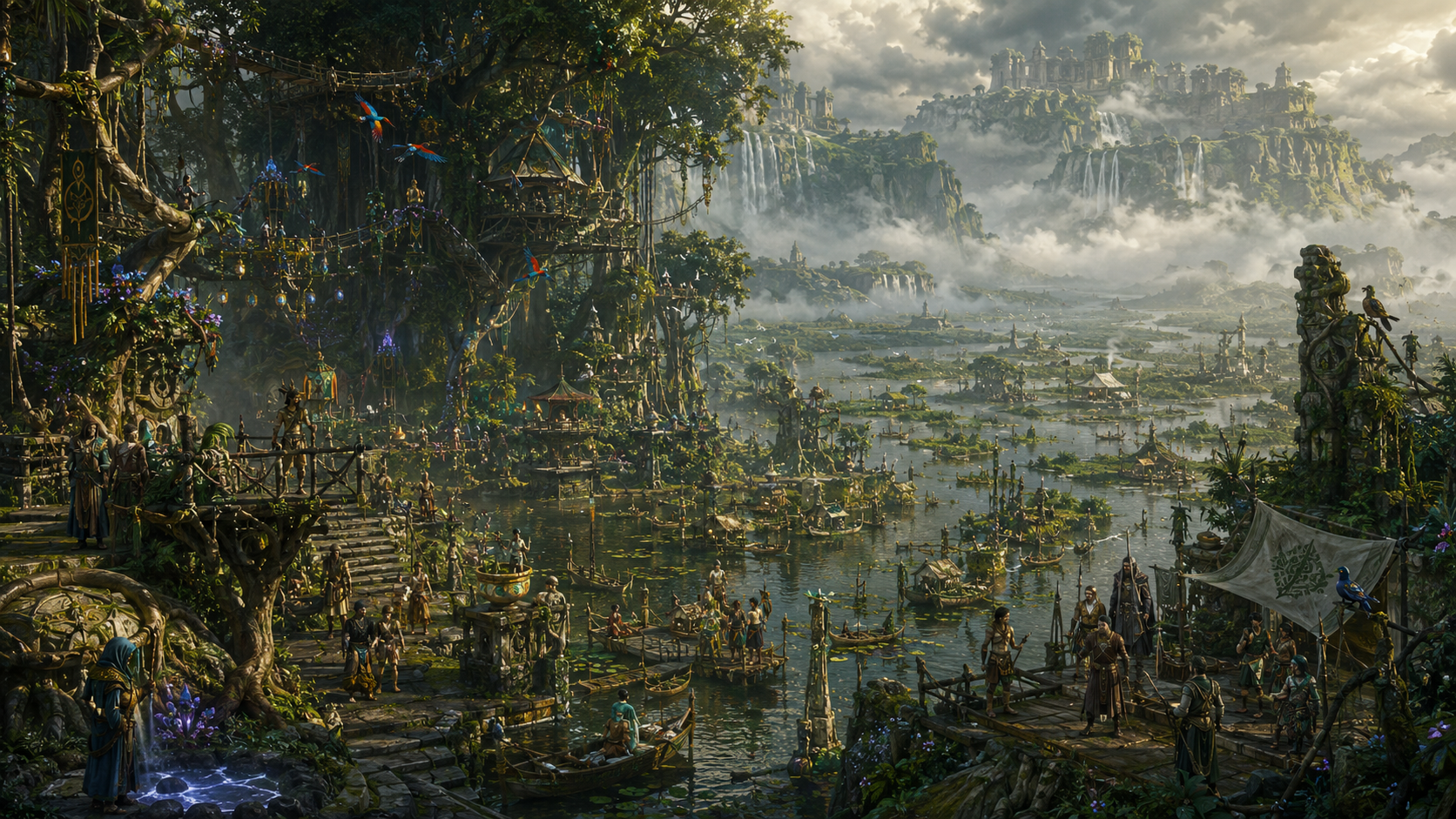
Ilyr
Ilyr is the southeastern continent of living green power.
To many outsiders, it is a place of forests, wetlands, mist, medicine, rivers, bright birds, colossal trees, hidden paths, insects that sing before rain, flowers that close around lies, and ruins so overgrown that stone and root can no longer be separated. Sailors call its coasts beautiful and unsettling. Merchants praise its medicines while complaining that nothing stays where a map says it should. Scholars arrive with measuring cords, glass vials, theories, and polite arrogance. Some leave wiser. Some leave angry. Some do not leave at all.
Ilyr is not empty wilderness.
It is not a simple jungle continent.
It is not a lost land waiting for outsiders to discover it.
Ilyr is a continent of living law, concealed routes, old ecological power, local treaties, healer houses, canopy cities, mist-bound courts, wetland peoples, river paths, dangerous ruins, plant spirits, animal powers, medicinal traditions, memory groves, oath-vines, sacred diseases, forbidden harvests, and communities that understand survival as relationship rather than conquest.
Many places in Ilyr do not ask who owns the land.
They ask who the land recognizes.
A road may close because a grove refuses passage.
A village may move because the floodplain dreams differently this year.
A treaty may be renewed by planting, not signing.
A cure may fail if harvested without permission.
A ruin may be inaccessible because the forest has chosen to grow over its name.
A court may hear testimony from people, birds, roots, elders, river-watchers, and scars left in bark.
Ilyr’s central question is:
What does civilization become when the living world is not backdrop, property, or resource, but participant?
Short Summary
Ilyr is the southeastern and equatorial primal continent of Thesalon.
It is known for the Living Canopy, the Mists of the Unknown, the Emerald Plateau, the Endless Wetlands, powerful river systems, medicinal abundance, concealed travel routes, ancient ruins reclaimed by life, spirit-haunted ecological zones, and cultures that treat land, water, plant, animal, weather, memory, and law as interconnected.
Ilyr is one of the most misunderstood continents in Thesalon because outsiders tend to describe it by what they cannot control.
They say maps fail.
They say roads vanish.
They say guides speak in riddles.
They say plants are dangerous.
They say the mists lie.
They say the people are secretive.
Ilyrian people might answer that the maps failed because the cartographer ignored flood season, the road vanished because it was never yours, the guide spoke carefully because careless speech kills, the plants defended themselves, the mist concealed what should not be taken, and secrecy is sometimes the name outsiders give to consent.
The defining principle of Ilyr is:
Living things have standing.
Not everywhere in the same way. Not always gently. Not always clearly. But across much of Ilyr, civilization is built around the idea that forests, wetlands, rivers, medicines, animal migrations, ancestral groves, and unseen powers are not passive resources. They must be negotiated with, honored, feared, studied, protected, appeased, or at least understood before people can safely act.
What Most People Know
Most people in Thesalon know Ilyr by reputation rather than direct experience.
They know that Ilyr lies in the southeastern reaches of the world. They know it is green, wet, fertile, ancient, and dangerous to the unprepared. They know the continent produces rare medicines, unusual resins, bright dyes, strong fibers, fragrant woods, living seeds, healing knowledge, strange poisons, botanical lore, and stories that sound impossible until a ship returns with proof.
They know the Living Canopy is one of the great natural wonders of Thesalon. They know the Mists of the Unknown are feared and respected. They know the Emerald Plateau is associated with highland settlements, medicinal traditions, old routes, and powerful green places. They know the Endless Wetlands are vast, inhabited, difficult to map, and dangerous without local guidance.
They also know that Ilyr does not welcome careless extraction.
A merchant who treats Ilyr as a warehouse may be refused guides.
A scholar who cuts samples without permission may find every trail closed.
A hunter who kills the wrong animal may be tried by a community they never saw.
A captain who dumps waste near a river-mouth may discover that no pilot will bring them inland again.
This does not mean Ilyr is hostile to outsiders. Ilyr trades, teaches, heals, negotiates, travels, and sends its own people across the world. But Ilyr expects visitors to understand that arrival is not permission.
Common Misconceptions About Ilyr
“Ilyr is wilderness.”
False.
Ilyr contains wilderness, but it also contains settlements, river towns, canopy platforms, healer houses, trail courts, wetland villages, plateau communities, sacred groves, hidden markets, coastal harbors, research houses, oral law networks, guide lineages, and political systems that outsiders often fail to recognize because they are not built from walls, roads, crowns, and flags.
Some Ilyrian communities are intentionally hard to find. That does not make them primitive. It means location is part of their security.
“Ilyrians hate outsiders.”
False.
Ilyr trades with outsiders, teaches outsiders, hires outsiders, heals outsiders, studies outsiders, rescues outsiders, and sometimes sends its own people far from home. What Ilyr often resists is extraction without relationship.
A foreigner who arrives with humility, patience, proper introductions, and respect for local knowledge may be welcomed. A foreigner who arrives with armed guards, sealed contracts, and assumptions about ownership may be treated as a threat.
“The land is alive, so everything is magical.”
False.
Many things in Ilyr are natural, cultural, spiritual, ecological, or legal rather than magical in a spellcasting sense. A trail may close because seasonal floods erased it. A plant may be dangerous because it is poisonous, not enchanted. A guide may refuse a route because a nesting migration is underway, not because of a curse.
At the same time, Ilyr contains real primal magic, spirits, living places, strange mists, sacred groves, and old powers. The difficulty for outsiders is learning which explanation applies before acting.
“The Mists of the Unknown are just fog.”
False.
The Mists of the Unknown are a major Ilyrian mystery and danger. Some travelers describe them as weather. Others describe them as spirit boundary, living defense, memory veil, ancient ward, or place where maps and certainty go soft. Public knowledge does not settle the truth.
The safe assumption is simple: never enter the Mists without someone who belongs to the route.
“Ilyrian medicine is just herbs.”
False.
Ilyrian healing traditions may include herbs, fungi, bark, fruit, venom, ritual, diet, spirit negotiation, land relationship, careful timing, memory, dream interpretation, surgery, poultices, songs, breath, river washing, and long observation of how living systems respond to harm.
An Ilyrian healer may know that the same plant can heal, poison, induce vision, or do nothing depending on where it grew, when it was cut, who asked for it, and what was promised afterward.
What People From Ilyr Might Know
An Ilyrian character may know how to read living signs that outsiders miss. They may know which insects warn of flood, which blossoms open before a predator crosses, which vines mark a closed path, which frogs stop singing near bad water, and which birds repeat human words only when danger is close.
They may know that a river route is not a road. It is a relationship with current, season, village, fish run, flood memory, and permission.
They may know that a medicine cannot always be bought twice from the same place. The first cure may be a gift. The second may require service. The third may be refused.
They may know that some places are not hidden because of greed. They are hidden because too many people knowing the way would destroy the place.
They may also know that Ilyr is not unified. A wetland village, canopy city, plateau healer house, coastal harbor, mistward court, and river-market community may all disagree about law, outsiders, trade, gods, medicine, hunting, and what the land is owed.
A character from Ilyr may not know the secrets of every green place. Ilyr is too large, too layered, and too locally specific for that. But they likely know the most important survival rule:
Ask what a place needs before asking what it can give.
The Shape of Ilyr
Ilyr is geographically and culturally diverse. Outsiders often collapse it into one image of endless green, but that is a mistake. Its major regions include vast canopy lands, fog-bound territories, plateaus, wetlands, river systems, coasts, old ruins, and hidden interior routes.
The same journey may require boat, rope bridge, canopy path, mud sled, vine lift, river pole, animal guide, and three different permissions.
The Living Canopy
The Living Canopy is one of Ilyr’s defining regions.
It is not merely a forest. It is an elevated world of immense trees, suspended walkways, grown platforms, branch-houses, rope bridges, vine roads, bird shrines, rain catchers, high gardens, fungal lamps, canopy markets, healer nests, watch platforms, and communities that live above the forest floor for reasons of safety, tradition, flood, spirit law, or ecological balance.
To outsiders, the Living Canopy may feel impossible. Roads sway. Houses grow. Bridges breathe. Rain becomes drinking water through leafwork. Messages move by bird, drum, scent, whistle, and vibration through wood.
Canopy communities may be highly sophisticated. They can maintain complex architecture without stone towers, preserve records in living bark and woven memory cords, and enforce law through access to route, branch, platform, and harvest.
Common character origins from the Living Canopy include canopy runner, bird-messenger, healer apprentice, rope bridge guard, platform carpenter, rain collector, vine-law witness, scholar of living architecture, or child of a high market family.
The Mists of the Unknown
The Mists of the Unknown are feared, respected, and poorly understood.
They are not simply a place where visibility is poor. They are a region, boundary, phenomenon, or set of territories where certainty weakens. Travelers report shifting paths, lost hours, voices that know private names, guides who vanish and reappear older, ruins that cannot be found twice, and animals that lead people away from what they wanted and toward what they needed.
Player-facing knowledge does not reveal the full truth of the Mists. What matters before play is how people treat them.
No careful Ilyrian treats the Mists as ordinary fog.
No wise outsider enters without permission, guide, and reason.
No honest map claims to master them.
No survivor tells the same story without trembling at least once.
The Mists are associated with hidden communities, lost expeditions, forbidden harvests, spirit courts, memory distortion, strange healing, old ruins, and living boundaries that may choose who crosses.
A character tied to the Mists may be a mist guide, lost-child survivor, hidden-court envoy, memory-scarred wanderer, fog shrine attendant, missing expedition descendant, or person whose true home cannot be found on public maps.
The Emerald Plateau
The Emerald Plateau is a highland green region associated with medicinal knowledge, old settlements, terraced growth, cloud forests, bright stone, sacred springs, old routes, watch houses, highland markets, and powerful healer traditions.
Where the Living Canopy rises through trees and the Endless Wetlands spread across water, the Emerald Plateau feels like a green height where air, stone, plant, and rain meet. Its communities may preserve old techniques of cultivation, medicine, weather reading, and route diplomacy.
Foreigners often seek Emerald Plateau medicines. Some come honestly. Others come with armed expeditions, stolen samples, false contracts, and buyers waiting in distant harbors.
Characters from the Emerald Plateau may be healer-scholars, terrace guardians, spring keepers, mountain herbalists, plateau traders, rare-seed stewards, oath-root witnesses, or protectors of forbidden medical knowledge.
The Endless Wetlands
The Endless Wetlands are vast, inhabited, shifting, and difficult to map.
They include marshes, flood forests, reed seas, blackwater channels, floating villages, stilt houses, fish traps, crocodile roads, medicinal bogs, spirit pools, mud shrines, insect choirs, hidden grave platforms, drowned paths, and seasonal settlements that move with water.
Outsiders often find wetlands frustrating because they expect land and water to behave as separate things. In the Endless Wetlands, ground may be temporary. A village may move. A court may meet on boats. A grave may float by design. A route may be safe only during a specific moon, flood height, or fish migration.
Characters from the Endless Wetlands may be poleboat guides, reed singers, swamp healers, fisher judges, crocodile-watchers, floating village guards, disease readers, drowned-path navigators, or people who understand that still water can be the loudest warning.
River Roads
Ilyr’s rivers are major travel networks, but they are not passive highways.
A river may have moods, rights, guardians, seasonal closures, fishing treaties, burial currents, flood claims, spirit markers, and communities that control passage by knowledge rather than fortification. Some routes are open to trade. Others are only for kin, medicine, mourning, or emergency.
River road law may include landing rights, no-cut banks, fish-run silence, funeral priority, flood refuge obligations, waste taboos, and restrictions on what may be taken from shore.
A river-born character may be a boat handler, ferry speaker, current reader, fish-run guardian, river court messenger, healer transporter, shrine keeper, or smuggler who knows the difference between hidden and forbidden.
Coastal Ilyr
Ilyr’s coasts connect the continent to Marithel, Suthrane, Vorrak, island traders, scholars, smugglers, pilgrims, and distant merchants.
Coastal Ilyr may look more familiar to outsiders because it has docks, markets, warehouses, ship repairs, coastal shrines, customs houses, and foreign quarters. But the coast is still Ilyrian. A harbor may require seed-oaths, waste inspections, river-mouth rituals, disease checks, living cargo declarations, and proof that a foreign ship is not carrying invasive pests, cursed soil, stolen cuttings, or forbidden roots.
Characters from coastal Ilyr may be harbor interpreters, pest inspectors, dock healers, ship medics, coastal traders, foreign-quarter negotiators, seed-law advocates, sailors, or people who grew up between Ilyrian law and foreign appetite.
Ancient Reclaimed Ruins
Ilyr contains ancient ruins, but many are not abandoned in the way outsiders mean.
Some ruins are covered by living growth because they are forgotten. Others are covered because the land has claimed them. Some are protected by communities. Some are dangerous because they were built before current law. Some are used as shrines, medicine gardens, seed vaults, spirit boundaries, or teaching sites.
A ruin overgrown by roots may be dead stone. It may also be evidence, prison, grave, archive, wound, or treaty partner.
Ilyrian characters often treat ruin-delving with suspicion unless the purpose is clear. A foreign expedition may call it archaeology. A local village may call it trespass against the dead, theft from the land, or opening an old injury.
Living Law
Ilyrian law is often misunderstood because it does not always resemble crown law, temple law, or written civil code. Much of it is local, witnessed, ecological, oral, seasonal, and tied to living relationships.
A law may be kept by elders, healers, guides, bird-speakers, river witnesses, root courts, memory groves, animal migrations, seasonal festivals, or formal councils. Some regions use written records. Others preserve law in knots, songs, carved seeds, living bark, scar patterns, painted poles, trail signs, or repeated public testimony.
Common Ilyrian legal ideas include:
| Legal Idea | Meaning |
|---|---|
| Harvest Consent | Valuable plants, animals, medicines, or materials may require permission before taking. |
| Route Recognition | A path may be open only to those recognized by guide, season, community, or land sign. |
| Living Witness | Trees, scars, animals, river signs, or ecological changes may be treated as evidence. |
| Seed Debt | Taking, planting, or carrying seeds may create obligation. |
| Grove Standing | A grove, wetland, spring, reef, tree, or animal group may have recognized legal weight. |
| Medicine Right | Certain cures may only be harvested, prepared, or given under specific obligations. |
| Return Duty | Those who take from a place may owe return, service, planting, protection, or testimony. |
| Closed Path | A route may be temporarily or permanently closed for ecological, spiritual, legal, or safety reasons. |
| Mist Boundary | Some places cannot be entered by ordinary claim, purchase, or map. |
| Wound Law | Damage to living places may require repair before other claims are heard. |
Living law does not mean every plant has the same rights as a person. It means communities recognize that survival depends on systems larger than individual appetite, and those systems must be represented in decisions.
Living Law in Play
A character from Ilyr may approach problems by asking different questions than other characters.
Not “Who owns this?” but “Who depends on this?”
Not “Can we take it?” but “What is owed if we take it?”
Not “Is the road open?” but “Who says the road is open?”
Not “Is this place dangerous?” but “Dangerous to whom, and why now?”
Not “Is this medicine rare?” but “What relationship makes it available?”
This makes Ilyrian characters especially strong for campaigns involving travel, healing, ecology, diplomacy, spirits, medicine, hidden places, and disputes over exploitation.
Healers, Medicines, and Sacred Harvests
Ilyr is famous for medicine.
Its healers are respected across Thesalon, but outsiders often misunderstand the source of that respect. Ilyrian medicine is not only a list of rare plants. It is knowledge of place, timing, preparation, relationship, diagnosis, story, spirit, diet, poison, weather, insects, patient memory, and consequences.
A medicine may require the first rain after a dry season.
A bark may cure fever only when taken from the shaded side of a living tree and repaid with planting.
A fungus may heal wounds but erase dreams if prepared incorrectly.
A venom may treat paralysis in one dose and cause it in another.
A flower may open only after a promise is spoken aloud.
A healer may refuse treatment until the patient names what they harmed.
Ilyrian healing is powerful because it is careful.
Medicine and Trade
Foreign demand creates problems.
Rare medicines can save lives abroad. They can also be overharvested, counterfeited, stolen, militarized, hoarded by the wealthy, or stripped of the relationships that make them safe. Ilyrian healer houses may sell some medicines freely, restrict others, and forbid export of the most dangerous or sacred preparations.
This creates character hooks for healers, smugglers, merchants, guards, scholars, and diplomats.
A character might be traveling to Marithel because a medicine was stolen, a patient needs treatment, a foreign buyer broke harvest law, a healer house is negotiating export terms, or a plague rumor requires investigation.
Sacred Disease
Some Ilyrian traditions treat certain illnesses not as blessings, but as conditions requiring ritual, social, and ecological response. A disease may indicate polluted water, spiritual trespass, broken harvest law, invasive species, bad trade practice, or old ruin exposure.
This does not mean Ilyrians blame every sick person for their illness. It means disease may be interpreted as evidence of relationship failure somewhere in the system.
Routes, Guides, and Concealment
Ilyr has roads, but many do not look like roads to outsiders.
A route may be a river current, canopy bridge, dry-season mud path, animal trail, vine lift, chain of host trees, bird-call sequence, floating reed path, fog interval, or series of villages that open guest access only after proper introduction.
Guides are not merely hired labor. They are interpreters between traveler and place. A guide may be responsible for the conduct of those they bring. If a foreign merchant violates harvest law, the guide may share blame. If an expedition vanishes, the guide’s family may owe testimony.
Common route rules include:
| Route Rule | Reason |
|---|---|
| Do not cut live path markers | They may be signs, witnesses, or living boundary claims. |
| Do not leave foreign seeds behind | Invasive growth can be a crime. |
| Do not drink from still pools without permission | Disease, spirit law, or community use may matter. |
| Do not silence warning animals | Their noise may protect travelers. |
| Do not harvest medicine while passing through | Passage is not harvest permission. |
| Do not mark hidden paths on public maps | Some concealment protects communities. |
| Do not force speed during flood season | A closed route may be saving your life. |
| Do not mock guide caution | Embarrassment kills fewer people than arrogance. |
A character from Ilyr may be patient with danger but impatient with arrogance.
Public Powers and Institutions
Ilyr does not have one continent-wide crown. Authority is distributed among communities, healer houses, guide lineages, river courts, canopy councils, wetland assemblies, plateau circles, mistward guardians, coastal harbors, ancestral groves, spirit-treaty keepers, and trade negotiators.
Healer Houses
Healer houses preserve medical traditions, train practitioners, regulate dangerous cures, protect sacred harvests, and negotiate with foreign buyers.
A healer house may be a formal institution, family lineage, temple-like school, grove community, river clinic, plateau archive, or traveling network.
Character connections include healer apprentice, patient, guard, herbal preparer, failed student, translator, field collector, medical scribe, or envoy sent abroad.
Guide Lineages
Guide lineages maintain route knowledge, seasonal timing, local permissions, flood paths, canopy access, mist boundaries, and rules for outsiders.
They are often more politically powerful than foreign visitors realize. A guide lineage can open a region to trade or close it without drawing a blade.
Character connections include river guide, canopy runner, mist escort, route singer, expelled apprentice, foreign expedition survivor, or person carrying a guide debt.
Canopy Councils
Canopy councils govern high settlements, branch routes, platform rights, harvest timing, rain capture, bird messaging, and disputes between families or trade groups.
Character connections include platform carpenter, rain collector, bird messenger, council runner, branch guard, living architecture student, or family representative.
River Courts
River courts hear disputes over landing rights, fishing, ferry obligations, flood damage, pollution, burial currents, trade access, and waterborne disease.
Character connections include court speaker, poleboat messenger, current witness, fish-run guardian, river judge’s child, or accused polluter seeking redemption.
Wetland Assemblies
Wetland assemblies may gather on boats, floating platforms, stilt houses, or seasonal dry ground. They settle disputes about water, fish, reeds, disease, seasonal movement, and relations with spirits or animals.
Character connections include reed singer, floating village guard, marsh healer, fisher advocate, crocodile watcher, disease reader, or drowned-path navigator.
Plateau Circles
Plateau circles preserve highland medicine, terrace law, spring rights, old routes, cloud forest practice, and relations between settlements.
Character connections include terrace guardian, spring keeper, highland trader, rare-seed steward, weather reader, or oath-root witness.
Mistward Guardians
Mistward guardians protect boundaries near the Mists of the Unknown. Outsiders rarely know their full structure, and many locals may know only the nearest guardians.
Character connections include mist guide, boundary singer, lost-child survivor, fog shrine keeper, memory-scarred messenger, or person raised in a place public maps cannot show.
Coastal Negotiators
Coastal negotiators handle contact with foreign merchants, ship captains, Maritheli freeports, Suthrani pilgrims, scholars, smugglers, and distant buyers.
Character connections include harbor interpreter, seed-law advocate, pest inspector, dock healer, trade witness, ship medic, or foreign-quarter mediator.
Ilyr and the Crownless Age
Ilyr was not the main battlefield of Vorrak’s invasion, but the Crownless Age still affects it.
War increases demand for medicine.
Refugees need healing, food, transport, and safe settlement.
Foreign powers seek resources faster than relationships can be formed.
Merchants look for rare cures to sell to frightened courts.
Scholars seek old ecological magic that might defend cities.
Desperate rulers may fund expeditions into places Ilyrians have warned against entering.
Ilyr’s response to the Crownless Age is not unified. Some Ilyrian communities argue for helping the wounded world. Others argue that foreign collapse should not justify violating living law. Some healers travel abroad. Some guide houses close routes. Some coastal negotiators expand trade. Some mistward guardians grow more restrictive. Some young Ilyrians leave to see whether the rest of Thesalon can learn relationship before it destroys what it needs.
A common Ilyrian criticism of the Crownless Age is that failed crowns are only the visible symptom. The deeper problem is that too many societies built power by pretending land, water, dead, labor, and memory could be used without consent.
A common Ilyrian hope is that collapse may teach humility.
A common Ilyrian fear is that collapse will teach only hunger.
Ilyr and Marithel
Ilyr and Marithel are connected by sea routes, medicinal trade, refugee ships, scholars, healers, seed law, coastal pilots, living cargo inspections, and disputes over what may be carried away from a place.
Marithel understands route law better than many continents. This gives Maritheli sailors and Ilyrian guides a point of connection. Both know that travel is not just movement. It is permission, trust, timing, and consequence.
But Marithel and Ilyr can also clash.
Marithel values passage. Ilyr values relationship.
Marithel may protect false names. Ilyr may ask what name the land knows.
Marithel may treat cargo as legal property. Ilyr may ask whether the cargo was harvested with consent.
Marithel may prize hidden routes. Ilyr may ask who is endangered by revealing them.
Marithel may see a harbor as sanctuary. Ilyr may ask what sanctuary owes to the place that feeds it.
An Ilyrian character in a Marithel campaign can bring an important perspective. They may understand why sea roads matter while questioning what is being taken along them.
Why Someone From Ilyr Might Be in Marithel
An Ilyrian character might be in Marithel because they are a healer serving refugee communities, a guide hired for an expedition, a scholar studying foreign law, a coastal negotiator, a ship medic, a seed-law advocate, a merchant of permitted medicines, a tracker pursuing stolen cuttings, a patient seeking a foreign cure, a witness in a trade dispute, a mist survivor seeking distance, or a young traveler testing whether the wider world is as careless as elders say.
They might be following a stolen plant, forbidden medicine, missing teacher, false contract, sick passenger, illegal harvest, escaped patient, foreign scholar, or ship that carried living cargo without proper seals.
They might also simply be leaving home because Ilyr is not one story. Some Ilyrians are restless. Some disagree with local law. Some were exiled. Some want coin, love, study, adventure, revenge, service, or distance from family obligations.
Marithel is especially plausible because its ships connect to Ilyrian coasts and because Windrider Freeport attracts people with complicated names, disputed cargo, medical needs, refugee cases, and legal ambiguity.
Why You Might Be Aboard the Azure Aviary
The campaign begins aboard the Azure Aviary, a Maritheli vessel traveling through Windrider Gulf waters.
An Ilyrian character might be aboard because you are serving as a healer, traveling as a passenger, guarding living cargo, escorting a patient, carrying permitted medicines, investigating stolen samples, following a foreign scholar, seeking Windrider Freeport’s legal protection, returning from a trade mission, watching someone with a dangerous illness, pursuing a smuggler, or working as crew after leaving the southeastern routes.
You might be aboard because someone on the ship carries something from Ilyr that should not have left.
You might be aboard because someone on the ship needs a cure only you know how to prepare.
You might be aboard because Marithel’s freeport law protects a person your home would judge differently.
You might be aboard because you believe the sea roads are beginning to carry more than trade.
An Ilyrian aboard the Azure Aviary should have a reason to care when law, route, medicine, danger, and obligation collide.
Ilyrian Character Origin Table
| Origin | Character Implication |
|---|---|
| Living Canopy Native | You understand height, rain, rope routes, bird messages, and grown architecture. |
| Mistward Survivor | You carry memory, warning, or uncertainty from the Mists of the Unknown. |
| Emerald Plateau Healer | You know medicine, springs, terraces, highland law, and sacred harvest limits. |
| Endless Wetland Local | You understand water paths, floating settlements, disease signs, and seasonal movement. |
| River Road Traveler | You know currents, landings, ferry law, fishing rights, and river testimony. |
| Coastal Negotiator | You grew up translating between Ilyrian law and foreign appetite. |
| Guide Lineage Child | You know routes are trust, not services purchased by coin alone. |
| Healer House Apprentice | You were trained to treat illness as body, story, place, and relationship. |
| Sacred Harvest Guardian | You protect medicines, seeds, resins, woods, or animals from misuse. |
| Reclaimed Ruin Witness | You saw an old place disturbed, defended, or misunderstood. |
| Foreign-Trade Interpreter | You learned how outsiders misunderstand Ilyr and how to survive their contracts. |
| Exile from Living Law | You broke, questioned, or were accused under a law tied to land or harvest. |
| Ship Medic | You carry Ilyrian healing onto foreign sea roads. |
| Stolen-Seed Pursuer | You are tracking a plant, cure, cutting, or seed taken without consent. |
Common Ilyrian Character Concepts
Healer of the Living Houses
You trained in a healer house, grove clinic, plateau circle, river infirmary, or traveling medical lineage. You understand that wounds are not only physical.
Questions to answer:
- What cure do you know that outsiders misunderstand?
- Who did you fail to heal?
- What medicine are you forbidden to sell?
- Why did you leave Ilyr?
Guide of Concealed Routes
You know paths that do not belong on public maps. You may guide travelers, protect routes, or decide who should never be allowed through.
Questions to answer:
- What route do you know?
- Who taught it to you?
- Who is looking for it?
- What would make you reveal it?
Mist-Touched Wanderer
You survived the Mists of the Unknown, or you come from a community near them. Your memory may be questioned by others, but you know something happened.
Questions to answer:
- What did you lose in the Mists?
- What did the Mists give back?
- Who does not believe your story?
- What sign makes you fear the Mists are near?
Wetland Boatguard
You come from floating villages, reed channels, blackwater paths, or seasonal marsh settlements. You know how to move through a world where ground is temporary.
Questions to answer:
- What water raised you?
- What creature did your village respect or fear?
- What seasonal law shaped your life?
- Why are you now at sea?
Canopy Runner
You move through height, branch, bridge, vine, platform, and rain. You are messenger, scout, courier, acrobat, guard, or hunter.
Questions to answer:
- What message did you carry that changed your life?
- What bridge are you forbidden to cross again?
- What bird, vine, or tree recognizes you?
- What do ground roads feel like to you?
Sacred Harvest Guardian
You protect a resource others want. It may be medicine, resin, fruit, venom, wood, seed, fiber, dye, or knowledge.
Questions to answer:
- What do you guard?
- Who wants it?
- What happened the last time it was taken wrongly?
- Why are you away from it now?
Coastal Interpreter
You grew up where foreign ships arrive and Ilyrian law must be explained before harm is done. You know trade, misunderstanding, patience, and suspicion.
Questions to answer:
- What foreign habit do you distrust?
- What Ilyrian custom do foreigners most often ignore?
- What contract do you regret translating?
- Who sent you to Marithel?
Reclaimed Ruin Scholar
You study ruins not as treasure vaults, but as wounds, records, warnings, and places the living world has chosen to cover.
Questions to answer:
- What ruin taught you caution?
- What foreign theory do you reject?
- What old name should not be spoken?
- What evidence are you carrying?
Seed-Law Advocate
You understand the legal, spiritual, and ecological consequences of carrying living things across borders.
Questions to answer:
- What seed, cutting, or living cargo matters to you?
- Who stole, sold, planted, or smuggled it?
- What damage could it cause?
- What court do you need to convince?
Exile of the Grove
You broke a living law, were accused of breaking one, or refused a judgment you thought was wrong.
Questions to answer:
- What law did you break or challenge?
- Were you guilty?
- Who still loves you at home?
- What would it take for the land to recognize you again?
Classes in an Ilyrian Context
| Class | Ilyrian Interpretation |
|---|---|
| Barbarian | Wetland fury warrior, canopy protector, ruin avenger, animal-bonded defender, exile whose rage speaks for a harmed place. |
| Bard | Route singer, memory keeper, bird-call messenger, treaty reciter, healing storyteller, mist survivor whose songs preserve safe paths. |
| Cleric | Healer of Veyra, river priest of Thalara, memory servant of Olyrra, life-and-death mediator, local shrine keeper, sacred harvest judge. |
| Druid | Grove speaker, wetland guardian, canopy shaper, storm caller, animal treaty keeper, primal law advocate. |
| Fighter | Boatguard, canopy sentinel, harbor protector, expedition guard, sacred harvest defender, guide-lineage warrior. |
| Monk | Breath-trained healer, canopy balance initiate, mist discipline walker, wetland stillness student, body-and-place ascetic. |
| Paladin | Oathbound protector of living law, healer house champion, anti-extraction defender, guardian of hidden routes, sacred grove sworn blade. |
| Ranger | River scout, canopy tracker, wetland pathfinder, beast sign reader, mist boundary watcher, foreign expedition monitor. |
| Rogue | Smuggler tracker, seed thief, foreign-quarter spy, hidden route courier, black-market medicine infiltrator, false contract hunter. |
| Sorcerer | Mist-marked bloodline, storm-green child, root-touched wanderer, disease survivor, living ruin inheritor, river-born omen bearer. |
| Warlock | Bargain bearer of grove, mist, river, beast, ruin, or old green power; seeker who owes service to something living and vast. |
| Wizard | Botanical scholar, living architecture student, medicine alchemist, ruin researcher, ecological arcanist, translator of old green inscriptions. |
Languages and Communication
Ilyr is linguistically rich. Common may be used in ports and foreign trade, but it does not replace local languages, route signs, animal calls, drum codes, scent marks, carved seeds, knot records, and ritual speech.
| Language or System | Common Use |
|---|---|
| Common | Foreign trade, coastal negotiation, mixed crews, public port business. |
| Elvish | Canopy scholarship, old songs, living architecture, certain grove traditions. |
| Sylvan | Spirit negotiation, primal rites, grove speech, fey-adjacent places, old living law. |
| Primordial | River, storm, earth, rain, flood, and elemental communication. |
| Druidic | Restricted nature signs, sacred instructions, hidden warnings, practitioner networks. |
| Aquan-related speech | Wetlands, river rites, water spirits, boat communities, flood signs. |
| Local Ilyrian languages | Home life, law, kinship, oral history, medicine, route memory. |
| Bird-call systems | Canopy messages, danger warnings, route coordination. |
| Drum and root vibration codes | Long-distance forest communication and ceremonial notices. |
| Knot, seed, and bark records | Legal memory, medicine records, route warnings, family testimony. |
An Ilyrian character may know languages because of healer training, guide work, coastal trade, spirit practice, wetland travel, canopy life, scholarship, or family duty.
Common Goods, Skills, and Traditions
Ilyrian travelers may carry permitted medicines, seed cords, resin seals, woven rain cloaks, living-fiber rope, carved seed tokens, river charms, insect-repelling oils, healing salves, bright dyes, waterproof bark records, mist beads, canopy knives, hollow reed flutes, preserved fruit, fungal lamp caps, bird-message cords, sacred harvest permits, or a small pouch of home soil that must never be spilled casually.
Common Ilyrian skills include reading weather through insects, identifying unsafe water, treating venom, moving quietly through dense growth, negotiating with guides, recognizing invasive species, preparing plant medicine, reading route signs, understanding animal warnings, navigating by sound, preserving food in humid climates, recognizing false harvest claims, and knowing when a path is closed.
Common Ilyrian sayings include:
“The road is not lost. You were not invited.”
“A cure taken without thanks becomes another wound.”
“Ask the river what it carried before you ask it to carry you.”
“Maps remember only what stood still.”
“The forest is not silent. You are not listening correctly.”
“Do not harvest from a grieving place.”
“A hidden village is not a secret. It is a boundary.”
“If the birds stop arguing, lower your voice.”
“Living law begins where appetite ends.”
“Some doors are made of leaves.”
Player-Safe Rumors
These rumors are safe for character background use. They may be true, false, exaggerated, or locally believed.
- A foreign scholar once mapped a river so precisely that the river changed course before the ink dried.
- A healer house on the Emerald Plateau can cure a fever that no temple in Suthrane can name, but only if the patient confesses what they took.
- A village in the Endless Wetlands moves every year, but the dead always know where to find it.
- The Mists of the Unknown once returned an expedition with every member alive and every memory borrowed from someone else.
- A Maritheli merchant is selling illegal Ilyrian cuttings under false spice labels.
- Some canopy bridges will not hold the weight of a liar.
- A bird in the Living Canopy repeats the last words of people who died off the path.
- A root court once sentenced a captain to plant trees until his grandchildren were old.
- The Emerald Plateau hides a spring that heals wounds but reveals inherited guilt.
- A wetland guide can pole a boat through a route that exists only during thunder.
- Some Ilyrian medicines stop working when sold too far from the place that gave them.
- A coastal harbor refused an entire fleet because one ship carried foreign soil in an open crate.
- A ruin in Ilyr grows leaves shaped like the hands of the people who built it.
- A mistward guardian in Marithel is looking for someone who should not remember Ilyr.
- The land recognizes some adopted children faster than blood heirs.
- A stolen seed has begun growing somewhere in Windrider Freeport.
Character Questions Before Session One
If your character is from Ilyr, answer at least three of these questions.
- What living place shaped you?
- What route, river, grove, wetland, canopy, plateau, coast, or mist boundary do you know best?
- What did your home teach you never to harvest?
- What plant, animal, river, or weather sign do you trust?
- What foreign habit makes you uneasy?
- What Ilyrian law do you still obey far from home?
- What relationship with land, water, medicine, or spirit are you responsible for?
- What did you take, protect, heal, or fail to return?
- Why did you leave Ilyr?
- Who in Ilyr would welcome you home?
- Who in Ilyr would ask what debt you have paid before welcoming you home?
- Why are you in Marithel?
- Why are you aboard the Azure Aviary?
- What living thing would you risk your life to protect?
- What cure, warning, route, or name do you refuse to sell?
- What do you believe outsiders most need to learn?
Playing an Ilyrian Character in This Campaign
An Ilyrian character brings relationship, medicine, ecological awareness, hidden route knowledge, and moral pressure into the campaign.
You do not need to play a druid, ranger, or healer to be Ilyrian. A fighter may guard a sacred harvest. A rogue may hunt smugglers of stolen seed. A cleric may serve healing law. A wizard may study living architecture. A bard may preserve route songs. A sailor may work between Ilyrian coasts and Maritheli sea roads. A paladin may swear to protect places that cannot speak in court. A warlock may carry a bargain with a mist, grove, river, beast, or ancient green power.
In a Marithel campaign, Ilyrian characters are especially useful because Marithel is a world of routes, cargo, law, and movement. Ilyrians understand that movement creates obligation. They may question what ships carry, where medicines came from, whether refugees have been fed, whether foreign cargo is alive, whether a map endangers hidden communities, and whether a route should be open simply because profit demands it.
An Ilyrian aboard the Azure Aviary may notice things other characters miss: a plant that should not be in the cargo, a sick passenger whose symptoms point to foreign soil, a route mark that resembles an Ilyrian warning, a sailor carrying a forbidden seed charm, a medicine prepared incorrectly, or a story whose missing piece is not human.
The most important question for an Ilyrian character is:
What did Ilyr teach you to listen to, and what will you do when no one else hears it?
Related Pages
- Overview of Thesalon
- Gods, Magic, and the Planes
- Peoples and Ancestries of Thesalon
- Languages and Communication
- Trade, Travel, War, and Exile
- Marithel
- Suthrane
- Vorrak
- People Far From Home
- Why Outsiders Come to Marithel
- Character Origins by Continent
- Healer and Caregiver Characters
- Scholar and Scribe Characters
- Travel in Thesalon